
 Overview of illiteracy in Amazonas and Manaus: regional disparities and sociodemographic challenges
Abstract
This article examines illiteracy in Brazil, particularly in populations in the state of Amazonas and the city of Manaus, using documentary research based on data from the 2022 Census and the 2023 National Household Sample Survey conducted by the Brazilian Institute of Geography and Statistics. The study aims to understand how sociodemographic factors such as age, race, and sex influence illiteracy rates, showing regional disparities and the challenges faced by vulnerable groups. Adopting a qualitative and descriptive approach, the study analyzes secondary data from official surveys, providing a comparison between national illiteracy rates and the unique characteristics of the Amazonian population. The results show that, despite the country's overall reduced illiteracy rates, a significant "debt" remains among older adults, due to limited access to education in past generations. Additionally, it was observed that black and brown populations—particularly in Amazonas—exhibit higher illiteracy rates, reflecting historical inequalities. Manaus has a 2% illiteracy rate, representing approximately 43,000 people, with a higher prevalence among women and older adults. These findings underscore the need for inclusive public policies geared toward reducing such disparities, focused on providing literacy for older adults and addressing racial and regional inequalities.
Keywords
illiteracy; documentary research; inequalities; Amazon
Resumo
O referido artigo investiga o analfabetismo no Brasil com foco nas populações do estado do Amazonas e município de Manaus, a partir de uma pesquisa documental utilizando dados do Censo 2022 e da Pesquisa Nacional por Amostra de Domicílios 2023 do Instituto Brasileiro de Geografia e Estatística (IBGE). O texto busca visa compreender como fatores sociodemográficos, como idade, raça e sexo, influenciam as taxas de analfabetismo, destacando as disparidades regionais e os desafios enfrentados por grupos vulneráveis. Com abordagem qualitativa e descritiva, utiliza análise de dados secundários provenientes de levantamentos oficiais, permitindo uma comparação entre o analfabetismo no âmbito nacional e as peculiaridades da população amazonense. Os resultados revelam que, apesar da redução geral da taxa de analfabetismo no país, há um "estoque" significativo entre os idosos, devido à falta de acesso educacional nas gerações passadas. Observa-se também que a população preta ou parda, especialmente no Amazonas, apresenta índices mais altos de analfabetismo, refletindo desigualdades históricas. Em Manaus, o índice é de 2%, representando cerca de 43 mil pessoas, com maior prevalência entre mulheres e idosos. Assim, fica evidente a necessidade de políticas públicas inclusivas para reduzir essas desigualdades, com foco na alfabetização de idosos e na atenção às disparidades raciais e regionais.
Palavras-chave
analfabetismo; documental; desigualdades; Amazonas
Introduction
Illiteracy is still a current challenge in Brazil and, “despite progress in meeting the growing demand for education, a significant portion of the population is not benefited and have low or no education” (Pinheiro & Oliveira, 2020, p. 202, our translation). The persistence of this indicator, even with the current legislation and public policies, shows the need for in-depth research to support the formulation and implementation of effective strategies to address the issue.
This article1 proposes a detailed analysis of this issue in Brazil with consideration of the populations in the state of Amazonas and the municipality of Manaus, based on data from the 2022 Census and the 2nd quarter 2023 National Household Sample Survey conducted by the Brazilian Institute of Geography and Statistics (IBGE). From a sociodemographic perspective, the study examines how factors such as age, sex, and race/skin color influence illiteracy rates and show regional and demographic disparities that persist in the country.
Adopting a comparative approach, the analysis shows the differences in illiteracy rates between regions, underscoring the inequalities that impact access to education. Thus, this article contributes toward a deeper understanding of the educational barriers faced by specific groups, particularly in the state of Amazonas and the municipality of Manaus.
Initially, we present population growth, which is moderate, with a rate of 0.52% since 2010, and the regional population distributions. The Southeast and Northeast regions remain the most populous, while the North and Central-West regions, although less inhabited, have the highest growth rates.
Then, we delve into the socioeconomic and racial inequalities that affect access to education and literacy, with consideration of race and skin color differences that persist, especially, in regions such as Amazonas. The analysis also covers the context of functional illiteracy, emphasizing the concentration of illiterates in older age groups, which shows educational gaps in past generations.
Finally, the article reflects public policies necessary to mitigate disparities, advocating for an inclusive education that addresses historical inequalities in access to education and educational quality. By examining gender, race and age, this study shows the priority needs of Brazilian society, reinforcing the importance of more effective and equitable policies for Brazil's social development, mainly for peripheral regions, such as the state of Amazonas.
It is demonstrated, through numbers, how illiteracy is still a historical debt in our regions, despite the Ten-Year Plans, more specifically Goal 9, which aims to raise the literacy rate of the population aged 15 years or older, eliminating absolute illiteracy and reducing functional illiteracy rates by at least 50% in the period of the National Education Plan (PNE) (Law No. 13.005, of June 25, 2014), which ended in 2024 without achieving its goals. Thus, it is underscored the relevance of more in-depth public policies geared toward the most affected populations and the most vulnerable regions.
Methodology
The descriptive and qualitative methodology adopted in this study with a documentary approach, classified by Marconi and Lakatos (2007) as public archive type, is based on official secondary data, mainly from the 2022 IBGE Census and complemented by educational data from the IBGE referring to the National Household Sample Survey (PNAD). These data include detailed information on the total resident population, categorized by regions, age group, sex and race/skin color, in addition to illiteracy indicators, organized according to age and skin color variables.
Data analysis was conducted in two main phases. First, a demographic analysis focusing on population growth and regional variations in the annual growth rate, with comparisons between the 2010 and 2022 censuses. This step enabled us to trace trends in Brazil's populational dynamics throughout the period. Then, an analysis focused on educational and racial inequalities, with an emphasis on illiteracy rates and educational access challenges faced by different racial and age groups.
The data were processed through descriptive analysis, involving calculations of geometric growth rates and percentage comparisons to examine changes in population and illiteracy rates over the period. Tables and graphs were prepared to illustrate the population distribution and disparities found between regions, as well as differences between age and race/skin color groups.
As the data used are public and released in a clustered format, the study respected personal data protection rules, maintaining anonymity and ensuring that the analysis was conducted in an ethical manner. Thus, the methodology applied ensures result reproducibility and provides a detailed view of the sociodemographic and educational variables addressed in the study.
Brazilian panorama
Brazil's official population is 203,062,512 inhabitants (Instituto Brasileiro de Geografia e Estatística [IBGE], 2022), according to the last population census in 2022. Compared to the 2010 data collection, Brazil's population grew by 6.5% (or 12,306,713 people), which results in an average annual growth of 0.52%, the lowest rate observed in the series under analysis. Table 1 presents the country's population growth based on all censuses:
Regarding data from Brazil's regions, the Southeast remains the most populous region in Brazil, with 41.8% of the population, followed by the Northeast, with 26.9%, South, 14.7%, North, 8.5% and Central-West, 8%. Compared to the last census, all regions had lower growth rates, which means that the Brazilian population has grown little in the last twelve years.
Based on these data, we observed that the regions with the highest rates were the Central-West, although it is the least populous, and the North, according to Table 2:
Table 2 shows the historical series for the growth rate. Based on the last three censuses, all regions showed decreases. The North region has a population of 17,349,619 inhabitants, with a growth rate above the national one (0.75%), and the state of Amazonas has 3,941,175 inhabitants (IBGE, 2022), with a growth of 1.03%. It is among the 14 states with growth above the national average.
From a municipal perspective, of the 20 largest municipalities in population2, 17 are capitals, and Manaus is one of them, with a population of 2,063,547. It is in the seventh position, with a growth rate of 1.14%, the highest among the cities, as shown in Table 3:
Table 3 provides a detailed view of the population distribution and growth or decline trends over a twelve-year period. This can be useful for analyses related to urbanization, urban planning and public policies, including educational ones.
It can be observed that the three cities above 100,000 inhabitants that had the highest populational growth are capitals, with Manaus, in the state of Amazonas, up from 1.8 million to 2,063,547, an increase of 261,500 people in twelve years. The data show that, despite the little increase in population rates in the last census, part of the population still needs more attention in this large country.
Explaining about the Census, Ferraro (2009) addresses how researchers can analyze data related to sex, skin color/race, and educational characteristics, such as literacy. He suggests that, by introducing concepts such as gender, race and class, researchers recognize that educational inequalities are not the result of physical differences, but rather of historical, social and power relations. These social relations occur between different groups, such as men and women, people of different skin colors/races, employers and workers, and between regions or federative units.
Brazil's Federal Constitution (FC), in article 205, clearly defines education as a right for all, thus establishing its universal scope (Brasil, 1988). This right must be offered without distinction of origin, race, sex, skin color, age and any other forms of discrimination (according to art. 3, IV of FC/88). However, despite the legal recognition of this class of rights, effective enforcement requires the identification of priority groups, that is, sets of individuals who share a common condition of need or vulnerability, with social rights being mitigating factors for the inequalities inherent in class societies and integrating marginalized groups or categories (Duarte, 2007).
Therefore, considering these populational data, it is important to reflect on educational disparities based on race and skin color. Florestan Fernandes (2008) argued on the issue of class and racial struggle: “the class situation only finds validity when a certain social category conquers the social and cultural economic requirements of a class (or part of a class)” (p. 33, our translation). However, he mentions how blacks were excluded from this process: “the ‘black’ lived in a society organized in classes without participating in the class regime” (Fernandes, 2008, p. 33, our translation). They faced social and racial exclusion, aspects that still strengthen inequality in the country and require broad debate.
These inequalities may include access to quality education, school dropout rates, access and permanence in education. Here, we seek to discuss the population based on skin color or race, in 2019 and 2022. Explicitly addressing race and skin color issues enables observing historically marginalized situations in the data. This is essential to support initiatives geared toward them.
Regarding Table 4, for 2019, there is a prevalence in the percentage of black or brown skin colors in Brazilians, Amazonians and Manauaras almost in all age groups, except for the 60-year-old group at the national level. In Manaus, the percentage of the black or brown population has the vast majority, with a total of 79%. The highest percentage is in the age group from 18 to 24 years, with 82%.
The year 2022 shows no major variations in relation to year 2019, at the national, state, and municipal levels. Manaus' population has a total of 78% of black or brown persons, well above the national statistics, which presents 56%. The highest percentage is in the age group from 40 to 59 years, with 80% of blacks or browns in the city, and the lowest percentage is in the age group from 0 to 3 years, with 75%.
In regions and states with strong indigenous heritage, it is essential to address the presence and contribution of these populations. In Brazil, indigenous people represent approximately 1,693,535 people, which corresponds to 0.83% of the total population. Notably in Manaus, this representation is even more significant, reaching 3.48% of the population, or 71,713 inhabitants. The 2015–2025 Municipal Education Plan (PME) also contains goals related to guaranteeing the right to education for indigenous peoples related to Youth and Adult Education (EJA) but integrated with vocational education. In a general context, Pinheiro and Santos (2016) analyze the guidelines established on indigenous school education in the PME:
The analysis of the indigenous school education established in the Manaus Municipal Education Plan guidelines for the ten-year period from 2015–2025 observed no innovative goals and strategies to address the challenges posed by the Amazonian context as to enforcing the right to education for indigenous peoples, such as expanding access to schooling for the population of indigenous communities and the implementation of the specific, intercultural and differentiated indigenous school demanded by the indigenous movement. To some extent, the 2015 Manaus PME shows inconsistency between the proposals and numerous initiatives claimed at the regional preparatory conferences (one held in Manaus) and the plans approved at the first Indigenous School Education Conference in 2009 (p. 92-93).
To a lesser extent, but no less relevant, quilombolas also have their share of contribution. They represent 0.65% of the Brazilian population. However, Manaus has 0.01%, totaling 214 quilombolas, according to the 2022 Census.
Including race and skin color in discussions on educational agendas enables discussing that all racial and ethnic groups have equal access to education, within their particularities. A clear understanding of racial inequalities in the educational system contributes to fostering public policies based on more effective strategies and programs to address them, including by reducing illiteracy.
Another important aspect to consider when discussing population is the perspective of gender and age group. Historically, women have faced oppression and marginalization. By prioritizing this approach, we not only uphold human rights, but also promote a more democratic society, and discussing age groups supports demographic analysis, planning and decision-making in various sectors.
Addressing this aspect is advocated by Mattos et al. (2013), who emphasize that there has been a significant increase in the presence of women in leadership positions around the world, including Brazil. Despite this progress, the gender equity issue remains complex and challenging, requiring the implementation of specific policies to address current disparities. An example of consideration of gender inequality was the creation, in 2003, of the Special Department of Policies for Women (SPM), responsible for formulating and coordinating public policies for women, with the objective of promoting gender equality.
National Plans of Policies for Women were among the actions implemented. The last plan, from 2013-2015, presents as one of its objectives:
Promoting quality education access and permanence for girls, young women and women, particularly considering groups with low education (adult and elderly women with disabilities, black, indigenous, from traditional communities, from the countryside and in prison and girls removed from child labor)
(Brasil, 2013, p. 23).
The plan aimed at gender equality in a democratic society in which oppression and discrimination against women still persist. However, in 2016, the Ministry of Women, Racial Equality, Youth and Human Rights, of which the National Department of Policies for Women was part, was discontinued. That department was relocated to another ministry, and the plans were no longer implemented.
However, the perspective of analysis by gender enables the formulation of more effective and inclusive public policies, meeting the real needs of the population. Thus, the following graphs show the characteristics of the Brazilian, Amazonian and Manauara populations in 2019 and 2022:

About Graph 1, we have in the 2019 data: the youngest age groups, 18-24, 15-17, 10-14, 6-9, 4-5 and 0-3, have a larger ratio of men than women, who represented more the population in the 60+, 40-59, 30-39 and 25-29 age groups. In 2019, the Brazilian population was more concentrated in the 40-59 age group.

About 2022, the trend is a greater proportion of men than women in almost all age groups, although in general the number of women is higher than that of men, with 51% of the population, mainly because the Brazilian population is concentrated in the age group of 30 to 60+ years, in which there is a higher number of women.
The 40-59 age group still represents a large portion of the population, but there was an increase in the 60+ age group compared to 2019. In Brazil, the distribution by sex changes when comparing age groups. In the younger age groups, there is a higher proportion of men from the age of 30, and the percentage of women is higher than that of men. Overall, the base of the Brazilian age pyramid has been shrinking, with women having a greater presence, with 94.2 men for every 100 women (IBGE, 2022).
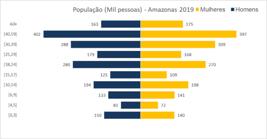
Regarding the state of Amazonas, the graphs above show a larger population in 2019, both for men and women, in the age group from 40 to 59 years, with 402,000 women and 397,000 men.
The Amazonian population, in general, has a balanced distribution, with a half-half percentage. The lowest population is in the 0-3 years age group, which may indicate a moderate birth rate relative to the other age groups. In summary, the state of Amazonas, in 2019, had a population distribution that was mainly concentrated in the middle-aged age groups (30-59 years).

Compared to 2019, in 2022 the numbers of women and men remain almost equal, with a predominance in the 40-59 age group. In this three-year period, the population grew little, as happened with the national data. Below are the graphs for the residents of the municipality of Manaus.


The Manaus population also grew little in the period from 2019 to 2022, with the same percentage of men (49%) and women (51%) in the two years presented, with a higher number of the population concentrated in the age groups from 30 to 59 years and lower between four and five years.
It is important to note that the distribution by sex and age has very similar behavior in the three regions analyzed, in addition to having undergone no extreme changes between the years, a very short period for a new format to occur. Still, it presents an overview for analysis in the period determined by the research.
In summary, Brazil has a population of 203,062,512 inhabitants, the state of Amazonas, 3,941,175, and Manaus, the locus of research, 2,063,547. This shows that the Amazonas capital has a large part of the state's population, with a predominance of the age group from 30 to 59 years, with the vast majority being black or brown (78%) and with more women (51%). With the population detailed, the illiteracy data are addressed below.
Illiteracy in Brazil and Amazonas
The IBGE considers illiterate persons who self-declare not knowing how to read and write, and functional illiterate persons aged 15 years or more with less than five years of school education: “these are people who attend or have attended school, and, even though they are ‘literate,’ they cannot understand short texts” (Leite & Cadei, 2016, our translation).
Based on these concepts, in the Brazilian context, despite the advances achieved in recent decades, there are still areas and population groups marked by high illiteracy rates. Regional inequalities are notorious and—as detailed in the theoretical framework—have deep historical roots. According to the PNAD, illiteracy rates by region and age group are presented as shown in Table 6:
The PNAD lacks data for 2020 and 2021 due to the COVID-19 pandemic, but we note that the national illiteracy rate decreased by 0.5% in a four-year period, and all Brazilian regions had a decrease or maintenance in their data. The only region that kept the percentage was the South. Although the rates have decreased, they remain asymmetrical in the country.
The North region was the second region that decreased the illiteracy rate most, more than the national average of 0.6%; however, the result still shows a region with an illiteracy rate higher than the country's average and more than double that of the Southeast region, which decreased only 0.1% in this time period. It is important to note that this region already had low illiteracy rates, as well as the South, which maintained the data.
In the state of Amazonas, the illiteracy rate is 4.9%, below the rate in the North region, but with an absolute number of 148,000 people. It is the 14th state in the ranking of illiteracy, which shows that there is still much to evolve. However, a positive aspect was that, in part, PNE goal 9 was achieved: “raising the literacy rate of the population aged 15 and over to 93.5% by 2015” (Law No. 13.005, of June 25, 2014, our translation). Amazonas is one of the 15 states that achieved this phase of the goal. Graph 7 provides a comparison:

Graph 7 shows illiteracy rates in 2022, comparing data at the national, state and municipal levels. It should be noted that Manaus has an index below the national average, which is certainly a positive point.
It is even more encouraging to note that in a span of just three years, from 2019 to 2022, the city was able to reduce its illiteracy rate from 3% to 2%. However, as in the case of the state, the municipality has a major challenge, as the percentage of 2% represents in absolute numbers 43,000 illiterate people in the city; this perspective is emphasized by Braga and Mazzeu (2017) when explaining that absolute data is what really shows illiteracy in the country. In fact, percentages can create the illusion of being close to the elimination of illiteracy—a goal that has not been achieved. Hence the need for a detailed profile of this quantity.
Table 7 details in absolute numbers the number of illiterate people aged 15 years or older by sex and age group. It is observed that there is a drop in the percentage of illiterates in the vast majority of the regions and age groups.
In 2022, Manaus had a higher prevalence of illiteracy for women. This situation contrasts with that of 2019, when there was a higher prevalence of illiterates among men. This change can be clearly observed in Table 8:
In 2019, Manaus had 45,000 illiterates, of whom 24,000 were men and 21,000 were women. The age group with the highest illiteracy rate was 60 years or older. In 2022, this number was reduced to 43,000, with a predominance of females.
The age group of 60 years or older continues to have the highest number of illiterates, with a total of 25,000. This situation is recurrent in data for Brazil and for the state of Amazonas. It can be concluded that the illiteracy bottleneck is found in older people, or, as proposed by Sampaio and Hizim (2022), the "debt bias" (p. 275, our translation), when the large percentage of low education is concentrated in the older population due to the lack of access to schools in past generations, perpetuating illiteracy.
According to Peres (2011), illiteracy affects older populations due to the government's negligence in establishing educational policies aimed at this age group. This situation reveals an educational exclusion, in which the education system is mainly aimed at preparing young people for the urban-industrial labor market, reflecting the logic of the capitalist system. This has contributed to the marginalization of older adults in the labor market and their exclusion in the sphere of education. Peres also argues that from the capitalist perspective there is no significant role for older adults, since individuals at this stage of life have become unproductive and obsolete (Peres, 2011).
Based on these insights, we observe that EJA—an educational modality that is often sidelined in Brazilian educational policies—presents an even deeper exclusion: the exclusion of older adults. This exclusion is based on a mistaken view of wasted educational investment that makes this group completely invisible, despite the constitutionally guaranteed rights. It is essential to recognize and address this double marginalization to ensure inclusive and equitable education for all.
Another aspect to be discussed is the racial issue. This point should also be emphasized, since education is not isolated from current racial inequalities in society. Historically, people of certain races have been marginalized and have had less access to quality education. This marginalization still resonates today, influencing the quality of and access to education.
In Brazil—which is conceived by the world and by itself as a paradise of miscegenation —the hypocrisy of not sufficiently questioning differences, which are many, has allowed the maintenance and aggravation of the silence that speaks in favor of prejudice. Non-plurality in education is just one of the means of preserving the major veneer of “racial democracy” that conceals the lack of actual democracy (Baibich, 2002, p. 113, our translation).
The excerpt discusses the complexity of the national identity and the racial dynamics in Brazil and underscores how racial inequality is sustained and perpetuated. The reference to “non-plurality in education” notes how educational institutions often fail to adequately recognize and debate racial diversity, contributing to the maintenance of stereotypes and discrimination. It underscores the urgency of addressing these issues to promote a deeper and more inclusive understanding of Brazilian society.
We have no data for Manaus based on the perspective of race or skin color of illiterate inhabitants; however, we can observe national and state-level indices for 2019 and 2022.

Graph 8 shows the major predominance of illiterates among black and brown people in the country. The data for the state of Amazonas presents higher percentages than the national numbers, with 88%.

Graph 9 shows that the rates for black or brown illiterates in 2022 decreased at the national and state levels, but without changing the major predominance of this indicator. Amazonas rates for illiteracy among blacks and browns remained higher than national levels, with 80%.
The data indicate that, despite their reduction, inequalities by region, skin color and race remain. According to the numbers, women are more literate than men, and whites had better educational indicators than blacks or browns. We can conclude that illiteracy is declining, but with a pattern: there is a higher ratio of illiterates among older age groups, which demonstrates that younger age groups of the population have more access to education and are taught how to read and write at the correct stage of life.
The significant portion of older adults who did not have an opportunity for education in their youth remain illiterate in adulthood. Thus, achieving the goals of the national, state and municipal plans for overcoming illiteracy requires intensified efforts oriented toward the older population.
Final considerations
The data indicate a gradual reduction in illiteracy rates at the national, state and municipal levels; however, the pace is still far below that which is necessary for achieving the goals of the ten-year plans, especially Goal 9.
Education in Brazil has always seen adversities, especially in maintaining the continuity of public policies. Saviani (2008) is commonly referred to when explaining public policies when noting that the mark of discontinuity in current education policies is present in the goal, always postponed, of eliminating illiteracy, among other educational indicators.
And, in a period recently impacted by a pandemic and reduced resources for EJA, illiteracy has been decreasing at a slow and insufficient rate considering Brazil's potential. Examining the reduction in illiteracy rates by region, there is a marked inequality between different parts of Brazil. The North region, historically characterized by peripheral conditions and structural inequalities, has still high illiteracy rates, with a rate of 6.4%. The state of Amazonas and its capital, Manaus, reflect this situation. In addition, by analyzing the data, it becomes evident that illiteracy in Brazil is strongly associated with factors such as skin color and age group, indicating a problem that is not only educational, but also social and structural.
Based on these data, from the IBGE 2022 Census and 2023 PNAD surveys, we observe policies that seek to address this situation. Among them, we note the resumption of operation in 2023 of the Department of Continuing Education, Literacy, Diversity and Inclusion (SECADI), seeking to ensure equity in education.
In continuity, we have the Literate Brazil Program (PBA), resumed in September 2024, which aims to provide literacy to young people and adults aged 15 years or older who could not study at the appropriate age, a policy clearly aimed at achieving PNE Goal 9, especially for regions with higher illiteracy rates:
the prioritization of literacy provision programs by areas, regions or federative entities with high rates of illiteracy, considering the most updated data from the Demographic Census and the Continuous National Household Sample Survey of the Brazilian Institute of Geography and Statistics Foundation – IBGE
(Ministry of Education [MEC], 2024, p. 1).
Still in the organization phase, the PBA arises as an important tool to boost the fight against illiteracy in the country. Another recent highlight is the 2024 National Pact for Overcoming Illiteracy and Improving Youth and Adult Education, which seeks, among its main objectives, to eliminate illiteracy and raise the educational level of the population, also as a response to PNE Goal 9.
These initiatives represent a breakthrough in tackling illiteracy in Brazil and renew the hope of transformation. However, their effectiveness depends on a continuous and sustained commitment so that, in fact, these initiatives contribute toward building a new education in the country and become long-term State policies rather than short-term government policies.
It is reinforced that survey numbers support the development of public policies geared toward the most affected populations. This article provided an overview of the current situation of illiteracy, focusing on a peripheral Brazilian state with negative impacts on illiteracy rates.
Acknowledgments
To the Amazonas State Research Support Foundation (FAPEAM), an entity whose sole purpose is to support basic and applied scientific research and experimental technological development, with the aim of increasing the stock of scientific and technological knowledge, as well as its application, in the interest of the economic and social development of the State of Amazonas.
-
Proofreading
Bibliographic standardization (APA 7th Ed.), proofediting and proofreading in Portuguese: Reinaldo Rodrigues <revisão@tikinet.com.br>English translation: Roberto Candido Francisco <montanha-mattoid@hotmail.com>English proofediting/proofreading: Cristina Saez <traducao@tikinet.com.br>
-
1
This article is part of the master's dissertation entitled The Right to Education for Young People and Adults: an analysis of access and permanence policies in the municipal network of Manaus-Amazonas.
-
2
They concentrate 22.1% of the total resident population.
Data availability
The contents underlying the research text are contained in the manuscript.
References
- Baibich, T. M. (2002). Os Flintstones e o preconceito na escola. Revista Educar, 19, 111-129.
-
Braga, A. C., & Mazzeu, F. J. C. (2017). O analfabetismo no Brasil: lições da história. RPGE - Revista On-line de Política e Gestão Educacional, 21(1), 24-46, 2017. https://periodicos.fclar.unesp.br/rpge/article/view/9986/6590
» https://periodicos.fclar.unesp.br/rpge/article/view/9986/6590 - Brasil. Constituição da República Federativa do Brasil de 1988 Brasília, DF: Presidência da República, 1988.
- Brasil. (2013). Plano Nacional de Políticas para as Mulheres Secretaria Especial de Políticas para as Mulheres.
- Duarte, C. S. (2007). A Educação como um direito fundamental de natureza social. Educação & Sociedade, 28(100), 691-713.
- Fernandes, F. (2008). A integração do negro na sociedade de classes (5a ed.). Globo.
-
Ferraro, A. R. (2009). Gênero, raça e escolarização na Bahia e no Rio de Janeiro. Cadernos de Pesquisa, 39(138), 813-835. https://publicacoes.fcc.org.br/cp/article/view/214
» https://publicacoes.fcc.org.br/cp/article/view/214 -
Instituto Brasileiro de Geografia e Estatística [IBGE]. (2022). Censo Brasileiro. IBGE. https://www.ibge.gov.br/estatisticas/sociais/populacao/22827-censo-demografico-2022.html
» https://www.ibge.gov.br/estatisticas/sociais/populacao/22827-censo-demografico-2022.html -
Instituto Brasileiro de Geografia e Estatística [IBGE]. (2023). Pesquisa Nacional por Amostra de Domicílios Contínua. IBGE. https://www.ibge.gov.br/estatisticas/sociais/saude/9171-pesquisa-nacional-por-amostra-de-domicilios-continua-mensal.html?edicao=20652
» https://www.ibge.gov.br/estatisticas/sociais/saude/9171-pesquisa-nacional-por-amostra-de-domicilios-continua-mensal.html?edicao=20652 -
Lei n.º 13.005, de 25 de junho de 2014. (2014, 25 de junho). Aprova o Plano Nacional de Educação - PNE e dá outras providências. Diário Oficial da União www.planalto.gov.br/legislação
» www.planalto.gov.br/legislação - Leite, F. R., & Cadei, M. M. S. (2016). Analfabetismo funcional: uma realidade preocupante. Revista Científica do Instituto Ideia: Avaliação e Políticas Públicas em Educação, 1, 13-19.
- Marconi, M. A., & Lakatos, E. M. (2007). Fundamentos da Metodologia Científica (6a ed.). Atlas.
-
Mattos, C. L. G., Almeida, S. M., & Castro, P. A. (2013). Educação e vulnerabilidade: um estudo etnográfico com jovens e mulheres em privação de liberdade. Revista Eletrônica de Educação, 7(1), 32-55. http://www.reveduc.ufscar.br
» http://www.reveduc.ufscar.br -
Ministério da Educação [MEC]. (2024). Programa Brasil Alfabetizado. MEC. https://alfabetizacao.mec.gov.br/pba
» https://alfabetizacao.mec.gov.br/pba - Peres, M. A. C. (2011). Velhice e analfabetismo, uma relação paradoxal: a exclusão educacional em contextos rurais da região Nordeste. Revista Sociedade e Estado, 26(3), 631-661.
- Pinheiro, R. C., & Oliveira, J. R. (2020). A utilização de jogos digitais educacionais na educação de jovens e adultos. Texto Livre: Linguagem e Tecnologia, 13(3), 200-223.
- Pinheiro, M. G. S. P., & Santos, J. N. (2016). Educação Escolar Indígena nos Planos de Educação: PNE (2014-2024) e PME - Manaus (2015-2025): avanços, permanências e desafios. Revista Amazônida, 1, 82-95.
- Sampaio, C. E. M., & Hizim, L. A. (2022). A Educação de Jovens e Adultos e sua imbricação com o ensino regular. RBEP, 103(264), 271-298.
-
Saviani, D. (2008, 5 de março). Desafios da construção de um sistema nacional articulado de educação. Ciclo de debates: a articulação entre a educação básica e a educação profissional– contribuições para a I Conferência Nacional de Educação Básica, Rio de Janeiro. https://www.youtube.com/watch?v=xxvfmk-UsQ4
» https://www.youtube.com/watch?v=xxvfmk-UsQ4
Edited by
-
Editors-in-charge:
Associate Editor: Adriana Varani https://orcid.org/0000-0002-7480-4998>Editor-in-Chief: Chantal Medaets https://orcid.org/0000-0002-7834-3834>

 Source:
  Source: IBGE, Annual Continuous PNAD – 2nd quarter (2023)
 Source: IBGE, Annual Continuous PNAD – 2nd quarter (2023)
 Source: IBGE, Annual Continuous PNAD – 2nd quarter (2023)
 Source:
  Source: IBGE, Annual Continuous PNAD – 2nd quarter (2023)
 Source: IBGE, Annual Continuous PNAD – 2nd quarter (2023)
 Source:
  Source: IBGE, Annual Continuous PNAD – 2nd quarter (2023)