
 Drug abuse by young people in contexts of social vulnerability: a systematic review
 ABSTRACT
This article aimed to conduct a systematic review of the scientific literature in Latin America regarding the multiple aspects associated with the onset of psychoactive substance use among adolescents and young people in contexts of social vulnerability. A search for scientific articles published between 2013 and 2021 was conducted in the Scielo, Lilacs, and RedIb databases, using the descriptors Substance-Related Disorders, Drug Abuse, Social Vulnerability, and Adolescents, as defined by DeCS/MeSH and the VHL. Twenty-two studies published in Portuguese, Spanish, and English were selected. Three categories were developed: Parental Upbringing and Experiences of Violence During Childhood, Peer Influence, and Context of Vulnerability and Social Exclusion, which identify the main findings of this study. The results show that adolescents experienced processes of social exclusion and disengagement from school, family, and social life. These processes produce health risks, including drug abuse, due to the conditions of social inequality in the different spheres of youth inclusion.
Keywords:
Drug abuse; social vulnerability; adolescents
RESUMO
O presente artigo objetivou realizar uma revisão sistemática da literatura científica na América Latina a respeito dos diversos aspectos associados ao início no consumo de substâncias psicoativas em adolescentes e jovens em contextos de vulnerabilidade social. Para isso, realizou-se uma busca de artigos científicos publicados durante o período de 2013 a 2021 nas bases de dados Scielo, Lilacs e RedIb, com os descritores Transtornos Relacionados ao Uso de Substâncias, Abuso de drogas, Vulnerabilidade social e Adolescentes, definidos por DeCS/MeSH e pela BVS. Foram selecionados 22 estudos publicados em português, espanhol e inglês. Elaboraram-se três categorias: Criança parental e experiências de violência durante a infância, Influência do grupo e Contexto de vulnerabilidade e exclusão social, que identificam os principais achados deste trabalho. Os resultados evidenciam que os adolescentes tinham experimentado processos de exclusão social, sem possibilidades de participação nas diversas áreas da vida social, como a desvinculação dos âmbitos escolar, familiar e social, considerando que as condições de iniquidade social nos diferentes âmbitos de inserção dos jovens produzem riscos à saúde, dentre eles o consumo de drogas.
Palavras-chave:
Abuso de drogas; vulnerabilidade social; adolescentes
RESUMEN
El presente artículo tuvo como objetivo realizar una revisión sistemática de la literatura científica en América Latina respecto de los múltiples aspectos asociados con el inicio en el consumo de sustancias psicoactivas en adolescentes y jóvenes en contextos de vulnerabilidad social. Se realizó la búsqueda de artículos publicados durante el período de 2013 a 2021 en las bases de datos Scielo, Lilacs y RedIb, con los descriptores Trastornos relacionados con sustancias, Abuso de drogas, Vulnerabilidad social y Adolescentes; definidos por DeCS/MeSH y BVS. Se seleccionaron 22 estudios publicados en portugués, español e inglés. Se elaboraron tres categorías: Crianza parental y experiencias de violencia durante la infancia, Influencia del grupo y Contexto de vulnerabilidad y exclusión social, que identifican los principales hallazgos de este trabajo. Los resultados evidencian que los adolescentes experimentan procesos de exclusión social sin posibilidades de participación en diversas esferas de la vida social como desvinculación del ámbito escolar, familiar y social, considerando que las condiciones de inequidad social en los distintos ámbitos de inserción de los jóvenes producen riesgos a la salud, entre ellos el consumo de drogas.
Palabras Clave:
Abuso de drogas; vulnerabilidad social; adolescentes
Introduction
According to the Report on Drug Use in the Americas (OAS & CICAD, 2019), drug use begins at an early age, reaching concerning levels among elementary school students (8th grade). Similar consumption trends are observed among men and women. The study indicates that tobacco is the only substance whose prevalence has decreased over time. Meanwhile, alcohol use among high school students is highest in both North and South America, with over 50% reporting use in the last month. In several countries, the rate of alcohol use among 8th-grade students exceeds 20% to 30%. As for cocaine-derived substances (cocaine hydrochloride, cocaine base paste - PBC, and crack), PBC is the most widely used in South America. The annual prevalence of use among students ranges from 0.17% to over 4%, with the highest rates observed among 8th-grade students.
Drug use is a complex and multi-causal issue, considered a public health problem that requires a comprehensive understanding, as it involves biological factors interacting with socioeconomic and demographic aspects (Abeldaño et al., 2014; Halpern et al., 2017). Therefore, a comprehensive, interdisciplinary, and multisectoral approach is necessary (Pedrosa et al., 2016). Early use of psychoactive substances can hinder healthy physical and psychosocial development (Bittencourt et al., 2015). Young people are at risk of progressing from experimental use to abuse, in addition to facing consequences and harms such as health problems, legal sanctions, family and social conflicts, school dropout, and feelings of guilt or anxiety (Bittencourt et al., 2015). Furthermore, there are limitations on their entry into the job market and the construction of meaningful social relationships that serve as a source of social support (Pedrosa et al., 2016).
The study population is undergoing the life stage of adolescence, which is characterized by biological, psychological, and social transformations that influence the development of identity and the differentiation from the primary social group (Reis et al., 2013; Oliveira et al., 2020). Historical and cultural factors must also be considered in the conception of adolescence. Several authors offer alternative perspectives to the traditional conception, attributing a specific political and social identity to young people. In the Latin American context, poverty, as a social and economic phenomenon, challenges the hegemonic model of youth, which proves to be contradictory in the face of a reality marked by exclusion and social vulnerability. Therefore, the experience of adolescence varies according to one's living conditions, contradicting the idea of homogenization based solely on age group or fixed cultural elements (Atanázio et al., 2013; Ximenes & Cidade, 2016).
Research shows that adolescents who use drugs experience vulnerable socioeconomic conditions and family problems in their daily lives, including weakened emotional bonds, experiences of violence, limited participation in family life, and drug abuse by family members, which often leads them to abandon their homes (Arpini & Gonçalves, 2011). Furthermore, it is considered that “entering the world of drugs” offers a possibility of recognition, albeit based on violence as a resource, which influences the construction of identity in the absence of social references and societal participation (Arpini & Gonçalves, 2011). Thus, young people face a double vulnerability: the context of socioeconomic and cultural inequalities as a risk factor for health, and substance use as a risk behavior that leads to stigmatization and social exclusion (Souza, 2016). Perspectives associated with youth risk, which imply as an inherent condition of their existence the impossibility of overcoming economic, social, and political inequalities, tend to victimize young people and reduce their active participation. Such perspectives ultimately justify processes of social inequality and poverty, holding the subjects themselves responsible for their situation of poverty. However, young people also develop alternative coping strategies, which highlights the importance of youth protagonism and building social ties within their communities (Ximenes & Cidade, 2016).
This study aimed to conduct a systematic review of the scientific literature in Latin America regarding substance use among adolescents and young people in contexts of social vulnerability.
Method
The systematic review followed the criteria indicated by the Preferred Reporting Items for Systematic Reviews and Meta-Analyses (PRISMA) criteria (Portuguese translation by Galvão et al., 2015). The study examined the scientific literature available in Latin America on various aspects associated with the use of psychoactive substances by adolescents and young people in contexts of social vulnerability.
In April 2021, the database search was conducted by consulting RedIb, Scielo, and Lilacs. The following descriptors were used: ‘Substance-related disorders,’ ‘Drug abuse,’ ‘Social vulnerability,’ and ‘Adolescents,’ according to the terminology of the DeCS/MeSH database and the VHL. The descriptor ‘young adult’ was excluded because it yielded no new results, resulting in a greater number of records for the youth age group using these terms. The descriptors were combined in English, Spanish, and Portuguese, resulting in strategies such as: “adolescents AND substance-related disorders”; “adolescents AND drug abuse”; “social vulnerability AND drug abuse”; and “social vulnerability AND adolescents.” No results were found using these strategies in the Latindex, Redalyc, or Biblat databases.
The following inclusion criteria were considered when selecting articles: a) empirical studies on factors related to substance use in contexts of social vulnerability among adolescents and young people; b) qualitative and quantitative studies; c) conducted in Latin America; d) written in Spanish, Portuguese, or English; and e) published between 2013 and 2021. Studies that were excluded were: research conducted with an adult population; articles of a purely theoretical nature; published before 2013; theses; studies that did not specify the social context of young people; and studies that analyzed the effects of substances on young people's quality of life and that, as a consequence of their use, present risk behaviors and impacts on their educational trajectory. Furthermore, studies describing and addressing drug intoxication in adolescents in public hospital emergency rooms and clinical treatment settings were excluded.
The analysis process consisted of the following steps: 1) reading of titles and abstracts; 2) inclusion and exclusion of articles according to the established criteria; 3) complete reading of pre-selected articles; and 4) final inclusion of articles, according to the research objectives and criteria. Articles were analyzed based on their methodology and instruments used to assess psychoactive substance use. They were also evaluated based on their investigation of participants' trajectories in relation to drug use, their theoretical approach to the problem, and the results obtained to understand the phenomenon in the context of social vulnerability.
Results
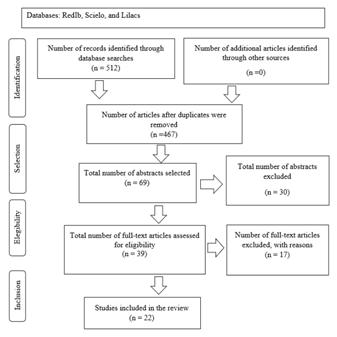
During the search process, a total of 512 articles were retrieved from the databases. Subsequently, after eliminating duplicates, the sample was reduced to 467 articles, which were then reviewed for titles and abstracts, resulting in the selection of 69 articles. Of the total abstracts selected, 39 were considered for full reading and eligibility determination. Finally, 17 were excluded, resulting in the final sample of 22 articles. The flowchart is illustrated in Figure 1.
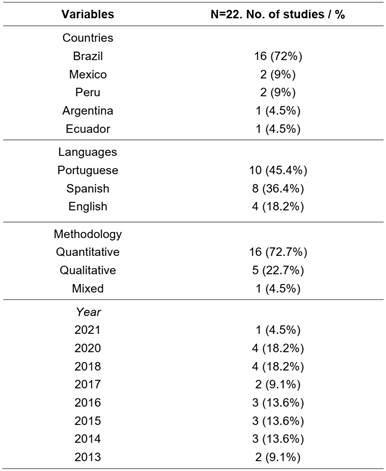
According to the descriptive data of this investigation, the countries in which the studies were conducted were: Brazil, with 72%, followed by Mexico and Peru, with 9% each, and Ecuador and Argentina, with 4.5% each. The articles were published in Portuguese (45.4%), Spanish (36.4%), and English (18.2%). In terms of year of publication, 18.2% were published in 2018 or 2020, 13.6% were published in 2014, 2015, or 2016, 9.1% were published in 2013 or 2017, and 4.5% were published in 2021 (Table 1).
Of the selected studies, 72.7% were quantitative, 22.7% were qualitative, and 4.5% were mixed methods. Most of the studies were cross-sectional, longitudinal, exploratory, descriptive, and/or correlational. Participants included adolescents from vulnerable backgrounds who had not completed high school, young high school students, or those who neither studied nor worked. Some studies also included samples of adolescents from private schools to establish possible comparative analyses according to socioeconomic status. Sample sizes ranged from 4 to 54,756 participants. Additionally, a single longitudinal study examined the mothers of the adolescents, forming a sample of 5,249.

The instruments used varied, depending on the area under investigation. Notable instruments included sociodemographic questionnaires, such as the SVI, which assesses aspects such as environment, culture, economy, access to legal assistance, and safety, and the ABIPEME SCALE for socioeconomic classification. The mother's level of education was also considered an individual socioeconomic indicator and was investigated through interviews or questionnaires.
Specific areas related to the influence of peers, family, and leisure time were assessed using instruments such as the Parental Bonding Instrument (PBI), the Integrated Questionnaire for the Measurement of Social Capital (IQ-MSC), the Leisure Diagnostic Battery (LDB), the Demographics and Leisure Data Questionnaire (QS DL), and the "My Memories of Upbringing" questionnaire (EMBU-I).

Instances of psychological and sexual abuse, physical and emotional neglect, as well as domestic violence, and religious participation, were assessed using self-administered questionnaires. Furthermore, the Self-Reporting Questionnaire (SRQ-20) was used to evaluate the mental health of mothers, and the Strengths and Difficulties Questionnaire (SDQ) was used for adolescents.
To identify substance use among young people, self-administered questionnaires and other more specific questionnaires were administered, such as the Alcohol, Smoking, and Substance Involvement Screening Test (ASSIST), the Alcohol Use Disorders Identification Test (AUDIT-C), the Drug Use Screening Inventory (DUSI), and the 6th version of the Addiction Severity Index (ASI-6). Similarly, knowledge about family members' substance use was obtained through questionnaires or interviews.
Furthermore, the studies also used records of patients using psychoactive substances from a psychosocial care center and databases of Research on the Prevalence of Psychoactive Substance Use. Furthermore, techniques such as semi-structured interviews, focused interviews, field diaries, and discussion groups were also employed.
The findings of this study were organized into the following categories to more clearly present the most frequently mentioned factors:
Parental upbringing and experiences of violence during childhood
Adolescents are exposed to vulnerabilities both within and outside their family contexts, including sexual assault and domestic violence, phenomena that, according to studies, are associated with substance use. This is because, when using substances, they can become involved in risky situations, and when faced with stressful events, such as these forms of violence, substance use serves as a means of alleviating suffering, highlighting the magnitude of these problems in young people who are already vulnerable in their life trajectories (Costa et al., 2015; Valle et al., 2018). According to Valle et al. (2018, p. 2), sexual assault is defined as “[...] any form of sexual contact that occurs without the person's explicit consent [...],” including physical aggression, such as touching intimate parts of the body and forced kissing; non-physical aggression, such as the exposure of genitals and being looked at; and rape. The author's findings indicate that alcohol consumption is associated with a higher likelihood of being a victim of sexual assault in both men and women. However, in an extrafamilial context, women who consumed alcohol were more vulnerable to sexual violence, while consumption by men was not associated with being victims of sexual violence in either context. In turn, studies show that women are more exposed to physical and non-physical violence within the family, and the prevalence among men is similar only outside this context.
For a better understanding, Valle et al. (2018) place family dysfunction within this dynamic as a prerequisite factor that makes young people vulnerable when there is little family cohesion and the roles of its members are not clearly defined. This leads to unequal power relations. In this context, sexual assault expresses the debasement of the other subject's autonomy and rights. Furthermore, it is argued that these situations of intrafamilial sexual assault begin at an early age and continue to occur even during adolescence, characteristically prolonging them over time, while alcohol use manifests itself only as one of the associated consequences (Valle et al., 2018). Therefore, within the family, violence is not directly associated with alcohol consumption, since the substance does not mediate the perpetration of the act, given its coexistence in time and space with the aggressor. In this case, the role of the substance takes on another place related to the victim as a means of coping with the stress caused (Valle et al., 2018). Similarly, Franco-Coffré et al. (2020) argue that losing emotional ties with a dysfunctional family is a reason for using illicit drugs because they offer an escape from reality (Atanázio et al., 2013).
The study by Gonçalves et al. (2016) addresses aspects occurring from childhood to early adolescence involving different types of abuse, such as physical, sexual, and emotional abuse, as well as physical neglect and domestic violence. These factors are linked to drug use. Thus, an association is observed between these adverse childhood experiences and the onset and continuation of substance use, often high-risk in the adolescent and adult population (Gonçalves et al., 2016). In this longitudinal study, it was found that, among the characteristics of the young people's mothers, 31.7% were smokers and 45.4% consumed alcohol; 70% had only eight years of schooling, and 30.9% had mental health problems. As for their children, at age 11, 1.4% used tobacco, 6% used alcohol, and 0.5% used illicit drugs, with the highest prevalence among boys. In addition, 14% of adolescents exhibited behavioral problems, which were more prevalent among boys (Gonçalves et al., 2016). The adverse childhood experiences (ACEs) results showed that girls had higher scores on the dimensions of emotional neglect, physical abuse, and domestic violence. At age 15, in the same sample of adolescents, 25% consumed alcohol and 6% tobacco—higher prevalence among girls—while 2.1% experimented with illicit drugs, with similar proportions between boys and girls. Regarding the relationship between substance use and adverse experiences during childhood, those who experienced some type of abuse or neglect had a higher prevalence of drug use. Thus, girls remained more vulnerable to both situations of violence and drug use. In this sense, a possible understanding proposed by Gonçalves et al. (2016), when discussing other studies, is that drug use would function, even if temporarily, as a way of seeking relief and pleasure in response to circumstances experienced since childhood, especially in contexts with limited family and social support.
Another factor considered in the research is the type of bond established between parents and their adolescent children, as well as its implications for drug use. Cerutti et al. (2015) point out that fathers and mothers who express little emotion increase the likelihood that their children will use tobacco. However, they also point out that children of affectionate parents may develop a marijuana dependence, though not an alcohol dependence, while a controlling parent constitutes a protective factor against tobacco and marijuana use (Cerutti et al., 2015). Regarding alcohol use, having a family member who abuses alcohol is a risk factor that increases the likelihood that a young person will also abuse alcohol, as well as tobacco or other illicit drugs (Reis et al., 2013; Cerutti et al., 2015; Jorge et al., 2017; Almeida & Lana, 2020). Regarding the age of adolescents, the older they are, the greater the possibility of developing dependence on the substance (Cerutti et al., 2015; Jorge et al., 2017).
Consistent with these findings, Villegas-Pantoja et al. (2014) found that tobacco, marijuana, and cocaine use onset occurs later when there are affectionate relationships with parents, but found no significant associations between perceived rejection, control, or favoritism and drug use. However, the dimensions of perceived parental upbringing differ according to the gender of the parents. Thus, paternal rejection is associated with early onset of use, including physical and verbal aggression and punishment, while in the case of maternal upbringing, this association is not significant. In turn, paternal control and favoritism behaviors were identified as protective factors. Another observation is that the later the onset of alcohol use, the older the age of onset of tobacco, marijuana, and cocaine use (Villegas-Pantoja et al., 2014).
Peer influence
According to Jorge et al. (2018), a study on illicit drug use and group influence found that having friends who participate in religious, sports, and cultural activities reduces the likelihood of illicit drug use compared to groups that only share school activities, constituting a protective factor. Similarly, the study by Jorge et al. (2017) indicates that participation in religious activities modifies excessive alcohol consumption patterns in adolescents because it fosters moral values, self-control, and healthy social networks (Silva et al., 2021). Participating in groups with friends of the opposite sex has been associated with increased substance use because, during adolescence, it can facilitate establishing interpersonal relationships with the opposite sex and in the area of sexuality. This promotes integration and achieving a social position within the peer group (Atanázio et al., 2013; Jorge et al., 2018). In this context, Almeida et al. (2018) analyzed the influence of adolescent substance use on perceived freedom in leisure (PFL) and found that ecstasy and marijuana use are associated with higher PFL. In other words, recreational use has positive effects, such as greater self-expression and satisfaction in socialization and relaxation, without negatively impacting competence, control, or perception of needs. Furthermore, no significant differences were found between the type of recreational activity—whether movement, social, or virtual—and substance use (Almeida et al., 2018). On the other hand, the results suggest that young people consume more substances than adolescents due to social pressure and economic independence, which gives them greater access to purchasing substances (Jorge et al., 2017). For adolescents, financial independence often translates into precarious work. Combined with studying, this increases stress. In this context, the need to integrate into the group of consumer peers appears to be a risk factor for alcohol use (Silva et al., 2021).
The contributions of Cardoso & Malbergier (2014) indicate that the presence of risk factors in adolescents' friendship groups influences drug use. One reason for this is social acceptance and group integration, beyond simply observing peer use. Consumption tends to increase according to the substance used: when friends used alcohol and other drugs, the likelihood of illicit drug use increased. However, the consumption of alcohol and tobacco separately decreased this likelihood. Adolescents with friends who regularly used substances were more likely to consume alcohol and less likely to use tobacco. This was especially true when their friends used both substances in addition to illicit drugs. Having friends who brought drugs to parties, in particular, increased the risk of illicit drug use (Cardoso & Malbergier, 2014). Additionally, having few friends was found to reduce the risk of consuming alcohol and/or tobacco, whereas not living with parents and failing a school year were found to increase this risk (Cardoso & Malbergier, 2014; Almeida & Lana, 2020).
Based on research by Podolano et al. (2020), in a study of adolescents whose parents were drug addicts in abstinence, the family is understood as the primary space for socialization. In this setting, the behaviors of family members impact the entire system of relationships, potentially constituting risk or protective factors for substance use. The results demonstrate that parental abstinence influences children to avoid drug use due to their awareness of the associated harm, highlighting the protective role of communication, family support, trust, and responsibility (Atanázio et al., 2013; Podolano et al., 2020). Consistent with previous studies, the peer group stands out as a risk factor for alcohol use and abuse. It is also the space where adolescents demonstrate ambivalence about family experiences and substance abuse due to social pressure and the need to belong to a group in specific situations, such as drinking at parties (Podolano et al., 2020). Thus, adolescents who expressed concern about a parent's history of addiction scored low on the AUDIT-C, while those who viewed consumption in social settings as acceptable presented a moderate risk of developing a pattern of alcohol abuse (Podolano et al., 2020).
Context of vulnerability and social exclusion
The role of social determinants of health in understanding health and disease processes demonstrates that individual behavior cannot be dissociated from the context in which it occurs. In economically peripheral countries that fail to guarantee basic social rights, extreme poverty and a lack of access to education and healthcare are created, which influence health and drug use patterns (Halpern et al., 2017). Along these lines, research shows that adolescents in these circumstances experience social exclusion and are deprived of opportunities to participate in different spheres of social life (Galhardi & Matsukura, 2018). Separation from school is a fundamental aspect because it impacts the present, through opportunities for peer interaction and identity formation, and the future, through professional and civic development (Galhardi & Matsukura, 2018). In this scenario of growing disengagement from school, family, and society, many adolescents take personal responsibility for dropping out of school, thus minimizing macrosocial dimensions such as social vulnerability, exclusion processes, and public policies (Galhardi & Matsukura, 2018). Furthermore, adolescents take responsibility not only for their school conduct but also for drug use, expressing that it stems from individual vulnerability and assuming personal responsibility for drug use or abuse (Almeida & Lana, 2020).
Similarly, Bittencourt et al. (2015) identify school dropout and contact with family members who use drugs or have experienced domestic violence as risk factors for drug use initiation among adolescents. Thus, for these young people, family life and school are characterized by violence and absence, and these institutions cease to be significant reference points for their development. During adolescence, when individuals are most vulnerable to environmental and social situations, family and school should provide fundamental support (Bittencourt et al., 2015).
In their research with young people who neither study nor work, known as ‘ninis,’ García et al. (2016) describe the context of social inequality in which they find themselves as a risk factor for substance use. Limited opportunities for social integration through work and school create new groups that are marginalized from productive activities. These groups then seek to occupy their time with new practices, including spending time with peers in meeting and entertainment settings as a form of social interaction. Thus, youth is defined as a period of labor and educational transition marked by fragmentation in light of new social vulnerabilities in postmodernity (García et al., 2016).
School institutions are influenced by the macrosocial and ideological structures. When placed in conditions of social exclusion, the absence of public policies aimed at reducing drug supply directly impacts the population. This results in increased demand and the reproduction of moral and biologistic paradigms. These paradigms stigmatize users and disregard contextual factors, which may justify exclusionary behaviors in schools and other social and family settings. Ultimately, this reinforces consumer behavior despite the consequences of drug use, creating a “vicious cycle” (Franco-Coffré et al., 2020; Almeida & Lana, 2020; Oliveira et al., 2020; Silva et al., 2021). On the other hand, drug use also constitutes a risk factor that intensifies other forms of violence, such as domestic violence against women, thereby deepening situations of vulnerability. This violence is often perpetrated by substance-dependent family members (Costa et al., 2015).
Social inequality in various spheres of young people's lives poses health risks, highlighting the importance of considering more than just economic factors, although some studies identify the latter as a risk factor for drug use (Reis et al., 2013). Abeldaño et al. (2014) found that having an income above the poverty line could act as a protective factor. However, the authors emphasize the need to further explore the relationship between poverty indicators and psychoactive substance use. Regarding socioeconomic status, Jorge et al. (2018) indicate that living in vulnerable areas is related to a low prevalence of substance use, while residing in less vulnerable areas increases consumption levels. These findings contradict those of Jorge et al. (2017), who observed an increase in the frequency of excessive alcohol consumption in individuals from socially vulnerable contexts. However, Jorge et al. (2017) argue that there is no unanimous consensus regarding the association between socioeconomic status and illicit drug use. Similarly, García & Costa (2016) report that social vulnerability did not significantly influence the onset of consumption, though they reinforce the strong association between having family and friends who use drugs and the onset of consumption.
Discussion
In understanding and intervening in the phenomenon of psychoactive substance use among adolescents and young people living in socially vulnerable contexts, it is necessary to address the biopsychosocial aspects and highlight the complexity of this behavior. This involves problematizing socially naturalized issues, such as the direct association between substance use and social exclusion, which reduces the issue to a mere public safety issue (Pedrosa et al., 2016). Motivations for drug use are understood based on the context in which they occur, which is characterized by fragile social and family ties, exclusion from work and school, and the specific characteristics of adolescence and youth in their quest to construct their own identity. Furthermore, belonging to this social group hinders the development of citizenship (Pedrosa et al., 2016).
Some differences are observed across countries in the category “Parental upbringing and experiences of violence during childhood.” A Mexican study emphasizes the relationship between characteristics of parental upbringing and the onset of drug use, with trust, support, and communication with parents being protective factors that delay the onset of drug use (Villegas-Pantoja et al., 2014). Brazilian studies indicate that not living with a parent, a lack of family dialogue, and substance use by family members associated with domestic violence constitute risk factors (Almeida & Lana, 2020; Cerutti et al., 2015; Reis et al., 2013). Regarding family characteristics, the profile of the young people's mothers was also analyzed. They had mental health problems and engaged in drug use, which influenced their children's behaviors. This also affected the situations to which they were exposed, which were associated with stressful events such as physical, emotional, and domestic violence. In this scenario, women were much more likely than men to experiment with substances (Gonçalves et al., 2016; Jorge et al., 2017). A study conducted in Ecuador presents similar findings, indicating that adolescents use substances to escape from family problems (Franco-Coffré et al., 2020). Thus, drugs are seen as a tool to offer resistance to adverse experiences, including childhood and adolescent situations involving sexual abuse and domestic violence, which are more prevalent in Brazilian and Peruvian studies, both within and outside the family (Costa et al., 2015; Valle et al., 2018).
Regarding the analyses observed in this category concerning the role of parents in their children's education, the fragility of family bonds, and the weakening of authority figures, it is important to note that although adolescents are immersed in high-risk environments, which increases the likelihood of drug use, this vulnerability also affects their parents. Studies show that these young people come from families with limited access to goods and services, healthcare, education, transportation, and unequal income distribution, all of which contribute to social exclusion (Almeida & Lana, 2020). The state does not provide opportunities that offer job and social stability, which directly affects these families' trajectories, keeping them on the margins of social inclusion and perpetuating their vulnerability (Pedrosa et al., 2016). These circumstances affect family dynamics. Parents are forced to leave home to work, or adolescents are forced to enter precarious employment early to contribute financially to their families. They spend most of their time away from home and are overloaded with tasks, reducing their contact with parents and family (Reis et al., 2013). The weakening of families and their role in caring for children is intertwined with poverty and the struggle for survival. A study by Arpini & Gonçalves (2011) shows that such circumstances make it difficult for children to find role models, though they can establish affective relationships with their mothers and fathers. Nevertheless, the suffering associated with poverty and structural violence persists.
Following these guidelines, when addressing situations of sexual violence within the family—the most frequently observed type of violence in studies and generally suffered more by women than men (Valle et al., 2018)—researchers argue that existing social inequality, given the macrosocial context that undermines the rights of communities and families, leads adolescents belonging to these already vulnerable groups to become targets of physical and symbolic violence, deepening the psychosocial risk to which they are exposed (Paixão & Souza, 2020). In addition to these inequalities, new family configurations emerge due to social and cultural transformations over time, in which the father figure may be absent or exercise authority through violence. Family roles are poorly defined, a situation that is exacerbated by poverty. In these conditions, traditional roles of care and education are no longer present (Innamoratto et al., 2015; Paixão & Souza, 2020). These individuals often reproduce a cycle of violence and abuse; they are parents who are now aggressors but were also victims of aggression throughout their lives (Paixão & Souza, 2020). Given these scenarios, social, institutional, and state interventions are proposed through public policies that guarantee the rights of adolescents and their families (Paixão & Souza, 2020).
The “Peer Influence” category was developed based on Brazilian studies in which this factor relates to socializing with friends, partying, and spending time in leisure spaces. Experimentation is another factor associated with the onset of drug use among young Brazilians; they seek pleasure and fun through drugs, as well as the possibility of gaining popularity and interacting with others, including members of the opposite sex, aiming for acceptance and social integration (Atanázio et al., 2013).
Finally, the results of the studies in the “Context of Vulnerability and Social Exclusion” category reveal that there are no differences when considering not only economic factors, but also factors related to inequality in access to health, education, culture, and work when addressing social vulnerability. These factors affect individuals' ability to exercise citizenship. This implies that risk increases when there are no social support spaces that foster adaptive responses to adolescents' psychosocial environments and offer opportunities for youth participation and protagonism (Soares et al., 2019). Situations of social insecurity, institutional violence, and the lack of authority exercised by these institutions, as well as drug availability in the community, influence risk exposure (García & Costa, 2016). It is necessary not to reduce the concept of social vulnerability solely to economic distribution, but to understand its complexity, highlighting the social fabric as a whole, as well as the conditions of existence related to adequate access to health services, education, work, social relationships, and symbolic goods (Soares et al., 2019). Therefore, it is essential to question whether individuals in these deprived realities are necessarily destined to develop consumer behaviors and to what extent this association stigmatizes individuals living in poverty.
Another aspect analyzed is related to the age at which consumption begins. Young people consume more than adolescents due to stress resulting from job insecurity, the accumulation of work and study, and peer pressure, highlighting the social conditions they experience (Jorge et al., 2017; Silva et al., 2021). Regarding the onset of substance use, there is a progression from legal to illegal substances, and a delay in the onset of alcohol consumption reduces the use of other drugs, which highlights the importance of early intervention during adolescence (Cardoso & Malbergier, 2014; Almeida & Lana, 2020).
Finally, the study's limitations relate to the difficulty of obtaining results through the search strategy used in the Latindex, Redalyc, and Biblat databases that could contribute to debates on the topic. We propose that future discussions include the results related to substance use in domestic violence and school dropout, as these are associated consequences that reinforce experiences of social vulnerability and the motivations for consumption as a means of alleviating suffering (Costa et al., 2015; Soares et al., 2019).
Final considerations
This systematic literature review examines the relationship between the context of social vulnerability among adolescents and young people who use psychoactive substances and the stigmatization and social exclusion associated with this behavior. In the field of drug use, it is necessary to problematize the experiences and meanings attributed to these them, as well as the circumstances in which these young people interact socially in such contexts. Further studying this population would allow for the design of public policies that specifically address their needs and issues while promoting their active participation in various health sectors.
References
-
Abeldaño, R. A., Fernández, A. R., Estario, J. C., & Ventura, C. A. A. (2014). El consumo de sustancias psicoactivas y su relación con condiciones de vulnerabilidad y pobreza en Argentina. SMAD, Revista Eletrônica Saúde Mental Alcool Drogas, 10(3), 111-8. http://dx.doi.org/10.11606/issn.1806-6976.v10i3p111-118
» https://doi.org/10.11606/issn.1806-6976.v10i3p111-118 -
Almeida, D. E. R. G., Andrade, A. L. M., Cruz, F. D., & Micheli, D. (2018). Perception of freedom in leisure among substance users and nonusers. Psico-USF, 23(1), 13-24. http://dx.doi.org/10.1590/1413-82712018230102
» https://doi.org/10.1590/1413-82712018230102 -
Almeida, C. S., & Lana, F. C. F. (2020). Relação entre espaço sociocultural e o consumo de substâncias psicoativas por adolescentes. Revista Gaúcha de Enfermagem, 41, 1-11. https://doi.org/10.1590/1983- 1447.2020.20190335
» https://doi.org/10.1590/1983- 1447.2020.20190335 -
Arpini, D. M., & Gonçalves, C. S. (2011). Drogas e álcool na relação com a violência: o olhar de adolescentes em situação de rua. PSico, 42(4), 442-449. https://dialnet.unirioja.es/descarga/articulo/3945218.pdf
» https://dialnet.unirioja.es/descarga/articulo/3945218.pdf -
Atanázio, E. A., Santos, J. M., Dionísio, L. R., Silva, J., & Saldanha, A. A. W. (2013). Vulnerabilidade ao uso do álcool: um estudo com adolescentes das redes pública e privada de ensino. SMAD, Revista Eletrônica Saúde Mental Alcool e Drogas, 9(1), 11-17. https://www.redalyc.org/pdf/803/80329902003.pdf
» https://www.redalyc.org/pdf/803/80329902003.pdf -
Bittencourt, A. L. P., García, L. F., & Goldim, J. R. (2015). Adolescencia vulnerable: factores biopsicosociales relacionados al uso de drogas. Revista Bioética, 23(2), 316-324. https://doi.org/10.1590/1983-80422015232070
» https://doi.org/10.1590/1983-80422015232070 -
Cardoso, L. R. D., & Malbergier, A. (2014). A influência dos amigos no consumo de drogas entre adolescentes. Estudos de Psicologia, 31(1), 65-73. http://dx.doi.org/10.1590/0103-166X2014000100007
» https://doi.org/10.1590/0103-166X2014000100007 -
Cerutti, F., Ramos, S. P., & Argimon, I. I. L. (2015). A implicação das atitudes parentais no uso de drogas na adolescência. Acta Colombiana de Psicología,18(2), 73-181. doi: 10.14718/ACP.2015.18.2.15
» https://doi.org/10.14718/ACP.2015.18.2.15 -
Costa, A. P. S., Oliveira, D. A., Rodrigues, M. P., & Ferreira, M. A. F. ( 2015). Violência doméstica e abuso de álcool e drogas na adolescencia. Revista Ciência Plural, 1(2), 48-56. https://periodicos.ufrn.br/rcp/article/view/7616
» https://periodicos.ufrn.br/rcp/article/view/7616 -
Franco-Coffré, J., Oviedo-Rodríguez, R., Donoso-Triviño, A., Piedra-Chávez, K., & Cujilán-Alvarado, M. (2020). ¡Quo Vadis Joven! Relatos del abuso de drogas em jóvenes de Guayaquil, Ecuador. Cultura de los Cuidados, 24(56), 26-41. http://dx.doi.org/10.14198/cuid.2020.56.03
» https://doi.org/10.14198/cuid.2020.56.03 -
Galhardi, C. C., & Matsukura, T. S. (2018). O cotidiano de adolescentes em um Centro de Atenção Psicossocial de Álcool e outras Drogas: realidades e desafíos. Cadernos de Saúde Pública, 34(3), 1-12. https://doi.org/10.1590/0102-311X00150816
» https://doi.org/10.1590/0102-311X00150816 -
Galvão, T. F., Pansani, T. S. A., & Harrad, D. (2015). Principais itens para relatar revisões sistemáticas e meta-análises: a recomendação PRISMA (Preferred Reporting Items for Systematic Reviews and Meta-Analyses). Epidemiologia e Serviços de Saúde, 24(2), 335-342. https://doi.org/10.5123/S1679-49742015000200017
» https://doi.org/10.5123/S1679-49742015000200017 -
García, V. M., & Costa, M. L. (2016). Consumo de drogas ilegales en escolares y la relación con el entorno. SMAD, Revista Eletrônica Saúde Mental Alcool Drogas, 12(1), 3-11. https://www.redalyc.org/pdf/803/80346410002.pdf
» https://www.redalyc.org/pdf/803/80346410002.pdf -
García, R. A. G., Martínez, K. I. M., Trejo, A. Y. P., & Benjet, C. (2016). Consumo de substâncias em los jóvenes que no estudian ni trabajan (NINIS). Caleidoscopio, (34), 27-39. https://doi.org/10.33064/34crscsh159
» https://doi.org/10.33064/34crscsh159 -
Gonçalves, H., Soares, A. L. G., Santos, A. P. G., Ribeiro, C.G., Bierhals, I. O., Vieira, L. S., Hellwig, N. L., Wehrmeister, F. C., & Menezes, A. M. B. (2016). Adverse childhood experiences and consumption of alcohol, tobacco and illicit drugs among adolescents of a Brazilian birth cohort. Cadernos de Saúde Pública, 32(10), 1-10. http://dx.doi.org/10.1590/0102-311X00085815
» https://doi.org/10.1590/0102-311X00085815 -
Halpern, S. C., Scherer, J. N., Roglio,V., Faller, S., Sordi, A., Ornell, F., Dalbosco, C., Pechansky, F., Kessler, F., & Von Diemen, L. (2017). Vulnerabilidades clínicas e sociais em usuários de crack de acordo com a situação de moradia: um estudo multicêntrico em seis capitais brasileiras. Cadernos de Saúde Pública; 33(6), 1-13. doi: 10.1590/0102-311X00037517
» https://doi.org/10.1590/0102-311X00037517 -
Innamoratto, M. G, Acquaviva, M. A., Canavessi, J. J., & Ruiz, J. D. (2015) Vulnerabilidad social, adicciones y prácticas delictivas Bilioteca Digital http://www.bibliotecadigital.gob.ar/items/show/1563
» http://www.bibliotecadigital.gob.ar/items/show/1563 -
Jorge, K. O., Ferreira, R. C., Ferreira, E. F., Kawachi, I., Zarzar, P. M., & Pordeus, I. A. (2018). Peer group influence and illicit drug use among adolescent students in Brazil: a cross-sectional study. Cadernos de Saúde Pública, 34(3), 1-14. doi: 10.1590/0102-311X00144316.
» https://doi.org/10.1590/0102-311X00144316 -
Jorge, K. O., Ferreira, R. C., Ferreira, E. F., Vale, M. P., Kawachi, I., & Zarzar, P. M. (2017). Binge drinking and associated factors among adolescents in a city in southeastern Brazil: a longitudinal study. Cadernos de Saúde Pública, 33(2), 1-13. doi: 10.1590/0102-311X00183115
» https://doi.org/10.1590/0102-311X00183115 -
OEA, & CICAD. (2019). Informe sobre el consumo de drogas en las américas 2019. http://www.oas.org/cicaddocs/Document.aspx?Id=4977
» http://www.oas.org/cicaddocs/Document.aspx?Id=4977 -
Oliveira, E. N., Nunes, J. M., Vasconcelos, M. I. O., Viana, L. S., Moreira, R. M. M., & Bezerra, M. R. Ç. (2020). The first time we don’t forget: knowing the drugs experienced by high school students. SMAD, Revista Eletrônica Saúde Mental Alcool Drogas, 16(2), 1-8. doi: https://dx.doi.org/10.11606/issn.1806-6976.smad.2020.165488
» https://doi.org/10.11606/issn.1806-6976.smad.2020.165488 -
Paixão, É. S., & Souza, J. C. N. (2020). O abuso sexual de crianças e adolescentes: considerações sobre o fenômeno. Revista Territorium, 27(I), 99-111. https://impactum-journals.uc.pt/territorium/article/view/1647-7723_27-1_8/6054
» https://impactum-journals.uc.pt/territorium/article/view/1647-7723_27-1_8/6054 -
Pedrosa, S. M., Reis, M. L., Gontijo, D. T., Teles, S. A., & Medeiros, M. (2016). The path to crack addiction: perceptions of people under treatment. Revista Brasileira de Enfermagem, 69(5), 899-906. http://dx.doi.org/10.1590/0034-7167-2016-0045
» https://doi.org/10.1590/0034-7167-2016-0045 -
Podolano, A., Mosmann, C., & Falcke, D. (2020). Adolescentes filhos de dependentes químicos abstinentes: como se relacionam com álcool?Revista de Psicologia da IMED, 12(1), 68-86. doi: https://doi.org/10.18256/2175-5027.2020.v12i1.3315
» https://doi.org/10.18256/2175-5027.2020.v12i1.3315 -
Reis, D. C., Almeida, T. A. C., Miranda, M. M., Alves, R. H., & Madeira, A. M. F. (2013). Vulnerabilidades a la salud en la adolescencia: condiciones socioeconómicas, redes sociales, drogas y violencia. Revista Latino-Americana de Enfermagem, 21(2), 1-9. https://www.scielo.br/pdf/rlae/v21n2/es_0104-1169-rlae-21-02-0586.pdf
» https://www.scielo.br/pdf/rlae/v21n2/es_0104-1169-rlae-21-02-0586.pdf -
Silva, S. Z., Pillon, S. C., Zerbetto, S. R., Santos, M. A., Barroso, T. M. M. D. de A., Alves, J. S., Cruz, J. P. M., & Gonçalves, A. M. S. (2021). Adolescentes em território de grande circulação de substâncias psicoativas: uso e prejuízos. Revista Eletrônica de Enfermagem, 23, 1-10. https://doi.org/10.5216/ree.v23.60854
» https://doi.org/10.5216/ree.v23.60854 -
Soares, F. R. R., Farias, B. R. F., & Monteiro, A. R. M. (2019) Consumption of alcohol and drugs and school absenteeism among high school students of public schools. Revista Brasileira de Enfermagem, 72(6):1692-1698. http://dx.doi.org/10.1590/0034-7167-2018-0828
» https://doi.org/10.1590/0034-7167-2018-0828 - Souza, J. (2016). A doença da humilhação. In J. Souza (Org.), Crack e exclusão social (pp. 29-38). Ministério da Justiça e Cidadania, Secretaria Nacional de Política sobre Drogas.
-
Valle, R., Bernabé-Ortiz, A., Gálvez-Buccollini, J. A., Gutiérrez, C., & Martins, S. S. (2018). Agresión sexual intrafamiliar y extrafamiliar y su asociación con el consumo de alcohol. Revista de Saúde Pública, 52, 86. https://doi.org/10.11606/S1518-8787.2018052000539
» https://doi.org/10.11606/S1518-8787.2018052000539 -
Villegas-Pantoja, M. A., Alonso-Castillo, M. M., Alonso-Castillo, B. A., & Martínez- Maldonado, R. (2014). Percepción de crianza parental y su relación con el inicio del consumo de drogas en adolescentes mexicanos. Aquichan, 14(1), 41-52. https://doi.org/10.5294/aqui.2014.14.1.4
» https://doi.org/10.5294/aqui.2014.14.1.4 -
Ximenes, V. M., & Cidade, E. C. (2016). Juventude e pobreza: implicações psicossociais do fatalismo. Revista Interamericana de Psicologia/Interamerican Journal of Psychology (IJP ), 50(1), 128-136. https://www.redalyc.org/pdf/284/28446021014.pdf
» https://www.redalyc.org/pdf/284/28446021014.pdf
The data supporting the findings of this study can be requested from the corresponding author upon reasonable request.

 Source: Prepared by the authors.