
 THE EFFECT MUSIC THERAPY IN CHILDREN WITH AUTISM: A SCOPING REVIEW
ABSTRACT.
To carry out a scoping review of the scientific literature to help answer the question: “What do studies published from January 2014 until February 2021bring about the effect of music therapy in children with autism?”; summarize and disseminate research data and identify existing gaps.
Method: PRISMA extension for scoping reviews (PRISMA-ScR): checklist and explanation (Tricco et al., 2018). Search strategies were developed in national and international databases in health sciences: PUBMED, EMBASE, WEB OF SCIENCE, PSYCHINFO, SCOPUS and LILACS to retrieve articles published between 2014 and February 2021.
Results: 50 articles were read in full and analyzed by reviewers, and 16 were selected for their eligibility. Only one article failed to determine the gains of music therapy.
Conclusions: The results of this review showed the positive effects of music therapy for communication and social interaction in children with autism. Most of the works are case studies, and the sample size is small, but the results achieved were quite favorable. Some works invested in long-term accompaniments to verify that the benefits of music therapy are stable and lasting; more follow-up work needs to be done and published. This review focused on the lack of a father figure in the music therapy process, a point that could be analyzed in future research.
Keywords:
Child; autismo; music therapy
RESUMO.
Realizar uma revisão de escopo da literatura científica para ajudar a responder à questão: “O que os estudos publicados a partir de janeiro de 2014 até fevereiro de 2021 trazem sobre o efeito da musicoterapia em crianças com autismo?”; sumarizar e divulgar os dados da investigação e identificar lacunas existentes.
Método: Scoping Review, seguindo os parâmetros de qualidade do PRISMA extension for scoping reviews (PRISMA-ScR): checklist and explanation (Tricco et al., 2018). Foram elaboradas estratégias de busca em bases de dados nacionais e internacionais em ciências da saúde: PUBMED, EMBASE, WEB OF SCIENCE, PSYCHINFO, SCOPUS e LILACS para a recuperação de artigos publicados entre 2014 e fevereiro de 2021.
Resultados: Foram lidos na íntegra e analisados pelos revisores 50 artigos, e 16 foram selecionados por sua elegibilidade. Apenas um artigo não foi classificado a determinar os ganhos da musicoterapia.
Conclusões: Os resultados desta revisão mostraram os efeitos positivos da musicoterapia para a comunicação e interação social de crianças com autismo. A maioria dos trabalhos é estudo de casos, e o número da amostra é pequeno, porém os resultados alcançados se mostraram bastante favoráveis. Alguns trabalhos investiram em acompanhamentos de longo prazo para constatar que os benefícios da musicoterapia são estáveis e duradouros; mais trabalhos com follow up precisam ser realizados e publicados. Esta revisão atentou para a falta da figura paterna no processo musicoterapêutico, um ponto que poderia ser analisado em futuras pesquisas.
Palavras-chave:
Criança; autismo; musicoterapia
RESUMEN.
Realizar una revisión de escopo de la literatura científica para ayudar a responder a la pregunta: “¿Qué estudios publicados desde enero de 2014 hasta febrero de 2021 provocan el efecto de la musicoterapia en niños con autismo?”; resumir y difundir datos de investigación e identificar las lagunas existentes.
Método: PRISMA extension for scoping reviews (PRISMA-ScR): checklist and explanation (Tricco et al., 2018). Se desarrollaron estrategias de búsqueda en bases de datos nacionales e internacionales en ciencias de la salud: PUBMED, EMBASE, WEB OF SCIENCE, PSYCHINFO, SCOPUS y LILACS para recuperar los artículos publicados entre 2014 y febrero de 2021.
Resultados: 50 artículos fueron leídos íntegramente y analizados por los revisores. y 16 fueron seleccionados por su elegibilidad. Solo un artículo no pudo determinar los beneficios de la musicoterapia.
Conclusiones: Los resultados de esta revisión mostraron los efectos positivos de la musicoterapia para la comunicación y la interacción social en niños con autismo. La mayoría de los trabajos son estudios de caso y el tamaño de la muestra es pequeño, pero los resultados obtenidos fueron bastante favorables. Algunos trabajos invirtieron en acompañamientos a largo plazo para verificar que los beneficios de la musicoterapia sean estables y duraderos; es necesario realizar y publicar más trabajo de seguimiento. Esta revisión se centró en la falta de una figura paterna en el proceso de musicoterapia, un punto que podría ser analizado en futuras investigaciones.
Palabras clave:
Niño; autismo; musicoterapia
Introduction
Autism Spectrum Disorder (ASD) is a complex neurodevelopmental disorder defined and diagnosed by behavior that usually manifests in early childhood and persists throughout life. The essential characteristics of individuals with ASD are impaired communication and social interaction and restricted and repetitive patterns of behavior, interests, or activities (American Psychiatric Association [APA], 2013).
The use of music to support interventions in the health-disease process is increasing because of its ability to interfere with human behavior in general (Nagaishi & Cipullo, 2017). In the research experience of group psychoanalytic treatment of autistic children, Lucero et al. (2021) reported that some responses were achieved during musical moments.
Music therapy uses musical experiences and the relationships that develop through these experi-ences to enable communication and expression, thus addressing some of the key issues for people with ASD (Sharda et al., 2019; Geretsegger et al., 2014). The necessary communicative components, such as joint attention, eye contact, and joy and pleasure, are characteristic events of shared and active music pro-duction and, therefore, inherent components of music therapy.
The need to conduct a review on the topic of music therapy and autism arose to strengthen, enrich, and complement the conclusions reached by the authors of the last Cochrane review (Geretsegger et al., 2014) on how music therapy can help children with ASD improve their skills in important areas such as social interaction and communication, contributing to increasing social adaptive skills and promoting the quality of the parent-child relationship.
The authors of the aforementioned review noted that the studies included small samples and pointed out, as a major gap, the lack of studies with longer follow-up periods, as it is not known how long the effects of music therapy last. Therefore, the present study conducted a scoping review of publications published after 2014 to verify and update the key findings and determine whether new studies included long-term follow-up assessments and larger samples.
The general objective of this study was to conduct a scoping review of the scientific literature to answer the following question: What do studies published from January 2014 to February 2021 reveal about the effects of music therapy on children with autism? In addition, it mapped the proportion and de-sign of studies addressing this question in the field of research on music therapy and children with autism. In this way, the contribution of music therapy to the treatment of children with autism in terms of communication and social interaction will be known, and it will be known whether gaps previously identified (Geretsegger et al., 2014) still exist and/or whether new gaps are identified.
Method
This is a scoping review of the effects of music therapy in children with autism. It was conducted according to the quality parameters of the PRISMA extension for scoping reviews (PRISMA-ScR): checklist and explanation (Tricco et al., 2018). The final protocol was prospectively registered in the Open Science Framework on August 31, 2020 (https://osf.io/zq362).
The review was conducted at the Interdisciplinary Graduate Program in Health Sciences - Federal University of São Paulo - Baixada Santista Campus. This is a convenience sample, in which the following are included:
-
work carried out individually or in groups, using music therapy as an intervention and specialized treatment for children with autism between the ages of three and 12 years, to study improvements in communication (verbal and nonverbal) and social interaction.
-
original quantitative or qualitative articles published between 2014 and February 2021 in English, Portuguese, and Spanish.
-
The following were excluded:
-
papers that were not aimed at specialized music therapy treatment, and
-
book chapters and scientific conference materials.
A search strategy was conducted using national and international health science databases to retrieve articles that addressed the topic. Sensitized search strategies were developed using the following databases: PUBMED, EMBASE, WEB OF SCIENCE, PSYCHINFO, SCOPUS, and LILACS. The search strategies were developed by an experienced librarian (AC), who followed the recommendations of the Peer Review of Electronic Search Strategies PRESS (McGowan et al., 2016), which consists of a set of recommendations for the development of the search strategy.
The selection and analysis of studies were performed in two steps. In the first step, two blind and independent reviewers (MM and VM) read all abstracts, ensuring that the process was performed out blindly, using the blind on feature offered by Rayyan; any disagreements were resolved by a third reviewer (ND). In the second step, the reviewers read and analyzed the selected studies to identify relevant results.
From the selected studies, the results were categorized as follows: descriptive data (title, reference, language, country of origin, objectives), method (design and duration), participants (number, age, gender, location), music therapy intervention, outcomes, and limitations.
Results
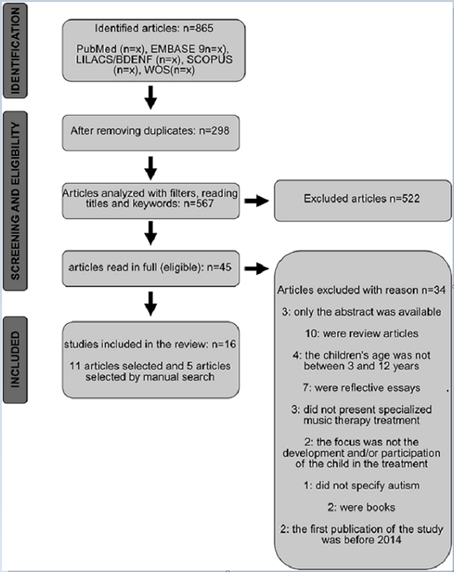
Of the 865 citations found, 298 were duplicates. Of the 567 citations, 522 were excluded, leaving 45. These have been read in full by the reviewers. After reading the full texts, 11 studies that met the eligibility criteria were selected. From the 11 selected articles, a manual search was conducted to find additional articles; thus, five studies were included (Figure 1):


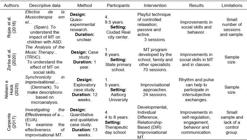


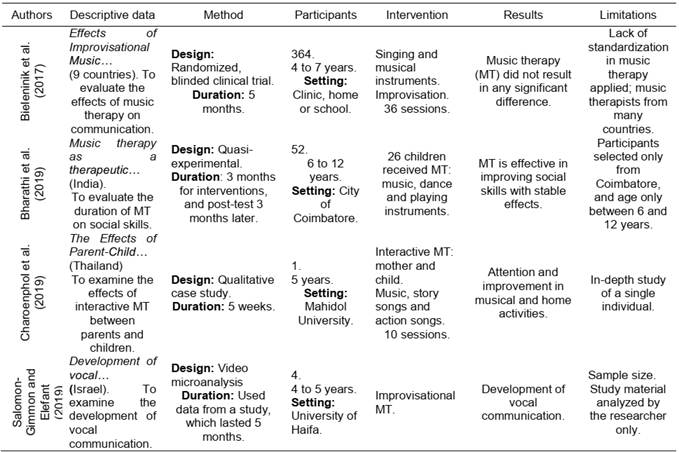
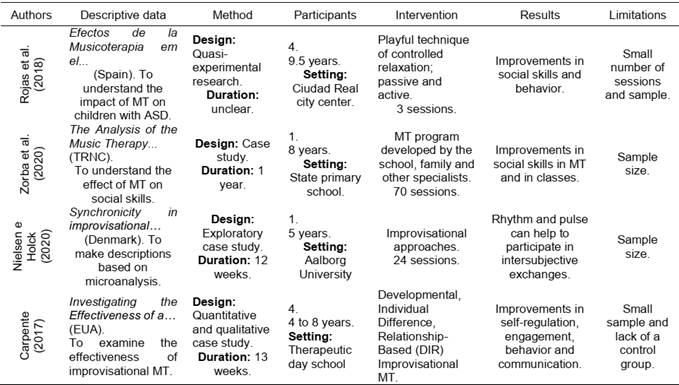
The 16 studies included in this review are listed in Charts 1, 2, 3, and 4. Recently, the production of articles has increased. Only two studies were published in Spanish and one in Portuguese, while the others were published in English. One study (Bieleninik et al., 2017) included nine countries with 364 participants: Norway, Australia, Brazil, Austria, Israel, Italy, Korea, the United States, and the United Kingdom; the other studies had much smaller samples.
These studies were published in music therapy, medical, music, and educational journals. The authors used scales, observations, comparisons, analyses, or microanalyses of videos and interviews with parents, other therapists, and teachers. The presence of parents at the time of assessment was quite strong in the analyzed studies. The instruments and means used to verify the improvements in the social skills of children with autism who received music therapy were thorough and rigorous in all studies included in this review.
In the study by Sharda et al. (2018), in addition to the initial assessment tests and diagnostic and behavioral reports, the children were evaluated before and after the intervention using magnetic resonance imaging for social communication and Resting State Functional Connectivity (RSFC) of the frontotemporal networks of the brain. Other final tests were also conducted to prove that the changes in brain connectivity shown by the RSFC were related to improvements in children's communication skills after music therapy.
All trials were designed to evaluate the effects of music therapy, to determine whether it could improve the development of social skills in autistic children, and to find out how. Most of the trials involved 20 or more sessions over a few weeks or months.
Discussão
Family involvement in the therapeutic process
In the studies by Charoenphol et al. (2019) and Thompson (2018), mothers were present in the therapeutic setting itself and attended each session with their child. In an international study by Bieleninik et al. (2017), parents received support and clarification about the disorder over three sessions. Studies, such as those by Bharati et al. (2019), Thompson (2018), and Ghasemtabar et al. (2015), involved the family during therapy and later, as they were followed up months or even years after treatment. In general, all studies showed the involvement of the family, even only through the initial and final interviews. This demonstrates the concern, need, and importance of involving the family in the process of caring for children with autism.
According to Charoenphol et al. (2019), parents are important in providing emotional support to their children and in developing social and communication skills; these authors reported improvements in children's communication at home and described how hugging, dancing, and riding on the mother's back brought attention and improved musical activities.
Thompson (2018) emphasized that participation provided a rare opportunity for mutual enjoyment between mothers and their children. These mothers described their newfound confidence in trying new ways to engage their children and persist in social interactions. The findings from Thompson's (2018) study suggest that by participating in mutually enjoyable play activities, parents were better able to see their children's potential and, thus, challenge negative perceptions of their children's developmental trajec-tories. In addition, the data from this study highlight the important role that caregiver nurturing and parent-ing self-efficacy can play in improving family quality of life.
In all studies, family participation was strongly represented by the presence of the mother, but not the father. Even in Thompson's (2018) study, which took place in a home setting, the father's experience was not captured by the fact that he did not attend the sessions; the mothers who attended were those who were able to stay home during the day. This suggests that future research that seeks to capture the experiences of a more diverse group of parents should offer more flexible session times.
Music therapy in the school context
The music therapy program in Zorba et al.'s (2020) case study was developed with the help of the participants’ schools, families, and professionals working with them. The room was prepared in advance for 70 music therapy sessions. However, in addition to this special room, the child was accompanied by a music therapist for 19 lessons in their regular classroom, where the child's interactions with peers and teachers were observed. The results revealed that the participants’ social skills of turn-sharing and expressing feelings improved both in the music therapy sessions and their daily classroom routines. This study describes how these skills are developed in the school environment and how music therapy can support this development.
In agreement with Zorba et al. (2020), Magraner and Valero (2016) stated that the school context is ideal for carrying out an ongoing music therapy intervention because it is where the child spends most of their time. In this recent study, music therapists conducted sessions with the children in the school's music room and concluded that the children became more communicative, even calling their peers by name. Their interest in music therapy and eye contact increased, while their aggressive behavior toward others decreased significantly.
Even in other studies where sessions did not specifically take place in school, the authors agreed that music therapy produces improvements in the school environment and at home, as the results indicated significant improvements in children's ability to share attention, engage with parents, and communicate with each other. For example, Freire et al. (2018) focused on how a child behaved outside the sessions, primarily at home and school, and found that, according to Carpente (2017), the gains in social communi-cation after receiving music therapy extended to playful contexts in environments unrelated to music ther-apy.
Music therapy techniques and resources used in research
Most studies have used musical improvisation. All articles emphasized interactions through musical instruments and/or songs.
Improvisation techniques are tuned to the child’s focus of attention to help them develop affect sharing and joint attention (Bieleninik et al., 2017). Carpente (2017) used improvisational music therapy performed within a DIRFloortime framework, in which the music was clinically improvised; that is, the music therapist created music based on the child’s musical responses and/or their movements, emotionali-ty, inclinations, or tendencies to promote engagement, relationship, attunement, and social communication.
In a study by Sharda et al. (2018), the music group received child-centered improvised music therapy using musical instruments, songs, and rhythmic cues to target social communication. Rabeyron et al. (2020) used instrumental and vocal improvisation, in which children had free access to the instruments and interacted with other children and therapists. Ghasemtabar et al. (2015) studied Orff's musical instruments through free and creative execution.
Thompson (2018) used therapy techniques that emphasized attunement to the child's mood and behavior, as well as the child's leadership and interests, within the Family-Centered Music Therapy (FCMT) model. In the work of Magraner and Valero (2016), there was imitation of the sounds that the child made, not only sounds made by the mouth or nose, but also the sounds of the heartbeat, for example. In the case study analyzed by Freire et al. (2018), the music therapist encouraged the patient's vocal ex-pressions, inserting them into short musical phrases on the keyboard or guitar. All studies that used musical improvisation aimed to promote social interactions between children with autism, the therapist, and the family.
Improvised or ready-made songs were used in the experiments. Charoenphol et al. (2019) used song stories and action songs to promote physical interaction between mothers and children based on an interactive music therapy approach. Thompson (2018) also used action songs to promote social interactions between children and their families. Magraner and Valero (2016) used songs with instructions and simple texts, onomatopoeias, animals, repetition of words, and familiar expressions to improve language. In the music therapy sessions of Rabeyron et al. (2020), songs were chosen beforehand for opening and closing.
Most of the interventions were delivered individually. In a study by Ghasemtabar et al. (2015), peers were considered intervention factors to improve social skills in children with autism, arguing that group musical environments provide opportunities to learn social skills such as imitation, turn-taking, social reciprocity, joint attention, shared affection, and empathy. Rabeyron et al (2020) strengthen these arguments by suggesting that participation in a music group has therapeutic effects.
Effects of music therapy on sessions and other contexts of the child's life
Studies have reported improvements in children's communication and social interaction after mu-sic therapy in other areas of their daily lives, such as at school, at home, and in other therapies. According to Charoenphol et al. (2019), children took home what they had learned from the sessions. In the study by Rojas et al. (2018), the evaluation was done by parents and teachers, which showed that there was progress at home and school, as it was precisely the parents and teachers who pointed out improvements in the child's social skills and behavior.
Ghasemtabar et al. (2015) and Bharathi et al. (2019) conducted experiments with pre-tests and, months after the interventions, post-tests to check the stability of the effects of music therapy. These were studies in full partnership with parents, as it was through them that children's social skills could be measured again in the post-test. Children's social behavior in everyday life was considered in the post-test.
Zorba et al. (2020) observed a child in 19 classes in the regular classroom, in addition to the 70 music therapy sessions. These authors found that the participant’s social skills of turn-sharing and expressing feelings improved in both music therapy and in classes. Similarly, Magraner and Valero (2016) reported that children applied some of the learning to other domains and contexts because, according to these authors, the patients showed signs of general improvement in other therapies, became more communicative with other therapists, and at school, began to call their peers by name. In other words, in addition to improvements in sessions related to interest, eye contact, attention development, and communication, parents and teachers reported a significant decrease in aggressive behavior toward others.
The results of Carpente (2017) indicated significant improvements in children's ability to share at-tention, engage with parents, and communicate reciprocally. According to this author, the results suggest that gains in social communication after receiving improvised music therapy extend to playful contexts in environments not associated with music therapy. In the study by Sharda et al. (2018), parents also reported improvements in the child's social communication at home and in other contexts after musical intervention.
In a phenomenological study, Thompson (2018) conducted a long-term follow-up with mothers who participated in home music therapy sessions with their children (Thompson, 2012; Thompson et al., 2014) to understand the duration of treatment gains. In addition, Thompson (2018) focused on the family's quality of life or the child's improvement in their daily life with their family. Four years after the interventions, all the mothers interviewed reported feeling more confident in dealing with their children's development and challenging their negative perceptions. They felt encouraged to try new ways to engage their children and continue social interactions, even after the music therapy sessions ended. They reported that the sessions were beneficial because they provided their children with opportunities to express their emotions and personality and to develop communication and relationship skills. This study showed that the benefits of music therapy are long-lasting and are not limited to the setting or time of therapy.
All studies, except the international study by Bieleninik et al. (2017), reported improvements in social skills and social interaction in children with autism in music therapy settings. And, as seen above, many authors also reported improvements in the context of home, school, or other therapies. In a study by Bieleninik et al. (2017), music therapy compared to standard care did not result in a significant difference in the severity of symptoms in the social affective domain; only small significant effects were found in social motivation and autistic mannerisms. However, a study of this magnitude, conducted in nine coun-tries, presents several issues that may need to be considered when evaluating the results, as the study did not examine specific clinical subgroups; therefore, two studies using data from the same study showed positive results. Salomon-Gimmon and Elefant (2019) conducted an in-depth video microanalysis of four cases in which the sessions were developed in an international study, and the findings revealed that, in most cases, vocal communication developed throughout the music therapy sessions. Mössler et al. (2019) observed videotaped sessions of 48 children from the same study and found that the music therapy rela-tionship is an important predictor of the development of social skills, as well as communication and lan-guage, and that music facilitates the creation of meaningful interactions on a nonverbal level and strength-ens the communication skills of children with autism.
The duration of the benefits of music therapy
Publications after 2014 brought about new developments, as some studies presented experiences with longer follow-up periods. For example, the aim of a study by Bharati (2019) was to evaluate whether music therapy can improve the development of social skills in children with autism and to verify whether these effects are long-lasting. In this Indian study, a pre-test was applied, and the post-test was adminis-tered three months after the intervention, with the help of parents, to explore the effects of music therapy. The authors worked with two groups that received music intervention, but one of the groups only listened to music, whereas the children in the other group danced, sang, and played instruments. In both cases, there were improvements in social skills, but the children in the active intervention group showed significantly greater improvement in the post-test period than those in the passive intervention group. The effec-tiveness of music therapy was consistent in the active intervention group over the three months following the interventions. This study demonstrated that music therapy is an effective intervention for improving the social skills of children with autism with stable effects.
Ghasemtabar et al. (2015) also applied a pre-test and post-test based on the Childhood Autism Rating Scale. Two months after the interventions, they re-administered the post-test in the follow-up phase to measure social skills with the help of parents and investigate the consistency of the effects of music therapy. This study aimed to determine the effectiveness of music therapy in improving social skills and its stability in children with autism. This Iranian study, as well as the study by Bharati et al. (2019), demonstrated that music therapy is an effective method with profound and consistent effects on improving the social skills of children with autism.
Thompson’s (2018) phenomenological study is an excellent example of the lasting effects of mu-sic therapy. This experiment sought to learn about parents’ perspectives on the long-term value of participating in family-centered music therapy. In fact, by interviewing the mothers of eight children four years after they participated in a 16-week home-based music therapy program, this study provides a unique long-term perspective on the outcomes of music therapy treatment. This is a fascinating Australian study in which 21 mothers participated in sessions alongside their children in a previous study (Thompson et al., 2014). The intervention took place in the child’s home, and the mothers were encouraged to practice musi-cal activities from the sessions in their daily lives. Thompson (2018) interviewed eight of these mothers four years later.
All the mothers interviewed emphasized that participating in music therapy together provided a rare opportunity for mutual enjoyment between them and their children. In the interviews, they reported that the music therapy sessions were beneficial because they provided a unique opportunity for their children to express their emotions and personalities and to develop communication and relationship skills. Mothers perceived long-term benefits in social relationships within the family, leading to a sense of enrichment in the child and quality of family life.
Final considerations
The studies presented here have confirmed that music therapy has positive effects on children with autism, influencing their communication (verbal and nonverbal) and social interaction, with satisfactory and long-lasting results: increased joy, pleasure, joint attention, eye contact, and closeness.
Here, we have finished describing what studies published since 2014 have to say about the effects of music therapy on children with autism, fulfilling the general objective of this research. This review was conducted to verify and update the main findings in the work of music therapy for autism: improvement in social interaction and communication skills, and to try to fill the main gap identified by Geretsegger et al. (2014): the lack of studies that follow the results obtained over a longer period to understand how long the benefits of treatment can last.
Most of the studies presented in this review did not prove the durability of the benefits of music therapy, but the three studies discussed above (Bharathi et al., 2019; Ghasemtabar et al., 2015; Thompson, 2018) brought novelties to the field, as they managed to consider this requirement by considering long-term evaluations, proving that the positive results achieved by music therapy for autism in the area of communication and social interaction are durable in the contexts in which the child lives, such as school and home.
Sample size is the second limitation of experiments conducted on music therapy and autism (Geretsegger et al., 2014). Based on the studies analyzed, we could say that there have been some changes in this aspect, as Bieleninik et al. (2017) included 364 participants. However, this was an international study conducted in nine countries that included several music therapists. Most studies involve a single music therapist, a pair, or a trio; in music therapy, as in other therapies, exclusive and personalized care is important. Therefore, most studies continue to use small sample sizes. Many studies, as can be seen in this review, are case studies.
A third limitation of the music therapy and autism studies analyzed here is the lack of research that includes the presence of the child's father in the overall development of treatment. It would be interesting for future research to analyze the presence and place of the father figure in the music therapy process of children with autism.
References
- American Psychiatric Association [APA]. (2013). Neurodevelopmental disorders: autism spectrum disorder In: Diagnostic and statistical manual of mental disorders (5th ed., p. 31-86).
-
Bharathi, G., Venugopal, A., & Vellingiri, B. (2019). Music therapy as a therapeutic tool in improving the social skills of autistic children. Egyptian Journal of Neurology, Psychiatry and Neurosureryg 55, 44. doi: https://doi.org/10.1186/s41983-019-0091-x
» https://doi.org/10.1186/s41983-019-0091-x -
Bieleninik, L., Geretsegger, M., Mössler, K., Assmus, J., Thompson, G., Gattino, G., Elefant, C., Gottfried, T., Igliozzi, R., Muratori, F., Suvini, F., Kim, J., Crawford, M. J., Odell-Miller, H., Oldfield, A., Casey, Ó., Finnemann, J., Carpente, J., Park, A-L. ... TIME-A Study Team. (2017). Effects of improvisational music therapy vs enhanced standard care on symptom severety among children with autism spectrum disorder: the TIME-A randomized clinical trial. JAMA, 318(6):525-535. doi: 10.1001/jama.2017.9478
» https://doi.org/10.1001/jama.2017.9478 -
Carpente, J . A. (2017). investigating the effectiveness of developmental, individual difference, ralationship-based (DIR) improvisational music therapy program on social communication for children with autism spectrum disorder. Music Therapy Perspectives, 35(2)160-174. doi: 10.1093/mtp/miw013
» https://doi.org/10.1093/mtp/miw013 -
Charoenphol, N., Chiengchana, N., & Tayrattanachai, N. (2019). The effects of parent-child interactive music therapy on sentence verbalization in a child with autism spectrum disorder: a case study. MJM, 8, 86-95. https://ejournal.upsi.edu.my/index.php/MJM/article/view/1878
» https://ejournal.upsi.edu.my/index.php/MJM/article/view/1878 -
Freire, M., Martelli, J., Estanislau, G., & Parizzi, B. (2018). O desenvolvimento musical de crianças com transtorno do espectro do autismo em musicoterapia: revisão de literature e relato de caso. Orfeu, 3(1), 145-171. doi: 105965/2525530403012018145
» https://doi.org/105965/2525530403012018145 -
Geretsegger, M, Elefant, C, Mössler, K .A., & Gold, C. (2014). Music therapy for people with autism spectrum disorder. Cochrane Database of Systematic Reviews, 2014(6):CD004381. doi: 10.1002/14651858.CD004381
» https://doi.org/10.1002/14651858.CD004381 -
Ghasemtabar, S. N., Hosseini, M., Fayyaz, I., Arab, S., Naghashian, A., & Poudineh, Z. (2015). Music therapy: an effective approach in improving social skills of children with autism. Advanced Biomedical Research, 4, 157. doi: 10.4103/2277-9175.161584
» https://doi.org/10.4103/2277-9175.161584 -
LaGasse, A. B. (2014). Effects of a music therapy group intervention on enhancing social skills in children with autism. Journal of Music Therapy, 51(03):250-275. doi: 10.1093/jmt/thu012
» https://doi.org/10.1093/jmt/thu012 -
Lucero, A., Vivés, J.-M., & Rosi, F. S. (2021). A função constitutiva da voz e o poder da música no tratamento do autismo. Psicologia em Estudo, 26 https://doi.org/10.4025/psicolestud.v26i0.48054
» https://doi.org/10.4025/psicolestud.v26i0.48054 -
Magraner, J. S. B., & Valero, G. B. (2016). La musicoterapia em el contexto escolar: estudio de un caso con transtorno del espectro autista. Revista Electrônica de LEEME, 37, 1-19. https://musica.rediris.es/leeme
» https://musica.rediris.es/leeme - McGowan, J., Sampson, M., Salzwedel, D., Cogo, E., Foerster, V., & Lefebvre, C. (2016). PRESS - peer review of electronic search strategies: 2015 guideline explanation and elaboration (PRESS E&E) CADTH.
-
Mössler, K ., Gold, C., Aßmus, J., Schumacher, K., Calvet, C., Reimer, S., Iversen, G., & Schmid, W. (2019). The therapeutic relationship as predictor of change in music therapy with young children with autism spectrum disorder. Journal of Autism and Developmental Disorders, 49(7):2795-2809. doi: 10.1007/s10803-017-3306-y
» https://doi.org/10.1007/s10803-017-3306-y - Nagaishi, K. Y., & Cipullo, M. A. T. (2017). Canção como recurso de trabalho para psicólogos: um levantamento de artigos publicados. Boletim de Psicologia, 67(146), 067-082.
-
Nielsen, J. B., & Holck, U. (2020). Synchronicity in improvisational music therapy - developing in intersubjective field with a child with autism spectrum disorder. Nordic Journal of Music Therapy, 29(2),112-131. doi: 10.1080/08098131.2019.1680571
» https://doi.org/10.1080/08098131.2019.1680571 -
Rabeyron, T., Del Canto, J. P. R., Carasco, E., Bissson, V., Vrait, F. X., Berna, F., & Bonnot, O. (2020). A randomized controlled trial of 25 sessions comparing music therapy and music listening for children with autism spectrum disorder. Psychiatry Research, 293, 113377. doi: 10.1016/j.psychres.2020.113377
» https://doi.org/10.1016/j.psychres.2020.113377 -
Rojas, D. G., Angulo, G. P., & Rodrigues, R. M. S. (2018). Efectos de la musicoterapia en el transtorno de espectro autista. Revista de Educación Inclusiva, 11(1), 175-192. https://revistaeducacioninclusiva.es/index.php/REI/article/view/317
» https://revistaeducacioninclusiva.es/index.php/REI/article/view/317 -
Salomon-Gimmon, M., &Elefant, C . (2019). Development of vocal communication in children with autism spectrum disorder during improvisational music therapy. Nordic Journal of Music Therapy, 28(3), 174-192. doi: 10.1080/08098131.2018.1529698
» https://doi.org/10.1080/08098131.2018.1529698 -
Sharda, M., Silani, G., Specht, K., Tillmann, J., Nater, U., & Gold, C. (2019). Music therapy for children with autism: investigating social behaviour through music. The Lancet. Child & Adolescent Health, 3(11), 759-761. doi: 10.1016/S2352-4642(19)30265-2
» https://doi.org/10.1016/S2352-4642(19)30265-2 -
Sharda, M., Tuerk, C., Chowdhury, R., Jamey, K., Foster, N., Custo-Blanch, M., Melissa Tan, M., Aparna Nadig, A., & Hyde, K. (2018). Music Improves Social Communication and Auditory-Motor Connectivity in Children with Autism. Translational Psychiatry, 8(1):231. doi: 10.1038/s41398-018-0287-3
» https://doi.org/10.1038/s41398-018-0287-3 -
Thompson, G . (2012). Family-centered music therapy in the home environment: promoting interpersonal engagement between children with autism spectrum disorder and their parents. Music Therapy Perspectives, 30(2):109-116. doi: 10.1093/mtp/30.2.109
» https://doi.org/10.1093/mtp/30.2.109 -
Thompson, G ., McFerran, K., & Gold, C. (2014). Family-centred music therapy to promote social engagement in young children with severe autism spectrum disorder: a randomized controlled study. Child: Care, Health and Development, 40(6):840-52. doi: 10.1111/cch.12121
» https://doi.org/10.1111/cch.12121 -
Thompson, G . A. (2018). Long-term perspectives of family quality of life following music therapy with young children on the autism spectrum: a phenomenoligical study. Journal of Music Therapy, 54(4):432-459. doi: 10.1093/jmt/thx013
» https://doi.org/10.1093/jmt/thx013 -
Tricco, A. C., Lillie, E., Zarin, W., O’Brien, K. K., Colquhoun, H., Levac, D. … Straus, S. E. (2018). PRISMA extension for scoping reviews (PRISMA-ScR): checklist and explanation. Annals of Internal Medicine, 169(7):467-473. doi: 107326/M18-0850
» https://doi.org/107326/M18-0850 -
Zorba, R.S., Akçamete, G., & Özcan, D. (2020). The analysis of the music therapy program’s effect on turn-sharing skills and expressing feelings of children with autismo spectrum disorder. Croatian Journal of Education, 22(2):631-656. doi: 10.15516/cje.v22i2.3405
» https://doi.org/10.15516/cje.v22i2.3405

 Source: The authors.
 Source: The authors.
 Source: The authors.
 Source: The authors.
 Source: The authors.