
 Economic liberalization in Haiti and its effects on rice production
Abstract
Structural adjustment programs, implemented in different developing countries, had impacts of different orders and magnitudes. This article presents an exploratory analysis of the effects of neoliberal economic policies on rice production in Haiti from the 1980s onwards. To this end, in addition to literature review, data and information were collected on websites of different organizations and research institutes. Findings indicate that, as a result of the neoliberal economic policy implemented in Haiti, there was a drastic reduction in tariffs on rice imports, and currently the cereal enters the country without any duties. The massive entry of foreign rice, especially North American, has had a negative impact on domestic production, which is virtually paralyzed in view of the continuous and growing entry of the imported cereal that reaches local consumer at a lower price. This is a complex and dramatic process, given that the Haitian population, which has been facing a serious situation of food insecurity, has the supply of its main food product increasingly dependent on imports, which are controlled by a few transnational corporations.
Keywords
Neoliberal economic policy; imports; rice; Haiti.
Resumo
Os programas de ajuste estrutural, implementados em diferentes países em desenvolvimento, tiveram impactos de diferentes ordens e magnitudes. Este artigo analisa, de modo exploratório, os efeitos da política econômica neoliberal sobre a produção de arroz no Haiti a partir da década de 1980. Para tanto, além de uma revisão bibliográfica, foram coletados dados e informações nos sites de diferentes organizações e institutos de pesquisa. Os resultados apontam que, a partir da política econômica neoliberal implementada no Haiti, houve uma drástica redução das tarifas para aquisição de arroz importado, sendo que atualmente o cereal ingressa no país sem nenhuma tarifa aduaneira. O ingresso massivo do arroz externo, sobretudo norte-americano, tem provocado um impacto negativo na produção nacional, a qual está praticamente paralisada frente à contínua e crescente entrada do cereal importado, que chega mais barato até o consumidor local. Trata-se de um processo complexo e dramático, visto que a população haitiana, que vem enfrentando uma grave situação de insegurança alimentar, tem o abastecimento do seu principal produto alimentar cada vez mais dependente de importações, as quais são controladas por poucas corporações transnacionais.
Palavras-chave
Política econômica neoliberal; importações; arroz; Haiti.
Résumé
Les programmes d’ajustement structurel, mis en œuvre dans les différents pays en développement, ont eu des impacts d’ordres et d’ampleurs différents. Cet article analyse, de manière exploratoire, les effets de la politique économique néolibérale sur la production de riz en Haïti depuis des années 1980. Pour ce faire, en plus d’une révision bibliographique, des données et des informations ont été collectées depuis des sites Web de différentes organisations et instituts de recherche. Les résultats montrent que, depuis la mise en œuvre de cette politique en Haïti, il y a eu une réduction drastique des tarifs douaniers sur le riz, la céréale entrant désormais dans le pays sans droits de douane. La rentrée massive de cette dernière, notamment en provenance du Nord-américain, a provoqué un impact négatif sur la production nationale, qui est pratiquement paralysée par l'afflux continu et croissant de riz importé, moins cher que le riz local. Il s’agit d’un processus complexe et dramatique, étant donné que la population haïtienne, confrontée à une grave situation d'insécurité alimentaire, à l'approvisionnement de son principal produit alimentaire de plus en plus dépendante des importations, qui sont contrôlés par quelques entreprises transnationales.
Mots-clés
: Politique économique néolibérale; importation; riz; Haïti.
Introduction
Structural adjustment programs, which accompany loans provided by the International Monetary Fund (IMF) and the World Bank to countries in economic crisis, were widely disseminated in the second half of the 20th century (Pereira, 2017; Veltmeyer; Petras; Vieux, 2016). These initiatives gained greater prominence from the 1980s onwards, when neoliberal policies promoted by international financial institutions were imposed on many Latin American countries, as occurred in Haiti (Florida; Redon, 2019). The implementation of structural adjustment programs alongside trade liberalization marked a decisive turn in the country's economic history, leading to the “withdrawal” of the State from several sectors and activities, particularly on issues linked to agriculture and food (Fréguin; Devienne, 2006). According to the World Trade Organization (WTO, 2023), Haiti is currently the most liberal country in Latin America and the Caribbean.
As a result, the agricultural sector - which in the mid-twentieth century (Blancpain, 2005) represented more than 40% of Haitian Gross Domestic Product (GDP) - has declined considerably over the subsequent decades. Its contribution, according to Beaucejour (2016), fell to 32% in 1985 and, according to recent data from the World Bank (2023), represents only 20.3% in 2022. State withdrawal, which affects the whole agricultural sector in Haiti, has had a strong impact on the production of rice - currently one of the main items of staple diet among Haitian families.
Rice consumption grew rapidly in Haiti (Chalmers, 2014; MARNDR, 2016; Redon; Petit-Bel, 2017; Dimanche, 2018). According to Chalmers (2014) and Faostat (2024), consumption increased from 8.2 kg/year per person in 1961, to 15.3 kg in 1980, and continued to expand, reaching 36.7 kg in 2000 and 56.7 kg in 2020. Rice is currently a preponderant item in Haitian staple diet surpassing corn and wheat, for example. As Redon and Petit-Bel (2017) and FAO (2022a) highlight, almost half of the Haitian staple diet is made up of rice, with a caloric value of more than 500 kilocalories out of 1,870 kilocalories considered per person/per day. Therefore, this cereal plays a fundamental role in the Haitian diet, being consumed practically every day and in all areas and locations in the country (Dimanche, 2018). However, despite such increase in consumption, there was a certain paralysis in local production and, during the same period, an exponential growth in imports.
Therefore, among all other staples, rice has been characterized, since the 1980s, by two opposing trends. Firstly, a rapid increase in its consumption and, secondly, the country's growing dependence on the international market (Dimanche, 2018). This increase in imports occurs precisely during a period marked by a change in economic policy based on free trade. Given this, this article presents an exploratory analysis of the effects of neoliberal policies on Haitian rice production.
In methodological terms, a literature review was carried out, including mainly academic articles and books, with emphasis on French-speaking literature. Some documents relevant to the subject under study were also accessed, with emphasis on government publications from the Ministry of Agriculture, Natural Resources and Rural Development (Ministère de l'Agriculture, des Ressources Naturelles et du Développement Rural, MARNDR). In addition, data and information were collected from the websites of the Food and Agriculture Organization of the United Nations (FAO), the World Bank, the Inter-American Institute for Cooperation on Agriculture (IICA), the Agricultural Statistics and Informatics Unit of the Haitian Institute of Statistics and Informatics (Unité des Statistiques et de l'Informatique Agricoles de l'Institut Haïtien des Statistiques et de l'Informatique, IHSI), Ministry of Economy and Finance (Ministère de Économie et des Finances, MEF), United States Department of Agriculture (USDA), United Nations Development Program (UNDP), World Trade Organization (WTO), Observatory of Economic Complexity (OEC), among others.
The analyzed data was chosen based on its relevance to the research objective. However, it should be noted that, due to the political crisis that affects the country, much information and documents are currently unavailable in digital format. Recognizing these limitations, without which research findings would more robust and conclusive, we decided to develop an exploratory analysis. Even so, available data allows us to understand the situation of rice market in Haiti, with emphasis on the evolution of imports and local production following the neoliberal policies promoted by international financial institutions in the 1980s.
This article is divided into four sections, in addition to this Introduction and final remarks. In the first of them, a brief presentation of Haiti is made and, for a better understanding of the studied topic, some important historical and contemporary points are highlighted. In the second section we comment on the rural space and the agricultural sector in the country, with emphasis on rice. The third section presents neoliberal policies and the different moments of their application in Haiti. The last section analyzes the impacts of neoliberal policy on the production and import of rice in the country from mid-twentieth century to present.
Brief presentation of Haiti
The Republic of Haiti is located in the Caribbean region and shares the island with the Dominican Republic. The country extends over an area of 27,500 km2, is located between 18⁰ and 20⁰ 6' north latitude and between 72⁰ 20' and 74⁰ 30' west longitude, and has a population of 11,905,897 inhabitants (IHSI, 2021). The country is administratively divided into ten (10) departments, 146 municipalities and 571 communal sections. According to data from Yves Cribb (1997), 25% of its territory is made up of plains and 75% of hills and mountains.
For a better understanding of Haiti, some points in its history are worth highlighting. Until the colonization process, there were native populations in its current territory, which were decimated following the arrival of the Spaniards, who settled in December 1492 and transformed the island into a colony. Later, in 1697, the Treaty of Ryswick was signed, in which Spain cedes part of Haitian territory to France. As highlighted by Manigat (2006), from 1697 to 1803, France established a colony in Haiti and, at the end of the 18th century, influenced by external and internal contexts, a revolution began, which led to Haiti's independence on January 1st. 1804. Consequently, that date marked the break with French colonial policy in the territory.
After the proclamation of the country's independence, the State under the command of Jean-Jacques Dessalines was both creator of the new social and economic order and its manager. As an agrarian rentier state, it took charge of establishing the land tenure system and method of exploitation that would enable extracting of the necessary resources (Étienne, 2007). Thus, Dessalines' agrarian policy was oriented towards export agriculture, which was already being practiced in the colony. This policy was mainly structured by three elements: nationalization of colonists’ land assets, redistribution of certain domains to former slaves and mobilization of an armed force, not only to protect the country from reestablishment of slavery, but also to force small farmers to remain on large plantations (Dorvilier, 2011; Étienne, 2007). This decision made peasants discontent as they could hardly distinguish their new situation from that they experienced during the colonial period (Étienne, 2007).
After Dessalines' assassination, Haiti was divided into two distinct political systems, with the formation of a republic in the South and a kingdom of hereditary feudal grants with a military structure in the North, led by Henri Christophe. Christophe organized his state along the lines of British capitalism and maintained the large plantation system, which guaranteed the political, economic and social order he had established. After his death in 1820, Jean-Pierre Boyer, who headed the Southern State, brought the two territories together under a republican State. In terms of agrarian policy, Boyer took measures to force farmers to remain on large plantations, in view of the drop in the volume of domestic production obtained in previous years. These repressive measures, according to Étienne (2007), increased the distance between the State and society and angered the peasants.
The beginning of the 20th century was marked by the North American occupation of Haiti, when in 1915 United States Marines landed in Port-au-Prince and occupied the country until 1934. Étienne (2007) sees this fact as the collapse of the Haitian State, which between 1804 and 1915 was unable to build a modern and stable State. American troops managed to pacify the national territory by massacring, with the help of the Haitian gendarmerie, hundreds of people who were part of the peasant resistance. After the end of the occupation, the country went through a series of new socioeconomic and, mainly, political crises until François Duvalier came to power in 1957.
From 1957 to 1986 the country experienced the bloodiest dictatorship in history. For 29 years, François Duvalier (popularly known as Papa Doc) and his son, Jean-Claude Duvalier (Baby Doc) governed the country (Célius, 1998), whose administration was marked by fear and widespread distrust due to murders of opponents of the dictatorship (Hurbon, 1987).
At the end of the 20th century, in 1986, following the exile of Jean-Claude Duvalier, the Haitian population felt free from dictatorship and, at the same time, yearned for democracy. However, political and economic instability, anarchy and widespread chaos blocked the long-awaited democratic transition. Between 1986 and 1990, the country went through several governments, including that of General Namphy, overthrown by Colonel Prosper Avril, who was forced to give up power under American pressure in 1990, and that of Leslie Saint-Roc Manigat, who won the 1987 elections. On December 16, 1990, elections were held, appointing Jean-Bertrand Aristide president. After several attempted coups, the president was overthrown on September 30, 1991, and a new military dictatorship was installed in the country over the following three years. On the other hand, internal resistance and condemnation from the international community, according to Étienne (2007), led to a latent crisis that culminated, on September 19, 1994, with a new American military intervention, with Aristide's return to power.
In the following decades, the country continued to face several major sociopolitical crises, as well as natural disasters, including the 2010 earthquake that killed more than 300,000 people and displaced thousands more (Bien-Aimé, 2016). Also, large-scale banditry, which already plagued the country, escalated with the assassination of acting president Jovenel Moïse, in July 2021.
These various changes, socioeconomic and political crises and increased violence turned this essentially agricultural nation into the economically poorest country in Latin America and the Caribbean. In 2022, Haiti had a per capita GDP of US$1,745.9 and, although there is no reliable data on poverty, World Bank estimates indicate that it reaches 63% of the population in 2023 (using US$3.65 per day as a criterion). Furthermore, Haiti has the Americas’ worst Human Development Index- HDI (PNUD, 2022) and hunger has remained at extremely high levels over the last 20 years, affecting virtually half of its population (FAO, 2022b).
The Haitian agricultural sector and rice production
Agriculture, throughout Haiti's history, has boosted the country's economy and rural life. In 1954, according to data from CEPAL (2005), the economically active population reached 1,298,000 people, 1,005,000 of which were dedicated to agriculture, that is, 77.4% of the total. In 1993, agriculture was the only source of income for 92% of the rural population (Pierre-Charles, 1993). However, employment in the agricultural sector fell from 54% in 1991 to 46% in 2021 (World Bank, 2023). According to FAO and the EU (2022), the contribution of agricultural activities to national wealth continued to decline as food insecurity increased steadily. The share of the agricultural sector in the country's GDP fell from 44.4% in 1950 to 20.3% in 2022 (Paul; Daméus; Garrabe, 2010; World Bank, 2023). In demographic terms, Haiti, which until the beginning of the 1980s was an essentially rural country, with nearly 80% of its population living in the countryside, has now become a predominantly urban country, with almost 60% of the population residing in cities (World Bank, 2023).
According to data from MARNDR (2010) and Faostat (2024), the agricultural area cultivated in Haiti was 1.28 million hectares in 2012, occupying more than 40% of the country's surface. The last Agricultural General Census, from 2008/09, counted just over one million agricultural holdings, with an average area of 0.93 ha. Haitian agriculture is, therefore, extremely fragmented, mostly family-run, and 32.7% of the cultivated area is intended for self-sufficiency, with cereals and food crops such as corn, rice, sorghum, beans, sweet potatoes and cassava.
Regarding farming intended for sale, some products are exported, such as coffee, mango, cocoa, sisal, tobacco, coconut and cotton. However, their production, like that of agricultural products generally, has declined in recent decades. Both FAO’s indexes, the agricultural production index and the food production index, show strong decline (Faostat, 2024). And, when we talk about Haitian farmers, we are essentially referring to a mass of paysan (as peasants are commonly called in Haitian Creole) who carry out diversified smallholding family farming, and who face a set of problems, such as lack of financial resources, of (public, private, philanthropic) support, transportation means, and low access to technological innovations and infrastructure, etc. (MARNDR, 2010).
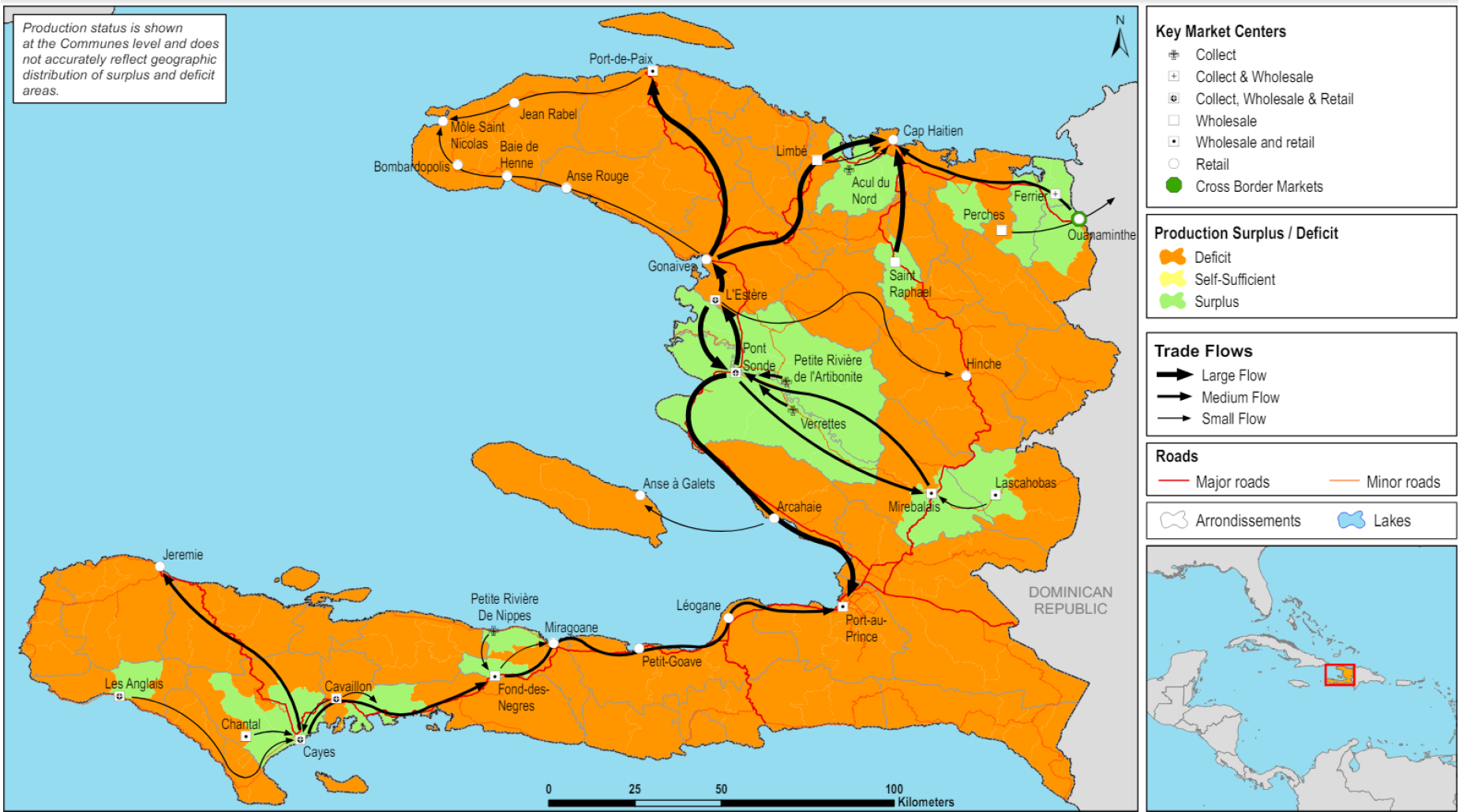
Of the 373 thousand tons of cereals harvested in the country in 2021 (World Bank, 2024b), 140 thousand tons were rice (Faostat, 2024), which corresponds to around 37.5% of cereals produced in the country. Around 130 thousand farmers were involved in rice production in 2012 (Reliefweb, 2012), which corresponds to around 12.7% of the number of agricultural holdings indicated in the 2008/09 Agricultural General Census (MARNDR, 2010). Rice is cultivated throughout the year and more than 80% of its total production is located in the Artibonite Department, along the Artibonite River (Moyo, 2024). Other departments also grow rice (in green in figure 1), but in much smaller quantities.
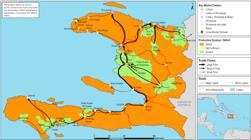
According to Moyo (2024), based on data from the USDA, in the last ten years the harvested area, rough production and average yield for rice cultivation have decreased in Haiti. In fact, rice production in the 2023/24 harvest is at the lowest level compared to the last ten years (figure 2). This discussion will be resumed in the following topics.

Most rice producers (85% of the total) hold micro farmland, cultivating less than one hectare, with an average area of 0.3 ha (IICA, 2012). These are, therefore, small family farms in which, as Lévy (2001) points out, farmers have to sell part of their production to purchase other basic consumer goods, whether food or not. However, despite the small farmland they own and the low income they can generate from this activity, being a rice producer in Haiti, argues Altineus (2015), is synonymous with economic success and social prestige.
Rice produced in the country is generally sold on the domestic market. And, according to IICA (2012), in this chain of commercial transactions, a number of actors can be identified, starting with the farmer, who generally sells it at public markets in his/her city. Thus, there can be either direct producer-consumer sales in these spaces or distribution through intermediaries who also sell on a local scale (such as revandez or detayan) or through small grocery stores. Furthermore, production can be purchased by intermediaries who take it to other cities and regions. In this case, the madan sara, women who act as itinerant intermediaries, take rice, as well as other food products, to large urban centers and sell there to local intermediaries (revandez or detayan), grocery stores and supermarkets (Osthe; Wesz Jr., 2024).
However, rice commercial circuits take different directions depending on the production area (IICA, 2012). Rice produced in the Artibonite valley has a wider distribution radius, reaching the country's main urban centers and sharing a market that is already 80% occupied by imported rice (FAO, 2023). Rice grown in other regions is mostly consumed in nearby areas (figure 1).
Neoliberal economic policy in Haiti
In the early 1970s, the capitalist system went through a major crisis in the post-war economic model and sank into a long and deep recession (Carinhato, 2008). Taking advantage of the crisis of interventionist and social welfare state, neoliberal ideas began to gain ground (Anderson, 1995). According to Saad Filho (2011), this system has grown stronger with the transformations in conditions of accumulation that accompanied the disarticulation of Keynesian-social-democratic consensus, the paralysis of developmentalism and the implosion of the Soviet Bloc. As highlighted by Anderson (1995), it was the rise to power of Margaret Thatcher in England, in 1979, of Reagan in the United States, a year later, of Khol, in 1982, in Germany and the turn of almost all countries in the north of Western Europe and North America to the right that drove the establishment of neoliberal ideology in Western Europe and North America in the 1980s. It was in this decade that we saw neoliberal expansion in these regions of advanced capitalism (Anderson, 1995).
The neoliberal governments of that period made decisions that drastically changed global economic dynamics. Thatcher governments in England, Reagan governments in the United States and other right-wing governments of the period - each of them, according to their specific needs - applied measures that put an end to state interventionist policies (Anderson, 1995). Analyzing the main measures of neoliberal policies, Anderson states that
Thatcher governments contracted monetary issuance, raised interest rates, drastically lowered taxes on high income earners, abolished controls on financial flows, created massive levels of unemployment, crushed strikes, imposed new anti-union legislation and cut social spending. In the United States, which lacked an welfare state like the European one, the neoliberal priority was rather put on military competition with the Soviet Union, conceived as a strategy to break the Soviet economy. It should be noted that, in domestic politics, Reagan also reduced taxes in favor of the rich, raised interest rates and dispelled the only serious strike of his administration (Anderson, 1995, p. 2).
During the 1980s, highly indebted developing countries were forced by international financial institutions to implement structural adjustment programs to deal with the various economic problems they faced. For Gaspard (2008, p. 16), “structural adjustment is defined as a set of economic policy measures currently recommended or imposed by international financial organizations to many countries in financial difficulties, accused of living beyond their means.”
Haiti was one of these countries that effectively implemented such measures in 1986. This year marked a double rupture: a political rupture, with the end of the Duvalier dictatorship, and an economic rupture, with the opening to the global market and the liberalization policy (Lévy, 2001). The State, faced with pressure from international financial organizations, was forced to apply the policy of reducing and/or eliminating barriers to trade. According to Laënnec Hurbon (1998, p. 145), since the beginning of the democratization process, in 1986, “the international community was only interested in opening new markets, while the structural adjustment policy in Haiti disregarded public interest.”
The first attempt to stabilize the economy was implemented in Haiti in the early 1980s, still under the government of Jean-Claude Duvalier, but it was quickly interrupted by the regime's reluctance towards economic liberalization (François, 2009; Baptiste, 2007). Thus, the effective implementation of neoliberal policies in Haiti occurred only after the end of the Duvalier regime, when the Structural Adjustment Plan was executed by the military government council. In 1986, the State opened provincial ports, changed customs fees, suspended export tariffs and import authorizations and published a special law that suspended previous measures to protect national production (Baptiste, 2007). The objective of this economic policy, recommended by international financial institutions and brutally adopted in the country, was to integrate Haiti into the world market and reduce prices in the local market (Lévy, 2001). However, as Étienne (2023) points out, trade liberalization disregarded the situation of local agricultural production and the socioeconomic and food impacts that could derive from these initiatives.
Despite Haiti implementing neoliberal policy, in 1994 the country’s economy was collapsing after the total economic embargo against the military regime. As a result, the international community and representatives of President Aristide were planning, among other things, a new structural adjustment program for economic stabilization, including a new round of initiatives for market liberalization, privatization and decentralization, as soon as the constitutional order were restored (Étienne, 2007). Once again, a series of economic measures were imposed on Haiti, following the reestablishment of constitutional order, which disregarded the demands of the population (Guillaume, 2020).
In January 1995, two months after reinstallation of Aristide government, 19 international institutions and 14 governments pledged US$1,200,000,000 in financial aid to Haiti. To receive part of this aid, the government agreed to the conditions imposed by international financial institutions for market liberalization by reducing import tariffs on certain products (Étienne, 2007). This new tariffs made Haiti one of the most open countries in Latin America and the Caribbean, with a simple arithmetic average tariff of 2.9% (WTO, 2003).
In the case of rice, the object of this study, neoliberal economic policy was expressed in drastic reduction in tariffs levied on imported rice. According to Altineus (2015) and Étienne (2023), tariffs dropped from 55% in 1986 to 35% in 1989 and 3% in 1995. And recently, in 2019, the Haitian Ministry of Economy and Finance announced the temporary suspension of the Value Added Tax on imported rice (FAO, 2019). Therefore, currently, foreign rice enters the country without any duties.
Rice production and imports in Haiti
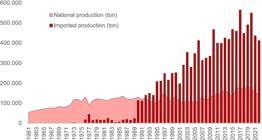
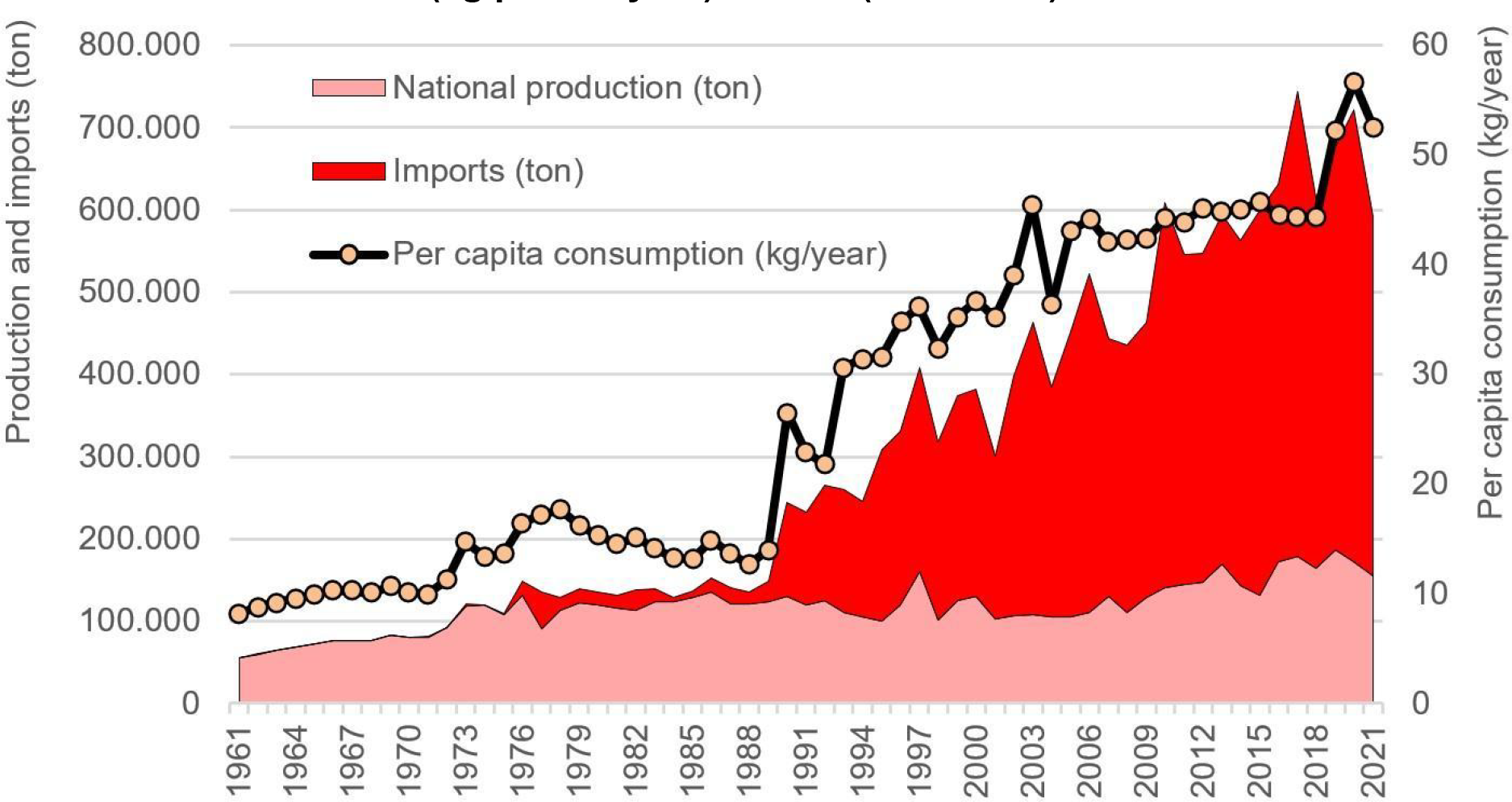
From the mid-20th century until 1980, Haiti produced the amount of rice necessary to feed the country's entire population (Altineus, 2015; Vivas, 2010). The nationalist policy carried out during the Duvalierist dictatorship, from 1957 to 1986, protected the domestic rice market (Lévy, 2001). However, from the mid-1980s onwards, the growth of local rice production became slow and, in parallel, there was an exponential growth in imports. Figure 3 highlights this movement, showing how, since the beginning of the 1990s, imports surpassed domestic production and currently remain at much higher levels. Taking an average of the last ten years (2012-2022), domestic production stands at 160 thousand tons, while imports reached 461 thousand tons. And, since the 2000s, nearly three quarters of the cereal consumed in Haiti comes from abroad1 (Faostat, 2024).
In 2022, domestic production fell by -18.6% compared to 2020 (figure 3). This drop is associated to the increasing lack of public safety in the country's main rice production region. In the Artibonite valley, which, as already mentioned, accounts for a large part of the country’s rice production, the presence of armed gangs has led to reduction in farmers’ financial capacity, to their displacement and reduced access to inputs and services and to their own lands (Fews Net, 2023; Moyo, 2024). Notwithstanding the impacts of the current crisis faced by Haiti, data from USDA (2024) indicate a continuous reduction in rice production in the country in the last ten years (figure 2), differing from Faostat’s (2024) data presented in figure 3.
The same occurs on the topic of imports. Faostat (2024) indicates a drop of 25.0% between 2020 and 2022 (figure 3), possibly also derived from the crisis, given that gangs began to control the country’s main port, located in the capital Port-au-Prince, which has more than 80% of its territory dominated by armed groups (ONU, 2024). According to USDA data (2024), however, the volume of imports is stable, with a slight growth of 4.0% between 2020/21 and 2022/23.
According to Lévy (2001) and Fréguin and Devienne (2006), this movement in rice production in Haiti is directly linked, at least in part, to economic policies implemented in the country over the last four decades, especially economic liberalization. The effects of tariff cuts during waves of liberalization were instantaneous on imports and domestic rice production and to this day are still felt.
In 1989, rice domestic production was estimated at 123,900 tons and imports was about 25,000 tons. But imports took off quickly after drastic tariff cuts. According to data in figure 3, imports increased from 25,000 tons in 1989 to 114,000 tons in 1990 and to 208,000 tons in 1995, the year when tariff was reduced from 35% to 3%. Domestic production, in turn, did not have this performance, falling from 123,900 to 100,000 tons between 1989 and 1995 (figure 3).
With the increase in per capita consumption, which has grown rapidly in recent decades (from 8.2 to 56.7 kg/year), domestic rice is increasingly insufficient to meet the demand of Haitian population (figure 4). While in the 1970s Haiti met its own demand for rice, the self-sufficiency rate declined consecutively: from 76.9% in 1989 to 38.8% in 2001, reaching 17.2% in 2020. Among the countries with the highest per capita consumption of rice, Haiti appears alongside those with the lowest self-sufficiency rate (Faostat, 2024).

Rice production and imports (ton) and per capita consumption (kg/person/year) in Haiti (1961-2021).
Some authors (Richardson et al., 2022), international bodies (World Bank, 2019) and state agencies (MARNDR, 2016) minimize the impact of these trade measures adopted in Haiti from the 1980s on rice production, attributing such production stagnation to other structural and natural factors, such as lack of financing, lack of maintenance of irrigation channels, drought, lack of quality seeds and fertilizers, etc. However, even though these mentioned elements influence production and productivity, the graphs make it clear that, after implementation of structural adjustment programs as an important part of neoliberal economic policy, rice production in Haiti was relegated to the background. In fact, Pressoir et al. (2006), Fréguin and Devienne (2006), among others, clearly recognized that increase in agricultural imports is not merely a result of the growth of urban population, but also of political choices that became explicit in tariff cuts that favored imports.
According to OEC (2023), over the last 30 years, rice represented between 5% and 10% of the total value of Haiti’s imports. In 2020, it was the most imported product ($292 million, representing 7.9% of the total), followed by refined petroleum (6.1%), fabric (4.1%) and palm oil (3. 4%). The United States is the main exporter of rice to Haiti and, therefore, the main beneficiary of market liberalization in the country. Among the products exported by the United States to Haiti, rice is also that with the highest value (25.1%), ahead of refined oil (20.6%) and poultry meat (6.8%). Generally, between 80% and 90% of rice annual imports come from the US, while the remainder originates from different nations (China, India, Pakistan, Dominican Republic, Guyana, Uruguay, among others). Haiti is the third largest market, behind Mexico and Japan, for US rice exports and the largest per capita consumer of rice in Latin America (Redon; Petit-Bel, 2017).
The United States’ share of total rice imports can be explained, firstly, by its proximity to Haiti and relatively low transportation costs (compared to Thailand, India, Vietnam and other major rice exporters) (Richardson et al., 2022). And, secondly, for its annual production capacity, which exceeds domestic demand (it has a self-sufficiency rate of 124.9%) (Faostat, 2024). Furthermore, the strong American influence in Haiti over the last century cannot be ignored, whose effects appear on different spheres of social, political and economic life in the Caribbean country (Bissindé, 2023).
The value of rice imports from the United States to Haiti grew almost uninterruptedly, rising from US$58.4 million in 1995 to US$245 million in 2020, which represents a 320% growth (OEC, 2023). On the other hand, volume, in tons, had a smaller expansion in the same period (164%) (Faostat, 2024). This increase in value in relation to quantity stem from increases in rice prices on the international market, which continues to show an upward trend, reaching its highest value in history in 2022 - US$ 1.70 per kg, a figure 8.5 times higher than that of 2001 and 2002 (figure 5).

Another point that deserves remark refers to the completely different conditions of rice production in Haiti and in the United States. Such disparity can be perceived in at least three elements. The first concerns technological and management standards, with American producers making use of modern machinery and equipment, in addition to high-yield seeds, fertilizers and agrochemicals (McBride; Skorbiansky; Childs, 2018), while Haitian farmers rely on traditional techniques and face constant difficulties in accessing new technologies and basic inputs (MARNDR, 2016). The second element refers to structural conditions, given that, in the United States, a producer has an average rice area of 209 hectares (while in Haiti, 85% of farmers have an average area of 0.3 hectares) and 100% of the surface is irrigated (compared to 8.8% in the Caribbean country) (IICA, 2012; Altineus, 2015; USDA, 2016, 2019). The presence of much larger areas and broad access to high-yield technology allow American farmers larger scale production, which reflects in lower production costs.
The third particularity is the almost inexistent state support for Haitian farmers, who lack credit, price, market, insurance or other policies, what does not occur in the United States, where the Farm Bill is in place. Even though the Farm Bill has reduced direct transfers to farmers in recent years, they remain protected by agricultural insurance, which aims to reduce high risks and uncertainties of agricultural activity resulting from climate instability, health conditions and market fluctuations (Kato; Delgado; Leite, 2017). Therefore, the absence of tariffs on rice imports exposes Haitian rice farmers to a situation of completely unequal and unfair competition.
The advantages held by American farmers are expressed in the higher average yields obtained per hectare. Compared to the United States, rice production per hectare in Haiti is much lower. Figure 6 illustrates it. For the entire period, which runs from 1961 to 2022, the average yield of rice production in the United States is significantly higher. While productivity in Haiti was 1,719 kg/ha in 1961, in the United States it was more than double. And this distance has widened over time - generally, an American producer obtains, in the same area, a yield three times higher than that of a Haitian farmer.

Given the conditions of competitiveness (and state support) of American producers, and the absence of import tariffs, imported rice arrives cheaper in Haiti. However, it presents greater variation/inflation. According to the Ministry of Economy and Finance and the Haitian Institute of Statistics and Informatics (2020), in January 2010, Consumer Price Index (CPI) with reference base 100 for local rice was 76.0, rising to 92.1 in 2015 and 97.9 in January 2018. During the same period, consumer price index for imported rice was 61.4, increasing to 66.1 in 2015 and 94.0 in January 2018. To calculate the CPI from 2010 to 2018, prices are aggregated using the geometric mean, comparing prices from the current period with prices from the previous period (MEF; IHSI, 2020). Based on this data, change in the inflation rate was calculated using the formula suggested by the Bank of Canada (2024) for this purpose.
Calculations show that, despite having a lower price, imported rice registered an inflation of 53.1% against 28.8% for the national cereal between 2010 and 2018. Devaluation of the national currency is what explains such difference, which does not necessarily mean that domestic rice has become more competitive. For the period under analysis, the Haitian currency suffered a very significant devaluation. According to the World Bank (2024c), gourde exchange rate went from 39.8 in 2010 to 50.7 in 2015 and to 68.3 in 2018. And, as dollar the currency used to buy rice on the international market, the more the national currency devalues against dollar, the more local currency needs to be exchanged to buy the same amount of merchandise. This has a direct impact on the price of imported cereal on the local market.
As three-quarters of the country's rice demand is covered by imports, this upward trend in prices has a major impact on access to this food among urban Haitians, thus contributing to food insecurity in the country (FAO, 2022a). This situation becomes even more worrisome if we consider that only three large corporations (Accra, Tchako and Rice Co) account for most of rice imports to the Haitian market (Furche, 2013; Richardson et al., 2022). The fact that the rice market in Haiti is highly dependent on a small number of importers could cause even greater harm to consumers due to reduced competition in this market.
Final remarks
Based on several discussions regarding economic liberalization in Haiti and the rice farming sector, this article sought to demonstrate, in an exploratory manner, the main impacts of this policy on rice production in the country. Findings indicated that liberalization of the agricultural market had different impacts. Rice farmers in Haiti, who did not and do not have access to either specific agricultural policies or transversal policies that could indirectly contribute to the sector, were unable to remain competitive in the national market in the face of rice imports driven by market liberalization. As this article has shown, the massive entry of imported rice has affected national production, which has been practically paralyzed due to the continuous and growing entry of American rice, whose production is much more competitive and, exempt of tariffs, arrives cheaper for the Haitian population.
Despite agriculture’s crucial role in the Haitian economy and lives of the population as one of the sectors that most absorbs labor, decline in agricultural production in recent decades affects the country as a whole. On the one hand, farmers are faced with completely disproportionate competition, increasing the precariousness of both farming activity and socioeconomic conditions of farming families, besides making the national economy increasingly vulnerable and dependent on the external context. On the other hand, urban consumers, in addition to purchasing a product of unknown origin, endure high inflation rates. In short, it is a complex and dramatic process, given that the Haitian population, faced with a serious situation of hunger, has the supply of its main food product increasingly dependent on imports, which, furthermore, are controlled by a few transnational corporations. To this end, the market liberalization process had a direct impact on sovereignty and food security in Haiti.
Considering that the objectives of the free trade policy, implemented in the scope of structural adjustment program, were to establish conditions for sustainable economic growth over time and with reduction in local market prices to improve living conditions of the population, market liberalization did not achieve its objectives in the country. On the contrary, it intensified some problems, as this article showed in the case of rice.
The absence of some data and the discontinuity of others hinder a more in-depth analysis of the topic covered. In any case, this article managed to understand the situation of rice production in Haiti, with emphasis on the evolution of imports and local production following the neoliberal policies promoted by international financial institutions from the 1980s onwards. In terms of future research, it would be pertinent to advance in more qualitative investigations, interviewing farmers, consumers, public authorities and other actors linked to the rice production chain, to capture their impressions and opinions on the effects of neoliberal policy in Haiti.
-
1
It is worth noting that this figure is provided by Faostat (2024); data from USDA (2024) shows a percentage even lower for domestic rice, since imports account for between 86.2% and 88.9% of rice consumption in the last ten years.
-
How to cite this article
FRENAT, Faniel; WESZ JUNIOR, Valdemar João. Economic liberalization in Haiti and its effects on rice production. Revista NERA, v. 27, n. 3, e10409, jul.-set., 2024.
References
- ALTINEUS, Franky. Espaces agraires en Haïti : structure foncière et production du riz dans le département Artibonite 2015. 142f. Dissertação (Mestrado em Geografia) - Unicamp, Campinas, 2015.
- ANDERSON, Perry. Balanço do neoliberalismo Rio de Janeiro: Paz e Terra, 1995.
- BANCO MUNDIAL. Agricultural financing in Haiti: diagnosis and recommendations. World Bank Group, Washington, 2019.
-
BANCO MUNDIAL. Indicators 2023. Disponível: https://data.worldbank.org/indicator Acesso em: 02 jan. 2024.
» https://data.worldbank.org/indicator -
BANCO MUNDIAL. Population active, total - Haïti. 2024a. disponível em: https://donnees.banquemondiale.org/indicator/SL.TLF.TOTL.IN?locations=HT Acesso em: 30 maio 2024.
» https://donnees.banquemondiale.org/indicator/SL.TLF.TOTL.IN?locations=HT -
BANCO MUNDIAL. Production de céréalière (tonnes métriques) - Haïti 2024b. disponível em : https://donnees.banquemondiale.org/indicateur/AG.PRD.CREL.MT?locations=HT Acesso em: 29 maio 2024.
» https://donnees.banquemondiale.org/indicateur/AG.PRD.CREL.MT?locations=HT -
BANCO MUNDIAL. Taxa de câmbio oficial (valor de moeda local por $ US, meio para o período) Haiti. 2024c. Disponível em: https://donnees.banquemondiale.org/indicator/PA.NUS.FCRF?locations=HT Acesso em: 29 maio 2024.
» https://donnees.banquemondiale.org/indicator/PA.NUS.FCRF?locations=HT -
BANCO DO CANADÁ. Feuille de calcule de l’inflation 2024. Disponível em: https://www.banqueducanada.ca/taux/renseignements-complementaires/feuille-de-calcul-de-linflation/ Acesso em: 13 junho 2024.
» https://www.banqueducanada.ca/taux/renseignements-complementaires/feuille-de-calcul-de-linflation/ - BAPTISTE, Bonny Jean. Liberalización comercial y producción de arroz en Haití. Observatorio de la Economía Latinoamericana, n. 87, p. 1-10, 2007.
- BEAUCEJOUR, Pierre Jameson. L’agriculture en Haïti. Les classiques des sciences sociales. Port-au-Prince, Haïti, 2016.
- BIEN-AIMÉ, Kensy. Droit au logement et personnes déplacées 2016. 95f. Monografia (Trabalho Social) - UEH, Port au Prince, Haïti, 2016.
- BISSINDÉ, Cam-naté Augusto. As relações entre Haiti e Estados Unidos: dependência e hegemonia. Revista Hoplos, v. 7, n. 12, p. 108-124, 2023.
- BLANCPAIN, François. La condition des paysans haïtiens. Du Code noir aux ruraux. Outre-Mers - Revue d’histoire, vol. 92, no. 346, p. 348-350, 2005.
- CARINHATO, Pedro Henrique. Neoliberalismo, reforma do Estado e políticas sociais nas últimas décadas do século XX no Brasil. Revista Aurora, v. 2, n. 1, p. 37-46, 2008.
- CÉLIUS, Carlo Avierl. Le contrat social haïtien. Revue du CRPLC, n. 10, p. 27-70, 1998.
- CEPAL. Analyse des indicateurs macroéconomiques de 1980-2005 Chili, 2005
- CHALMERS, Camille. Alerte à la déstructuration du marché du riz dans l’Artibonite 2014.
- DIMANCHE, Jude. Diagnostic de la filière rizicole haïtienne 2018. 152f. Monografia (Agronomia) - Université Laval, Laval, Canada, 2018.
- DORVILIER, Friz. Gouvernance associative et développement local en Haïti Port-au-Prince, Haïti, Université d’État d’Haïti, 2011.
- ÉTIENNE, Bélony. La crise de la production de riz en Haïti, comment pallier à cet effet : cas de la vallée de l'Artibonite 2023. 66f. Dissertação (Mestrado em Gestão) - Université De Liège, Liège, Belgica, 2023.
- ÉTIENNE, Sauveur Pierre. L’énigme haïtienne. Échec de l’État moderne en Haïti Université de Montréal, 2007.
- FAO e UE. Profil des systèmes alimentaires-Haïti. Activer la transformation durable et inclusive de nos systèmes alimentaires Rome, Montpellier, Bruxelles, pp.1-44, 2022.
-
FAO. Haiti suspende impostos sobre arroz importado 2019. Disponível em: https://www.fao.org/giews/food-prices/food-policies/detail/es/c/1181866/ Acesso em: 04 jan. 2024.
» https://www.fao.org/giews/food-prices/food-policies/detail/es/c/1181866/ -
FAO. Panorama regional de la seguridad alimentaria y nutricional 2021. 2022b. Disponível em: https://www.fao.org/3/cc0640es/cc0640es.pdf Acesso em: 08 dez. 2023.
» https://www.fao.org/3/cc0640es/cc0640es.pdf -
FAO. Profil des systèmes alimentaires en Haïti 2022a. Disponível em: https://doi.org/10.4060/cc2295fr Acesso em: 04 jul. 2023.
» https://doi.org/10.4060/cc2295fr -
FAOSTAT. Data. 2024. Disponível em: https://www.fao.org/faostat/en/#data Acesso em: 08 nov. 2023.
» https://www.fao.org/faostat/en/#data -
FEWS NET. Perspective de l’offre et du marché de céréales en Haïti 2023. Disponível em: https://fews.net/fr/latin-america-and-caribbean/haiti/perspectives-de-loffre-et-du-marche/novembre-2023 Acesso em: 05 de junho 2024.
» https://fews.net/fr/latin-america-and-caribbean/haiti/perspectives-de-loffre-et-du-marche/novembre-2023 -
FEWS NET. Production and trade flow map: Haiti local rice 2018. Disponível em: https://reliefweb.int/map/haiti/production-and-trade-flow-map-haiti-local-rice-may-2018 Acesso em: 05 de junho 2024.
» https://reliefweb.int/map/haiti/production-and-trade-flow-map-haiti-local-rice-may-2018 - FLORIDA, Dieupuissant; REDON, Marie. L’espace rural haïtien en mutation : du déclin de la caféiculture au développement de l’économie informelle dans la Chaîne des Cahos. Les Cahiers d’Outre-Mer, v. 279, p. 115-141, 2019.
-
FRANÇOIS, Jeannot. L’application de la politique d’ajustement structurel en Haïti. Le Nouvelliste, 2009. Disponível em: https://lenouvelliste.com/article/76043/lapplication-de-la-politique-dajustement-structurel-en-haiti#google_vignette Acesso em: 16 maio 2023.
» https://lenouvelliste.com/article/76043/lapplication-de-la-politique-dajustement-structurel-en-haiti#google_vignette - FRÉGUIN, Sandrine; DEVIENNE, Sophie. Libéralisation économique et marginalisation de la paysannerie en Haïti : le cas de l’Arcahaie. Revue tiers monde, n. 3, p. 621-642, 2006.
-
FURCHE, Carlos. The Rice Value Chain in Haiti Policy proposal. 2013. Disponível em: https://s3.amazonaws.com/oxfamus/www/static/media/files/haiti-rice-policy-backgrounder.pdf Acesso em: 16 dez. 2023.
» https://s3.amazonaws.com/oxfamus/www/static/media/files/haiti-rice-policy-backgrounder.pdf - GASPARD, Fritzner. Haïti : le programme d'ajustement structurel et problèmes politiques Paris : Hannattan, 2008.
- GUILLAUME, Ambroise. Analyse sociohistorique du Processus de démocratisation en Haïti amorcé en 1986 : Enjeu culturel et économique 2020. 130f. Dissertação (Mestrado em Sociologia) - Université du Québec à Montréal, Montréal, Canada, 2020.
- HURBON, Laënnec. Comprendre Haïti. Essai sur l’État, la nation, la culture Paris, Ed. Karthala, 1987.
- HURBON, Laënnec. Démocratisation, identité culturelle et identité nationale en Haïti. Revue du CRPLC, n. 10, p. 217-238, 1998.
- IHSI. Estimation de la population 2021. Disponível em: ihsi.gouv.ht/indicator-population. Acesso em: 05 ago. 2023.
-
IICA. Haiti: etude de la filiere riz. 2012. Disponível em: https://timothyschwartzhaiti.com/wp-content/uploads/Rice_Haiti.pdf Acesso em: 05 ago. 2023.
» https://timothyschwartzhaiti.com/wp-content/uploads/Rice_Haiti.pdf - KATO, Karina; DELGADO, Nelson; LEITE, Sergio Pereira. O seguro agrícola na Farm Bill de 2014: notas de conjuntura UFRRJ - CPDA - OPPA, Rio de Janeiro, 2017.
- LÉVY, Michael. Conflits terriens et réforme agraire dans la plaine de l’Artibonite (Haïti). Cahiers des Amériques Latines, n. 36, p. 183-206, 2001.
- MANIGAT, Leslie. F. Eventail d'Histoire Vivante d'Haïti, des Préludes à la Révolution de Saint Domingue jusqu'à nos Jours (1789-2007). Port-au-Prince, Haïti, Collection du CHUDAC, 2006.
- MARNDR. Développement rural en Haïti : Diagnostic et axes d’intervention P-Au-P, 2005.
-
MARNDR. Recensement général de l’agriculture 2010. Disponível em : https://agriculture.gouv.ht/statistiques_agricoles/EnqueteExploitation/Dossier-Presentation/Exploitants%20et%20exploitations%20agricoles.pdf Acesso em: 29 maio 2024.
» https://agriculture.gouv.ht/statistiques_agricoles/EnqueteExploitation/Dossier-Presentation/Exploitants%20et%20exploitations%20agricoles.pdf -
MARNDR. Situation de l’offre de riz en Haïti 2016. Disponível em: https://agriculture.gouv.ht/statistiques_agricoles/wpcontent/uploads/2016/11/Situation-de-la-fili%C3%A8re-riz-2014-15.pdf Acesso em: 04 jan. 2024.
» https://agriculture.gouv.ht/statistiques_agricoles/wpcontent/uploads/2016/11/Situation-de-la-fili%C3%A8re-riz-2014-15.pdf - MCBRIDE, William D.; SKORBIANSKY, Sharon R.; CHILDS, Nathan. US rice production in the new millennium: changes in structure, practices, and costs. Economic Research Service, Economic Research Bulletin, n. 202, 2018.
- MEF; IHSI. Indice des prix à la consommation (IPC) base 100 en 2017-2018. Port-au-Prince, Haïti, 2020.
-
MOYO, Shannon. Situation update: Haiti agriculture 2024. Disponível em: https://ipad.fas.usda.gov/highlights/2024/04/Haiti/index.pdf Acesso em: 30 maio 2024.
» https://ipad.fas.usda.gov/highlights/2024/04/Haiti/index.pdf -
OEC. Haiti 2023. Disponível em: https://oec.world/en/profile/country/hti Acesso em: 05 ago. 2023.
» https://oec.world/en/profile/country/hti -
OMC. La stabilité sociopolitique aiderait Haïti à tirer profit de ses efforts de libéralisation Examen des politiques commerciales. 2003. Disponível em: https://www.wto.org/french/tratop_f/tpr_f/tp222_f.htm Acesso em: 26 ago. 2023.
» https://www.wto.org/french/tratop_f/tpr_f/tp222_f.htm -
ONU. Múltiplas crises no Haiti atingiram “ponto crítico” 2024. Disponível em: https://news.un.org/pt/story/2024/01/1826797 Acesso em: 10 jun. 2024.
» https://news.un.org/pt/story/2024/01/1826797 - OSTHE, John; WESZ Jr., Valdemar Wesz. Abastecimento alimentar em contextos de crise: uma análise sobre o Haiti. Confins, n. 63, 2024.
- PAUL, Bénédique; DAMEUS, Alix; GARRABE, Michel. Le processus de tertiarisation de l’économie haïtienne. Études caribéennes, n. 16, p. 1-15, 2011.
- PEREIRA, João Márcio Mendes. Metamorfoses da política de ajuste estrutural do Banco Mundial (1980-2014). Sociologias, v. 19, p. 390-422, 2017.
- PIERRE-CHARLES, Gérard. L’économie haïtienne et sa voie de développement pp. 272, 1993.
-
PNUD. Human Development Report 2021/2022 2022. Disponível em: https://hdr.undp.org/ Acesso em: 16 dez. 2023.
» https://hdr.undp.org/ -
PRESSOIR, Gaël et al. Les filières agricoles haïtiennes 2016. Disponível em: https://agritrop.cirad.fr/580386/1/ID580386.pdf Acesso em: 29 ago. 2023.
» https://agritrop.cirad.fr/580386/1/ID580386.pdf - REDON, Marie; PETIT-BEL, Raoul. Réduire l’insécurité mais augmenter la vulnérabilité? Assistance alimentaire et riziculture en Haïti. Les Cahiers d’Outre-Mer, v. 275, p. 143-161, 2017.
-
RELIEFWEB. Zones rizicoles d’Haïti: vous n’en croyez pas à vos yeux 2012. Disponível em: https://reliefweb.int/report/haiti/zones-rizicoles-d%E2%80%99ha%C3%AFti-vous-n%E2%80%99en-croirez-pas-vos-yeux Acesso em: 30 maio 2024.
» https://reliefweb.int/report/haiti/zones-rizicoles-d%E2%80%99ha%C3%AFti-vous-n%E2%80%99en-croirez-pas-vos-yeux - RICHARDSON, Matthew et al. A broken market: can increased access to broken rice decrease food insecurity in Haiti? Food Security, v. 14, n. 6, p.1387-1400, 2022.
- SAAD FILHO, Alfredo. Crise no neoliberalismo ou crise do neoliberalismo? Crítica e Sociedade, v.1, n. 3, p. 6-19, 2011.
-
USDA. Haiti’s U.S. Rice Imports 2016. Disponível em: https://www.ers.usda.gov/webdocs/outlooks/39144/56601_rcs-16a-01.pdf?v=8796.6 Acesso em: 13 jan. 2024.
» https://www.ers.usda.gov/webdocs/outlooks/39144/56601_rcs-16a-01.pdf?v=8796.6 -
USDA. Census of Agriculture United State 2019. Disponível em: https://www.nass.usda.gov/Publications/AgCensus/2017/Full_Report/Volume_1,_Chapter_1_US/usv1.pdf Acesso em: 11 dec. 2023.
» https://www.nass.usda.gov/Publications/AgCensus/2017/Full_Report/Volume_1,_Chapter_1_US/usv1.pdf -
USDA. Grain and Feed Annual 2024. Disponível em: https://apps.fas.usda.gov/newgainapi/api/Report/DownloadReportByFileName?fileName=Grain%20and%20Feed%20Annual_Port-au-Prince_Haiti_HA2023-0003.pdf Acesso em: 13 jun. 2024.
» https://apps.fas.usda.gov/newgainapi/api/Report/DownloadReportByFileName?fileName=Grain%20and%20Feed%20Annual_Port-au-Prince_Haiti_HA2023-0003.pdf - VELTMEYER, Henry; PETRAS, James; VIEUX, Steve. Neoliberalism and class conflict in Latin America: A comparative perspective on the political economy of structural adjustment. Springer, 2016.
-
VIVAS, Esther. Le marché haïtien du riz : un cas emblématique de la dérégulation capitaliste 2010. Disponível em: https://www.cadtm.org/ Acesso em: 08 dez. 2023.
» https://www.cadtm.org/ - YVES CRIBB, André. Politique des prix agricoles et sécurité alimentaire en Haïti (1971-1986) Port-au-Prince, Haïti, 1997.
-
The editing process for this article was carried out by Camila Ferracini Origuela.

 Source:
  Source:
  Source: Own elaboration based on
  Source: Own elaboration based on
  Source: Own elaboration based on
  Source: Own elaboration based on