
 ALTERNATIVES TO UNLIMITED ECONOMIC GROWTH AND THE POST-DEVELOPMENT PROPOSITIONS
Abstract
The carbon-intensive economic model faced significant questioning in the 1970s and 1980s, leading to the dissemination of the idea of sustainable development after the 1990s. However, this concept has also been subject to scrutiny in recent decades. In this context, Post-development has emerged from cultural movements with a set of distinct proposals and initiatives that aim to create alternatives to the model of unlimited economic growth. More recently, two post-developmentalist movements have gained greater visibility: Degrowth and Buen Vivir. This article aims to identify, map, and analyze transitional proposals and practices from post-developmentalist movements. To this end, an integrative review of 45 peer-reviewed academic articles was conducted, followed by a thematic analysis and synthesis of the findings. As a result, 415 proposals were identified and classified into 13 themes and 53 categories. Among the characteristics of the analyzed proposals, it is noted that some are compatible with sustainable development, while others are compatible with the carbon-intensive model. This variety of themes, categories, and proposals reflects the diversity and contradictions within post-development movements, which present multiple transformative initiatives in different territories. The mapping conducted enhances visibility and understanding of the interfaces between Post-development proposals, enabling comprehension of pathways for creating and implementing pluriversal initiatives.
Keywords:
Post-development; Degrowth; Good Living; Sustainability; Economic alternatives
Resumo
O modelo econômico intensivo em carbono encontrou forte questionamento nos anos 1970-1980, levando à disseminação da ideia do desenvolvimento sustentável após os anos 1990 que, por sua vez, entrou em questionamento nessas últimas décadas. Nesse contexto, emergiu o Pós-desenvolvimento, formado por movimentos culturais com um conjunto de proposições e iniciativas distintos, que visam criar alternativas ao modelo de crescimento econômico ilimitado. Mais recentemente, duas frentes pós-desenvolvimentistas ganharam maior visibilidade: o Decrescimento e o Bem Viver. Assim, este artigo visa identificar, mapear e analisar as proposições e práticas de transição provenientes dos movimentos pós-desenvolvimentistas. Para isso, foi realizada revisão integrativa de 45 artigos acadêmicos revisados por pares, seguida de análise e síntese temática. Assim, 415 proposições foram identificadas e classificadas em 13 temas e 53 categorias. Dentre as características das proposições analisadas, nota-se que parte delas é compatível com o desenvolvimento sustentável ou com o modelo de uso intensivo de carbono. Essa variedade de temáticas, categorias e proposições reflete a diversidade e as contradições dos movimentos pós-desenvolvimentistas, que apresentam múltiplas iniciativas transformadoras em diferentes territórios. O mapeamento realizado contribui para dar visibilidade e compreender as interfaces entre as propostas do Pós-desenvolvimento, possibilitando compreender os caminhos para a criação e implementação de iniciativas pluriversais.
Palavras-chave:
Pós-desenvolvimento; Decrescimento; Bem Viver; Sustentabilidade; Alternativas econômicas
Resumen
El modelo económico intensivo en carbono fue objeto de un fuerte cuestionamiento en las décadas de 1970-1980, lo que llevó a la difusión de la idea del desarrollo sostenible después de los años 1990, el cual, a su vez, ha sido cuestionado en las últimas décadas. Como resultado, surgió el Posdesarrollo, un conjunto de proposiciones e iniciativas distintas que buscan alternativas al modelo de crecimiento económico ilimitado. Recientemente, dos frentes post-desarrollistas han ganado mayor visibilidad: el Decrecimiento y el Buen Vivir. En este contexto, este artículo tiene como objetivo identificar, mapear y analizar las proposiciones y prácticas de transición provenientes de los movimientos del Posdesarrollo. Por eso, se realizó una revisión integrativa de 45 artículos académicos revisados por pares, seguida de una síntesis temática. Así, se identificaron y clasificaron 415 proposiciones en 13 temas y 53 categorías. Entre las características de las proposiciones analizadas, se observa que parte de ellas es compatible con el desarrollo sostenible o con el modelo de uso intensivo de carbono. Esta diversidad de temas, categorías y proposiciones refleja el alcance y contradicciones del movimiento post-desarrollista, que presenta múltiples iniciativas transformadoras que se están estudiando e implementando en todo el planeta. El análisis realizado contribuye con la visibilidad y con la comprensión de las interfaces entre las propuestas del Posdesarrollo, lo que puede permitir entender los caminos para la creación e implementación de iniciativas pluriversales.
Palabras-clave:
Posdesarrollo; Decrecimiento; Buen Vivir; Sostenibilidad; Alternativas Económicas
INTRODUCTION
The recent worsening of the environmental crisis seems to highlight the limitations of the logic of unlimited, carbon-intensive economic growth and of sustainable development itself, since it contains the notion of economic growth in its proposals, as evidenced by the Sustainable Development Goals (SDGs). Namely, the 8th goal – Decent Work and Economic Growth (LATOUCHE, 2009; MARTINE; ALVES, 2015; THEYS & GUIMONT, 2019; ROCKSTRÖM et al., 2023; UN, 2024).
Some authors argue that the term "sustainable" in the context of development reflects an instrumentalist paradigm (CAMPAGNA; GUEVARA; LE BOEUF, 2017), and it could even be seen as an oxymoron (LATOUCHE, 2009; REDCLIFT, 2005). Furthermore, it can be considered a trilemma due to the challenges in reconciling economic growth, social well-being, and environmental sustainability (MARTINE; ALVES, 2015, p. 434).
This scenario has sparked debates about alternatives to the current carbon-intensive economic model, which threatens to cross safe and just planetary boundaries (ROCKSTRÖM et al., 2023). It often prioritizes profit over nature and the quality of life of local populations. These debates have fueled the quest for real transformations or at least mitigating solutions, discussed and developed from various perspectives, including technicists, anthropocentrists, and ecocentrists. This represents Post-development. These debates have fueled the quest for genuine transformations or at least mitigating solutions, discussed and developed from various perspectives, including technicists, anthropocentrists, and ecocentrists. This represents Post-development. In multiple studies and publications addressing the various movements associated with this topic, numerous examples of proposals and practices can be found that aim to transform the current economic model and the lifestyles that accompany it (LATOUCHE,2009; GEORGESCU-ROEGEN, 2013; ESCOBAR, 2021; HICKEL et al., 2022; KOTHARI et al., 2019; ZIAI, 2007; GUDYNAS, 2011; GIBSON-GRAHAM, 2005; ESCOBAR, 2005, 2007; ACOSTA, 2016).
To promote the collective vision of "an ecologically wise and socially just world," the recent publication Pluriverse: A Post-Development Dictionary, organized by Kothari, Salleh, Escobar, Demaria, and Acosta, presents a compilation of transformative alternatives associated with post-development. These initiatives include Degrowth and Buen Vivir, as well as other movements such as Ubuntu, Ecofeminism, Gross National Happiness, Deep Ecology, Convivialism, Ecovillages, Alternative Currencies, and the Slow Movement, among many others.
Post-development propositions are being mapped and analyzed in several case studies and territories, both in the North (FOUKSMAN & KLEIN, 2019; TZEKOU & GRITZAS, 2023; KAUL et al., 2022; and FITZPATRICK et al., 2022) and the global South (MARTINS, 2014; Gervazio et al., 2023; Leão et al., 2016; Montero et al., 2019; Nirmal & Rocheleau, 2019; Sánchez & Moscoso, 2017; Santos et al., 2017; Vargas, Zuñiga and Alcantara, 2020; Piaia & Wedig, 2022; Schöneberg, 2015; Gerber & Raina, 2018; Soto, 2019). Escobar (2015, p. 15) points out that there are multiple transition narratives, which articulate "true cultural and ecological transitions to different models of society, going beyond strategies that offer anthropocentric conditions as solutions". Mapping these narratives is fundamental, particularly for studies focused on pluriversality.
Different authors, including Kothari et al. (2021), argue the need to challenge the prevailing idea of hegemonic economic growth and highlight the various theories and practices associated with the Post-development movement. In light of the escalating ecological crisis and climate emergency, which have detrimental effects on both human and non-human lives, these discussions serve as a “beacon of hope”, as noted by Escobar (2015, p. 461).
Considering this panorama, what are the main transition propositions and practices emerging from the post-development movement? This article seeks to identify and analyze the transition proposals and practices stemming from the Post-development movement. To achieve this, a bibliographic review was conducted, drawing on literature related to post-development, with a particular focus on the Degrowth movement and, more prominently, the Buen Vivir (or Good Living) movement.
It is essential to recall the etymology of the word "proposition," which originates from the Latin verb "proponere," meaning "to put in front." From a philosophical perspective, a proposition is "a representation of the possibility of a possible world, an affiguration of a state of possible things" (RODRIGUES, 2010, p. 157). Morin and Kern (2003) suggest that during multiple crises—such as ecological, political, social, and values crises—we seek to identify alternative worlds, including those that have historically been silenced or deemed impossible due to their origins: diverse or pluriversal worlds (KILOMBA, 2019; KOTHARI et al., 2021; SANTOS, 2023). These crises, or polycrises, are defined by the rapid pace of technological and social changes characteristic of contemporary society (KURZWEIL, 2024; LOPES-PORTILLO ROMANO, 2018). This speed opens up a future filled with acute uncertainties (BUCCI, 2023; HARARI, 2024), causing feelings of apprehension, anxiety, and, above all, dissatisfaction and misinformation among various social segments (DA EMPOLI, 2020). Ultimately, the polycrisis fundamentally stems from the transition the world is experiencing between a carbon-intensive, socially exclusionary, and environmentally irresponsible economic model and a socially inclusive and environmentally responsible model based on renewable energy. This transition is taking place amidst strong tensions and clashes.
POST-DEVELOPMENT MOVEMENTS: BUEN VIVIR AND DEGROWTH
To understand post-development, it is first necessary to understand the polysemic concept of development. Originating in a Eurocentric context and popularized in President Truman's post-World War II speech, the term "development" has come to signify a continuous and linear transformation aimed at creating order from social disorders (COWEN & SHENTON, 2005; ACOSTA, 2016). However, in the current economic model, the economic dimension is often limited or prioritized, with the logic of continuous and infinite growth, despite development being described as sustainable (BRUNDTLAND, 1987; DU PISANI, 2006), liberating (SEN, 2010), and human-centered (UNDP, 1990). The objective of this article is not to analyze the history and concepts already discussed in the existing literature (ESCOBAR, 2005, 2007; COWEN & SHENTON, 2005; SEN, 2010; ZIAI, 2007; KOTHARI et al., 2021; FERREIRA & RAPOSO, 2017; AMARO, 2017). Instead, it aims to explore alternatives that are being developed or implemented in response to what appears to be a failure in current approaches.
In the twentieth century, post-development, in its various forms, emerged as an "umbrella" concept stemming from critiques of development. It encompasses transformative initiatives, distinct and even divergent movements and perspectives that seek or inspire alternatives to the development model that has been in force since the nineteenth century, based on unlimited economic growth. Kothari et al. (2021) listed more than eighty initiatives that exemplify these pluriversal paths, most of which are local or regional in nature. The best-known examples are Degrowth (DEMARIA et al., 2013; LATOUCHE, 2009; KALLIS, 2011) and Buen Vivir (GUDYNAS, 2011; ACOSTA, 2015, 2016). The challenge, among others, is how to implement and share local propositions and practices without losing the logic of pluriversality.
Pluriversality enables differences to coexist harmoniously and challenges the dominant logic, which tends to be universalizing and exclusionary (Kothari et al., 2021). Rather than promoting a single globalized and homogenized world, the "pluriverse" envisions a convergence of alternatives,
a world where many worlds fit, as the Zapatistas of Chiapas say. The worlds of all people must coexist with dignity and peace, without depreciation, exploitation, or misery. A pluriversal world overcomes patriarchal attitudes, racism, casteism, and other forms of discrimination. In it, people relearn what it means to be a humble part of "Nature," leaving behind narrow anthropocentric notions of progress based on economic growth (Kothari et al., 2021, p. 43).
Strictly speaking, Post-development is not anti-development, but a proposal to deconstruct the development-growth process as a fundamental principle in organizing social life (ESCOBAR, 2007). While this process has improved lives for some, it also creates inequality, violence, and discrimination, both symbolic and physical (GIBSON-GRAHAM, 2005). Escobar (2005) maintains that Post-development is defined by several key characteristics: revaluing traditional cultures, trusting traditional knowledge despite the specialization of knowledge, creating more human, culturally, and ecologically sustainable worlds, and considering social and popular movements as the basis for advancing to a new society (ESCOBAR 2007).
Buen Vivir is closely tied to the worldviews and philosophies of Latin America, particularly among the indigenous peoples of the global South, with a particular focus on the Andean communities. This perspective emphasizes the intrinsic value of non-human beings, the importance of diversity and collectivity, and the enhancement of the quality of life for all living beings. This stands in contrast to a focus on continual individualistic growth (ACOSTA, 2016; ALCANTARA; SAMPAIO, 2017; KOTHARI et al., 2021). There are three main currents in the Buen Vivir movements : (i) indigenist/pachamamista; (ii) socialist/statist, and (iii) post-developmentalist/ecologist. The first and third are more closely linked to the defense of territories, while the second is more closely related to the rise of Buen Vivir in the public policies of certain countries (HIDALGO-CAPITÁN; ARIAS; ÁVILA, 2014; ALCÂNTARA & ZUHIDALGO-CAPITÁN, ARIAS, & ÁVILA, 2014; ALCÂNTARA & ZUÑIGAÑIGA, 2021).
Acosta (2015; 2016) highlights that the proposals of Buen Vivir reflect a worldview distinct from the Western perspective. This worldview originates from non-capitalist and decentralized community roots, aiming to transcend issues such as racism, patriarchy, and machismo. Additionally, it advocates for several initiatives, including the establishment of the Rights of Nature, the promotion of solidarity-based economic systems, the reduction of consumerism and productivism, and a decrease in working hours.
Degrowth, in turn, is more related to the societies of the global North. It proposes abandoning the goal of unlimited growth, reducing the material footprint, and adopting a critical stance towards the developmental paradigm. It proposes different, more democratic societies, where people live, work, and consume with social justice (DEMARIA et al., 2013; LATOUCHE, 2009; FITZPATRICK et al., 2022; NASCIMENTO & TASSO, 2019). Georgescu-Roegen (2012), writing on the origins of Degrowth in the 1970s, presented eight proposals that address the reduction of inequalities, the reduction of expendable consumption, the end of planned obsolescence and the production of superfluous items, in addition to the appreciation of time for leisure, family, and friends.
Expanding on these ideas, Latouche (2009, p. 42) proposed a "virtuous circle" of eight interdependent actions "capable of triggering a process of serene degrowth": reevaluate (values), reconceptualize (the view of the world), restructure (the production systems and social relations according to the values after the reevaluation), redistribute (wealth), relocate (produce locally, prioritizing local companies), reduce (excessive consumption and waste), reuse (avoid single use products, combating planned obsolescence), and recycle (waste). The author also pointed out more concrete central propositions, including the following: integrating the damages generated by transportation into overall costs; restoring peasant agriculture by focusing on local, seasonal, natural and traditional practices; transforming productivity gains into reduced working time and job creation, to increase leisure time; promoting relational goods such as time for friendship and knowledge; reducing energy waste; and implementing taxes on advertising (LATOUCHE, 2009).
In the following section, the method used to analyze post-developmental propositions will be presented, along with the results of its application.
METHODOLOGICAL PATH
To achieve the overall objective, a quantitative-qualitative, exploratory, and descriptive method was adopted, utilizing an analysis of secondary sources on Post-development (CRESWELL, 2007; MARCONI & LAKATOS, 2003). To this end, an integrative literature review (ILR) was conducted, which differs from traditional reviews in that it serves as a form of research capable of generating new knowledge on the subject by synthesizing and critiquing the representative literature related to the specified topic (TORRACO, 2016). In this case, the focus is on the propositions of Post-development, particularly those associated with Buen Vivir and Degrowth.
Based on the guiding question of this research (What are the transition propositions coming from the Post-development movement?), a thematic/conceptual structure of integrative review (ibid.) was adopted, in which the keywords for the review were: "post development" + propos*; postdevelopment + propos*; "pós-desenvolvimento"; "buen vivir" + propuestas/proposiciones; "good living" + propos*; and "bem viver" + propos*. The databases consulted were the CAPES journal platformand the Brazilian Digital Library of Theses and Dissertations (BDTD). It is worth noting that propositions related to Degrowth were not included among the keywords, as a recent and current systematic review on the subject, published by Fitzpatrick et al. (2022), was one of the inspirations for this article.
The next phase involved selecting articles for a complete analysis based on their titles and abstracts. The criteria defined for the selection in this integrative review were as follows: peer-reviewed publications written in Portuguese, English, or Spanish that presented propositions or practices related to the Post-development movement. In the journals consulted, 481 articles were initially identified. After excluding articles that didn't meet the selection criteria, duplicates, and those not directly related to the theme of the analysis, 45 articles were selected, encompassing over 70 authors.
The entire content of these 45 texts was analyzed. Along with the critical analysis (TORRACO, 2016), information was gathered and categorized based on the following criteria: title, authors, year, and place of publication; identified propositions (synthesis and total quantity); whether or not a case study was included (if so, where it was located), and the link to access the complete publication. The identification of the case study analysis is relevant, as it helps assign materiality to the propositions. The cases make it possible to generate "theoretical insights that are transferred to other times and places" (BARTLETT & VAVRUS, 2017, p. 905).
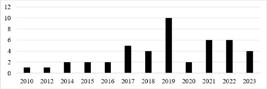
Articles published between 2010 and 2023 were reviewed, as illustrated in Graph 1 (below). Most of the selected articles are from 2017 onwards, with notable concentrations in the years 2019 (22% of the material analyzed), 2021 (13%), and 2022 (13%).
There is a diversity of journals publishing on the subject, totaling 41 different publications. Among these journals, only three stood out for having published more than one article: Ecological Economics (linked to the International Society for Ecological Economics – ISEE) with three different publications, Alternautas (London – England, University of Warwick Press) and Desenvolvimento e Meio Ambiente (Federal University of Paraná – UFPR, Brazil), each with two articles.
Out of the 45 articles reviewed, 51.1% include case studies, which amounts to a total of 23 articles. Some of these case studies are comparative and involve multiple territories or countries. The case studies span 14 different countries, predominantly in the global South, especially in Latin America and the Caribbean, as illustrated in Figure 1. Brazil had the highest number of case studies, with a total of eight. Ecuador and Mexico followed, each with three case studies, while Bolivia and Chile each had two. Additionally, there is one study from each of the following countries: Argentina, Australia, Bhutan, Colombia, the United States, Greece, Haiti, India, and the United Kingdom.

Image with countries in which case studies were identified. Source: prepared by the authors in Google Maps, 2024.
The analysis and interpretation of the information collected began with a table containing all the post-developmentalist propositions identified in the selected texts. This process was divided into two parts: a bibliometric analysis and an analysis of the propositions. A thematic synthesis was employed to group the propositions into specific themes and categories (MARCONI & LAKATOS, 2003; FITZPATRICK et al., 2022; THOMAS & HARDEN, 2008). As a result, 13 themes were developed, which were further divided into 53 categories.
The approach used for the groupings was based on the systematic review and thematic synthesis conducted by Fitzpatrick et al. (2022). It included adaptations to reflect the realities of Latin America and Post-development theories, as well as considerations of the characteristics of the collected material. To refine the groupings, the procedure of similarities and differentiations was adopted (FACHIN, 2001). Thus, the themes that grouped the propositions were:
-
A- Agriculture and Food;
-
B- Science and Technology;
-
C- Culture and Education;
-
D- Energy;
-
E- Ethical and non-speculative finance and financial democracy;
-
F- Governance and Geopolitics;
-
G- Housing, Transport and Regional Planning;
-
H- Nature;
-
I- Production and Consumption;
-
J- Quality of life and Integral health;
-
K- Reduction of inequality;
-
L- Work
-
M- Tourism.
The authors of this article acknowledge that every typology has an insurmountable degree of subjectivity and intersubjectivity, and that other authors could create alternative typologies. However, the most relevant are the propositions themselves, gathered from the selected articles based on the method described above. The results of the research and discussion are presented below, with the categories and main propositions.
POST-DEVELOPMENTALIST PROPOSITIONS AND PRACTICES
The review of the 45 articles yielded a table containing 415 post-developmental propositions. However, since many of these propositions were similar, the analysis and synthesis process resulted in a refined total of 217 propositions. As previously mentioned, these propositions were organized into 13 themes, which were further divided into 53 categories, as illustrated in Figure 2 and Table 1, arranged in descending order based on the number of propositions in each theme.
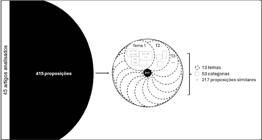
Results of the thematic analysis and synthesis of post-developmentalist propositions. Source: Prepared by the authors, 2024.
Thematic classification of the identified propositions and practices (decreasing order of the total number of propositions in each theme)
It is essential to recognize that a proposition can engage with more than one theme or category. The classification into categories was necessary for analysis, following the method used by Fitzpatrick et al. (2022) and Thomas & Harden (2008). This approach also helps communicate results effectively to diverse audiences. An illustration is the proposition "Eradicate poverty," which encompasses various themes, including the "reintegration between human beings and Nature." This concept engages with both the cultural dimension and specific categories related to Nature.
Table 1 shows the number of propositions by theme (last column on the right – "T") and category (penultimate column on the right – "C"). The themes with the greatest diversity of propositions are linked to Production and Consumption (42), Culture and Education (42), and Agriculture and Food (21). According to the analysis by Fitzpatrick et al. (2022), it's important to note that when authors present or create a proposition, they don't always provide comprehensive details or a thorough plan for implementing it. In some cases, propositions are mentioned only briefly.
Thematic classification of the identified propositions and practices (decreasing order of the total number of propositions in each theme)
The categories with the greatest diversity of propositions are: Sufficiency lifestyles (with 13 different propositions, such as overcoming consumerism or promoting shared consumption); Diverse culture and education (11, including simple living, or voluntary simplicity); Reducing environmental pressures, including mining (11, for example, sustainable extraction, limits on the extraction of natural resources); Individual autonomy (8, for instance, self-sufficiency and self-management of people living in community, decolonization of the social imaginary); Reducing waste (8, such as repair workshops, tool libraries); and Food sovereignty (8, through productive and commercial policies with agroecological and cultural criteria; biofairs, etc.).
These categories are distributed into four themes, with a particular emphasis on two: Production and Consumption, and Culture and Education. The former focus likely stems from the issues of the climate emergency, while the second aims to promote actions to change the course of today's society.
To identify the key propositions of post-developmentalism, an analysis was conducted focusing on those that were most frequently referenced in the various works examined (see Table 2). In other words, Table 2 highlights the propositions that gained prominence due to the similar initiatives proposed by different authors. These propositions are categorized into seven main themes: Agriculture and Food, Culture and Education, Energy, Ethical and Non-Speculative Finance, Governance and Geopolitics, Nature, and Production and Consumption. Additionally, there are 11 specific categories, with Biocentrism/Ecocentrism being the most prevalent. Details of these post-developmentalist propositions are presented in Table 2.
In the fields of Governance and Geopolitics, the concept of ecological democracy is noteworthy. This approach aims to decentralize decision-making through various participatory methods. Examples include regular deliberative forums, participatory budgeting, voluntary working groups, local direct democracy, and participatory democracy. It also promotes small-scale self-organization with networks of collectives, including social movements (FITZPATRICK et al., 2022; BENALCÁZAR & de LA ROSA, 2021; HIDALGO-CAPITÁN & CUBILLO-GUEVARA, 2022; MONTERO et al., 2019; ACOSTA, 2015; FERREIRA & RAPOSO, 2017; TZEKOU & GRITZAS, 2023; HIDALGO-CAPITÁN et al., 2019; KAHLAU, SCHNEIDER and SOUZA-LIMA, 2019; FRIGGERI, 2021; SODRÉ & HESPANHOL, 2022; ABREU & PEZARICO, 2020; DINERSTEIN and DENEULIN, 2012; MADRUGA, 2019; FONSECA et al., 2022; ÁVILA-ROMERO, 2018; FONSECA et al., 2022). On the other hand, the concept of Plurinationality highlights the importance of recognizing and valuing ethnic diversity within national states. It emphasizes the self-determination of peoples, the decentralization of local power, and the acceptance of heterogeneity, which challenges the idea of a uniform national identity. Examples of this can be seen in decolonization policies, such as the implementation of quotas and reparative measures (GUERRA et al., 2023; HIDALGO-CAPITÁN and CUBILLO-GUEVARA, 2022; BENALCÁZAR & de LA ROSA, 2021; MARTINS, 2014; HIDALGO-CAPITÁN et al., 2019; CUBILLO-GUEVARA et al., 2016).
Among the four categories in Culture and Education, the category of Traditional/Ancestral Knowledge is particularly significant. It explores the issues related to traditional populations, their lifestyles, cultures, and knowledge systems. Furthermore, it advocates for greater recognition and autonomy for these communities (FITZPATRICK et al., 2022; VENTURIN, et al., 2023; BISHT, 2022; NIRMAL & ROCHELEAU, 2019; KAHLAU, SCHNEIDER and SOUZA-LIMA, 2019; SOTO, 2019; NIRMAL & ROCHELEAU, 2019; FRIGGERI, 2021; MADRUGA, 2019; ASSIS, 2021; DIEDRICH & BIONDO, 2021; SANTOS, et al., 2017; LEÃO et al., 2016; ÁVILA, 2019). In contrast to the anthropocentric perspective that dominates many Western societies today, some authors advocate for a more bio- or ecocentric worldview. This perspective emphasizes that human beings are not separate from Nature, nor are they superior to other species. The focus of these authors is on finding harmony or reintegrating human beings with Nature, as well as reconnecting humanity with Planet Earth (GERVAZIO et al., 2023; ABREU & PEZARICO, 2020; GUERRA et al., 2023, MONTERO et al., 2019; ALCANTARA & SAMPAIO, 2017; MARTINS, 2014; ÁVILA, 2019; DOURADO, 2021; MADRUGA, 2019; GUERRA et al., 2023; FRIGGERI, 2021). The Interculturality and Diversity category highlights the recognition and defence of diverse identities and cultures. It values the heterogeneity of diverse identities, cultures, and practices. This category promotes the idea of harmonious and respectful coexistence among different ways of life (ALCÂNTARA & SAMPAIO, 2017; GUERRA et al., 2023; HIDALGO-CAPITÁN & CUBILLO-GUEVARA, 2022; MONTERO et al., 2019; HIDALGO-CAPITÁN et al., 2019; SOTO, 2019; BENALCÁZAR & DE LA ROSA, 2021; MACÍAS, 2017; ÁVILA-ROMERO, 2018).
In the theme of Nature, the category of Nature's Rights stands out, emphasizing the need to strengthen the laws that protect it. It is also signalled that these rights should become a constitutional component (FITZPATRICK et al., 2022; FRIGGERI, 2021; HIDALGO-CAPITÁN & CUBILLO-GUEVARA, 2022; FERREIRA & RAPOSO, 2017; ALCÂNTARA & ZUÑIGA, 2021; HIDALGO-CAPITÁN et al., 2019; BRASIL & BRASIL, 2014; ACOSTA, 2015; VENTURIN, et al., 2023; SOTO, 2019).
Propositions related to Agroecology and Food Sovereignty predominated in the theme Agriculture and Food. Agroecology refers to the design of sustainable agroecosystems. This set of proposals includes various agroecological transition experiences and peasant agroecology, such as permaculture, as discussed in seven separate articles (FITZPATRICK et al., 2022; FONSECA et al., 2022; DIEDRICH & BIONDO, 2021; SANTOS, et al., 2017; DOURADO, 2021; ABREU & PEZARICO, 2020). Food sovereignty refers to the ability of each community to define its own policies, such as those for sustainable agriculture, thereby ensuring its nutritional self-sufficiency (ALCANTARA & SAMPAIO, 2017; ÁVILA-ROMERO, 2018; HIDALGO-CAPITÁN et al., 2019; DOURADO, 2021; HIDALGO-CAPITÁN & CUBILLO-GUEVARA, 2022; BENALCÁZAR & DE LA ROSA, 2021; VENTURIN, et al., 2023).
Production and Consumption stands out for highlighting the importance of fostering alternative economies, including the solidarity economy and related concepts such as the bioeconomy, social economy, and care economy (HIDALGO-CAPITÁN et al., 2019; HIDALGO-CAPITÁN & CUBILLO-GUEVARA, 2022; SOTO, 2019; ALCANTARA & SAMPAIO, 2017; BENALCÁZAR & DE LA ROSA, 2021; FERREIRA & RAPOSO, 2017; BRASIL & BRASIL, 2014; TZEKOU & GRITZAS, 2023). The proposal to promote fair trade and commerce also falls under the category of Alternative/Solidarity Economies.
In the theme of Energy, degrowth propositions stand out (FITZPATRICK et al., 2022). They are also present in the Energy Democracy category, which involves transitioning to renewable energy, in order to guarantee renewable, decentralized, coexistence and community-owned systems (FITZPATRICK et al., 2022; LEMOS & BELLO, 2019; FONSECA et al., 2022; MARTÍNEZ-ALIER et al., 2010; ÁVILA-ROMERO, 2018; HIDALGO-CAPITÁN et al., 2019).
Finally, the theme of ethical and non-speculative finance addresses the management and accessibility of economic resources. Its proposals primarily aim to support currencies, credit systems, and non-speculative exchange methods. Examples include the establishment of time banks, credit unions, cooperative banks, and alternative or social currencies (FITZPATRICK et al., 2022; ÁVILA-ROMERO, 2018; VARGAS, ZUÑIGA and ALCANTARA, 2020; ÁVILA-ROMERO, 2018; FONSECA et al., 2022; CUBILLO-GUEVARA et al., 2016).
A CRITICAL ANALYSIS: BREADTH, DIVERSITY, AND SPECIFICITY
There is a diverse array of post-development themes, categories, and propositions that span various sectors and aspects of society. These include diverse lifestyles, the reduction of social inequality, decreased consumption, and minimized unnecessary production. Additionally, these themes advocate for a change in the relationship between humans and other species. Notably, the most common category identified is related to Bio/Ecocentrism (LATOUCHE, 2009; GEORGESCU-ROEGEN, 2012; KOTHARI et al., 2021, ESCOBAR, 2021; HICKEL et al., 2022).
Proponents of Post-development argue that we are currently experiencing a period of polycrisis (MORIN & KERN, 2003), characterized by complex challenges and problematic issues (HEAD, 2008; WEHRDEN et al., 2017). During this time, the safe and just planetary boundaries on which we rely are under threat (ROCKSTRÖM et al., 2023). To effectively tackle these challenges, we need to adopt multiple approaches and embrace perspectives that are less anthropocentric and more diverse (SANTOS, 2023). Ecocentrism, for example, accepts that humans are part of Nature and have "(...) responsibility to respect the web of life and regenerate the damage caused by the ideological dominance of anthropocentrism" (KOPNINA et al., 2018, p.123).
Additional themes closely linked to those proposed by seminal authors include relocation (LATOUCHE, 2009; ESCOBAR, 2021), prioritizing the use of renewable energy sources (LATOUCHE, 2009; GEORGESCU-ROEGEN, 2012; KOTHARI et al., 2021), as well as promoting local and organic agriculture for everyone (LATOUCHE, 2009; GEORGESCU-ROEGEN, 2012; KOTHARI et al., 2021).
Although the issue of leisure time (GEORGESCU-ROEGEN, 2012) was not directly addressed in the analyzed propositions, it is close to part of the debate raised in the category Reconceptualizing work, present in the degrowth propositions (FITZPATRICK et al., 2022; ACOSTA, 2015; MARTÍNEZ-ALIER et al., 2010; BELING, 2019), as well as in the category Production and Consumption – Lifestyles of sufficiency (HIDALGO-CAPITÁN et al., 2019; HIDALGO-CAPITÁN & CUBILLO-GUEVARA, 2022).
It's important to note that the proposals do not solely focus on the economy or the breakdown of mercantile logic. While the themes of production and consumption are central to the discussion, the mapping also includes proposals related to human behavior and individual daily lifestyles, such as reducing meat consumption and fostering coexistence within groups, communities, or associations.
The proposals have distinct scales: municipal, regional, and some are focused on countries such as plurinational states. They also address various global issues, such as the reform of international organizations. In other words, they range from the human, local scale, passing through those that depend on social movements, public policies, or sectoral legislation, all the way to international institutions or regulations. It was also possible to verify that there is an extensive public policy agenda with 50 goals, 100 objectives, and 340 instruments related to Degrowth (FITZPATRICK et al., 2022), in addition to the National Plans related to Buen Vivir (MONTERO et al., 2019; SOTO, 2019; CUBILLO-GUEVARA et al., 2016).
In this context, it is observed that post-development proposals may also be analyzed alongside the objectives of Buen Vivir, based on their scales of action (HIDALGO-CAPITÁN & CUBILLO-GUEVARA, 2022). These presuppose three approaches: (i) biocentric sustainability (harmony with Nature and other beings), which alings directly with the propositions on ecocentrism in the Culture and Education category and the Nature category; (ii) social equity (harmony between people), which connects with the Governance and Geopolitics and Reduction of inequalities categories; and (iii) personal satisfaction (harmony with oneself), more linked to some propositions of the Culture and Education, Work and Quality of life categories and integral health.
This diversity, as a whole, contributes to shaping the post-development ideal by deconstructing the central principle of organizing contemporary social life: the notion of economic growth (ESCOBAR, 2005, 2007). However, this variety can also be overshadowed by the profusion of themes, categories, and proposals, which may lead to the fragmentation of society and diminish the conditions for individuals, families, and voters to mobilize effectively.
As for the characterization of the elements of Post-development, as outlined in the differences between the transformative initiatives and the reformist solutions described in the Post-development dictionary (KOTHARI et al., 2021), it is observed that most of the identified propositions align with post-developmental premises, such as agroecology (FONSECA et al., 2022; DIEDRICH & BIONDO, 2021; SANTOS, et al., 2017; DOURADO, 2021; ABREU & PEZARICO, 2020); common goods (FITZPATRICK et al., 2022; LEMOS & BELLO, 2019; FONSECA et al., 2022); and the Italian philosophy and slow (food) movement, identified both in the research by Fitzpatrick et al. (2022) and in that of Alcantara and Sampaio (2017).
In turn, the propositions of the categories Traditional/ancestral knowledge and the repoliticization and empowerment of social movements stem from essential post-developmental elements in Escobar's perspective (2005; 2007).
On the other hand, some of the identified propositions do not exhibit specific characteristics related to post-development; instead, they tend to be more generic or abstract, particularly in the category of Quality of Life and Integral Health. Additionally, some of these propositions align with the sustainable development agenda, such as the Circular Economy (HIDALGO-CAPITÁN & CUBILLO-GUEVARA, 2022; HIDALGO-CAPITÁN et al., 2019), the bioeconomy (TZEKOU & GRITZAS, 2023), and the reform of international organizations (FITZPATRICK et al., 2022).
Therefore, Post-development is not inherently opposed to development (ESCOBAR, 2007), despite its criticisms and opposition to the paradigm of continuous growth. Part of the proposals compatible with the current market economy, which facilitates the transition to sustainability and can be illustrated through the proposals for mandatory recycling (FITZPATRICK et al., 2022; FONSECA et al., 2022), family farming (GERVAZIO et al., 2023; ABREU & PEZARICO, 2020) or organic, artisanal and subsistence farming (FITZPATRICK et al., 2022; GERBER and RAINA, 2018), dissemination of social technologies (KAHLAU, SCHNEIDER and SOUZA-LIMA, 2019; POZZEBON & FONTENELLE, 2018), advertising regulation (FITZPATRICK et al., 2022; GERBER and RAINA, 2018), among others. Two additional examples involve the establishment of guarantees for the universal provision of essential human needs. These concepts are reflected in proposals for universal basic income (FITZPATRICK et al., 2022; FOUKSMAN & KLEIN, 2019) and in the implementation of public policies promoting positive discrimination, such as affirmative action (HIDALGO-CAPITÁN et al., 2019; HIDALGO-CAPITÁN & CUBILLO-GUEVARA, 2022).
The analysis of the publications reveals that the Post-development movement is characterized by a range of propositions that promote pluriversal transformative initiatives. However, many of these propositions are challenging to implement in the short or medium term and may even seem utopian or impractical. This creates a significant challenge in establishing the necessary conditions for realizing these ideas, even in theoretical terms.
Latouche (2009) acknowledges that, while the concept of degrowth is revolutionary in theory—reflecting a vision for society—it tends to be reformist in practice due to the constraints of political realism. He emphasizes that the revolutionary potential of his concrete utopia "is not incompatible with political reformism, provided that the inevitable compromises of action do not degenerate into compromised thinking" (LATOUCHE, 2009, p. 93).
It is very relevant to note that there has been significant progress concerning the analyses of Post-development propositions and practices compared to earlier ones (SODRÉ & MEDEIROS HESPANHOL, 2022; DINIZ FILHO, 2022), which had not identified so many concrete cases or propositions. This is taken up by Escobar (2015, p. 461), who suggests that a "beacon of hope" emerges as transformative alternatives contribute to highlighting the different possibilities of action for the transition towards sustainability, that is, different possible and interconnected paths. Schöneberg et al. (2022) provide an illustrative example by comparing various practices and initiatives that serve as alternatives to traditional development. These initiatives have the potential to transform socio-ecological relationships towards a pluriverse perspective. However, it is essential to note that these efforts may be filled with contradictions. In some cases, the authors or stakeholders involved may not explicitly reference the concept of Post-development.
It is possible to compare and contrast the ideas of degrowth authors from the North with those advocating for Buen Vivir in the South. This comparison highlights the potential for these two perspectives to complement each other, as noted by Beling (2019), Sparn (2019), and Kaul et al. (2022). Beling (2019) concluded that the authors of Buen Vivir demonstrate a greater connection with the propositions associated with traditional peoples, emphasizing territories and production processes. They also critique neo-extractivism. In contrast, degrowth proponents focus more on global relations, exacerbated consumption, actions focused on cities, and energy, among others.
In this sense, the table of propositions shows that plurinationality, for example, is raised chiefly in Buen Vivir research (GUERRA et al., 2023; HIDALGO-CAPITÁN & CUBILLO-GUEVARA, 2022; BENALCÁZAR & DE LA ROSA, 2021; MARTINS, 2014; HIDALGO-CAPITÁN et al., 2019; CUBILLO-GUEVARA et al., 2016), while the propositions related to the theme of Work and the categories of Exchange and Earthly Justice concentrate on degrowth. Furthermore, there is a broader range of perspectives in the propositions of the Sufficiency Lifestyles category, for example, when it concerns reducing/overcoming productivism and consumerism, questioning current consumption patterns (POZZEBON & FONTENELLE, 2018; TZEKOU & GRITZAS, 2023; LEMOS & BELLO, 2019; ACOSTA, 2015; BELING, 2019) and the need to promote shared and sufficient consumption (FITZPATRICK et al., 2022; FERREIRA & RAPOSO, 2017; FONSECA et al., 2022).
Acosta (2015), Cubillo-Guevara et al. (2016), Ávila-Romero (2018), and Madruga (2019) all conducted research on Buen Vivir, highlighting a more biocentric worldview. These authors advocate fostering a less extractive relationship with nature and promoting its de-commodification. Thus, the importance of integrating platforms among scientists, philosophers, activists, producers, and other stakeholders from the global South and North is emphasized, as proposed by Martínez-Alier et al. (2010).
CONCLUSION
This research aims to analyze the transition propositions and practices associated with the movements that form Post-development. It is based on a review of peer-reviewed academic literature sourced from Capes journals and databases of dissertations and doctoral theses. The integrative review enabled us to synthesize 415 propositions extracted from 45 publications authored by more than 70 scholars from various countries, resulting in 217 propositions that promote the deconstruction of the paradigm of unlimited economic growth. They were classified into a wide variety of themes and categories, which interact at different levels. This range of themes reflects the scope, diversity, and even contradictions of the post-development movement, with transformative initiatives being implemented in different territories around the world.
The bibliometric analysis highlights this more practical relationship by approaching the theme through the cases studied in various territories, which reveal the dialogues and approximations of post-developmental propositions in different socioeconomic contexts across fourteen countries.
Some of the propositions take time to come to fruition, especially those related to educational processes, awareness, behavioral, cultural, or political changes, which involve many key actors in the arenas of debate and implementation. Conversely, post-development proposals are being registered in the formulation of public policies, government plans, and multilateral institutions.
The movements associated with Post-development are highly diverse. Some propositions are more specific, while others are more generic; some are more utopian, while others are more pragmatic. Additionally, certain propositions align to some extent with the current economic model, indicating that Post-development is not inherently anti-development. The analysis also allowed us to verify differences, divergences, and complementarities among the propositions from authors from the North and the South, which deserve to be better known and clarified to expand the possibilities of collaboration and global integration. We must avoid falling into the utopia of universalization, as territories have their specificities and cultures have their identities that must be respected.
The method employed to map the diversity of Post-development proposals tends to fragment the perspective of the analyzed works. This fragmentation makes it challenging to gain a deeper understanding of the context in which these proposals were developed, as well as to grasp the synergies, interactions, or contradictions among them. This gap represents a significant avenue for future research.
Given the limitation of the survey, which only includes publications in three languages and does not account for literature from books and chapters, it is recommended that future research expand the scope to include these types of literature, particularly from Eastern sources. Additionally, researchers should consider exploring how the proposed ideas are implemented and may also look into alternative ways of classifying these propositions based on their materiality, specificity, and applicability across different scales.
APPENDICES
| Proposition | Theme: category |
|---|---|
| Family fanning (including diversified production) | Agriculture and food: Sustainable agriculture |
| Knowledge and use of non-conventional food plañís (PÂNC) from local biodiversity | |
| Institutionalize artisanal and subsistence organic agriculture (including the proposal to move to 100% organic agriculture) | |
| Promote small-scale agriculture (e.g., intensive community, home, and urban gardening; local food stores and co-ops) | |
| Ecosystem restoration associated with food and medicinal plant production | |
| Agroecology - including experiences of agroecological transition, as well as restoring peasant agroecology (e.g., Permaculture) Agroforestry | Agriculture and food: Agroecology |
| Income generation through regenerative practices (organic and agroecological agriculture, etc.) | |
| End food waste | Agriculture and food: Sustainable diets |
| Eat local and seasonal food | |
| Normalize the slow food philosophy (and slow movement) | |
| Reduce meat and dairy consumption | |
| Reform agricultural and consumer education (e.g., farm visits, outreach, literature, hands-on courses) | |
| Environmental conservation of natural resources and enhancement of sociobiodiversity through the rescue and use of native seeds | Agriculture and food: Food sovereignty |
| Develop networks and cooperatives, organic markets and fair trade, as well as alternative food networks (e.g., bio-fairs, consumer cooperatives, municipal markets, labeling and taxing food m iles; food selfsufficien cy; commun ity-supported agriculture) | |
| Effective food security, as well as food and nutritional security, with crop diversification | |
| Phase out chemical pesticides, fertilizers, and GMOs | |
| Promote seed sharing, seed banks (e.g., seed sharing festivals) | |
| Rebuilding soil fertility (e.g., networks of manure storage facilities; local organic matter banks) | |
| Redistribution of land to peasants and/or landless people (Promote return to the land) | |
| Food sovereignty (e.g., through production and commercial policies with agroecological and cultural criteria; organic production) | |
| Dissemination of tangible and intangible heritage and creation of research networks focusing on heritage | Science and technology - Tools for coexistence |
| Encourage technological (re)appropriation (including the development of interactive graphical tools and group processes to identify concrete pathways for decoupling and recoupling based on empirical connectedness and dependency at multiple scales. Creation of case studies and multi-scale demonstrations in plain language with accessible illustrations and interactive learning tools such as games) | |
| Promote convivial technologies (including the development of replicable/adaptable methods to document/diagram/illustrate the connections of different groups of people in commodity networks and/or consumer networks of those interested in disconnecting from growing economies) | |
| Social technology (e.g., understood as a process of social and political construction capable of producing emancipatory results from a local point of view) | |
| Activist-led science | Science and technology -Technological sovereignty |
| Moratorium and reorientation of techno-scientific innovation Reassessing the role of technology | |
| Minimize patent monopolies | |
| Access to education, freeflow of information | Culture and Education |
| Relational goods | |
| Search for self-knowledge, change of values, awareness, and expansion of levels of consciousness | |
| Ecological class consciousness | |
| Cultures of sufficiency and simple living (e.g., Voluntary Simplicity; anti-accumulation conception of minimalism; theory of interaction ritual, and the need to establish a society founded on more materially deprived bases) | |
| Dissolution of binaries | |
| Free education and healthcare for all | |
| It encourages a rethinking of the artificial nature of many of the pillars of contemporary society. | |
| Prioritizing use value over exchange value, transformation towards an economy based on reciprocity, solidarity, sustainability, sufficiency, social inclusion, and relationality | |
| Promoting participation in cooperation processes focusing on cultural industries in Latin America | |
| Critical epistemic review of capitalist, colonial, and modern assumptions. | |
| Ecocentrism, biocentrism | Culture and Education - biocentrism, ecocentrism |
| Balance/harmony/reciprocity/reintegration between societies, human beings, and nature | |
| Reconnect with the Earth | |
| Mutual respect between humans and extra-humans, with egalitarian, respectful and balanced relationships, understanding of the deep integration between all elements of the cosmos Understanding the body as territory, ending the separation between humans and nature | |
| New sociopolitical and cultural formulation: based on the dialogue between the perspectives and contributions of pre-modernity, modernity, and post-modernity | Culture and Education - Traditional/ancestral knowledge |
| Restore the sense of solidarity and community among people Restore/revalue indigenous and local knowledge (traditional peoples included), rescue traditional or ancestral knowledge Revaluation of cultural identities, autonomy for local populations, interaction and integration between popular movements, and the economic and social incorporation of populations. | |
| Valorization of traditional ways of life and identities, including the resumption of traditional community ways of life, and alternative ways of life to the Western one | |
| The connection of spirituality with all aspects of life | Culture and Education - Spiritualities and Affections |
| Conviviality, which is linked to the dimensions of care, belonging, creativity, freedom, autonomy, spirituality, reciprocity, and complementarity | |
| Celebratory spirit, (self)sufficient lifestyle, time-rich, and less individualistic | |
| Spiritualities and ethics, with secularism of States, to guarantee harmonious coexistence between religions and spiritual practices | |
| Practice reciprocity | |
| Recover love | |
| Be grateful, be thankful | |
| Democratization of diverse cultural expressions, encouraging the use of cultural goods and services | Culture and Education - Interculturality and diversity |
| Interculturality | |
| Recognition of diversity, diverse identities; Recognizing the power of hybrid or minority cultures, claiming both cultural diversity and the diversity of ways of producing, understanding production, and generating knowledge | |
| Learn to speak multiple languages | Culture and |
| Autonomy of processes in each territory, self-sufficiency, and self-management of people living in the community | Education: Individual autonomy |
| Decolonization and Decolonizing the Social Imaginary | |
| Establish structural and institutional mechanisms that lead to local socioeconomic progress through self-determination, governance, and autonomy | |
| Focus on systemic interdependencies and elements of power and domination | |
| Oppose English-speaking imperialism | |
| Repoliticization of community problems and the promotion of self-determined responses | |
| Valuing the human in relation to capital | |
| Oppose economic determinism and ethnocentrism | Culture and Education: Critical Education |
| Possibility of creating plural modernities, which are works of local episteme and reality, so that such alternatives offer better ways of protecting (and dignifying) life on the planet | |
| Promote emancipatory education (including comprehensive, inclusive, and intercultural education and contextual education) | |
| Build off-grid (energy) systems | Energy: Energy Democracy |
| Ensuring renewable, decentralized, co-existent, and community-owned systems - transition to renewable energy | |
| Oppose large-scale renewable systems | |
| Energy sovereignty: A rapid transition to renewable sources | |
| Phase out current nuclear power | Energy: Stop nuclear power |
| Remove subsidies for nuclear energy | |
| Abolish fossil fuel subsidies | Energy: Stop fossil fuels |
| Decreasing the annual global cap and the equity-based program based on historical responsibility | |
| Phase out existing fossil fuels, including policies to reduce CO2 emissions | |
| Nationalize to phase out fossil fuel companies | |
| Reduce energy demand and use (e.g., Industrial Energy Consumption Tax, Share TPES equitably) | Energy: Energy sufficiency |
| Support non-speculative currencies, credit and exchange systems (e.g., Time banks; Credit unions, Cooperative banks; Merged or time-based currencies; Alternative currencies or social currencies; Local or regional non-market exchange systems; Local mutual credit systems; Proof-of-Cooperation cryptocurrency), as well as solidarity finance, Public finance funds, Economic democracy | Ethical and non-speculative finance and financial democracy |
| Democratize and decentralize money (e.g., Nationalize banks for social and ecological purposes; decentralize banking and financial institutions, Encourage tax disobedience; Conduct regular debt audits; Progressive tax on profits and capital accumulation from all sources, Debt-free public money; Demonetization/decommodification) | |
| Socially responsible and ecologically sensitive investment (e.g., Financing a (decommodified) basic income; Ecological restoration projects; Care services) | |
| Tax justice for socio-ecological justice | |
| Market regulation, in order to avoid the concentration of market power in the hands of a few stakeholders | |
| Severe restrictions on foreign investment | |
| Financial sovereignty | |
| Dismantling hierarchies (e.g., General consumer strike; acquisitions of metabolic vehicles by workers -ports, airports, highways, etc.) | Diverse Governance and Geopolitics |
| Local democratic ownership of public services and resources (e.g., community ownership) | |
| Reforming international organizations | |
| Regulate the lobby | |
| Abolish investment in military infrastructure | Governance and Geopolitics - Ending the Military-Industrial Complex |
| Less military activity | |
| Defend and restore the commons (e.g., local gift shops; rent-free store; gift shop; community gardens; community-supported agriculture (CSA); tool libraries; open-plan workshops; citizens' self-help groups; swap clubs; farmers' markets; cooperatives; community land trusts; community volunteer bees; bicycle kitchens) | Governance and Geopolitics -Common Goods |
| Strengthening and opening of permanent public spaces for exchange between populations, the right to enjoy the city and its spaces | |
| Collective way of life that values life in its entirety; valuing community life or re-communization of society | |
| Transnational Alignment, going beyond the limitations of national borders | Governance and Geopolitics -Plurinationality |
| Coexistence in multipolarity | |
| Plurinationality (e.g. : National Plurinational State challenging the homogeneous national identity, with ethnic diversity in the decentralization of local power; plurinationality through decolonization policies (quotas, reparatory measures, preferential treatments), self-determination (constitutional recognition of nations and incorporation of their own rights into the State's legislative body) and interculturality (measures of: coexistence, convergence, complementarity and unity); | |
| Provide a platform on which social movements from the global North and South can converge (including conservationists, trade unions, small farmers' movements, and movements in the South advocating a low-impact economy) | Governance and Geopolitics -Repolarization and strengthening of social movements |
| Transformative political mobilization for the good of the community | |
| New sociopolitical imaginary, built from local communities and embodied in knowledge and practices that are alternatives to models exported from the West. | |
| Decentralize decision-making (e.g., regular deliberative forums; economic democracy; participatory budgeting; voluntary working groups, multi-level confederal direct and local direct democracy; participatory democracy; small-scale self-organization with networks of collectives; citizen-initiated referendums; peaceful participatory pluridemocracies, including social movements) -participatory processes | Governance and Geopolitics: Ecological Democracy |
| Increase social housing (e.g., Nationalization of vacant properties; Expropriation of large landowners; Redensification policies) | Housing, Transport, and Regional Planning - Land Justice |
| Restricting the commodification of property (e.g., progressive property tax; Maximum per capita floor area quota; Incentives against vacant housing (e.g., taxes); Rent limits and controls; Revitalization and/or (temporary) utilization of vacant buildings, such as permaculture on vacant land) | |
| Limit high-speed transport infrastructure | Housing, Transport and Regional Planning - Mobility |
| Promote modal shift to active transportation (e.g. walking, cycling; Proactive construction of cycling infrastructure; Walkable neighborhoods; Freight transportation by bicycle - e.g. postal delivery, Cargonomy) | |
| Promote modal shift to public transport (e.g., bus, trolleybus, metro, train) | |
| Reduce fossil and motorized mobility (e.g. : Limit cars at city level and within households; Introduce environmental taxes; Reduce the availability of parking spaces; Close roads to cars in city centers; Stop the expansion of motorways and highways; Emphasize accessibility over vehicular mobility; Reduce traffic volume, consumption and use of vehicles and planes; Subsidize or reduce taxes to encourage citizens to live close to their workplaces; Restrict car ownership - congestion charges, limited driving days for cars; Replace short car trips <5 km with walking and cycling; Encourage electric bicycles; Impose heavy tax increases on private transport; including heavy import taxes on cars) | |
| Raising socio-ecological standards for new buildings | |
| Encourage small cities (including ideal habitats, optimized habitats by limiting the size of cities, favoring the concentration of dispersed populations in small and intermediate cities) Designing and implementing shrinking cities | Housing, Transport and Regional Planning - Socially beneficial and ecologically sensitive planning |
| Reduce the scale of the urban built environment by reducing the scale of physical structures (e.g. : Limit urban sprawl and gentrification; Limit land use for human settlements at national and international levels; Control the development of holiday homes; Limit the usable area of the household (per capita in m2); Prohibit the construction of detached single-family homes; Prohibit developments on agricultural land; and reduce, limit or prohibit mega-infrastructures and mega-structures). | |
| Retrofit (modernization) of existing buildings (e.g., Bars with passive design; Apply incentives and benefits for conscious urban rehabilitation) | |
| Common and shared facilities (e.g. shared cars, communal spaces, tools, gardens, kitchen, leisure facilities, free or low-cost provision of safe and energy-efficient kitchen equipment, shared facilities in the neighbourhood; Change of ownership to user) | Housing, Transport, and Regional Planning - Housing Sufficiency |
| Prioritize small, highly self-sufficient communities | |
| Promote shared housing (e.g. Ecovillages; Cohousing and housing cooperatives; Ecocommunes; Urban villages; Multigenerational housing; Small housing) | |
| Collective ownership of land and buildings | |
| Bioconstruction | Housing, Transport and Regional Planning: Socially beneficial and ecologically sensitive planning |
| Abandon GDP and adopt a range of socio-ecological indicators (e.g., gross national happiness) | Alternative indicators of social progress |
| Moving away from concrete as the primary building material, exploring alternative building materials specific to each location and climate | Nature: Reduce environmental pressures, including mining |
| Reducing maximum limits on resource use, emissions, and pollution (e.g., limiting the input of raw materials into production; restricting final consumption of energy and resources; personal energy quotas) | |
| Sustainable extraction, limiting the extraction of renewable and non-renewable natural resources, conditioning them on the resources' reproductive capacity (e.g., limits on mining) | |
| Moratoriums on resource extraction and large infrastructure | |
| Oppose speculative negative emissions technologies | |
| Oppose resource annexation by corporations and governments | |
| Prohibition of mining activity in indigenous territories | |
| Reduce the production and use of chemicals | |
| Reduce industrial fishing activities | |
| Ecological tax reform | |
| Solution to the water crisis in indigenous territories | |
| Bottom-up empowerment of women to control their reproductive rights | Nature: Stable demographics |
| Legislate the Rights of Nature, or Pachamama (including in the country's constitution) | Nature: Rights of Nature |
| Decolonial environmental justice | Nature: Decolonial environmental justice |
| Create resource sanctuaries (e.g., ecological reserves and botanical gardens; reforestation projects, memorials for the preservation of knowledge) and nature conservation | Nature: Restoring and preserving biodiversity |
| Care for ecosystems to stop degradation and initiate regeneration Half of the country with protected areas, 60% of forest cover; Circular economy | Production and consumption -Alternative/Solidarity economies |
| Promotion of alternative economies, including the solidarity economy and others such as: social, self-consumption, family, community, popular, collaborative, reciprocity, care, bioeconomy, in addition to social/local exchange networks, food banks, etc. Economic objectives must be subordinated to the functioning of natural systems without losing sight of respect for human dignity, ensuring quality for people, building a solidarity-based economic system, sustained on community bases and guided by reciprocity, and subordinated to the limits imposed by Nature | |
| Promote fair trade, fair commerce | |
| Multifunctional use of the territory, e.g., agricultural production, community-based tourism, educational, cultural, and health projects, volunteering, among other alternative productive activities. | |
| Anti-utilitarianism | Production and Consumption -Sufficiency Lifestyles |
| Awareness about sustainable and responsible consumption | |
| Sustainable economy, through transition to production, consumption, and work systems that generate less consumption of natural resources, less waste production, and greater availability of free time | |
| Change to a production method that has ecological issues as its pillar, for a balanced use of nature, harmony between human beings and nature | |
| Promote shared and sufficient consumption | |
| Forms of production obey the vital needs of society | |
| Let's overcome the defense of infinite economic growth, of progress as something linear, as well as the utilitarian view of nature as synonyms or means for development. | |
| Recreate or regenerate interdependent local networks (of knowledge, practices, and solidarity) that operate on different terms, with an ethos of sufficiency. While diminishing colonial and dependent global networks | |
| Reduction in the consumption of per capita units of sand-based products | |
| Reduction/overcoming of productivism and consumerism, including questioning consumption patterns (global North) and extractivism (South) | |
| Reduce conspicuous consumption | |
| Exchange systems | |
| Prohibit advertising (e.g., billboards; advertising children's toys or fossil fuels) | Production and Consumption - Limit advertising |
| Tax advertising (e.g., taxing unhealthy and unsustainable products such as junk food, fossil fuels, automobiles, aviation, etc.) | |
| Regulate advertising (e.g., Limit public spaces; Public control of advertising and media; Eliminate tax breaks for advertising; Restrict advertising to only basic human needs and self-fulfillment; Mortgages and large houses); no outdoor advertising | |
| Self-production (e.g., Encourage do-it-yourself, artisanal production; Promote makerspaces, fablabs, hackerlabs, creativity studios, bench manufacturing; Expand public financial support, subsidies, tax exemptions, and grants to promote mutual aid) | Production and Consumption -Nonprofit democratic models |
| Nonprofit cooperatives (e.g., Institutionalize nonprofit organizations as the standard; Tax incentives for cooperatives) | |
| Smaller businesses (Promote hobby businesses, small private businesses, community-based social enterprises) | |
| Commons-based peer production (Designing local global production; digital commons; collaborative production; Creative Commons license (github)) | |
| Direct activism and sabotage (e.g., anti-capitalism malware program) | Production and Consumption -Socially useful production |
| Dismantle large corporations (e.g., start by reducing the most socio-ecologically destructive sectors, such as SUV production, weapons, beef, private transportation, advertising, and planned obsolescence) | |
| Diversification of production | |
| Worker- owned production systems | |
| Mandatory environmental impact assessments (Life cycle assessments of all goods and services; Progressive unit pricing schemes in waste management) | Production and Consumption -Reducing waste |
| Rainwater harvesting | |
| Against waste: austerity | |
| Ensure the right to repair (e.g., repair shops, tool libraries, open workshops, bike kitchens) | |
| Ban planned obsolescence | |
| Mandatory recycling, including composting of organic waste | |
| Mandatory ecological footprint labeling | |
| Ecological effluent treatment | |
| Relocalize economic activities (local production, including small-scale production) | Production and Consumption -Relocalization |
| Reterritorialization, centrality of the territory | |
| Proposes transitions to "human-scale development" | Production and consumption: Alternative/Solidarity economies |
| They present a similar approach to the schism that exists between the way we currently live under capitalism and their vision of a dignified life. | Production and Consumption: Lifestyles of Sufficiency |
| Mapping growth trajectories and paths and their intersection with actually existing ecologies/cultures/territories | Production and Consumption: Relocalization |
| Better living conditions, based on solidarity and reciprocity Improvement of people's quality of life (food, housing, work, etc.), in which the historical process of each people is recognized, including the quality of life between the subject and the environment | Quality of life and comprehensive health - Living conditions |
| Strong opposition to capitalism and the embodiment of hope for a better life | |
| Practice care (self others, and the Earth) | Quality of life and comprehensive health - Health |
| Health promotion | |
| Comprehensive health (physical, mental, emotional, spiritual, and social health), including types of complementary or traditional medicine such as traditional Chinese medicine, acupuncture, Ayurveda, indigenous medicine, Anthroposophy, herbal medicine, chiropractic, homeopathy, etc. | |
| Creation of a women's council for BV | Reducing inequality |
| Gender equality and body sovereignty (e.g. full equality of rights for all; state wages for housewives; regularization of domestic workers; public credit institutions for women; gender parity in all public and private organizations; laws against symbolic violence against women and LGBT people in the media; legalization of sex workers; specialized courts and police stations against gender violence) | |
| Redistribute land, labor, capital, and resources within and between countries (e.g., highly progressive wealth tax; wealth cap, etc.), including the redistribution of income and wealth | |
| Reducing inequalities, for example, through transnational networks capable of challenging the structures that produce (and maintain) social inequalities | |
| Ensure universal provision of fundamental human needs (e.g., Universal Basic Income, Universal Basic Income, Universal Provision of Basic Public Services) | Reducing inequality: Eradicating poverty |
| Support for political resistance movements and the defense of social justice | Reducing inequality: Justice |
| Defend, respect, and include the perspectives of local and pluralist grassroots movements to ensure distributive justice | |
| Collective rights and/or renegotiation of rights and needs, including, for example: Political movement, popular mobilizations, which value the rights of the collective | |
| Implementation of positive discrimination policies (affirmative action), increasing the initial capabilities and opportunities for the most disadvantaged people, and limiting them to the most advantaged | |
| Economic justice | |
| Transformative justice (e.g.: Oppose all forms of racism-be anti-racist; Restorative justice measures; Dismantle colonialism and its structures; Access to legal services, etc.), and also: Overcoming racism, patriarchy and sexism; eliminating racial and gender prejudices, valuing differences, including the plurality of indigenous peoples; Protagonism of women and traditional peoples in driving change and occupying spaces of power | |
| Work Sharing | Work - Low unemployment |
| Job guarantee (with a decent wage) | |
| Proactive recycling and procurement programs | Work - Socio-ecological jobs |
| Part-time rights (Legal facilitation of bridging programmes and/or "short week" legislation) | Work -Reconceptualizing work |
| Reallocate productivity gains to work less (and create jobs) | |
| Reduce the time of paid salaried work (reduction of working hours), and its redistribution | |
| Self-defined work | |
| Mutirões | Work: Redistribute (re)productive activities |
| Redistribute (re)productive activities (e.g., Fund pensions according to unpaid care work contributions; Encourage men to share care work equally; Expand community volunteering) | |
| Limit long-distance trade (e.g., Export quotas; Transition from road freight to electric rail; Establish cooperative port systems with traffic limits; Reduce exports; Reduce intra-industry trade between similar countries; Shorter supply chains) | Replacement |
| Renegotiate trade agreements and intellectual property rights (e.g., World Trade Organization, especially agricultural subsidies; WTO Trade-Related Aspects of Intellectual Property Rights -TRIPS) or even not join the WTO | |
| Limit fossil fuel-based travel, especially high-carbon and longdistance travel, as well as severe limits on mass tourism (and a ban on mountain climbing); | Tourism - Limit tourism |
| Moratorium on tourism ventures | |
| Promote slow tourism | |
| Tourism education | Tourism - Rethinking tourism |
| Detailed spatial planning | |
| Prioritizing the right to live over the right to travel | |
| Local cooperative ownership | |
| Alternative tourism | |
| Community-Based Tourism |
References
- ABREU, M. M.; PEZARICO, G. O Bem Viver e a agricultura familiar: reflexões preliminares para compreender implicações da técnica e trabalho. Revista Grifos, n. 48, p. 167–182, 2020.
- ACOSTA, Alberto. El Buen Vivir como alternativa al desarrollo. Algunas reflexiones económicas y no tan económicas. Política y Sociedad, [s. l.], v. 52, n. 2, 2015.
- ACOSTA, Alberto. O Bem Viver: uma Oportunidade Para Imaginar Outros Mundos. 1. ed. São Paulo: Editora Elefante & Editora Autonomia Literária, 2016.
- ALCANTARA, Liliane Cristine Schlemer; SAMPAIO, Carlos Alberto Cioce. Bem viver como paradigma de desenvolvimento: utopia ou alternativa possível?. Desenvolvimento e Meio Ambiente, [s. l.], v. 40, p. 231–251, 2017.
- ASSIS, D. N. C. DE. Contra o Racismo, Sexismo e pelo Bem-Viver! Mulheres contra hegemônicas pensando uma nova forma de ser e existir. Albuquerque: Revista de História, v. 13, n. 26, p. 33–46, set. 2021.
-
ÁVILA, Carolina Álvarez. Movimiento de Mujeres Indígenas por el Buen Vivir: marchando entre la política, lo político y lo ontológicamente diverso en Argentina, Nuevo Mundo Mundos Nuevos, 2019. DOI: https://doi.org/10.4000/nuevomundo.76814
» https://doi.org/10.4000/nuevomundo.76814 -
ÁVILA ROMERO, Agustín. Hacia un diálogo de alternativas entre la economía solidaria y la economía social: El buen vivir como horizonte descolonial. Cooperativismo & Desarrollo, [S. l.], v. 26, n. 112, 2017. DOI: 10.16925/co.v25i112.2033.
» https://doi.org/10.16925/co.v25i112.2033. - BELING, Adrián E. South-North Synergies for a “civilizational transition” toward sustainability: Dialogue of knowledges among buen vivir, degrowth, and human development. Revista Colombiana de Sociologia, [s. l.], v. 42, n. 2, p. 279–300, 2019.
- BENALCÁZAR, P. C.; ROSA, F. J. U. DE L. The institutionalized buen vivir: A new hegemonic political paradigm for Ecuador. Revista Brasileira de Politica Internacional, v. 64, n. 1, 2021.
- BISHT, A. Sand futures: Post-growth alternatives for mineral aggregate consumption and distribution in the global south. Ecological Economics, jan. 2022.
- BRASIL, F. S.; BRASIL, M. S. Economia solidária, bem viver e decrescimento: primeiras aproximações. Emancipacao, [s. l.], v. 13, n. 3, p. 93–104, 2014.
- BRUNDTLAND, Gro Harlen. The Brundtland Report: “Our Common Future”FGV. Rio de Janeiro: 1988.
- BUCCI, Eugênio. Incerteza, um ensaio. Como pensamos a ideia que nos desorienta (e orienta o mundo digital. Belo Horizonte: Autêntica, 2023).
- CAMPAGNA, Claudio; GUEVARA, Daniel; LE BOEUF, Bernard. Sustainable development as deus ex machina. Biological Conservation, [s. l.], v. 209, p. 54–61, 2017. Disponível em: .
- COWEN, M.; SHENTON, R. Doctrines of development. London; New York: Routledge, 2005.
- CRESWELL, Jonh W. Projeto de pesquisa: métodos qualitativo, quantitativo e misto. Porto Alegre: Artmed, 2007-. ISSN 1098-6596.
- CUBILLO-GUEVARA, A. P.; HIDALGO-CAPITÁN, A. L.; GARCÍA-ÁLVAREZ, S. El Buen Vivir como alternativa al desarrollo para América Latina. Iberoamerican Journal of Development Studies, v. 5, n. 2, p. 30–57, 2016.
- CUBILLO-GUEVARA, A. P.; HIDALGO-CAPITÁN, A. L. Good Living Goals. A proposal for the construction of a global trans-development. Alternautas, v. 6, n. 2, p. 71–87, 2019.
- DA EMPOLI, Giuliano. Os engenheiros do caos. Como as Fake News, as teorias da conspiração, e os algoritmos estao sendo utilizados para disseminar ódio, medo e influenciar eleições. São Paulo: Vestígio, 2020.
- DEMARIA, Federico et al. What is degrowth? from an activist slogan to a social movement. Environmental Values, [s. l.], v. 22, n. 2, p. 191–215, 2013.
- DIEDRICH, G. E.; BIONDO, E.; BULHÕES, F. M. Agroecologia e Bem Viver como modo de vida e como modelo sustentável de produção agrícola e de consumo de alimentos. COLÓQUIO - Revista do Desenvolvimento Regional, v. 18, n. 3, p. 230–255, 2021.
- DINERSTEIN, A. C.; DENEULIN, S. Hope Movements: Naming Mobilization in a Post-development World. Development and Change, v. 43, n. 2, p. 585–602, mar. 2012.
- DOURADO, N. P. Territorialidade camponesa e o bem viver agroecológico. Revista Campo-Território, v. 16, n. 41 Ago., p. 212–241, set. 2021.
- DU PISANI, Jacobus A. Sustainable development–historical roots of the concept. Environmental Sciences, [s. l.], v. 3, n. 2, p. 83–96, 2006.
- DUNLAP, Alezxander et al. Post-Development and Degrowth : Volume 1. Tvergastein. Interdisciplinary Journal of the environment, [s. l.], v. 1, 2021.
- DUNLAP, Alezxander; RUELAS, Alejandro; SØYLAND, Lisa. Debates in Post-development and degrowth. Tvergastein. Interdisciplinary Journal of the environment, [s. l.], v. 2, p. 229, 2023.
- ESCOBAR, Arturo. Degrowth, postdevelopment, and transitions: a preliminary conversation. Sustainability Science, [s. l.], v. 10, n. 3, p. 451–462, 2015.
- ESCOBAR, Arturo. O lugar da natureza e a natureza do lugar : globalização ou pós-desenvolvimento. In: LANDER, Edgardo (Org.). A colonialidade do saber: eurocentrismo e ciências sociais. Perspectivas latino-americanas, [s. l.], p. 133–168, 2005.
- ESCOBAR, Arturo. “Post-development” as concept and social practice. Exploring Post-Development: Theory and Practice, Problems and Perspectives, [s. l.], p. 18–31, 2007.
- ESCOBAR, Arturo. Reframing civilization(s): from critique to transitions. Globalizations, [s. l.], p. 1–18, 2021. Disponível em: .
- ESCOBAR, Arturo. Transiciones : a space for research and design for transitions to the pluriverse . Design Philosophy Papers, [s. l.], v. 13, n. 1, p. 13–23, 2015.
- FACHIN, Odilia. Fundamentos de metodologia. São Paulo: Saraiva, 2001 (5ª edição)
- FERREIRA, B.; RAPOSO, R. Evolução do(s) Conceito(s) de Desenvolvimento. Um Roteiro Crítico1. Cadernos de Estudos Africanos, n. 34, p. 113–144, dez. 2017.
- FITZPATRICK, N.; PARRIQUE, T.; COSME, I. Exploring degrowth policy proposals: A systematic mapping with thematic synthesis. Journal of Cleaner Production, v. 365, n. June, 2022.
- FONSECA, R. A. A. et al. Por outros modos de bem viver: o pluriverso de alternativas. E-cadernos CES, n. 38, dez. 2022.
- FOUKSMAN, E.; KLEIN, E. Radical transformation or technological intervention? Two paths for universal basic income. World Development, v. 122, p. 492–500, out. 2019.
- FRIGGERI, F. P. Good Living and Indoamerican Socialism: An Epistemic-Political Search. Revista Brasileira de Ciencias Sociais, v. 36, n. 105, p. 1–17, 2021.
- GEORGESCU-ROEGEN, Nicholas. O decrescimento: entropia, ecologia e economia. São Paulo: Senac, 2013.
- GERBER, J.-F.; RAINA, R. S. Post-Growth in the Global South-Some Reflections-India and Bhutan. Ecological Economics, p. 353–358, 2018.
- GERVAZIO, W. et al. Sustentabilidade e bem viver segundo os agricultores familiares do Projeto de Desenvolvimento Sustentável São Paulo, na Amazônia norte mato-grossense, Brasil. Revista de Economia e Sociologia Rural, v. 61, n. 2, 2022.
- GIBSON-GRAHAM, J. Katherine. Diverse economies: Performative practices for “other worlds”. Progress in Human Geography, [s. l.], v. 32, n. 5, p. 613–632, 2008.
- GIBSON-GRAHAM, J. K. Surplus possibilities: Postdevelopment and community economies. Singapore Journal of Tropical Geography, [s. l.], v. 26, n. 1, p. 4–26, 2005.
- GUDYNAS, Eduardo. Transitions to Post-Extractivism: Directions, Options, Areas of Action. Beyond Development: Alternative Visions From Latin America, [s. l.], p. 165–189, 2011.
- GUDYNAS, Eduardo. “Buen Vivir: Today’s tomorrow”, Development, v. 54, n. 4, p. 441-7, 2011.
- GUERRA, D. A. DE P. X. F. et al. Elementos do Bem Viver dos Povos Indígenas Brasileiros. Research, Society and Development, v. 12, n. 5, p. e3112541072, abr. 2023.
- HANAČEK, Ksenija et al. Ecological economics and degrowth: Proposing a future research agenda from the margins. Ecological Economics, [s. l.], v. 169, n. March 2019, 2020.
- HARARI, Yuval Noah. Nexus. Uma breve história das redes de informação, da Idade da Pedra à inteligência artificial. São Paulo: Cia das letras, 2024.
- HEAD, Brian W. et al. Wicked problems in public policy. Public policy, v. 3, n. 2, p. 101, 2008.
- HICKEL, Jason et al. Degrowth can work - here’s how science can help. [s. l.: s. n.], 2022.
- HIDALGO-CAPITÁN, A. L. et al. Good Living Goals An alternative proposal to the Sustainable Development Goals. Iberoamerican Journal of Development Studies, v. 8, n. 1, p. 6–57, 2019.
- HOPWOOD, Bill; MELLOR, Mary; O’BRIEN, Geoff. Sustainable development: Mapping different approaches. Sustainable Development, [s. l.], v. 13, n. 1, p. 38–52, 2005.
- KAHLAU, C.; SCHNEIDER, A. H.; SOUZA-LIMA, J. E. DE. Tecnologia Social como Alternativa ao Desenvolvimento: indagações sobre Ciência. Tecnologia e Sociedade. R. Tecnol. Soc, 2019. Disponível em:
- KALLIS, Giorgos. In defence of degrowth. Ecological Economics, [s. l.], v. 70, n. 5, p. 873–880, 2011. Disponível em: .
- KAUL, Shivani et al. Alternatives to sustainable development: what can we learn from the pluriverse in practice?. Sustainability Science, [s. l.], v. 17, n. 4, p. 1149–1158, 2022. Disponível em: .
- KILOMBA, Grada. Memórias da plantação: episódios de racismo cotidiano. Tradução de Jess Oliveira. Rio de Janeiro: Editora Cobogó, 2019.
- KOPNINA, H., Washington, H., Taylor, B. et al. Anthropocentrism: More than Just a Misunderstood Problem. J Agric Environ Ethics 31, 109–127, 2018.
- KOTHARI, Ashish; et al. Pluriverso: dicionário do pós-desenvolvimento. Editora Eled. São Paulo: [s. n.], 2021.
- KURZWEIL, Ray. A singularidade está mais proxima. A fusao do ser humano com o poder da inteligencia artifical. São Paulo: Goya, 2024.
- LATOUCHE, Serge. Pequeno tratado do decrescimento sereno. São Paulo: [s. n.], 2009.
- LEÃO, A. L. M. D. S.; FERREIRA, B. R. T.; GOMES, V. P. D. M. Um “elefante branco” nas dunas de Natal? Uma análise pós-desenvolvimentista dos discursos acerca da construção da Arena das Dunas. Revista de Administracao Publica, v. 50, n. 4, p. 659–687, jul. 2016.
- LEMOS, W. G. D. S.; BELLO, E. Bem-viver e comum: alternativas do constitucionalismo econômico e ecológico latino-americano ao modelo capitalista de produtivismo extrativista. Revista de Direito Economico e Socioambiental, v. 10, n. 2, p. 158–184, maio 2019.
- LOPES-PORTILLO ROMANO, José Ramon. La gran transición. Retos e oportunidades del cambio tecnológico exponencial. México: FCE, 2018.
- MACÍAS, P. G. G. Sumak Kawsay: Una cosmovisión desde el sur con sentido de justicia bio-social. Anuario Iberoamericano de Derecho Internacional Penal, v. 5, p. 138–156, maio 2017.
- MADRUGA, L. A. Os povos indígenas e o Estado brasileiro: reflexões sobre o conceito de desenvolvimento e as propostas do bem viver. Diálogo, n. 41, p. 25, ago. 2019.
- MARCONI, M.; LAKATOS, E. Fundamentos de metodologia científica. 5. ed. São Paulo: Atlas, 2003.
- MARTINE, George; ALVES, José Eustáquio Diniz. Economia, sociedade e meio ambiente no século 21: Tripé ou trilema da sustentabilidade?. Revista Brasileira de Estudos de Populacao, [s. l.], v. 32, n. 3, p. 433–459, 2015.
- MARTINS, P. H. Bien Vivir, uma metáfora que libera a experiência sensível dos Direitos Coletivos na Saúde. Revista Latinoamericana de Estudios sobre Cuerpos, Emociones y Sociedad, v. 6, n. 16, p. 12–23, 2014.
- MEBRATU, Desta. Sustainability and sustainable development: Historical and conceptual review. Environmental Impact Assessment Review, [s. l.], v. 18, n. 6, p. 493–520, 1998.
- MORIN, Edgar. Introdução ao pensamento complexo. 4ª edição. Brasil: Editora Sulina, 2011.
- MORIN, Edgar; KERN, Anne-Brigitte. Terra-Pátria. Tradução: Paulo Azevedo Neves da Silva. — Porto Alegre: Sulina, 2003.
- NASCIMENTO, Elimar Pinheiro do; TASSO, João Paulo Faria. Notas sobre a trajetória do decrescimento: origens, concepções e proposições. Paper do NAEA, [s. l.], v. 28, 2019.
- NIRMAL, P.; ROCHELEAU, D. Decolonizing degrowth in the post-development convergence: Questions, experiences, and proposals from two Indigenous territories. Environment and Planning E: Nature and Space, v. 2, n. 3, p. 465–492, set. 2019.
- O’NEILL, Daniel W et al. A good life for all within planetary boundaries. Nature Sustainability, [s. l.], v. 1, n. 2, p. 88–95, 2018. Disponível em: .
- ONU - ORGANIZAÇÃO DAS NAÇÕES UNIDAS. Objetivos de Desenvolvimento Sustentável. 2024. Disponível em: .
- PEÑA FORERO, Elcy Del Pilar. Una aproximación del Buen Vivir y el Turismo Rural como Alternativas de Desarrollo del Municipio de Cajamarca, Colombia. Compendium, [s. l.], v. 23, n. 44, p. 1–28, 2020.
- PIAIA, E.; WEDIG, J. K. O bem-viver Kaingang como contraponto à colonialidade e ao desenvolvimento. Polis (Santiago), v. 21, n. 62, abr. 2022.
- POZZEBON, M.; FONTENELLE, I. A. Fostering the post-development debate: the Latin American concept of tecnologia social. Third World Quarterly, v. 39, n. 9, p. 1750–1769, set. 2018.
-
PROGRAMA DAS NAÇÕES UNIDAS PARA O DESENVOLVIMENTO (PNUD). Relatório de desenvolvimento humano (RDH-PNUD). Relatório de Desenvolvimento Humano 1990. Disponível em: http://hdr.undp.org/en/reports/global/ hdr1990
» http://hdr.undp.org/en/reports/global/ hdr1990 - REDCLIFT, Michael. Sustainable development (1987-2005): An oxymoron comes of age. Sustainable Development, [s. l.], v. 13, n. 4, p. 212–227, 2005.
-
ROCKSTRÖM, J., Gupta, J., Qin, D. et al. Safe and just Earth system boundaries. Nature 619, 102–111 (2023). https://doi.org/10.1038/s41586-023-06083-8
» https://doi.org/10.1038/s41586-023-06083-8 - RODRIGUES, Osvaldino Marra. Vista do Pensamento, proposição e mundo: notas de um rascunho sobre o Tratado Lógico-Filosófico. Revista Opinião Filosofica, Jul/Dez. de 2010, n. 02, v.01, p. 151-160.
- SANTOS, A. B. (2023). A terra dá, a terra quer. Brasília: UBU.
- SANTOS, L. C. R. et al. Agroecologia: saberes e práticas locais como componentes do Bem Viver. RELACult - Revista Latino-Americana de Estudos em Cultura e Sociedade, v. 3, p. 1–22, 2017.
- SEN, A. Desenvolvimento como Liberdade. Tradução: Laura Teixeira Motta. São Paulo: Companhia das Letras, 2010.
- SODRÉ, M. T.; HESPANHOL, R. A. DE M. Limites do pós-desenvolvimento na crítica ao desenvolvimento. Mercator, v. 21, n. 1, p. 1–11, jun. 2022.
- SOTO, D. P. El buen vivir como racionalidad económica alternativa-2019. Analecta Política, v. 9, n. 17, p. 277–298, 2019.
- SPANGENBERG, Joachim H. Sustainability science: A review, an analysis and some empirical lessons. Environmental Conservation, [s. l.], v. 38, n. 3, p. 275–287, 2011.
-
STEFFEN, Will et al. Planetary boundaries: Guiding human development on a changing planet. Science, [s. l.], v. 347, n. 6223, p. 1259855, 2015. Disponível em: https://doi.org/10.1126/science.1259855
» https://doi.org/10.1126/science.1259855. - STEFFEN, Will et al. The trajectory of the anthropocene: The great acceleration. Anthropocene Review, [s. l.], v. 2, n. 1, p. 81–98, 2015.
- THEYS, Jacques; GUIMONT, Clémence. « Nous n ’ avons jamais été “ soutenables ” : pourquoi revisiter aujourd ’ hui la notion de durabilité forte ? ». [s. l.], v. 10, n. im, p. 0–25, 2019.
-
THOMAS, J.; HARDEN, A. Methods for the thematic synthesis of qualitative research in systematic reviews. BMC Med. Res. Methodol, v. 8, n. 1, p. 1–10, 2008. https://doi.org/10.1186/1471-2288-8-45
» https://doi.org/10.1186/1471-2288-8-45. - TORRACO, Richard J. Writing Integrative Literature Reviews: Using the Past and Present to Explore the Future. Human Resource Development Review, [s. l.], v. 15, n. 4, p. 404–428, 2016.
- TZEKOU, E. E.; GRITZAS, G. The interconnection between ecology and direct democracy in alternative food networks. Partecipazione e Conflitto, v. 16, n. 1, p. 138–159, 2023.
-
VALDIVIELSO, Joaquín; MORANTA, Joan. The social construction of the tourism degrowth discourse in the Balearic Islands. Journal of Sustainable Tourism, [s. l.], v. 27, n. 12, p. 1876–1892, 2019. Disponível em: https://doi.org/10.1080/09669582.2019.1660670
» https://doi.org/10.1080/09669582.2019.1660670. - VARGAS, Rodrigo Cuevas; ZUÑIGA, Christian Henríquez; ALCANTARA, Liliane Cristine Schlemer. Community-based tourism: The good living perspective as an alternative to development in Latin America and the Abya Yala. Desenvolvimento e Meio Ambiente, [s. l.], v. 54, p. 167–183, 2020.
- VENTURIN, E.; DESIDÉRIO, S. S.; SOGLIO, F. K. D. Agroecologia e Bem viver: promovendo saúde coletiva. Informe GEPEC, v. 27, n. 1, p. 264–280, mar. 2023.
- VICENCIO MURILLO, Yessica; BRINGAS RÁBAGO, Nora L. Conflictos entre la conservación y el turismo en áreas naturales protegidas: el buen vivir como aspiración para Bahía de los Ángeles. Teoría y Praxis, [s. l.], v. 9, n. Especial, Marzo 2014, p. 49–73, 2014.
- WEHRDEN, H., C. LUEDERITZ, J. LEVENTON, AND S. RUSSEL. 2017. “Methodological challenges in sustainability science: A call for method plurality, procedural rigour, and longitudinal research.” Challenges in Sustainability 5(1): 35–42. Disponível em: .
- ZIAI, A. Exploring Post-development: Theory and Practice, Problems and Perspectives. [s.l.] Routledge, 2007.
Edited by
-
Editors in ChargeAlexandra Maria OliveiraAlexandre Queiroz Pereira


