
 ANALYSIS OF THE EFFECT OF ACUPUNCTURE AND PHOTOBIOMODULATION ON MUSCLE FATIGUE
ABSTRACT
Main Goals: To analyze whether acupuncture and photobiomodulation have an effect on muscle fatigue. Secondary goals: identify which is more efficient in reducing fatigue effects; verify if after the protocols applying the individuals are able to perform the same workload, or improve it. Methods: It is a quantitative and experimental study; sample: [72 active subjects (42 males 32 females, 20 to 38 y, median: age 25.79 years, height 172.01 cm, weight 72.28 kg, body mass index 24.37)]. Fatigue assessed by BOSCO modified protocol in force plate, generated with 100 counter movement jump until failure, or at the request of the individual. Results: After the treatment protocols, the results show a significant difference after the intervention in groups A and D, as can be seen in chart 3, figures 3 and 4. Conclusion: We conclude that acupuncture and photobiomodulation are efficient in minimizing fatigue, indicating that these treatment intervention protocols can improve muscular performance with jump height gain.
Key-words:
Acupuncture; Photobiomodulation; Muscle fatigue; Counter movement jump
RESUMO
Objetivo principal: Analisar se a acupuntura e a fotobiomodulação têm efeito na fadiga muscular. Objetivos secundários: identificar qual é mais eficiente na redução dos efeitos da fadiga; verificar se após a aplicação dos protocolos os indivíduos conseguem realizar a mesma carga de trabalho, ou melhorá-la. Métodos: Trata-se de um estudo quantitativo e experimental; amostra: [72 indivíduos ativos (42 homens 32 mulheres, 20 a 38 anos, média: 25,79 anos, altura 172,01 cm, peso 72.28 kg, IMC 24.37)]. Fadiga avaliada pelo protocolo BOSCO modificado em uma plataforma de força e gerada com 100 saltos com contramovimento até a falha, ou a pedido do indivíduo. Resultados: Após os protocolos de tratamento, os resultados mostram diferença significativa após a intervenção nos grupos A e D, como pode ser observado na tabela 3, figuras 3 e 4. Conclusão: Concluímos que a acupuntura e a fotobiomodulação são eficientes na minimização da fadiga, indicando que esses protocolos de intervenção terapêutica podem melhorar o desempenho muscular com ganho de altura do salto.
Palavras-chave:
Acupuntura; Fotobiomodulação; Fadiga muscular; Salto com contramovimento
Introduction
One of the most notable characteristics of skeletal muscles is their great adaptability whether resulting from immobilization, aging or physical exercise. In acute cases, these characteristics are even more notable, such as in the face of muscle fatigue. 1
We can also define muscle fatigue as any reduction in the capacity of the neuromuscular system to generate force, which can be divided into central; with a reduction in the nerve impulse of motor neurons responsible for recruiting motor units during contraction; and the peripheral where there is failure or limitation in the contraction of the motor unit itself, in some studies we can see strong evidence that, during exhaustive workloads, the efficiency of muscular performance drops with fatigue. 2
Fatigue involves the action of physiological processes in structures of the motor cortex, that control the contractile proteins of the muscle, due to neurological, electrophysiological, mechanical, metabolic factors, among others; which will directly interfere with the synchrony of the functioning of central nervous system (CNS), and its peripheral pathways, and will generate an increase in the concentration of creatine kinase blood levels, causing partial destruction of the connective tissue.3
Acupuncture
There are many researches’ lines carried out in different areas, methods, and individuals, associated the use of acupuncture as a treatment for fatigue or muscle pain; these scientific papers, generally are more focused for the control of muscle pain and not too focused to muscle fatigue. 4); (5
The acupuncture technique causes three local effects:
-
. electrical (stimulates synapses);
-
. neurochemical (due to tissue damage that releases substances);
-
. mixed (due to the association of the first two).
Cells release histamine, serotonin, potassium ions and bradykinin, which decreases the excitation threshold and membrane action potential.6
It is also related to peripheral and central mechanisms, as it stimulates type A afferent nerve fibres and mainly type C nociceptive fibres, which send the impulse to the spinal cord, activating analgesia mechanisms, generating inhibition of the effects of sympathetic transmission of nociceptive impulses to the CNS, thus resulting in analgesia and pain suppression, and the stimulation of various somatic, autonomic and hormonal reflex responses. Some supra-spinal mechanisms participate in the modulation of the nociceptive stimulus, and are related to the analgesia caused by acupuncture. It is known that the electrical potential of acupuncture needles generates a stimulus that will act on the free nerve endings existing at these points.7
This action alters the electrical potential of the cell membrane, causing a difference in action potential, which will generate a nervous stimulus. During the conduction of the stimulus from the spinal cord to the brain, the nerve pathways make connections with various parts of the central nervous system (CNS), through these pathways, acupuncture stimulates the reticular formation, the hypothalamus, the limbic system and cortical areas. Therefore, inserting a needle into the somatic part can interact with the CNS, constituting a form of treatment for emotional pathologies such as anxiety, tension, fear and panic.8
Physiologically, acupuncture induces the production of neuronal hormones and neurotransmitters that are secreted into the blood, the humoral effect also depends indirectly on the central nervous system, which determines the release, at the endocrine level, of substances, causing an increase in the production of opioid peptides and inhibition of pain, being nowadays widely used to treat different types of pain such as neuralgia, headaches and delayed onset muscle pain.9
Photobiomodulation
As a rehabilitation method has been widely studied, its effects on skeletal muscle include reducing pain and tissue healing, reducing fatigue, gaining strength and relaxation, whether in active, sedentary individuals or even in athletes. Such results are due to the bio modulatory action exerted by light on the organism, through the photochemical effect where chromophores absorb light energy and transform it into chemical energy, producing local and/or systemic biological effects in the organism.10
Absorption occurs in the mitochondria, interfering with cellular respiration, for red and infrared waves, the chain of events involves the entry of oxygen into the cell, resumption of respiration and acceleration of ATP, as muscle contraction has a great expense for the events in this chain and also interfere with the body functional performance.11
The ideal application parameters have not yet been completely determined, even with a large volume of studies in this field, knows the dose is what modulates the correct and beneficial effect on the muscle point, the energy density, type of emission, the form of application and which wavelengths are decisive for the result.12
In this way, we realize that mechanical, chemical, physical or electrical intervention processes are used on a large scale to combat the effects of muscle fatigue, and acupuncture and photobiomodulation have been little studied in this process in active individuals, who are not associated with a sedentary lifestyle. or being considered an athlete, whether amateur or high-performance.
Methods
Sample and Sample Division
This research is a quantitative and experimental, composed of 72 subjects active; (42 male and 32 female); between 20 and 38 years, age median 25.79 years; heigh median 172, 01 cm; weight median 72.28 kg and Body Mass Index (BMI) median 24.37, as shown on Table 1 with an anthropometric data and similarity analysis.
For the inclusion criteria, we used men and women aged between 20 and 38 years, who maintained regular physical activity of at least 60 minutes and a maximum of 80 minutes per week. As an exclusion criterion, we did not select individuals who were sedentary or who did not practice at least 60 minutes or who exceeded more than 180 minutes a week of regular physical activity, who had had any infection in the last 4 weeks, had autoimmune diseases, had or already having had anaemia, having suffered a muscle injury or fracture within the last year, tendon or ligament injury in the last six months, having undergone cancer treatment in the last five years, taking replacement therapy or hormonal treatment, continuously using anti-inflammatory.
The sample will be made up of 72 individuals, select with in students from UNIFESP, São José dos Campos campus, divided into 4 groups composed of 18 members each, selected randomly and randomized by draw at the time of application of the protocols. The group A (acupuncture), was submitted by acupuncture treatment protocol; group B (placebo), was submitted by placebo acupuncture treatment protocol; group C (control), did not undergo any type of intervention, group D (photobiomodulation), was submitted by photobiomodulation treatment protocol. To determine the sample to be used in this research, we used the equation below where we work with an infinite population, which is the most suitable for this type of study:
Fatigue analysis and Protocol for Fatigue induction
The Komi and Bosco, protocol was used, modified through the execution of three successive counter movement jump (CMJ) exercises, with maximum power, performed on a force platform made by EMG System Brazil®, model Biomec 412, operated by EMGlab2 software, from the same manufacturer. The data was captured and saved in (.txt) format for later analysis. No prior warm up was done, we demonstrated in a video what the standard CMJ was to be performed, subsequently, the data was transported to a spreadsheet, where it was organized and tabulated. Statistical tests were carried out using JASP® software, for analysis, validation, conformation and verification.13
After completing the fatigue analysis protocol, we used modified protocol, to fatigue generation with 100 CMJ continuous performed on a rigid floor without prior warming up, each individual was informed that the test could be interrupted, for your’ s request, if were no longer able to continue, or at the evaluator’s request that monitored him, if it was identified that the movements were not within the standard parameters.14
The individual was considered fatigued, if when was unable to continue the tests, or by evaluator's analysis, if detected an inadequate pattern of CMJ, like a reduced jump height due to the individual's lack of power in performing the CMJ. Becoming evident in these cases, the fatigue. After analyzing the data, we were able to compare the heights of the first three CMJ with the last three, and check whether or not there was fatigue, and whether or not there was recovery, after applying the treatment protocols.15
Ethical conditions
The project was cleared by the Ethics Committee of Research, from Universidade Federal de São Paulo (CEP/UNIFESP) and receive the approval number: 6,157,636/2023. All patients signed an Informed Consent Form, sent via electronic form (google forms) prior to the beginning of the study.
Treatment protocols
Group A - Acupuncture treatment protocol
It is somewhat controversial try to explain, within the current scientific model used and accepted within the scientific community, the effects of the acupuncture inside to the Traditional Chinese Medicine, as well as trying to explain the circulation patterns of vital energy in the meridians. Because it is simply impossible to demonstrate by this same scientific method how this happens. Since this energy cannot be measured, quantified or even visualized. As well as the stimulation and sedation techniques used in acupuncture, such as the manipulation of needles with clockwise or counter clockwise rotation or the introduction of needles against or in favour of the circulation of the energy meridian.16
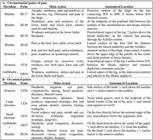
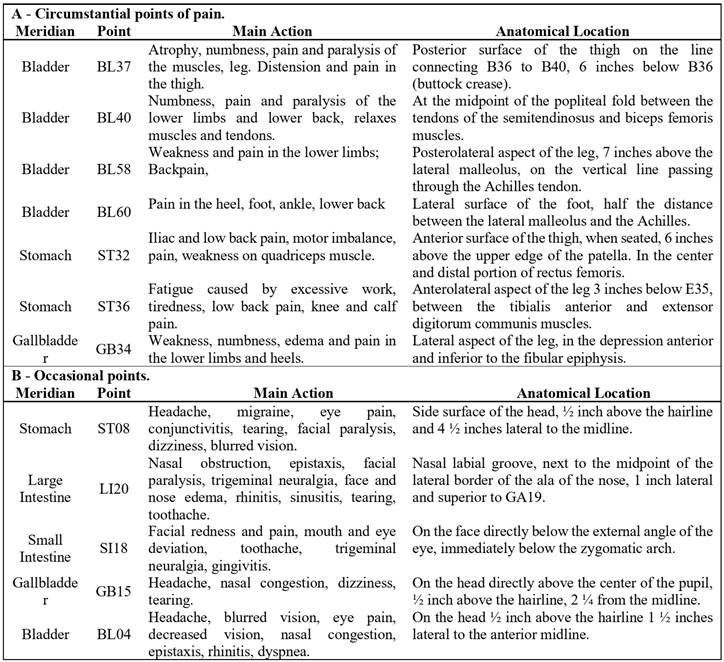
The technique lasted thirty minutes; and the needles were manipulated during insertion with a 90° counter clockwise rotation with the aim of causing “sedation”, that is, a potential for local relaxation at the applied point, and applied bilaterally. We used stainless steel acupuncture needles from the Dong Bang ® brand, measuring 0.25 x 40, sterile for individual use, which were discarded after use in a container suitable for collecting sharp material, Descarpack ®, and were taken for disposal in sharp material collection site, this procedure aims to avoid contamination of the participants and/or the researcher during the needle insertion procedure. We selected the points as described in Chart 1, Figure 1 according to the bibliography consulted as being the most efficient indicated for the treatment of painful processes, fatigue, cramps in the lower limbs and lower back.17
Group B - Placebo treatment protocol
The selected points according to the researched literature are located on the head and face, have their main actions not related to reducing pain in the lower and upper limbs, back or chest region, but have related to pathologies located on the face, like headache, orofacial pain, respiratory diseases, ocular and neurological disorders The points chosen for this group are called occasional and are described in the Chart 1, Figure 2, the technique lasted thirty minutes; without needle manipulation, the objective is not to cause relaxation as done in group A, they were punctured unilaterally and have no effect on the trunk and lower limbs, as previously reported.17
We must highlight that, according to extensive bibliographical research carried out, also described by several authors, it is very difficult to create a placebo technique with needle insertion without causing any effect on the body. Several authors have tried placebos without insertion, which cannot be considered a placebo, as without there being physical action on the point it was, therefore, not stimulated, being equated to no action. So, we decided to use acupuncture with needle insertion for this group.18


Group C- Control
After applying the fatigue induction protocol, group C did not undergo any intervention. But they were asked to wait and rest in a sitting position for thirty minutes; so that the same recovery and rest time criteria were used as the other groups.
Group D- Photobiomodulation treatment protocol
Underwent the photobiomodulation treatment protocol using the same anatomical locations of the acupuncture points used in group A, already described in Chart 1.
The treatment lasted 12 min; and the individuals were asked to wait and rest in a sitting position for 18 minutes; so that the same recovery and rest time criteria were used as the other groups, we use this parameter: (Wave-length 830 nM, power 100 mW, dose 1,785 j/cm2, time 50 seconds per point). We use a laser model: 830 nm Thera Laser; from the DMC® brand, manufactured in São Carlos, SP, Brazil, and are the same as those used in the study from Leal Júnior et al.20
We are not using the same points in this study, because not all points are completely coincident with acupuncture points, and in our study, we aim to try to analyze whether acupuncture is effective or not. In this way, we will only use the parameters from the study mentioned below, with the points being the same as those from group A like as described in Chart 1, Figures 1 and 2.
Results
We can consider that the sample was representative as it was selected from a group of university students who performed some type of physical activity during the week, and were therefore not sedentary and/or amateur or professional athletes.
Table 2 and Figure 3 and show that there is a significant difference before and after intervention in group A, and D the difference between of the sum of the height median for the CMJ 1 and 2, calculated using the equation:
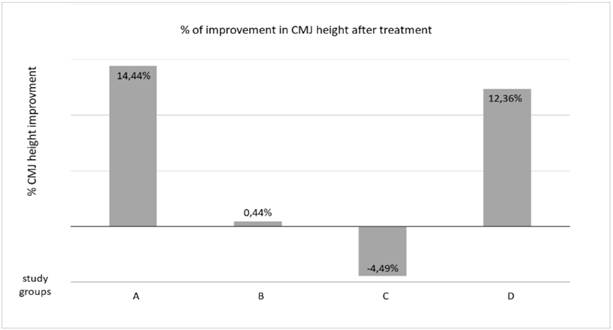
is (2.60 cm, and 2.45 cm) with (d = 0.387 and 0.413) respectively, for (p < 0.001). On Figure4 we can see the evolution of height gain representing (14.44% and 12.36%) respectively.

Comparative analysis between the sum height median of (CMJ) 1 and 2, and difference between [CMJ (J2 - J1)].

When we analyze the same data in the other groups, we can also see in the same Chart 4 and Figures3and4, that in group B the difference between the median height CMJ 1 and 2; using the same equation is (+ 0.08 cm), with (d = 0.013), for (p = 1), representing (0.44%) gain in jump height, this value it considered stable, demonstrating there is no statistical difference intra-group in this case. For group C where there was no intervention, the difference between the median heights between CMJ 1 and 2, is (-0.76 cm), with (d = - 0.122), for (p = 0.045), representing a yield loss of (- 4.49%), demonstrating there is no statistical difference intra-group in this case also, with and an evident worsening of results between one test and another. Making it clear that the fatigue generation protocol was able to accomplished the objective.
Analysis of variance (ANOVA) demonstrated that for the CMJ it statistically significant differences within groups, based on the interaction of group and treatment factors:
, as we can see in Table 3. A posteriori paired comparisons indicated that the interventions had significant positive effects on post-intervention fatigue indices in groups A and D.
Discussion
In our study, the sample was composed of active individuals. During our bibliographical research, when we compared similar studies with the generation of fatigue through CMJ with compared treatment protocols, we no found similar researches with our work. So, we can say that according to the papers analyzed we do not have studies that compared acupuncture and photobiomodulation as a treatment method for the effects of fatigue.
In a study on Kuitunen et al.21 sought to verify the voluntary activation and mechanical performance of the triceps surae after fatigue, stating that there are several factors that cause fatigue, including the decrease in the pre-activation of the knee extensor muscle fibres (quadriceps) in association with central fatigue and peripheral which could explain the local fatigue. We verified, in our study, local fatigue when applying the fatigue protocol, and in most cases just after 30 repetitions of the CMJ, which does not correspond to central fatigue, but rather to peripheral fatigue.
When talking about acupuncture and post-intervention CMJ; Hübscher et al.22, sought to verify the immediate effects of acupuncture on strength performance and evaluated, through electromyography, the parameters of strength, height and power, determining that there was no significant increase in the height of the maximum jump with a bipedal fall, compared to the treatment with acupuncture, placebo acupuncture and control group; but identified a significant increase in the maximum isometric strength of the quadriceps. This corroborates our findings, although the placebo method in this study was different from ours, we found during our study, that there was a significant increase on CMJ height, especially in comparison with the control group, as already demonstrated in the results presented in Chart 3 and Figure 3 and 4.
In the case of the CMJ; Loturco et al.23, evaluated a group of elite sprinters using the CMJ and force platform and found that after applying the tests, the relationship between CMJ height and sprint capacity affects the competitive level of sprinters, establishing that it is possible that improvements in CMJ height in these group of athletes may result in better sprint performances, without however establishing the relationship between an increase in height in centimetres corresponding to an improvement in speed in seconds. This was also verified in our study, in the data presented in Chart 3 and in Figures 3 and 4 in both group A and D.
Analyzing the effect of photobiomodulation in athletes; Leal Junior et al.24, identified that photobiomodulation can delay the perceived onset of muscle fatigue and exhaustion. Its photobiomodulation parameters are the same as those used in our study and corroborate our results.
In a systematic review consisting of 13 articles, Leal Junior et al. (25, identified that there is an improvement in performance in skeletal muscles during exercise and can accelerate recovery when applied before exercise, according to their research.
In one study that analyzed the asymmetry of knee muscle stiffness; Vieira, 26, identified that there was a reduction in knee joint stiffness, and the maintenance of vertical stiffness after the muscle fatigue induction protocol, but identified that there were no significant differences when comparing the asymmetry of knee joint stiffness and vertical movement stiffness of the lower limbs, in the eccentric action of the CMJ, before and immediately after carrying out a muscle fatigue induction protocol. We verified in our study, from the reports of the individuals tested that there was the appearance of muscular rigidity in some cases, however it was not evident that this rigidity was the factor that prevented the continuation of the execution of the CMJ, but the inability to generate force to continue the jumps.
Now for Rodacki et al. 27, the decline in the muscle ability to produce force was the main factor responsible for the decrease observed in jump height after fatigue. This was also verified by us when carrying out the fatigue induction protocol.
In the case of healthy and sedentary individuals Farias 28, observed that, after undergoing a fatigue induction protocol, they presented changes in postural control during static stabilometric tests, which can be interpreted to increased neuromuscular response to try to overcome the instability generated by fatigue. Although we did not analyze stabilometry in our study, we were able to observe that during the application of the fatigue induction protocol, when the individuals were already close to reaching the point of muscular fatigue, we observe this postural instability, most likely resulting from the effects of fatigue on the muscle control.
Analyzing the performance of vertical jump Knihs 29, identified that shortly after applying the protocols there was an influence of the acute effects of fatigue on jumping performance, while the performance responses analyzed on 24h and 48h could indicate subacute responses to fatigue or muscle damage generated by the protocols.
Our study was carried out in a single moment for individuals for no more than 45 minutes, therefore it was not possible to evaluate what the effects of fatigue would be over longer intervals of time, and this would also open up another possibility, which would be the analysis of the effect of delayed onset muscle soreness on the generation of muscle strength and the jumping performance 24 and/or 48 hours after the interventions. And sought analyze active individuals who were subjected to a fatigue induction protocol and treated on a treatment protocol with acupuncture and photobiomodulation to try to minimize the effects of this fatigue, and in our bibliographical research. And we did not find similar studies with the same fatigue generation, treatment and sample characteristics as our study.
Conclusion
Therefore, when analyzing the primary goals, we found that both methods showed an improvement in the CMJ values, on the groups where the treatment protocol was applied (A and D), these data are equivalent to an improvement in performance in percentage points of the (+14.44%) for the group A and (+12.36)% for the group D, the effects of both acupuncture and photobiomodulation are positive and were able to minimize the effects of muscle fatigue, which may suggest that there was an increase in the generation of muscle contraction without presenting limitations in the execution of movements. Analyzing the secondary goals, due to the very close values, it is not possible to say that one treatment protocol stands out over the other, as both were efficient in minimizing the effects of muscle fatigue.
It is also possible to state that individuals were able to perform and even overcome the same workload after applying the intervention protocols, making it evident that groups A and D have a clearly more efficient response than groups B and C, so also according to the data presented, the protocol generate fatigue on group C, since the individuals were unable to reverse the initial condition.
We conclude that based on the results found and presented, there’s possible acupuncture and laser are efficient in minimizing the effects of fatigue after the application of a fatigue generation protocol. With an indication that these treatment protocols can enhance muscular performance and can be generate gain in height jump post-intervention.
More studies are needed in order to identify which factors may be responsible for this improvement in CMJ height, analyzing other variables, such as: pain, power and muscle strength to determine whether there is a gain in these indicators and what this value would be.
As well as different samples involving athletes and sedentary individuals with a larger number of individuals, thus being able to determine whether there is an adequate parameter of improvement compared to methods already extensively studied such as medication, cryotherapy treatments, thermotherapy, massage therapy, among others.
During the study, there were limitations to a larger collection of individuals for the sample, the low adherence to participation in the project and the lack of knowledge and clarification of individuals about the possibility of a severe painful sensation caused by acupuncture, limited us in obtaining a larger number of participants. The Covid 19 pandemic also greatly delayed data collection, as we were forced to stop testing on several occasions due to isolation orders imposed by health bodies. In view of these challenges, the sample presented was the one that was possible to achieve in this scenario.
Acknowledgements:.
We would like to thank the students at UNIFESP/São José dos Campos campus, who volunteered to collaborate with this research, whose collaboration allowed us to achieve the goals and meet determined deadlines and objectives.
References
-
1 Ascensão A, Magalhães J, Oliveira J, Duarte JA, Soares J. Fisiologia da fadiga muscular: Delimitação conceitual, modelos de estudo e mecanismos de fadiga de origem central e periférica. Rev Port Cien Desporto. 2003;3(1):108. DOI: 10.5628/rpcd.03.01.108.
» https://doi.org/10.5628/rpcd.03.01.108 -
2 Abd-Elfattah HM, Abdelazeim FH, Elshennawy S. Physical and cognitive consequences of fatigue: A review. J Adv Res. 2015;6(3):351-358. DOI: 10.1016/j.jare.2015.01.011.
» https://doi.org/10.1016/j.jare.2015.01.011 -
3 Woledge RC. Possible effects of fatigue on muscle efficiency. Acta Physiol Scand. 1998;162(3):267-273. DOI:10.1046/j.1365-201X.1998.0294e.x.
» https://doi.org/10.1046/j.1365-201X.1998.0294e.x -
4 Barlas P, Robinson J, Allen J, Baxter GD. Lack of effect of acupuncture upon signs and symptoms of delayed onset muscle soreness. Clin Physiol. 2000;20(6):449-456. DOI:10.1046/j.1365-2281.2000.00280. x.
» https://doi.org/10.1046/j.1365-2281.2000.00280. x -
5 Parisotto D. Efeito imediato da aplicação da acupuntura na dor muscular tardia e na capacidade de contração muscular [dissertation]. Curitiba: Universidade Federal do Paraná; 2014. [accessed 2022 Sept 20]. Avaliable from: http://hdl.handle.net/1884/37102
» http://hdl.handle.net/1884/37102 -
6 Silvério-Lopes S, Mota MPGD. Influência da acupuntura no limiar de percepção dolorosa de musculatura submetida a esforço repetitivo. Braz J Pain. 2018;1(3):207-211. DOI:10.5935/2595-0118.20180041.
» https://doi.org/10.5935/2595-0118.20180041 -
7 Vanin AA, Miranda EF, Machado CSM, de Paiva PRV, Albuquerque-Pontes GM, Casalechi HL, et al. What is the best moment to apply phototherapy when associated to a strength training program? A randomized double-blinded placebo-controlled trial: Phototherapy in association to strength training. Lasers Med Sci. 2016; 31:1555-1564. DOI:10.1007/s10103-016-2015-7.
» https://doi.org/10.1007/s10103-016-2015-7 -
8 Zhao ZQ. Neural mechanism underlying acupuncture analgesia. Prog Neurobiol. 2008;85(4):355-375. DOI: 10.1016/j.pneurobio.2008.05.004.
» https://doi.org/10.1016/j.pneurobio.2008.05.004 -
9 Hübscher M, Vogt L, Bernhörster M, Rosenhagen A, Banzer W. Effects of acupuncture on symptoms and muscle function in delayed-onset muscle soreness. J Altern Complement Med. 2008;14(8):1011-1016. DOI:10.1089/acm.2008.0173.
» https://doi.org/10.1089/acm.2008.0173 -
10 Karu TI, Pyatibrat LV, Afanasyeva NI. Cellular effects of low power laser therapy can be mediated by nitric oxide. Lasers Surg Med. 2005;36(4):307-314. DOI:10.1002/lsm.20148.
» https://doi.org/10.1002/lsm.20148 -
11 Alves VMN, Furlan RMMM, Motta AR. Immediate effects of photobiomodulation with low-level laser therapy on muscle performance: An integrative literature review. Rev CEFAC. 2019;21(4). DOI:10.1590/1982-0216/201921412019.
» https://doi.org/10.1590/1982-0216/201921412019 -
12 Lopes-Martins RAB, Marcos RL, Leonardo PS, Prianti Jr AC, Muscará MN, Aimbire F, et al. Effect of low-level laser (Ga-Al-As 655 nm) on skeletal muscle fatigue induced by electrical stimulation in rats. J Appl Physiol. 2006;101(1):283-288. DOI:10.1152/japplphysiol.01318.2005.
» https://doi.org/10.1152/japplphysiol.01318.2005 -
13 Komi PV, Bosco C. Utilization of stored elastic energy in leg extensor muscles by men and women. Med Sci Sports. 1978;10(4):261-265. PMID: 750844. https://pubmed.ncbi.nlm.nih.gov/750844/
» https://pubmed.ncbi.nlm.nih.gov/750844/ -
14 Braz TV, Pennati ES, Spigolon LMP, Vieira NA, Pellegrinoti IL, Borin JP. Comparação entre diferentes métodos de medida do salto vertical com contramovimento. Rev Bras Cien Mov. 2010;18(2):43-49. DOI: 10.18511/rbcm. v18i2.1234
» https://doi.org/10.18511/rbcm. v18i2.1234 -
15 Skurvydas A, Jascaninas J, Zachovajevas P. Changes in height of jump maximal voluntary contraction force and low-frequency fatigue after 100 intermittent or continuous jumps with maximal intensity. Acta Physiol Scand. 2000;169(1):55-64. DOI:10.1046/j.1365-201x.2000.00692. x.
» https://doi.org/10.1046/j.1365-201x.2000.00692. x - 16 Pomeranz B, Stux G, Berman B. Basics of acupuncture. Berlin: Springer; 2003. [accessed2022 Oct 23].
-
17 Medeiros R, Saad M. Acupuncture: Physiological effect beyond the placebo effect. Mundo Saude. 2009;33(1):69-72. DOI: 10.15343/0104-7809.200933.1.10.
» https://doi.org/10.15343/0104-7809.200933.1.10 -
18 Vincent C, Lewith G. Placebo controls for acupuncture studies. J R Soc Med. 1995;88(4):199. [accessed2022 Jan 15] Available from: Available from: https://www.ncbi.nlm.nih.gov/pmc/articles/PMC1295163/
» https://www.ncbi.nlm.nih.gov/pmc/articles/PMC1295163/ - 19 Sussmann DJ. Acupuntura: Teoría y práctica. Buenos Aires: Kier; 2000.
-
20 Leal Junior ECP, Lopes-Martins RAB, Vanin AA, Baroni BM, Grosselli D, De Marchi T, et al. Effect of 830 nm low-level laser therapy in exercise-induced skeletal muscle fatigue in humans. Lasers Med Sci. 2009;24(3):425-431. DOI:10.1007/s10103-008-0592-9.
» https://doi.org/10.1007/s10103-008-0592-9 -
21 Kuitunen S, Avela J, Kyröläinen H, Komi PV. Voluntary activation and mechanical performance of human triceps surae muscle after exhaustive stretch-shortening cycle jumping exercise. Eur J Appl Physiol. 2004;91(4):538-544. DOI:10.1007/s00421-003-1004-2.
» https://doi.org/10.1007/s00421-003-1004-2 -
22 Hübscher M, Vogt L, Ziebart T, Banzer W. Immediate effects of acupuncture on strength performance: A randomized controlled crossover trial. Eur J Appl Physiol. 2010;110(2):353-358. DOI: 10.1007/s00421-010-1510-y.
» https://doi.org/10.1007/s00421-010-1510-y -
23 Loturco I, Contreras B, Kobal R, Fernandes V, Moura N, Siqueira F, et al. Vertically and horizontally directed muscle power exercises: Relationships with top-level sprint performance. PLoS One. 2018;13(7). DOI: 10.1371/journal.pone.0201475.
» https://doi.org/10.1371/journal.pone.0201475 -
24 Leal Junior ECP, Lopes-Martins RAB, Dalan F, Ferrari M, Sbabo FM, Generosi RA, et al. Effect of 655-nm low-level laser therapy on exercise-induced skeletal muscle fatigue in humans. Photomed Laser Surg. 2008;26(5):419-424. DOI:10.1089/pho.2007.2160.
» https://doi.org/10.1089/pho.2007.2160 -
25 Leal-Junior ECP, Vanin AA, Miranda EF, de Carvalho PDT, Dal Corso S, Bjordal JM. Effect of phototherapy (low-level laser therapy and light-emitting diode therapy) on exercise performance and markers of exercise recovery: A systematic review with meta-analysis. Lasers Med Sci. 2015;30(3):925-939. https://pubmed.ncbi.nlm.nih.gov/24249354 DOI: 10.1007/s10103-013-1465-4.
» https://doi.org/10.1007/s10103-013-1465-4» https://pubmed.ncbi.nlm.nih.gov/24249354 -
26 Vieira TM. Influência da fadiga muscular na assimetria da rigidez dos membros inferiores [dissertation]. Belo Horizonte: Universidade Federal de Minas Gerais; 2019. [accessed2023 Feb 12]Available from:Available from:http://hdl.handle.net/1843/30594
» http://hdl.handle.net/1843/30594 -
27 Rodacki AL, Fowler NE, Bennett SJ. Multi-segment coordination: Fatigue effects. Med Sci Sports Exerc. 2001;33(7):1157-1167. https://www.researchgate.net/publication/11895211_Multi-segment_coordination_Fatigue_effects DOI: 10195-9131/01/3307-1157/$3.00/0.
» https://doi.org/10195-9131/01/3307-1157/$3.00/0» https://www.researchgate.net/publication/11895211_Multi-segment_coordination_Fatigue_effects -
28 Farias RV. Avaliação do equilíbrio estático após a indução de fadiga muscular em membros inferiores [dissertation]. Teresina: Universidade Federal do Piauí; 2018. [accessed2023 Feb 15] Available from: Available from: http://repositorio.ufpi.br:8080/xmlui/handle/123456789/1047
» http://repositorio.ufpi.br:8080/xmlui/handle/123456789/1047 -
29 Knihs DA. Efeitos agudos e subagudos da fadiga induzida por diferentes cargas de trabalho sobre a simetria da rigidez e da coordenação no salto vertical [dissertation]. Florianópolis: Universidade Federal de Santa Catarina; 2019. [accessed2023 Feb 17] Available from: Available from: https://repositorio.ufsc.br/handle/123456789/206336
» https://repositorio.ufsc.br/handle/123456789/206336

 Source: authors
 Source: Adapted from Sussmann
  Source: Adapted from Sussmann
  Source: authors.
 Source: authors.