
 THE EFFECT OF ARTIFICIAL INTELLIGENCE-POWERED EDUCATIONAL TOOLS ON PHYSICAL EDUCATION AND SPORT PRE-SERVICE TEACHERS' CURRICULUM LITERACY
ABSTRACT
This study examined the association between the use of AI-powered educational tools and Physical Education and Sports pre-service teachers’ curriculum literacy outcomes within an explanatory sequential mixed-methods design. The quantitative part employed a quasi-experimental pretest–posttest single-group design, and the qualitative phase used a phenomenological approach. Participants were 30 Physical Education and Sports pre-service teachers (10 female, 20 male). Quantitative data were collected using the Curriculum Literacy Scale, while qualitative data were gathered through a semi-structured interview form informed by the Technology Acceptance Model (TAM). The intervention lasted seven weeks. During the process, participants used AI-powered tools (MagicSchool and Eduaide) to design and evaluate unit plans, daily lesson plans, 5E lesson plans, cooperative learning activities, and question–answer tasks. Quantitative data were analyzed using a paired-samples t-test, and qualitative data were analyzed via descriptive content analysis. Results indicated a statistically significant difference between pretest and posttest curriculum literacy scores in favor of the posttest. Qualitative findings yielded themes reflecting participants’ perceptions and intentions regarding the use of AI-powered tools, interpreted through TAM-related constructs. Overall, the findings suggest that integrating AI-powered educational tools into planning and instructional design practices in Physical Education and Sports teacher curriculum warrants further implementation and research.
Keywords:
Curriculum literacy; Preservice teacher; Artificial intelligence; Physical Education and Sport Teacher
RESUMO
Este estudo examinou a associação entre o uso de ferramentas educacionais apoiadas por inteligência artificial (IA) e os resultados de letramento curricular de licenciandos em Educação Física e Esporte, por meio de um delineamento de métodos mistos sequencial explicativo. A etapa quantitativa utilizou um delineamento quase experimental de grupo único com pré-teste e pós-teste, e a etapa qualitativa adotou uma abordagem fenomenológica. Participaram 30 licenciandos (10 mulheres, 20 homens). Os dados quantitativos foram coletados com a Curriculum Literacy Scale, e os qualitativos com um roteiro de entrevista semiestruturada fundamentado no Technology Acceptance Model (TAM). A intervenção durou sete semanas. Nesse período, os participantes utilizaram as ferramentas apoiadas por IA (MagicSchool e Eduaide) para elaborar e avaliar planos de unidade, planos diários de aula, planos no modelo 5E, atividades de aprendizagem cooperativa e tarefas de perguntas e respostas. Os dados quantitativos foram analisados por teste t para amostras pareadas, e os qualitativos por análise de conteúdo descritiva. Os resultados indicaram diferença estatisticamente significativa entre os escores de pré-teste e pós-teste de alfabetização curricular, em favor do pós-teste. Os achados qualitativos geraram temas relacionados às percepções e intenções de uso, interpretados à luz de construtos do TAM. Em conjunto, os achados sugerem que integrar ferramentas educacionais apoiadas por IA às práticas de planejamento e design instrucional na formação de professores de Educação Física e Esporte merece maior implementação e investigação.
Palavras-chave:
Letramento curricular; Professor em formação; Inteligência artificial; Professor de educação física e esportes
Introduction
The Physical Education and Sports Curriculum aim to develop skills such as self-management, communication, cooperation, fair play, social responsibility, leadership, sensitivity, and respect for nature through sports and physical activities1. The curriculum is an arrangement of experiences covering all activities related to the teaching of a course2. Teachers are primarily responsible for implementing these experiences in educational environments. Therefore, it is crucial for educators to comprehend and implement the curriculum accurately and to organize students' learning experiences in line with the curriculum principles3. This also brings along the importance of curriculum literacy. Curriculum literacy is a competence that can add features such as understanding, interpreting, commenting on the curriculum, arranging the curriculum according to the current conditions, and eliminating deficiencies, if necessary4. In this aspect, curriculum literacy is a factor that enhances both the quality of teaching and teacher skills, contributing significantly to student success5 , 6. For this reason, studies aimed at increasing the curriculum literacy competencies of teachers or pre-service teachers to become teachers in the future are very important in achieving the goals of the Physical Education and Sports curriculum. In the literature, it is stated that physical education teachers consider themselves inadequate in the knowledge of curriculum7, and 56.25% of teachers have problems mastering the physical education and sport course curriculum8. Similarly, Özcan and Mirzeoğlu9 stated that 55% of the Physical education and sport teachers had difficulty in understanding the curriculum. Evaluating all these, there is a need for innovative teaching approaches that will improve the curriculum literacy competencies of physical education and sport teachers or pre-service teachers. At this point, artificial intelligence-powered educational tools can be utilized.
Artificial intelligence (AI), one of today's most important technologies, is the transfer of human intelligence to computers or machines by modelling10. On the other hand, AI refers to software or applications that enable computers to simulate human behaviour in tasks like inference, analysis, learning, problem-solving, pattern recognition, and decision-making11 , 12. In this respect, AI applications are seen as an important instrument in improving the quality of education13. For this reason, it is seen that AI-powered educational tools are widespread in educational environments. For example, ClassDojo helps teachers to manage their classrooms better by providing real-time analyses of student behaviour and engagement. Edx an AI-powered tool that can grade and provide feedback on student essays. TeacherKit an AI-powered tool that helps teachers manage administrative tasks. The tool can monitor and report students' behaviour. DreamBox an AI-powered tool provides real-time current curriculum by evaluating student performance. Research in the literature indicates that AI-powered applications like ChatGPT enhance students' learning experiences through interactive lesson plans, exercise programs, training methods, health, and nutrition14. It is stated that AI-powered educational tools are widely used in higher education15 - 18, student assessment12 , 19 - 23, data mining24 and intelligent tutoring systems25. With this study, AI-powered educational tools are expected to contribute to pre-service Physical Education and Sports teachers' future profession.
In the study based on technology acceptance theory, pre-service teachers were enabled to use AI-Powered Educational Tools (AIPET) in educational processes and their curriculum literacy competencies and their views on AIPET were investigated. Technology acceptance model is one of the most basic theories explaining the adoption of a new technology by individuals26. According to this model, the acceptance and use of a new technology is explained as the effect of the perceived usefulness, ease of use and attitudes of individuals about that innovation and technology on their usage intentions27 - 30 (Figure 1). The adoption of new technology by pre-service teachers will facilitate its effective use in their professional lives, leading to easier acceptance by new generations31. It is stated that the teachers find this technology useful and easy and using is increasing day by day by teachers, when the studies on the teachers acceptance of AIPET in the literature are considered32 - 34. Therefore, it is thought that studies on the integration of AI technologies into education and training processes are crucial.

There are studies investigating the curriculum literacy competencies of teachers and pre-service teachers in the literature35 - 38, but the studies investigating the curriculum literacy levels of Physical Education and Sports teachers and pre-service teachers are quite limited39 - 42. Additionally, it has been observed that there are not enough experimental studies on curriculum literacy skills. Similarly, there are not enough studies examining the effect of AI-Powered Educational Tools (AIPET) on curriculum literacy competencies. Considering all these, there is a need to investigate the effect of AIPET on the curriculum literacy competencies of pre-service Physical Education and Sports (PES) teachers. The aim of the study, designed in the perspective of the technology acceptance model, is to investigate the effect of AIPET on the curriculum literacy competencies of pre-service teachers studying in the PES teacher education program. The following questions were sought for this purpose.
1. How are the curriculum literacy competencies of pre-service PES teachers?
2. What is the effect of curriculum activities prepared with AIPET on the curriculum literacy competencies of pre-service PES teachers?
3. What are the opinions of pre-service PES teachers about AIPET?
The current study is intended to help the PES teachers to understand how they can use AIPET to support their teaching activities and how they can make their programs more effective with these tools. The explanatory sequential design intends to explain initial quantitative results with qualitative data by connecting the two databases. In this two-phase design, the first phase involves collecting quantitative data, analyzing the results, and then gathering qualitative data to explain the quantitative results in more detail.
Methods
Sample
Explanatory sequential design was employed to examine the effect of AIPET on the curriculum literacy competencies of pre-service teachers enrolled in a PES teacher education program. Explanatory sequential design, one of the mixed method designs, is used to obtain a wide perspective on the topic investigated43 , 44. The quantitative part of the study was modelled as a quasi-experimental pretest–posttest single-group design. In this design, the effect of the experimental procedure is tested with a single group study45. For the qualitative component, the study adopted a qualitative descriptive interview approach, informed by a phenomenological sensitivity in the sense that it sought to capture participants’ experiences and perceptions46.
The study group of the study was determined by Criterion Sampling method, one of the non-random sampling models. In the criterion sampling method, preferred to study and review all situations meeting some importance criteria, the criteria can be predetermined or determined by the researcher46 , 47. The criteria include studying in the PES Teaching program, succeeding in the courses of Educational Psychology and Introduction to Educational Science, and continuing with the Principles and Methods of Teaching course. The participants of the study consisted of 30 students studying in the PES Teaching Program at the School of PES of a State University in Turkey in the 2023-2024 academic year autumn term (Table 1).
The criterion for participation in the qualitative part of the study was to have participated in the experimental study investigating the effect of AIPET on curriculum literacy competencies. In the qualitative part of the study, 28 students studying in the PES Teaching program participated, and 2 students participating in the experimental study did not participate. Information about the participants is given in Table 2.
Procedures
“Curriculum Literacy Scale” developed by Akyıldız48 and “Interview Form” designed by the researchers were used as data collection tools in the study.
Curriculum Literacy Scale: The scale consists of 4 sub-dimensions; Curriculum Objectives, Curriculum Content, Learning-Teaching Process, and Assessment and Evaluation. Curriculum Goals sub-dimension aims to measure the literacy levels related to competencies of goals and aims, Curriculum Content related to program content competencies, Learning-Teaching Process related to learning and teaching process competencies, and finally Assessment and Evaluation related to assessment and evaluation competencies. In the original study, scale's Cronbach Alpha reliability coefficients were found to be .84 for Curriculum Goals, .90 for Curriculum Content, .94 for Learning-Teaching Process, .93 for assessment and evaluation, and .97 for the whole scale. In the current study, the Cronbach Alpha reliability coefficients for the sub-dimensions of the scale in the pretest were .92 for curriculum goals, .97 for curriculum content, .97 for learning and teaching process, .97 for assessment and evaluation and .99 for the whole scale. In the posttest, Cronbach Alpha reliability coefficients for the sub-factors of the scale were .89 for curriculum goals, .95 for curriculum content, .97 for learning and teaching process, .96 for assessment and evaluation, and .98 for the whole scale.
Interview Form: This form is a semi-structured interview form including questions about pre-service teachers' use of AIPET for teaching purposes. The pre-service teachers wrote their opinions in their own handwriting. Each pre-service teacher completed the interview form within 10-15 minutes. The activities conducted in all stages of the study are shown in Figure 2.
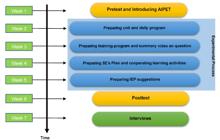
At the beginning of the experimental process, the Curriculum Literacy Scale as a pretest and posttest measurement tool was applied to the study group. During the process (4 weeks), MagicSchool and Eduaide applications, which can be used within the scope of Teaching Principles and Methods Course, were introduced to the study group. The pre-service teachers prepared unit plan, lesson plan, training plan, video summarising, generating questions from videos, lesson plans in accordance with 5E model, collaborative activities and individualised education program (IEP) for special needs students with the tools included in these applications. The application took 4 weeks and at the end of the application, a post-test was applied and the pre-service teachers were asked for their opinions on the use of AIPET for teaching purposes in the following week. The weekly activities carried out in the experimental group are given in Table 3 in detail week by week.
The ethical report was received by University Social and Human Sciences Ethics Committee with the date 06.12.2023 and number 280.
Statistical analysis
For the quantitative part of the study, the pre-test and post-test data collected for investigating the effect of AIPET on pre-service PES teachers' curriculum literacy were collected via www.kebirapor.com (online data collection platform). At the end of the experimental process, the data were transferred to the SPSS software and normality distribution was analysed at first. The results of the normality test are given in Table 4.
The results of the analyses showed that the Skewness and Kurtosis values were between -2 and +2 (see Table 4). Therefore, the data obtained were suitable for parametric tests49 , 50. Paired sample t-test analysis was performed on the quantitative data obtained from the participants. Qualitative interview data were analyzed using thematic content analysis guided by the Technology Acceptance Model (TAM).
Results
In this section of the study, the findings are presented according to each sub-problem. In this context, the findings of the first problem of the study, the curriculum literacy levels of pre-service PES teachers according to their pretest scores before experimental process, are presented in Table 5.
It is seen that the curriculum literacy competencies of the pre-service PES teachers vary between 3.86 and 3.88 and are at the level of “Mostly” (see Table 5). The findings of pre-service teachers’ curriculum literacy competencies according to the posttest scores after the experimental process are given in Table 6.
As it is obvious from the Table 6, the curriculum literacy competencies of the pre-service PES teachers vary 4.27 and 4.34 and the level of “Always”. It is seen that Curriculum literacy competencies of pre-service teachers increased after the experimental process.
Paired sample t-test analysis was performed to investigate the second problem of the study, determining the effect of curriculum activities carried out with AI-powered educational applications on the curriculum literacy competencies of pre-service PES teachers, and the results of the analysis are presented in Table 7.
As a result of the analysis from Table 7, a statistically significant difference was found between the pretest and posttest curriculum literacy scores of pre-service PES teachers, favoring the posttest. The effect sizes (Cohen’s d) ranged from .46 to .59, indicating a moderate magnitude51 , 52. Taken together, the results indicate a positive tendency in curriculum literacy scores after the AIPET activities.
In order to determine the third sub-problem of the study, the views of the pre-service PES teachers on AIPET, an interview form was applied to the students and content analysis was performed on the collected qualitative data in the perspective of Technology Acceptance Model. Among the items in the interview form of the students, “1- Have you ever used AI applications before the experimental application? If you have used them, please write their names?” The answers to the question are shown in Figure 3.

As it is seen in Figure 3 (a) that a majority of the pre-service PES teachers (n=18, f=57%) have used at least one AI application before. Pre-service PES teachers stated that they used ChatGPT (n=14, f=67%), SnapChat MyAll (n=6, f=28%) and Gemini (old name: Google Bard) (n=1, f=5%) in order of use (see Figure 3 (b)). A part of the pre-service PES teachers (n=12) stated that they have not used any AI application before.
The findings of the content analysis of the responses of pre-service PES teachers to the other items in the interview form in the perspective of technology acceptance model are presented in Table 8.
After the content analysis (see Table 8), five different themes related to the use of AIPET by pre-service teachers were observed. Accordingly, it was seen that most of the pre-service teachers' opinions (f=28) on the use of AIPET were in the Perceived Usefulness theme. The Perceived Usefulness theme contains the codes of Saving Time, Facilitating Learning, Contribution to Out-of-School, Material Richness, Personalised Learning, and Guidance. Perceived Ease of Use (f=23) theme follows this theme. The Perceived Ease of Use theme contains the codes of Ease of Planning, Lack of Technical Skills, Ease of Access to Information, Lack of Visual Content, Ease of Research, Language Problem, and Lack of Keywords. The theme of Anxiety (f=5) contains the codes of Concern and Addiction. The theme of Reluctance (f=3) contains the code of Laziness, and the theme of Motivation (f=1) contains the code of Intrinsic Motivation. This part of the study, quotations and comments related to the codes and themes are presented.
Some quotations related to the “Perceived Usefulness” theme are as follows:
“...it saves time since it minimises the speed that we can get to the subject or its content...” [S1]. “...a very useful application in order to save time...” [S22]. “...the AI application used saved time...” [S25]. “...For the student; provides systematic learning, provides better development, provides learning order...” [S14]. “...It helped me to do the homework easier and faster...” [S19]. “... for a better understanding of the lesson, games can be designed that are related to the lesson outside the lesson and at the same time the student can have fun...” [S6]. “...There are many benefits such as instant feedback, personalisation of learning...” [S17]. “...Providing guidance, giving sample ideas...” [S23].
Some quotations related to the “Perceived Ease of Use” theme are as follows:
“...thanks to the AI we used in this context, it provided easy implementation from the planning stage to the evaluation stage of the educational outcomes we wanted to implement...” [S2]. “...it was a very ideal solution for various planning and programs in a very short time...” [S11]. “...At the beginning, I had difficulty in every part of using the application because I was not familiar with computers generally...” [S10]. “...it is useful to convey the information we want to transfer to the student both in a short time and in terms of the appropriateness of the goals, targets and acquisitions...” [S20]. “...One of the parts I had the most difficulty with was finding external video and visual supporting examples while producing content, and one of the other parts I had difficulty with was translating foreign language themed applications...” [S3].
Some quotations related to the “Anxiety” theme are as follows:
“... I have a great concern that over time, it may blunt people's ability to make the necessary effort for research, scanning sources and accessing information and create a lazier, ready-made generation...” [S13]. “...I think that AI will cause bigger problems in the coming period. For example, it can seize us...” [S27]. “...of course, AI should be used in the future, but too much will lead both educators and students to ease. This is not something I support. I am in favour of everyone going through difficult periods and difficult exams...” [S4].
Some quotations related to the “Reluctance” theme are as follows:
“...the disadvantage of AI in education is that it can make students lazy...” [S19]. “... AI will prepare education and training programs and educators will not need to tire themselves. This is both good and bad because educators will not tire and use their brains, which will prevent the emergence of new ideas...” [S21].
Some quotations related to the “Motivation” theme are as follows:
“...It helped me to do the homework more willingly and comfortably...” [S19].
Discussion
When the pretest scores of the curriculum literacy competencies of the pre-service PES teachers were examined, their curriculum literacy levels appeared to be high. This finding is consistent with prior studies in the literature39 , 41 , 53. Similarly, another study54 examining teachers from different branches reported comparable curriculum literacy levels between PES teachers and teachers from other disciplines. Gülpek & Şahin39 also highlighted the similarity between PES teachers and pre-service PES teachers in terms of curriculum literacy. This pattern may be related to the practice-oriented nature of PES teaching, which can facilitate the enactment of theoretical knowledge in authentic instructional contexts. In addition, because PES programs admit students through a special skills examination, it is plausible that students’ prior field-specific competencies and sustained engagement in sports may be associated with higher curriculum literacy scores. Taken together, the results indicate that the participating pre-service PES teachers entered the study with relatively strong curriculum literacy competencies.
In the second sub-problem of the study, when the association between AIPET activities and curriculum literacy competencies was examined through pretest–posttest comparisons, it was found that there was a statistically significant difference in favour of the posttest in all sub-dimensions. However, since the study was designed as a single-group pretest–posttest quasi-experiment, these findings should be interpreted cautiously in terms of causal inference. Nevertheless, the results indicate a positive tendency in curriculum literacy scores following the implementation. Darayseh32 emphasised that AI offers great potential for teachers and students to access the information they need easily and quickly. In addition, rapid content generators, translation assistants, visual and voice advisor bots, course creators, student assessment tools, educational game generators, and collaborative educational activity generators can facilitate the work of students and teachers18 , 55. The MagicSchool and Eduaide applications used in the study allow students to create unit plans and lesson plans with limited input through tools such as the Unit Plan Generator and Lesson Plan Generator. In this context, it can be said that the use of these tools in the study group may be associated with higher competencies related to teaching goals. Similarly, the video summariser and IEP builder tools in MagicSchool enable teachers to prepare lesson content quickly. Eduaide provides advantages in producing collaborative teaching activities (puzzles, learning stations, think-pair-share, etc.) for the desired subject. The findings suggest that the structured use of these applications by pre-service teachers in the study group is accompanied by a positive tendency in competencies related to curriculum content and teaching–learning processes. Additionally, the video-question summarizing feature of MagicSchool and the tools in the questions section of Eduaide enable teachers to generate assessment materials. Calatayud et al.56 stated that AI offers substantial possibilities for student assessment, although not all of this potential has been reached yet. Bagunaid et al.57 integrated an AI-based algorithm into a learning management system to evaluate students and make recommendations and reported that the designed system evaluated student data more accurately and produced better suggestions than traditional methods. AI applications are expected to contribute to the creation and evaluation of assessment tools. In the present study, pre-service PES teachers used video-based question generation to create a multiple-choice assessment tool with the desired number of items in a short time. Considering these findings, it can be stated that the assessment-related features of AIPET are associated with more favourable posttest outcomes in the assessment and evaluation literacy sub-dimension; however, this interpretation should be made cautiously given the research design.
Another significant finding from the study is that most pre-service PES teachers are already utilizing existing AI tools. Many of the pre-service PES teachers in the study are aware of AI-powered tools and intend to use them. The analysis of the interview data gathered from pre-service PES teachers, within the perspective of the TAM, revealed that the following benefits were perceived: saving time, facilitating learning, contribution to out-of-school learning, material richness, personalised learning, and guidance. Ease of planning and ease of access to information were also emphasised. Some difficulties were identified, such as lack of technical skills, lack of visual content, language problems, and lack of keyword selection skills. Additionally, it was stated that AI technologies may create anxiety, cause addiction-related concerns, and lead to laziness. In the original TAM, “Perceived Usefulness” and “Perceived Ease of Use” explain the adoption of a new technology, which is mediated by attitude26. However, Venkatesh et al.30 compared various models and demonstrated that external factors (e.g., anxiety, effort expectancy, and social norms) also impact the intention to use technology. In this regard, it can be said that language problems, lack of technical skills, limitations related to visual content, anxiety, and reluctance may negatively influence intention and actual use. At the same time, these concerns should not be viewed only as resistance; they may also reflect critical professional judgment and ethical awareness about responsible technology use (e.g., maintaining pedagogical control, avoiding overreliance, and ensuring appropriate use). Several studies have indicated that pre-service teachers’ anxiety towards AI may hinder the effective integration of AIPET into education34 , 58 - 60. Therefore, the anxiety levels of pre-service teachers may be reduced by encouraging more guided interaction with AIPET and ensuring participation in AI literacy training, while also supporting reflective and ethically informed use.
Conclusion
Overall, the study identified statistically significant pretest–posttest differences in favor of the posttest across curriculum literacy and its sub-dimensions (curriculum objectives, curriculum content, learning–teaching process, and assessment and evaluation) among pre-service PES teachers, while the qualitative findings indicated that participants were generally open to AI-powered educational tools, reported intentions to use them in their professional practice, and emphasized benefits such as saving time, facilitating access to information, and supporting instructional planning—alongside concerns (e.g., anxiety, overreliance, reduced effort, language and skill-related difficulties) that may be interpreted not only as barriers but also as reflective professional judgment and ethical awareness regarding responsible technology use.
Although the study found significant effects of using AIPET in the PES curriculum, these results should be interpreted within some limitations: the single-group pretest–posttest design and the absence of a control group limit causal attribution; the small, local sample drawn from a single university restricts generalizability; the exclusive use of MagicSchool and Eduaide introduces a scope limitation that constrains transferability to other AI-powered educational tools and generative AI systems (e.g., ChatGPT, Gemini, Claude); the seven-week implementation period may be insufficient to capture change in slower-moving constructs such as attitudes toward AI; and reliance on a self-report curriculum literacy scale increases the risk of perceptual bias. Accordingly, future research should employ multi-group, control-group experimental designs with larger and more diverse samples across institutions; examine additional outcomes (e.g., learning–teaching process competence, curriculum fidelity, technology literacy, and AI literacy) using multiple data sources (performance tasks, instructional products, observation/rubrics, system logs); replicate the intervention with different AI tools; and deepen understanding of underlying mechanisms through qualitative inquiry (e.g., interviews, focus groups, reflective journals). In parallel, structuring AI literacy and effective/ethical prompting training within teacher education programs may support a more competent, critical, and pedagogically grounded use of AI as an instructional assistant in PES contexts.
References
-
1. MEB. Beden Eğitimi ve Spor Öğretim Programı [Curriculum of Physical Education and Sport]. Ankara: Ministry of National Education; 2018. n.d. [cited 2024 Oct 12]. Available from: https://mufredat.meb.gov.tr/ProgramDetay.aspx?PID=324
» https://mufredat.meb.gov.tr/ProgramDetay.aspx?PID=324 - 2. Demirel Ö. Kuramdan Uygulamaya Eğitimde Program Geliştirme [Curriculum Development in Education from Theory to Practice]. 7th ed. Ankara: Pegem; 2004.
-
3. Çetinkaya S, Tabak S. Curriculum literacy efficiency of preservice teachers. Ondokuz Mayis Univ J Educ. 2019;38(1):296-309. DOI: https://doi.org/10.7822/omuefd.535482
» https://doi.org/10.7822/omuefd.535482 -
4. Keskin A, Korkmaz H. Meaning given to the concept of “curriculum literacy” by teachers. In: Proceedings of the 5th International Conference on Curriculum and Instruction; 2017 Oct 26-28; Muğla, Turkey. n.d. [cited 2024 Oct 12]. Available from: https://epo-der.org/wp-content/uploads/2024/02/EPOK_2017_Abstract.pdf
» https://epo-der.org/wp-content/uploads/2024/02/EPOK_2017_Abstract.pdf -
5. Karagülle S, Varki E, Hekimoğlu E. An investigation of the concept of program literacy in the context of applicability and functionality of educational program. J Educ Reflections. 2019;3(2):85-97. n.d. [cited 2024 Oct 12]. Available from: https://izlik.org/JA78YD92UG
» https://izlik.org/JA78YD92UG -
6. Yıldırım VY, Dursun F. Development of the school administrators’ curriculum literacy levels scale. J Kirsehir Educ Fac. 2019;20(2):705-750. DOI: https://doi.org/10.29299/kefad.2019.20.02.007
» https://doi.org/10.29299/kefad.2019.20.02.007 -
7. Sağın AE, Karabulut Ö. Determination of the perceptions of physical education and sport teachers about pre-service education. Gaziantep Univ J Sport Sci. 2020;5(2):121-133. DOI: https://doi.org/10.31680/gaunjss.728004
» https://doi.org/10.31680/gaunjss.728004 -
8. Uğraş S. In which subject physical education teachers feel inadequate? Canakkale Onsekiz Mart Univ J Sport Sci. 2018;1(1):1-16. n.d. [cited 2024 Oct 10]. Available from: https://izlik.org/JA89XH74GW
» https://izlik.org/JA89XH74GW -
9. Özcan G, Mirzeoğlu AD. The visions of students, parents and physical education teachers as opposed to physical education curriculum. Amasya Educ J. 2014;3(1):98-121. DOI: https://doi.org/10.17539/aej.41060
» https://doi.org/10.17539/aej.41060 -
10. Atalay M, Çelik E. Artificial intelligence and machine learning applications in big data analysis. Mehmet Akif Ersoy Univ J Soc Sci Inst. 2017;9(22):155-172. DOI: https://doi.org/10.20875/makusobed.309727
» https://doi.org/10.20875/makusobed.309727 -
11. Hwang GJ, Xie H, Wah BW, Gašević D. Vision, challenges, roles and research issues of artificial intelligence in education. Comput Educ Artif Intell. 2020;1:100001. DOI: https://doi.org/10.1016/j.caeai.2020.100001
» https://doi.org/10.1016/j.caeai.2020.100001 -
12. Chen X, Xie H, Zou D, Hwang GJ. Application and theory gaps during the rise of artificial intelligence in education. Comput Educ Artif Intell. 2020;1:100002. DOI: https://doi.org/10.1016/j.caeai.2020.100002
» https://doi.org/10.1016/j.caeai.2020.100002 -
13. Pantelimon FV, Bologa R, Toma A, Posedaru BS. The evolution of AI-driven educational systems during the COVID-19 pandemic. Sustainability. 2021;13:13501. DOI: https://doi.org/10.3390/su132313501
» https://doi.org/10.3390/su132313501 -
14. Genç N. Artificial intelligence in physical education and sports: New horizons with ChatGPT. Akdeniz J Sport Sci. 2023;6(1 Suppl):17-32. DOI: https://doi.org/10.38021/asbid.1291604
» https://doi.org/10.38021/asbid.1291604 -
15. Zawacki-Richter O, Marín VI, Bond M, Gouverneur F. Systematic review of research on artificial intelligence applications in higher education: Where are the educators? Int J Educ Technol High Educ. 2019;16:39. DOI: https://doi.org/10.1186/s41239-019-0171-0
» https://doi.org/10.1186/s41239-019-0171-0 -
16. Zhao X, Cox A, Cai L. ChatGPT and the digitisation of writing. Humanit Soc Sci Commun. 2024;11:482. DOI: https://doi.org/10.1057/s41599-024-02904-x
» https://doi.org/10.1057/s41599-024-02904-x -
17. Sundberg L, Holmström J. Using no-code AI to teach machine learning in higher education. J Inf Syst Educ. 2024;35(1):1-11. https://doi.org/10.62273/CYPL2902
» https://doi.org/10.62273/CYPL2902 -
18. Wardat Y, Tashtoush MA, Alali R, Saleh S. Artificial intelligence in education: Mathematics teachers’ perspectives, practices and challenges. Iraqi J Comput Sci Math. 2024;5(1):60-77. DOI: https://doi.org/10.52866/ijcsm.2024.05.01.004
» https://doi.org/10.52866/ijcsm.2024.05.01.004 -
19. Mirchi N, Bissonnette V, Yilmaz R, Ledwos N, Winkler-Schwartz A, Del Maestro RF. The virtual operative assistant: An explainable artificial intelligence tool for simulation-based training in surgery and medicine. PLoS One. 2020;15:e0229596. DOI: https://doi.org/10.1371/journal.pone.0229596
» https://doi.org/10.1371/journal.pone.0229596 -
20. Janpla S, Piriyasurawong P. The development of an intelligent multilevel item bank model for the national evaluation of undergraduates. Univers J Educ Res. 2020;8:4163-4172. DOI: https://doi.org/10.13189/ujer.2020.080942
» https://doi.org/10.13189/ujer.2020.080942 -
21. Saplacan D, Herstad J, Pajalic Z. Feedback from digital systems used in higher education: An inquiry into triggered emotions. In: Transforming Our World through Design, Diversity and Education: Proceedings of Universal Design and Higher Education in Transformation Congress 2018. Amsterdam: IOS Press; 2018. p.421-430. DOI: https://doi.org/10.3233/978-1-61499-923-2-421
» https://doi.org/10.3233/978-1-61499-923-2-421 -
22. Samarakou M, Fylladitakis ED, Karolidis D, Früh WG, Hatziapostolou A, Athinaios SS, et al. Evaluation of an intelligent open learning system for engineering education. Knowl Manag E-Learn. 2016;8:496-513. DOI: https://doi.org/10.34105/j.kmel.2016.08.031
» https://doi.org/10.34105/j.kmel.2016.08.031 -
23. Rodriguez AA, Boticario JG, Finat C, Petrie H. Setting accessibility preferences about learning objects within adaptive e-learning systems: User experience and organizational aspects. Expert Syst. 2017;34:e12187. DOI: https://doi.org/10.1111/exsy.12187
» https://doi.org/10.1111/exsy.12187 -
24. Aruğaslan E, Çivril H. Data mining and artificial intelligence studies in the field of education in Turkey. Int J Technol Sci. 2021;13(2):81-89. n.d. [cited 2024 Oct 10]. Available from: https://izlik.org/JA36BF78KA
» https://izlik.org/JA36BF78KA -
25. Mousavinasab E, Zarifsanaiey N, Kalhori SRN, Rakhshan M, Keikha L, Saeedi MG. Intelligent tutoring systems: A systematic review of characteristics, applications, and evaluation methods. Interact Learn Environ. 2021;29(1):142-163. DOI: https://doi.org/10.1080/10494820.2018.1558257
» https://doi.org/10.1080/10494820.2018.1558257 -
26. Davis FD. Perceived usefulness, perceived ease of use, and user acceptance of information technology. MIS Q. 1989;13(3):319-340. DOI: https://doi.org/10.2307/249008
» https://doi.org/10.2307/249008 -
27. Güntepe ET, Usta ND. Use of educational technologies in learning environment: Algodoo in the framework of technology acceptance model. J Sivas Cumhuriyet Univ Inst Educ Sci. 2022;1(1):19-29. n.d. [cited 2024 Oct 9]. Available from: https://izlik.org/JA46XH74WP
» https://izlik.org/JA46XH74WP -
28. Granic A, Marangunic N. Technology acceptance model in educational context: A systematic literature review. Br J Educ Technol. 2019;50(5):2572-2593. DOI: https://doi.org/10.1111/bjet.12864
» https://doi.org/10.1111/bjet.12864 -
29. Legirs P, Ingham J, Collerette P. Why do people use information technology? A critical review of the technology acceptance model. Inf Manag. 2003;40(3):191-204. DOI: https://doi.org/10.1016/S0378-7206(01)00143-4
» https://doi.org/10.1016/S0378-7206(01)00143-4 -
30. Venkatesh V, Bala H. Technology acceptance model 3 and a research agenda on interventions. Decis Sci. 2008;39:273-315. DOI: https://doi.org/10.1111/j.1540-5915.2008.00192.x
» https://doi.org/10.1111/j.1540-5915.2008.00192.x -
31. Hamutoğlu NB. Cloud computing technologies: The adaptation studies of TAM3 scale into Turkish. Sakarya Univ J Educ. 2018;8(2):8-25. DOI: https://doi.org/10.19126/suje.297586
» https://doi.org/10.19126/suje.297586 -
32. Darayseh AA. Acceptance of artificial intelligence in teaching science: Science teachers’ perspective. Comput Educ Artif Intell. 2023;4:100132. DOI: https://doi.org/10.1016/j.caeai.2023.100132
» https://doi.org/10.1016/j.caeai.2023.100132 -
33. Nja CO, Idiege KJ, Uwe UE, Meremikwu AN, Ekon EE, Erim CM, et al. Adoption of artificial intelligence in science teaching: From the vantage point of African science teachers. Smart Learn Environ. 2023;10:42. DOI: https://doi.org/10.1186/s40561-023-00261-x
» https://doi.org/10.1186/s40561-023-00261-x -
34. Zhang C, Schießl J, Plößl L, Hofmann F, Zikuda MG. Acceptance of artificial intelligence among pre-service teachers: A multigroup analysis. Int J Educ Technol High Educ. 2023;20:49. DOI: https://doi.org/10.1186/s41239-023-00420-7
» https://doi.org/10.1186/s41239-023-00420-7 -
35. Aslan S, Gürlen E. Curriculum literacy levels of secondary school teachers. J Kirsehir Educ Fac. 2019;20(1):171-186. DOI: https://doi.org/10.29299/kefad.2018.20.01.006
» https://doi.org/10.29299/kefad.2018.20.01.006 -
36. Erdem C, Eğmir E. Prospective teachers’ levels of curriculum literacy. Afyon Kocatepe Univ J Soc Sci. 2018;20(2):123-138. DOI: https://doi.org/10.32709/akusosbil.428727
» https://doi.org/10.32709/akusosbil.428727 -
37. Keskin A, Korkmaz H. Development of teachers’ curriculum literacy perception scale. J Turk Educ Sci. 2021;19(2):857-884. DOI: https://doi.org/10.37217/tebd.917130
» https://doi.org/10.37217/tebd.917130 -
38. Yılmaz G, Kahramanoğlu R. Examining the relationship between curriculum literacy levels, curriculum orientations and curriculum fidelity levels of teachers. J Interdiscip Educ Res. 2021;5(10):178-187. n.d. [cited 2024 Oct 13]. Available from: https://izlik.org/JA47AX48CK
» https://izlik.org/JA47AX48CK -
39. Gülpek U, Şahin ŞK. Physical education and sports teachers’ curriculum literacy and education efficiency levels. Int J Humanit Art Res. 2023;8(Special Issue):11-26. DOI: https://doi.org/10.5281/zenodo.8256806
» https://doi.org/10.5281/zenodo.8256806 -
40. Atlı K, Kara Ö, Mirzeoğlu AD. Investigating physical education teachers’ perceptions about their curriculum literacy levels according to some variables. Gazi J Phys Educ Sport Sci. 2021;26(2):281-299. n.d. [cited 2024 Oct 13]. Available from: https://izlik.org/JA73WT78EK
» https://izlik.org/JA73WT78EK -
41. Işıkgöz ME. Analysis of the predictors affecting curriculum literacy levels of physical education teacher candidates. J Int Educ Sci. 2022;9(31):21-37. DOI: https://doi.org/10.29228/INESJOURNAL.62595
» https://doi.org/10.29228/INESJOURNAL.62595 -
42. Şınego GS, Çakmak M. Examination of education program literacy levels of teachers. J Kesit Acad. 2021;7(27):233-256. DOI: https://doi.org/10.29228/kesit.51337
» https://doi.org/10.29228/kesit.51337 - 43. Creswell JW, Creswell JD. Research design: Qualitative, quantitative, and mixed methods approach. 6th ed. Los Angeles: Sage; 2022.
- 44. Maral M. Açıklayıcı sıralı desen [Explanatory sequential pattern]. In: Özdemir A, editor. Karma yöntem araştırmaları [Mixed methods research]. 2nd ed. Ankara: Detay Yayıncılık; 2024. p.70-101.
- 45. Büyüköztürk Ş, Çakmak EK, Akgün ÖE, Karadeniz Ş, Demirel F. Bilimsel araştırma yöntemleri [Scientific research methods]. Ankara: Pegem; 2010.
- 46. Yıldırım A, Şimşek H. Sosyal bilimlerde nitel araştırma yöntemleri [Qualitative research methods in the social sciences]. 12th ed. Ankara: Seçkin; 2021.
-
47. Yağar F, Dökme S. Planning of qualitative researches: Research questions, samples, validity and reliability. Gazi Sağlık Bil. 2018;3(3):1-9. n.d. [cited 2024 Oct 10]. Available from: https://izlik.org/JA23JS34AK
» https://izlik.org/JA23JS34AK -
48. Akyıldız S. A conceptual analysis of curriculum literacy concept: A study of scale development. Electron J Soc Sci. 2020;19(73):315-332. DOI: https://doi.org/10.17755/esosder.554205
» https://doi.org/10.17755/esosder.554205 - 49. Almquist YB, Kvart S, Brännström L. A practical guide to quantitative methods with SPSS. Stockholm: Stockholm University; 2019.
- 50. George D, Mallery P. IBM SPSS statistics 26 step by step: A simple guide and reference. New York: Routledge; 2019.
-
51. Rice ME, Harris GT. Comparing effect sizes in follow-up studies: ROC area, Cohen’s d, and r. Law Hum Behav. 2005;29:615-620. DOI: https://doi.org/10.1007/s10979-005-6832-7
» https://doi.org/10.1007/s10979-005-6832-7 - 52. Cohen J. Statistical power analysis for the behavioral sciences. 2nd ed. Hillsdale (NJ): Lawrence Erlbaum Associates; 1988.
-
53. Korucuk M, Özlü M. Evaluation of educational program literacy of students receiving sports education. Mediterr J Sport Sci. 2023;6(2):456-475. DOI: https://doi.org/10.38021/asbid.1257305
» https://doi.org/10.38021/asbid.1257305 -
54. Berkant HG, Mansuroğlu C. The investigation of teachers’ curriculum literacy and reflective thinking tendencies. Ahi Evran Univ J Soc Sci Inst. 2022;9(1):97-116. DOI: https://doi.org/10.31592/aeusbed.1104843
» https://doi.org/10.31592/aeusbed.1104843 -
55. Fitria TN. Artificial intelligence (AI) in education: Using AI tools for teaching and learning process. Proc Semin Nas Call Pap. 2021;4(1):134-147. n.d. [cited 2024 Oct 10]. Available from: https://prosiding.stie-aas.ac.id/index.php/prosenas/article/view/106
» https://prosiding.stie-aas.ac.id/index.php/prosenas/article/view/106 -
56. Calatayud GV, Espinosa PP, Vila RR. Artificial intelligence for student assessment: A systematic review. Appl Sci. 2021;11:5467. DOI: https://doi.org/10.3390/app11125467
» https://doi.org/10.3390/app11125467 -
57. Bagunaid W, Chilamkurti N, Veeraraghavan P. AISAR: Artificial intelligence-based student assessment and recommendation system for e-learning in big data. Sustainability. 2022;14:10551. DOI: https://doi.org/10.3390/su141710551
» https://doi.org/10.3390/su141710551 -
58. Ayanwale MA, Frimpong EK, Opesemowo OAG, Sanusi IT. Exploring factors that support pre-service teachers’ engagement in learning artificial intelligence. J STEM Educ Res. 2024. DOI: https://doi.org/10.1007/s41979-024-00121-4
» https://doi.org/10.1007/s41979-024-00121-4 -
59. Yıldız İ, Taşhan A. Artificial intelligence: A threat or a facilitator? A qualitative study in the textile industry. Igdir Univ J Econ Adm Sci. 2023;9:1-14. DOI: https://doi.org/10.58618/igdiriibf.1187395
» https://doi.org/10.586818/igdiriibf.1187395 -
60. Falebita OS. Assessing the relationship between anxiety and the adoption of artificial intelligence tools among mathematics preservice teachers. Interdiscip J Educ Res. 2024;6:1-13. DOI: https://doi.org/10.38140/ijer-2024.vol6.20
» https://doi.org/10.38140/ijer-2024.vol6.20
-
Data Availability Statement:
The data supporting the findings of this study are available within the article.
Edited by
-
Editor:
Carlos Herold Junior
The data supporting the findings of this study are available within the article.

 Source:Davis
 Source:The authors
 Source: The authors