
 THE USES OF PIERRE BOURDIEU’S THEORY TO STUDY BODY AND HEALTH IN THE ACADEMIC-SCIENTIFIC FIELD OF PHYSICAL EDUCATION
ABSTRACT
This integrative literature review examines the use of Pierre Bourdieu’s concepts in the academic field of Physical Education (PE) in Brazil to explore body and health in scientific articles published from 2016 to 2021. The findings indicate that these concepts are often applied in isolation to support or refute arguments without systematically utilizing Bourdieu’s sociological framework. Such applications fall short of fully conveying the theoretical intentions of Bourdieu. Nonetheless, they reflect an attempt by PE researchers to critically engage with the theory of practice. Moreover, the review underscores the presence of inequalities and dominance within the realms of body and health in PE, particularly through economic and symbolic capital. It reveals how dominant players within these subfields continue to enforce domination via symbolic violence in both bodily practices and sports or public health contexts. The findings confirm that habitus dispositions are not innate, illustrating that the dominations and inequalities prevalent in the social sphere disproportionately impact those with less economic and cultural capital in terms of body and health.
Keywords:
Physical Education; Body; Health; Bourdieu; Integrative Review
RESUMO
Esta revisão integrativa da literatura analisa como o campo acadêmico-científico da Educação Física (EF) no Brasil utilizou os conceitos operados por Pierre Bourdieu para estudar corpo e saúde em artigos científicos publicados entre 2016 e 2021. Resultados revelam que os usos apresentam-se, majoritariamente, isolados e refutam ou reforçam argumentos, não mobilizando os conceitos sistematicamente como propõe a teoria sociológica de Bourdieu. Assim, são insuficientes para explicar as intenções teóricas dos autores. Todavia, ratificam um esforço dos agentes do campo da EF para realizar um exercício reflexivo com a teoria da prática. Ademais, evidenciam desigualdades e dominações que atravessam o corpo e a saúde na EF, especialmente a partir do capital econômico e simbólico. Os agentes dominantes que estruturam os subcampos analisados, perpetuam as dominações, através do exercício da violência simbólica, nas práticas corporais, esportivas ou na saúde pública. As disposições dos habitus não são naturais, ratificando que as dominações e desigualdades que atravessam o espaço social atingem os que possuem menos capital econômico e cultural em relação ao corpo e à saúde.
Palavras-chave:
Educação Física; Corpo; Saúde; Bourdieu; Revisão Integrativa
Introduction
The academic-scientific field of Physical Education (PE) in Brazil is predominantly influenced by biomedical knowledge, which underscores a strong link between body, health, and physical fitness1),(2. This perspective has shaped PE’s professional practice and bolstered its scientific legitimacy3),(4. Since the second decade of the 21st century, there has been a significant increase in the dissemination of knowledge, particularly through the influence of individuals connected to the biodynamic sub-area5),(6.
However, in parallel, there is also a movement towards integrating the field of PE with the Human and Social Sciences, highlighted by an increase in teachers from the sociocultural sub-area7 and publications on body8, health9, and other topics such as sport and epistemology10),(11. From 2005 to 2017, the Thematic Working Group on Physical Activity and Health, during the Brazilian Congress of Sports Sciences, noted a rise in papers on PE and Public Health12. Andrade et al.13 reported that from 2009 to 2013, the predominance of papers using theoretical frameworks from the field at the institution’s events.
A deeper examination of this work is crucial for understanding its developments, advancements, and limitations. This can help identify the field’s dynamics and bolster the debate within PE’s sociocultural and pedagogical sub-areas, while addressing potential historical oversight14),15,(16.
Pierre Bourdieu’s works are a significant reference for the sociocultural and pedagogical subfield of PE. Between 2016 and 2020, PE articles applied Bourdieu’s theory to analyze various subjects, including volleyball17),(18; public sport and leisure policies in the journal Pensar a Prática19; thematic focus in PE postgraduate dissertations and theses20, and its methodological approaches21; electronic games in PE journals10; PE graduate dissertations and theses in the field11),(21; and exploring how the academic-scientific field of PE employs Bourdieu’s theory22.
However, Medeiros and Godoy23 reviewed studies in the Revista Brasileira de Ciências do Esporte from 1979 to 2007 and observed a lack of systematic use of Bourdieu’s relational concepts. Similarly, Brasil24 reviewed articles and materials in journals or graduate programs in PE from 1977 to 2017, finding that most employed Bourdieu’s work in a superficial, topical conceptual manner, as outlined in the types of theoretical appropriation proposed by Catani et al25.
Catani et al.25 outlined three types of appropriation: incidental, when the author’s texts appear solely in bibliographical references and not in the text body, lacking a direct relationship or appearing in footnotes; topical-conceptual, characterized by the isolated use of quotes or concepts in an occasional and unsystematized manner, to support arguments or results; and the way of working, when Bourdieu’s theoretical framework is employed systematically, engaging in a relational thought process with reflective exercise approach.
This highlights significant limitations because Bourdieu’s Theory of Practice or Praxiology - an analytical system considering the subject and social and symbolic aspects relationally26) - is grounded in concepts such as habitus, field, and capital. The habitus explains the dispositions that subjects incorporate through perception schemes. The field is a space for struggles and disputes between agents, with the aim of dominating and monopolizing capital, being structured according to the amount of capital accumulated by the agents. Capital comes in various forms and the main ones are: economic, cultural, social and symbolic27.
Historically, Bourdieu’s interest in body and health, evident since the 1960s, has covered topics such as gender, sport, sexuality and prostitution, integrating the body and health practices of individuals from various social classes into a sociological framework28),(29.
Understanding how body and health are discussed in relation to Bourdieu’s theory within PE is vital for uncovering the dynamics formed from a relational perspective. Thus, this review aims to analyze how scientific articles published in Brazil’s leading PE journals from 2016 to 2021 have used Bourdieu’s theory to discuss body and health, either separately or relationally. It seeks to pinpoint characteristics, concepts, themes, limitations, and advancements in theoretical appropriation.
Methodology
This article originates from a master’s research project conducted between 2020 and 2022 at the Federal University of Goiás30. It presents an integrative literature review31, framed by the question: “How does the academic-scientific field of PE in Brazil utilize Pierre Bourdieu’s theory to explore body and health from 2016 to 2021?” As a method, the integrative review employs a structured protocol to synthesize findings from existing bibliographic production31.
The search involved health databases such as BIREME (the Latin American and Caribbean Center), LILACS (Latin American and Caribbean Literature in Health Sciences), and SciELO (Scientific Electronic Library Online), as well as nine prominent PE journals: Movimento, Motrivivência, Pensar a Prática, LICERE (Interdisciplinary Leisure Graduate Program at the Universidade Federal de Minas Gerais), Revista Brasileira de Ciências do Esporte, Journal of Physical Education, Motriz: Journal of Physical Education, Revista Brasileira de Educação Física e Esporte, and Revista Brasileira de Atividade Física e Saúde. Selection of these journals was influenced by data from the Sucupira Platform (2013-2016), which signaled their ‘scientific prestige’ or the extent of their ‘symbolic capital’ within Brazil’s PE field24. This time frame (2016 to 2021) was chosen to build upon and refresh a prior study’s findings regarding the application of Bourdieu’s theory in Brazilian PE research24.
The search unfolded in two phases. The first, done during September and October 2020, paired Bourdieu’s theoretical descriptors with PE-related terms: Bourdieu AND Physical Education OR Sport, Football, Gymnastics, Leisure, Bodily Practices; and Sport AND Habitus OR Subfield. The subsequent phase, spanning from October 2020 to March 2021, employed the descriptors: Bourdieu, Habitus, Field, Distinction, Inequality, Symbolic Capital, Cultural Capital, Ethos, Hexis, Modus operandi, Subfield, Domination, and Symbolic Violence.
Descriptors were used in Portuguese and English in both phases. Initially, 690 texts were identified - 76 from databases and 614 from the selected PE journals. After removing 45 duplicates, 645 texts remained. Further refinement using inclusion criteria - being a scientific article published in an indexed journal, focusing on research conducted in Brazil, mentioning ‘Bourdieu’ within the text, and citing Bourdieu’s works in the bibliography - led to the exclusion of another 571 texts. Consequently, 74 articles were preliminarily chosen. A thorough review of their titles, abstracts, keywords, introductions, and references, facilitated by Adobe Acrobat Reader’s search function, narrowed the selection to 11 articles addressing body and/or health, either individually or in connection, thus forming the analytical corpus (Figure 1).
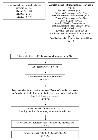
Flowchart for selecting articles to comprise the corpus of analysis for this review based on the integrative review model31.
The 11 articles selected were thoroughly read, and sections discussing the body and health were highlighted for further analysis. We identified the registration units within these passages. Then, thematic categories were developed using Bardin’s content analysis method32. This process was done a priori by the concepts and notions foundational to Bourdieu’s theoretical framework. We also identified and outlined, a posteriori, themes related to PE and body culture to support category analysis. Each highlighted excerpt underwent further analysis to determine the types of theoretical appropriation of Bourdieu’s work to facilitate discussion on body and health, based on the criteria established by Catani et al.25.
Results
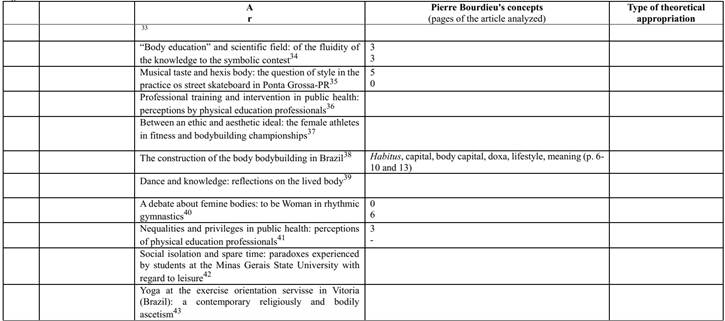
This review analyzed 11 scientific articles published in leading journals within the academic field of PE in Brazil from 2016 to 2021. These articles explored body and health through the lens of Pierre Bourdieu’s concepts (Chart 1). Notably, no articles meeting the inclusion criteria were published in 2021. The articles covered a broad spectrum, including body education and electronic movement games; training and performance of PE professionals in public health; gymnastics; dance; skateboarding; bodybuilding; yoga in Exercise Guidance Services; and social distancing practices during the COVID-19 pandemic.
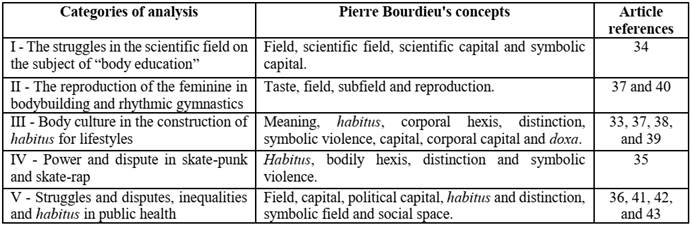
Through content analysis, we were able to pinpoint the Bourdieusian concepts and notions embedded in each article, as well as the types of theoretical engagement, based on the criteria established by Catani et al.25 (Chart 1). A significant observation was that the articles predominantly applied Bourdieu’s concepts either incidentally (n = 4) or in a topically conceptual manner (n = 4). Subsequently, the articles and the concepts they employed were categorized into five analytical categories (Chart 2).
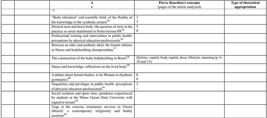
Articles on the body and health published between 2016 and 2021, concepts and types of theoretical appropriation of Bourdieu’s work and categories of analysis.
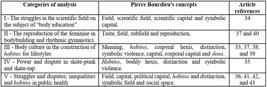
Categories of analysis and Pierre Bourdieu’s concepts used to discuss body and health in Physical Education from scientific articles published between 2016 and 2021.
In the first category - struggles in the scientific field of ‘body education’ - we understand from the utilized concepts that success in this field stems from the accumulation of both pure and institutionalized scientific capital. This accumulation is seen as the primary driver of movements benefiting agents in the ongoing struggles within the field. These concepts also highlight the symbolic battles aimed at gaining both scientific and symbolic capital, revealing the dynamics of academic-scientific production in PE, shaped by hegemonic trends. This sometimes leads to the migration of researchers to other knowledge domains34.
In the second category - the reproduction of femininity in bodybuilding and rhythmic gymnastics - the discussed concepts illustrate how the operational rules of these sports’ subfields generate preferences based on aesthetic choices. The application of the concepts of field and taste demonstrates how the reproduction of femininity, directed by the rules of these subfields, influences agents’ actions, reinforces gender stereotypes, and demands bodily sacrifices for continued participation37),(40. The notion of taste is crucial for understanding the perpetuation of gender stereotypes, particularly in bodybuilding, where achieving a body that aligns with feminine ideals is essential for competition success37),(40.
The third category - body culture in constructing lifestyles’ habitus - suggests that embedding habitus within the realm of body hexis fundamentally requires the systematic exertion of power within the agent’s field. This action articulates aesthetic identity tied to musical style and is linked to gestural aesthetics. Skateboarders, for example, develop body schemas that structure their habitus and guide their practical sense35. The dynamics of bodybuilding and lifestyle-related behaviors also influence this sport’s nature38. The dispositions rooted in the habitus are crucial for embracing dance knowledge39; likewise, players of Electronic Movement Games develop preferences and ascribe meanings to their practice based on their capital volume33.
The fourth category - power and conflict in skate-punk and skate-rap - showcases the conflicts among skateboarders of differing styles, rooted in musical aesthetics (punk rock and rap). It unveils symbolic domination enacted through style-specific practical actions35. The concepts discussed show the efforts aimed at securing domination over social space to monopolize power.
Finally, the fifth category - conflicts, inequality, and habitus in public health - illuminates the disputes inherent to public health across various contexts. The concepts detailed are intended to elucidate the experience of PE professionals, affected by symbolic violence originating from the dominant biomedical logic in the field. This influence extends to initial training and impedes professional performance in the public health sector36),(41),(42.
Discussion
This review found a limited number of scientific studies that applied Bourdieu’s framework to explore body and/or health. Additionally, the application of Bourdieu’s theory in the analyzed articles was limited, with few concepts used in a fragmented and unsystematic manner, failing to fully support the authors’ theoretical goals. This finding aligns with research by Medeiros and Godoy23 and Brasil24. Despite these limitations, the data suggest an effort within the PE community to engage with and apply Bourdieusian concepts, although this effort is incomplete. Such endeavors indicate PE’s progression towards fostering critical discussions on body and health, which are crucial for enhancing the sociocultural sub-area.
Baptista, Castro, and Ludorf34 researched ‘body education’ within the Brazilian scientific community, revealing that individuals affiliated with funding organizations like the National Council for Scientific and Technological Development are more likely to gain economic and symbolic capital, securing a more advantageous position in the field. In PE, the most recognized contributors are either part of the biodynamics sub-area or connected to other research domains (e.g., education), leading to a migration of researchers6),(44. This trend underscores PE’s growing focus on sociocultural and pedagogical sub-areas14 since the late 1990s15.
In studies related to the body, Oliveira, Silva, and Almeida37 examined fitness and bodybuilding competitions, while Boaventura and Vaz40 analyzed the portrayal of female bodies in rhythmic gymnastics. These studies showed that the symbolic representation of femininity in these sports is shaped by the impositions of the sports field, making such behaviors seem natural to the athletes and reinforcing dominance mechanisms.
The imposition of cultural norms, driven by the prevailing logic and manifested through educational practices, is defined by Bourdieu and Passeron45 as symbolic violence. These practices are essential for athletes to develop traits traditionally considered masculine (control, strength, endurance) yet representative of femininity (grace, beauty, delicacy)40.
This analysis is supported by research on Kabyle society46, which highlighted the social imposition of bodily standards. Bourdieu argued that women embody specific moral behaviors, dress codes, hairstyles, and even gazes, embedding feminine identities and behaviors as natural.
Barreto, Barros, and Oliveira Junior35, in their study on the musical aesthetics of two skateboarding groups and its influence on skateboarding style, identified elements of dominance. The skate-rap group, characterized by the speed and aggressiveness of their techniques and obstacles35, represents the ongoing conflict with skate-punk practitioners, illustrating symbolic violence. Bourdieu’s theory elucidates the strategic use of aesthetic imposition by musical styles to shape dispositions, practical sense, and symbolically dominate, thereby monopolizing power in social spaces. This confirms that aesthetics play a key role in the consolidation of power, reinforcing symbolic dispositions at the level of habitus45.
Understanding how body culture intersects with the construction of habitus for lifestyles reveals that a key mechanism guiding body-building practices is doxa - commonly held beliefs and opinions, as Bourdieu’s theory47 indicates. To solidify the discipline that shapes a bodybuilder’s physique38, doxic adherence is crucial for individuals to adapt to this lifestyle, as it relies on the internalization of body schemas necessary to adhere to the ‘rules of the game’.
Mendes, Franco, and Ohl38, in their study of bodybuilding in Brazil, highlighted the importance of the body as a significant asset for personal trainers or PE students. For them, muscle development is a key investment38, providing professional recognition and improving their field position. Additionally, controlling the athlete’s body to fit a hegemonic model - characterized by cleanliness and health, without alcohol or cigarettes - is vital for this strategy38. The imposition of ‘clean and healthy bodies’ was apparent in bodybuilding2),(38),(48, aiming to present health through low body fat and developed muscles, yet often overlooking the risks of anabolic steroids and their health consequences49),(50.
Nascimento39’s research on the construction of dance knowledge demonstrates that dispositions are essential for the continuous integration of knowledge, playing a critical role in incorporating body culture into an individual’s habitus. Another study by Silva Monteiro, Velasquez, and Silva33, examining scientific works on Electronic Movement Games in PE, found that the accumulation of capital influences tastes, which in turn shapes participants’ attitudes towards practice. The volume of capital is central to the development of agents’ perception schemes and dispositions, as observed in the subfield of electronic movement games33. According to Bourdieu51, taste forms dispositions crucial for developing a practical understanding of sport and body culture, influenced by the accumulated capital that drives specific behaviors according to the ‘rules of the game’.
Conversely, a study on the social space of public health through the Exercise Guidance Service reveals that habitus43, with enduring dispositions, originates from these spaces. Yoga classes in this context show the potential to create symbolic goods43, incorporating religiosity into the body as a ‘divine construction’. Despite habitus’s tendency to be conservative, Bourdieu explains that it can be modified and is not fixed51),(52.
In the context of public health, a study on COVID-19’s impact on university students highlighted the amplification of social inequalities42, notably affecting women, people of color, and those with limited financial resources and lack of access to technology, underscoring electronic devices as markers of social distinction. Bourdieu51 suggests that economic capital accumulation shapes life paths, with class habitus guiding tastes and choices. Analyzing PE professionals in public health, Neves and Assumpção41) found that the cultural capitals within the PE field indicate the challenges of altering established practices, emphasizing existing hierarchies. They also noted that the initial training in undergraduate health courses influences professional performance through the imposition of the university’s cultural norms, creating durable dispositions in the habitus, as indicated by Bourdieusian theory36),(52. However, PE professionals in public health services can perform legitimately due to political capital gained from student activism and extended pedagogical training, showing the significance of institutionalized cultural capital45),(51),(52. This interaction with public health’s internal logic and circumstances leads to struggles, disputes, symbolic violence, and reinforces professional inequalities, affirming that contexts like employment conditions, income distribution, and access to food are crucial for understanding the health-disease relationship53),(54.
Final considerations
This literature review identified 11 articles over a five-year period that applied Bourdieu’s theory to discussions on the body and health. These studies were published in five journals within the PE field: Movimento, Motrivivência, Licere, Pensar a Prática, and Revista Brasileira de Ciências do Esporte. The analysis revealed that these articles typically examined body and health in isolation to explore a variety of topics, including body education and electronic movement games; the training and roles of PE professionals in public health; gymnastics; dance; skateboarding; bodybuilding; yoga within Exercise Guidance Services; and social distancing during the COVID-19 pandemic. The findings suggest sparse scientific work on body and health utilizing Bourdieu’s theory within PE. Additionally, the articles demonstrated an unstructured application of Bourdieu’s concepts, often employed individually to support or challenge arguments. This approach reveals a limitation in theoretical application, lacking in depth to clearly articulate the authors’ theoretical intentions. Nonetheless, these publications showcase a reflective effort by PE field agents to advance the understanding of body and health within Brazilian PE.
In summary, the results illustrate that agent interactions within the PE field are predominantly influenced by economic and symbolic capital, shaping dispositions and conflicts. Dominant agents in the analyzed sub-fields maintain their positions through the exercise of symbolic violence, which is evident in bodily practices, sports, and public health sectors. Given that habitus dispositions are not innate but structured constructs, symbolic violence, domination, and inequalities, whether overt or concealed, pervade social spaces, affecting those with lesser economic and cultural capital in relation to body and health. Future research should explore these findings further using additional Bourdieu concepts and themes central to the PE academic-scientific field. Expanding to new journals and databases, including theses and dissertations, could enhance our comprehension of how Bourdieu’s theory is utilized by those structuring the field of Brazilian PE.
Acknowledgments:
This work was carried out with the support of the University of Brasilia’s2024 Budget Law (proc no. 71080012). Dean’s Office of Postgraduate Studies at the University of Brasilia, DPG Notice No. 0003/2024 (PPGEF internal notice 01/2024) - support for student permanence, maintenance, and development of postgraduate student research projects.
References
-
1 Paiva FSL. Notas para pensar a Educação Física a partir do conceito de campo. Perspectiva. 2004[accessed on:07 March 2024] ;22:51-82. Available from: Available from: http://educa.fcc.org.br/scielo.php?script=sci_arttext&pid=S0102-54732004000300004
» http://educa.fcc.org.br/scielo.php?script=sci_arttext&pid=S0102-54732004000300004 - 2 Soares CL. Educação Física: raízes europeias e Brasil. 3ª ed. Campinas: Autores Associados; 2004.
- 3 Lazzarotti Filho A. O modus operandi do campo acadêmico-científico da Educação Física no Brasil [tese]. Florianópolis: Universidade Federal de Santa Catarina; 2011. 95 p.
- 4 Carvalho YM. O “mito” da atividade física e saúde. 5ª ed. São Paulo: Hucitec; 2016.
-
5 Lazzarotti Filho A, Silva AM, Mascarenhas F. Transformações contemporâneas do campo acadêmico-científico da educação física no Brasil: novos habitus, modus operandi e objetos de disputa. Movimento [Internet]. 2014 [accessed on 16 mar. 2024];20 (esp):67-80. Available from: DOI: 10.22456/1982-8918.48280
» https://doi.org/10.22456/1982-8918.48280 -
6 Lazzarotti Filho A, Mascarenhas F, Stigger MP, Silveira R, Silva AM. Tendências no campo da educação física brasileira: análise dos documentos produzidos pela área 21 da Capes. Rev Bras Ciênc Esporte. 2018 [accessed on: 4 May 2023] Jul;40(3):233-41. Available from: DOI: 10.1016/j.rbce.2018.02.005
» https://doi.org/10.1016/j.rbce.2018.02.005 -
7 Gomes LC, Furtado HL, Souza Junior MBM, Silva MM. Programas de pós-graduação stricto sensu em educação física no Brasil: diversidades epistemológicas na subárea pedagógica. Movimento [Internet]. 2019[accessed on:16 March 2024] ;25.. DOI: 10.22456/1982-8918.84501.
» https://doi.org/10.22456/1982-8918.84501 -
8 Quixabeira AP, Ferreira RKA. Uma análise da produção do conhecimento em periódicos da Educação Física: o corpo em destaque (2012-2018). Rev. Eletr. Pesquiseduca [Internet]. 2021 [accessed on 1 Aug. 2024 ];13(29):373-85. DOI:10.58422/repesq.2021.e1040.
» https://doi.org/10.58422/repesq.2021.e1040 -
9 Mantovani TVL, Maldonado DT, Freire ES. A relação entre saúde e educação física escolar: uma revisão integrativa. Movimento [Internet]. 2021;27. DOI: 10.22456/1982-8918.106792.
» https://doi.org/10.22456/1982-8918.106792 -
10 Borsato M, Brasil MR, Oliveira VM, Mattes VV, Souza J. A produção acadêmico-científica sobre jogos eletrônicos em periódicos da área de Educação Física no Brasil. Motrivivência. 2019;31(60):1-21. DOI: 10.5007/2175-8042.2019e59692
» https://doi.org/10.5007/2175-8042.2019e59692 -
11 Frasson JS, Molina Neto V, Wittizorecki ES. A produção científica resultante de teses e dissertações em programas de pós-graduação em educação física no período de 2013 a 2017. Movimento [Internet]. 2019;25. DOI: 10.22456/1982-8918.85355
» https://doi.org/10.22456/1982-8918.85355 -
12 Antunes PC, Neves RLR, Pasquim HM. Panorama da produção científica do GTT Atividade Física e Saúde do CBCE: aproximações com a saúde pública. In: Wachs F, Lara L, Athayde P, organizadores. Atividade Física e Saúde. Natal: EDUFRN; 2020. Available from: Available from: https://public.cbce.org.br/arquivos/repositorio/.pdf Accessed on: 24 Jan. 2026.
» https://public.cbce.org.br/arquivos/repositorio/.pdf -
13 Andrade RVV, Espírito-Santo G, Moraes DR, Castiel LD. Práticas corporais no SUS: uma análise a partir das entidades Colégio Brasileiro de Ciências do Esporte - CBCE(Grupo de Trabalho Temático Atividades Física e Saúde - GTTAFS) e Sociedade Brasileira de Atividades Física e Saúde (SBAFS). In: Wachs F, Lara L, Athayde P, organizadores. Atividade Física e Saúde. Natal: EDUFRN ; 2020. Available from: Available from: https://public.cbce.org.br/arquivos/repositorio/Atividade.pdf Accessed on: 24 Jan. 2024.
» https://public.cbce.org.br/arquivos/repositorio/Atividade.pdf -
14 Silva RH, Sacardo MS, Sousa WL. Dilemas da política científica da educação física brasileira em tempos de produtivismo acadêmico. Movimento [Internet]. 2014[ accessed on 16 Apr. 2024];20(4):1563-85. DOI: 10.22456/1982-8918.43145.
» https://doi.org/10.22456/1982-8918.43145 - 15 Telles S, Lüdorf SMA, Pereira EG. Subáreas sociocultural e pedagógica na educação física: ainda a caminho do fim. In: Telles S, Ludorf SMA, Pereira EG, organizadores. Pesquisa em Educação Física: perspectivas sociocultural e pedagógica em foco. Rio de Janeiro: Autografia; 2017. p. 8-20.
- 16 Amaral SCF. Temas ressonâncias e dissonâncias da pós-graduação na formação de docentes/pesquisadores de/para educação física da região sudeste no nordeste brasileiro. In: Chaves-Gamboa M, Sánchez-Gamboa S, Taffarel C, organizadores. Produção do conhecimento em educação física no nordeste brasileiro: o impacto dos sistemas de pós-graduação na formação dos pesquisadores da região. Campinas: Librium; 2017. p. 106-17.
-
17 Lopez LA, Silveira R, Stigger MP. O campo da Educação Física visto a partir da produção acadêmica sobre voleibol. Rev Bras Ciênc Esporte. 2016 Jul;38(3):235-42. DOI: 10.1016/j.rbce.2013.09.005.
» https://doi.org/10.1016/j.rbce.2013.09.005 -
18 Moreira TS, Mezzadri FM, Souza DL, Moraes e Silva M. O perfil da produção científica em língua portuguesa sobre o voleibol. Motriv [Internet]. 2017;29(51):119-35. Accessed on: 28 March 2024. Available from: Available from: https://periodicos.ufsc.br/index.php/motrivivencia/article/view/2175-8042.2017v29n51p119
» https://periodicos.ufsc.br/index.php/motrivivencia/article/view/2175-8042.2017v29n51p119 -
19 Sousa DP, Gabriel BJ, Antunes AC, Pedroso B, Oliveira Junior CR, Freitas Jr MA. As produções do periódico “pensar a prática” que relacionaram os seus objetos às políticas públicas de esporte e lazer (1998-2015). RPP [Internet]. 2016 [accessed on 12 Apr. 2024];19(3). DOI: 10.5216/rpp.v19i3.4114.
» https://doi.org/10.5216/rpp.v19i3.4114 -
20 Castro PHZC, Silva AC, Silva LAI, Lüdorf SMA. A produção científica em educação física de 2001 a 2010: caminhos da construção de um campo. Movimento [Internet]. 2017[accessed on 11 Apr. 2024];23(3):869-82. DOI: 10.22456/1982-8918.64610.
» https://doi.org/10.22456/1982-8918.64610 -
21 Castro PHZC, Silva AC Lüdorf SMA,. Dissertações e teses em educação física: uma investigação sobre abordagens metodológicas. Movimento [Internet]. 2019 [accessed on 16 abr. 2024];25. DOI: 10.22456/1982-8918.82495.
» https://doi.org/10.22456/1982-8918.82495 -
22 Brasil MR, Oliveira VM, Mattes VV, Marchi Júnior W, Souza J. Os usos da teoria sociológica de Pierre Bourdieu em periódicos científicos da área de Educação Física no Brasil. Rev Bras Ciênc Esporte. 2020;42. DOI: 10.1590/rbce.42.2019.123.
» https://doi.org/10.1590/rbce.42.2019.123 -
23 Medeiros CCC, Godoy L. As referências de Pierre Bourdieu e Norbert Elias na Revista Brasileira de Ciências do Esporte: mapeando tendências de apropriação e de produção de conhecimento na área da Educação Física (1979-2007). Rev Bras Ciênc Esporte. 2009[accessed on: 16 Apr. 2024];30(2):199-214. Available from: Available from: http://revista.cbce.org.br/index.php/RBCE/article/view/445/361
» http://revista.cbce.org.br/index.php/RBCE/article/view/445/361 - 24 Brasil MR. Os usos da teoria sociológica de Pierre Bourdieu na área de Educação Física no Brasil (1977-2017) [dissertação]. Maringá: Centro de Ciências da Saúde, Universidade Estadual de Maringá 2018. 228 p.
- 25 Catani A, Catani D, Pereira G. As apropriações da obra de Pierre Bourdieu no campo educacional brasileiro. Rev Port Educ. 2002;15(1):5-25.
- 26 Bourdieu P. Pierre Bourdieu: sociologia. São Paulo: Ática; 1983.
- 27 Bourdieu P. O poder simbólico. Rio de Janeiro: Difel e Bertrand Brasil; 1989.
- 28 Medeiros CCC. Corpo. In: Catani AM, Nogueira MA, Hey AP, Medeiros C, organizadores. Vocabulário Bourdieu. Belo Horizonte: Autêntica; 2017.
-
29 Montagner MÂ. Pierre Bourdieu, o corpo e a saúde: algumas possibilidades teóricas. Ciênc Saúde Colet. 2006[accessed on: 29 March 2024] Abr;11(2):515-26. DOI: 10.1590/S1413-81232006000200028.
» https://doi.org/10.1590/S1413-81232006000200028 - 30 Costa BRC. Pierre Bourdieu e os temas corpo e saúde no campo acadêmico-científico da Educação Física [dissertação]. Goiânia: Faculdade de Educação Física e Dança, Universidade Federal de Goiás; 2022. 131 p.
-
31 Mendes KDS, Silveira RC de CP, Galvão CM. Revisão integrativa: método de pesquisa para a incorporação de evidências na saúde e na enfermagem. Texto Contexto Enferm. 2008 [accessed on: 28 Feb. 2024] Out;17(4):758-64. DOI: 10.1590/S0104-07072008000400018.
» https://doi.org/10.1590/S0104-07072008000400018 - 32 Bardin L. Análise de conteúdo. São Paulo: Edições 70; 2016.
-
33 Silva Monteiro LC, Castillo Velásquez FS, Salles da Silva AP. Jogos eletrônicos de movimento e educação física: uma revisão sistemática. RPP [Internet]. 2016 [accessed on 16 Apr. 2024];19(2). DOI: 10.5216/rpp.v19i2.39153.
» https://doi.org/10.5216/rpp.v19i2.39153 -
34 Baptista GG, Castro PHZC, Ludorf SMA. “Educação do corpo” e campo científico: da fluidez do conhecimento às lutas simbólicas. Rev Bras Ciênc Esporte. 2017[accessed on: 7 March 2024] Out;39(4):330-7. DOI: 10.1016/j.rbce.2017.07.002.
» https://doi.org/10.1016/j.rbce.2017.07.002 -
35 Barreto AA, Barros SM, Oliveira Junior CR. Gosto musical e hexis corporal: a questão do estilo na prática do skate de rua em Ponta Grossa-PR. Motrivivência. 2017[accessed on: 7 March 2024];29(50):50-61. DOI: 10.5007/2175-8042.2017v29n50p50.
» https://doi.org/10.5007/2175-8042.2017v29n50p50 -
36 Neves RL de R, Assumpção LOT. Formação e intervenção profissional em saúde pública: percepções de profissionais de educação física. Movimento [Internet]. 2017 [accessed on 18 Aug. 24]; 23(1):201-12. DOI: 10.22456/1982-8918.65321.
» https://doi.org/10.22456/1982-8918.65321 -
37 Oliveira VA, Silva AM, Almeida DF. Entre um ideal ético e estético: as atletas em campeonatos de fitness e fisiculturismo. RPP [Internet]. 2019[accessed on: 7 March 2024];22. DOI: 10.5216/rpp.v22.52582.
» https://doi.org/10.5216/rpp.v22.52582 -
38 Mendes MIB de S, Franco MA, Ohl F. A construção do corpo pelo culturismo no Brasil. Movimento [Internet]. 2019 [accessed on16 Apr. 2024 ];25. DOI: 10.22456/1982-8918.74985.
» https://doi.org/10.22456/1982-8918.74985 -
39 Nascimento M de M. Dança e conhecimento: reflexões sobre o corpo vivido. Motriv [Internet]. 2020[accessed on: 21 March 2024] ;32(62):1-17. DOI: 10.5007/2175-8042.2020e65366.
» https://doi.org/10.5007/2175-8042.2020e65366 -
40 Boaventura PLB, Vaz AF. Corpos femininos em debate: ser mulher na ginástica rítmica. Movimento. 2020 [accessed on:7 March 2024] ;26. DOI: 10.22456/1982-8918.90272.
» https://doi.org/10.22456/1982-8918.90272 -
41 Neves RL de R, Assumpção LOT. Desigualdades e privilégios no trabalho em saúde pública: percepções de profissionais de educação física. RPP [Internet]. 2020 [accessed on:7 March 2024] ;23. DOI: 10.5216/rpp.v23.59011.
» https://doi.org/10.5216/rpp.v23.59011 -
42 Castilho CT, Ribeiro SP, Ungheri BO. Distanciamento social e tempo livre: paradoxos vivenciados por estudantes da Universidade Estadual de Minas Gerais no âmbito do lazer. Licere. 2020 [accessed on: 8 March 2024];23(3):93-125. DOI: 10.35699/2447-6218.2020.25216.
» https://doi.org/10.35699/2447-6218.2020.25216 -
43 Gomes LR, Galak EL, Almeida FQ. O Yoga no serviço de orientação ao exercício (SOE) de Vitória/ES: uma ascese contemporânea religiosa e corporal. RPP [Internet]. 2020 [accessed on 15 Apr. 2024] ;23. DOI: 10.5216/rpp.v23.56650
» https://doi.org/10.5216/rpp.v23.56650 - 44 Telles S, Lüdorf SMA, Pereira EG. Subáreas sociocultural e pedagógica na educação física: ainda a caminho do fim. In: Telles S, Lüdorf SMA, Pereira EG, organizadores. Pesquisa em Educação Física: perspectivas sociocultural e pedagógica em foco. Rio de Janeiro: Autografia; 2017. p. 8-20.
- 45 Bourdieu P, Passeron JC. A Reprodução. Rio de Janeiro: Francisco Alves; 1975.
- 46 Bourdieu P. A dominação masculina. Rio de Janeiro: Bertrand Brasil; 2002.
- 47 Deer C. Doxa. In: Catani AM, Nogueira MA, Hey AP, Medeiros C, organizadores. Vocabulário Bourdieu. Belo Horizonte: Autêntica ; 2017.
- 48 Silva AL dos S. Nos domínios do corpo e da espécie: eugenia e biotipologia na constituição disciplinar da educação física. Porto Alegre: Orquestra; 2014.
- 49 Lovisolo H. Em defesa do modelo JUBESA (juventude, beleza e saúde). In: Bagrichevyski M, Palma A, Estevão A, Da Ros MA, organizadores. A saúde em debate na Educação Física - Vol. 2. Blumenau: Nova Letra; 2006. p. 157-78.
- 50 Pich S, Gomes IM, Vaz AF. Mercadorização biopolítica: sobre escolhas saudáveis em tempos de consumo. In: Bagrichevyski M, Palma A, Estevão A, Da Ros MA, organizadores. A saúde em debate na Educação Física - Vol. 3. Ilhéus: Editus; 2007. p. 187-208.
- 51 Bourdieu P. A distinção: crítica social do julgamento. São Paulo: Edusp-Zouk; 2007.
- 52 Bourdieu P. Senso prático. Petrópolis: Vozes; 2009.
- 53 Castiel LD. Quem vive mais morre menos? Estilo de riscos e promoção de saúde. In: Fraga AB, Wachs F, organizadores. Educação Física e Saúde Coletiva - Políticas de Formação e Perspectivas de Intervenção. 1ª ed. Blumenau: Edibes; 2003. p. 79-97.
- 54 Caponi S. A saúde como objeto de reflexão filosófica. In: Bagrichevsky M, Palma A, Estevão ARM, organizadores. A saúde em debate na Educação Física- Vol. 1. Blumenau: Edibes ; 2003. p. 191.

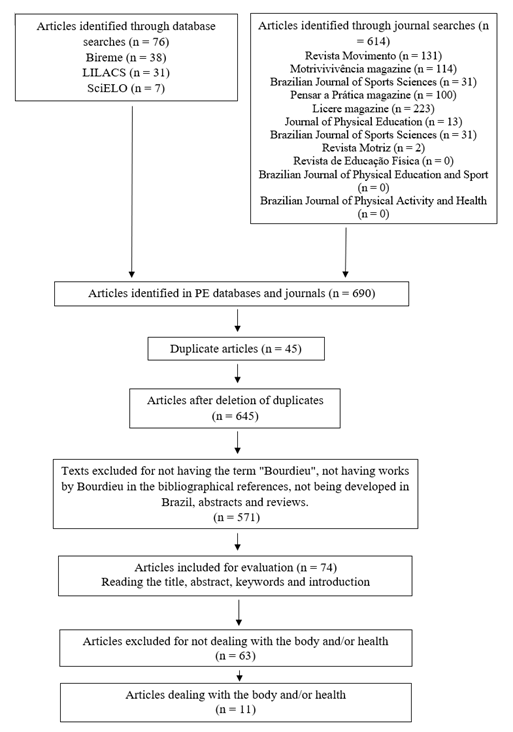 Note: n = number of articles.Source: Prepared by the authors.
 Source: prepared by the authors, based on the data selected for analysis.