
 From performance to exhaustion: Burnout and precariousness in the Post-Digital Creator Economy
Abstract
The present study aims to understand how Burnout Syndrome, manifested as exhaustion and occupational stress, impacts the Creator Economy and affects new generations. The research deepens the analysis of the performance crisis amidst intense technological changes in work, which affect the subjectivity and the commodified identity construction of young creators. Burnout is articulated as a symptom of digital techno-neoliberal capitalism, establishing a dialogue with Brazilian structural issues, such as the precariousness of Pejotization and the logic of the Gig Economy. The methodology consists of an exploratory bibliographic review that supports the theoretical framework. The focus resides on the contribution to the field of Communication, through the examination of market transformations, algorithmic management, and the incessant pursuit of professional relevance.
Keywords
Burnout; creator economy; post-digital era employment; media consumption and production; identity
Resumo
O presente estudo objetiva compreender como a Síndrome de Burnout, manifestada como estafa e estresse ocupacional, impacta a Creator Economy e se manifesta entre as novas gerações. A pesquisa aprofunda a análise da crise do desempenho em um cenário de intensas transformações tecnológicas no trabalho, que afetam a subjetividade e a construção identitária mercantilizada de jovens criadores. O burnout é articulado como sintoma do capitalismo tecno-neoliberal digital, estabelecendo um diálogo com questões estruturais brasileiras, como a precarização da pejotização e a lógica da Gig Economy. A metodologia consiste em uma revisão bibliográfica exploratória que fundamenta o aporte teórico. O foco reside na contribuição ao campo da Comunicação, por meio do exame das transformações do mercado, da gestão algorítmica e da busca incessante por relevância profissional.
Palavras-chave
burnout;
creator economy
; emprego na era pós-digital; consumo e produção midiáticos; identidade
Resumen
El presente estudio tiene como objetivo comprender cómo el Síndrome de Burnout, manifestado como agotamiento y estrés ocupacional, impacta la Creator Economy y se manifiesta en las nuevas generaciones. La investigación profundiza el análisis de la crisis del desempeño en un escenario de intensas transformaciones tecnológicas en el trabajo, que afectan la subjetividad y la construcción identitaria mercantilizada de jóvenes creadores. El burnout se articula como síntoma del capitalismo tecno-neoliberal digital, estableciendo un diálogo con cuestiones estructurales brasileñas, como la precarización de la Pejotização y la lógica de la Gig Economy. La metodología consiste en una revisión bibliográfica exploratoria que fundamenta el aporte teórico. El foco reside en la contribución al campo de la Comunicación, mediante el examen de las transformaciones del mercado, la gestión algorítmica y la incesante búsqueda de relevancia profesional.
Palabras clave
creator economy; empleo en la era posdigital; consumo y producción mediática; identidad
Introduction
The intersection of Burnout Syndrome and the Creator Economy in the post-digital era is a complex phenomenon that shapes the identity construction of digital influencers. The Creator Economy, an ecosystem in which content creators monetise their productions, was impacted by the COVID-19 pandemic and the entry of Generation Z into the labour market. This group prefers creative roles to traditional jobs but faces unique challenges, including exhaustion exacerbated by hyper exposure and productivity demands (Aytac; Pehlivan, 2020).
The concept of the performance society, characterised by an excess of positivity and the incessant pursuit of success, implies consequences for mental health in this context. The transition to a performance society, according to Han, emphasises self-entrepreneurship and the transformation of the individual into their own product. This cultural shift is exemplified in the Creator Economy, where the need to continuously produce and monetise content overrides mental well-being (Dias; Rocha, 2024). The COVID-19 pandemic aggravated this scenario, influencing economic structures and mental health, and is associated with an increase in depressive symptoms (Park et al., 2024). Digital influencers were pressured to meet growing content demands while navigating the pandemic's impact on economic and psychological stability.
Investigating this theme is necessary, anchored in the observation of transformations in the communication market and in the difficulties of maintaining professional relevance in a scenario dominated by international monopolies and information overload. Identifying the problem is fundamental to understanding its causes and effects and can serve as a reference for those experiencing symptoms in a context that transforms people into products. Therefore, the general objective of this work is to understand how Burnout Syndrome affects the Creator Economy and manifests among new generations, shaping the identity construction of young workers in the post-digital era. Specifically, it seeks to: (i) analyse how contemporary productive dynamics relate to malaise and which types of social, political, or economic projects they serve; (ii) examine the speed of contemporary relationships governed by smartphones, globalisation, content production, and hyper exposure; and (iii) identify theoretical-practical reflections on cancel culture and its effects on influencers.
Methodology
The present study is based on an exploratory bibliographic review that aims to establish a critical, multidisciplinary perspective on burnout in the Creator Economy. This approach is justified for mapping the dynamics of exhaustion, understood as a structural issue inherent to digital platforms and the labour market, overcoming the view focused on individual failure (Caminhas, 2024). The theoretical framework draws on insights from philosophy, social psychology, communication, and digital culture, enabling analysis of the work's conceptual pillars. Initially, burnout is conceptualised as a triad of exhaustion, depersonalisation, and diminished personal accomplishment (Cordes & Dougherty, 1993; Perlman & Hartman, 1982). Subsequently, the analysis deepens into the influence of algorithmic management, which, although conferring a certain autonomy, contributes to job insecurity (Hajiheydari & Delgosha, 2024; Peng et al., 2024), and into applicable theoretical models, such as Self-Determination Theory and the Job Demands-Resources Model (Hajiheydari & Delgosha, 2024; Peng et al., 2024). Finally, the discussion is anchored in the Brazilian reality, examining how Pejotization and the Gig Economy reinforce the structural precariousness of work (Caminhas, 2024). The research is theoretical and does not involve empirical investigation.
Burnout Syndrome: the burnout society
The term Burnout Syndrome, proposed by Freudenberger (1974), describes a state of emotional, mental, and physical exhaustion resulting from chronic occupational stress. The phenomenon is typically characterised by three central dimensions: emotional exhaustion, depersonalization (or cynicism), and reduced personal accomplishment (Maslach & Jackson, 1981). Recognised as a condition directly related to work by the World Health Organisation (WHO) in its International Classification of Diseases (ICD-11), the syndrome extends beyond individual health and constitutes a complex social and organisational issue, with direct impacts on productivity and labour dynamics.
Several risk factors contribute to the development of the syndrome, including high workloads and a discrepancy between expectations and job requirements (Prem, 2022). Additionally, emotional labour requires maintaining a specific expression, which often results in wear and tear (Ivancevic; Ivanovic, 2022). The resurgence of interest in the topic is, in part, associated with the Millennial generation, for whom problematic internet use is identified as a significant risk factor (Mao et al., 2024).
The COVID-19 pandemic intensified the prevalence of burnout and depression (Lin et al., 2021). This context reinforces Han’s (2017) analysis of the achievement society, in which self-exploitation occurs under the guise of freedom, generating a paradox in which the individual is simultaneously an exploiter and an exploited. This dynamic is particularly evident in the Creator Economy, where hyper exposure and the mental productive load lead to exhaustion. Scientific literature points to a strong correlation between burnout and depression (Veltyshchev et al., 2017; Wang et al., 2025). To combat burnout, prevention strategies that promote healthier work environments and mitigate the deleterious effects of the achievement society are fundamental (França et al., 2014).
The context of work in the Post-Digital Era: precariousness and the NEET Generation
Vulnerability to unemployment and precariousness disproportionately affects the Millennial and Z generations. Formed amid successive economic crises, these cohorts have developed a new relationship with work. The precariousness of autonomy and flexibility relative to the stability offered by conventional careers is observed (Antunes et al., 2022). Adherence to the Gig Economy and, subsequently, to the Creator Economy, is perceived as a cultural and strategic response to a scenario of scarce formal opportunities. Such a phenomenon is conceptualised by Abílio (2020) as the real subsumption of the hustle to digital logic.
The Creator Economy in Brazil is deeply intertwined with the country's socioeconomic challenges, particularly economic instability and high youth unemployment. Such factors drive young Brazilians toward the platform economy, which is seen as a strategic necessity for subsistence and professional relevance (Machado, 2001; Baltar & Krein, 2013). This scenario is exacerbated by the consolidation of Pejotization, a practice that classifies workers as independent contractors. This practice shifts the activity's risks and costs directly to the individual, intensifying labour precariousness (Baltar & Krein, 2013). Employment precarity is a hallmark of the platform economy, characterised by the absence of social protections, exacerbated by the constant pressures of algorithmic management and the demand for self-promotion (Alauddin et al., 2024; Caminhas, 2024). Consequently, exhaustion is common. The need to continuously produce content to maintain visibility and income, in an environment that typically rewards only a high-performing minority, exacerbates self-exploitation and burnout. This condition indicates that exhaustion transcends individual failure, revealing itself as a symptom of the market's structural precariousness (Caminhas, 2024; Scott & Woods, 2024; Verwiebe et al., 2025).
The Gig Economy is a labour market characterised by temporary professionals without an employment bond (Crary, 2016; Abílio, 2019). This structure was intensified in Brazil by the COVID-19 pandemic, which accentuated youth unemployment, leading to the expansion of informal work (Costa, 2020; Nazzari; Silva, 2023). In the national context, the model manifests as Pejotization, an independent hiring model that, although it offers autonomy, imposes high economic volatility. Precariousness is consolidated through the transfer of risks and costs to individuals, exposing workers to labour instability (Abílio, 2019; Abílio, 2020; Auguste et al., 2023).
The impact of this model on young people is notable, affecting their financial and psychological well-being. On the psychological plane, job insecurity, pressure for performance, and social isolation can generate suffering (Glavin; Schieman, 2021). This dissolution of boundaries is a symptom of 24/7 capitalism, a regime in which human activity is incessantly captured by productive logic (Crary, 2016). For professionals in the creative economy, the model exposes them to global competition and emotional fatigue stemming from the need for continuous innovation and marketing (Ravenelle et al., 2022; Scott; Woods, 2024). The Creator Economy emerges, thus, as a career possibility that, although offering monetisation opportunities, intensifies the workload and the pressure for a constant online presence, establishing a direct connection between the precariousness of the Gig Economy and the exhaustion experienced by content creators (Rauber et al., 2021; Scott; Woods, 2024).
The Creator Economy as an epicenter: work dynamics and performance
The Creator Economy has emerged as a significant force in the digital landscape, transforming content production, distribution, and monetisation. This ecosystem is currently valued at over 104 billion dollars (Dahm; Heydenreich, 2023). Platforms like YouTube, Instagram, and TikTok were fundamental to creators' ability to monetise their content (Ma et al., 2023).
This conjuncture gave rise to the concept of creative entrepreneurs, whose success is mediated by the dynamics of digital platforms, which employ algorithms and governance structures that influence visibility and monetisation opportunities (Edeling; Wies, 2024; Eisenbeis; Rinsdorf, 2024). In response, creators adopt multi-platform strategies (Ma et al., 2023), reflecting the culture of convergence and participation (Jenkins, 2008). The demand for constant engagement from an active audience intensifies productive pressure, blurring the boundary between producers and consumers.
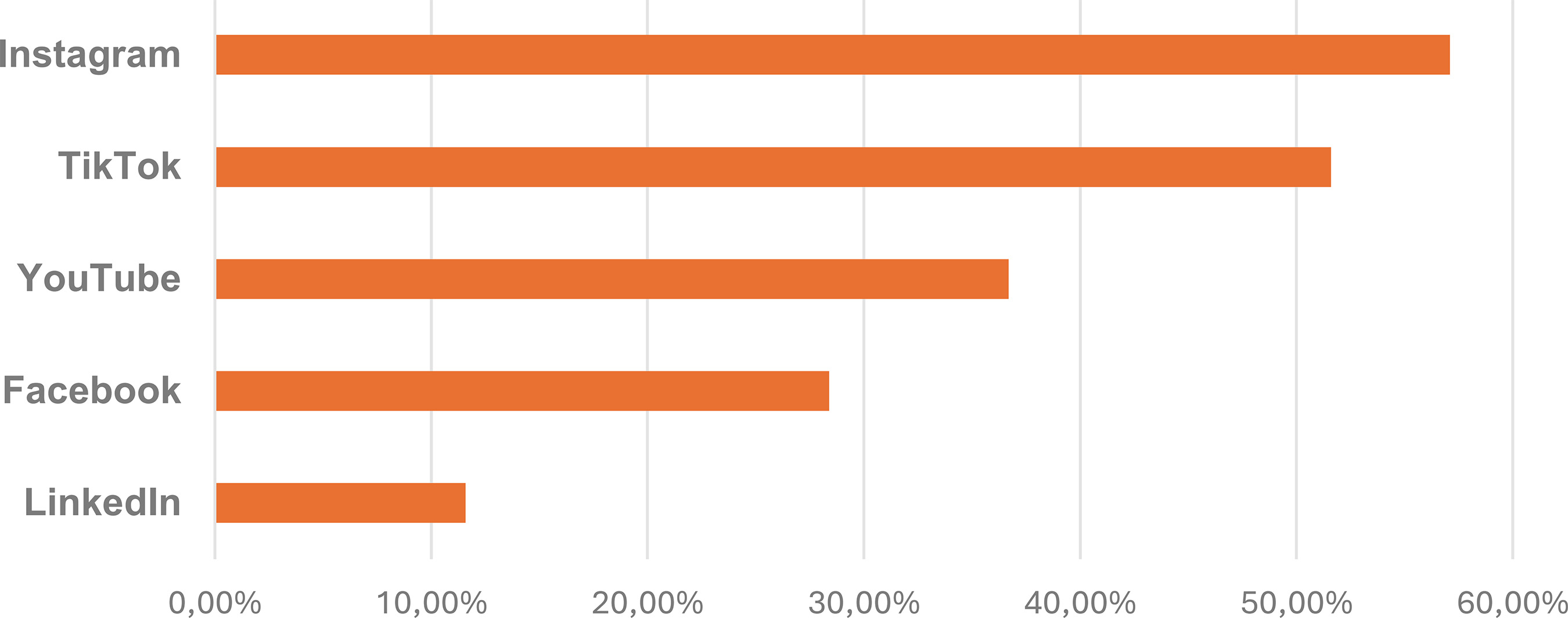
Despite the market volume, the internal dynamics of this ecosystem reveal challenges. Income distribution is notably unequal (as shown in Chart 1), and market power is concentrated in a few platforms (as shown in Chart 2). Such information reinforces economic precarity and the need for continuous adaptation (Rieder et al., 2023). The fusion between personal and professional identities raises concerns about the commodification of individuality and the risk of exhaustion, connecting the vigour of this market to the central theme of burnout (Massaro, 2022). The Creator Economy has emerged as a significant force in the digital landscape, transforming content production, distribution, and monetisation. This ecosystem is currently valued at over 104 billion dollars (Dahm; Heydenreich, 2023). Platforms like YouTube, Instagram, and TikTok were fundamental to creators' ability to monetise their content (Ma et al., 2023).
This conjuncture gave rise to the concept of creative entrepreneurs, whose success is mediated by the dynamics of digital platforms, which employ algorithms and governance structures that influence visibility and monetisation opportunities (Edeling; Wies, 2024; Eisenbeis; Rinsdorf, 2024). In response, creators adopt multi-platform strategies (Ma et al., 2023), reflecting the culture of convergence and participation (Jenkins, 2008). The demand for constant engagement from an active audience intensifies productive pressure, blurring the boundary between producers and consumers.
Despite the market volume, the internal dynamics of this ecosystem reveal challenges. Income distribution is notably unequal (as shown in Chart 1), and market power is concentrated in a few platforms (as shown in Chart 2). Such information reinforces economic precarity and the need for continuous adaptation (Rieder et al., 2023). The fusion between personal and professional identities raises concerns about the commodification of individuality and the risk of exhaustion, connecting the vigour of this market to the central theme of burnout (Massaro, 2022).


The Creator Economy concentrates power in international monopolies. For the Communication professional, the central challenge is maintaining relevance in a supersaturated environment governed by the attention economy (Franck, 2019; Krieken, 2019). This incessant struggle for attention is mediated by the opaque algorithmic management of platforms. Algorithms not only dictate content distribution but also impose discipline on subjectivity and production frequency (Duffy & Meisner, 2022; Verwiebe et al., 2024). Consequently, content value is determined by opaque mechanisms, leading creators to perceive unpredictable control (Verwiebe et al., 2024). The psychological cost of this subordination manifests as algorithmic exhaustion and burnout (Duffy & Meisner, 2022). This condition reflects the conflict between the need for visibility inherent to Communication and the opacity of algorithmic regulation, ultimately representing the failure of the individual's capacity to remain relevant in an unequal control system (Duffy & Meisner, 2022; Omidi, 2025).
Algorithmic management, which determines visibility and success, constitutes a significant source of stress. Such a mechanism leads creators into a continuous cycle of analysis and adaptation to maintain relevance (Thorne, 2023). This dynamic generates anxiety when trying to decipher opaque mechanisms (Albiez, 2022). The concept of algorithmic exhaustion describes the psychological cost of this engagement, which leads to dissatisfaction and burnout (Karhawi; Prazeres, 2022). The lack of transparency sustains a power differential, contributing to feelings of exploitation and insecurity (Frankovics, 2022; Choi et al., 2023).
Work intensity and precarization are other determining factors. The Creator Economy demands high productivity, with intense schedules and strict deadlines that, combined with instability, contribute to exhaustion (Deuze, 2023; Gregersen; Ormen, 2023). Studies indicate that the pressure to continuously produce new content aggravates the problem, and some creators have increased productivity by over 800% over a decade (Gregersen; Ormen, 2023). The creative process is frequently marked by involved labour, in which creators engage in complex and iterative production practices to obtain recognition, leading to emotional and physical fatigue (Scott; Woods, 2024).
This labour scenario is inserted into a cultural context of digital image massification. The rise of social media transformed content production by allowing users to become co-authors of their own narratives (Autenrieth, 2018). The selfie phenomenon, as a complex form of social interaction (Santos, 2015; Cipolletta, 2019), illustrates a culture of self-exposure that promotes an incessant search for validation, potentially exacerbating anxiety and feelings of inadequacy (Reichert, 2023). The confluence of these factors imposes challenges on mental health. The search for metrics, such as views and likes, can lead to a harmful fixation (Frankovics, 2022). Systemic issues of algorithmic pressure and labour intensity remain central challenges for career sustainability (Lukan & Zajc, 2024).
The individual as a product: narcissism, vigilantism, and the Transparency Society
The concept of the Self-As-Product in contemporary society is intrinsically linked to the rise of social media, which has become an essential platform for personal marketing and digital influence. The phenomenon is characterised by the transformation of individual identity into a marketable product, driven by the need for self-promotion and validation in a hyper-visible digital scenario (Groys, 2016). The culture of narcissism is evident in how individuals invest in their public image in pursuit of recognition (Buffardi & Campbell, 2008; Cenizo, 2021; Brailovskaia & Bierhoff, 2019). This dynamic establishes a complex interaction between entrepreneurship, the personal brand, and the psychological implications of constant self-exposure.
Social media platforms have become crucial tools for personal branding, blurring the boundaries between the creator and the product (Groys, 2016). The influencer phenomenon exemplifies this tendency to normalise self-promotion and self-exploitation as part of work (Gómez & Pascual, 2023). The incessant search for validation can create a vicious cycle that significantly affects mental health (Brailovskaia, 2024). Constant social comparison can lead to decreased self-esteem and increased anxiety and depression (Arigo et al., 2024). In this sense, the exhibitionist society, as described by Han, commodifies personal identity, which results in hypervisibility, self-exploitation, and, consequently, exhaustion (Han, 2017).
Driven by capitalist logics, platforms transform individuals into commodities by encouraging them to create personal brands (Németh, 2024). Although the Self-As-Product offers opportunities for entrepreneurship, the emphasis on self-promotion can lead to a fragmented conception of identity and a superficial understanding of the self. Such a process highlights the risks associated with the commodification of subjectivity (Milivojević, 2014; Castaño, 2017).
The imperative of the Creator Economy requires young workers to adopt the logic of the Self-As-Product, resulting in a commodified identity construction that is intrinsically linked to the success of their brand. Consequently, identity is converted into a continuous performance and a capital asset, distancing itself from an internal process of self-knowledge. This transformation is driven by neoliberal norms that convert authenticity into a marketable strategy, a process termed "authenticization" (Plesa, 2023). Such dynamics tend to compromise the individual's self-understanding and freedom, affecting mental health. The fusion between the authentic self and the brand-persona constitutes the genesis of vulnerability. Promotional work on social media requires building a distinct brand for each platform, which forces creators to balance personal authenticity with the demands of digital economies (Scolere et al., 2018). This makes identity performance strategic, but inherently vulnerable.
In this context, platforms impose specific skills and resort to algorithms and metrics as control mechanisms (Omidi, 2025). These mechanisms directly influence identity construction, reshaping creative work. Hyper-exposure and the incessant need for external validation, measured by volatile metrics, are fragile and subjective (Mears & Beauvais, 2025). Therefore, when brand performance fails, the collapse is perceived not only in the career dimension but also in the very existence of identity (Scolere et al., 2018). Burnout, in this framework, manifests as a symptom of the failure to sustain the idealised performative self-demanded by platform capitalism (Omidi, 2025; Sujon & Ntalla, 2025). This condition reflects the tension between creativity and the platform's architecture of commodification.
The direct consequence is hypervisibility, characterised by the constant need to be seen and validated online, which can lead to superficial forms of self-exploitation (Abreu, 2016). Social networks exacerbate narcissistic tendencies, acting as platforms for self-promotion and the search for validation through engagement metrics (Buffardi; Campbell, 2008; Gnambs; Appel, 2018).
Constant exposure transforms the digital environment into a panopticon, where users are observers and observed, creating a system of mutual surveillance (Allmer et al., 2013). This dynamic not only reinforces conformist behaviours but also creates the conditions for digital lynchings, a manifestation of the surveillance culture. The Transparency Society, as described by Han, accelerates the flow of information and commodifies all aspects of life, leading to the loss of otherness (Capella; Wenz, 2023). The voluntary sharing of personal information makes individuals vulnerable to big data analysis, which consolidates the commodification of experiences (Allmer et al., 2013). For Han, the reflective pause (contemplation and silence) is the counterpoint to combat the self-exploitation that leads to burnout (Capella; Wenz, 2023).
Final Considerations
The general objective of this work was to understand how Burnout Syndrome affects the Creator Economy and manifests among new generations, shaping the identity construction of young workers in the post-digital era. The analysis demonstrated that burnout, in this context, does not present itself as an isolated phenomenon, but as a symptomatic ailment of digital techno-neoliberal capitalism, aggravated by hyperconnectivity and contemporary acceleration.
The argumentation showed that labour precarization, systemic unemployment, and the consolidation of the Gig Economy created the conditions for the rise of the Creator Economy. The study delved into the dynamics of this ecosystem, revealing how algorithmic pressure and the demand for high productivity convert it into an epicentre of exhaustion. Subsequently, the analysis turned to psychosocial consequences, discussing the transformation of the individual into a Self-As-Product. It was verified that the need for continuous self-promotion, inserted in a culture of narcissism and vigilantism, weakens creators' mental health. Such dynamics, which include the fear of disinformation and the consequences of cancelling, generate a crisis of trust and intensify the individual's exhaustion in the digital ecosystem.
Thus, the research objectives were achieved by demonstrating that factors such as high competitiveness, dependence on advertising capitalism, narcissistic self-image, and structural labour precarization contribute to the deterioration of young people's mental health in the Creator Economy. The main theoretical contribution of this work lies in articulating Byung-Chul Han's thought with the material dynamics of this new market, arguing that burnout transcends individual failure and emerges as a political symptom of the performance society.
As a limitation, the exclusively theoretical-bibliographical character of this research is highlighted. For future research, conducting empirical investigations with content creators is suggested to deepen the understanding of their subjective experiences. Even so, it is hoped that this analysis serves as a critical alert regarding the urgency of rethinking work and subjectivation models that shape the future in the post-digital era.
-
Double blind review system
-
How to cite:
SOUSA, J. H. V. de; SOUZA, L. L. F. de; BARBOSA, M. R. A.; CORDEIRO, H. C. From performance to exhaustion: Burnout and precarization in the Post Digital Creator Economy. São Paulo: INTERCOM – Revista Brasileira de Ciências da Comunicação, v. 49 (2026), e2026106. https://doi.org/10.1590/1809-58442026106en
-
Use of Artificial Intelligence (AI):
In preparing this work, the authors used the AI tools Gemini Pro and SciSpace to organize the writing workflow and identify citations relevant to the article. After using these tools/services, the authors reviewed and edited the content as necessary and assume full responsibility for the publication’s content.
-
INTERCOM encourages data sharing; however, in compliance with ethical guidelines, it does not require the disclosure of any means of identifying research participants, thereby preserving their privacy. The practice of open data aims to enable the reproducibility of results and ensure full transparency of published research outcomes, without requiring the identification of research subjects.
-
Inclusive Language:
The authors employ inclusive language that acknowledges diversity, demonstrates respect for all individuals, is sensitive to differences, and promotes equal opportunities.
-
Plagiarism Check:
Intercom Journal submits all documents approved for publication to plagiarism verification using a dedicated tool.
-
XML Editing and Markup:
IR Publicações
-
Funding:
CNPq
Data Availability:
All data supporting this article are contained within the body of the text.
References
-
ABÍLIO, L. C. Uberización: De la iniciativa empresarial a la autogestión subordinada. Psicoperspectivas, v. 18, n. 3, p. 41–51, 2019. DOI: https://doi.org/10.5027/PSICOPERSPECTIVAS-VOL18-ISSUE3-FULLTEXT-1674.
» https://doi.org/10.5027/PSICOPERSPECTIVAS-VOL18-ISSUE3-FULLTEXT-1674 - ABÍLIO, L. C. Uberização e juventude periférica: desigualdades, autogerenciamento e novas formas de controle do trabalho. Novos estudos CEBRAP, v. 39, n. 3, p. 579-597, 2020.
-
ABREU, C. L. Hipervisibilidade e self-disclosure: novas texturas da experiência social nas redes digitais. Revista Vis, v. 13, n. 2, p. 194–219, 2016. DOI: https://doi.org/10.5216/VIS.V13I2.34196.
» https://doi.org/10.5216/VIS.V13I2.34196 -
ALAUDDIN, F. D. A. et al. The Influence of Digital Platforms on Gig Workers: A Systematic Literature Review. Heliyon, v. 11, n. 1, e41491, 2024. DOI: 10.1016/j.heliyon.2024.e41491.
» https://doi.org/10.1016/j.heliyon.2024.e41491 -
ALBIEZ, M. Der Algorithmus, meine Arbeit und Ich – Einfluss von Algorithmen auf Content Creator:innen der Video Plattform YouTube. Gruppe. Interaktion. Organisation. Zeitschrift Für Angewandte Organisationspsychologie (Gio), v. 53, p. 63–71, 2022. DOI: https://doi.org/10.1007/s11612-021-00616-3.
» https://doi.org/10.1007/s11612-021-00616-3 -
ALLMER, T. et al. Social Networking Sites in the Surveillance Society: Critical Perspectives and Empirical Findings. Bern: Peter Lang, 2014. DOI: https://doi.org/10.3726/978-1-4539-1166-2.
» https://doi.org/10.3726/978-1-4539-1166-2 -
ANTUNES, I.; MARTINEZ, L. M. The effectiveness of sales promotion techniques on the millennial consumers’ buying behavior. ReMark - Revista Brasileira de Marketing, v. 21, n. 3, p. 784-836, 2022. DOI: https://doi.org/10.5585/remark.v21i3.19997.
» https://doi.org/10.5585/remark.v21i3.19997 -
ARIGO, D. et al. Social Comparison and Mental Health. Current Treatment Options in Psychiatry, v. 11, p. 17–33, 2024. DOI: https://doi.org/10.1007/s40501-024-00313-0.
» https://doi.org/10.1007/s40501-024-00313-0 -
AUGUSTE, D.; ROLL, S.; DESPARD, M. R. Democratizing the Economy or Introducing Economic Risk? Gig Work During the COVID-19 Pandemic. Work And Occupations, 2023. DOI: https://doi.org/10.1177/07308884231202032.
» https://doi.org/10.1177/07308884231202032 -
AUTENRIETH, U. Bilder in medial vermittelter Alltagskommunikation. In: Handbuch Soziale Interaktion Wiesbaden: Springer VS, 2019. p. 249–268. DOI: https://doi.org/10.1007/978-3-658-06508-9_16.
» https://doi.org/10.1007/978-3-658-06508-9_16 -
AYTAC, H. M.; PEHLIVAN, S. Viral Pandemics as Possible Psycho-immunological Causes of Psychiatric Symptoms: From Past to Present. Journal of Academic Research in Health Sciences, v. 3, n. 1, p. 92–98, 2020. DOI: https://doi.org/10.26650/JARHS2020-S1-0012.
» https://doi.org/10.26650/JARHS2020-S1-0012 -
BALTAR, P.; KREIN, J. D. A retomada do desenvolvimento e a regulação do mercado do trabalho no Brasil. Caderno Crh, Salvador, v. 26, n. 68, p. 273–292, 2013. DOI: 10.1590/S0103-49792013000200005.
» https://doi.org/10.1590/S0103-49792013000200005 -
BRAILOVSKAIA, J. The “Vicious Circle of addictive Social Media Use and Mental Health” Model. Acta Psychologica, v. 247, p. 104306, 2024. DOI: https://doi.org/10.1016/j.actpsy.2024.104306.
» https://doi.org/10.1016/j.actpsy.2024.104306 -
BRAILOVSKAIA, J.; BIERHOFF, H.-W. Generation Me: Soziale Medien und Narzissmus. Pid - Psychotherapie Im Dialog, v. 20, n. 03, p. 26–30, 2019. DOI: https://doi.org/10.1055/A-0771-7047.
» https://doi.org/10.1055/A-0771-7047 -
BUFFARDI, L. E.; CAMPBELL, W. K. Narcissism and Social Networking Web Sites. Personality and Social Psychology Bulletin, v. 34, n. 10, p. 1303–1314, 2008. DOI: https://doi.org/10.1177/0146167208320061.
» https://doi.org/10.1177/0146167208320061 -
CAMINHAS, L. R. P. Precarity revisited: Exploring camming work in Brazil and experiences of precarity in platform-based (erotic) content production. International Journal of Cultural Studies [S. l.], 2024. DOI: 10.1177/13678779241244410.
» https://doi.org/10.1177/13678779241244410 -
CAPELLA, V. B.; WENZ, L. R. Byung-Chul Han: la sociedad trasparente digital o el infierno de lo igual. Scio, n. 23, p. 151–184, 2023. DOI: https://doi.org/10.46583/scio_2022.23.1102.
» https://doi.org/10.46583/scio_2022.23.1102 -
CASTAÑO, L. C. Las redes sociales y la cultura de la autopromoción: apuntes para una teoría de la identidad mosaico. Doxa Comunicación, n. 24, p. 13–36, 2017. DOI: https://doi.org/10.31921/DOXACOM.N24A1.
» https://doi.org/10.31921/DOXACOM.N24A1 -
CENIZO, C. El narcisismo en la sociedad de consumo: el caso de los influencers españoles. REDMARKA. Revista de Marketing Aplicado, v. 25, n. 1, p. 21–39, 2021. DOI: https://doi.org/10.17979/REDMA.2021.25.1.8080.
» https://doi.org/10.17979/REDMA.2021.25.1.8080 -
CHOI, Y. O. et al. Creator-friendly Algorithms: Behaviors, Challenges, and Design Opportunities in Algorithmic Platforms. In: INTERNATIONAL CONFERENCE ON HUMAN FACTORS IN COMPUTING SYSTEMS, 2023. Anais [...]. 2023. DOI: https://doi.org/10.1145/3544548.3581386.
» https://doi.org/10.1145/3544548.3581386 -
CIPOLLETTA, G. Ubiquitous Self: From Self-Portrait to Selfie. In: Handbook of Research on the Investigation of Digital Humanism and Its Evolving Perspectives**.** Hershey: IGI Global, 2020. p. 93–115. DOI: https://doi.org/10.4018/978-1-7998-1796-3.CH006.
» https://doi.org/10.4018/978-1-7998-1796-3.CH006 -
CORDES, C. L.; DOUGHERTY, T. W. A Review and an Integration of Research on Job Burnout. Academy of Management Review, v. 18, n. 4, p. 621-656, 1993. DOI: 10.5465/AMR.1993.9402210153.
» https://doi.org/10.5465/AMR.1993.9402210153 -
COSTA, S. S. Pandemia e desemprego no brasil. Revista De Administração Pública, v. 54, n. 4, p. 969-978, 2020. DOI: https://doi.org/10.1590/0034-761220200170.
» https://doi.org/10.1590/0034-761220200170 - CRARY, J. 24/7: capitalismo tardio e os fins do sono. São Paulo: Ubu editora, 2016.
-
DAHM, M. H.; HEYDENREICH, J. Einleitung. In: DAHM, M. H.; HEYDENREICH, J. (ed.). Handbuch Creator Economy Wiesbaden: Springer Nature, 2024. p. 1–2. DOI: https://doi.org/10.1007/978-3-658-44657-4_1.
» https://doi.org/10.1007/978-3-658-44657-4_1 -
DEUZE, M. Considering mental health and well-being in media work. The Australian Journalism Review, v. 45, n. 1, p. 15–26, 2023. DOI: https://doi.org/10.1386/ajr_00115_7.
» https://doi.org/10.1386/ajr_00115_7 -
DIAS, K. S.; ROCHA, C. M. F. Neoliberalismo, capitalismo de plataforma, trabalho imaterial e a emergência dos influenciadores digitais e criadores de conteúdo. Convergências, v. 1, n. 4, p. 62–82, 2024. DOI: https://doi.org/10.59616/cehd.v1i4.936.
» https://doi.org/10.59616/cehd.v1i4.936 -
DUFFY, B. E.; MEISNER, C. Platform governance at the margins: Social media creators’ experiences with algorithmic (in)visibility. Media, Culture & Society, v. 45, n. 2, p. 285–304, 2022. DOI: 10.1177/01634437221111923.
» https://doi.org/10.1177/01634437221111923 -
EDELING, A.; WIES, S. Embracing entrepreneurship in the creator economy: The rise of creatrepreneurs. International Journal of Research in Marketing, 2024. DOI: https://doi.org/10.1016/j.ijresmar.2024.07.003.
» https://doi.org/10.1016/j.ijresmar.2024.07.003 -
EISENBEIS, U.; MEZGER, M.; RINSDORF, L. Kreativwirtschaft und Creator Economy: Ein Überblick. GESIS - Leibniz-Institut für Sozialwissenschaften, 2024. DOI: https://doi.org/10.21241/ssoar.95669.
» https://doi.org/10.21241/ssoar.95669 - FLYVERBOM, M. The Digital Prism: Transparency and Managed Visibilities in a Datafied World. Cambridge: Cambridge University Press, 2019.
-
FRANÇA, T. L. B. et al. Burnout syndrome: characteristics, diagnosis, risk factors and prevention. Journal of Nursing UFPE on line, v. 8, n. 10, p. 3539–3546, 2014. DOI: https://doi.org/10.5205/6347.
» https://doi.org/10.5205/6347 -
FRANCK, G. The economy of attention. Journal of Sociology, v. 55, n. 1, p. 8–19, 2019. DOI: https://doi.org/10.1177/1440783318811778
» https://doi.org/10.1177/1440783318811778 -
FRANKOVICS, C. How Content Creators Respond to the Metric-Based Control of Platforms Over Their Career. In: ACADEMY OF MANAGEMENT, 2022. Proceedings [...]. v. 2022, n. 1, 2022. DOI: https://doi.org/10.5465/ambpp.2022.18025abstract.
» https://doi.org/10.5465/ambpp.2022.18025abstract - FREUDENBERGER, Herbert J. Staff burnout. Journal of Social Issues, v. 30, n. 1, p. 159-165, 1974.
-
GLAVIN, P.; SCHIEMAN, S. Dependency and Hardship in the Gig Economy: The Mental Health Consequences of Platform Work. Socius, v. 8, 2022. DOI: https://doi.org/10.1177/23780231221082414.
» https://doi.org/10.1177/23780231221082414 -
GNAMBS, T.; APPEL, M. Narcissism and Social Networking Behavior: A Meta-Analysis. Journal of Personality, v. 86, n. 2, p. 200–212, 2018. DOI: https://doi.org/10.1111/JOPY.12305.
» https://doi.org/10.1111/JOPY.12305 -
GÓMEZ, E. B.; PASCUAL, A. S. Cuando lo que está en juego es la venta de uno mismo: el caso del influencer emprendedor. Bajo Palabra, 2023. DOI: https://doi.org/10.15366/bp2023.33.006.
» https://doi.org/10.15366/bp2023.33.006 -
GREGERSEN, A.; ORMEN, J. The Output Imperative: Productivity and Precarity on YouTube. New Media & Society, v. 25, n. 8, p. 1871-1891, 2021. DOI: https://doi.org/10.1080/1369118x.2021.2006745.
» https://doi.org/10.1080/1369118x.2021.2006745 -
GROYS, B. Autodiseño, o narcisismo productivo. Arq (Santiago), n. 95, p. 140–145, 2017. DOI: https://doi.org/10.4067/S0717-69962017000100140.
» https://doi.org/10.4067/S0717-69962017000100140 -
HAJIHEYDARI, N.; DELGOSHA, M. S. Investigating engagement and burnout of gig-workers in the age of algorithms: an empirical study in digital labor platforms. Information Technology & People, 2024. DOI: 10.1108/itp-11-2022-0873.
» https://doi.org/10.1108/itp-11-2022-0873 - HAN, B.C. Sociedade do cansaço 2. ed. Petrópolis: Editora Vozes, 2017.
- HEEMSBERGEN, L. From radical transparency to radical disclosure: reconfiguring (in)voluntary transparency through the management of visibilities. International Journal of Communication, v. 10, p. 14, 2016.
-
IVANCEVIC, S.; IVANOVIC, T. Burnout Syndrome. In: BRYSON, J. R.; DANIELS, P. W. (ed.). Elgar Encyclopedia of Services Cheltenham: Edward Elgar Publishing, 2022. p. 385–387. DOI: https://doi.org/10.4337/9781800377486.burnout.syndrome.
» https://doi.org/10.4337/9781800377486.burnout.syndrome - JENKINS, H. Cultura da convergência São Paulo: Aleph, 2008.
-
KARHAWI, I.; PRAZERES, M. Exaustão algorítmica: influenciadores digitais, trabalho de plataforma e saúde mental. Reciis, v. 16, n. 4, p. 800–819, 2022. DOI: https://doi.org/10.29397/reciis.v16i4.3378.
» https://doi.org/10.29397/reciis.v16i4.3378 -
KRIEKEN, R. Georg Franck’s ‘The Economy of Attention’: Mental capitalism and the struggle for attention. Journal of Sociology, v. 55, n. 1, p. 3–7, 2019. DOI: 10.1177/1440783318812111.
» https://doi.org/10.1177/1440783318812111 -
LIN, Y. S. et al. COVID-19 Pandemic Is Associated with an Adverse Impact on Burnout and Mood Disorder in Healthcare Professionals. International Journal of Environmental Research and Public Health, v. 18, n. 7, p. 3654, 2021. DOI: https://doi.org/10.3390/IJERPH18073654.
» https://doi.org/10.3390/IJERPH18073654 -
LUKAN, T.; ČEHOVIN ZAJC, J. Platform lethargy: Relational work perspective on influencer precarity. International Journal of Cultural Studies, 2024. DOI: https://doi.org/10.1177/13678779241268208.
» https://doi.org/10.1177/13678779241268208 -
MA, R.; GUI, X.; KOU, Y. Multi-Platform Content Creation: The Configuration of Creator Ecology through Platform Prioritization, Content Synchronization, and Audience Management. In: INTERNATIONAL CONFERENCE ON HUMAN FACTORS IN COMPUTING SYSTEMS, 2023. Anais [...]. 2023. DOI: https://doi.org/10.1145/3544548.3581106.
» https://doi.org/10.1145/3544548.3581106 -
MACHADO, L. A. DA INFORMALIDADE À EMPREGABILIDADE (reorganizando a dominação no mundo do trabalho). Caderno Crh, Salvador, v. 15, n. 37, 2002. DOI: 10.9771/CCRH.V15I37.18603.
» https://doi.org/10.9771/CCRH.V15I37.18603 -
MAO, P.; CAI, Z.; CHEN, B.; SUN, X. The association between problematic internet use and burnout: A three-level Meta-analysis. Journal of Affective Disorders, v. 352, p. 321–332, 2024. DOI: https://doi.org/10.1016/j.jad.2024.01.240.
» https://doi.org/10.1016/j.jad.2024.01.240 -
MASLACH, Christina; JACKSON, Susan E. The measurement of experienced burnout. Journal of Organizational Behavior, v. 2, n. 2, p. 99-113, 1981. DOI: https://doi.org/10.1002/job.4030020205
» https://doi.org/10.1002/job.4030020205 -
MASSARO, G. The Influencer Industry Princeton: Princeton University Press, 2022. DOI: https://doi.org/10.1515/9780691234076.
» https://doi.org/10.1515/9780691234076 -
MEARS, A.; BEAUVAIS, T. Learning to Like the Likes and the Hate: The Labor of Internet Fame in the New Attention Economy. Social Problems, 2025. DOI: 10.1093/socpro/spaf028.
» https://doi.org/10.1093/socpro/spaf028 - MILIVOJEVIĆ, T. Selfie or Virtual Mirror to New Narcissus. Informatologia, v. 20, n. 2, p. 293–312, 2014.
-
MONTES, J. L. Q. El “habitar web”: arraigo, enajenación y transparencia en la época técnica moderna. Logos, v. 48, n. 134, p. 27–42, 2020. DOI: https://doi.org/10.26457/LRF.V0I134.2526.
» https://doi.org/10.26457/LRF.V0I134.2526 -
NAZZARI, R. K.; SILVA, M. R. R. mercado de trabalho dos jovens no Brasil. Revista Debates, v. 17, n. 2, p. 175–199, 2023. DOI: https://doi.org/10.22456/1982-5269.132298.
» https://doi.org/10.22456/1982-5269.132298 -
NÉMETH, E. A közösségi média a fogyasztó társadalom terméke. Lélektani okok és következmények. SYMBOLON, 2024. DOI: https://doi.org/10.46522/s.2024.02.3.
» https://doi.org/10.46522/s.2024.02.3 -
OMIDI, A. Rethinking work in the creator economy: Insights from labor process theory. Media, Culture & Society, 2025. DOI: 10.1177/01634437251363828.
» https://doi.org/10.1177/01634437251363828 -
ORGANIZAÇÃO MUNDIAL DA SAÚDE (OMS). Classificação estatística internacional de doenças e problemas relacionados com a saúde: 11ª Revisão (CID-11). Genebra: OMS, 2019. Disponível em: https://icd.who.int/ct/icd11_mms/en/release Acesso em: 16 dez. 2025.
» https://icd.who.int/ct/icd11_mms/en/release -
PARK, E.; SHIN, C. Y.; JEON, S. J.; HAM, B. Is There such a Thing as Post-Viral Depression?: Implications for Precision Medicine. Biomolecules & Therapeutics, 2024. DOI: https://doi.org/10.4062/biomolther.2024.170.
» https://doi.org/10.4062/biomolther.2024.170 -
PENG, J. et al. Every coin has two sides: a self-determination perspective on the relationship between algorithmic management and gig workers’ job burnout. Journal of Managerial Psychology, 2024. DOI: 10.1108/jmp-12-2023-0737.
» https://doi.org/10.1108/jmp-12-2023-0737 -
PERLMAN, B.; HARTMAN, E. A. Burnout: Summary and Future Research. Human Relations, v. 35, n. 4, p. 283-305, 1982. DOI: 10.1177/001872678203500402.
» https://doi.org/10.1177/001872678203500402 -
PLESA, P. Authenticization: Consuming commodified authenticity to become “authentic” subjects. Theory & Psychology, 2023. DOI: 10.1177/09593543231174030.
» https://doi.org/10.1177/09593543231174030 -
PREM, S. Burnout Syndrome. RGUHS Journal of Medical Sciences, v. 13, n. 3, 2023. DOI: https://doi.org/10.26463/rjms.13_3_10.
» https://doi.org/10.26463/rjms.13_3_10 -
RAVENELLE, Alexandrea; KOWALSKI, Ken Cai. Working at the Nexus of Global Markets and Gig Work. In: JONAS, Andrew E. G.; DANIELS, Mike B.; RICE, Jennifer L. (org.). Geographies of Disruption: Place-Making in the Twenty-First Century. Londres: Routledge, 2022. p. 151-163. DOI: https://doi.org/10.4324/9781003191049-12.
» https://doi.org/10.4324/9781003191049-12 -
REICHERT, R. Selfies: Selbstthematisierung in der digitalen Bildkultur. Bielefeld: Transcript Verlag, 2023. DOI: https://doi.org/10.14361/9783839436653.
» https://doi.org/10.14361/9783839436653 -
RIEDER, B. et al. Making a Living in the Creator Economy: A Large-Scale Study of Linking on YouTube. Social Media and Society, v. 9, n. 2, 2023. DOI: https://doi.org/10.1177/20563051231180628.
» https://doi.org/10.1177/20563051231180628 -
SANTOS, F. C. THE FACES OF SELFIE: Revelations of social photography. Revista Brasileira de Ciências Sociais, v. 31, n. 92, 2015. DOI: https://doi.org/10.17666/319202/2016.
» https://doi.org/10.17666/319202/2016 -
SCOLERE, L.; PRUCHNIEWSKA, U.; DUFFY, B. E. Constructing the Platform-Specific Self-Brand: The Labor of Social Media Promotion. Social Media and Society, v. 4, n. 3, 2018. DOI: 10.1177/2056305118784768.
» https://doi.org/10.1177/2056305118784768 -
SCOTT, M.; WOODS, C. W. ‘Burnt out by all the exploitation’: Involuted labour in creative fields. Journal of Sociology, 2024. DOI: https://doi.org/10.1177/14407833241282096.
» https://doi.org/10.1177/14407833241282096 -
SUJON, Z.; NTALLA, I. Special issue introduction: reflecting on TikTok creators and digital economies. Continuum: Journal of Media & Cultural Studies, p. 1–19, 2025. DOI: 10.1080/10304312.2025.2549003.
» https://doi.org/10.1080/10304312.2025.2549003 -
THORNE, S. L. #Emotional: Exploitation & Burnout in Creator Culture. CLCWeb: Comparative Literature and Culture, v. 24, n. 4, 2023. DOI: https://doi.org/10.7771/1481-4374.4088.
» https://doi.org/10.7771/1481-4374.4088 -
VELTYSHCHEV, D. Y.; KOVALEVSKAYA, O. B.; SERAVINA, O. F. The connection between professional burnout and depression: a review of foreign research. Psikhicheskoe zdorov'e, n. 74, p. 62-68, 2017. DOI: https://doi.org/10.30629/2618-6667-2017-74-62-68.
» https://doi.org/10.30629/2618-6667-2017-74-62-68 -
VERWIEBE, R. et al. Working on an algorithm-controlled platform as a content creator: What explains unequal earnings on YouTube? European Societies, p. 1-23, 2025. DOI: https://doi.org/10.1162/euso.a.42
» https://doi.org/10.1162/euso.a.42 -
WANG, S. et al. Unraveling the interconnectedness between physician burnout and symptoms of depression, anxiety, and stress: a network analysis among Chinese psychiatrists. Frontiers in Public Health, v. 12, 2025. DOI: https://doi.org/10.3389/fpubh.2024.1493424.
» https://doi.org/10.3389/fpubh.2024.1493424
Edited by
-
Editors Responsible for Submission, Desk Review, and Evaluation:
Ana Paula Goulart de Andrade (UFRRJ) and Jorge Carlos Felz Ferreira (UFJF)
-
Editors in Chief:
Dr. Marialva Barbosa — Federal University of Rio de Janeiro (UFRJ)Dr. Sonia Virginia Moreira — Rio de Janeiro State University (UERJ)
-
Executive Editors:
Dr. Jorge C. Felz Ferreira — Federal University of Juiz de Fora (UFJF)Dr. Ana Paula Goulart de Andrade — Federal Rural University of Rio de Janeiro (UFRRJ)
-
Associate Editor:
Dr. Sandro Torres de Azevedo — Federal University of Rio de Janeiro (UFRJ)

 Source: Influencer Marketing Hub (2024).
 Source: Influencer Marketing Hub (2025).