
 PUBLIC AND GOVERNMENTAL COMMUNICATION IN BRAZIL: proposal of an index for the perception of relationship with the public
ABSTRACT
The text presents concepts, implications, and consequences of political communication in relation to government communication, referencing the principles of Public Communication listed by the Brazilian Association of Public Communication (ABCPública) and Public Administration as presented in the Federal Constitution of Brazil. The methodological proposal for analyzing the degree of maturity and distortion of purpose of Government Communication is based on a case study (Yin, 2001) of the Brazilian Ministry of Health's Instagram page using Content Analysis (Bardin, 2009). The final result is a maturity level of two (2) in the application of a formula developed and presented in this article.
Keywords
government communication; principles of public communication; content analysis; communication management
RESUMO
O texto apresenta conceitos, implicações e consequências da comunicação política à comunicação governamental tendo como referência os princípios da Comunicação Pública elencados pela Associação Brasileira da Comunicação Pública (ABCPública) e da Administração Pública apresentados na Constituição Federal do Brasil. A proposta metodológica para análise do grau de maturidade e de distorção de finalidade da Comunicação Governamental ancora-se em um estudo de caso (Yin, 2001) da página do Ministério da Saúde brasileiro no Instagram por meio da Análise de Conteúdo (Bardin, 2009). O resultado final é de grau de maturidade nível dois (2) em aplicação de fórmula elaborada e exposta no presente artigo.
Palavras-chave
comunicação governamental; princípios da comunicação pública; análise de conteúdo; gestão da comunicação
RESUMEN
El texto presenta conceptos, implicaciones y consecuencias de la comunicación política en relación con la comunicación gubernamental, haciendo referencia a los principios de Comunicación Pública establecidos por la Asociación Brasileña de Comunicación Pública (ABCPública) y la Administración Pública, tal como se presentan en la Constitución Federal de Brasil. La propuesta metodológica para analizar el grado de madurez y la desviación del propósito de la Comunicación Gubernamental se basa en un estudio de caso (Yin, 2001) de la página de Instagram del Ministerio de Salud de Brasil, utilizando el Análisis de Contenido (Bardin, 2002). El resultado final es un nivel de madurez de dos (2) en la aplicación de una fórmula desarrollada y presentada en este artículo.
Palabras clave
comunicación gubernamental; principios de comunicación pública; análisis de contenido; gestión de la comunicación
Introduction
This article aims to present a communicational maturity index that can serve as a benchmark for analyzing content produced within organizational communication, with a particular focus on governmental communication. The existence of parameters that encompass both qualitative and quantitative factors facilitates the replication of studies and enables comparisons across organizations and historical periods. The selected parameters include the constitutional principles of Public Administration established in the Brazilian Federal Constitution, as well as the twelve principles of Public Communication defined by the Brazilian Association of Public Communication (ABCPública). The academic and practical relevance of proposing a classification of communicational maturity in the field of Public and Governmental Communication aligns with the need for organizations to be accountable to the public. This is particularly important given that citizens are able to evaluate an organization’s public communication and, consequently, form opinions about it and its actions, as argued by Flores and Garcia (2019). Communication managers, scholars, and practitioners may thus assess Governmental Communication in terms of its level of maturity, especially regarding its citizen-centered focus and potential distortions of its purpose. The closer Governmental Communication aligns with a citizen-centered approach and adheres to the principles of Public Communication and Public Administration, the higher its level of maturity and the lower the distortion of its scope.
The present case study consists of the analysis of 222 posts published on the Brazilian Ministry of Health’s Instagram page between April 1 and April 29, 2024. The guiding research question is: To what extent does the Brazilian Ministry of Health’s governmental communication on Instagram comply with the principles of Public Communication and foster relationships with its audiences? The application of the maturity index enables analysis based on pre-established parameters and allows for the identification of communicational practices. Flores and Garcia (2019) emphasize that the role and study of communication within organizations appear to be gaining the importance they deserve, “since the construction of discourse within organizations has been transformed, adapting communication strategies according to context” (Flores; Garcia, 2019, p. 84, our translation). According to the authors, whether in public or private organizations, organizational discourse itself constitutes an element that enables the integration of members and the achievement of institutional objectives. Furthermore, they highlight that the appropriate use of discourse, particularly when conveyed through spokespersons, “enables favorable outcomes for organizations or, conversely, turns communication opportunities into scenarios with negative effects, thereby putting trust and reputation at risk especially in a public context where communication strategies are increasingly scrutinized by audiences” (Flores; Garcia, 2019, p. 84, our translation). It is understood that an organization’s page on digital platforms constitutes an official public space for discourse and image management.
Therefore, establishing parameters for analyzing Public and Governmental Communication practices becomes strategic for both scholars and communication managers. Integrating management perspectives, communication practices, and guiding principles contributes to both the practice and the analysis of governmental organizational communication. The analysis of posts published by the Brazilian Ministry of Health between April 1 and April 29, 2024, is particularly strategic when considering the principles of Public Communication outlined by ABCPública and the constitutional principles of Public Administration. In a historical moment in which public health is highly prominent, the perception of the management of the institution responsible for the Unified Health System (SUS), as well as the actions of its communication managers, acquires particular significance within governmental communication. In this sense, this article offers both theoretical and managerial contributions.
Theorical Framework
Based on the premise that informing is not the same as communicating (Wolton, 2010), and considering the context provided by the digital public sphere within Web 2.0, it becomes possible to develop an analytical framework capable of establishing a maturity scale. The adoption, or absence, of a relational governmental communication policy is thus understood as a matter of organizational management choice.
Models of e-participation can be organized as follows:
-
Managerial model: focused on the efficiency of service delivery.
-
Consultative model: centered on the inclusion of citizens in policy formulation.
-
Participatory model: characterized by active, bidirectional interaction between government and citizens.
Reddick (2011) examines different forms of participation in government, ranging from one-way communication (from Public Administration to citizens), to two-way interaction initiated by Public Administration (consultative), and ultimately to the most advanced form of e-participation - bidirectional interaction initiated both by citizens and Public Administration (participatory).
The three models of e-participation discussed by Reddick (2011) are originally derived from Chadwick and May (2003) and Kamal (2009). The first model, managerial, refers to the delivery of more efficient and effective services through e-government initiatives. The second, consultative, incorporates citizens into the policy decision-making process. The third model, considered by Reddick (2011) as the highest level of e-participation, is the participatory model, which emphasizes two-way interaction between government and citizens. In this model, citizens’ contributions may directly shape public policies.
Each model is briefly outlined below. According to Reddick (2011), these three models can be positioned along a continuum, with the managerial model representing the lowest level of e-participation and the participatory model representing the highest, due to its emphasis on interaction between citizens and government. The consultative model occupies an intermediate position, reflecting a moderate level of active e-participation.
The managerial model is government-driven, with one-way information flows directed toward citizens (Chadwick; May, 2003). In this form of participation, citizens merely use what is made available online by the government. Public Administration determines what content is published online, thereby controlling the level of interaction in a one-way dynamic (Pina; Torres; Royo, 2010). Citizens are able to receive information or services, but they cannot influence or alter the service delivery process.
The consultative model emphasizes interaction between Public Administration and citizens. Rather than focusing primarily on efficient service delivery, as in the managerial model, Public Administration in this context seeks to improve policy decisions through citizen input (Anttiroiko, 2010; Organisation for Economic Co-operation and Development, 2004). Common technologies used in this model include social media platforms such as the internet, Facebook, and Twitter (Anttiroiko, 2010). As such, the consultative model can contribute to improvements in public policy by incorporating citizen perspectives (Kolsaker; Lee-Kelley, 2008).
The participatory model represents the highest level of e-participation. In this model, interaction with citizens is fundamental to the development of public policies (Andersen; Henriksen; Secher; Medaglia, 2007). Unlike the more top-down managerial model, the participatory model involves complex and multidirectional flows of information between government and citizens, designed to shape and improve policy outcomes (Jaeger, 2005). Policy changes may result directly from citizen feedback (Chadwick; May, 2003), and initiatives may emerge from bottom-up processes, an aspect not observed in the managerial or consultative models. Common technologies associated with this model include e-voting, online opinion polls, and virtual town hall meetings (Andersen; Henriksen; Secher; Medaglia, 2007). The ultimate goal of the participatory model is to enhance democracy and strengthen citizen participation in governance (Macintosh; Whyte, 2008).
By bringing the concepts of e-participation models analyzed by Reddick (2011) into the field of Governmental Communication, it becomes possible to relate them to the twelve principles of Public Communication, as presented in Figure 1.

The twelve principles can be classified into three categories according to their purpose: deontological, informational, and communicational. The deontological category is directly related to the principles of Public Administration, encompassing the promotion of rights and democracy, the treatment of communication as a state policy, inclusiveness and plurality, the guarantee of impersonality, adherence to ethical standards, and the pursuit of effectiveness. These elements reflect the application of the principles of Legality, Impersonality, and Efficiency, as well as constitutional provisions established in the Brazilian Federal Constitution.
The informational category, in turn, is associated with ensuring broad access to information and combating misinformation. The communicational principles, grounded in a two-way communication process, include fostering dialogue, encouraging participation, listening to society, and maintaining a citizen-centered focus.
From this perspective, it becomes possible to identify, within communication actions and policies, which characteristics are implemented both by senior management in governmental institutions and by communication managers. Establishing relationships between management models and the principles of Public Communication and Public Administration is therefore essential. In terms of measurement, this article aims to analyze the degree of maturity of public and governmental communication practices, based on proposed parameters grounded in the principles of Public Administration and Public Communication.
To this end, it is necessary to present the concepts of Public Communication and Governmental Communication. Governmental Communication is characterized by the public disclosure of governmental actions, which is, in fact, a constitutional requirement. It also fulfills the principle of legality, as it is connected to other legal frameworks, such as the Access to Information Law (Lei de Acesso à Informação – LAI) and the General Data Protection Law (Lei Geral de Proteção de Dados – LGPD).
According to Brandão (2009), both governmental communication and public communication can be understood in terms of their capacity to influence the construction of the public agenda, as well as their role in informing citizens, ensuring accountability, and fostering civic participation.
Although the concepts of Public Communication and Governmental Communication may appear similar, the distinction proposed by Duarte (2011) is particularly precise.
Governmental communication concerns the flows of information and patterns of interaction involving the Executive branch and society. The Executive encompasses public companies, institutes, regulatory agencies, and the military sector, whereas the government itself refers to its temporary leadership. Political communication, in turn, pertains to discourse and action aimed at shaping public opinion regarding ideas or activities related to power
(Duarte, 2011, p. 126, emphasis in the original, our translation).
In this context, also considering the twelve principles of Public Communication proposed by ABCPública, the classical view of unilateral governmental communication is overcome. As emphasized by França (2002), communication should be understood as a process, and therefore relational, in which the subjects involved interact dynamically, seeking circularity and totality within the communicative process. This enables the intervention of social actors, interaction, shared actions, and processes of exchange.
Digital platforms are embedded in everyday life. Although they are primarily oriented toward private institutions, and their algorithms tend to reflect this, it can be argued that public communication strategies must position themselves wherever the population is present. Consequently, governmental bodies incorporate a presence on digital platforms as part of their information and communication strategies. Previous studies, such as those by Bonsón, Royo, and Ratkai (2015) and Rodrigues (2021), highlight the importance of this presence not only for dissemination purposes but also for enhancing transparency and fostering interaction between citizens and Public Administration.
Bonsón, Royo, and Ratkai (2015) emphasize that digital platforms provide expanding opportunities for citizen participation, while Chun and Luna-Reyes (2012) argue that these environments can offer organizations valuable insights into users’ opinions, emotions, intentions, behaviors, and characteristics. From this perspective, grounded in the concept of Web 2.0 and the understanding of digital platforms as public spheres that enable relational dynamics, a content analysis of posts was conducted in order to identify the communicational characteristics present.
Metodology
Each post was evaluated based on the principles of Public Communication. For instance, a post that fulfills deontological principles receives one (1) point, informational principles one (1) point, and communicational principles three (3) points, totaling five (5) points. Posts that do not meet any of these principles receive zero (0) points.
The methodological approach adopted was Content Analysis (Bardin, 2009), applied to the Brazilian Ministry of Health’s Instagram page. The choice of this platform was based on the criterion of the organization’s largest number of followers, totaling 2.8 million as of April 30, 2024. The selection of this governmental body is justified by the relevance of public health as a topic, as well as by the strategic importance of addressing informational fraud (misinformation) related to health-related actions. The period analyzed spans from April 1 to April 29, 2024.
This research can be classified as an exploratory/descriptive single case study (Yin, 2001). It is considered exploratory and descriptive, as well as a single case study, because it focuses on the positioning of the Brazilian Ministry of Health on Instagram - a potential digital public sphere. Within this context, the qualitative perspective, through Content Analysis of the Ministry’s posts, enables the examination and description of the institution’s positioning according to the proposed criteria for classifying the degree of communicational maturity.
Internet access in Brazil increased in 2023: 84% of the population aged ten and above were connected, representing approximately 156 million people. In 2022, this figure was 81%, according to data from the TIC Domicílios 2023 survey conducted by the Regional Center for Studies on the Development of the Information Society (CETIC). Instagram ranks as the second most accessed platform in Brazil, according to data from the Global Digital Insights report, also considering messaging applications (CETIC, 2023; G1, 2023). Table 1 below presents the percentage of access among Brazilian internet users.
The choice of Instagram is justified by its position as the second platform with the highest number of users, as shown in Table 2, ranking just behind Facebook.
.
Posts were classified as either informational or communicational. Adherence to the deontological principles of Public Communication carries a weight of one (1), as do the principles of Public Administration, given their legal obligatoriness. Informational principles are also assigned a weight of one (1), since they constitute an inherent characteristic of any post that fulfills the legal requirements for its existence. Communicational principles, however, are assigned a weight of three (3). This higher value reflects the fact that such principles are not intrinsic to the nature of posts but rather represent a distinguishing feature. If a post is identified as failing to comply with deontological principles or the principles of Public Administration, it receives a score of zero. An example of non-compliant content is a post published on the Oswaldo Cruz Foundation (Fiocruz) website on April 15, 2024, featuring a photograph of the then Minister of the Environment, Marina Silva, with the headline: “The Minister and Climate Change: An Interview with Marina Silva”.

Screenshot of a call containing content that does not comply with ethical principles or those of Public Administration.
Although it is an interview with the highest authority of a federal body, it is understood that the principle of impersonality has been violated, given that the highly personalized headline disregards even the name of the institution led by the minister. The designation “The Minister,” without identifying the corresponding body, conveys a sense of exclusivity that does not exist, since the Federal Government includes more than one minister, such as the Minister of Planning and Budget, Simone Tebet.
It can be anticipated that the findings of this study confirm the predominance of the managerial model, as described by Reddick (2011), and reinforce the analysis by Bonsón, Royo, and Ratkai (2015) regarding the limited use of social media for citizen interaction. The low average score indicates that the Brazilian Ministry of Health has not yet fully explored communicational principles, as suggested by Saad (2020) and Watanabe (2017). The development of a parameter to assess the degree of maturity in Public and Governmental Communication aims to support the analysis of management practices in relation to paradigms, actions, and public policies in the field. It does not seek to promote a simplistic dichotomy - for example, between management models - but rather to clarify and provide tools for managers concerning the objectives and characteristics of public organizational communication.
The index is applicable to both managerial practice and academic research. Public sector communication managers can use it to assess the alignment between institutional objectives and communication practices on digital platforms. This evaluation encompasses both form and content. Interaction levels may be correlated with metrics, such as likes, comments, and shares, without, however, being reduced to them. From a research perspective, the index enables comparative analyses of communication and engagement strategies within the context of public communication. It allows for the examination of whether organizations are fulfilling their communicative role, whether in legally mandated terms or according to managerial orientations. The perception of public management regarding its relationship with audiences thus becomes evident beyond the discourse of its managers.
Watanabe (2017) emphasizes that digital platforms not only provide an additional channel for governmental bodies to inform the population, but also foster a new perspective of more active citizen participation, contributing to transformations in public sector communication toward greater dialogue and transparency. Saad (2020) highlights the nature of social media as a connected and heterotopic public space that enables communicative engagement for both organizations and individuals. The author underscores that digital social platforms offer a public space of “visibility and discourse through a set of characteristics that allow for the repetition and persistence of content, as well as its replication, scalability, and searchability” (Saad, 2020, p. 45, our translation).
Considering these important observations regarding the characteristics of digital platforms, as well as the influence of algorithmic governance and its impact on organizational communication, it is necessary to acknowledge the particularities of public organizational communication within these environments. The flexibility in contracting, funding, and content promotion typical of the private sector does not find a direct parallel in public institutions. Even when paid communication actions occur on digital platforms and digital communication techniques are employed to increase reach and “break through algorithmic bubbles”, the competition in terms of thematic appeal and financial resources is not comparable to that faced by private organizations. Employing strategies such as Search Engine Optimization (SEO) to organically promote public health-related content, while a significant portion of online audiences seeks entertainment, such as reality shows, poses a substantial challenge in the field of public communication. In light of this, the analysis of criteria is proposed as presented in Table 3.
.
Compliance with the principles of Public Administration accounts for five (5) points. The combined presence of Public Administration and informational principles totals seven (7) points. When deontological values are added, the score reaches 13 points. The full set of principles, including communicational ones, amounts to a total of 25 points. It should be noted that the scoring considers the average of the variables analyzed - in this study, the number of posts. In the case of a communication plan, the variables correspond to those established in the Communication Policy. Accordingly, the proposed framework for maturity and distortion of purpose is structured as follows:
-
Up to seven (7) points – Initial maturity level, in which the organization is focused on the basic functions of Governmental Communication, fulfilling essential legal requirements and informational processes, corresponding to the managerial model described by Reddick (2011).
-
Between eight (8) and 13 points – The organization demonstrates awareness of its mission beyond basic legal compliance. This second level reflects the implications of managerial positioning within organizational and social contexts and may be associated with either the managerial or participatory model.
-
Between 14 and 19 points – This third level tends to promote participation within the communicational process and to engage the population more actively. There is a stronger alignment with collaborative and participatory models. At this stage, Communication Management is more likely to play a strategic role within the organization.
-
Between 20 and 25 points – This represents the highest level of maturity and the lowest degree of distortion. Practices such as data collection regarding audiences, their needs, and expectations may be encouraged, and strategic insights can be developed to support senior management.
By way of illustration, consider a post that provides information about the date, time, and locations of a “D-Day” vaccination campaign, using standard campaign visuals without reference to any authority figure. This post should be analyzed as follows: it complies with the principles of Public Administration, thus receiving one (1) point in this category. It also meets deontological criteria, including “Promoting Rights,” “Treating Communication as a State Policy,” “Ensuring Impersonality,” and “Adhering to Ethical Standards,” which adds one (1) point for the deontological dimension. In terms of informational principles, the requirement “Ensuring Access to Information” is fulfilled, adding one (1) point. However, the hypothetical post (Figure 3) does not incorporate any communicational principles, such as “Fostering Dialogue,” “Encouraging Participation,” “Listening to Society,” or “Focusing on the Citizen.” Therefore, the total score would be calculated as follows: three (Public Administration principles), plus four (deontological principles), plus one (informational principle), plus zero (communicational principles), resulting in eight (8) points. This places the post within the second classification level, closer to initial maturity than to the third level.

It is acknowledged that, due to variations in scoring, there may be specific nuances within each macro-classification. The analysis of individual organizations to determine their precise positioning within the maturity scale may therefore constitute the subject of future studies.
Results
Table 4 shows the distribution of posts by category and score..
For measurement purposes, the proposal is to calculate the average score by dividing the total values by the number of posts. This methodology can also be adapted to organizational communication planning by applying it to the goals and objectives established by the organization. Within the planning context, it becomes possible to determine in advance which managerial model is most desirable for the organization in a given context.
The content analysis of the 222 posts, conducted between April 1 and April 29, 2024, yielded the following data:
-
190 posts were classified as informational content, involving the dissemination of information to the public (Figure 4).
-
25 posts presented communicational characteristics. This category includes content that features direct public participation - such as testimonials (Figure 4) - or that encourages user engagement in public policies or on digital platforms.
-
Three (3) posts potentially violate the principle of impersonality, as they highlight public officials in leadership positions to the detriment of the institution itself.
-
Four (4) posts consist of tributes or address broader health-related themes. One example is a tribute to Ivone Lara.
It is noteworthy that the theme of misinformation (Figure 9) appeared in 11 posts. Considered a principle of Public Communication, efforts to combat misinformation were identified in 5% of the total posts during the analyzed period. Additionally, video content, an intrinsic feature of the platform, was used in 42.79% of the posts. This strategy facilitates, for instance, audience participation within the Ministry’s own productions and enhances engagement (Figure 10).
The 190 informational posts complied with the principles of Public Administration, as well as informational principles and the deontological principle of adhering to ethical standards. In contrast, the 25 communicational posts fulfilled all principles (Figure 11). A total of seven (7) posts were excluded from the analysis: three (3) for violating the principle of impersonality and four (4) for not aligning with the thematic scope.
Thus, 190 posts met eight (8) principles, while 25 posts fulfilled all principles. Applying the formula 190 × 8 + 25 × 25 yields a total score of 2,145. Dividing this value by the number of valid posts results in an average score of 9.97 per post. This places the organization at the first level of maturity, based on the proposed framework and the calculated mean. This outcome can be explained by the fact that only 11.6% of the analyzed posts exhibit communicational/relational characteristics.
It can therefore be inferred that the Brazilian Ministry of Health’s primary objective is to inform the public about its actions and initiatives, as well as to promote education through information. The organization makes use of video formats to enhance reach on Instagram. This approach aligns with the managerial model of communication, characterized by unidirectional or purely informational practices. There is no evident encouragement of participation, nor is there systematic management of user-generated information to inform senior decision-making. As a result, the interactive principles of Public Communication, as outlined by ABCPública, are largely overlooked.
This analysis is consistent with findings from previous studies, which indicate that Public Administration often operates within what Reddick (2011) describes as a “Web 1.5” model. The underutilization of these digital environments - both in practical and managerial terms - reveals an instrumental approach to communication, rather than a strategic one. The emphasis lies on “transmitting” content deemed important by management, rather than understanding and responding to public demands.
Another point of concern is the missed opportunity to leverage public inquiries as a basis for producing clarifying and responsive content. The lack of interaction results in the underutilization of the communicational potential of the platform. For example, the organization could address rumors, foster spaces for educommunication, and explore other participatory functions.
Future research may focus on refining the maturity index, conducting comparative analyses across governmental institutions as well as between governmental and non-governmental public organizations. Its application in the planning of organizational communication policies - both public and private - may help guide actions and enhance self-assessment among communication professionals and senior management, particularly in terms of relationships with diverse audiences.
Below, we present examples of posts according to the proposed categorization.


Conclusion
This study contributes a practical tool for evaluating governmental communication, applicable to both managers and researchers. It is recommended that public managers adopt the proposed index to design more participatory communication strategies aligned with the principles of Public Communication. In Brazil, the use of digital platform pages has largely prioritized informational purposes over their relational potential, as indicated by studies such as Rodrigues (2021), Heringer, Carvalho, and Leite (2019), and Reddick (2010), among others.
The development of evaluative criteria that extend beyond mere presence on digital platforms contributes to more effective communication management. In public organizational communication and more specifically in governmental communication, the particularities of action and legal frameworks may lead to specific practices and omissions. Distortions in communication policy within these organizations may result in the appropriation of public communication for partisan purposes, to the detriment of public policy.
One situation in which distortions in governmental communication have practical consequences is the interruption of mandates due to noncompliance with the legal principles that guide Public Administration. Such discontinuities in governance may, in turn, interrupt public policies, including communication policies themselves.
Having instruments that justify communication actions and policies in the public and governmental spheres is therefore essential. Fostering audience engagement is strategic and, within digital platforms, imperative for the success of a relational communication policy - one in which the public is not merely an audience, but also a funder, through taxation, and a legitimizing agent, through voting. Institutional image crises in public bodies are also linked to potential distortions in the objectives of public and governmental communication for partisan ends. Addressing misinformation necessarily depends on the credibility of governmental communication.
Adherence to legal principles is paramount. Recognizing the population as legitimate content producers within the citizen–government relationship is equally fundamental. Governmental pages on digital platforms should function as spaces for two-way communication, rather than merely for informational posts. Responding to comments, mapping key questions, understanding public positions, and identifying social needs and demands are actions that elevate public organizational communication to a strategic level. It is through these relationships that information is gathered and conveyed to senior management. As Rodrigues (2021) argues, it is not sufficient to simply be online or to maintain digital spaces; it is necessary to develop relational strategies and overcome barriers, including managerial ones. This is also a reality in the context of public health communication.
Health is one of the most critical public issues and gained heightened visibility during the COVID-19 pandemic. It is also a domain in which misinformation proliferates. Criticism, reflection, and disagreement should not be automatically classified as “hate speech” or “misinformation,” but rather understood as expressions of the population within a dialogical relationship. The findings suggest a tendency toward what Reddick (2010) termed “Web 1.6,” meaning the use of interactive platforms - such as digital media - primarily for informational purposes, without fostering participation or interaction with organizational publics. Instances of noncompliance with the constitutional principle of impersonality were also identified, indicating the appropriation of governmental communication for partisan communication practices.
Information is essential; however, relational perspectives are what truly define the digital public sphere. Actions taken on digital platform pages reflect organizational culture. Striving to comply with legislation, as well as with the principles of Public Administration and Public Communication, is a crucial step toward strengthening practices, institutional culture, and public perception of governmental organizations. Developing tools, concepts, and instruments to measure communicational maturity is therefore strategic.
Failure to comply with Public Administration principles, particularly in posts that disregard impersonality, demonstrates distortions in the purpose of governmental communication. Even when occasional, such distortions undermine credibility, including in relation to the predominantly informational objectives. Analysis guided by the proposed index may thus lead to greater rigor in publications and, consequently, to the strengthening of communication as a State policy rather than merely a governmental one.
The existence of objective and measurable parameters supports both the monitoring of communication practices and policies by public and communication managers and the academic investigation of governmental communication as a tool for fostering citizenship and engagement with the population or, alternatively, as a mechanism serving the appropriation of the public by private interests, or of the State by its administration. In this sense, the present study contributes to advancing the field of Public and Governmental Communication, while also proposing applications and refinements that may enhance communication management in these domains. Further studies, criteria, and approaches to measurement are welcome in order to address existing theoretical and practical gaps.
-
Double-blind review system
-
Reviewers
Cristine Gerk (Portuguese)Felicity Clarke (English)Federal University of Rio de Janeiro (UFRJ)
-
How to cite:
HERINGER, Leandro P. Public communication and governmental communication in Brazil: proposal of an index for the perception of relationships with publics. São Paulo: INTERCOM - Revista Brasileira de Ciências da Comunicação, v. 49 (2026), e2026127. https://doi.org/10.1590/1809-58442026127en
-
INTERCOM Journal encourages data sharing but, in compliance with ethical guidelines, does not require disclosure of any means of identifying research subjects, thus preserving their privacy. The practice of open data aims to enable reproducibility and ensure full transparency of published research results, without requiring the identification of research participants.
-
Inclusive Language
The author uses inclusive language that recognizes diversity, demonstrates respect for all people, is sensitive to differences, and promotes equal opportunities.
-
Plagiarism Check
INTERCOM Journal submits all documents approved for publication to plagiarism verification using a dedicated tool.
-
INTERCOM Journal encourages data sharing but, in compliance with ethical guidelines, does not require disclosure of any means of identifying research subjects, thus preserving their privacy. The practice of open data aims to enable reproducibility and ensure full transparency of published research results, without requiring the identification of research participants.
-
XML Editing and Markup
IR Publicações
-
Funding
CNPq
-
Article submitted to similarity check
Data Availability
All data supporting this article are contained within the text.
References
-
ASSOCIAÇÃO BRASILEIRA DA COMUNICAÇÃO PÚBLICA (ABCPública). 12 Princípios da Comunicação Pública Goiânia: ABCPública, 2021. Disponível em: https://abcpublica.org.br/wp-content/uploads/2023/12/e-book_abc_12_principios_v8.pdf Acesso em: 01 mar. 2026.
» https://abcpublica.org.br/wp-content/uploads/2023/12/e-book_abc_12_principios_v8.pdf -
ANDERSEN, Kim Viborg; HENRIKSEN, Helle Zinner; SECHER, Christine; MEDAGLIA, Rony. Costs of e-participation: the management challenges. Transforming Government: people, process and policy, Bradford, v. 1, n. 1, p. 29-43, 2007. DOI:10.1108/17506160710733689. Disponível em: https://www.emerald.com/tg/article-abstract/1/1/29/376190/Costs-of-e-participation-the-management-challenges?redirectedFrom=fulltext Acesso em: 01 mar. 2026.
» https://doi.org/10.1108/17506160710733689» https://www.emerald.com/tg/article-abstract/1/1/29/376190/Costs-of-e-participation-the-management-challenges?redirectedFrom=fulltext -
ANTTIROIKO, Ari-Veikko. Innovation in democratic e-governance: Benefitting from Web 2.0 applications in the public sector. International Journal of Electronic Government Research (IJEGR), Hershey, v. 6, n. 2, p. 18-36, 2010. DOI: 10.4018/jegr.2010040102. Disponível em: https://www.igi-global.com/article/innovation-democratic-governance/42145 Acesso em: 09 mar. 2026.
» https://doi.org/10.4018/jegr.2010040102» https://www.igi-global.com/article/innovation-democratic-governance/42145 - BARDIN, Laurance. Análise de conteúdo Lisboa: Edições 70, 2009.
-
BONSÓN, Enrique; ROYO, Sonia; RATKAI, Melinda. Citizens' engagement on local governments' Facebook sites. An empirical analysis: The impact of different media and content types in Western Europe. Government Information Quarterly, Amsterdam, v. 32, n. 1, p. 52-62, 2015. DOI: /10.1016/j.giq.2014.11.001. Disponível em: https://www.sciencedirect.com/science/article/abs/pii/S0740624X14001567 Acesso em: 09 mar. 2026.
» https://doi.org/10.1016/j.giq.2014.11.001» https://www.sciencedirect.com/science/article/abs/pii/S0740624X14001567 - BRANDÃO, Elizabeth Pazito. Conceito de comunicação pública. In: DUARTE, Jorge (Orgs.) Comunicação pública: estado, mercado, sociedade e interesse público, p. 1-33, São Paulo: Atlas, 2009.
-
CENTRO REGIONAL DE ESTUDOS PARA O DESENVOLVIMENTO DA SOCIEDADE (CETIC). TIC Domicílios 2023 Disponível em: https://cetic.br/pt/tics/domicilios/2023/domicilios/A/ Acesso em: 01 mar. 2026.
» https://cetic.br/pt/tics/domicilios/2023/domicilios/A/ -
CHADWICK, Andrew; MAY, Christopher. Interaction between States and Citizens in the Age of the Internet: e-government in the United States, Britain, and the European Union. Governance, Hoboken, v. 16, n. 2, p. 271-300, 2003. DOI: 10.1111/1468-0491.00216. Disponível em: https://onlinelibrary.wiley.com/doi/epdf/10.1111/1468-0491.00216 Acesso em: 01 mar. 2026.
» https://doi.org/10.1111/1468-0491.00216» https://onlinelibrary.wiley.com/doi/epdf/10.1111/1468-0491.00216 -
CHUN, Soon Ae; REYES, Luis F. Luna. Social media in government. Government Information Quarterly, Amsterdam, v. 29, n. 4, p. 441-445, 2012. DOI: 10.1016/j.giq.2012.07.003. Disponível em: https://www.sciencedirect.com/science/article/abs/pii/S0740624X12001037 Acesso em: 01 mar. 2026.
» https://doi.org/10.1016/j.giq.2012.07.003» https://www.sciencedirect.com/science/article/abs/pii/S0740624X12001037 - DUARTE, Jorge. Sobre a emergência do(s) conceito(s) de comunicação pública. In: KUNSCH, Margarida Maria Krohling (Org.). Comunicação pública, sociedade e cidadania, p. 121-134. São Caetano do Sul: Difusão, 2011.
- FRANÇA, Vera. Paradigmas da comunicação: conhecer o quê? In: MOTTA, Luiz Gonzaga; WEBER, Maria Helena; FRANÇA, Vera; PAIVA, Raquel (Orgs.) Estratégias e culturas da comunicação, p. 13-29. Brasília: Editora Universidade de Brasília, 2002.
-
FLORES, Hilda Gabriela Hernández; GARCÍA, Guillermo Carrera. Propuesta de dos metodologías para el análisis del discurso organizacional: caso gubernamental y corporativo. Organicom, São Paulo, v. 16, n. 30, p. 82-92, 2019. DOI: 10.11606/issn.2238-2593.organicom.2019.154442. Disponível em: https://revistas.usp.br/organicom/pt_BR/article/view/154442 Acesso em: 01 mar. 2026.
» https://doi.org/10.11606/issn.2238-2593.organicom.2019.154442» https://revistas.usp.br/organicom/pt_BR/article/view/154442 -
FIOCRUZ. Fundação Oswaldo Cruz. Radis destaca reconstrução das políticas ambientais no Brasil. Adriano de Lavor, Ana Cláudia Peres e Luíza Zauza (Radis). Portal Fiocruz, 22 abr. 2024. Disponível em: https://portal.fiocruz.br/noticia/2024/04/radis-destaca-reconstrucao-das-politicas-ambientais-no-brasil Acesso em: 01 mar. 2026.
» https://portal.fiocruz.br/noticia/2024/04/radis-destaca-reconstrucao-das-politicas-ambientais-no-brasil -
G1. 36 milhões de pessoas no Brasil não acessaram a internet em 2022, diz pesquisa. G1, 16 maio 2023. Disponível em: https://g1.globo.com/tecnologia/noticia/2023/05/16/36-milhoes-de-pessoas-no-brasil-nao-acessaram-a-internet-em-2022-diz-pesquisa.ghtml Acesso em: 02 mar. 2026.
» https://g1.globo.com/tecnologia/noticia/2023/05/16/36-milhoes-de-pessoas-no-brasil-nao-acessaram-a-internet-em-2022-diz-pesquisa.ghtml -
HERINGER, Leandro Peters; CARVALHO, Rodrigo Baroni de; LEITE, Ramon Silva. Governo eletrônico e o uso de redes sociais na comunicação com os usuários do Sistema Único de Saúde (SUS): estudo de caso do Facebook da Secretaria de Estado de Saúde de Minas Gerais. RAHIS - Revista de Administração Hospitalar e Inovação em Saúde, v. 16, n. 2, p. 52-68, 2020. DOI: 10.21450/rahis.v16i2.5816. Disponível em: https://revistas.face.ufmg.br/index.php/rahis/article/view/5816 Acesso em: 03 mar. 2026.
» https://doi.org/10.21450/rahis.v16i2.5816» https://revistas.face.ufmg.br/index.php/rahis/article/view/5816 -
JAEGER, Paul T. Deliberative democracy and the conceptual foundations of electronic government. Government Information Quarterly, Amsterdam, v. 22, n. 4, p. 702-719, 2005. DOI: 10.1016/j.giq.2006.01.012. Disponível em: https://www.sciencedirect.com/science/article/pii/S0740624X06000062?casa_token=aMNGSA5d0hoAAAAA:FdHPNGLhoR0aAR0Oo94ZoMCreLvGVTji_nRPKsBaVIuKtrYK1ePuJAEn8cI0L2ymTjjpHe3yJc17 Acesso em: 03 mar. 2026.
» https://doi.org/10.1016/j.giq.2006.01.012» https://www.sciencedirect.com/science/article/pii/S0740624X06000062?casa_token=aMNGSA5d0hoAAAAA:FdHPNGLhoR0aAR0Oo94ZoMCreLvGVTji_nRPKsBaVIuKtrYK1ePuJAEn8cI0L2ymTjjpHe3yJc17 -
KAMAL, Muhammad Mustafa. An analysis of e-participation research: moving from theoretical to pragmatic viewpoint. Transforming Government: people, process and policy, Bradford, v. 3, n. 4, p. 340-354, 2009. DOI: 10.1108/17506160910997865. Disponível em: https://www.emerald.com/tg/article-abstract/3/4/340/374285/An-analysis-of-e-Participation-research-moving?redirectedFrom=PDF Acesso em: 01 mar. 2026.
» https://doi.org/10.1108/17506160910997865» https://www.emerald.com/tg/article-abstract/3/4/340/374285/An-analysis-of-e-Participation-research-moving?redirectedFrom=PDF -
KEMP, Simon. Digital 2023: Brazil [S. l.]: DataReportal, 2023. Disponível em: Digital 2023: Brazil report Acesso em: 08 mar. 2026.
» Digital 2023: Brazil report - KOLSAKER, Ailsa; LEE-KELLEY, Liz. Citizens' attitudes towards e-government and e-governance: a UK study. International Journal of Public Sector Management, Bingley, v. 21, n. 7, p. 723-738, 2008.
-
ORGANISATION FOR ECONOMIC CO-OPERATION AND DEVELOPMENT. Promise and problems of e-democracy: challenges of online citizen engagement. Paris: OECD Publishing, 2004. DOI: https://doi.org/10.1787/9789264019492-en.. Disponível em: https://www.oecd.org/en/publications/promise-and-problems-of-e-democracy_9789264019492-en.html Acesso em: 02 mar. 2026.
» https://doi.org/10.1787/9789264019492-en» https://www.oecd.org/en/publications/promise-and-problems-of-e-democracy_9789264019492-en.html -
MACINTOSH, Ann; WHYTE, Angus. Towards an evaluation framework for eParticipation. Transforming Government: people, process and policy, Bradford, v. 2, n. 1, p. 16-30, 2008. DOI: 10.1108/17506160810862928. Disponível em: https://www.emerald.com/tg/article-abstract/2/1/16/375993/Towards-an-evaluation-framework-for-eParticipation?redirectedFrom=fulltext Acesso em: 02 mar. 2026.
» https://doi.org/10.1108/17506160810862928» https://www.emerald.com/tg/article-abstract/2/1/16/375993/Towards-an-evaluation-framework-for-eParticipation?redirectedFrom=fulltext -
PINA, Vicente; TORRES, Lourdes; ROYO, Sonia. Is e-government leading to more accountable and transparent local governments? An overall view. Financial Accountability & Management, Hoboken, v. 26, n. 1, p. 3-20, 2010. DOI: 10.1111/j.1468-0408.2009.00488.x. Disponível em: https://onlinelibrary.wiley.com/doi/epdf/10.1111/j.1468-0408.2009.00488.x Acesso em: 09 mar. 2026.
» https://doi.org/10.1111/j.1468-0408.2009.00488.x» https://onlinelibrary.wiley.com/doi/epdf/10.1111/j.1468-0408.2009.00488.x - REDDICK, Christopher G. (Ed.). Citizens and e-government: evaluating policy and management: Evaluating policy and Management. Hershey: IGI Global, 2010.
-
REDDICK, Christopher G. Citizen interaction and e-government: evidence for the managerial, consultative, and participatory models. Transforming Government: people, process and policy, Bradford, v. 5, n. 2, p. 167-184, 2011. DOI: 10.1108/17506161111131195. Disponível em: https://www.emerald.com/tg/article-abstract/5/2/167/375679/Citizen-interaction-and-e-governmentEvidence-for?redirectedFrom=fulltext Acesso em: 09 mar. 2026.
» https://doi.org/10.1108/17506161111131195» https://www.emerald.com/tg/article-abstract/5/2/167/375679/Citizen-interaction-and-e-governmentEvidence-for?redirectedFrom=fulltext - RODRIGUES, Luciano Braz dos Santos. As contribuições das redes sociais como ferrramenta de governança e interação com os cidadãos: O caso da Prefeitura Municipal de Salvador. 2021. Dissertação (Mestrado em Administração Pública) - Instituto Superior de Ciências do Trabalho e da Empresa, Instituto Universitario de Lisboa (ISCTE-IUL), Departamento de Ciência Política e Politicas Públicas, Lisboa (Portugal).
-
SAAD, Elizabeth. A comunicação das organizações diante de públicos, esfera pública e opinião pública: como as plataformas sociais digitais se encaixam nisso? Organicom, São Paulo, v. 17, n. 33, p. 39-48, 2020. DOI: 10.11606/issn.2238-2593.organicom.2020.175986. Disponível em: https://revistas.usp.br/organicom/pt_BR/article/view/175986 Acesso em: 02 mar. 2026.
» https://doi.org/10.11606/issn.2238-2593.organicom.2020.175986» https://revistas.usp.br/organicom/pt_BR/article/view/175986 - WATANABE, Cristiana Yumie. Redes Sociais, Comunicação Pública e Impeachment: estudo de caso da utilização do Facebook pelo Palácio do Planalto. 2017. Dissertação (Mestrado em Comunicação, Cultura e Tecnologias da Informação) - Instituto Superior de Ciências do Trabalho e da Empresa, Instituto Universitario de Lisboa (ISCTE-IUL), Departamento de Sociologia, Lisboa (Portugal).
- YIN, Robert K. Estudo de caso: planejamento e métodos. Porto Alegre: Bookman, 2021.
- WOLTON, Dominique. Informar não é comunicar Porto Alegre: Sulina, 2010.
Edited by
-
Editors Responsible for reception, desk review and evaluation
Ana Paula Goulart de Andrade (UFRRJ)Jorge Carlos Felz Ferreira (UFJF)
-
Editors-in-Chief
Dr. Marialva Barbosa – Federal University of Rio de Janeiro (UFRJ)Dr. Sonia Virginia Moreira – Rio de Janeiro State University (UERJ)
-
Executive Editors
Dr. Jorge C. Felz Ferreira – Federal University of Juiz de Fora (UFJF)Dr. Ana Paula Goulart de Andrade – Federal Rural University of Rio de Janeiro (UFRRJ)
-
Associate Editor
Dr. Sandro Torres de Azevedo – Federal University of Rio de Janeiro (UFRJ)

 Source: ABCPública (2021, p. 3).
 Source:
  Source: Developed by Copilot with commands created by the article's author.
 Source: Screenshot of the Brazilian Ministry of Health's Instagram page.
 Source: Screenshot of the Brazilian Ministry of Health's Instagram page.
 Source: Screenshot of the Brazilian Ministry of Health's Instagram page.
 Source: Screenshot of the Brazilian Ministry of Health's Instagram page.
 Source: Screenshot of the Brazilian Ministry of Health's Instagram page.
 Source: Screenshot of the Brazilian Ministry of Health's Instagram page.
 Source: Screenshot of the Brazilian Ministry of Health's Instagram page.
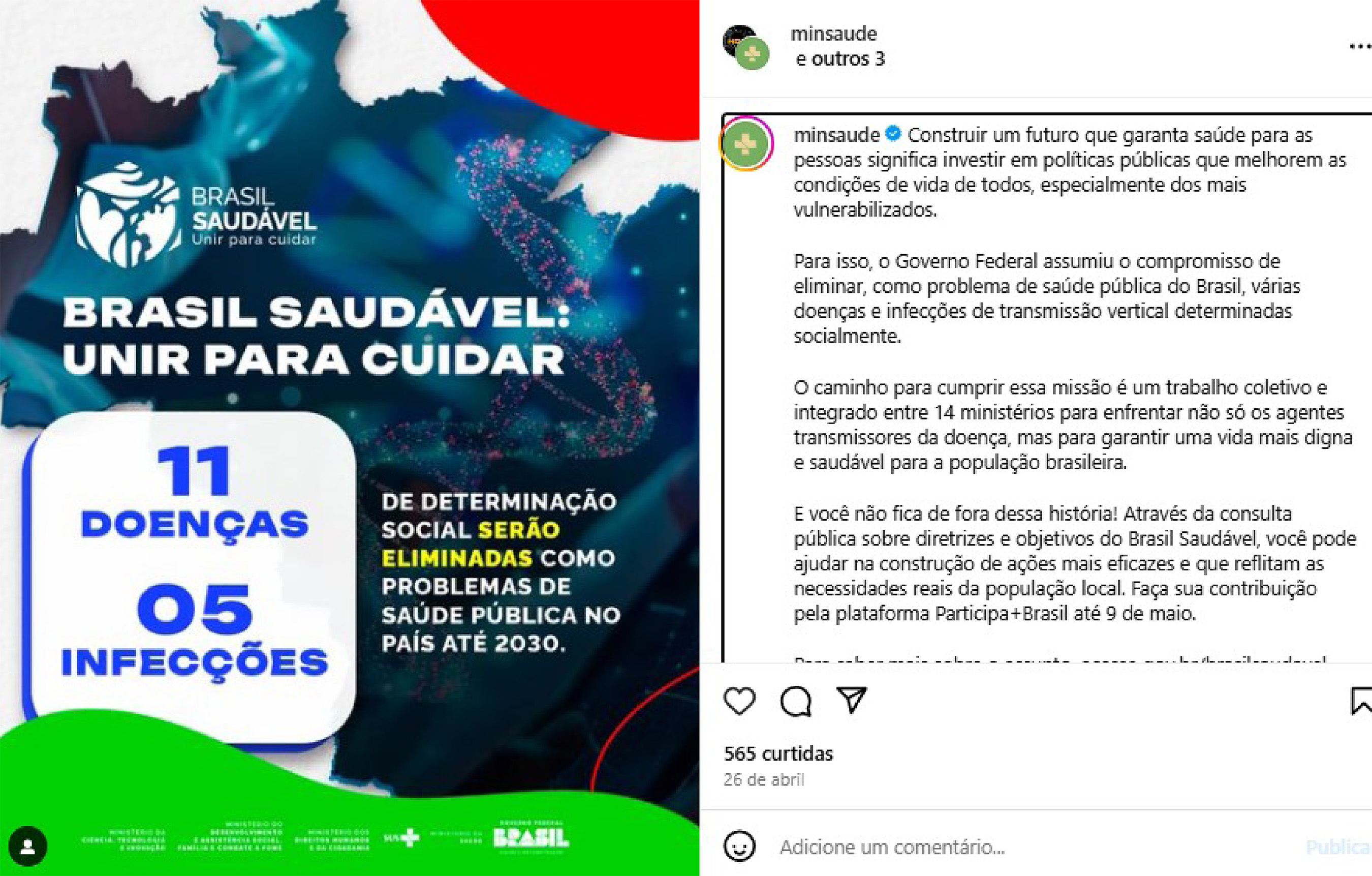 Source: Screenshot of the Brazilian Ministry of Health's Instagram page.