 Broad-spectrum resistance in lettuce germplasm to the soil-borne pathogens Berkeleyomyces basicola and B. rouxiae
ABSTRACT
One of the emerging biotic problems of the lettuce (Lactuca sativa) crop in Brazil is the black root rot caused by two Berkeleyomyces species, B. basicola and B. rouxiae. Although sources of resistance have already been reported for B. basicola, there is still no information about the response of distinct lettuce accessions to B. rouxiae. Herein, we evaluated a diversified germplasm collection, composed of accessions from different L. sativa morphotypes, searching for sources of genetic resistance effective against isolates of both causal agents of the black root rot disease complex. Sixty-eight L. sativa accessions were initially screened for resistance to one B. basicola isolate. Thirty-three accessions (with the highest levels of resistance) were inoculated again with two B. basicola and two B. rouxiae isolates. Similar levels of resistance were observed for the isolates of B. basicola and B. rouxiae. The lettuce morphotypes ‘Romaine’, ‘Batavian’, and ‘Crispy loose-leaf’ displayed higher frequency of accessions with resistance to both fungi. Broad-spectrum resistance against both pathogens detected in distinct lettuce morphotypes opens the opportunity for breeding programs to incorporate these genetic factors in a wide range of commercial cultivars.
Keywords:
Lactuca sativa; cultivar reaction; breeding; resistance; wilting; black root rot
RESUMO
Um dos problemas bióticos emergentes da cultura da alface (Lactuca sativa) no Brasil é a podridão negra das raízes causada por duas espécies de Berkeleyomyces (B. basicola e B. rouxiae). Embora fontes de resistência já tenham sido relatadas para
B. basicola, ainda não há informações sobre a resposta de diferentes acessos de alface para B. rouxiae. No presente trabalho, uma diversificada coleção de germoplasma, composta por acessos de diferentes morfotipos de L. sativa, foi avaliada visando identificar fontes de resistência efetivas contra isolados de ambos os agentes causais da podridão negra das raízes. Sessenta e oito acessos de L. sativa foram inicialmente avaliados para resistência a um isolado de B. basicola. Trinta e três acessos (com os maiores níveis de resistência) foram inoculados novamente com dois isolados de B. basicola e dois de B. rouxiae. Níveis semelhantes de resistência foram observados para os isolados de B. basicola e B. rouxiae. Os morfotipos de alface ‘Romana’, ‘Batavia’ e ‘Crespa’ apresentaram maior frequência de acessos com resistência a ambos os fungos. A resistência de amplo espectro detectada contra ambos os patógenos em morfotipos distintos de alface abre a oportunidade para os programas de melhoramento incorporarem esses fatores genéticos em uma ampla gama de cultivares comerciais.
Palavras-chave:
Lactuca sativa; reação de cultivares; melhoramento genético; resistência; murcha; podridão negra das raízes
Awide array of biotic problems can affect the lettuce (Lactuca sativa L.) crop in tropical and subtropical Brazilian regions (Sala & Costa, 2012). In addition, the traditional practice of the growers of carrying out successive production cycles in the same field area has gradually increased the incidence of soil-borne pathogens (Cabral et al., 2019). One of the emerging problems is the black-root rot caused by Berkeleyomyces basicola (former Thielaviospsis basicola) (Nel et al., 2018). However, novel taxonomic approaches have subdivided the genus Berkeleyomyces into two previously undescribed cryptic species: B. basicola and B. rouxiae (Nel et al., 2018). The two Berkeleyomyces species do not show clear-cut host specificities, and they may indistinctly infect ≈170 plant species (Farr & Rossman, 2022). In susceptible hosts, endoconidia and chlamydospores are profusely produced (Pereg, 2013). The persistence of chlamydospores in the soil and the broad host range of the Berkeleyomyces species makes difficult to eradicate these pathogens from infested fields (Nel et al., 2018). The infection cycle begins with a short biotrophic phase followed by a necrotrophic phase where the pathogen induces the characteristic dark coloration of the roots, resulting in root rot and foliage wilting (Mims et al., 2000; Pereg, 2013).
The lettuce market in Brazil is highly segmented with a wide range of commercial morphotypes (Sala & Costa, 2012), including ‘Green crispy loose-leaf’ (market leader), ‘Butterhead’, ‘Iceberg’, ‘Mimosa’ (= ‘Green and Red salad bowl’ or ‘Super crispy’) and ‘Cos/Romaine’. In Brazil, the black root rot was first detected in lettuce in Rio de Janeiro State in the late 1990s (Silva et al., 1999), and it is currently a major limiting factor for the production of ‘Iceberg’ and ‘Butterhead’ morphotypes across all regions (Sala et al., 2008; Souza, 2022). With the expansion of production areas infested with B. basicola and/or B. rouxiae (Souza, 2022), the implementation of novel management alternatives is required. However, the available options for either cultural or chemical control of these pathogens are scarce, inefficient and/or costly (O’Brien & Davis, 1994; Souza, 2022). In this scenario, the use of resistant cultivars is one of the few sustainable methods of control.
Sources of genetic resistance in Lactuca germplasm were reported only to isolates of the former species T. basicola (Sala et al., 2008). However, it is difficult to determine precisely against which fungal species these germplasm sources were evaluated due to the recent subdivision of B. basicola and B. rouxiae. Lettuce cultivation can be equally affected by both fungal pathogens as indicated by the similar levels of incidence of B. basicola and B. rouxiae across different producing regions of Brazil (Souza et al., 2025). Thus, the objective of the present work was to evaluate a diversified germplasm collection (composed of accessions from different L. sativa morphotypes) searching for sources of multiple genetic resistance effective against isolates of the two causal agents of the black root rot disease - B. basicola and B. rouxiae.
MATERIAL AND METHODS
Berkeyleyomyces isolates and inoculation bioassays
All bioassays were carried out in the greenhouses of Embrapa Vegetables (15º56’00”S; 48º08’00”W, 996 m altitude) in Brasília-DF, Brazil. The B. basicola and B. rouxiae isolates employed in the present study were obtained from symptomatic lettuce plants (Souza et al., 2025). The B. basicola isolates (EH-2733 and EH-2740) were collected in Vargem Bonita-DF (15º47’60”S; 47º52’58”W) and Paulínia-SP (22º45’40”S; 47º9’15”W). The B. rouxiae isolates (EH-2741 and EH-2743) were collected in Uberlândia-MG (18º55’8”S; 48º16’37”W) and Santa Maria de Jetibá-ES (20º2’27”S; 40º44’45”W), respectively (Souza et al., 2025). This collection of isolates was grown in Petri dishes (9 cm-diameter), containing Potato Dextrose Agar + tetracycline (PDA-t) culture medium, in a BOD incubator at a constant temperature of 23°C (12 hours light and 12 hours dark) for 15 days (Souza, 2022). Conidial suspensions were prepared by adding 10 mL of sterile distilled water to each plate, then the conidia were released with the aid of a soft bristle brush. The spore suspensions were subsequently filtered through a double-layer gauze. The spore concentration was estimated under an optical microscope by counting them with the aid of a Neubauer chamber. In the final step, the suspension was adjusted to concentrations of 7.5 x 10⁵ or 2 x 10⁶ conidia/mL. Seeds of the lettuce accessions were sown in 6.2 cm deep polystyrene trays with 128 cells, containing previously sterilized commercial substrate (Plantmax®), sown at 3 mm depth, and kept at a greenhouse (approximately 15-28oC) where they were irrigated twice a day. At 21 days after germination, the seedlings were gently removed from the cells and washed in running water aiming to eliminate the substrate adhered to the roots. Then the root system of each seedling was immersed in 3 mL of the spore suspension (2 x 10⁶ conidia/mL) for three minutes. The residual suspension was placed near the crown area of each transplanted seedling with the aid of a micropipette. The seedlings were then transplanted into 72-cell trays containing 1/3 of the substrate (Plantmax®) infested ten days before with a conidial suspension (7.5 x 10⁵ conidia/gram of substrate) (Sala et al., 2008). Mock-inoculated controls were dipped into sterile distilled water and transplanted to trays containing non-colonized substrate and kept at least one meter away from the inoculated plants to avoid cross contamination.
Evaluation criteria implemented in the bioassays
The disease assessments were performed 21 days after inoculation, using a visual scale based upon the degree of symptom severity on the lettuce roots as proposed by O’Brien & Davis (1994) where: 1 = absence of symptoms, 2 = traces of necrosis in the root system, 3 = up to 50% of the root system with necrosis, 4 = more than 50% and less than 90% of necrotic root system, and 5 = more than 90% of the root system severely affected (Figure 1). The average grade reaction of each material was calculated, expressed by the arithmetic mean of the scores. This assessment was used to classify the lettuce accessions into three arbitrary categories of reaction namely: resistant (average severity scores between 1.0 and 2.0), intermediate resistant (scores between 2.01 and 4.0) and susceptible (scores between 4.01 and 5.0) (Sala et al., 2003). A disease severity index (DSI) was calculated from the data of the average grade reaction of each cultivar according to McKinney (1923), where DSI = [Σ (reaction grade x frequency) / (total number of units x maximum scale grade)] x 100. After obtaining the DSI for each germplasm accession, the data were submitted to analysis of variance. The DSI was transformed into a square root of x+1 to normalize its distribution. The DSIs were compared and grouped using the Scott-Knott test (P≤0.05) using the SISVAR package (Ferreira, 2011).

Grading scale for quantifying the severity of the symptoms induced by Berkeleyomyces species in lettuce (Lactuca sativa) roots: 1 = absence of symptoms, 2 = traces of necrosis in the root system, 3 = up to 50% of the root system with necrosis, 4 = more than 50% and less than 90% of necrotic root system and 5 = more than 90% of the root system severely affected (O’Brien & Davis, 1994). Brasília, Embrapa Vegetables, 2021.
Bioassay #1: Initial screening of lettuce accessions to B. basicola isolate EH-2733
In order to simplify the screening process, the 68 Lactuca accessions were initially evaluated (August and September 2021) for reaction to only a single fungal isolate under greenhouse conditions (Table 1). The B. basicola EH-2733 isolate was chosen for this initial screening due to its aggressiveness to major commercial lettuce cultivars (data not shown). The experiment was carried out in a completely randomized design with 68 lettuce accessions (with and without inoculation) with three replications, each consisting of four seedlings. The cultivars ‘Elisa’ (‘Butterhead’ morphotype) and ‘La Brillante’ (‘Batavian’ morphotype) were used as susceptible and resistant controls, respectively (Sala et al., 2008).
Bioassay #2: Search for sources of resistance to four isolates of two Berkeleyomyces species in a subset of accessions identified with a resistant reaction in the bioassay #1
From the initial screening of bioassay #1 (Table 1), 33 of the most promising accessions within the resistant reaction category (grades 1.0-2.0) were selected and evaluated in a second bioassay. These accessions were separately inoculated with two B. basicola isolates (EH-2733 and EH-2740) and two B. rouxiae isolates (EH-2741 and EH-2743) (Souza, 2022). The experiment was carried out in a greenhouse in a completely randomized design with 33 accessions x four isolates and three replications (with four plants each). Due to lack of seed availability, the cultivars ‘Romaine Balão’, ‘Penlake’, and ‘Blonde de Paris’, grouped in bioassay #1 as resistant (Table 1), were not reevaluated in bioassay #2. The accession ‘PI 342444’ was used as a resistant control (Sala et al., 2008). The cultivars ‘Branca de Paris’, ‘Vanguard 75’, ‘Aurélia’, and ‘Elisa’ were used as susceptible controls.
RESULTS AND DISCUSSION
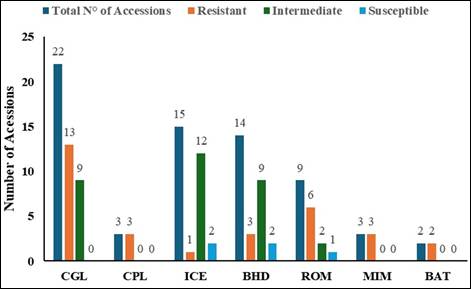
Among the 68 lettuce accessions evaluated in bioassay #1, 31 were classified as resistant, 32 as intermediate resistant, and five as susceptible to B. basicola EH-2733 (Table 1). All accessions belonging to the morphotypes ‘Mimosa’, ‘Batavian’, and ‘Crispy purple loose-leaf’ were resistant to B. basicola (Figure 2). Six out of the nine ‘Cos/Romaine’ accessions were classified as resistant. Thirteen out of the 22 accessions of the ‘Crispy green loose-leaf’ morphotype were classified as resistant and nine displayed intermediate reaction. In the ‘Butterhead’ morphotype, only three out of the 14 accessions were classified as resistant to B. basicola. From the ‘Iceberg’ morphotype, only one out of 15 accessions was classified as resistant, 12 displayed intermediate reactions and two were susceptible. Therefore, at least one accession with superior levels of resistance was detected within each morphotype.
The disease severity, calculated by the McKinney (1923) index, indicated in the bioassay #1 a wide range of responses (Table 1) varying from 28.33 (for the cultivars ‘BRS Mediterrânea’ and ‘La Brillante’) to 85.00 (for the cultivar ‘Elisa’). Our results are in overall agreement with previous screening assays that indicated a heterogeneous response to B. basicola isolates among the different lettuce morphotypes. Cultivars of the ‘Butterhead’ group have shown high levels of susceptibility to B. basicola. Conversely, most cultivars of the ‘Crispy green loose-leaf’, ‘Crispy purple loose-leaf’, and ‘Batavian’ morphotypes displayed resistant reaction, whereas the ‘Iceberg’ accessions showed heterogeneous reaction to B. basicola isolates (Sala et al., 2008). Similarly, we also observed low frequency of resistant accessions within the ‘Butterhead’ and ‘Iceberg’ accessions, although few exceptions were detected. Similar susceptibility variation among morphotypes was also observed for B. basicola under field and greenhouse conditions in California (Koike, 2008).
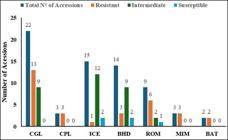
Reaction classes of 68 lettuce (Lactuca sativa) accessions from distinct morphotypes to the Berkeleyomyces basicola isolate EH-2733. *Lettuce morphotypes: Crispy Green Loose-Leaf (CGL), Crispy Purple Loose-Leaf (CPL), Iceberg (ICE), Butterhead (BHD), Cos/Romaine (ROM), Mimosa (MIM), and Batavian (BAT). Brasília, Embrapa Vegetables, 2021.
In the bioassay #2, significant differences in the DSI values were observed among the 33 accessions of the most promising accessions detected in the bioassay #1 in response to the two isolates of each Berkeleyomyces species. However, similar responses were observed for DSIs to B. basicola and B. rouxiae, even though some exceptions were detected. The subgroup of accessions, including ‘Little Gem’, ‘Maravilha 4 Estações’ (‘Butterhead’), ‘Salvius’ (‘Cos/Romaine’), ‘Argeles’ (‘Crispy green loose-leaf’) and ‘La Brillante’ (‘Batavian’) displayed a phenotypically stable resistance reaction against all four isolates of the two Berkeleyomyces species (Table 2). The identification of accessions with contrasting reactions for the two Berkeleyomyces species will allow the employment of them as parental lines in additional inheritance as well as in genetic mapping studies of the resistance factor(s) for both pathogens.
A low frequency of susceptible accessions to B. basicola and B. rouxiae isolates was observed in the morphotypes ‘Mimosa’, ‘Batavian’, and ‘Crispy green loose-leaf’. This observation is relevant from the breeding standpoint. ‘Crispy green loose-leaf’ is the most economically important morphotype under Brazilian conditions (Sala & Costa, 2012). The morphotypes ‘Cos/Romaine’, ‘Batavian’, and ‘Mimosa’ are increasing their market share in the country over the last few decades. However, the most impressive cultivation and consumption increase was observed in the ‘Iceberg’ morphotype (Sala & Costa, 2012). In fact, the ‘Iceberg’ is the most challenging morphotype in terms of genetic improvement for resistance to Berkeleyomyces species since it displayed a low frequency of accessions with adequate levels of resistance. The cultivar ‘Salinas 88’ (‘Iceberg’) showed specific resistance against B. basicola isolates, confirming previous data of Sala et al. (2008). However, this accession did not show adequate levels of resistance to B. rouxiae isolates.
A subgroup of accessions including ‘Hanson’, ‘BRS Lélia’, ‘Crespa Verão’, ‘PI 342444’, and ‘Prado Mimosa’ displayed a peculiar type of species-specific resistance to B. basicola. (Table 2). The accessions ‘Salinas 88’, ‘PI 342444’, and ‘BRS Mediterrânea’ showed a resistance reaction against isolates of B. basicola but displayed heterogeneous responses against the two isolates of B. rouxiae. The accession ‘Crespa Repolhuda’ exhibited an interesting pattern of heterogeneous response, showing superior levels of resistance to three isolates (two B. basicola and one B. rouxiae), but displayed a susceptible reaction to the B. rouxiae EH-2733 isolate.
Inheritance studies conducted by Sala et al. (2003) proposed a dominant monogenic model (called Tb gene/locus) controlling resistance to T. basicola in the accession ‘PI 342444’. Herein, accessions of ‘Cos/Romaine’ and ‘Batavian’ morphotypes and a large majority of accessions of ‘Crispy loose-leaf’ were resistant to all isolates of both fungi, indicating that the Tb locus might also control resistance to isolates of the species B. rouxiae. However, the original source of the Tb locus (‘PI 342444’) displayed good levels of resistance to B. basicola isolates (EH-2733 and EH-2740) but not to B. rouxiae isolates (EH-2741 and EH-2743) in the bioassay #2, indicating a species-specific reaction of this accession. Therefore, alternative hypotheses were proposed suggesting either the presence of two distinct genes (one controlling resistance to B. rouxiae and other to B. basicola) in close linkage within a putative cluster of resistance genes, which is a common feature in the lettuce genome (McHale et al., 2009; Christopoulou et al., 2015) or the presence of distinct resistant gene(s) in the accessions of ‘Cos/Romaine’, ‘Batavian’, and ‘Crispy loose-leaf’ morphotypes. In this context, allelic tests involving crossings of ‘PI 342444’ and these novel sources of large-spectrum resistance should be carried out to assess the genetic control of this trait.
No clear-cut host specificity was observed across the four isolates of the two fungal species in relation to lettuce accessions. Only a slight variability in the aggressiveness/virulence profile of the isolates was observed within the subgroups of accessions. For example, the accessions ‘Hanson’, ‘BRS Lélia’, ‘Crespa Verão’, ‘PI 342444’, and ‘Prado Mimosa’ displayed resistance to B. basicola isolates EH-2733 and EH-2740, but they were susceptible to both B. rouxiae isolates. In fact, differential pathogenicity patterns among isolates from both Berkeleyomyces species have been reported, suggesting the presence of putative fungal pathotypes and/or races in lettuce (Nakane et al., 2019; Souza et al., 2025). Differential resistance patterns among morphotypes have been observed in other pathosystems involving lettuce. For example, the cultivars of the morphotypes ‘Cos/Romaine’ and ‘Mimosa’ behave as the most resistant to Fusarium oxysporum f. sp. lactucae race 1, while most cultivars from the ‘Iceberg’ morphotype were susceptible (Cabral et al., 2019).
One of the few sustainable and durable methods for controlling pathogens is pyramiding multiple disease resistance genes into a single cultivar (Mundt, 2018). Effective resistance factors against other lettuce pathogens are also present in the five accessions that exhibited the highest levels of multi-resistance against isolates of both Berkeleyomyces species (viz. ‘Litte Gem’, ‘Maravilha 4 Estações’, ‘Salvius’, ‘Argeles’, and ‘La Brillante’). The cultivar ‘Little Gem’ is a source of resistance to Xanthomonas campestris pv. vitians (Bull et al., 2007), whereas ‘Argeles’ was identified as the best source of resistance against all Brazilian isolates of Bremia lactucae (Franco et al., 2021). The cultivar ‘La Brillante’ is another accession of interest from the breeding standpoint, showing high levels of resistance against all Berkeleyomyces isolates as well as to B. lactucae, Verticillium dahliae, Orthotospovirus tomatomaculae, Orthotospovirus impatiens necromaculae, and X. campestris pv. vitians (Sala et al., 2008; Hayes et al., 2011, 2014; Simko et al., 2015; 2018; Fontes et al., 2019). In turn, the cultivar ‘Salvius’ displayed high levels of tolerance for heat-associated physiological disorders, including tipburn and premature bolting (Holmes et al., 2019). Thus, the use of this subgroup of accessions as potential sources of useful traits would be a judicious strategy for breeding programs aiming at the development of multi-resistant cultivars with adaptation to warm climates.
Dynamic plant-fungal interactions have been investigated in different pathosystems involving Berkeleyomyces species and dicotyledonous hosts (Mauk & Hine, 1988; Hood & Shew, 1997; Mims et al., 2000). A subset of resistant tobacco and Viola accessions reacted to Berkeleyomyces isolates by exhibiting papillae and callose formation in sites of fungal invasion in epidermal cells (Hood & Shew, 1997; Mims et al., 2000). This phenotypic response suggests the potential involvement of NB-LRR-like resistance genes to Berkeleyomyces (Wang et al., 2021). However, in the lettuce Berkeleyomyces pathosystem, the genetic factors as well as the biochemical and cytological mechanisms have not yet been fully characterized. In the lettuce genome, numerous genes potentially involved in resistance responses have already been characterized, including factors encoding NB-LLR-like proteins (McHale et al., 2009; Christopoulou et al., 2015). The identification of sources with high levels of resistance for both B. basicola and B. rouxiae in accessions of different morphotypes opens the breeding opportunity to incorporate these genetic factors in a wide range of commercial lettuce cultivars, being crucial for the development of lettuce cultivars with stable and durable resistance against Berkeleyomyces species.
ACKNOWLEDGMENTS
The authors are grateful for the financial support provided by grants from EMBRAPA, CNPq, and FAP-DF. The authors are also grateful to CNPq for scholarships. This study was also financed by the Coordenação de Aperfeiçoamento de Pessoal de Nível Superior (CAPES), Finance Code 001.
REFERENCES
-
BULL, CT; GOLDMAN, PH; HAYES, R; MADDEN, LV; KOIKE, ST; RYDER, E. 2007. Genetic diversity of lettuce for resistance to bacterial leaf spot caused by Xanthomonas campestris pv. vitians Plant Health Progress 8: 11. doi.org/10.1094/PHP-2007-0917-02-RS
» https://doi.org/10.1094/PHP-2007-0917-02-RS -
CABRAL, CS; FONSECA, MEN; OLIVEIRA, VR; BOITEUX, LS; REIS, A. 2019. A single dominant gene/locus model for control of Fusarium oxysporum f. sp. lactucae race 1 resistance in lettuce (Lactuca sativa). Euphytica215: 114. DOI: 10.1007/s10681-019-2441-2
» https://doi.org/10.1007/s10681-019-2441-2 -
CHRISTOPOULOU, M; MCHALE, LK; KOZIK, A; REYES-CHIN, WO; WROBLEWSKI T; MICHELMORE, RW. 2015. Dissection of two complex clusters of resistance genes in lettuce (Lactuca sativa). Molecular Plant-Microbe Interactions28: 751-765. DOI: 10.1094/MPMI-06-14-0175-R
» https://doi.org/10.1094/MPMI-06-14-0175-R -
FARR, DF; ROSSMAN, AY. 2022. Fungal Databases, U.S. National Fungus Collections, ARS, USDA, https://nt.ars-grin.gov/fungaldatabases/ Accessed18 June 2022.
» https://nt.ars-grin.gov/fungaldatabases/ -
FERREIRA, DF. 2011. SISVAR: A computer statistical analysis system. Ciência e Agrotecnologia 35: 1039-1042. DOI: 10.1590/S1413-70542011000600001
» https://doi.org/10.1590/S1413-70542011000600001 -
FONTES, MG; CABRAL, CS; LIMA, MF; FONSECA, MEN; BOITEUX, LS. 2019. Phenotypic expression and species-specific reaction of Lactuca sativa ‘PI 342444’ to groundnut ringspot virus (GRSV) and tomato spotted wilt virus (TSWV) isolates. European Journal of Plant Pathology 155: 231-238. DOI: 10.1007/s10658-019-01766-3
» https://doi.org/10.1007/s10658-019-01766-3 -
FRANCO, CA; MARIN, MV; SILVA, EHC; SOARES, RS; CANDIDO, WS; SOUZA, LN; CAPRIO, CH; VIDAL, RL; PANIZZI, RC; BRAZ, LT. 2021. Monitoring virulence of Bremia lactucae as a breeding tool against lettuce downy mildew from south and southwest Brazilian regions. European Journal of Plant Pathology 159: 179-189. DOI:10.1007/s10658-020-02154-y
» https://doi.org/10.1007/s10658-020-02154-y -
HAYES, RJ; MCHALE, LK; VALLAD, GE; TRUCO, MJ; MICHELMORE, RW; KLOSTERMAN, SJ; SUBBARAO, KV. 2011. The inheritance of resistance to Verticillium wilt caused by race 1 isolates of Verticillium dahliae in the lettuce cultivar La Brillante. Theoretical and Applied Genetics 123: 509-517. DOI: 10.1007/s00122-011-1603-y
» https://doi.org/10.1007/s00122-011-1603-y -
HAYES, RJ; TRENT, MA; TRUCO, MJ; ANTONISE, R; MICHELMORE, RW; BULL, CT. 2014. The inheritance of resistance to bacterial leaf spot of lettuce caused by Xanthomonas campestris pv. vitians in three lettuce cultivars. Horticulture Research1: 14066. DOI: 10.1038/hortres.2014.66
» https://doi.org/10.1038/hortres.2014.66 -
HOLMES, SC; WELLS, DE; PICKENS, JM; KEMBLE, JM. 2019. Selection of heat tolerant lettuce (Lactuca sativa L.) cultivars grown in deep water culture and their marketability. Horticulturae5: 50. DOI: 10.3390/horticulturae5030050
» https://doi.org/10.3390/horticulturae5030050 - HOOD, ME; SHEW, HD. 1997. Initial cellular interactions between Thielaviopsis basicola and tobacco root hairs. Journal of Phytopathology 87: 228-235.
-
KOIKE, ST. 2008. Black root rot caused by Thielaviopsis basicola on lettuce in California. Plant Disease 92: 1368. DOI: 10.1094/PDIS-92-9-1368A
» https://doi.org/10.1094/PDIS-92-9-1368A - MAUK, P; HINE, R. 1988. Infection, colonization of Gossypium hirsutum and G. barbadense, and development of black root rot caused by Thielaviopsis basicola Journal of Phytopathology 78: 1662-1667.
-
McHALE, LK; TRUCO, MJ; KOZIK, A; WROBLEWSKI, T; OCHOA, OE; LAHRE, KA; MICHELMORE, RW. 2009. The genomic architecture of disease resistance in lettuce. Theoretical and Applied Genetics 118: 565-580. DOI:10.1007/s00122-008-092-1
» https://doi.org/10.1007/s00122-008-092-1 - McKINNEY, RH. 1923. Influence of soil temperature and moisture on infection of wheat seedlings by Helminthosporium sativum Journal of Agricultural Research6: 195-218.
-
MIMS, CW; COPES, WE; RICHARDSON, EA. 2000. Ultrastructure of the penetration and infection of pansy roots by Thielaviopsis basicola Journal of Phytopathology 90: 843-850. DOI: 10.1094/PHYTO.2000.90.8.843
» https://doi.org/10.1094/PHYTO.2000.90.8.843 -
MUNDT, CC. 2018. Pyramiding for resistance durability: Theory and practice. Phytopathology 108: 792-802. DOI: 10.1094/PHYTO-12-17-0426-RVW
» https://doi.org/10.1094/PHYTO-12-17-0426-RVW -
NAKANE, R; MIKI, S; IKEDA, K; SAKAI, H; HAYASHI, K; USAMI, T. 2019. First report of black root rot of lettuce in Japan caused by Berkeleyomyces rouxiae Journal of General Plant Pathology 85: 436-439. DOI: 10.1007/s10327-019-00860-y
» https://doi.org/10.1007/s10327-019-00860-y - NEL, WJ; DUONG, TA; WINGFIELD, BD; WINGFIELD, MJ; BEER, ZW. 2018. A new genus and species for the globally important, multihost root pathogen Thielaviopsis basicola Plant Pathology 67: 871-882.
-
O’BRIEN, RG; DAVIS, RD. 1994. Lettuce black root rot - A disease caused by Chalara elegans Australasian Plant Pathology 23: 106-111. DOI:10.1071/APP9940106
» https://doi.org/10.1071/APP9940106 -
PEREG, LL. 2013. Black root rot of cotton in Australia: The host, the pathogen and disease management. Crop & Pasture Science 64: 1112-1126. DOI: 10.1071/CP13231.
» https://doi.org/10.1071/CP13231 -
SALA, FC; COSTA, CP. 2012. Retrospectiva e tendência da alfacicultura brasileira. Horticultura Brasileira 30: 187-194. DOI: 10.1590/S0102-05362012000200002
» https://doi.org/10.1590/S0102-05362012000200002 - SALA, FC; COSTA, CP; TEIXEIRA-YAÑEZ, LDD; BLAT, SF. 2003. Reação de alface a murchadeira (Thielaviopsis basicola). Horticultura Brasileira 21: 336.
-
SALA, FC; COSTA, CP; TEIXEIRA-YAÑEZ, LDD; FABRI, EG; BLAT, SF. 2008. Reação de alface a murchadeira (Thielaviopsis basicola). Horticultura Brasileira 21: 336. DOI: 10.1590/S0102-05362008000300021
» https://doi.org/10.1590/S0102-05362008000300021 - SILVA, AMS; AKIBA, F; CARVALHO, AO; RIBEIRO, RLD.; ARAÚJO, JSP. 1999. Podridão negra de raízes de quiabeiro e alface incitada por Thielaviopsis spp. In: 32o Congresso Brasileiro Fitopatologia, Book of Abstracts. Brasília: SBF. (CD-ROM).
-
SIMKO, I; OCHOA, OE; PEL, MA; TSUCHIDA, C; FONTI FORCADA, C; HAYES, RJ; MICHELMORE, RW. 2015 Resistance to downy mildew in lettuce ‘La Brillante’ is conferred by Dm50 gene and multiple QTL. Phytopathology105: 1220-1228. DOI: 10.1094/PHYTO-02-15-0057-R
» https://doi.org/10.1094/PHYTO-02-15-0057-R -
SIMKO, I; RICHARDSON, CE; WINTERMANTEL, WM. 2018. Variation within Lactuca spp. for resistance to Impatiens necrotic spot virus Plant Disease 102: 341-348. DOI: 10.1094/PDIS-06-17-0790-RE
» https://doi.org/10.1094/PDIS-06-17-0790-RE - SOUZA, RL. 2022. Identificação molecular e patogenicidade de espécies de Berkeleyomyces associadas a hortaliças no Brasil com ênfase na cultura da alface Recife: UFRP. 62p. (MSc. Dissertation).
-
SOUZA, RL; FRANCO, CA; NAKAGAWA, SI; PERDOMO, DN; TORRES, TB; VELOSO, IS; FONSECA, MEN; BOITEUX, LS; REIS, A. 2025. Molecular identification, relative prevalence, and host range of Berkeleyomyces species associated with the lettuce and other leaf vegetables in Brazil. Tropical Plant Pathologyv.49, p. online. https://doi.org/ 10.1007/s40858-025-00708-1
» https://doi.org/10.1007/s40858-025-00708-1 -
WANG, Y; LI, X; FAN, B; ZHU, C; CHEN, Z. 2021. Regulation and function of defense-related callose deposition in plants. International Journal of Molecular Sciences22: 2393. DOI: 10.3390/ijms22052393
» https://doi.org/10.3390/ijms22052393
STATEMENTS AND DECLARATIONS
Data will be made available upon request to the corresponding author.