
 Urban Studies in the Geography of the Comunidade do Pilar: An Integrative Systematic Literature Review
Abstract
From a methodological perspective, using an integrative systematic literature review, this study aims to outline a theoretical and evolutionary overview of the Comunidade do Pilar in Recife/PE. Exploratory in nature, the corpus was qualitatively constructed from the analysis of 5 studies derived from a universe of 26 works published in institutional repositories and national and international journals. Based on the defined methodological scope, it was possible to observe that the Comunidade do Pilar, despite being located in the Bairro do Recife, the city's historical center, lacks significant and current scientific productions about its resistance processes, highlighting a theoretical gap in the field of Urban Geography.
Keywords:
Comunidade do Pilar; Territory; Resistance; ZEPH; Urban Geography.
Resumo
Do ponto de vista metodológico, utilizando uma revisão sistemática integrativa da literatura, esse estudo tem como objetivo traçar um panorama teórico e evolutivo sobre a Comunidade do Pilar, em Recife/PE. De caráter exploratório, o corpus foi construído qualitativamente a partir da análise de 5 estudos originados de um universo de 26 trabalhos publicados em repositórios institucionais e periódicos nacionais e internacionais. A partir da definição do escopo metodológico mencionado, foi possível perceber que a Comunidade do Pilar, apesar de estar localizada no Bairro do Recife, centro histórico da cidade, não tem produções científicas expressivas e nem atuais sobre seus processos de resistência, evidenciando uma lacuna teórica no campo da Geografia Urbana.
Palavras-chave:
Comunidade do Pilar; Território; Resistência; ZEPH; Geografia Urbana
Resumen
Desde una perspectiva metodológica, utilizando una revisión sistemática integrativa de la literatura, este estudio tiene como objetivo delinear un panorama teórico y evolutivo de la Comunidade dol Pilar en Recife/PE. De carácter exploratorio, el corpus se construyó cualitativamente a partir del análisis de 5 estudios derivados de un universo de 26 trabajos publicados en repositorios institucionales y revistas nacionales e internacionales. Con base en el alcance metodológico definido, fue posible observar que la Comunidade do Pilar, a pesar de estar ubicada en el Barrio do Recife, el centro histórico de la ciudad, carece de producciones científicas significativas y actuales sobre sus procesos de resistencia, evidenciando una brecha teórica en el campo de la Geografía Urbana.
Palabras clave:
Comunidade do Pilar; Territorio; Resistencia; ZEPH; Geografía Urbana.
Introduction
Territory is a concept that precedes space. In Raffestin's view (1993), territory is a production from space that is later territorialized. Based on this geographic category, we understand the city as a result of social transformations that have occurred over time (Sposito, 1988).
One of these transformations is implemented by capitalism and its tendency to transform everything into a commodity (Villaça, 2000), consequently generating conflicting processes of exclusion and resistance. Based on this context, this study seeks to bring conceptual aspects regarding the occupation process of the Pilar Community in the Bairro do Recife, historic center of Recife (PE). The first signs of the existence of an occupation in the urban perimeter of Bairro do Recife appear around the 18th century in an area called “Fora de Portas” (Outside Doors), already outlining marked differences in the pattern of infrastructure “inside” and “outside doors”, that is, delimiting the different urban formations existing in the historic center of the metropolis (Nery, 2012).
Costa and Araújo Sobrinho (2013) point out that the literature on urban centralities and intra-urban studies began to be part of geographic constructs from the 1960s onwards. Understanding this aspect, this study adds to this debate a perspective on power relations as something instituted between actors or groups in space and time (Silva; Azevedo, 2016). It also has contributions from Dourado and Sobrinho (2023), (Araújo and Sobrinho 2022). Thus, identifying the need to fill a theoretical gap regarding the questions regarding the representation of the Pilar Community in the literature of Urban Geography, this study seeks to construct a theoretical panorama about the community, outlining through a systematic integrative review of the literature, its characterization, evolution of studies, tensions and suggestions for future studies.
Historical centers, capitalist advancement and counter-hegemonic actors
The origin of cities is essentially explained by their social and political bias, being predominantly a place of domination (Sposito, 1988). Thus, the city has in each of its spaces particularities that make up its social formation, with the historic center being a symbolic reference of its foundation, preserving within itself the essence of the urban (Scarlato; Costa, 2017).
In metropolises, the expansion of centers was accompanied, in parallel, by the emergence of subcenters, increasing the need for commercial and service structures (Sposito, 1991). Being a place of production and consumption, cities, at an intraurban level and from a capitalist scenario, have their investments in collective goods and services directed to popular classes with greater purchasing power (Sposito, 1988; Sposito, 1991).
However, there are actors who fight against this type of exclusionary planning, generating conflicting movements of resistance against capital, specifically configuring a fight for “material and immaterial territory” (Cardona; Sobreiro Filho, 2016). Thus, beyond collective access to urban infrastructure, the concept of the right to the city is expanded, seeking changes in accordance with the deepest interests of the individual (Harvey, 2014). In this context, it can be said that it is in the dialectic between the territory and the movement of counter-hegemonic actors that the formation of a new territory with collective identities forged there is strengthened (Balem; Reys, 2024).
A brief presentation of the Recife neighborhood
In addition to being considered the historical center of the city, the Bairro do Recife was closely linked to the Port of Recife. Between 1542 and 1831, the area was focused on sugar production and the slave trade, and is currently characterized by its multiple uses, with the presence of municipal agencies, service and commercial companies, integrated public transportation centers (Nery, 2012; Santos, 2019), in addition to strong tourist attractions, such as museums, bars, and restaurants. Santos (2019) highlights that before being a historical center; Bairro do Recife is a center and a centrality, terms that, from a geographical point of view, have specificities.
A landmark of the first major urban intervention in the capital, the neighborhood had, in the 1910s, sectors of its original core demolished to comply with the new orders of urbanism with French influence, resulting in expropriations and favoring the growth of marginalized populations, who began to build informal housing in the area. Despite this, the interventions of that time brought value to the neighborhood, which had widened avenues and a new profile of residents, especially the local elite (Nery, 2012). Around the 1960s, the Pilar Community, located north of the historic center, began its consolidation process in the Recife neighborhood, which in turn experienced a process of neglect by the municipal government, attracting popular classes to the neighborhood (Santos, 2019). This neglect justifies the revitalization processes that later became frequent in the neighborhood, attracting public and private investments and, at times, generating a process of expulsion of people who lived there; in relation to the Pilar community, the projects are characterized by the promise of housing and leisure areas (Santos, 2019). Regarding these revitalization processes in Bairro do Recife, Giustina (2010) reports that the local urbanization gained a European aesthetic, losing local aspects and not being projects capable enough to attract the population back. On this point, Santos (2019) highlights that the situation of the historic center is no different from other port areas in the world, with narrow streets marked by insalubrity. From this perspective, Giustina (2010) points out that the uniqueness of Bairro do Recife lies in the construction based on its natural port, which, together with its geographic location, sets it apart from other port cities.
Among the factors related to the process of emptying of Old Recife is the search by some residents for better housing conditions, causing the lack of use for several large houses and warehouses in the neighborhood, consequently leading to the attraction of low-income populations to occupy the region (Santos, 2019). It is worth mentioning that the Church of Pilar was built on the ruins of the Fort of São Jorge and, subsequently, its perimeter attracted a flow of people and also businesses, which also contributed to the consolidation of the Pilar community (Santos, 2019), “Fora de Portas” or “Favela do Rato”.
The occupation of the Pilar Community
Discussions involving the revitalization of central areas with significant historical and cultural value bring reflections to the public authorities regarding their performance in the construction of socially diverse territories, even though there are few examples of revitalization actions that have maintained the popular classes in the localities (Nery, 2012).
In terms of the milestone for the beginning of its occupation, it can be said that it was in the 1970s, after the expropriation of existing buildings between the Pilar factory and the Moinho Recife for the installation of the extension of the Port of Recife, that the community began to be gradually densified by low-income families who already occupied the historic site due to the connection with port activities and others coming from the hinterland of Pernambuco, which, at that time, was experiencing one of its worst droughts (Nery, 2012; Alves, 2016; Santos, 2019). Map 1 shows the location of the community:


Regarding the architecture during this period of occupation, it can be said that it was characterized by low-rise mixed-use buildings - residential and commercial - and small and medium-sized warehouses. It is worth noting that due to the lack of continuity in the expansion of the Port of Recife, the area, which was already predominantly made up of ruins of expropriated properties, was closed off with twometer-high walls; already listed by IPHAN, the Church of Our Lady of Pilar was the only monument spared from demolition (Giustina, 2010). Until 1978, some buildings in the Recife neighborhood were used by merchants and prostitutes, who began to occupy the space until the new intervention and standardization, by the municipal government, of the division of the territory into Special Preservation Zones (ZEPH), culminating in the completion of the plan that constitutes 31 historical sites and in the subsequent revitalization plans that began to maintain this specific interest in preservation (Nery, 2012). From this name, four Hubs were created: Alfândega, Bom Jesus, Novo Recife and Pilar. Regarding the latter, it is worth highlighting its architectural and urban diversity (Alves, 2016).
The ZEPHs are the result of the Recife Historic Sites Preservation Plan (PPSHRMR), established by Municipal Law No. 13,957, which in 1996 became Special Zones for the Preservation of Historical-Cultural Heritage (ZEPH), with heritage sites such as the Nossa Senhora do Pilar Church, the Brum Railway Station and the Brum Fort, in addition to archaeological findings (Soares, 2019).
According to Nery (2012), the Pilar Community is located in an area that, historically, was intended for the most popular classes, however, they were still included in the economic and social dynamics of the neighborhood due to their location as a passageway. From the 1970s onwards, after the demolition of the houses, the area became increasingly densely populated by homeless individuals who had been expelled from their places of origin, causing the community to absorb the population that was not included in other areas (Nery, 2012).
Like other geographic spaces, the Recife neighborhood has physical separations that delimit the socioeconomic conditions of its users and residents, calling the walls that, until a certain point, separated each area “Portas”. According to the author, the separation became evident when defining the perimeter to be listed in the historic neighborhood, which did not include the area called “Fora de Porta”, today known as Comunidade do Pilar, in reference to the Nossa Senhora do Pilar Church (Nery, 2012; Santos, 2019).
In relation to the “Portas”, the Recife neighborhood had its urban configuration defined based on three accesses: “Gate of the land”, “Gate of the sea” and “Gate of the ferry”, the first providing access to Olinda, the second providing access to the sea and the third connecting the island to the continent; over the first gate, later replaced by the “Arco Bom Jesus”, it can be said that it was officially the main access control to the city, and therefore, in 1870, the Pilar Community was known as “Povoado Fora de Portas” (Village Outside the Gates) precisely because of its fragmentation of the space located outside the gates that protected the city (Nery, 2012; Santos, 2019).
According to Giustina (2010), until 2009, the community did not have good living conditions, with risks to the health of residents due to the lack of basic sanitation and the presence of fires caused by the presence of clandestine electrical connections.
According to Nery (2012), these separations influenced the division of the neighborhood into sectors when the 1998 Revitalization Plan was implemented, which named the community an “area of renewal” due to the precarious infrastructure conditions. Regarding housing conditions, Nery (2012) reports that the region had been marked since 1970, predominantly by ruins, still reflecting the partial demolition carried out by Portobrás with the aim of expanding the Port of Recife, which did not happen.
Specifically regarding the Church, it is understood that it remained surrounded by open areas until the end of the 19th century, when the Pilar Factory was initially built and, later, its facilities were expanded, definitively altering the empty spaces in the area (Giustina, 2010).
Also from this perspective, Giustina (2010) highlights that for some years, the church continued to be administered by the factory, a context that only changed from 1990 onwards, when it passed its function to the Archdiocese of Olinda and Recife, which, shortly thereafter, ended the church's religious activities, culminating in the church's urban isolation.
In this sense, Nery (2012) states that the geographic space of Recife is characterized by its areas of poverty due to the lack of infrastructure - sanitation, water, leisure, among others - and the precariousness of housing. Added to this issue is the feeling of not belonging to the rest of the neighborhood.
The Pilar is located in a space with high symbolic value, but at the same time, it is separated from the city and its social dynamics, and is therefore vulnerable to urban interventions and exclusions, something that in turn occurs due to the very conditions of the built environment of the community in the shape of a fortress, which protects and also separates (NERY, 2012).
In 1998, the Bairro do Recife was listed as a heritage site, which received a favorable opinion highlighting its landscape and architectural relevance and, especially, the fact that the city is built between mangroves and rivers (SANTOS, 2019). In that same year, the new zoning guidelines also promoted the development of a new Revitalization Plan for the Bairro do Recife, favoring the revitalization process of spaces with symbolic and historical value (NERY, 2012). However, the Pilar Hub was the only one not to receive investments, further worsening its degradation process (NERY and CASTILHO, 2009) and promoting a discrepancy in investments between the Hubs to be revitalized.
In addition to “Fora das Portas”, the name “Favela do Rato” also sought to name the Pilar Community which at a certain point, due to its high level of unhealthiness, attracted rats to the area; the production of wheat by Moinho Recife, a former company that was concentrated in the area, also motivated the proliferation of rodents, thus favoring the nickname (NERY and CASTILHO, 2009; NERY, 2012; SANTOS, 2019). Regarding the Recife Neighborhood Revitalization Plan, the Pilar Hub would be provided with multiple-use facilities and housing, but by 2010, nothing had been built (Nery, 2012). In 2002, the Recife City Hall, in an agreement between the municipal and state administrations and the Port of Recife, proposed the Urban Requalification and Social Inclusion Program for the Pilar Community (PRUISCP) for the area, which at that time belonged to the Union and was destined for the Port of Recife under state management, which guaranteed the permanence of the community; however, the agreements between the administrations were not implemented by the state government and the Port, which presented new interests for the area in which the Pilar Program would be inserted (Nery; Castilho, 2009; Nery, 2012). Still on the subject of programs, in 2003 the Recife-Olinda Cultural Tourist Complex Plan was launched, which also sought to incorporate the requalification of Pilar, something that did not go ahead (Nery, 2012; Santos, 2019), together with the complex. In 2007, the municipal government announced the regularization of land obstacles, updating the PRUISCP to consider new collective and housing spaces, in addition to having the community's lands, until then belonging to the state sphere, ceded to the municipality (Nery; Castilho, 2009; Nery, 2012).
At the time of Nery's (2012) study, the community had the following public services: a municipal school, a health center, and commercial activities developed by the residents themselves, such as snack bars and bars; Regarding the new facilities included in the program, the following are included: a school with a multi-sports court, a daycare center, a health center, a public market, a craft shop and a craft store, among other facilities for the community, which will also have the urban infrastructure established, with paving, water, electricity and sanitation (Nery; Castilho, 2009; Alves, 2016).
In addition, Nery and Castilho (2009) emphasize that the physical integration of the community into the neighborhood would occur through the restoration of the Pilar Church and the construction of a square in front of it, which would open onto Alfredo Lisboa Avenue. The authors' study also identifies the creation of a social development plan in the program, seeking to train residents.
The wide dissemination of the project and the registration of residents may explain, at a given moment, the increase in the population of Pilar (Giustina, 2010). However, despite the initial euphoria of the residents, data from Nery (2012) indicate that the vast majority of the population only believes in the project when it is actually implemented.
In this program - the Urban Requalification and Social Inclusion Program of the Pilar Community - in addition to the integration proposal, the interest in involving the residents themselves in the works, generating employment and income, was also highlighted; it is worth noting, however, that the project that provided for the delivery of 588 apartments and other equipment related to basic infrastructure, had only 204 apartments delivered up to that point and more than ten years of delay in the works, bringing reflection on the inclusion proposal indicated by the project (Santos, 2019). In this program, the intervention in Pilar designed a “Multiple Center” focused on commercial, service, leisure and housing uses, also prioritizing the economic efficiency of the Recife neighborhood (Nery; Castilho, 2009).
For Santos (2019), the community is the target of territorial disputes between capitalists and non-capitalists due to its location - in a listed polygon in the neighborhood - and history, which increases the interest of the real estate market and the attraction of public and private investments in the historic site.
Methodological Procedures
This chapter presents the details of the methodological procedures adopted to develop this study. The research is qualitative and exploratory in nature and, in terms of method, is based on methodological pluralism, that is, on the multiple need for theories to support the investigation (Alves, 2008).
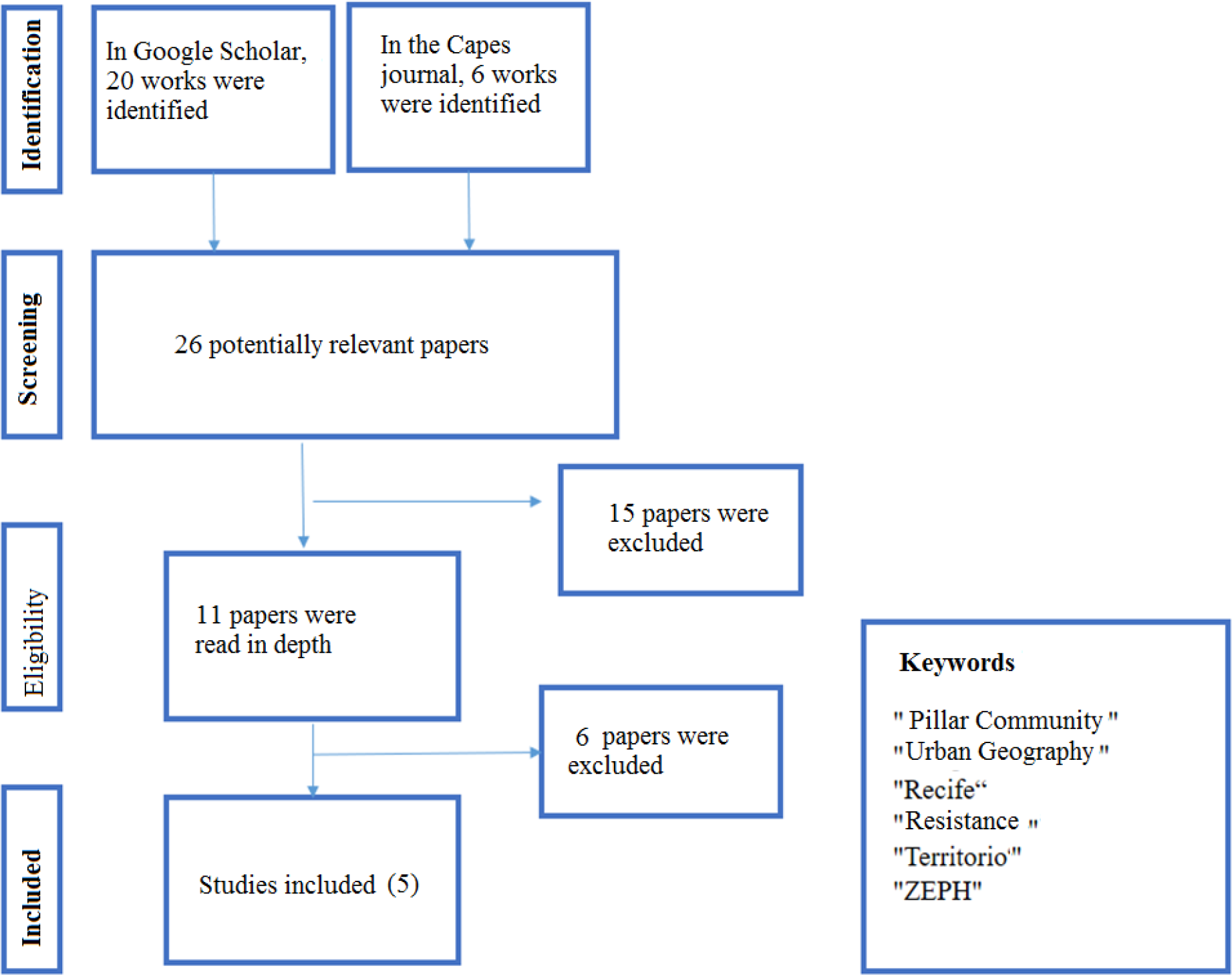
To compose the theoretical framework involving the historical centers and the counter-hegemonic actors, bibliographic research was developed in the Google Scholar databases in the journal of the Fundação Coordenação de Aperfeiçoamento de Pessoal de Nível Superior (Capes).
The methodological choice for the integrative systematic review of the literature is due to the fact that the procedure provides a comprehensive theoretical survey, identifying patterns, trends and gaps of a specific research object (Puglia et al., 2024).
Thus, understanding the need to clarify the development of studies on the Pilar Community, the methodological scope adopted allows for a broad integration of the indicators evaluated (Mendes et al., 2024).
To conduct the integrative review, searches were made in the electronic databases of Google Scholar, Capes journal, Scientific Electronic Library Online (Scielo), Scopus and also in the proceedings of the National Meeting of Graduate Studies and Research in Geography (Enanpege), one of the main academic meetings in Geography.
The review protocol follows the following steps: definition of the research question; search in the databases; selection of articles; data extraction; assessment of methodological quality; synthesis of data; assessment of the quality of evidence; and, finally, the written publication of the results (Galvão; Pereira, 2015).
The definition of the guiding question of this study sought to understand in an evolutionary way how the literature has been studying the Pilar Community. In addition, we also intend to understand: What are the fields of study? How does Urban Geography portray this location? These are parallel questions that also guide this review. For the subsequent stages, the following keywords were defined: “Community of Pilar”; “Urban Geography”; “Recife”; “Resistance”; “Territory”; “ZEPH”.
The included studies will be grouped into two categories of analysis, namely: “Community of Pilar: a theoretical overview” and “Empirical findings of the case studied”, both analyzed by Bardin (2016).
Pillar Community: a theoretical overview
Five studies originating from databases of theses and dissertations and scientific journals in the areas of geography, archaeology, urban development and the environment were reviewed. Based on the selected keywords, it was possible to observe that the scientific production developed is massively focused on the Recife neighborhood, with few studies focused on the Pilar Community. From Table 1, we can summarize the findings that answer the question established for this review.
The data in Chart 2 makes us reflect that, although 80% of the productions found are theses and dissertations, the studies are not disseminated in the format of scientific articles, a format that would increase the chances of greater dissemination of knowledge about the empirical case. Regarding the areas of study, the following data stand out in Graph 1:

It can be seen that of the 5 productions found, 2 originate from the geographic field. Regarding the evolution of the studies, it can be observed that the publications are spaced out and without a period with a significant number of productions (graph 2):

Based on bibliometric data, it is understood that the community began to be studied academically in 2008, but studies remained diffuse in the following years, indicating an incipient empirical field involving urban and territorial studies.
Empirical findings of the case studied
The major difference between the Pilar Community and other communities in Recife and Brazil, according to Nery and Castilho (2009), is the fact that it is located in a historically preserved area, increasing its real estate value. However, based on the studies reviewed, there is a lack of literature on the incorporation of low-income populations into revitalization processes in historic centers and, when they do occur, studies show that there is an imminent risk of “voluntary expulsion”, that is, when pressured by the real estate market (Nery, 2012).
In terms of exclusion, Nery (2012) states that the fact that the community is located in a preservation area makes its inclusion and permanence even more challenging, both for its residents and for the government and authors of requalification programs. Fragmentation as a social group weakens inclusion processes, generating demobilization and, through revitalization projects, increasing phenomena such as gentrification (Nery; Castilho, 2009).
Thus, it is understood that Nery's (2012) study is enlightening in pointing out that the socio-spatial configuration of the Recife Neighborhood, as well as its urban evolution, has drawn physical and symbolic limits to determine the place of the poorest classes and those with high purchasing power. Soares (2019) analyzes that even with the name ZEPH and in a historical centrality, the infrastructure of the Pilar Community falls short of the revitalization processes of the Recife Neighborhood. Regarding its inclusion in the perspective of revitalization projects, Gustina (2010) points out that it is presented in a fragile way, since they are not convincing. This fact is consistent with the vision of Villaça (2000) when pointing out that from the transformations implemented by capitalism and its consequent form of commodifying its actions, there tends to be conflicting processes of exclusion and resistance. In terms of organization, Nery's study (2012) points out that the community has a weak capacity to make demands due to little community organization; in addition, the author points out that, due to its geographical layout that favors “isolation”, the community is marked by the predominance of illicit activities, which, as a consequence, generates a distancing of residents with regard to their representation in government bodies. Despite this scenario, marked by the lack of mobilization and lack of involvement in the elaboration of revitalization programs, the analyses of Nery and Castilho (2009) indicate that the lack of representation is, from a certain perspective, understandable given the strong distrust in relation to public authorities. Regarding this perspective, Santos (2019) articulates that there is a desire in the community to actively participate in public life in the neighborhood, including leisure activities, and also a feeling of hope with the promises regarding their permanence on the island. Therefore, in terms of political organization, the study by Santos (2019) indicates that, although there are no political leaders, the community is able to fight for its rights and be active in demands against accumulation through dispossession, resisting the hegemony of capital, exclusionary urban planning and expanding the concept of the Right to the City based on the interests of the community (HARVEY, 2014; CARDONA and SOBREIRA FILHO, 2016).
The study by Santos (2019) is also important for the construction of this panorama because it allows us to understand that, despite promoting inclusion, the revitalization projects that have existed to date have kept the community marginalized. Gustina (2010) agrees with this perspective by indicating that, although all the projects seek to reverse the degradation of the Bairro do Recife, they do not, in practice, advance this new urbanism for Pilar, which has been subject to expropriations since the 1970s, with the attempt to expand the Port.
One of the projects cited by Santos (2019) involves the revitalization of Moinho do Recife, which, despite having been approved by IPHAN, required adjustments to the project by order of the agency, preventing even more harmful impacts on the space located a few meters from Pilar. It is worth noting that, despite the compensatory measures for the approval of the project, Moinho did not comply with all the obligations provided for by law for the protection of heritage, resulting in a reduction in the area occupied by the community, which is still undergoing transformations from the Porto Novo project, which aimed to transform the Recife neighborhood into a tourist center (SANTOS, 2019).
Santos (2019) lists some of the community's achievements in recent years, namely: the community becomes a ZEIS, ensuring land regulation and permanence in the location; programs designed by Fab Lab, in conjunction with the São Francisco Hydroelectric Company (Chesf), with the creation of a token for measuring temperature, heartbeats and referral to health centers; other initiatives of the project also include leisure activities, such as street cinema and internet access, in addition to the Ecohorta project, with suspended hours in the housing units.
Regarding these advances, specifically regarding the transformation of the community in Zeis, Santos (2019) points out that there are projects that intend to transform these areas into neighborhoods, changing the protection and allowing the area to be open to real estate speculation. Regarding the other projects, the study assesses that these technologies are not capable of improving the lifestyle of the community as a whole, especially because some residents do not have technological skills. Thus, Santos (2019) analyzes that there is still a long way to go for the inclusion of Pilar, even reinforcing alternatives that value the historicity of the community. It is from this perspective that Scarlato and Costa (2017) outline their understanding of historic centers as the essence of the urban nature of cities.
Nery and Castilho's (2009) hypothesis is that the profusion of revitalization programs was enhanced by community resistance. However, in this sense, Santos (2019) analyzes that historical heritage can often function as obstacles to unbridled capitalist development in space, especially when this appropriation occurs for the purpose of homogenizing and elitizing the territory, and is not consistent with the working classes that live there.
In this way, the precariousness of Pilar, combined with the model of society focused on income concentration, further aggravates the concentration of people in the community without access to basic goods and services (NERY and CASTILHO, 2009). Regarding these territorial impacts, Santos (2019) states that, by the end of his research, the community had lost more than 50% of its original territory since 2009, reinforcing the reduction of its space as a result of revitalization projects and real estate speculation.
From this perspective, regarding the profusion of revitalization programs, Nery and Castilho's (2009) hypothesis is that the community's resistance over decades influenced the number of urban recovery projects. In this sense, Santos (2019) analyzes that historical heritage sites can often act as obstacles to unbridled capitalist development in space, especially when this appropriation occurs for the purpose of homogenizing and elitizing the territory, and is not consistent with the working classes that live there.
In parallel with the projects for inclusion and revitalization of the historic center, aimed at specific segments of society, it is clear that tourism and territorial marketing related to the Recife neighborhood has increased, highlighting the city's heritage and culture on a national and international scale (SANTOS, 2019). In other words, in this case, marketing appropriates the territory as a result of the social transformations that have occurred over time (SPOSITO, 1988).
With regard to subsistence and socioeconomic aspects, most residents live off informality, such as street trading, prostitution, drug trafficking, in addition to activities that benefit from tourism, such as major events (NERY and CASTILHO, 2009; NERY, 2012). Its water supply is not adequate, classifying the community as an area of high precariousness in this factor (SANTOS, 2019).
Regarding the studies, it can be said that the one by Alves (2016) stands out for bringing a debate very much tied to archaeology and the study by Nery (2012), focused on discussions involving social exclusion and the concept of urban requalification in historic areas. Nery and Castilho (2009) highlight in their study the need to develop a sense of belonging among residents and to understand that, more than revitalization projects, the community needs to have its basic needs met.
Finally, the study by Santos (2019) identifies the existing housing buildings as the symbol of the achievements resulting from the community's struggle to remain in the area, increasingly strengthening the counter-hegemonic struggle and the formation of a territory forged from the collective identities constructed there (BALEM and REYS, 2024).
Final considerations
Based on a systematic integrative literature review, this article sought to construct an overview of the scientific production on the Pilar Community, in Recife/PE. The community is located in the Recife neighborhood, a locus where several discussions in terms of use and appropriation of the territory are also centered. The area has historically been associated with a space densely populated by homeless populations who, expelled from their territories of origin, began to occupy the region. Due to its strategic location and great interest to capital, whether in the form of real estate or tourism, Pilar is the subject of struggles for permanence and also for access to basic infrastructure rights.
From the review, it was possible to perceive that the Pilar Community is an important area with regard to discussions involving the revitalization of central areas and is no different from other cases existing in port areas with high historical and cultural value. However, it is clear that there is not a great profusion of studies on the community, a fact evidenced by the low expressiveness of the scientific production found.
Furthermore, it is possible to observe that the production is completely restricted to the Northeast, specifically to UFPE. In other words, despite the case being extremely intertwined with the debates developed in Urban Geography, it is clear that there are not even substantial productions on the empirical case analyzed here locally. This point is evidenced when we analyze the evolution of the studies in a temporal perspective, where the first scientific study on the community is dated 2008 and the last in 2019. After 2019, important milestones can be seen in urban studies in the Bairro do Recife neighborhood that directly influence the community, but the absence of studies after that year limits in-depth and updated debates on the locus, evidencing a powerful theoretical and empirical gap.
Also regarding the bibliometric analysis, despite the largest number being concentrated in the geographic field, it is noteworthy that during the review, studies were excluded due to their strong link with the archaeological area, with no correlation with studies on the territorial struggle and socio-spatial changes over the years. It is also worth noting the large number of studies focused on territorial struggles in the Bairro do Recife neighborhood and the invisibility of the community even in this spectrum.
With regard to revitalization projects, it can be seen that despite the fact that they promoted inclusion in documents and in the media, the reality of the studies indicate that the community has remained marginalized to date. Regarding socioeconomic aspects, it was possible to observe that the community survives on informal work and also on illicit practices.
With regard to collective resistance actions, it is understood that despite the lack of political organization, the community has managed to notice advances since its permanence in the territory. Although it is not a limit, it was also possible to see that the name ZEPH did not prevent the community from shrinking over the years, nor did it prevent the large number of revitalization projects with exclusionary content. However, it is observed that the legislation in this case acts as one of the obstacles in favor of the community's permanence.
Therefore, it is clear that the Pilar Community is consolidating a territory due to the population's counter-hegemonic struggles. Despite the slow delivery of structural services for life in society - such as housing, sanitation and leisure - it is clear that its residents persist even in the face of local setbacks.
In terms of scientific production, there is a need for a theoretical contribution that goes beyond the history of the community, focusing its debates on the current challenges of its residents. One of the limitations of this study, based on the review carried out, was the absence of recent theoretical findings for a greater confrontation with the literature, specifically in the field of Urban Geography. However, despite empirically observing the advances of capital in historic centers, it can be said preliminarily that the Pilar Community subverts the idea presented in the literature in terms of the commodification of the territory, since it still resists in its place of origin.
Data Availability:
Research data are available in the body of the article and in repositories.
References
- ALVES, F. D. Considerações sobre métodos e técnicas em geografia humana. Dialogus, Ribeirão Preto, v. 4, n. 1, p. 227-241, 2008.
- ALVES, R. B. Primeiras ocupações residenciais da Rua de São Jorge no Bairro do Recife: um estudo das estruturas arqueológicas/arquitetônicas da Quadra 55 na área do Pilar, Recife-PE. 2016. Dissertação (Mestrado) - Universidade Federal de Pernambuco, Recife, 2016.
-
ARAÚJO , D. F. C. de . ; SOBRINHO, F. L. A. O Avanço do Neoliberalismo e a Reforma Agrária Brasileira . Geopauta, [S. l.], v. 6, p. e10947, 2023. DOI: 10.22481/rg.v6.e2022.10947. Disponível em: https://periodicos2.uesb.br/index.php/geo/article/view/10947 Acesso em: 11 jan. 2025.
» https://doi.org/10.22481/rg.v6.e2022.10947.» https://periodicos2.uesb.br/index.php/geo/article/view/10947 - BALEM, T.; REYES, P. B. Práticas Urbanas Insurgentes como participação popular o planejamento urbano. PIXO-Revista de Arquitetura, Cidade e Contemporaneidade, v. 8, n. 28, p. 128-141, 2024.
- BARDIN, L. 1ª ed. Análise de Conteúdo. São Paulo: Edições 70, 2016.
- CARDONA, D. V.; SOBREIRO FILHO, J. Os movimentos socioterritoriais: entre as classes e os movimentos populares/The socioterritorial movements: between classes and popular movements. REVISTA NERA, n. 30, p. 148-168, 2016.
- COSTA, E. B.; ARAÚJO SOBRINHO, F. L. Cidade, urbano e urbanização: fundamentos metodológicos para o estudo do turismo. Turismo em foco, p. 269, 2013.
-
DOURADO, J.; SOBRINHO, F. L. A. A fragmentação à margem da rodovia: as práticas espaciais dos moradores de espaços residenciais fechados. Geopauta, [S. l.], v. 7, p. e11606, 2023. DOI: 10.22481/rg.v7.e2023.e11606. Disponível em: https://periodicos2.uesb.br/index.php/geo/article/view/11606 Acesso em: 11 jan. 2025.
» https://doi.org/10.22481/rg.v7.e2023.e11606.» https://periodicos2.uesb.br/index.php/geo/article/view/11606 - GALVÃO, T. F.; PEREIRA, M. G. Redação, publicação e avaliação da qualidade da revisão sistemática. Epidemiologia e Serviços de Saúde, v. 24, p. 333-334, 2015.
- GIUSTINA, L. B. D. O pilar que ficou: um estudo de conservação em bens patrimoniais a partir do conceito de valor: o Caso da Igreja do Pilar do Recife. 2010. Dissertação (Mestrado) - Universidade Federal de Pernambuco, Recife, 2010.
- HARVEY, D. Edição padrão. Cidades Rebeldes: Do Direito à Cidade à Revolução Urbana. São Paulo: Martins Fontes, 2014. 296 p.
- MENDES, K. D. S.; SILVEIRA, R. C. D. C. P.; GALVÃO, C. M. Revisão integrativa: método de pesquisa para a incorporação de evidências na saúde e na enfermagem. Texto & contextoenfermagem, v. 17, p. 758-764, 2008.
- NERY, N. S. Inclusão socioespacial de comunidades pobres: programa de requalificação urbanística e inclusão social da Comunidade do Pilar, Bairro do Recife-PE. 2012. Dissertação (Mestrado) - Universidade Federal de Pernambuco, Recife, 2012.
- NERY, N. S.; CASTILHO, C. J. M. Comunidade do Pilar e a revitalização do bairro do Recife Possibilidades de inclusão socioespacial dos moradores ou gentrificação. Revista Hum@ nae, v. 3, n. 1, 2009.
- PUGLIA, C. C. et al. Abordagens para o envelhecimento ativo e saúde do idoso. Brazilian Journal of Implantology and Health Sciences, v. 6, n. 4, p. 1320-1330, 2024.
- RAFFESTIN, C. 1ª ed. Geografia do Poder. São Paulo: Ática, 1993. 270 p.
- SANTOS, A. P. Acumulação por despossessão vista cartograficamente: Comunidade do Pilar. 2019. Dissertação (Mestrado) - Universidade Federal de Pernambuco, Recife, 2019.
- SCARLATO, F. C.; COSTA, E. B. D. A natureza do urbano. Confins. Revue franco-brésilienne de géographie/Revista franco-brasilera de geografia, n. 30, 2017.
- SPOSITO, M. E. B. 16ª ed. Capitalismo e urbanização. Contexto, 1988. 80 p.
- SPOSITO, M. E. B. Estruturação urbana e centralidade. Encuentro de geógrafos de América Latina (anais), p. 44-55, 1991.
- SILVA, M.; AZEVEDO, F. F. Geografia e poder: conflitos, resistências e contra poderes territoriais. Revista da ANPEGE, v. 12, n. 18, p. 163-184, 2016.
- VILLAÇA, F. Espaço Intra-urbano. 1ª ed. São Paulo: Studio Nobel, 2000. 392 p.
-
Editor:
Altemar A. Rocha

 Source: Prepared by the authors, 2024.
 Source: Prepared by the authors, 2024.
 Source: Prepared by the authors, 2024.
 Source: Prepared by the authors, 2024.