
 The East-West Nebula of Calligraphy
ABSTRACT
The article examines calligraphy as an intercultural language and communicational process that transcends the boundaries between writing and image. Based on the analysis of Fernando Lemos’s work and the dialogue with artists and theorists such as Henri Michaux, Roger Caillois, Shiryu Morita, and Roland Barthes, Ryuta Imafuku proposes the concept of a “nebula of calligraphy” to describe the symbolic exchange between Eastern and Western visual cultures. Grounded in the Japanese principle of hisshoku, understood as the creative friction between gesture and matter, the text situates calligraphy as an aesthetic and communicational practice of the contemporary imaginary..
KEYWORDS
visual communication; writing and image; interculturality; aesthetics of gesture; imaginary
RESUMO
O artigo examina a caligrafia como linguagem intercultural e processo comunicacional que ultrapassa fronteiras entre escrita e imagem. A partir da análise da obra de Fernando Lemos e do diálogo com artistas e pensadores como Henri Michaux, Roger Caillois, Shiryu Morita e Roland Barthes, Ryuta Imafuku propõe o conceito de “nebulosa da caligrafia” para descrever o intercâmbio simbólico entre as culturas visuais do Oriente e do Ocidente. Com base no princípio japonês hisshoku, entendido como fricção criadora entre gesto e matéria, o texto situa a caligrafia como prática estética e comunicacional do imaginário contemporâneo
PALAVRAS-CHAVE
comunicação visual; escrita e imagem; interculturalidade; estética do gesto; imaginário
Rather than treating calligraphy as a genre of visual art, I would like here to envision a universal impulse of raw human creativity. Calligraphy, not as static representation, but as a manifestation of a vital, spiritual élan of becoming, from which emerges a nebula of dynamic movement, a “calligraphic imagination” crossing oceans and continents from East to West. When I view Fernando Lemos’s work in its entirety, what impresses me most is the endless movement of this nebula, its infinite and expansive universe.
Calligraphy is the wild impetus of this celestial mass. It is the spirit of the faculty of human mimesis, the boundless imagination of humble creation and being created. Fernando Lemos is undoubtedly one of the sublime “calligraphers” on this planet, together with, not only Japanese and Chinese traditional calligraphers, but also Kufic calligraphers of the Muslim world, and various Western 20th century artists like Paul Klee, Joan Miró, Henri Michaux, Franz Kline, John Cage, and Roland Barthes, who all shared this nebula of imagination.
Photographs taken by Lemos in Japan in 1963 provide excellent proof of this vital synchronicity. In a photo of a small temple warehouse building [Fig. 1], “Silos Particular,” he focuses on the geometric lines drawn on the walls rather than the form of the building itself.


Before architecture exists as physical construction, Lemos’s eyes are keenly aware of the existence of the mimetic composition of lines, and the lines photographed show a surprising similarity to the pictographic proto-character that marks the Chinese character “king” [Fig. 2]. The proto-kanji character of “king” written on animal bones would later change from a hieroglyphic representation of the shape of an ax to a more symbolic and geometric style of clerical script “王.” Lemos unwittingly sees through the modern landscape the history of the transformation of hieroglyphs implied by the Chinese character for “king.” And to extract such iconographic symbolism, Lemos’s eyes adopt a slanting position. This gaze, indifferent to the peculiar and realistic aspects of Japanese traditional architecture, is anti-orientalist. In the East-West Nebula of Calligraphy, there is no longer an essentialist East nor West. There is a mesmerizing movement itself that creatively stirs and mixes the gaze and imagination of the East and the West.
Natural History of Writing: hisshoku
“Kaku,” which means “write” in Japanese, also signifies “scratch” and “lack.” These multiple meanings, which must have the same origin, suggest that, in Japan and China, the origin of “writing” began by scratching the shell of a turtle. Similarly in Western languages, there are associations between the sound of “scribe” and “scratch” in English. The historical homology between the act of writing and scratching is evident in Old Germanic runes carved into the bark of beech or birch trees. Franz Kafka, who referred to his “writing” as “kritzeln” (scribble, almost scratch), believed that scratching paper with a pen meant engraving final sentences on one’s own body with an execution machine, to which his novel, In the Penal Colony, alludes. “Writing” began with primordial pain, carving, and scratching. Those serious about the act of calligraphy have always commenced from this natural history of writing/scratching.
The Japanese word fumi or “letter” also has a suggestive etymological connection. Fumi is the noun form of the verb fumu, meaning “to step on.” In calligraphic history, characters were first created by tracing the footprints of birds or small animals on the ground, an invention of mimetic sensibility. The word fude (brush) as a tool to create fumi (letter) is also a shortened form of fumite, which literally means “stepping hand.” In the etymology of fumi (letter), there is the physical memory of the hand following and imitating the shapes of animal footprints. Our hands, now so dominated by digital superficial fingers, may experience a revival, remembering the primal feeling of fumite acquired as bodily mimesis. The true essence of writing is to regain the exquisite sense of “contact” established between the hand with brush and paper, aroused within our collective memories.
Kyuyo Ishikawa, contemporary calligrapher and a supreme historian of Japanese calligraphy, describes the art of “contact,” “friction,” and “detachment” between the tip of the brush and the paper as the suggestive concept of hisshoku (筆蝕). Hisshoku is an invented word created by combining hitsu (brush) and shoku (eclipse). Shoku, as eclipse, means that either the sun or the moon is “occluded” or “eroded” when coming into contact with each other. The “traces” that contain hiding and erosion created by mutual contact of the self (brush) and the other (paper) are the living forms that make calligraphy possible. Shoku also means “to touch” and is similar to the technique of “touch” in Western painting. However, hisshoku is an “organic combination” of tactile sensations and traces delicately controlled in the act of writing. The “traces” created by all the delicate touches and detachments mescaline which is extracted from the hallucinogenic cactus- starting, scribing, and finishing strokes, performed by the hand holding the brush, finally generate the beauty and intensity of the characters. This visual result that is hisshoku finally influences the content of the text itself. We are reminded that “writing” is the trace of scratches.
Kyuyo Ishikawa’s recent work Snow on March 11, 2011: Odaiba Nuclear Power Plant Explosion [Fig. 3] is a masterpiece that demonstrates hisshoku in the present time.

The catastrophic destruction caused by the earthquake and tsunami that struck the northeastern part of the Japanese archipelago in March 2011, and the subsequent disaster by radioactivity due to the damage of the nuclear power plant in Fukushima, have fundamentally shaken our views of nature and civilization. Ishikawa presented a large-scale work with the motif of the nuclear accident, as the ultimate practice of his hisshoku. It is a work imagining the disaster when the same accident occurs in the middle of Tokyo Bay. We imagine how these letters, written intensely on paper with a brush, engrave the experience of damage and pain in rare strokes. Sounds of trembling, slipping, creaking and crumbling, and the extreme roar of the earth that nevertheless regenerates. Calligraphy becomes a memory of disaster and solemnity. It is what French philosopher Maurice Blanchot ambiguously called l’écriture du désastre (the writing of the disaster/the disaster’s writing).
HENRI MICHAUX - GRAPHIS SCRIPTA
Some of Fernando Lemos’s calligraphic works in sumi and acrylic on Japanese paper show a striking resemblance to Henri Michaux’s drawings, especially those of the 1950s [fig. 4]. As a poet and painter, Michaux was a pioneer who sought to overcome the division between writing and painting at the intersection of literature and art and approached the mystery of signes condensed into calligraphic brevity. In Michaux, writing attempts to deviate from language as much as possible, and figurative elements attempt to be liberated from figurative images.

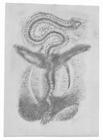
After wandering around Japan, Asia, and South America in the 1930s, Michaux began to create mysterious forms of drawings that were neither droplets, symbols, nor living organisms, apparently taking inspiration from Japanese calligraphy and sumi-e. Those best-known works are permeated by the primordial urge of consciousness to explore the source of the very generation of images through experimental dosing of mescaline, which is extracted from the hallucinogenic cactus. In a sense, it marks a precursor to the practice of hisshoku in its abandonment of intention and its attempt to explore the primordial contact between the hand and the medium.
The styles of Michaux’s drawings by mescaline vary widely. Something like broken letters, depicting ridges, grooves, spirals, and fine dots. Delicate and thrilling line movements reminiscent of the vibration of a seismometer needle. An entire screen is covered with fine meshes that arouse irritation. However, it can be said that these drawings are the trajectory of his search for the roots of “writing.” Michaux poetically describes the movement of overflow, flooding, explosion, and outflow of lines, its torrent of energy as follows:
Time similarly affected, duration now elastic, abnormally drawn out, all dimensions now afloat. (…) When it came to written letters, certain of the down strokes would spin themselves out beyond measure, warping the word, streaking forth from the word, their graphic traces carried away by their own impulse, driven by the urgent need to represent and figure whatever lay at hand and which abetted their sudden and swift temptations - sketches cut short all too soon.
(Michaux, 1950)1
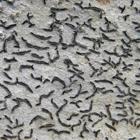
For me, Michaux’s words are directly associated with the dynamism of the quivering, twisting lines in Lemos’s drawings such as Desenho só desenho a sós [Fig.5]. This work by Lemos, drawn with sumi ink and acrylic on Japanese washi paper, suggests the mimetic magic of the proto-letters. It seems to be some primordial écriture housed in birds, snakes, trees, fruits and lichens. I’m reminded of a special moss called graphis scripta. Graphis scripta is a crustose lichen that clings to surfaces of bark and stone [Fig.6]. Also called “script lichen” or “secret writing lichen,” this may be the most letter-like organism in nature. When Michaux’s ink drawing, Movement (1950) [Fig.7], breaks the limits of the patterns of static characters that jump out into moving signs, they create dynamic lines that closely resemble the patterns of graphis scripta. The “natural history of writing” in the calligraphic imagination originating from nature forms a mysterious vein of art running from Michaux to Lemos.

YUKEI TESHIMA, YUICHI INOUE AND MARIO PEDROSA
Arriving in Brazil in 1953, Fernando Lemos’s drawings first achieved recognition in São Paulo, awarded for best Brazilian drawing in the 4th São Paulo Biennial in 1957. That year’s biennial opened in the frenzy of abstract expressionism sweeping the art world. Representative works of Japanese art sent to São Paulo that year included two avant-garde calligraphers’ masterpieces: Yukei Teshima’s Houkai (“Collapse”) and Yuichi Inoue’s Gutetsu (“Commit to being stupid”) [Fig. 8, 9].


Brazilian writer and art critic Mario Pedrosa, curator of this biennial, had spent some time at the National Museum of Modern Art in Tokyo, researching Japanese contemporary art. Pedrosa was deeply moved by a series of abstract calligraphic works called bokushou (墨象), which concentrate on the shape in motion created by every shade of the ink. This discovery by Pedrosa was the impetus for inviting Teshima and Inoue to the Biennial. Teshima’s “Collapse” and Inoue’s “Gutetsu” created a sensation. This is because calligraphy, which should be the writing of meaningful characters, was clearly sublimated into a pure form of fluidity and abstraction. There is no doubt that Lemos, who exhibited at the same biennial, witnessed this work. Lemos had also visited Japan in the 1960s and encountered this new movement of calligraphy.
Japanese avant-garde calligraphy in the 1950s took new inspiration from American abstract expressionists, such as Franz Kline and Jackson Pollock. It is suggestive that one of Kline’s works appeared on the cover of the first issue of the avant-garde calligraphy magazine Bokubi (墨美) [fig. 10], which was launched by an influential calligrapher Shiryu Morita in 1951. However, the relationship of influence was not necessarily one-sided. The sensibility of focusing on active strokes rather than static forms of calligraphy and Zen paintings already existed in Japan before World War II, and in the postwar, a new force seeking to break down the traditional formality of Japanese calligraphy “encountered” American abstract expressionism. The latent sensibility grasped the foreign stimulus.

It is said that Pedrosa, who visited Teshima’s atelier, was surprised by the dynamic expression of Collapse and asked: “Does this represent something that is collapsing?” At that moment, Teshima, meeting someone who could not understand the meaning of the kanji, became convinced of the universality of calligraphy. For Teshima, the content of this work was not the characters written, but an expression of the tremendous destructive power when everything collapsed in the midst of air raids nearing the end of war. The character of the work was the ultimate testimony of how Teshima felt, the “sheer beauty” in things crumbling, even as he experienced horrific and inexpressible disaster.
Pedrosa’s impression was similar to Lemos’s insight, faced with Teshima’s and Inoue’s calligraphy. Although ideograms, letters resist the reductive forces of articulation as mere ideological symbols, but become direct representations of human emotions and ethics. Gutetsu, which Inoue exhibited at the São Paulo Biennial, is an anti-formalistic work that momentarily depicts the artist’s post-war inner determination on the verge of mental explosion, trying to maintain the utmost ethical integrity by living a life of utter foolishness in a paradoxical sense. The characters convey the ethics of doctta ignorantia as one stroke. In this moment, a magnificent nebula of calligraphy covered Teshima, Inoue, and Lemos across borders.
ROGER CAILLOIS - SEPTARIA
If chisels and knives for engraving stone have the same origin as the act of driving a brush into paper, the universe of calligraphy has included rubbings of stone monuments and seal engravings from the beginning of human history. Or, I should say that before the advent of paper, humans already wrote ancient characters into stone, animal bones, and tree bark. Stone, in particular, because of its inorganic nature, has become a privileged medium for thinking about the origin of characters that dwell in the non-living world.
The drama of hisshoku that ancient people experienced for the first time was not only to engrave letters onto stone, but also to discover and imitate the signs embedded geologically in the very material called stone. French philosopher Roger Caillois, in his book L’écriture des pierres, immersed himself in the nebula of stone as a writing medium, and passionately pursued the roots of écriture.
Les signes dispersés qui composent l’ecriture des pierres invitent l’esprit à en chercher d’autre qui les répercutent. Me voice devant eux: je contemple, je décris. Un jeu commence, qui est tout à la fois invention et savoir.
(CALOIS, 1970)2
Caillois suggests that the search for the nebula of signes drawn by stone is an adventure that leads to the source of human knowledge. The stone then privileged by Caillois’s quest was septaria. Septaria, also referred to as dragon stone, is a concretion composed of aragonite, calcite and limestone, with internal cavities or cracks [Fig. 11]. Caillois points out that the patterns inscribed on the septaria are similar to the Runic alphabets used in Old Germanic languages. The ancient Germanic people carved Runes with a stylus into the bark of trees. That the artificially drawn magical pattern closely resembles the pattern of septaria is said to be proof that there exists a mysterious code in the natural world.

Caillois describes the rhythmic pattern of the figures in septaria. An impulse continues to project lines that find their way into the mineral world. The retraction of the stone on itself is evocatively called “a starry void.” He sees a nebula in the intricate patterns of septaria and even has a vision of a stone monument engraved with ancient Chinese characters.
Parmi ces minuscules séismes, un dessin tranquille est miracle. Chaque lézarde contribue alors à inscrire, comme le ciseau du sculpteur aux stéles de la Chine, la calma éternité d’un caractère.
(CAILLOIS, 1971, p. 147)
Caillois’s celestial body of stone is also the celestial body of letters. Caillois’s description of septaria is, for me, written as if he were writing about the nature of calligraphy itself.
When Roger Caillois came to Japan in 1972, he happened to see an exhibition of Morita’s works in Kyoto, and struck by the work, realized the astonishing correspondence with stone patterns. Ciffres (“印”) was published in Tokyo in 1979 as an collaboration between Morita and Caillois. The appearance of Ciffre (1979), a rare large-format book created by the prestigious book designer Kohei Sugiura, in which Caillois contributed texts along-side eight calligraphic works by Shiryu Morita, was a defining epoch-making event. Caillois, in the trembling echoing signs of Shiryu Morita, discovered the mysterious principle and impulse in the art of calligraphy, a writing within stones.
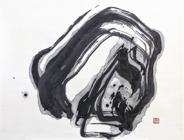
Here is Morita’s calligraphic work En (“Circle”) [Fig.12] published in Ciffres. Caillois’s following passage on stone patterns seems to be a precise explanation of Morita’s work.
(...) un obscur frémissement anime leur gelée polarisée. On dirait qu’avant de se combattre ou de s’accoupler, ces amibes en train de proliférer, mais fragiles, peut-être solubles, éprouvent le besoin de se reconnaître tout en appréhendant les périls d’un premier contact, peut-être corrosif.
(CALOIS, 1971, p. 147)
I want to acknowledge the term “corrosive” used here. Corrosion, erosion or eclipse occurs between brush and paper. Hisshoku, the eclipse of brush, suggests a universal principle permeating our artistic universe.
As one of the leaders of avant-garde calligraphers, Shiryu Morita launched a magazine Bokubi in 1951. In 1952, he organized the avant-garde calligraphy group “Bokujinkai” in Kyoto with Yuichi Inoue and others. Inspired by Western abstract painting movements such as Miró, Klee and Klein, he made calligraphy known internationally as a plastic art. Together with Yuichi Inoue, Nankoku Hidai and other influential calligraphers, he exhibited at the São Paulo Biennial in 1959. There is little doubt that Fernando Lemos had seen Morita’s work up close.
PHILOSOPHICAL NEBULA OF CALLIGRAPHY
In a suggestive essay titled, “Nature’s r,” Vietnam-born contemporary American filmmaker Trinh T. Minh-ha presents a provocative discussion of the sophisticated aesthetic of calligraphy, rejecting the orthodox “articulation” of language and sensation. For example, removing the “n” from the word nature and replacing it with various consonants at the word’s beginning can create meaningful new words (for instance, in French): mature, rature, sature, etc. This word transformation, in spite of semantic changes by substitution, emphasizes the stability of the root -ature in the word. But try to delete r, and word is suspended in the form na-tu. It becomes a semantically and phonetically unsolvable sign, destroying fixed representation and refusing articulation. The “r” in nature is a kind of “gray area.” We can “listen carefully, critically, ec-static-ally, to its musical intervals.” Sumi-e and calligraphy are visual projections of such borderline, gray, and critical “music.” [Fig.13] Trinh T. Min-ha perceives the importance of this vital duration, the ever-becoming movement in brush and ink, in the following passage written by 16th-century Chinese art critic Li Rihua:

In painting, it is important to know how to retain, but also how to let go. In the tracing of forms, although the goal is to fully reach a result, the entire art of execution resides in the intervals and the fragmentary suggestions. Hence the necessity to know how to let go. This implies that the painter’s brush strokes interrupt themselves (without interruption of the breath that animates them) to better fill themselves with “surplus meaning.” Thus, a mountain can comprise unpainted sections and a tree can do without parts of its branches in such a manner that these remain, in this state of becoming, between being and non-being.
(MINH-HA, 2011, p. 68)
Brushstrokes interrupted. A delicate movement of detachment, to “let go.” The time-space in sketching and writing with the brush is animated by waves of breath. In this area of twilight gray lies the essence of calligraphy. Unlike any arbitrary creation, the flickering élan of “becoming” between existence and non-existence begins to breathe.
Moroccan writer and critic Abdelkebir Khatibi, in his essay “Le tracé calligraphique,” draws on the evocative concept of intersigne (inter-sign) to explore the “gray area” of Arabic calligraphy. In Islamic cosmology, God gave revelations to Prophet Muhammad through his voice. If the Qur’an contains the words spoken by God himself through the mouth of the prophets, then calligraphy, as a transcription of the Qur’an, is the intersigne that wobbles between written and non-written from the beginning. And when “history” is overwritten in the sacred prophecies, the “wounds” of rule and slaughter that occur in the transition of dynasties will also be engraved in the calligraphy. This scar is also the intersigne that sways between myth and history, and what Khatibi calls “la blessure du nom propre” left by handwriting. Calligraphy, as the intersigne, inevitably engraves those scars that arise when one resists the erasure of history. [Fig.14]

This gray area of intersigne is the field of meaning lost. Roland Barthes, French philosopher and semiotician, said that “writing” is, in its own way, a path to reach satori (the Zen occurrence) in which meaning is suspended. “Writing” is a seismism which perturbs the thinking subject and causes speech-void (vide de parole) through the state of satori. Trinh T. Minh-ha suggestively names this ambiguously trembling “void” discovered by Barthes “a plural void”.3
Roland Barthes was an outstanding traveler who discovered numerous “traits” (traits), “signs” (signes) and “inter-signs” (intersignes) actively working and flickering in the Japanese expressive culture of everyday life. Barthes came to Japan in 1966 for the first time, stayed for a month, sometimes lecturing but principally wandering as an epistemological “flâneur” in the streets of Tokyo and Kyoto. Barthes was fascinated by the astonishing abundance of sophisticated, anti-narcissistic, almost silent signs of “écriture,” sensually graceful and humble, and revisited Japan in 1967 twice, writing finally in 1970, one of his most private, blissful books, L’emp ire des signes.
What he depicts in the book is a half-imagined country composed of bare signs and semantic voids. It is rather a creation of the author’s craving fantasy, a utopia full of signs, which might be better called another Garabagne, the imaginary country Henri Michaux traveled to in his fictitious travelogue. In this imaginary land called Japan, Barthes paid special attention to its two particular cultural expressions, haiku and calligraphy, as crystals of signifié fuit (the signified that flees). Both in haiku and calligraphy, for Barthes, signs are subtly arranged, displayed, and never naturalized or rationalized. In these practices, signs are empty, their signified always flee and never reach any norm nor authoritative morality. Barthes writes:
Et c’est aussi un vide de parole qui constitue l’écriture; c’est de ce vide que partent les traits don’t le Zen, dans l’exemption de tout sens, écrit les jardins, les gestes, les maisons, les bouquets, les visages, la violence.
(Barthes, 2015, pp. 11-12)4
These “traits” born from the “plural void” must be the origins of the calligraphic imagination that can reside in anyone’s hands. Three years before Barthes, Fernando Lemos also visited Japan, sensed the impulse of calligraphic expression, undoubtedly breathing the same atmosphere. And Barthes himself, as a peculiar line-drawing artist, left behind many works with watercolor, crayon and sumi [Fig.15] that seemed to put his theory of semiotics into calligraphic practice.

In a page of L’empire des signes, Barthes placed a haiga (haiku picture) called “Picking mushroons” [Fig.16] by eighteenth century haiku poet and calligrapher Yayuu Yokoi, with following cryptic caption.
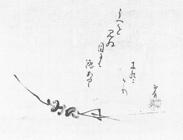
Where does the writing begin?
Where does the painting begin?
(Ibid., p.32. Translation mine)
No center, no structure, no perspective. No claims, no ideas, no philosophies. Nevertheless, there is a graceful gesture that sweeps away the advent and antagonism of “meaning” with the stroke of the brush, rubbing the paper that is the momentary movement of hisshoku. This is the trait that arises from nothing.
Yokoi’s haiku can be read as follows. “Ueominu menimoyokuari kinokogari.” “He gets greedy /always looking down / on the mushrooms.” While walking through the mountains to pick mushrooms, he suddenly finds himself never looking up. Even he, who should have come to contemplate the nature, had a desire to acquire mushrooms. In that moment, écriture is born from nothing. Traits like traces with no beginning and no end.
John Cage, an American composer and mycologist, foraged for mushrooms as his second vocation, wandered through the woods of Stony Point in a suburb of New York City. In the woods, his artistic greediness for arbitrary “self-expression” disappeared. After absorbing the quintessence of American abstract expressionism and Eastern philosophy, he also created paintings with mysterious lines of plural void and non-intention. He was also a “calligrapher” who explored the hidden nebula of new drawing [Fig. 17].
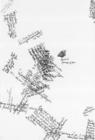
Cage spoke of the world of mushrooms as mysterious. Within the same species, forms change. In one, poison disappears when heated, in another, appears. Mushrooms are an amalgamation of silence, chance, and indeterminacy, which is very much like music. (cf. John Cage, “Music Lover’s Field Companion,” Silence. Wesleyan University Press, 1961, pp.274-276). Music as non-intention, leading to nature, a renunciation of control, a movement to “let go.” The product of an empty mind. No beginning, middle, or end. A processual adventure itself, not objective. These words, to me, describe the precise and intuitive mysteries of calligraphy.
The Nebula of Calligraphy lays before us within a great galaxy to celebrate together the conscious and unconscious connections of many artists. Within this nebula, meteors of various colors fly with trailing tails, stretch across the fertile darkness of human imagination, past to future. Fernando Lemos is one such shooting meteor.
-
1
Henri Michaux, Emergences/Resurgences. Translated by Richard Sieburth. New York: The Drawing Center, 2000, p.66. Originally published as Émergences-Résurgences by Éditions d’Art Albert Skira, 1972.
-
2
Roger Caillois, L’écriture des pierres. Genève: Editions d’Art Albert Skira, 1970, epigraph.
-
3
Trinh T. Minh-ha, “The Plural Void: Barthes and Asia,” When The Moon Waxes Red. London: Routledge, 1991, pp.209-222.
-
4
Roland Barthes, L’empire des signes. Paris: Seuil, 2015, pp.11-12. [Originally published by Édition d’Art Albert Skira, 1970
Data Availability Statement
The data supporting this research are available within the body of the article.
References
- BARTHES, Roland. L’empire des signes Paris: Seuil, 2015.
- BLANCHOT, Maurice. L’écriture du désastre Paris: Gallimard, 1980.
- CAILLOIS, Roger. L’écriture des pierres Paris: Flammarion, 1970.
- CAILLOIS, Roger. Un caractère chinois. In: Pierres Paris: Éditions Gallimard, 1971
- CAGE, John. Music Lover’s Field Companion. In: Silence Wesleyan University Press, 1961
- CAGE, John., & LONG, L. Mushroom book New York: C.F. Peters Corporation, 1972.
- IMAFUKU, Ryuta. A nebulosa Este-Oeste da caligrafia Tokyo University of Foreign Studies, 2025.
- INOUE, Yuichi. Gutetsu [Painting]. Presented at the 4th São Paulo Biennial, São Paulo, Brazil, 1957.
- ISHIKAWA, Kyuyoh. Snow on March 11, 2011: Explosion of the Odaiba Nuclear Plant [Calligraphy]. Tokyo, Japan, 2013.
- KAFKA, Franz. In der Strafkolonie Leipzig: Kurt Wolff Verlag, 1919.
- KHATIBI, Abdelkebir. Le tracé calligraphique Casablanca: Éditions Le Fennec, 1983.
- LEMOS, Fernando. Desenho só desenho a sós [Ink and acrylic on washi paper]. Private collection, 2012.
- MICHAUX, Henri. Mouvement Paris: Gallimard, 1950.
- MINH-HA, Trinh, T. When the moon waxes red: Representation, gender and cultural politics. New York: Routledge, 1991.
- MINH-HA, Trinh, T. Elsewhere, within here: immigration, refugeeism and the boundary event. Londres: Routledge, 2011
- MORITA, Shiryu, & CAILLOIS, Roger. Chiffres Tokyo: Kōhei Sugiura Editions, 1979.
- PEDROSA, Mario. Texts for the 4th São Paulo Biennial São Paulo: Fundação Bienal de São Paulo, 1957.
- RIHUA, Li. Lun Yu Hua Shuo [Theory of Painting]. Manuscript, 1590.
- TESHIMA, Yukei. Houkai [Painting]. Presented at the 4th São Paulo Biennial, São Paulo, Brazil, 1957.
- YOKOI, Yayū. (18th century). Picking mushrooms [Haiga]. In: Barthes, R. L’empire des signes Paris: Seuil, 1970.
Edited by
-
Publishers:
Adriana TeixeiraFábio Fonseca de CastroMaurício Ribeiro da SilvaNorval Baitello

 Source:O calígrafo occidental: Fernando Lemos e o Japão, Edições Tinta-da-china, 2024
 Source: Kyuyo Ishikawa, Kaku to iukoto (『書くということ), Bungei-shunju, 2002.
 Source: Kyuyo Ishikawa, Ishikawa Kyuyo Taizen (『石川九楊大全』), Sayu-sha, 2024.
 Source: Henri Michaux, Emergences/Resurgences, Skira, 2000
 Source: Fernando Lemos, mais a mais ou menos, Sesc Bom Retiro, 2019.

 Source: Catalogue de l’Exposition Henri Michaux, The Seibu Museum of Art, 1983.
 Source: Hikari Museum, Gifu, Japan
 Source: The National Museum of Art, Osaka, Japan

 Source: Roger Caillois, L’ecriture des pierres, Flammarion, 1980.
 Source: Roger Caillois, 印: Ciffres, Zauho Press, 1979.
 Source: Tokyo National Museum
 Source: Abdelkebir Khatibi, Blessure du nom propre, Denoël, 1986.
 Source: Roland Barthes, SCAM 2024
 Source: Roland Barthes, L’empire des signes, Albert Skira, 1970
 Source: Every Day is a Good Day: The Visual Art of John Cage, Hayward Publishing, 2010.