
 The internship with research in the formative proposal of the degree in mathematics at IFAC - Cruzeiro do Sul Campus: report of experience
ABSTRACT
The article presents an experience report resulting from the implementation of the internship methodology with research in the mathematics degree program. The aim of the research was to analyze the contributions of the research internship to the training of future mathematics teachers at the degree course of the Federal Institute of Acre-Campus Cruzeiro do Sul. Methodologically, we adopted qualitative research with narratives as an investigative strategy, as well as a bibliographic and documentary survey, and the data collected was analyzed using Textual Discourse Analysis (TDA). The results show that the internship with research favors the initial training of teachers who teach mathematics, by bringing together theory and practice, training institution and internship locus at work, with contextualized experiences and, in the development of answers to problem situations, through research and intervention projects.
Keywords:
Teacher Education; Internship with Research; Mathematics Teaching
RESUMO
O artigo apresenta um relato de experiência resultante da implementação da metodologia de estágio com pesquisa na licenciatura em matemática. A pesquisa teve como objetivo analisar as contribuições do estágio com pesquisa para a formação dos futuros professores de matemática, na licenciatura do Instituto Federal do Acre-Campus Cruzeiro do Sul. Metodologicamente, adotamos como estratégia investigativa a pesquisa qualitativa com narrativas, além de levantamento bibliográfico e documental, e os dados coletados foram analisados por via da Análise Textual Discursiva (ATD). Os resultados evidenciam que o estágio com pesquisa favorece a formação inicial dos professores que ensinam matemática, por aproximar teoria e prática, instituição formadora e lócus de estágio no trabalho, com experiências contextualizadas e, no desenvolvimento de respostas às situações-problemas, por via projeto de pesquisa e intervenção.
Palavras-chave:
Formação de Professores; Estágio com Pesquisa; Ensino de Matemática
Introduction
The aim of this paper is to analyze the contributions of the research internship in a training cycle (2019-2022) in the initial teacher training of mathematics graduates at the Federal Institute of Acre-Campus Cruzeiro do Sul.
The Federal Institute of Acre (IFAC), Cruzeiro do Sul Campus, has been offering teacher training for mathematics teaching since 2011, contributing to the inclusion of mathematics graduates in the public and private education networks for the final years of primary and secondary education. Since 2019, it has implemented the internship methodology with research, with the latest reformulation of the Course Pedagogical Project (PPC) by Resolution of the IFAC Superior Council (CONSU/IFAC Resolution Nº 24, 2018).
The research is based on the central question: “What are the contributions of the internship with research in the initial teacher training in mathematics at the Federal Institute of Acre-Campus Cruzeiro do Sul?”.
For this production, on the one hand, as an investigation, the methodology of this study was developed by the qualitative approach, made possible by bibliographical research, documentary research and qualitative research with narratives, in which the data collected was analyzed through Textual Discourse Analysis (TDA).
Muylaert et al. (2014, p. 198) point out that a qualitative study using narratives allows the researcher to visualize and understand the tensions in the speeches produced by the interviewees “so that the resonances and dissonances of meanings that emerge from the speeches are problematized from the chain of speeches that constitutes the fabric in which biographical accounts and facts experienced are interwoven”.
In addition to systematizing and analyzing the interviews based on the assumptions of Muylaert et al. (2014), the main elements of DTA were used to disassemble the text, establish relationships, capture what emerges and the self-organized process. This cross-cutting process allowed for a more in-depth analysis of the official texts and course documents analyzed, exploring their meanings, senses and clearly exposing the relationships between them.
On the other hand, as a research report, this article is systematized as an experience report consisting of the introduction, final considerations and references common to academic papers; and the specific structure is organized into sections: Theoretical-methodological context of the internship experience with research; The formation of the researcher teacher and mathematics education; The internship with research in the formative proposal of the degree in mathematics at the Cruzeiro do Sul Campus; and The internship experience with research: the narrative of mathematics undergraduates.
In order to clarify how this article was produced, the theoretical and methodological elements of the research will be presented in detail in the next section.
Theoretical-methodological context of the internship experience with research
In Brazil, the supervised student internship, defined by Law N. 11.788, of September 25, 2008, in article 1, is presented as:
[...] supervised school educational act, developed in the work environment, which aims to prepare for the productive work of students who are attending regular education in institutions of higher education, professional education, high school, special education and the final years of elementary school, in the professional modality of youth and adult education (Brasil, 2008).
In this sense, it must be part of the course’s pedagogical project, integrating the student’s training itinerary, to guarantee learning of specific competences for professional activities, in the contextualization between the curriculum and the student’s development and, their citizen life with the world of work (Brasil, 2008).
The first notes on the inclusion of research in the Supervised Internship in initial teacher training appear in the work of Ghedin, Brito e Almeida (2006) e Ghedin (2004; 2010), who points out, based on the experience carried out at the Amazonas State University (UEA), that the articulating axis between theory and practice as spaces for training “is the concept of research, as an epistemological and methodological instrument in the process of building the knowledge of the teacher in training” (Ghedin, 2004, p. 57). In this way, it requires both intervention and investigation, as the teacher in training is a researcher in action, producing teaching/pedagogical work at the same time as investigating (Zogaib; Santos-Wagner, 2019; Azevedo; Gonzaga, 2018).
In the training of future teachers, three contributions of the internship with research stand out: reflective activity as an investigative practice; reflection on the curriculum as an object of knowledge and problematization; and reflection on educational practice in terms of the skills that need to be developed for the educator’s pedagogical work. The concern with pedagogical practice is not disconnected from the development of research for the acquisition of researcher skills in academic production (Azevedo; Gonzaga, 2018).
In the teacher training process, this is reflected in the creation of a strong critical education movement:
The development of these embryonic investigations by the trainees, using data collection procedures and instruments, during the ECS activities, is understood as an important moment of training in and through research, since it is in the elaboration and use of different data collection procedures, it is through the problematizing gaze in the face of everyday school situations, that they are developing research skills and training themselves as future research teachers (Oliveira; Paniago, 2023, p. 490).
In the internship with research, the teacher in training has his or her identity legitimized by a process of scientific education that gives new meaning to pedagogical work based on classroom experiences. Theoretical and methodological tools are used to reframe the internship process, so that its results are not restricted to their future professional work, but are extended to the scientific community through the communication and publication of research results (Azevedo; Gonzaga, 2018; Ferreira; Ferraz, 2021). To this end, the internship with research allows the intern to advance in strategies to better intervene in reality; to get to know the school better, its resources and its structure for classes; to expand the methodological repertoire in possibilities for teaching content; and to effectively take advantage of the training period so that, when developing and applying the CBT, what happens in training is not detached from the reality of the school. By learning to observe, establish relationships and variables present in everyday school life, in their own reality, teachers in training are constantly reconstructing their teaching know-how (Rocha et al., 2020).
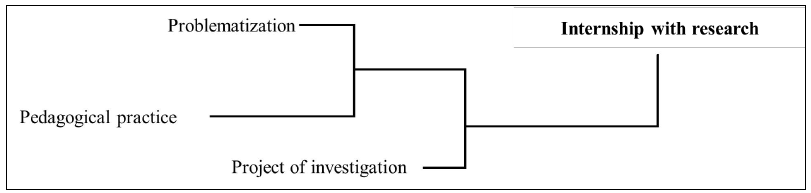
This is because, in the internship with research, the supervised internship is developed through a research project that brings together and articulates personal conceptions, theories and practices from the school context. In the research project, problem situations found in the school are analyzed and must be answered, in other words, training is triggered in which the internship activity is made possible by motives-stimuli, in which investigative and pedagogical actions, giving rise to a new meaning for the internship in teacher training (Rabelo; Abib; Azevedo, 2021). In short, the internship with research brings together the analysis of contexts, reflective activity and intervention in reality during the teacher training process, establishing a method of problematizing pedagogical practice, through a research project (Fig. 1).

In the context of the internship with research, an epistemological matrix is being constituted, whose proposal incorporates elements such as: Attitudinal/Formative Dimension (Ethical Precepts - Aesthetic Precepts); Conceptual Dimension (Contents - Internship Actions); Procedural Dimension (Planning - Practice - Intervention). These dimensions are developed by debates on: scientific matrix (reality), critical intellectual; teacher emancipation, research habitus, social and technological transformations, among other elements (Azevedo; Gonzaga, 2018, Rabelo; Abib; Azevedo, 2021; Albuquerque et al., 2022; Dal-Cin; Kleinubing, 2021).
These dimensions, on the one hand, are the result of an epistemological process that is transcribed into three formative aspects: the conceptual or theoretical, consisting of the knowledge for the internship actions; the procedural or methodological, which articulates the organization and planning in the internship, which integrates observation, participation and intervention; the attitudinal, which supports the ethical and aesthetic precepts of the internship actions and also manifests itself in reflective processes for teacher training. The research internship is especially committed to the social and technological transformations experienced today (Azevedo; Gonzaga, 2018). On the other hand, the conceptual or content aspects, the methodological aspects and the attitudinal or contextual aspects have the teaching and learning process as their central concern, seeking to answer questions such as: “what is the best teaching method? how to motivate students? how to deal with student indiscipline? etc.” (Rabelo; Abib; Azevedo, 2021).
As a scientific matrix, the internship with research, by investigating school reality, transforms the intern into a producer of theoretical proposals that can be glimpsed in the school and academia, achieving a totalizing dimension of life and pedagogical work committed to the courage to innovate and create, transforming teaching work from the inside out through the internship (Rabelo; Abib; Azevedo, 2021). This is because the process requires: “[...] training of the critical intellectual teacher, highlighting the need for research communities and for the trainee to be considered a subject of learning in the research process” (Albuquerque et al., 2022).
Finally, the epistemological nature of the internship with research is characterized by: fostering teacher emancipation; tackling the problem of the theory-practice relationship; placing academic research and school research in analytical and collaborative tension; maintaining an investigative and evaluative character in the production of transformations in the self (teacher) and the other (student); acting to build a habitus of research and investigation into reality (Dal-Cin; Kleinubing, 2021). Next, we’ll see how the training of a teacher-researcher links the internship process with research in mathematics education.
The research internship in the mathematics degree program at the Cruzeiro do Sul Campus
The training of teachers who teach mathematics at the Cruzeiro do Sul Campus of the Federal Institute of Acre (IFAC) began in the first semester of 2011, established through its Pedagogical Course Project (PPC). In 2018, after defending the thesis “The precariousness of teacher training for basic education at the Federal Institute of Science, Education and Technology of Acre - Cruzeiro do Sul Campus”, the PPC was reformulated, taking into account the discussions within the collegiate and the Structuring Teaching Nucleus (NDE) of the course. Among the many changes required, there was an urgent need to rethink the form and organization of the Supervised Internship, as Araújo (2018, p. 177) pointed out that:
As we can summarize among the problems mentioned in the Mathematics Degree internship are: I. The lack of a specific regulation for the degree; II. A general regulation with many flaws; III. Lack of organization; IV. No set date for the internship; V. One internship overlapping the other; VI. More than one internship carried out at the same time; VII. Lack of evaluation criteria defined and known by the student interns; VIII. The internship was carried out as if it wasn’t a priority for the course and/or the institution; IX. Lack of support from pedagogues and teachers in the area; X. Lack of teachers for the internship; XI. Lack of contact with the school for the internship; XII. No feedback from teachers or schools; XIII. There were no exchanges, no evaluation of the internship; XIV. Disorganization led to trainees not taking part in school life, meetings and planning.
For this reason, the reformulation was carried out between September 2017 and March 2018. With the approval published in the Resolution of the IFAC Superior Council (CONSU/IFAC), Nº. 24, of May 4, 2018 (IFAC, 2018), the restructured PPC proposed the internship with research as a means of developing a training model called the critical researcher teacher paradigm.
In the PPC, this concept of the critical researcher teacher is anchored in Ghedin, Brito and Almeida (2006) and Ghedin (2004; 2010), for whom the critical researcher teacher (also known as a reflective teacher) must be an active researcher of their own teaching practice. This is the teacher who investigates and reflects on their own teaching practice, continually seeking to improve it. This approach implies that the teacher not only transmits knowledge, but also becomes an agent of change and transformation in education.
In order to understand the state of internships with research, we worked with a corpus of eight documents that were coded into: D1 - Course Pedagogical Project (PPC); D2 - Teaching plan: Internship seminar with research II; D3 - Teaching plan: Supervised curricular internship II; D4 - Teaching plan: Supervised curricular internship I; D5 - Teaching plan: Internship seminar with research I; D6 - Teaching plan: Supervised curricular internship III; D7 - Teaching plan: Internship seminar with research III; and D8 - Teaching plan: TCC and scientific communication. These documents were analyzed and the following categories emerged: course curriculum matrix, methodologies and syllabus. In the proposal for the internship with research, we highlight below the elements that make up the supervised curricular internship, the internship seminars with research and the Capstone and scientific communication.
Added to the concept of curriculum matrix are the subcategories: syllabus and methodology. The former is defined as a description that sets out the body of knowledge that must be taught and learned, which is presented in its various dimensions, which can be conceptual, procedural and attitudinal. The second refers to the teaching process and is made up of a set of methods, techniques and practices that are articulated to promote the teaching and learning process. In the course’s curriculum matrix, the organization of the curriculum structure is arranged in such a way that:
[...] course is organized by disciplines, with a semester period, being 2,209 hours in disciplines aimed at the general and specific training of the graduate in Mathematics, 521 hours of teaching practices as a curricular component integrated into the disciplines, 400 hours of supervised curricular internship - which should be offered from the 4th semester of the course, through the disciplines of supervised internship and internship seminars with research (IFAC, 2018, p. 23).
The paradigmatic model was materialized in the course planning, so that the supervised curricular internship subjects I, II, III and IV would have a workload of 100 hours each and would be complemented by internship seminars with research I, II and III, which have a workload of 25 hours each, in addition, the systematic internship with research was instituted in the matrix (Fig. 2).

The Course Conclusion Work (TCC) and Scientific Communication in the PPC is an integrated part of the research internship methodology. The research internship methodology provided for in the course is carried out through observation, research and teaching at the institution agreed as the internship locus. In this sense, the PPC states that: “In the training path of the mathematics graduate, the internship will begin in the 4th period, with a workload of 400 (four hundred) hours, arranged every semester in stages of 100 hours in each semester” (IFAC, 2018, p. 36-37). For the internship with research, collaborative work was planned between teachers from the pedagogy area, teachers from the training area (mathematics graduates) and collaborating teachers from the school that was the subject of the internship.
The operationalization of the internship with research is clarified by Normative Instruction Nº. 1/2017 of the Course Board which, in Appendix 1 of the PPC, defines the following methodological conditions for its development:
[...] In the Internship Seminar with Research I, the student will publicly present - I Introduction; II - Justification; III - Problem; IV - General and Specific Objectives and V - Guiding questions.
[...] In Research Seminar II, the student will publicly present the theoretical framework and methodology of their project.
[...] In Research Seminar III, the student will publicly present their complete research, including the data analyzed and the conclusion reached.
[...] Once the CBT - monograph project has been approved during the activities of the Internship Seminar with Research I subject, changing the topic will only be allowed with the preparation of a new project, upon fulfilling the following requirements (IFAC, 2018, p. 113).
The syllabuses for internships and internship seminars with research, as compulsory subjects, are set out in Table 1.
In Table 1, when sizing up the syllabuses, we can see that these categories consolidate, based on the information model in Fig. 4, the elements of the general objectives of the supervised curricular internship seminars. However, two other elements should be highlighted: methodological procedures and assessment.
The elements of the curriculum matrix, syllabus and methodologies in the internship seminars were consolidated from a perspective that places the general objectives as a common element in issues such as: integrating theoretical and practical knowledge, with emphasis on field research and capturing research through data collection instruments. These are all elements that integrate research and the internship. In detail, the specific objectives have a different perspective, a more technical approach to preparing for research, as they highlight the following items: planning the research, defining the research approach, studying data processing, among other aspects.
From a methodological point of view, the internships are arranged in a structure of planning, organization, execution and evaluation of curricular activities in the stages and/or levels prescribed for each internship. In document four (D4), the procedures are better clarified:
The internship will be developed through the following methodological procedures: internship seminar with research, preparation of the introduction to the research project, observation of the physical and didactic-pedagogical structure, observation of the regencies, planning of the regencies, regencies and preparation of the internship report with research. There will also be individual assistance to guide the research project and internship.
In D2 (p. 1), we also exemplify what is common in the methodological process of internship seminars: “[...] Commented readings and dialogic presentations of the units; Development of the supervised curricular internship. There will also be the promotion of individual assistance for guidance on the research project and internship”. It is clear that not all internships will have the time to prepare the introduction, since they are processes that follow one another, advancing gradually, as can be seen in Fig. 4, presented above.
Regarding the evaluation in supervised curricular internships and internship seminars with research, in all documents that transcribe the conditions of this category, the implementation of diagnostic, formative, and summative evaluations is mentioned, which in common systematize an integrated and procedural evaluation process of the internship with research (Table 2).
Regarding the development of the TCC for the course, we note a systematic, gradual, procedural and articulated construction that begins in the 4th semester of the course within the internship seminars with research and in the supervised curricular internships. Thus, the TCC and scientific communication discipline is not considered a preparatory discipline, but a genuinely practical component that must be conducted with a student advisor, at a time when there is no more internship to be carried out, since the four internships must be carried out from the 4th to the 7th period, in the 8th semester of the course, the TCC is the exercise of improvement and systematization of the formative path built throughout the internships with research.
The general objective of the TCC and scientific communication discipline is: “To develop scientific research with theoretical and methodological depth on a specific research object for the consolidation of the final work of the Higher Education Degree in Mathematics” (D8, p. 1). The specific objectives are set out to:
- Exercise specific methods and techniques for selecting, organizing and systematizing the theoretical framework for the TCC;
- Select, organize and apply data collection and analysis instruments for developing research that segments the course completion work;
- Prepare and defend the Final Work (TCC) for the Higher Education Degree in Mathematics (D8, p. 1).
The methodological procedures of the TCC and scientific communication focus on: “Commented readings, dialogic presentations of thematic units and self-assessment; Monitoring of research results. There will also be monitoring of the application of data collection instruments, in addition to individual assistance with advisors” (D8, p. 1).
In the assessment, it is proposed that the discipline will be based on the criteria and procedures established by the Didactic-Pedagogical Organization (ODP) (CONSU/IFAC Resolution Nº. 2/2018) and items 6.8 and 8 of the Pedagogical Project of the Higher Education Degree in Mathematics (CONSU/IFAC Resolution Nº. 024/2018): “N1 and N2 will constitute the final version of the course completion work and its public defense, in accordance with the criteria of CONSU/IFAC Resolution Nº. 024/2018 (Course PPC)” (D8, p. 2).
To support this analysis, the next section moves on to the narrative of the undergraduates.
Internship experience with research: the narrative of the undergraduates
From the formative experiences of teachers in initial training to teach mathematics, the following categories emerged: relationship between the complexity of the internship process and research versus improvement of learning through experience; contextualized mathematics, overcoming the idea of mathematics as a “seven-headed beast”; and praxis.
We then proposed listening to former students through a Google Forms questionnaire, since it was difficult to find students who were already working as teachers or still lived in other cities or rural areas of Cruzeiro do Sul. Ten former students responded to the questionnaire out of the 16 invitations sent. The data collected in the questionnaire were organized based on Muylaert et al. (2014, p. 196):
To analyze the material, it is recommended to gradually reduce the text, operating with condensation of meaning and generalization, dividing the content into three columns, the first one contains the transcription, the second one contains the first reduction and the third one contains only the key words. Then, categories are developed, first for each of the narrative interviews, and then they are organized in a coherent system for all the interviews conducted in the research, with the final product being the joint interpretation of the aspects relevant to both the informants and the researcher.
When discussing the narratives and the relationships between the complexity of the internship process with research and the improvement of learning through experience, we observed that the interviewees present a vision in which elements such as anxiety and fear are overcome by good experiences, a phase in which mistakes are used to learn and improve:
The internship with research is the best path for future practices in the academic profession. However, it is not an easy path to follow, and it does provide us with good experiences and positive things. And in the end, we always learn something from this experience. The internship may be the most complex phase in the student’s life, but it is the phase in which mistakes can be made in order to learn and improve throughout the experience (A1).
This relationship is built collaboratively, including co-teaching as an important step in training and being able to closely observe the internship partner, the “what” also generates learning. This was expressed by A2, so that: “both the teaching phase and the co-teaching phase are of fundamental importance for the undergraduate student, as they are rich moments of learning that contribute to positively subsidizing future teaching performance”, when understanding teachers and students and their life stories and overcoming as part of the training process. The contextualized mathematics category overcomes the idea of mathematics as a “seven-headed beast” and makes the experience of the internship with research much more exciting for training as a teacher, as they begin to understand that through research it is possible to overcome difficulties with content, with methodological procedures, with assessment, in short, with the development of student learning. In addition, it goes beyond a limitation of teaching work that:
[...] it presents the student with a subject that is merely abstract, forgetting to show its importance and its applications in everyday life. However, it is important to work with mathematics in a contextualized way for better understanding. Finally, I believe that I achieved my goals and that my work has been recognized by everyone (A3).
By using data collection methods, such as systematic observation for the development of the internship with research, the student realizes that his/her learning possibilities are enriched, going beyond just content. This generates an education that goes beyond the idea of “[...] mathematics, which, for most students, is a boring subject, the students’ terror (A4)”.
The internship with research is also articulated in the praxis subcategory. According to A5:
During the supervised internship, I was given the opportunity to experience an enriching moment in both a personal and professional sense. The classroom experience allowed me to learn methodologies and practices that will be essential in my work as an educator, as well as to verify the functionality of methodologies studied during the undergraduate course. I realized that a good teacher-student relationship can make a difference in terms of teaching quality, because when the teacher gives students the opportunity to participate in class, they feel motivated and consequently their performance in understanding concepts can increase.
This dimension also extends to the student at the school where the internship takes place, because the student, in an integrated perspective of theoretical and practical training, is also favored in such a way that: “during my pedagogical practice, I listed significant knowledge to the students, so that they could see the use of mathematics in their experience, using this tool, to become critical and active citizens in the society in which they live (A5)”. The experience of the internship with research, in the narrative of the undergraduates, brings a concept that succinctly captures the relationship between the complexity of the internship process with research versus the improvement of learning through experience, and contextualized mathematics overcomes the idea of mathematics as a “seven-headed beast”. Therefore, a severe critique of the dominant conception of internship is necessary to free it for the formative potential that the internship with research has.
Following the survey to evaluate the internship with research proposal, a form was applied to former students, obtaining responses from 7 participants. In the table below, the responses to one of the questions were systematized using the principles of ATD. The participant code is identified by participating student (A), response order number and graduate (E).
The analysis of the emerging categories shows that, for most respondents, the internship with research brought several contributions. For participants A1E, A2E, A3E and A4E, we observed contributions such as: improvement in their teaching practices, in the practice of being a teacher, in critical and research training. In addition, participant A6E also mentioned the delay in offering the courses, which goes against the principles presented in the course’s PPC, in which the courses must be offered starting in the 4th period and concurrently. This may justify participant A5E’s lack of understanding of the proposal’s contributions to his training as a mathematics teacher.
When students were asked about how they understand the importance of the internship with research in their teacher training, they pointed out the connection between theory and practice, preparation for writing the TCC and the contribution to critical training as fundamental.

Perception of Teacher Education Students about the Importance of Research-Based Internships in Initial Teacher Education
Although this approach is positive among students in practice, we still perceive some limitations and difficulties that can be overcome by reflecting on the experience, by the faculty maturing on the proposal and, over time, by making the necessary adaptations to the training project. Below, we highlight some limitations that can be classified into three areas.
The first area concerns the operationalization of the dynamics of the internship with research. This methodology requires overcoming the compartmentalization of knowledge, which is very common in undergraduate courses. Thus, it improves the organization of time in training, especially related to time for research.
In our proposal, the option adopted begins the training process for research from the fourth semester, integrating the internship with the research seminar. This experience showed that not only the academic building can be the environment for training. We have successfully carried out the Internship with Research Seminar within the internship locus schools and this has effectively linked theory and practice, preparation for the internship with implementation of the internship, as well as the identification of problem situations and their transformation into research, as can be analyzed in table 4, which presents the study topics of seven academics from the 2019 class.
In this area, we also highlight the limits imposed when teacher trainers also have difficulties as researchers. Good supervisors are needed for research projects so that students in training can be productive and perform adequately during their internship with research.
In the second area, there are the limits of the methodological dimension. The internship with research does not allow research to be done only in the last semester of the course, nor is it possible or viable to restrict the syllabuses to the aspects of locus, level or teaching modality prescribed in each discipline of supervised curricular internship. Once again, experience shows that students reach their object of study at different times and that, if we only coldly follow the syllabus, we will not be successful.
We realized the need to make processes more flexible so that those who want to do research in elementary school (Internship I), in the 1st and 2nd year of high school (Internship II), in the 3rd year of high school (Internship III) or in professional education, in youth and adult education (Internship IV) can return - regardless of the time of the semester or the syllabus - to experience the research stage, although this does not mean ignoring or not fulfilling the proposal of each of the syllabuses. Another limit that must also be faced from a methodological point of view is the clarification of the difference between a research project and an action project, of the procedures for preparing the project and of the definition of methods. This makes the undergraduate student the protagonist of his/her research, developing in him/her the capacity for triangulating data, producing theoretical references, analyzing problem situations focused on an action research model, overcoming the weakness of the theoretical-methodological knowledge of the interns.
As a third area of difficulties, the limits of the social dimension of teacher training are listed, summarized by two central issues. On the one hand, it is necessary to respect and redefine the concept of the teacher-researcher, understanding that research is also part of teaching and requires time, investment and workforce. On the other hand, it is necessary to insist on the need to consolidate teacher emancipation, because, to be a teacher-researcher, one must have freedom. Considering the narratives, we can see that the internship with research provides an opportunity for teaching practice, not only the internship, but also reflecting and developing the project that allows (re)analyzing the “pedagogical practice”.
Conclusion
The training of the teacher-researcher demands a critical reflection on the predominant concepts of knowledge, culture and language and requires that the internship with research be seen as a training of the educational scientist, given by systematic investigation processes. The paradigm to be consolidated consists of understanding that educators in training are scientists in training, as researchers of their own praxis. This perception requires the appropriation of technical and operational instruments for the autonomous production of knowledge. In the internship with research, the logic that there is no room for scientific production in undergraduate studies is overcome, based on the student’s role as a researcher (Azevedo; Gonzaga, 2018).
This training occurs through systematic investigation processes that place theory and practice as inseparable. It is a training that perceives pedagogical work as a source of reflection and investigation and that is processed through moments of construction of research attitudes in the school context, moments of reflection on action and recognition of the importance of interdisciplinarity for the research and teaching and learning process (Azevedo; Gonzaga, 2018).
The training of educators through the internship with research is an extremely relevant, economical form of scientific initiation, contextualized to the educational reality and integrated into the undergraduate course curriculum. It prepares beyond the academic space, building and being an extension of a scientific life that can be propagated to the school where the teacher will work after graduating, creating other conditions for teaching as a pedagogical laboratory (Dal-Cin; Kleinubing, 2021).
Ferreira and Ferraz (2021, p. 289) assess that the internship with research provides: “[...] continuous learning by observing the classroom, planning, making mistakes and making possible corrections; knowing the routine of the institution, having a critical and reflective view of their performance and that of others in the classroom”. This context thus forms a professional who acts, transforms, criticizes, reflects on their work environment, their praxis and the knowledge already socially instituted (Oliveira; Paniago, 2023).
The experience of the internship with theoretical-methodologically presented research brings together stages of diagnosis, observation, problematization, elaboration of the research project, development of the research, systematization and presentation of the results through the TCC. It is a process in which the teacher in training develops strategies, gets to know the school, tests methodologies and develops and implements new knowledge.
To be effective, it requires a commitment to mobilizing theoretical knowledge generated by literature review or theoretical foundation, as well as an increased commitment to scientific production through elements that are sometimes overlooked in academic training, especially in specific training such as a degree in mathematics. Focusing on writing academic textual genres and even elements such as narratives and experience reports, in addition to investing in discussions, case studies, and collective discussions that go beyond the classroom, are ways to enable training consolidated through research.
Improving and mastering research methods is an effective way to train research teachers. Providing them with the opportunity to learn and raise questions, hypotheses, and measure results with research strategies is to bring academia closer to the school reality and to commit to its quality. Restructuring the expectations of teachers in the training process, committing them not only to “what” the school is, but to the potential it can achieve.
From these reflections, it is concluded that the internship with research, even as a nascent process, reaffirms the importance of giving voice to undergraduates so that they see themselves not only as educators for a specific area, but as teachers of complete human beings. However, much more than a methodological proposal, it is necessary to understand that the internship with research is a school, education and society project committed to an ideal of emancipation.
References
-
ALBUQUERQUE, Jacirene Vasconcelos de; SILVA, Luely Oliveira da; LEAL, José Fernando Pereira; SOUZA, Ronilson Freitas de. Estágio como pesquisa no Programa de Pós-Graduação em Educação e Ensino de Ciências na Amazônia: diálogos iniciais. Revista de Ensino de Ciências e Matemática, v. 13, n. 3, p. 1-22, 2022. https://doi.org/10.26843/rencima.v13n3a06
» https://doi.org/10.26843/rencima.v13n3a06 - ARAÚJO, José Júlio César do Nascimento. A precarização da formação de professores para a Educação Básica no Instituto Federal de Ciência, Educação e Tecnologia do Acre - Campus Cruzeiro do Sul. Tese (Doutorado em Educação) - Universidade Federal do Amazonas, Manaus, 2018.
-
AZEVEDO, Rosa Oliveira Marins; GONZAGA, Amarildo Menezes. O lugar do estágio com pesquisa na formação inicial de professores de ciências. EDUCA - Revista Multidisciplinar em Educação, v. 5, n. 11, p. 61-83, 2018. 10.26568/2359-2087.2018.3408
» https://doi.org/10.26568/2359-2087.2018.3408 -
BRASIL. Lei N. 11.788, de 25 de Setembro de 2008. Dispõe sobre o estágio de estudantes; altera a redação do art. 428 da Consolidação das Leis do Trabalho - CLT, aprovada pelo Decreto-Lei nº 5.452, de 1º de maio de 1943, e a Lei nº 9.394, de 20 de dezembro de 1996; revoga as Leis nºs 6.494, de 7 de dezembro de 1977, e 8.859, de 23 de março de 1994, o parágrafo único do art. 82 da Lei nº 9.394, de 20 de dezembro de 1996, e o art. 6º da Medida Provisória nº 2.164-41, de 24 de agosto de 2001; e dá outras providências. Diário Oficial da União, Brasília, 26 set. 2008. https://www.planalto.gov.br/ccivil_03/_ato2007-2010/2008/lei/l11788.htm
» https://www.planalto.gov.br/ccivil_03/_ato2007-2010/2008/lei/l11788.htm -
DAL-CIN, Jamile; KLEINUBING, Neusa Dendena. Articulações entre pesquisa e estágio: a pesquisa-ação enquanto estratégia de formação em educação física. Pensar a Prática, v. 24, 2021. https://doi.org/10.5216/rpp.v24.65901
» https://doi.org/10.5216/rpp.v24.65901 -
FERREIRA, Lucimar Gracia; FERRAZ, Roselane Duarte. O estágio com pesquisa: um olhar sobre o processo ensinar/aprender. Educação em Análise, v. 6, n. 2, p. 277-294, 2021. https://doi.org/10.5433/1984-7939.2021v6n2p277
» https://doi.org/10.5433/1984-7939.2021v6n2p277 -
GHEDIN, Evandro. A Pesquisa como Eixo Interdisciplinar no Estágio e a Formação do Professor Pesquisador- Reflexivo. Olhar de Professor, v. 7, n. 2, p. 57-76, 2004. https://revistas.uepg.br/index.php/olhardeprofessor/article/view/1403
» https://revistas.uepg.br/index.php/olhardeprofessor/article/view/1403 - GHEDIN, Evandro (Org.). Professor reflexivo no Brasil: gênese e crítica de um conceito. 6. ed. São Paulo: Cortez, 2010.
- GHEDIN, Evandro; BRITO, César Lobato; ALMEIDA, Luis Sérgio Castro de. Estágio na formação de professores: diferentes olhares. Manaus: UEA, 2006.
-
IFAC. Instituto Federal do Acre. Resolução CONSU/IFAC Nº. 24/2018, de 04 de maio de 2018. Dispõe sobre a Aprovação da Reformulação do Projeto Pedagógico do Curso Superior de Licenciatura em Matemática do Campus Cruzeiro do Sul do Instituto Federal de Educação, Ciência e Tecnologia do Acre - IFAC. Boletim de Serviço, Nº 33, Rio Branco, 18 maio 2018. Cruzeiro do Sul: IFAC, 2014. https://www.ifac.edu.br/orgaos-colegiados/conselhos/consu/resolucoes/2018/resolucoes-2018-1/resolucao-consu-ifac-no-24-2018
» https://www.ifac.edu.br/orgaos-colegiados/conselhos/consu/resolucoes/2018/resolucoes-2018-1/resolucao-consu-ifac-no-24-2018 -
MUYLAERT, Camila Junqueira; SARUBBI JÚNIOR, Vicente; GALLO, Paulo Rogério; ROLIM NETO, Modesto Leite; REIS, Alberto Olavo Advincula. Narrative interviews: an important resource in qualitative research. Revista da Escola de Enfermagem da USP, v. 48, n. spe2, p. 184-189, 2014. https://doi.org/10.1590/S0080-623420140000800027
» https://doi.org/10.1590/S0080-623420140000800027 - OLIVEIRA, Adrielly Aparecida de; PANIAGO, Rosenilde Nogueira. A formação docente na e pela pesquisa no contexto do estágio curricular supervisionado: possibilidades e desafios para sua efetivação. Revista Thema, v. 22, n. 2, p. 485-499, 2023.
-
RABELO, Leandro de Oliveira; ABIB, Maria Lucia Vital dos Santos; AZEVEDO, Maria Nizete de. Estágio com Pesquisa na Formação Inicial de Professores: transformação dos sentidos sobre a atividade docente. Ciência educ., v. 27, e21001, 2021. https://doi.org/10.1590/1516-731320210001
» https://doi.org/10.1590/1516-731320210001 -
ROCHA, Simone Albuquerque da; DOMINGUES, Isa Mara Colombo Scarlati; MIZUKAMI, Maria da Graça Nicoletti; SANTOS, Ivanete Rodrigues dos. Casos de ensino como estratégia investigativa-formativa no estágio do Parfor. Cadernos de Pesquisa, v. 50, n. 176, p. 575-591, 2020. https://doi.org/10.1590/198053146755
» https://doi.org/10.1590/198053146755 -
ZOGAIB, Simone Damm; SANTOS-WAGNER, Vânia Maria Pereira dos. Estágio, pesquisa e geometria na educação infantil: um estudo sobre (de)composição de figuras geométricas. Educação em Perspectiva, v. 10, p. e019021, 2019. https://doi.org/10.22294/eduper/ppge/ufv.v10i0.7090
» https://doi.org/10.22294/eduper/ppge/ufv.v10i0.7090
-
Financing:
There was no financing.
-
Availability of research data:
The entire dataset supporting the results of this study is available upon request to the author Marcondes de Lima Nicácio, as it includes personal information of research participants protected by an informed consent form provided directly to those responsible for the research.
-
How to cite this article:
NICÁCIO, Marcondes de Lima; ARAÚJO, José Júlio César do Nascimento. The internship with research in the formative proposal of the degree in mathematics at IFAC - Cruzeiro do Sul Campus: report of experience. Educar em Revista, Curitiba, v. 41, e96531, 2025. https://doi.org./10.1590/1984-0411.96531
The entire dataset supporting the results of this study is available upon request to the author Marcondes de Lima Nicácio, as it includes personal information of research participants protected by an informed consent form provided directly to those responsible for the research.

 Source: The authors (2024).
 Source: The authors (2024).
 Source: Field research, using google forms (2024).