 The Relationships Between the Dimensions of Scientific and Technological Literacy and the Joint Mobilization of the Domains of Scientific Knowledge
ABSTRACT:
The Domains of Scientific knowledge (DSK), when mobilized together in the classroom, allow for the understanding of science as a social practice, considering it not just as accumulated knowledge, but also involving its modes of production. In this theoretical article, we demonstrate the relationships between the dimensions of Scientific and Technological Literacy (STL) and the mobilization of the DSK. Based on these relationships, we show the possibilities for developing the practical, cultural, civic, and social transformation dimensions of STL through the mobilization of the DSK. We also present the implications for both teaching and research.
Keywords:
Science teaching as social practice; Social nature of science and technology; Teaching and learning processes; Teaching methods and techniques
RESUMO:
Os domínios do conhecimento científico (DCC) quando mobilizados conjuntamente em sala de aula permitem a compreensão da ciência como uma prática social, considerando-a não apenas como conhecimento acumulado, mas envolvendo seus modos de produção. Neste artigo teórico, expomos as relações entre as dimensões da Alfabetização Científica e Tecnológica (ACT) e a mobilização dos DCC. A partir dessas relações demonstramos as possibilidades de se desenvolver as dimensões prática, cultural, cívica e para transformação social da ACT a partir da mobilização dos DCC. Apresentamos também as implicações para o ensino e para a pesquisa.
Palavras-chave:
Ensino de ciências como prática social; Natureza social da ciência e tecnologia; Processos de ensino e aprendizagem; Métodos e técnicas de ensino
RESUMEN:
Los Dominios del Conocimiento Científico (DCC), cuando se movilizan conjuntamente en el aula, permiten la comprensión de la ciencia como una práctica social, considerándola no solo como un conjunto de conocimientos, sino también involucrando sus modos de producción. En este artículo teórico, exponemos las relaciones entre las dimensiones de la Alfabetización Científica y Tecnológica (ACT) y la movilización de los DCC. A partir de estas relaciones, demostramos las posibilidades de desarrollar las dimensiones práctica, cultural, cívica y de transformación social de la ACT mediante la movilización de los DCC. Presentamos también las implicaciones para la enseñanza y la investigación
Palabras-clave:
Enseñanza de las ciencias como práctica social; Naturaleza social de la ciencia y la tecnología; Procesos de enseñanza y aprendizaje; Métodos y técnicas de enseñanza
INTRODUCTION
Scientific and Technological Literacy (STL) (Auler, 2003; Auler & Delizoicov, 2001; Fourez, 1997, 2003, 2005; Lorenzetti, 2021; Milaré et al., 2021; Richetti & Milaré, 2021; Rosa & Amaral, 2021) envisions the critical formation of citizens through conscious actions regarding scientific and technological knowledge. However, some perspectives have prioritized the commodification of scientific knowledge (G. Fernandes, 2025; Pugliese, 2022). In contrast, several authors (Archanjo Junior & Gehlen, 2021; G. Fernandes, 2025; G. Fernandes, Barbosa, et al., 2024; G. Fernandes, Fernandes, et al., 2024; I. H. Fernandes et al., 2025; Lemes et al., 2023) have proposed approaches that promote student autonomy, as well as the social transformation of their local communities. In this context, the STL proposal emerges, recognizing that student discussions reflect not only Scientific Literacy (SL) or Technological Literacy (TL), but also STL itself (G. Fernandes, Fernandes, et al., 2024). According to the authors, STL dimension as a means of social transformation has the potential to engage students in social, political, and ethical issues related to science and technology. Its development depends on the teacher’s intentionality and is directly linked to the students’ ability, as social actors, to understand and actively participate in social, political, and economic activities. In this work, we do not intend to explore in depth the concepts of SL or TL in isolation, nor to debate their specific definitions and approaches. Instead, we seek to emphasize and give visibility to discussions related to Scientific and Technological Literacy (STL) as an integrated concept, considering the interrelationships and complementarities between science and technology in the contemporary context, focusing on the critical and emancipatory education of individuals.
Starting from understanding that scientific practice is a social construct (Longino, 1990, 2002), within communities with norms and values, it becomes essential to provide students with opportunities to appropriate elements of this practice. To expose the social character of scientific practice, works that situate science teaching as a social practice have emerged in the literature (Sasseron, 2024; M. B. e Silva & Sasseron, 2021; F. C. Silva et al., 2022). In that regard, students can understand science as it is, a socially constructed human endeavor that involves norms, practices, and values (Longino, 1990; M. B. e Silva & Sasseron, 2021).
Literature (Sasseron, 2024; M. B. e Silva & Sasseron, 2021; F. C. Silva et al., 2022) has shown that science teaching as a social practice can be developed in the classroom by mobilizing the conceptual, epistemic, social, and material domains of scientific knowledge (R. Duschl, 2008; Stroupe, 2014). Duschl (2008) reveals that the theoretical foundations of the domains of scientific knowledge (DSK) are based on the literature of Learning Sciences and Scientific Studies2 and Science Education.
Conceptual domain refers to the conceptual structures and cognitive processes used in scientific reasoning, characterized by the use of theories, principles, laws, and ideas (R. Duschl, 2008; Stroupe, 2014). Epistemic domain addresses the frameworks used to develop and evaluate scientific knowledge, defined as the philosophical basis that justifies what is known and why that knowledge is believed (R. Duschl, 2008; Stroupe, 2014). Social domain encompasses the processes and contexts that shape how knowledge is communicated, represented, argued, and debated, highlighting the establishment of norms, practices, and routines for both proposing and evaluating ideas (R. Duschl, 2008; Stroupe, 2014). In turn, material domain encompasses creation, adaptation, and use of tools, technologies, and resources that support the intellectual work of the practice (Pickering, 1995; Stroupe, 2014).
In a context where the aim is to discuss and promote STL dimensions with a view to achieving the social transformation of students, and considering the contemporary scenario and proposals of Science Education, in this study, we seek to answer the following question: Considering that in science teaching as a social practice there is a need for the conceptual, epistemic, social, and material domains of scientific knowledge to be mobilized together, what are the relationships between the dimensions of STL and DSK?
Therefore, in this work, our objective is to theoretically explain the relationships between STL dimensions and the joint mobilization of DSK. In that regard, in the following sections, we seek to explore the notion of science teaching as a social practice (Sasseron, 2024; M. B. e Silva & Sasseron, 2021; F. C. Silva et al., 2022), advancing theoretically in understanding STL as social transformation (G. Fernandes, Fernandes, et al., 2024; I. H. Fernandes et al., 2025), investigating the relationships between the mobilization of domains of scientific knowledge (R. Duschl, 2008; Stroupe, 2014) and STL dimensions (G. Fernandes, Fernandes, et al., 2024; I. H. Fernandes et al., 2025).
SCIENCE TEACHING AS A SOCIAL PRACTICE
Based on the philosophy of science that understands scientific activity as a social practice and highlights its social character as an indispensable condition to educate individuals capable of critically evaluating reality and transforming it, science teaching as a social practice implies the creation of didactic situations. In these situations, students would engage with content, materials (concrete and abstract ones), practices, and processes of constructing understanding in the classroom (M. B. e Silva & Sasseron, 2021; F. C. Silva et al., 2022; F. C. Silva & Sasseron, 2025). Then, students understand that science is not an endeavor restricted to a few individuals, but a social activity grounded in critical interactions developed within and by the scientific community (M. B. e Silva & Sasseron, 2021).
In Science Education, the objective of understanding science as a social practice is not linked to training scientists capable of exercising the practical dimensions of investigation, argumentation, and modeling (Sasseron, 2024). According to the author, its main objective is to prepare individuals capable of understanding and critically interacting with a society in which scientific knowledge and artifacts shape everyday activities and relationships. Therefore, teaching science as a social practice does not correspond to teaching for the training of future scientists. On the contrary, it proposes to address the themes and processes of science to build understanding in the classroom, comprehending science as a social practice.
In science teaching as a social practice, learning goes beyond understanding knowledge itself, also encompassing the ways in which it was generated, considering the contexts of teaching and learning. This allows us to understand not only what we know about them, but also the reasons that underpin our confidence in that knowledge (Sasseron, 2024; F. C. Silva et al., 2022; Stroupe, 2014). This perspective can contribute to combating the tendency for denialist and conspiratorial discourses to be accepted as valid by the population (Sasseron, 2024).
Science Teaching as a social practice supported by the mobilization of DSK
The social nature of science (Longino, 1990, 2002) has exerted influence on the literature in the field of Science Education, contributing to the development of pedagogical proposals through the domains of scientific knowledge (R. Duschl, 2008; Stroupe, 2014), and more recently, science teaching as a social practice (Sasseron, 2021, 2024; M. B. e Silva & Sasseron, 2021; F. C. Silva et al., 2022; F. C. Silva & Sasseron, 2025). Considering the social nature of science in educational proposals reinforces the need to understand that science does not occur in isolation, but rather within specific cultures, societies, and eras.
In that regard, understanding that teaching and learning of science, comprehending it as a social practice, is realized through the mobilization of the domains of scientific knowledge (Sasseron, 2024; M. B. e Silva & Sasseron, 2021; F. C. Silva et al., 2022; F. C. Silva & Sasseron, 2025). DSK mobilization can occur through practices characteristic of the sciences, such as argumentation, investigation, and modeling (Sasseron, 2024), which promote the intellectual engagement of students by shaping them as epistemic agents (Stroupe, 2014). In these teaching activities context, students’ knowledge is broadened and their interactions with social and cultural aspects of their reality are strengthened, suggesting that science teaching as a social practice can present science as a critical activity, capable of building knowledge about the natural world, solving problems, and fostering conceptual and methodological innovations for society (Sasseron, 2024).
The way people relate to science is shaped by the social and cultural context in which they are embedded (Feinstein & Waddington, 2020). They interpret and respond to science according to the attitudes, values, and tendencies of the groups to which they belong. Access to science occurs through social networks, where individuals turn to acquaintances for assistance in understanding and practicing science, acting within the limits and possibilities defined by their communities. When addressing topics related to science and technology in the classroom, from the perspective of science teaching as a social practice, it is essential the teacher recognizing that students are members of diverse social groups, with distinct sociocultural experiences and realities, carrying with them marks and characteristics specific to their ways of thinking, acting, and relating (Sasseron, 2024). Then, when these students participate in scientific and practical activities, norms and values stemming from their daily and community life are inevitably brought into the school environment, which demands the recognition and appreciation of this diversity. Furthermore, there is a possibility that they may hold beliefs and values that conflict with those of scientific activity; therefore, it is essential to promote a space for open and unbiased dialogue, where ideas and perceptions can be shared and discussed (Sasseron, 2024). According to the author, this approach allows the practices of evaluating phenomena in the natural world to not only be taught but also experienced in accordance with the students’ reality.
SCIENTIFIC AND TECHNOLOGICAL LITERACY
STL characterization
The launch of the Russian satellite Sputnik in 1957 marked the beginning of a new era in Science Education in the United States of America (USA), and is widely recognized as the event that generated intense criticism of secondary education at the time (Lorenz, 2008). In the 1960s, in the USA, movements led by scientists sought to determine which aspects of scientific literacy and technological literacy would be necessary for the general public, based on the assumption that both shared, in principle, the same stance towards science and technology (Ogawa, 1998). However, according to the author, the public was treated as a passive target of these movements, without being considered a stakeholder in the process of reforming Science Education. For the author and in accordance with Duschl (1985), this model of reform, driven by the scientific community, has proven ineffective. Additionally, reading, writing, and arithmetic skills were so intrinsically linked to the concept of “literacy” that the proposal to expand them to include science and technology, traditionally considered “adornments” in the curriculum of schools around the world, would require significant efforts in the field of public education (Bowyer, 1990).
In Brazil, discussions about Science Education, and consequently about STL have had significant repercussions (Lorenzetti & Delizoicov, 2001; Milaré & Richetti, 2021). The enactment of the Law of Guidelines and Bases of National Education in 1961 brought changes in Brazilian educational policy by eliminating mandatory federal programs that hindered curricular reforms, thus creating a favorable environment for initiatives such as those of the Brazilian Institute of Education, Science and Culture (IBECC in its Portuguese acronym), introduced in the early 1960s (Lorenz, 2008; Milaré & Richetti, 2021). This period was significant for Science Education in Brazil, as it expanded its place in the school curriculum with a greater focus on civic education (Milaré & Richetti, 2021). However, according to the authors, the 1964 military coup interrupted the conception of Science Education geared towards civic formation, redirecting it towards a vocational focus during the military regime.
The social movement known as STL emerged in response to the strengthening interrelationships between science, technology, and society (Fourez, 1997). For the author, at the end of the last century, it became clear that integration into industrialized society required reading and writing skills, and currently, the need for familiarity with science and technology is being discussed so that individuals can fully participate in the contemporary world without being overwhelmed by technoscience. From the 20th century second half, with intensification of the interdependence between science and technology and their social, political, and ethical impacts, STL consolidated itself as an integrated and critical concept, especially in the 1990s (G. Fernandes, 2025). According to the author, STL has gained relevance by promoting the formation of citizens capable of understanding and interacting critically in a world shaped by science and technology, encompassing both a global dimension, aimed at the common public, and a school dimension, directed at formal education, focusing on curricular reforms, teacher education, and teaching materials.
In Brazil, STL emerges as a field of research and practice that spans different contexts (Aires & Lambach, 2010; Mello & Guazzelli, 2011; Milaré & Alves Filho, 2010; Richetti & Filho, 2009), from social and cultural issues to teacher education and public health. This diversity of approaches highlights the potential of STL to promote reflection, formative processes, and actions that contribute to social transformation in the educational field.
STL definition
In the 1960s, scientists considered that literacy was related to the ability to understand science and technology as scientists themselves do, to think like them, to sympathize with science and technology, to appreciate these areas, and to support their activities (Ogawa, 1998). Brazilian studies discuss the semantic variations between expressions related to “literacy” and “alfabetização”3, highlighting that their divergences and similarities do not originate from, nor belong to, the field of Science Education (Milaré & Richetti, 2021; M. B. e Silva & Sasseron, 2021). This work seeks to clarify the use of the term “literacy” in the expression STL, adopted as the theoretical reference proposed for this text. The understanding of the term is based on the concept of literacy by Freire (2019), whose educational vision is considered relevant to Science Education by promoting the development of individuals capable of understanding the knowledge, practices, and values of the field to analyze situations and make decisions in different contexts of their lives, thus broadening their understanding of the world (G. Fernandes, Fernandes, et al., 2024; Milaré & Richetti, 2021; M. B. e Silva & Sasseron, 2021).
According to Fourez (1997), concern or involvement with STL can be analyzed from three main perspectives, which emerge from simultaneously convergent and conflicting interests, thus requiring “political” negotiations when establishing curricula or making decisions about Science Education policies. From the first perspective, STL seeks to achieve humanistic goals by enabling each person to fully explore and utilize their potential. From the second one, STL is also promoted for economic reasons, as it is related both to the individual’s adaptation to economic and social pressures, and to the expansion of employment opportunities in a competitive economy and national economic growth. From the third and last perspective, STL is seen as a means of promoting democracy by providing sufficient knowledge about science and technology to stimulate public debate and prevent decisions from being delegated exclusively to technocrats. In that regard, the author identifies three central objectives of STL: individual autonomy, related to the humanistic perspective; communication with others, associated with democratic and humanistic viewpoints; and situation management, connected to the socioeconomic objective.
In addition to these three perspectives, we understand STL initially from two complementary approaches: a global one, which encompasses science and technology issues within a broad educational approach, and another school-based approach, focused on formal education and education of students in basic and/or higher education. By global perspective, STL can be developed in museums, planetariums, science centers, NGOs, companies that invest in internal training and research, and public bodies responsible for formulating evidence-based policies. Furthermore, it is also developed in traditional and digital media, expanding access to knowledge, stimulating critical reflection, and strengthening participation in social debates and decisions based on scientific and technological evidence.
Literature in Science Education (G. Fernandes, Fernandes, et al., 2024; Milaré & Richetti, 2021) understands that the concept of STL by Fourez (1997, 2005) is aligned with the concept of literacy by Freire (1987, 2003, 2019), and for this text, from a global perspective, STL can be understood as a movement that should empower the social, technical, and cultural subject, promoting communication, autonomy, and mastery of understanding, involving scientific and technological knowledge to understand the reality and act meaningfully in solving individual, local, and global problems.
STL for social transformation
Construction of Conception III of Scientific Literacy
Contributions by Roberts (2011) for conceptions I (internal one) and II (external) of scientific literacy has been widely debated and investigated in the literature (Moura, 2021; Norambuena-Meléndez et al., 2023, 2023; Ribeiro, 2024; M. B. e Silva & Sasseron, 2021; Sjöström, 2018, 2024; Valladares, 2021). In this article, the discussions are directed towards the conception III of Scientific Literacy (Sjöström, 2018, 2024; Valladares, 2021), exploring its relationship with STL, which we will define at the end of this section as a possible path to promoting social transformation.
Sjöström and Eilks (2018) refer to Conception III of SL as critical scientific literacy, arguing that it should imply a politicized Science Education for emancipation and socio-eco-justice. According to the authors, “SL conception III implies science for transformation, where the emphasis in Science Education is on ethics and transformation” (Sjöström & Eilks, 2018, p. 78). They also highlight the tensions, which can be seen as an evolution between conceptions II and III, although they acknowledge the risk of over-categorization. These tensions are exemplified by conceptual pairs, such as modernism (conception II) and postmodernism (conception III); neoliberalism (conception II) and ideological consciousness (conception III); sustainable development (conception II) and critical sustainability (conception III); and cognition/metacognition (conception II) and epistemic and transformative learning (conception III). Conception III emphasizes the development of critical citizenship for transformation and calls for a reconsideration of the content and contexts of Science Education. In that regard, controversial, relevant, and authentic socio-scientific issues, such as those related to the debate on sustainability, should be the main objectives of the curriculum. The authors also point to the need to intensify research, curriculum development, and continuing teacher training aligned with this perspective.
Valladares (2021) carried out a systematic theoretical analysis of the main conceptions of the concept of scientific literacy developed in the last two decades, ranging from the transmissive perspective of scientific literacy (conception I) to a transformative vision (conception III), characterized by a stronger engagement with social participation and emancipation. The author uses conceptual tools from sociology and philosophy of education to critically examine the notions of participation and scientific emancipation associated with conception III, highlighting the growing need to define them more precisely as conceptual components of SL. The author argues that conception III should encompass both a broad conception of participation, which makes visible the invisible and informal acts carried out by diverse groups to build society, and an alternative notion of emancipation committed to liberation. Social activism in conception III is presented as a response to the disturbing issues facing humanity, such as the climate crisis, mass migrations, the spread of misinformation and fake news, and the advancement of digital technologies (Valladares, 2021). According to the author, COVID-19 pandemic highlighted the contradictions of an unprecedented techno-scientific development, which while profoundly redefining the relationships between nature, culture, and humanity, fails to equitably include all people in the benefits of science and technology. Valladares (2021) emphasizes that participation and scientific empowerment are not homogeneous, as students are not an undifferentiated mass, in addition to the social divisions of race, gender, and age. Then, it becomes essential to broaden the scope and understanding of the components of conception III of scientific literacy, which should promote a “transformation of structures, institutions, and social relations towards societies in which greater conditions of plurality, symmetry, equity, and equality prevail, and especially social and educational justice” (Valladares, 2021, p. 561).
Expanding the debate beyond the concept of SL and incorporating discussions on Science Education, Sjöström (2024) argues that, since 2007, publications addressing ideas related to conception III have resulted in at least eight distinct and largely independent proposals for this perspective. According to the author, the various interpretations of conception III converge on common emphases, such as (environmental) engagement, pluralism, the perception of complexity, the political dimension, and responsible knowledge in action. Based on these interpretations, the author suggests six new curricular emphases for conception III, which include: STS (science and technology studies) perspectives, ethical-sociopolitical perspectives, agency4, philosophical values and existential cultural perspectives. The author further proposes an integrated conceptualization for conception III of SL, based on the different perspectives that compose it, characterizing it as based on broad “scientific knowledge, basic literacy, and digital literacy, and an understanding of our complex world from pluralistic perspectives (interdisciplinary, critical, history-philosophy-sociology, intersectionality, indigenous worldviews, relationalism), being engaged and prepared for ‘glocal’5 action” (Sjöström, 2024, p. 1).
Convergences between STL and the Conception III of SL
We understand that STL (Auler, 2003, p. 2001; Auler & Delizoicov, 2001; Dutra et al., 2017; Fourez, 1997, 2003, 2005; Fumeiro et al., 2019; Lawall, 2021; Lorenzetti, 2021; Milaré & Richetti, 2021; Richetti & Milaré, 2021; Rosa & Amaral, 2021) and the concepção III of SL (Sjöström, 2024; Sjöström & Eilks, 2018; Valladares, 2021) share several elements in common, initially discussed by Fourez in the 1990s and extensively explored by other researchers. These elements include: (i) action and social participation; (ii) concern for social and economic justice; (iii) emancipation of individuals; (iv) transformation of individuals and their realities; (v) equality; (vi) democracy; (vii) interdisciplinarity; (viii) citizenship; (ix) empowerment; (x) social justice; (xi) recognition of ideology; (xii) educational justice; (xiii) political engagement; and (xiv) sustainability. These elements reinforce the convergence between conception III of SL and STL.
STL (Auler & Delizoicov, 2001; Fourez, 1997; Fumeiro et al., 2019; Lorenzetti, 2021; Milaré & Richetti, 2021) encompasses humanistic objectives that empower individuals to act and participate actively in their social environment, negotiating decisions autonomously in the face of natural and social pressures, and developing communication skills to transmit messages, by authentically engaging with issues related to science and technology, building strategies to solve everyday problems, designing and developing projects aimed at transforming the world, and making informed decisions that promote an understanding of the nature and role of science in society.
Authors such as Sjöström (2024), Sjöström and Eilks (2018), and Valladares (2021) emphasize that Vision III of Scientific Literacy seeks to integrate responsible knowledge into action, grounded in broad scientific knowledge, fundamental and digital literacy, strengthened social engagement, “glocal” action, and a broad conception of participation, promoting social activism and greater involvement in social transformation.
In that regard, it is possible consider that STL also shares the principles of conception III of SL, since its objectives include building a more democratic, fair, sustainable, and egalitarian society in social, educational, and economic aspects (Fourez, 1997, 2003; Milaré & Richetti, 2021; Rosa & Amaral, 2021). In addition to training a skilled workforce and encouraging scientific and technological vocations to strengthen economic and technological potential, SLT seeks to reduce inequalities generated by a lack of understanding of technoscience. It also promotes social organization and provides the means for individuals to participate in democratic debates that require knowledge and critical thinking. Democratization of knowledge plays a fundamental role in elucidating the inequalities and afflictions generated by capitalist society, forming critical individuals capable of making informed decisions and understanding the nature and role of science and technology in society, thus contributing to a social transformation towards a more just and equitable society. In accordance with the STL, Sjöström (2024), Sjöström and Eilks (2018), and Valladares (2021) understand that conception III of SL proposes a politicized Science Education, oriented towards socio-eco-justice and characterized, among other things, by sustainability and epistemic learning, with the aim of promoting a more equitable society with greater social and educational justice.
Some of the guiding elements of STL (Auler, 2003; Dutra et al., 2017; Fabri, 2020; G. Fernandes, 2025; Fourez, 1997, 2003, 2005; Lorenzetti, 2021), consistent with conception III of SL, include empowerment, autonomy, and training for lucid, full, and integral citizenship, which aim to contribute to the social and intellectual emancipation of citizens, as well as the transformation, through education, of the reality of the contemporary world. Accordingly, conception III of SL seeks emancipation as disidentification6 and committed to liberation, the development of critical citizenship, and the pursuit of transformation and social justice (Sjöström & Eilks, 2018; Valladares, 2021).
STL (G. Fernandes, 2025; Fourez, 1997; Lawall, 2021; Rosa & Amaral, 2021) aligns with educational policies that integrate science into its social contexts, promoting discussion of scientific ideologies7 within the school context. When combined with interdisciplinary practices, it enables students to articulate ethical, political, and economic knowledge, as well as develop a critical and broad understanding of the world, mediated by science and technology. In turn, conception III of SL converges with ideological awareness, promoting an interdisciplinary practice that emphasizes understanding a complex world and prioritizes ethics in Science Education (Sjöström, 2024; Sjöström & Eilks, 2018; Valladares, 2021).
STL Social Transformation Dimension
It is in this context that we identify an intrinsic relationship between STL (Auler, 2003; Auler & Delizoicov, 2001; Dutra et al., 2017; Fabri, 2020; Fourez, 1997, 2003, 2005; Fumeiro et al., 2019; Lawall, 2021; Lorenzetti, 2021; Milaré & Richetti, 2021; Richetti & Milaré, 2021; Rosa & Amaral, 2021) and conception III (Sjöström, 2024; Sjöström & Eilks, 2018; Valladares, 2021) of SL that we broadened the perspective of the social transformation dimension of school SLT (G. Fernandes, Fernandes, et al., 2024) based on the concept of local social actors (Archanjo Junior & Gehlen, 2021).
Therefore, based on the concept of literacy by Paulo Freire (2019), on the conception of students as social actors (Archanjo Junior & Gehlen, 2021) and of articulation with the concept III of SL (Sjöström, 2024; Sjöström & Eilks, 2018; Valladares, 2021), we understand that the social transformation dimension of STL promotes the emancipation and empowerment of students. This enables students to act and exercise their social participation in a conscious way, both locally and globally. Such participation must be grounded in social, educational, and economic justice, democracy, citizenship, sustainability, equality, politics, the recognition of ideologies, and interdisciplinary perspectives, enabling them to transform themselves and the reality in which they are embedded. Furthermore, to develop effective social transformation, it is essential to consider, throughout the entire process, the experiences and traditions of local actors, ensuring the incorporation of popular knowledge as an integral part of practices and decision-making.
STL DIMENSIONS AND DSK
Considering that science teaching as a social practice occurs through the joint mobilization of the DSK (Sasseron, 2024; M. B. e Silva & Sasseron, 2021; F. C. Silva et al., 2022), we seek to theoretically explain the relationships between STL dimensions (G. Fernandes, Fernandes, et al., 2024) and the joint mobilization of DSK (R. Duschl, 2008; Stroupe, 2014). Based on the contributions by Shen (1975), Bocheco (2011) and Lorenzetti (2021) and Fernandes et al. (2024) proposed a systematization of STL dimensions in the school context: practical, cultural, civic, and social transformation. Fernandes (2025), in turn, establishes a relationship between STL dimensions and conceptions I, II, and III of SL, demonstrating how these dimensions manifest and are characterized in the classroom context, as detailed in Box 1.

Characterization of STL dimensions in conceptions I, II and III of SL in the classroom context.
Therefore, based on Box 1, it can be observed that the different conceptions of SL, developed over the years by the agenda of the Science Education area, find a structured parallel in the STL proposal. A particularly relevant aspect is that STL dimensions clearly and objectively explain its purpose in the educational context, indicating concrete paths for its development. This organization allows us to understand how each dimension can be developed to foster civic education among students. The inclusion of the Social Transformation dimension is also noteworthy.
Practical dimension of STL
The practical dimension of STL is characterized by the moment when “students seek to understand natural phenomena, processes, and the functioning of everyday technologies, using scientific and technological knowledge, based on elements of scientific language” (G. Fernandes, Fernandes, et al., 2024, p. 6). In that regard, to understand natural phenomena, processes, and the functioning of everyday technologies, using scientific and technological knowledge within the framework of scientific language, students mobilize: (i) conceptual domain allows them to access the conceptual structures, cognitive processes, theories, principles, laws, and ideas used in scientific reasoning and, therefore, in using scientific language; (ii) epistemic domain, because to understand natural phenomena, processes, and the functioning of technologies by using scientific and technological knowledge and scientific language, students access the structure of knowledge, such as data, evidence, rules, and criteria help them decide what they know and why they are convinced of it; (iii) social domain, when seeking to understand natural phenomena, processes, and the workings of technologies, students can find forms of representation and communication that aid in the appropriation of scientific and technological knowledge; and (iv) material domain, based on the creation, adaptation, and use of tools, technologies, and other resources to support the use of scientific language and the process of understanding natural phenomena, as well as the processes and functioning of technologies.
Cultural dimension of STL
According to Fernandes et al. (2024, p. 6), cultural dimension is defined by “understanding the historical and social contexts in which scientific and technological knowledge is embedded, promoting philosophical and sociological reflection and discussion on the nature of science and technology”. To understand the historical and social contexts in which scientific and technological knowledge is embedded, fostered by philosophical and sociological reflection and discussion on the nature of science (NoS) and the nature of technology (NoT), students can mobilize: (i) conceptual domain, since scientific theories, principles, laws, and ideas are embedded in historical and social contexts. Reflecting on and discussing these concepts of the cultural dimension requires students to contextualize scientific knowledge within its historical and social context, recognizing that scientific theories are shaped by social conditions and the needs of society; (ii) epistemic domain, because to reflect on philosophy and sociology of NoS and NoT, since they evolved from the interaction between science, philosophy, and society over time, students utilize knowledge structures such as data, evidence, principles, theories, rules, and criteria, situating them in time to develop and evaluate scientific knowledge; (iii) social domain, by observing the modes of communication and debate of scientific knowledge, the student builds a foundation for philosophically and sociologically discussing how scientific and technological knowledge is legitimized and disseminated over time; and (iv) material domain, for students to create, adapt and use tools, technologies, and registrations8 and other resources to support and underpin their discussions, as well as to corroborate their reflections and understandings about the historical and social context in which scientific and technological knowledge is embedded.
Civic dimension of STL
In the civic dimension of STL, students reflect on issues involving the application and social contextualization of scientific and technological knowledge. In this process, they argue about socio-scientific and socio-technological aspects, as well as the influence of science and technology on society, considering factors such as economics, industry, consumption, aesthetic trends, ethics, and belief in progress, among others (G. Fernandes, Fernandes, et al., 2024). For students to deal with decisions involving the application and contextualization of scientific and technological knowledge, and to argue about socio-scientific and socio-technological aspects and their relationships with the social environment, they can mobilize: (i) conceptual domain to compose and legitimize their arguments, through theories, principles, laws and ideas, on socio-scientific and socio-technological aspects; (ii) epistemic domain to act confidently in making decisions that involve applying the social context of scientific knowledge, since this domain allows students to decide what they know and why they are convinced of it; (iii) social domain to decide the best way to communicate their arguments to legitimize their hypotheses about socio-scientific and socio-technological aspects; and (iv) material domain to create, adapt, and use tools, technologies, and registrations both to support their decision-making and to corroborate their arguments.
Social transformation dimension of STL
The social transformation dimension of STL is an action-oriented dimension, therefore an engagement dimension, as students actively participate in discussions, reflections, and transformative actions, based on dialogue and problematization to analyze changes in social structures (G. Fernandes, Fernandes, et al., 2024). According to the authors, the students demonstrate the ability to understand and act critically and reflectively on social, political, economic, and ethical issues related to science and technology, promoting transformations in their reality and in society. To understand and act critically and reflectively on social, political, economic, and ethical issues related to science and technology, students can mobilize: (i) conceptual domain to appropriate the theories, principles, laws, and ideas necessary to reason scientifically and technologically about the social, political, economic, and ethical issues of science and technology to transform their reality; (ii) epistemic domain to develop and evaluate scientific and technological knowledge, since this domain is the philosophical basis by which students decide what they know and why they are convinced they know it, and thus they can understand and act critically and reflectively about science and technology to transform their reality; (iii) social domain, since the success of students’ critical and reflective engagement with social, political, economic, and ethical issues related to science and technology depends on how these students communicate, present, argue, and debate scientific and technological knowledge; and (iv) material domain because students’ understanding and critical engagement with social, political, economic, and ethical issues are related to their ability to create, adapt, and use tools, technologies, registration forms, and other resources to argue, negotiate, validate, and legitimize their arguments.
Relationship between the DSK and STL dimensions
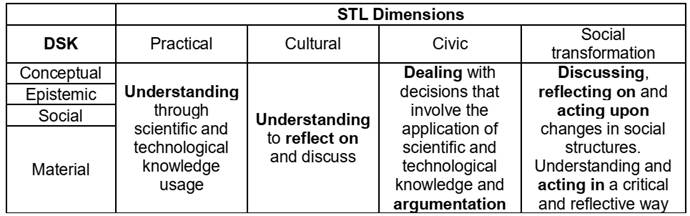
Based on what was presented in the previous section, Box 2 and 3 proposes how the mobilization of DSK (conceptual, epistemic, social, and material) can promote STL dimensions (practical, cultural, civic, and social transformation).


Box 4 highlights the relationships between the verbs and complements of the STL dimensions and the mobilization of DSK.

Relationship between the mobilization of DSK (conceptual, epistemic, social and material) and STL dimensions (practical, cultural, civic and social transformation) within educational context.
The verbs to understand and to reflect indicate individual analysis, while to discuss, to deal with, and to argue indicate more explicit social interactions. The verb to act (upon and in) refers to the effective practice and intervention in the natural world. It is important to highlight, however, that the social domain does not only refer to the process of consensus, dissent, or organization of students in the face of an argument, data, evidence, or artifact, since this mobilization belongs to the scope of the epistemic domain. Although verbs like to understand initially refer to the individual sphere of learning, it is possible that, in this process, the student mobilizes the social domain, especially when considering how and in what way arguments, data, evidence, and artifacts can be communicated, represented, argued, or debated. Then, even individually, but within a group, the student can mobilize social skills by reflecting on practices, norms, and more appropriate criteria for communication and representation of constructed understandings.
CONCLUSION
The social transformation dimension of STL occurs in conjunction with the practical, cultural, and civic dimensions. In that regard, we theoretically explain the relationships between the STL dimensions (G. Fernandes, Fernandes, et al., 2024) and the joint mobilization of the DSK (R. Duschl, 2008; Stroupe, 2014). These relationships can enhance students’ understanding of the social nature of science and technology, through their participation in the processes, practices, and content of science and technology.
The relationships between STL dimensions (practical, cultural, civic and social transformation) and the DSK (conceptual, epistemic, social and material) are not defined by a list of characteristics constructed in a specific context, but by the students’ participation in their own learning environments, based on the joint mobilization of domains of scientific knowledge in the classroom. There is no hierarchy or order in which these domains emerge; they need to be mobilized together to reveal elements that characterize STL dimensions.
Therefore, the relationships presented in this theoretical article aim to bring students closer to the legitimate practices of scientific work, promoting an education focused on emancipation and empowerment for understanding the unfolding of science and technology. This training helps them to act and exercise their social participation in a conscious and critical manner, both in local and global contexts, based on principles of social, educational and economic justice, democracy, citizenship, sustainability, equality, politics, recognition of ideologies and interdisciplinary approaches. That is the way students become individuals capable of transforming themselves and the reality in which they live.
Furthermore, this theoretical discussion may have implications for both research and Science Education. In the field of research, it proposes a theoretical model that articulates the DSK and STL dimensions, considering the diversity of school contexts. This model allows for the analysis of curricula, teaching materials, and classroom interactions, focusing on both scientific and technological aspects. Since this model does not presuppose a specific context, we suggest future research involving diverse and inclusive school contexts. In the field of education, it points to ways to develop more critical, engaged, and socially situated teaching practices. This is characterized by discussing frameworks that make it possible to rethink the science curriculum to give students the opportunity to engage with DSK and understand that science is a social practice through pedagogical practices that engage with the reality and challenges experienced by students in their communities.
Acknowledgments
We thank the Coordination for the Improvement of Higher Education Personnel (CAPES) for the financial support for the translation of this manuscript and the Graduate Program in Education: Knowledge and Social Inclusion at the Faculty of Education of UFMG.
References
-
Aires, J. A., & Lambach, M. (2010). Contextualização do ensino de Química pela problematização e alfabetização científica e tecnológica: Uma possibilidade para a formação continuada de professores. Revista Brasileira de Pesquisa em Educação em Ciências, 10(1), Artigo 1. https://periodicos.ufmg.br/index.php/rbpec/article/view/3984
» https://periodicos.ufmg.br/index.php/rbpec/article/view/3984 -
Archanjo Junior, M. G. de, & Gehlen, S.T. (2021). A tecnologia social na programçaão de um curriculo crítico-tranformador na educação em ciências. Ensaio Pesquisa em Educação em Ciências (Belo Horizonte), 23, e24929. https://doi.org/10.1590/1983-21172021230112
» https://doi.org/10.1590/1983-21172021230112 -
Arnold, J., & Clarke, D. J. (2014). What is ‘Agency’? Perspectives in Science Education Research. International Journal of Science Education https://www.tandfonline.com/doi/abs/10.1080/09500693.2013.825066
» https://doi.org/10.1080/09500693.2013.825066 -
Auler, D. (2003). alfabetização científico-tecnológica: Um novo “paradigma”. Ensaio Pesquisa em Educação em Ciências (Belo Horizonte), 5, 68-83. https://doi.org/10.1590/1983-21172003050107
» https://doi.org/10.1590/1983-21172003050107 -
Auler, D., & Delizoicov, D. (2001). Alfabetização Científico-Tecnológica Para Quê? Ensaio Pesquisa em Educação em Ciências (Belo Horizonte), 3, 122-134. https://doi.org/10.1590/1983-21172001030203
» https://doi.org/10.1590/1983-21172001030203 -
Biesta, G., & Tedder, M. (2007). Agency and learning in the lifecourse: Towards an ecological perspective. Studies in the Education of Adults, 39(2), 132-149. https://doi.org/10.1080/02660830.2007.11661545
» https://doi.org/10.1080/02660830.2007.11661545 -
Bocheco, O. (2011). Parâmetros para a abordagem de evento no Enfoque CTS [Dissertação, Universidade Federal de Santa Catarina]. https://repositorio.ufsc.br/xmlui/bitstream/handle/123456789/95281/294999.pdf?sequence=1&isAllowed=y
» https://repositorio.ufsc.br/xmlui/bitstream/handle/123456789/95281/294999.pdf?sequence=1&isAllowed=y -
Bowyer, J. (1990). Scientific and Technological Literacy: Education for Change https://www.semanticscholar.org/paper/Scientific-and-Technological-Literacy%3A-Education-Bowyer/4db45cbde525bad449052f4377a51b1d2aeb5ceb
» https://www.semanticscholar.org/paper/Scientific-and-Technological-Literacy%3A-Education-Bowyer/4db45cbde525bad449052f4377a51b1d2aeb5ceb -
Duschl, R. (2008). Science Education in Three-Part Harmony: Balancing Conceptual, Epistemic, and Social Learning Goals. Review of Research in Education, 32(1), 268-291. https://doi.org/10.3102/0091732X07309371
» https://doi.org/10.3102/0091732X07309371 -
Duschl, R. A. (1985). Science Education and Philosophy of Science Twenty-Five Years of Mutually Exclusive Development. School Science and Mathematics, 85(7), 541-555. https://doi.org/10.1111/j.1949-8594.1985.tb09662.x
» https://doi.org/10.1111/j.1949-8594.1985.tb09662.x -
Dutra, G. E., Oliveira, E. C., & Pino, J. C. D. (2017). Alfabetização científica e tecnológica na formação do cidadão. Revista Signos, 38(2), Artigo 2. https://doi.org/10.22410/issn.1983-0378.v38i2a2017.1375
» https://doi.org/10.22410/issn.1983-0378.v38i2a2017.1375 -
Fabri, F. (2020). Ensino de ciências, alfabetização científica e tecnológica e enfoque ciência, tecnologia e sociedade: O que pensam docentes dos anos iniciais do ensino fundamental em exercício? Revista Práxis, 12(24), Artigo 24. https://doi.org/10.47385/praxis.v12.n24.1277
» https://doi.org/10.47385/praxis.v12.n24.1277 -
Feinstein, N. W., & Waddington, D. I. (2020). Individual truth judgments or purposeful, collective sensemaking? Rethinking science education’s response to the post-truth era. Educational Psychologist, 55(3), 155-166. https://doi.org/10.1080/00461520.2020.1780130
» https://doi.org/10.1080/00461520.2020.1780130 -
Fernandes, G. (2025). Há uma crise na Alfabetização Científica e Tecnológica? Uma reflexão crítica sobre STEM e transformação social. VESTIGARE: Revista de Pesquisas em Educação, Ciências e Tecnologias, 1, 4-28. https://doi.org/10.5380/vrpect.1.97827
» https://doi.org/10.5380/vrpect.1.97827 -
Fernandes, G., Barbosa, G. M., Allain, L. R., & Santos, D. L. (2024). Unidades de ensino potencialmente significativas a uma situação de estudo: Avaliando o conhecimento científico de estudantes da educação básica a partir de uma tecnologia social. Investigações em Ensino de Ciências, 29(2), Artigo 2. https://doi.org/10.22600/1518-8795.ienci2024v29n2p231
» https://doi.org/10.22600/1518-8795.ienci2024v29n2p231 -
Fernandes, G., Fernandes, I. H., & Santos, D. L. (2024). Alfabetização científica e tecnológica como transformação social: Uma reflexão para a sua promoção no ensino de ciências a partir de uma tecnologia social. Ensaio Pesquisa em Educação em Ciências (Belo Horizonte), 26, 1-21. https://doi.org/10.1590/1983-21172022240195
» https://doi.org/10.1590/1983-21172022240195 -
Fernandes, I. H., Santos, D. L., & Fernandes, G. (2025). Alfabetização Científica e Tecnológica Escolar Como Transformação Social: Uma Análise a Partir de Uma Situação de Estudo Apoiada por Tecnologia Social. Revista Brasileira de Pesquisa em Educação em Ciências, e53657-29. https://doi.org/10.28976/1984-2686rbpec2025u129
» https://doi.org/10.28976/1984-2686rbpec2025u129 - Fourez, G. (1994). Alfabetizacion científica y tecnológica: Acerca de las finalidades de la enseñanza de las ciencias Ediciones Colihue.
-
Fourez, G. (1997). Scientific and Technological Literacy as a Social Practice. Social Studies of Science, 27(6), 903-936. https://doi.org/10.1177/030631297027006003
» https://doi.org/10.1177/030631297027006003 - Fourez, G. (2003). Crise no ensino de ciências? Investigações em Ensino de Ciências, 8(2), Artigo 2.
- Fourez, G. (com Lecompte, V. englebert, Grootaers, D., & Tilman, P. M. y F.). (2005). Alfabetización cinetífica y tecnológica: Acerca de las finalidades de la enseñanza de las ciencias (3o ed.). Colihue.
- Freire, P. (1987). Pedagogia do oprimido (17o ed.). Paz e Terra.
- Freire, P. (2003). Pedagogia do Oprimido Paz e Terra.
- Freire, P. (2019). Educação como prática da liberdade (53o ed.). Paz & Terra.
-
Fumeiro, C. L., Silveira, S. S. dos S., Martins, S. N., & Omena, V. J. M. (2019). Alfabetização científica e tecnológica como Princípio da formação do cidadão. Educitec - Revista de Estudos e Pesquisas sobre Ensino Tecnológico, 5(11), Artigo 11. https://doi.org/10.31417/educitec.v5i11.741
» https://doi.org/10.31417/educitec.v5i11.741 - Lawall, I. T. (2021). Olhares para além das inlhas interdisciplinares de racionalidade no uso da alfabetização científica e tecnológica. Em T. Milaré, G. P. Richetti, L. Lorenzetti, & J. de P. A. Filho (Org.), Alfabetização científica e tecnológica na Educação em Ciências: Fundamentos e Práticas(p. 96-110). Editora LF.
-
Lemes, A. F. G., Magnani, L. H., Mendes, M. T., & Allain, L. R. (2023). Confluências na formação de educadores das áreas de Ciências da Natureza e Linguagens a partir da Tecnologia Social das tintas de terra. Práxis Educativa, 18, 1-20. https://doi.org/10.5212/PraxEduc.v.18.21374.064
» https://doi.org/10.5212/PraxEduc.v.18.21374.064 -
Longino, H. E. (1990). Science as Social Knowledge: Values and Objectivity in Scientific Inquiry. Em Science as Social Knowledge Princeton University Press. https://doi.org/10.1515/9780691209753
» https://doi.org/10.1515/9780691209753 -
Longino, H. E. (2002). Socializing Knowledge. Em The Fate of Knowledge (p. 124-144). Princeton University Press. https://muse.jhu.edu/pub/267/monograph/book/60871
» https://muse.jhu.edu/pub/267/monograph/book/60871 -
Lorenz, K. M. (2008). Ação de instituições estrangeiras e nacionais no desenvolvimento de materiais didáticos de ciências no Brasil: 1960-1980. Revista Educação em Questão, 31(17), Artigo 17. https://periodicos.ufrn.br/educacaoemquestao/article/view/3903
» https://periodicos.ufrn.br/educacaoemquestao/article/view/3903 - Lorenzetti, L. (2021). A Alfabetização Científica e Tecnológica: Pressupostos, História e Compreensões da Alfabetização Científica e Tecnológica. Em T. Milaré , G. P. Richetti , L. Lorenzetti , & J. P. Alves Filho(Org.), Alfabetização científica e tecnológica na Educação em Ciências: Fundamentos e Práticas (p. 47-73). Livraria da Física.
-
Lorenzetti, L., & Delizoicov, D. (2001). Alfabetização científica no contexto das séries iniciais. Ensaio Pesquisa em Educação em Ciências (Belo Horizonte), 3, 45-61. https://doi.org/10.1590/1983-21172001030104
» https://doi.org/10.1590/1983-21172001030104 -
Mello, L. S. G. de, & Guazzelli, I. R. B. (2011). A alfabetização científica e tecnológica e a educação para a saúde em ambiente não escolar. Revista Brasileira de Ensino de Ciência e Tecnologia, 4(1), Artigo 1. https://doi.org/10.3895/S1982-873X2011000100002
» https://doi.org/10.3895/S1982-873X2011000100002 -
Milaré, T., & Alves Filho, J. de P. (2010). Ciências no nono ano do ensino fundamental: Da disciplinaridade à alfabetização científica e tecnológica. Ensaio Pesquisa em Educação em Ciências (Belo Horizonte), 12, 101-120. https://doi.org/10.1590/1983-21172010120207
» https://doi.org/10.1590/1983-21172010120207 - Milaré, T., & Richetti, G. P. (2021). História e compreensão da alfabetização científica e tecnológica. Em T. Milaré, G. P. Richetti, L. Lorenzetti , & J. de P. A. Filho (Org.), Alfabetização científica e tecnológica na Educação em Ciências: Fundamentos e Práticas (p. 19-46). Editora Livraria da Física
- Milaré, T., Richetti, G. P., Lorenzetti, L., & F Filho, J. de P. A. (2021). Alfabetização científica e tecnológica na educação em ciências: Fundamentos e práticas (1o ed., V. 1). Livraria da Física.
-
Moura, C. (2021). Para que história da ciência no ensino? Algumas direções a partir de uma perspectiva sociopolítica. Revista Brasileira de Ensino de Ciências e Matemática, 4(3). https://doi.org/10.5335/rbecm.v4i3.12900
» https://doi.org/10.5335/rbecm.v4i3.12900 -
Norambuena-Meléndez, M., Guerrero, G. R., & González-Weil, C. (2023). What is meant by scientific literacy in the curriculum? A comparative analysis between Bolivia and Chile. Cultural Studies of Science Education, 18(3), 937-958. https://doi.org/10.1007/s11422-023-10190-3
» https://doi.org/10.1007/s11422-023-10190-3 -
Ogawa, M. (1998). Under the Noble Flag of ‘Developing Scientific and Technological Literacy’. Studies in Science Education, 31(1), 102-111. https://doi.org/10.1080/03057269808560116
» https://doi.org/10.1080/03057269808560116 -
Pickering, A. (1995). The Mangle of Practice: Time, Agency, and Science University of Chicago Press. https://press.uchicago.edu/ucp/books/book/chicago/M/bo3642386.html
» https://press.uchicago.edu/ucp/books/book/chicago/M/bo3642386.html -
Pugliese, G. O. (2022). STEM education no contexto das reformas educacionais: Os efeitos das políticas de educação globalizantes no currículo e na profissionalização docente [Tese, Universidade de São Paulo]. https://doi.org/10.11606/T.48.2022.tde-17032022-110235
» https://doi.org/10.11606/T.48.2022.tde-17032022-110235 -
Ribeiro, K. D. F. (2024). Análise de uma proposta pedagógica à luz de perspectivas formativas transformativas. REAMEC - Rede Amazônica de Educação em Ciências e Matemática, 12, e24103-e24103. https://doi.org/10.26571/reamec.v12.18161
» https://doi.org/10.26571/reamec.v12.18161 - Richetti, G. P., & J Filho, J. de P. A. (2009). Automedicação: Um tema social para o Ensino de Química na perspectiva da Alfabetização Científica e Tecnológica. Alexandria: Revista de Educação em Ciência e Tecnologia, 2(1), Artigo 1.
-
Richetti, G. P., & Milaré, T. (2021). O Óleo no Nordeste Brasileiro: Aspectos da (an)alfabetização Científica e Tecnológica. Revista Brasileira de Pesquisa em Educação em Ciências, e29065-29. https://doi.org/10.28976/1984-2686rbpec2021u11871215
» https://doi.org/10.28976/1984-2686rbpec2021u11871215 - Roberts, D. A. (2011). Exploring the Landscape of Scientific Literacy. Em C. Linder, L. Östman, D. A. Roberts, P.-O. Wickman, G. Erickson, & A. MacKinnon (Org.), Exploring the Landscape of Scientific Literacy(p. 11-27). Routledge/Taylor and Francis.
- Rosa, C. T. W. da, & Amaral, L. C. Z. (2021). Formação cidadã no ensino de Ciências: Diálogo com a ACT. Em T. Milaré, G. P. Richetti, L. Lorenzetti, & J. de P. A. Filho (Org.), Alfabetização científica e tecnológica na Educação em Ciências: Fundamentos e Práticas(p. 74-95). Editora LF.
-
Roudometof, V. (2015). The Glocal and Global Studies. Globalizations, 12(5), 774-787. https://doi.org/10.1080/14747731.2015.1016293
» https://doi.org/10.1080/14747731.2015.1016293 -
Sasseron, L. H. (2021). Práticas constituintes de investigação planejada por estudantes em aula de ciências: Análise de uma situação. Ensaio Pesquisa em Educação em Ciências (Belo Horizonte), 23, e26063. https://doi.org/10.1590/1983-21172021230101
» https://doi.org/10.1590/1983-21172021230101 - Sasseron, L. H. (2024). Alfabetização Científica como perspectiva formativa: Resultados de pesquisa e possibilidades de novos estudos. Em C. A. de O. M. Júnior (Org.), Análise de dados em Educação para a Ciência e a Matemática Texto e Contexto.
- Shen, B. S. P. (1975). Science Literacy: Public understanding of science is becoming vitally needed in developing and industrialized countries alike. American Scientist, 63(3), 265-268.
-
Silva, M. B. e, & Sasseron, L. H. (2021). Alfabetização científica e domínios do conhecimento científico: Proposições para uma perspectiva formativa comprometida com a transformação social. Ensaio Pesquisa em Educação em Ciências, 23, 1-20. https://doi.org/10.1590/1983-21172021230129
» https://doi.org/10.1590/1983-21172021230129 -
Silva, F. C., Nascimento, L. A., Valois, R. S., & Sasseron, L. H. (2022). Ensino de ciências como prática social: Relações entre as normas sociais e os domínios do conhecimento. Investigações em Ensino de Ciências, 27(1), Artigo 1. https://doi.org/10.22600/1518-8795.ienci2022v27n1p39
» https://doi.org/10.22600/1518-8795.ienci2022v27n1p39 -
Silva, F. C., & Sasseron, L. H. (2025). Mobilization of Scientific Knowledge Domains to Build Epistemic Practices Among Pre-service Chemistry Teachers. Science & Education https://doi.org/10.1007/s11191-024-00607-y
» https://doi.org/10.1007/s11191-024-00607-y -
Sjöström, J. (2018). Science Teacher Identity and Eco-Transformation of Science Education: Comparing Western Modernism with Confucianism and Reflexive “Bildung”. Cultural Studies of Science Education, 13(1), 147-161. https://doi.org/10.1007/s11422-016-9802-0
» https://doi.org/10.1007/s11422-016-9802-0 -
Sjöström, J. (2024). Vision III of scientific literacy and science education: An alternative vision for science education emphasising the ethico-socio-political and relational-existential. Studies in Science Education, 0(0), 1-36. https://doi.org/10.1080/03057267.2024.2405229
» https://doi.org/10.1080/03057267.2024.2405229 -
Sjöström, J., & Eilks, I. (2018). Reconsidering Different Visions of Scientific Literacy and Science Education Based on the Concept of Bildung. Em Y. J. Dori, Z. R. Mevarech, & D. R. Baker(Org.), Cognition, Metacognition, and Culture in STEM Education: Learning, Teaching and Assessment(p. 65-88). Springer International Publishing. https://doi.org/10.1007/978-3-319-66659-4_4
» https://doi.org/10.1007/978-3-319-66659-4_4 -
Stroupe, D. (2014). Examining Classroom Science Practice Communities: How Teachers and Students Negotiate Epistemic Agency and Learn Science-as-Practice. Science Education, 98(3), 487-516. https://doi.org/10.1002/sce.21112
» https://doi.org/10.1002/sce.21112 -
Takkaç Tulgar, A. (2024). A Compromise between Global and Local: Glocal Identity and Its Effects on Pragmatic Development. Journal of Language, Identity & Education, 23(1), 49-65. https://doi.org/10.1080/15348458.2021.1956319
» https://doi.org/10.1080/15348458.2021.1956319 -
University Press, O. (2025, junho 14). Adjetivo glocal Dicionário Oxford Advanced Learner’s. https://www.oxfordlearnersdictionaries.com/us/definition/english/glocal?q=glocal
» https://www.oxfordlearnersdictionaries.com/us/definition/english/glocal?q=glocal -
Valladares, L. (2021). Scientific Literacy and Social Transformation. Science & Education, 30(3), 557-587. https://doi.org/10.1007/s11191-021-00205-2
» https://doi.org/10.1007/s11191-021-00205-2
-
3
Translation note: In Brazilian education, by characteristics of the language, alfabetização, commonly translated as literacy, refers to learning the writing code, understanding how to register sounds using letters and understanding the writing. On the other hand, literacy is understood as social use of the written language, which complements the process.
-
4
Based on Biesta and Tedder (2007) and Arnold and Clarke (2014), Sjöström (2024) understands agency as the capacity for intentional transformative action and/or as purposeful action oriented towards future goals.
-
5
According to the Oxford Dictionary, the word glocal is an adjective with “characteristics or related to factors that are both local and global” (University Press, 2025). The expression arises from the union of the words “global” and “local”, indicating the need to think and act considering both global relations and local realities and demands. It is present in different works from several areas (Roudometof, 2015; Takkaç Tulgar, 2024) but with the same perspective, integrating global and local discussions in analyses and actions.
-
6
We understand “emancipation as disidentification” as a process of liberation that involves breaking with socially imposed identities and roles, which can be limiting or oppressive. In that regard, emancipation is not just the achievement of rights or opportunities, but also the ability to question, deconstruct, and move away from categories and expectations that have been assigned by social, cultural, or educational systems.
-
7
Fourez (1994) discusses how the content taught in science classes, often considered neutral, carries ideologies and worldviews that shape how students understand science. These ideologies are present in the examples, narratives, structure of books, and even in teaching practice itself, albeit implicitly. For the author, “[...] absence of analysis, on the contrary, leads to a discourse that is not chosen, but also not neutral” (Fourez, 1994, p. 214), it is therefore necessary for teachers to consciously take responsibility for the choices involved in their teaching.
-
8
Inscriptions can be understood as visual records of scientific information, such as graphs, tables, diagrams, images, and other formats that capture and make visible data, evidence, principles, theories, laws, ideas, and concepts.
-
CECIMIG thanks CNPq (National Council for Scientific and Technological Development in its Portuguese acronym) and FAPEMIG (Foundation for Research Support of the State of Minas Gerais also in its Portuguese acronym) for the founding for editing this article
-
Data availability
All the data supporting the results of this study were published in the article itself.
-
2
Science Studies is an interdisciplinary area of study encompassing the philosophy and history of science, anthropology, and sociology.
All the data supporting the results of this study were published in the article itself.

 Source: Adapted from
 Source: Prepared by the authors (2025). 1 G.
  Source: Prepared by the authors (2025)