
 The meanings of violence against children and adolescents, according to education professionals
Abstract
Violence against children and adolescents is a problem that cuts across all socioeconomic, educational, and ethnic groups. Its occurrence causes human suffering and considerable harm to the development of both the individual and society. In this context, education plays a vital role in preventing violence against children and adolescents. However, it is essential to understand how education professionals perceive this issue so they can act more effectively. Thus, this study aimed to understand the meanings of violence against children and adolescents according to education professionals. To this end, an exploratory qualitative study was conducted with 90 professionals from six public schools in the city of Maceió, AL. The Thematic Drawing-and-Story Procedure (DET) was applied, and data were analyzed according to Vaisberg. The analysis of the DETs made it possible to identify four thematic categories: (I) the naturalization and transgenerational nature of intrafamilial violence; (II) the effects of violence on the lives of children and adolescents; (III) the absence of the protective role of the state, society, and the school; and (IV) the school as the main agent in addressing violence. Education professionals represented violence against children and adolescents as a transgenerational family problem, reflecting the underlying difficulties in addressing this violence, but there was also evidence of professional engagement and recognition of the school’s potential in combating this issue.
Keywords:
Violence against children and adolescents; Education professionals; Meanings; Thematic Drawing-and-Story Procedure (DET)
Resumo
A violência contra crianças e adolescentes é uma problemática que perpassa todos os grupos socioeconômicos, educacionais e étnicos. Sua ocorrência gera sofrimento humano e considerável prejuízo ao desenvolvimento do indivíduo e da sociedade. Tendo isso em vista, a educação desempenha um papel vital na prevenção da violência contra crianças e adolescentes. No entanto, é essencial compreender qual é o entendimento que os profissionais da educação têm sobre a temática, para que possam atuar de forma mais eficaz. Assim, objetivou-se compreender os significados acerca da violência contra crianças e adolescentes segundo os profissionais da educação. Para tanto, realizou-se uma pesquisa exploratória de caráter qualitativo, na qual participaram 90 profissionais de seis escolas públicas da cidade de Maceió - AL. Aplicou-se o Procedimento Desenho-Estória com Tema (DET) e a análise de dados foi realizada de acordo com Vaisberg. A análise dos DET’s possibilitou identificar quatro categorias temáticas: I) a naturalização e a transgeracionalidade da violência intrafamiliar; II) os efeitos da violência produzidos na vida da criança e do adolescente; III) a ausência do papel de proteção do estado, da sociedade e da escola, e IV) a instituição escolar como principal agente no enfrentamento da violência. Os profissionais da educação representaram a violência contra crianças e adolescentes como um problema familiar transgeracional, refletindo as dificuldades latentes do enfrentamento dessa violência, mas também se observa o engajamento de alguns profissionais e a potência da escola no combate dessa problemática.
Palavras-chave:
Violência contra crianças e adolescentes; Profissionais da educação; Significados; Desenho-Estória com Tema
Introduction
Violence against children and adolescents encompasses any acts or omissions by parents, relatives, and guardians, as well as by institutions and society at large, that cause physical, emotional, or other forms of harm to this group (Toledo; Sabroza, 2013). Research (Santos et al., 2019; Henriques; Dutra-Thomé; Rosa, 2022) identifies violence as a risk factor for the development of children and adolescents, producing effects on identity, personality disorders, and social adaptation. Consequently, a child who is frequently subjected to different forms of violence may suffer serious cognitive, emotional, and physical problems that can persist throughout life (Santos et al., 2019).
Accidents and acts of violence may affect up to 1 billion children and adolescents worldwide each year (FBSP, 2023). This includes cases of physical, sexual, and emotional violence, as well as neglect, involving individuals between the ages of two and seventeen. In the state of Alagoas, in 2022 alone, 952 cases of sexual violence were reported, 312 of which involved children between zero and nine years of age (Torres, 2023).
In order to reduce the negative impacts in the short, medium, and long term, it is necessary to develop strategies for preventing violence against children and adolescents. In this regard, education plays a vital role in preventing such violence, extending not only to the school environment but also to the family and community, fostering broad awareness that can significantly reduce the number of cases (Ribeiro; Costa, 2023).
The school is the primary setting where a child tends to exhibit signs of the violence they have experienced, and for this reason, educators play an important role in addressing and resolving the problem (Miura et al., 2023). Thus, since the earlier mistreatment is identified, the greater the possibility of helping the child and preventing further harm, school professionals must be able to recognize and take appropriate measures in such situations (Miura et al., 2023).
However, studies (Schek et al., 2018; Ribeiro; Fernandes; Melo, 2021) have shown that professionals in the education system are not adequately prepared to deal with situations of this nature, leading them to act inappropriately when faced with the necessary procedures and referrals. Thus, one way to reduce this issue and, consequently, prevent further mistakes would be to prepare educators through continuous training, enabling them to better identify and report cases of violence.
The school, as a space for development and protection, plays a crucial role in identifying and preventing situations of violence. However, the effectiveness of these preventive actions depends directly on the understanding and preparedness of educators to recognize and intervene in such cases. In light of this, the present article aims to understand the meanings of violence against children and adolescents according to education professionals.
Method
Type of study
This is an exploratory qualitative study. This type of research seeks to understand the phenomenon within the context in which it occurs, providing a detailed understanding of human behavior and the social environment, while valuing the perspectives and experiences of the individuals involved (Lösch; Rambo; Ferreira, 2023).
Participants
Ninety professionals from six public elementary schools (Ensino Fundamental I) in Maceió took part in this study, four of which were municipal and two state schools. The sampling was based on convenience, as all the schools are located near the university responsible for conducting the research.
Ethical aspects
The study complied with ethical standards for research involving human subjects and was approved by the Ethics Committee of the Federal University of Alagoas (UFAL), under Certificate of Presentation for Ethical Consideration (CAAE) No. 39947120.0.0000.5013, opinion No. 6.230.875, and was authorized by the participating schools. Data were collected only after the professionals signed the Free and Informed Consent Form (TCLE). It is also worth noting that fictitious names were used to preserve the anonymity of participants.
Data collection procedure and instruments
All professionals from the six schools were invited to take part in the study. Data collection took place between October 2022 and August 2023 during pedagogical meetings, in line with the availability of the school community. In total, six workshops were held, one in each school, during which the Thematic Drawing-and-Story Procedure was applied (Aiello-Vaisberg, 1995).
The Thematic Drawing-and-Story Procedure (DET), as proposed by Tânia Maria José Aiello-Vaisberg (2020), is a variation of the Drawing-and-Story Procedure (DE), created by Walter Trinca in 1972 at the University of São Paulo. Originally, the DE was developed as an auxiliary tool in unstructured psychological interviews and in graphic and thematic projective tests, with the aim of broadening the understanding of psychic dynamics through the production of drawings and spontaneous narratives (Trinca, 2013). The DE is based on Winnicott’s psychoanalytic theory, seeking to facilitate emotional communication in the intersubjective context (patient and therapist), while also enabling the expression of spontaneous gesture and creativity in one’s interaction with others (Tardivo, 2013).
The Thematic Drawing-and-Story Procedure (DET), in turn, consists of asking participants to create drawings and tell stories based on a theme previously defined by the researcher. This technique has been used in the investigation of social representations, making it possible to access the collective imagination and the unconscious dimensions that permeate certain social issues (Santos; Peres, 2020; Miura et al., 2021; Santos et al., 2022). Its use is flexible and can be applied to groups that differ in age, socioeconomic status, cultural level, or psychopathological condition, provided that participants are able to express their ideas about the proposed theme both graphically and verbally (Aiello-Vaisberg, 2020).
To ensure the participatory and meaningful application of the DET, workshops were adopted as a methodological strategy aimed at creating a space of care, attentive listening, and creativity, grounded in Winnicott’s theoretical framework (2019). According to the psychoanalyst (2019), the “potential space” is an intermediate area between internal and external reality that emerges in the relationship between the individual and the environment. In this study, the workshops were conceived as instruments to foster this potential space, encouraging meaningful reflections on the meanings of violence against children and adolescents through the drawings and stories produced by education professionals.
For the application of the Thematic Drawing-and-Story Procedure, participants were first given a blank A4 sheet of paper and a black pencil. They were then asked to create a drawing on the theme of violence against children and adolescents. After completing the drawing, participants were asked to write a story and give it a title. To conclude the workshop, a collective session was held in which education professionals — on a voluntary basis — could share their drawing-and-story and discuss what they had produced. Each DET session lasted on average between 1 hour 30 minutes and 2 hours.
The workshops were conducted by members of a research group, ranging from two to four people (master’s and undergraduate students in Psychology), with the purpose of distributing responsibilities among the group. The discussions were recorded and fully transcribed after the conclusion of each activity, and field diaries were also prepared for every session.
Data analysis
The analysis of the DETs was carried out according to Aiello-Vaisberg (2020). For the author (2020), the interpretive work with drawings involves three stages: (I) free reading; (II) reflection; and (III) interpretive construction based on what stands out and completing the drawing. However, Aiello-Vaisberg (2020) emphasizes that the researcher has autonomy and is free to create forms that support the transferential reading of the material, but the proposed objective must not be lost from sight — namely, grasping the social representations or meanings of the theme.
The first stage of analysis made it possible to develop preliminary investigative ideas and, subsequently, to establish analytical criteria. The criteria were defined based on excerpts from the story text, the title, and the drawing itself, in order to assist in the later process of thematic categorization. Ten indicators were established: the person who commits the violence; the gender of the person who commits the violence; the person who suffers the violence; the gender of the person who suffers the violence; the type of violence; the kinship relation; the nature of the violent acts; the form of the violent acts; the place where the violence occurs; and who provides protection from the violence.
To classify the type and nature of violence, the typology proposed by the WHO (2002) was used, divided into three main categories according to the characteristics of the perpetrator of the act of violence: self-directed violence (self-inflicted); interpersonal violence; and collective violence. This initial categorization distinguishes between violence that a person inflicts on themselves, violence inflicted by another person or a small group of people, and violence inflicted by larger groups, such as states, organized political groups, militias, and terrorist organizations. Each of these three main categories is further subdivided to study more specific types of violence: interpersonal (family violence or community violence) and collective (social, political, or economic) (WHO, 2002). The nature of violent acts can be further broken down into: physical violence, psychological violence, sexual violence, and neglect (WHO, 2002).
It is worth noting that, in a DET, more than one mention of a given indicator could be identified, such as more than one person perpetrating violence. Due to this multiplicity of references in the productions, some indicators exceeded the total number of participants (n=90). Thus, it should be emphasized that, for these indicators, the count was based on the total number of references.
The second stage aimed to develop categories from the study material, that is, it considered everything that stood out in the materials (DETs and transcripts of statements from the workshops) that allowed for an interpretive construction. It should be noted that this categorization process entails separating and grouping the recording units from the study material.
Repetition of terms and words was therefore used as a supporting procedure in the process of coding and developing the initial categories. Thus, it was first necessary to distinguish the themes of each material separately and then bring the themes together to establish the categories. Consequently, the themes that appeared most frequently and showed similarities were grouped to create the categories. Subsequently, the formation of intermediate categories made it possible to develop the final categories of analysis. It should be noted that, in the analysis, no type of inference was made, even when indications of something were present; only what was explicit in the story, the drawing, and the participants’ statements was recorded.
Finally, the third phase, defined by Aiello-Vaisberg (2020) as the stage aimed at reflecting on the materials, involved formulating hypotheses, inferences, and interpretations of the results, based on the updated framework on the subject.
Results and discussion
Participant profile
Most of the participating professionals were female (73; 81.1%), followed by male (17; 18.9%). In terms of age, there was a predominance of professionals between 31 and 50 years old (54; 60%). Their professional background was mostly made up of teachers (63; 70%), followed by coordinators (nine; 10%). According to the 2022 School Census (Brazil, 2023), the teaching staff of Brazilian basic education includes more than 2.3 million professionals, of whom 1.8 million (79.2%) are women.
In elementary education, women account for 77.5% of teachers, and in high school, they make up 57.5%. The census also revealed a prevailing age range of 40 to 49 years (35.2%) across all stages of education. With regard to school management, according to the census, most positions (80.7%) are held by women. The sample in this study corroborates the data published in the Basic Education Census.
Characteristics of the Perpetrator of Violence and the Person Who Suffers Violence
With regard to the perpetration of violent acts, 29 participants (30.2%) did not specify in their DETs who committed violence against children and adolescents. Among those who did specify, 61 (69.8%) highlighted the predominance of family members, namely: father (17.8%), parents/guardians (13; 13.5%), mother (10; 10.4%), stepfather (nine; 9.4%), grandfather/uncle (six; 6.2%), and grandmother/aunt (two; 2.1%). In addition, other DETs indicated as perpetrators of violence children (three; 3.1%), school professionals (two; 2.1%), unknown adults (two; 2.1%), a neighbor (one; 1.0%), the public authorities (one; 1.0%), and society (one; 1.0%). The drawings also made it possible to observe the gender of the perpetrator: 40 DETs (43.0%) indicated male; in 39 (41.9%) gender was not specified; and in 14 (15.1%) female.
With regard to the person suffering violence, 60 DETs (60.6%) showed that the child was the main target, followed by adolescents (13; 13.1%). It is worth noting that 26 participants (26.3%) did not specify in their drawings who the person suffering violence was. As for gender, 37 participants (39.8%) identified the victim as female and 28 (30.1%) as male. In addition, in 28 DETs (30.1%) gender was not specified.
These data corroborate the findings of the Brazilian Forum on Public Security (FBSP, 2023), which identifies children as the main victims of violence, predominantly perpetrated by fathers, mothers, or stepfathers. As for the victim’s gender, however, there is a divergence, since the FBSP (2023) data indicate that boys (54.1%) are the most affected.
Types of violence committed and the nature of violent acts
It was found that 63 DETs (67.7%) indicated intrafamily violence as the main social setting for violent acts, followed by 17 (18.3%) indicating community violence, five (5.4%) collective social violence, and eight (8.6%) with no specification. It is important to highlight that although 29 participants (30.2%) did not specify in their texts or drawings who the perpetrator was, the home was mentioned as the place where the violence occurred. Thus, the violence described was considered to be intrafamily.
With regard to the nature of the violent acts, psychological and physical violence each appeared 34 times (26.1%). These were followed by sexual violence (24; 18.5%), neglect (22; 17.0%), and unspecified (16; 12.3%). It should be noted that more than one type of violence could appear in a single drawing; therefore, the figures presented here do not correspond to the total number of participants.
The FBSP (2023) showed that all types of violence against children and adolescents increased from 2021 to 2022. The rate of rape was 104.0% per 100,000 inhabitants in the specific age group, physical abuse was 45.1%, and abandonment of a vulnerable person was 18.7%. These data partially corroborate the DETs represented by the education professionals.
Thematic analysis of the DETs and discussion of the data
It was possible to identify four thematic categories; however, a single DET could fall into more than one category. The stories were transcribed, and any information that could identify the participant was removed, without impairing comprehension of the material produced.
The normalization and transgenerational aspect of intrafamily violence
A large portion of the professionals participating in the study (63; 67.8%) represented in their DETs intrafamily violence against children and adolescents, as well as the kinship ties between the perpetrator and the victim. They reported cases involving fathers, mothers, the family in general, stepfathers, uncles, brothers-in-law, and the mother’s boyfriends as perpetrators of violence against children and adolescents.
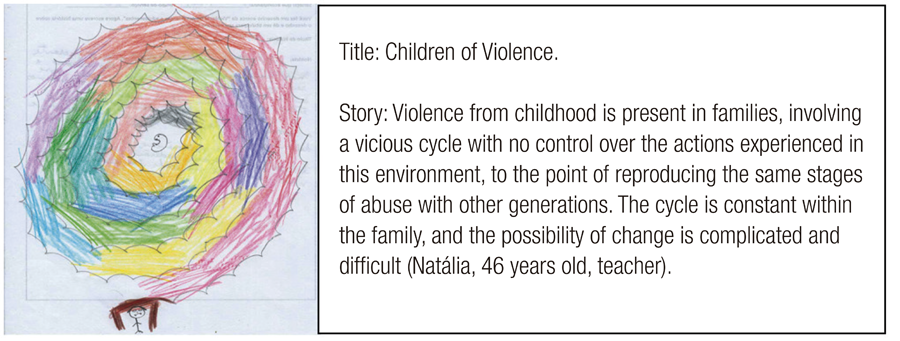
The transgenerational intrafamily aspect of violence was represented in some DETs:

Teacher Natália discusses the transgenerational aspect of violence as a vicious cycle. Research (Dutton; Starzomski; Ryan, 1996; Kerner; Julian; McKenry, 1997) indicates that children and adolescents who directly or indirectly experience intrafamily violence are more likely to become aggressors or victims of aggression, which contributes to the perpetuation of the cycle of violence across generations. More recent research (Henriques; Dutra-Thomé; Rosa, 2022) corroborates that violence against children and adolescents is a phenomenon sustained by cultural and transgenerational norms and is often linked to the social acceptance of such violent behavior. Furthermore, the FBSP (2023) data presented above, concerning the increase in this type of violence, to some extent reveal the difficulties and challenges of public policies in addressing this issue. In this respect, one participant’s account portrays violence against children and adolescents as naturalized among family members and considered a form of education, in addition to being a phenomenon that spans generations:
[…] because for the family, violence — having been naturalized over generations as a way of disciplining the child — can be treated as something common, since they were raised that way and believe that violence is the right way to raise their children (Fernanda, 40 years old, teacher).
This teacher’s account aligns with Teodoro’s (2020) reflection on the various forms of violence that children and adolescents have experienced throughout history, such as physical, sexual, and psychological aggression, which have been naturalized and legitimized in different social spheres. According to the author (2020), intrafamily violence — especially physical violence — continues to be seen as an acceptable disciplinary method, reflecting the persistent devaluation of childhood, even with the advancement of laws that recognize the child as a rights-bearing individual.
In the professionals’ DETs, physical violence is shown as being justified by alcoholic fathers who beat their daughters when they do not perform household chores; by mothers who hit their daughters whenever they cry; and by families who assault children for expressing a desire to play — or as a supposed form of education. The DETs presented by the professionals illustrate how the use of physical violence by the family is justified with the intention of “disciplining,” “educating,” or “solving a problem.” These data show that some participants perceive physical violence against children as a continuation of the culture of “a spanking teaches,” as patterns of violence that are perpetuated and become rooted in family norms and expectations.
The participants also portray how the violence experienced by the child in the home environment can end up being reproduced in the school setting:

Teacher Vitória shows in her DET that the violence experienced at home generates the violence practiced by the child at school. According to Peçanha (2013), one of the main causes of violence occurring within the school setting is the reproduction by children of what they learn in other environments, especially at home. “The aggressor often comes from disturbed and/or dysfunctional family relationships and is frequently subjected to domestic violence, ultimately reproducing at school the use of force and intimidation to which they are subjected in their family environment” (2013, p. 15).
The perception of the naturalization and the transgenerational aspect of intrafamily violence indicates that the problem has become entrenched and has been delegated to the family, where nothing more can be done, since the fact is already consummated, reinforcing the absence of actions for addressing and preventing the problem. Education professionals seem to perceive the phenomenon of violence in this way, as 68 out of 90 DETs (78.6%) do not present a solution to the situation of abuse but instead focus on its occurrence and effects, confirming the impossibility of breaking the cycle of violence. This finding helps to explain the difficulties reported by professionals in the process of identifying, reporting, and addressing cases of intrafamily violence in schools. This difficulty was identified in studies conducted two decades ago (Vagostello et al., 2003; Gralville-Garcia et al., 2009), as well as in more recent research (Huçalo; Grisoski; Suzuki, 2022; Miura et al., 2023), which seems to indicate an entrenchment in the face of this challenge.
Effects of violence on the lives of children and adolescents
Violence against children and adolescents produces significant and long-lasting repercussions, both for the victims and for the community as a whole. From a social perspective, the presence of such violence perpetuates cycles of inequality and suffering, affecting the health and well-being of these individuals (Ribeiro; Costa, 2023). The representations in 40 DETs (44.4%) highlight the effects of different forms of violence on the lives of children and adolescents.
The consequences of violence can extend beyond childhood, affecting victims’ adult lives through, for example, personality disorders and difficulties in social adaptation (Sufredini; More; Krenkel, 2016; Wolbert; Ornelas Alexandrino; Kind, 2024). The nature and severity of these consequences depend on the type, intensity, and frequency of the violence experienced by children (Aquino et al., 2021). Teresa (45 years old, special education teacher) describes the long-term scars that violence can leave on the lives of these children and adolescents: “Regardless of the context of the story, the ending will always be sad, because the scars of violence are eternal.”
Childhood is a crucial period of human development; therefore, exposure to violence at this early stage can cause harm that profoundly affects the overall development of these children. Reactions to child violence vary depending on the circumstances and the individual characteristics of the victims, which can result in a wide range of repercussions (Aquino et al., 2021; Wolbert; Ornelas Alexandrino; Kind, 2024).
Through the DETs, it was possible to observe participants’ views on the consequences of violence in various areas of children’s and adolescents’ lives. Physical, emotional, behavioral, cognitive, and social effects were highlighted in the drawings and stories presented by the professionals. More general effects, such as eternal scars, bodily marks, “diseases of the mind,” suffering, and physical and emotional disintegration, were also evident in seven outputs (17.5%).
From the perspective of the harms related to the mental health of children and adolescents, Anunciação et al. (2022) emphasize that victims often present low self-esteem and a lack of psychosocial autonomy, which may contribute to higher rates of suicide and to the recurrence of violent reactions in their social relationships, especially in the school environment, resulting in difficulties adapting to society.
One of the participants depicts the consequences in her DET:

When it comes to exposure to emotional violence during childhood and adolescence, Henriques, Dutra-Thomé, and Rosa (2022) highlighted it as a significant risk factor for development, capable of causing cognitive and behavioral harm, affecting the mental and physical health of individuals across different age groups, and influencing relationship dynamics throughout life. Among these harms, the authors pointed out that children and adolescents seem more likely to retain and internalize symptoms, whereas adults tend to display aggressive behaviors more overtly.
The analysis of the DETs showed that professionals are aware of the consequences in different areas of children’s and adolescents’ lives, understanding the short-, medium-, and long-term impacts on these individuals. The effects of psychological violence represented in 34 outputs (26.1%) were: low self-esteem, difficulties in relationships, sadness, insecurity, problems with school performance, distress, and emotional emptiness.
The consequences of physical violence represented in 34 outputs (26.1%) were: physical and emotional wounds, deep sadness, withdrawal, fear, insecurity, changes in school behavior, and difficulties in socialization. In five outputs (12.5%), participants highlighted the effects of neglect and abandonment through feelings of helplessness, loneliness, lack of adequate socioemotional development, sadness, isolation, and exhaustion.
Sexual violence represented in 24 outputs (18.5%) revealed the following consequences: deep sadness, withdrawal, changes in school behavior, serious emotional problems such as depression and anxiety, feelings of anger, guilt, and shame. In one of the DETs, a teacher (Patrícia, 55 years old) emphasized the seriousness of the effects produced by sexual violence, highlighting in her story the suffering of an adolescent who decided to take his own life.
The effects represented by the professionals in their DETs regarding the different types of violence are consistent with the literature (Santos et al., 2019; Henriques; Dutra-Thomé; Rosa, 2022). Professionals demonstrate an understanding and awareness of the harms of violence in the lives of children and adolescents, and most of the DETs portray it as a serious and complex problem, but without a solution. Rather, the endings of the stories point to the worsening of physical and psychological illnesses and, in some cases, to the repetition of violence.
This understanding expressed by the professionals may have stemmed from training and education on the subject, but also from their own experiences of abuse, as in the case of a teacher (Fabiana, 59 years old), who, in her account, shared that she experienced situations of violence in her childhood and felt abandoned by the adults who, instead of protecting her, assaulted her. This finding points to the importance of listening to, supporting, and protecting professionals who may also be suffering from violence. Furthermore, it reinforces the understanding of the difficulties faced by education professionals in the process of identifying, reporting, and addressing cases of intrafamily violence in schools.
Absence of the protective role of the state, society, and the school
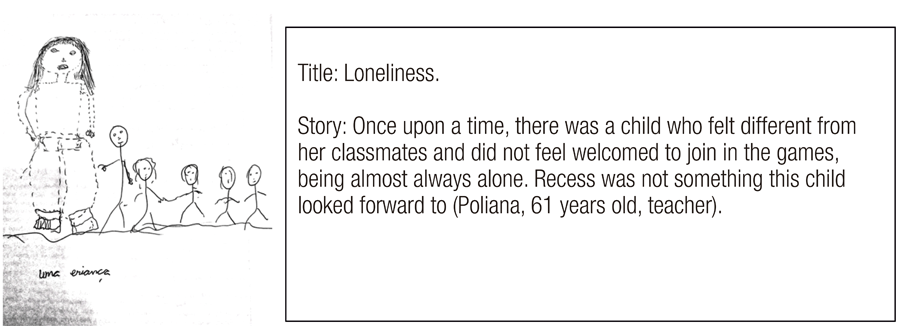
The analysis of the DETs showed that, in nine of them, the school was represented as a place where violence is produced or reproduced. Of these, three pointed to student-on-student violence occurring within the school environment as a way of reproducing what children see and experience in their homes. On the other hand, two drawings mentioned violence between staff/teachers and students. In one DET, the teacher uses archaic teaching methods with a wooden ruler/paddle (palmatória) on the children, and in another DET, the school janitor hits a child who disobeyed him. Four DETs highlighted the school institution more generally as a space for reproducing family, community, cultural, and state violence, as well as an environment of segregation (as shown in the example below) and prejudice against students with disabilities.

The school institution is seen by society as a space for intellectual development, learning, and growth, as well as a place founded on safety and protection. However, incidents of violence in schools have become increasingly frequent (Barbieri, Santos, & Avelino, 2021). A study conducted by Souza (2019) in the state of São Paulo found that 81% of students and 90% of teachers reported being aware of situations of violence that occurred in state schools where they taught in 2019. Among the most frequent types of school violence, bullying, verbal aggression, and physical aggression stood out in this context.
It was found that the participants in this study portrayed school violence, in general, as a reproduction of various forms of violence experienced in the family, culture, community, and society. This finding corroborates the results of Zucco and Trindade (2024), who noted that the violence committed by students within the school environment, according to education professionals, stems from the cultural and family vulnerability context in which they are situated, concluding that “school violence is highlighted as an expression of structural violence” (2024, p. 16).
Furthermore, through the words of a social worker, it was possible to understand her view regarding the exercise of the duties of the state and society:
We live in a society with great inequality, and this disparity ends up causing a series of forms of violence. These people become vulnerable, and the public authorities, which should be fulfilling their role of providing public policies, are instead spinning their wheels, thereby spreading even more violence (Isadora, 55 years old, social worker).
Recognizing children and adolescents as rights-bearing individuals requires respecting each stage of their development and their identity. This recognition is essential to overcoming violent practices that end up being legitimized by society and internalized within the family environment. Instead of combating this violence, the state often acts as a mediator in its legitimation, fostering the internalization of oppressive and demeaning practices (Teodoro, 2020).
However, the Child and Adolescent Statute has been fundamental in denaturalizing violence against children, highlighting the importance of public policies in addressing violent practices rooted in families, culture, and society. It also emphasizes the need to train health and education professionals to recognize signs of violence and report cases to the Guardianship Council, thereby promoting greater protection for the most vulnerable (Bussinger; Silva; Costa, 2020). From this perspective, the rapprochement between the state and society should focus on recognizing and protecting the most vulnerable. Yet, for this to be effective, it is essential that society, families, and social protection agencies remain attentive to the factors that reveal the various forms of violence (Teodoro, 2020).
The school as the main agent in addressing violence
This category addresses the representations of 22 (21.4%) DETs regarding the school as an institution for addressing violence against children and adolescents. Of these, nine (8.7%) identified the school as a place of safety for victims, seven (6.8%) indicated the teacher, two (1.9%) the school psychologist, two (1.9%) the social worker, one (1.0%) the principal, and one (1.0%) the pedagogical team, as shown in the figure below:

The school plays an extremely important role, given that it is an environment where children and adolescents spend a large part of their day (Santos et al., 2019). Teachers and other school professionals are in a strategic and privileged position, since daily contact with their students allows for greater interaction and awareness of events (Ribeiro; Costa, 2023). Thus, as the school institution is one of the main intermediaries of conflicts within society, understanding its role in situations of violence is essential for reviewing and assessing the measures being taken in these cases (Santos et al., 2019).
From the analysis of the DETs that identified the school as a place of protection, the stories revealed that the actions taken by teachers and other school staff arose from the signs shown by students after the violence had already occurred. It can thus be understood that some participants view the school environment as a space of response, that is, an institution of secondary or tertiary prevention, when the violence has already taken place. There was no mention, in the story-drawings, of the school as a place of primary prevention, that is, before the violence had occurred.
Of the DETs that identified the school as an institution of response, seven mentioned mobilizing the protection network, distributed among the Guardianship Council (four), the police (two), and the Basic Health Unit (one). Working within a network is an effective way to interrupt violence, as it allows for a broader view of situations and the planning of integrated actions, enabling each sector to focus on its own responsibilities (Ferreira, 2023). In this regard, although the school plays a fundamental role in the system for guaranteeing rights, on its own it has limited reach and requires coordinated action with other agencies—such as the health sector, the judiciary, and others—in order to ensure the full protection of children and adolescents (Santos et al., 2019).
However, in order to reduce child and youth violence rates, the school must not only be a space of response but also an environment for prevention. The WHO (2002) suggests three modalities, among them primary prevention, which targets the general population, seeking to raise awareness about violence and promote family guidance as well as teaching appropriate care and attitudes to children. And although primary prevention actions are often supported by wide-reaching campaigns, such as television ads and posters, this modality also includes the development and implementation of strategies for preventing and combating violence.
In this regard, Faraj, Scott, and Siqueira (2020) conducted an action research project in two schools in Rio Grande do Sul, which sought, through workshops and dialogue spaces, to prevent violence between parents/guardians and their children. The study concluded that primary prevention actions in the school setting are necessary to reduce cases of child and youth violence. Moreover, the authors emphasized that participants viewed the project favorably, as they considered the meetings to be moments of reflection and clarification regarding the harm caused by violence to their children’s development.
The finding that 21.4% of the education professionals in this study consider the school a place for preventing violence reinforces that the school environment can and should be a space of care and protection for children and adolescents, as well as a powerful setting for responding to violence.
Final considerations
Education professionals portrayed violence against children and adolescents as a complex, multifaceted phenomenon that is difficult to address. The naturalization and transgenerational nature of intrafamily violence were predominantly represented. This finding reveals the difficulty professionals face in reporting and addressing this phenomenon. In light of both findings from two decades ago and more recent academic literature, the challenge appears to be entrenched.
It was also observed that professionals are aware of and understand the harmful effects of violence on child development, representing short-, medium-, and long-term harm through Thematic Story-Drawings that depict sadness, depression, low self-esteem, fear, anxiety, aggressiveness, social isolation, school problems, and difficulties in relationships. This demonstrates that education professionals have some knowledge about the phenomenon of violence, especially concerning its consequences for children and adolescents. What seems to be lacking are the resources to transform that knowledge into actions of response.
Violence in the school context was portrayed as a reproduction of the various forms of violence experienced by children in their homes, neighborhoods, society, and culture, as well as the reproduction of the “spanking educates and disciplines” culture by education professionals. This finding reveals how the school, far from being an isolated space, reflects and reinforces the violent structures present in social culture, making the response to this type of violence more complex.
It was also observed that just as important as addressing child and youth violence is listening to, supporting, and protecting education professionals, who may themselves be experiencing situations of violence and, consequently, may be unable to identify and report the violence present in schools because they are suffering from similar situations.
Thus, it is essential to recognize that teachers not only face the challenge of dealing with the violence experienced by their students but also live through forms of violence that need to be acknowledged, addressed, and prevented. The absence of institutional support contributes to the perpetuation of this cycle, reinforcing the need for public policies that ensure dignified working conditions, spaces for listening, and continuing education that includes care for education professionals.
The professionals who identified the school as the main protective institution highlighted different actors—such as teachers, school psychologists, social workers, principals, and pedagogical teams—as playing important roles in responding to violence against children and adolescents. This finding indicates that, within the school community, there are professionals available to support and protect children and adolescents and to address the problem of violence.
With regard to the limitations of this study, the research was based on the perspectives of a specific group of education professionals, which may not reflect the diversity of opinions and experiences of all educators.
References
- AIELLO-VAISBERG, Tânia Maria José. Investigação de representações sociais. In: TRINCA, Walter (org.). Formas lúdicas de investigação em psicologia: procedimento de desenhos-estórias e procedimento de desenhos de famílias com estórias. São Paulo: Vetor, 2020. cap. 11, p. 185-207.
-
AIELLO-VAISBERG, Tânia Maria José. O uso de procedimentos projetivos na pesquisa de representações sociais: projeção e transicionalidade. Psicologia USP, São Paulo, v. 6, n. 2, p. 103-127, 1995. Disponível em: http://pepsic.bvsalud.org/scielo.php?script=sci_arttext&pid=S1678-51771995000200007&lng=pt&nrm=iso Acesso em: 16 jul. 2024.
» http://pepsic.bvsalud.org/scielo.php?script=sci_arttext&pid=S1678-51771995000200007&lng=pt&nrm=iso -
ANUNCIAÇÃO, Leilane Lacerda et al. Violência contra crianças e adolescentes: intervenções multiprofissionais da atenção primária à saúde na escola. Saúde em Debate, Rio de Janeiro, v. 46, n. 3, p. 201-212, 2022. https://doi.org/10.1590/0103-11042022E315
» https://doi.org/10.1590/0103-11042022E315 -
AQUINO, Erick Verner de Oliveira et al. Fatores socioeconômicos e saúde de crianças em contexto de violência. Aletheia, Canoas, v. 54, n. 1, p. 96-104, 2021. https://doi.org/DOI10.29327/226091.54.1-10
» https://doi.org/DOI10.29327/226091.54.1-10 -
BARBIERI, Bianca da Cruz; SANTOS, Naiara Ester dos; AVELINO, Wagner Feitosa. Violência escolar: uma percepção social. Revista Educação Pública, Rio de Janeiro, v. 21, n. 7, p. 1-5, 2021. Disponível em: https://educacaopublica.cecierj.edu.br/artigos/21/7/violencia-escolar-uma-percepcao-social Acesso em: 22 jul. 2024.
» https://educacaopublica.cecierj.edu.br/artigos/21/7/violencia-escolar-uma-percepcao-social - BRASIL. Instituto Nacional de Estudos e Pesquisas Educacionais Anísio Teixeira (INEP). Censo da educação básica 2022: notas estatísticas. Brasília, DF: INEP, 2023.
-
BUSSINGER, Rebeca Valadão; SILVA, Roberta Scaramussa; COSTA, Bruna de Almeida. O processo de (des)naturalização das práticas punitivas a partir da promulgação do estatuto da criança e do adolescente e da lei 13.010/2014. Revista da Faculdade de Educação da Universidade do Estado de Mato Grosso, Cáceres, v. 34, n. 2, p. 243-263, 2020. https://doi.org/10.30681/21787476.2020.34.243263
» https://doi.org/10.30681/21787476.2020.34.243263 -
DUTTON, Donald George; STARZOMSKI, Andrew; RYAN, Lee. Antecedents of abusive personality and abusive behavior in wife assaulters. Journal of Family Violence, v. 11, n. 2, p. 113-132, 1996. Disponível em: https://link.springer.com/article/10.1007/BF02336665 Acesso em: 10 jun. 2025.
» https://link.springer.com/article/10.1007/BF02336665 -
FARAJ, Suane Pastoriza; SCOTT, Juliano Beck; SIQUEIRA, Aline Cardoso. Escola como um espaço de prevenção da violência: um relato de experiência. Barbarói, Santa Cruz do Sul, n. 57, p. 254-273, 2020. https://doi.org/10.17058/barbaroi.v0i57.11266
» https://doi.org/10.17058/barbaroi.v0i57.11266 -
FERREIRA, Ana Lúcia. A escola e a rede de proteção de crianças e adolescentes. In: ASSIS, Simone Gonçalves de et al. (org.). Impactos da violência na escola: um diálogo com professores. Rio de Janeiro: Fiocruz, 2023. cap. 9, p. 237-262. https://doi.org/10.7476/9786557082126.0011
» https://doi.org/10.7476/9786557082126.0011 -
FBSP. Fórum Brasileiro de Segurança Pública. 17º Anuário Brasileiro de Segurança Pública. São Paulo: FBSP, 2023. Disponível em: https://forumseguranca.org.br/wp-content/uploads/2023/07/anuario-2023.pdf Acesso em: 27 maio 2024.
» https://forumseguranca.org.br/wp-content/uploads/2023/07/anuario-2023.pdf -
GRANVILLE-GARCIA, Ana Flávia et al. Conhecimentos e percepção de professores sobre maus-tratos em crianças e adolescentes. Saúde e Sociedade, São Paulo, v. 18, n. 1, p. 131-140, 2009. https://doi.org/10.1590/S0104-12902009000100013
» https://doi.org/10.1590/S0104-12902009000100013 -
HENRIQUES, Catarina Gordiano Paes; DUTRA-THOMÉ, Luciana; ROSA, Edinete Maria. Violência emocional intrafamiliar contra crianças e adolescentes e suas repercussões: uma revisão sistemática de literatura. Psico, Porto Alegre, v. 53, n. 1, p. 1-12, 2022. https://doi.org/10.15448/1980-8623.2022.1.39085
» https://doi.org/10.15448/1980-8623.2022.1.39085 -
HUÇALO, Ana Paula; GRISOSKI, Daniela Cecília; SUZUKI, Claudio Shigueki. Prevenção à violência sexual infantil: um relato sobre as ações desenvolvidas com trabalhadores da educação em um município de pequeno porte em alusão ao 18 de maio. Perspectivas em Diálogo: Revista de Educação e Sociedade, Naviraí, v. 9, n. 20, p. 263-274, 27 maio 2022. Disponível em: https://periodicos.ufms.br/index.php/persdia/article/view/14806 Acesso em: 10 jun. 2025.
» https://periodicos.ufms.br/index.php/persdia/article/view/14806 -
KERNER, Jonh Edward; JULIAN, Tereza; MCKENRY, Patrick Charles. Application of attachment theory to male violence toward female intimates. Journal of Family Violence, v. 12, n. 2, p. 211-228, 1997. DISPONÍVEL EM: HTTPS://LINK.SPRINGER.COM/ARTICLE/10.1023/A:1022840812546 ACESSO EM: 10 JUN. 2025.
» HTTPS://LINK.SPRINGER.COM/ARTICLE/10.1023/A:1022840812546 -
LÖSCH, Silmara; RAMBO, Carlos Alberto; FERREIRA, Jacuques de Lima. A pesquisa exploratória na abordagem qualitativa em educação. Revista Ibero-Americana de Estudos em Educação, Araraquara, v. 18, p. 1-18, 2023. https://doi.org/10.21723/riaee.v18i00.17958
» https://doi.org/10.21723/riaee.v18i00.17958 - MIURA, Paula Orchiucci et al. Potencialidades de prevenção da violência contra crianças e adolescentes nos equipamentos públicos de Maceió, Alagoas. In: MIURA, Paula Orchiucci; OLIVEIRA, Adélia Augusta Souto de; VASCONCELOS, Angelina Nunes de (org.). Violências contra crianças e adolescentes: espaços de prevenção e intervenção na assistência social, educação e saúde. Maceió: UFAL, 2023. cap. 4, p. 113-148.
-
MIURA, Paula Orchiucci et al. The meanings of pregnancy in adolescence for young people without a history of pregnancies. Paidéia, Ribeirão Preto, v. 31, e311, 2021. https://doi.org/10.1590/1982-4327e3114
» https://doi.org/10.1590/1982-4327e3114 - OMS. Organização Mundial da Saúde. Relatório mundial sobre violência e saúde. Geneva: World Health Organization, 2002.
-
PEÇANHA, Ingrid Silva Barbosa. Reflexões acerca da violência escolar. Brasil de Fato, Juiz de Fora, p. 15, abr. 2013. Disponível em: https://www.ufjf.br/graduacaocienciassociais/files/2010/11/REFLEX%c3%95ES-ACERCA-DA-VIOL%c3%8aNCIA-ESCOLAR-Ingrid-Silva-Barbosa-Pe%c3%a7anha.pdf Acesso em: 20 abr. 2024.
» https://www.ufjf.br/graduacaocienciassociais/files/2010/11/REFLEX%c3%95ES-ACERCA-DA-VIOL%c3%8aNCIA-ESCOLAR-Ingrid-Silva-Barbosa-Pe%c3%a7anha.pdf -
RIBEIRO, Fernanda Maria Araújo; FERNANDES, Flávia Emília Cavalcante Valença; MELO, Rosana Alves. Rede de proteção a crianças e adolescentes em situação de violência na visão dos profissionais. Revista Baiana de Enfermagem, Salvador, v. 35, p. 1-11, 2021. Disponível em: https://periodicos.ufba.br/index.php/enfermagem/article/view/42099 Acesso em: 08 jun. 2024.
» https://periodicos.ufba.br/index.php/enfermagem/article/view/42099 -
RIBEIRO, Marcelo Costa; COSTA, Juliana da Silva. O papel da educação na prevenção da violência contra crianças e adolescentes. Revista Direito em Foco, Amparo, v. 15, n. 1, p. 383-399, 2023. Disponível em: https://portal.unisepe.com.br/unifia/wp-content/uploads/sites/10001/2023/06/Viole%CC%82ncia-contra-ECA-Aluna-Juliana-Costa-e-Prof.-Marcelo-Ribeiro.pdf Acesso em: 15 mar. 2024.
» https://portal.unisepe.com.br/unifia/wp-content/uploads/sites/10001/2023/06/Viole%CC%82ncia-contra-ECA-Aluna-Juliana-Costa-e-Prof.-Marcelo-Ribeiro.pdf -
SANTOS, Kedma Augusto Martiniano et al. Quais os significados sobre família em situação de pandemia para os adolescentes? Ciência & Saúde Coletiva, Rio de Janeiro, v. 27, n. 1, p. 193-203, 2022. https://doi.org/10.1590/1413-81232022271.08222021
» https://doi.org/10.1590/1413-81232022271.08222021 - SANTOS, Manoel Antônio dos; PERES, Rodrigo Sanches. D-E, D-E (T) e DF-E: estado da arte. In: TRINCA, Walter (org.). Formas lúdicas de investigação em psicologia: procedimento de desenhos-estórias e procedimento de desenhos de famílias com estórias. São Paulo: Vetor, 2020. cap. 12, p. 211-223.
-
SANTOS, Wellen Renata Costa et al. O papel da escola para o enfrentamento da violência sexual contra crianças nos discursos de professores do ensino fundamental em Augusto Corrêa - PA. @rquivo Brasileiro de Educação, Belo Horizonte, v. 6, n. 14, p. 114-154, 2019. https://doi.org/10.5752/P.2318-7344.2018v6n14p114-154
» https://doi.org/10.5752/P.2318-7344.2018v6n14p114-154 -
SCHEK, Gabriele et al. Práticas profissionais que silenciam a violência intrafamiliar contra crianças e adolescentes. Texto & Contexto: Enfermagem, Florianópolis, v. 27, n. 1, p. 1-8, 2018. https://doi.org/10.1590/0104-07072018001680016
» https://doi.org/10.1590/0104-07072018001680016 -
SOUZA, Ludmilla. Violência contra professores e alunos cresce na rede pública paulista. Agência Brasil, São Paulo, 18 dez. 2019. Disponível em: https://agenciabrasil.ebc.com.br/educacao/noticia/2019-12/violencia-contra-professores-e-alunos-cresce-na-rede-publica-paulista Acesso em: 13 maio 2024.
» https://agenciabrasil.ebc.com.br/educacao/noticia/2019-12/violencia-contra-professores-e-alunos-cresce-na-rede-publica-paulista -
SUFREDINI, Francieli; MORE, Carmen Leontina Ojeda Ocampo; KRENKEL, Scheila. Abuso sexual infanto-juvenil na perspectiva das mães: uma revisão sistemática. Contextos Clínicos, São Leopoldo, v. 9, n. 2, p. 265-278, dez. 2016. https://doi.org/10.4013/ctc.2016.92.11
» https://doi.org/10.4013/ctc.2016.92.11 - TARDIVO, Leila Salamão de La Plata Cury. Derivações do procedimento de desenhos-estórias: atendimentos em grupo. In: TRINCA, Walter (org.). Procedimento de desenhos-estórias: formas derivadas, desenvolvimentos e expansões. São Paulo: Vetor, 2013. cap. 12, p. 339-364.
-
TEODORO, Carla Cristina. Criança e adolescente: da invisibilidade social e naturalização da violência à perspectiva da proteção integral. Humanidades em Perspectivas, Curitiba, v. 2, n. 4, 2020. Disponível em: https://www.revistasuninter.com/revista-humanidades/index.php/revista-humanidades/article/view/117 Acesso em: 23 ago. 2024.
» https://www.revistasuninter.com/revista-humanidades/index.php/revista-humanidades/article/view/117 - TOLEDO, Luciano Medeiros; SABROZA, Paulo Chagastelles. Violência: orientações para profissionais da atenção básica de saúde. Rio de Janeiro: ENSP/Fiocruz, 2013.
-
TORRES, Josenildo. Rede de Atenção às Violências promove ações contra o abuso e a exploração sexual de crianças e adolescentes. Secretaria de Estado da Saúde de Alagoas, Maceió, 11 maio 2023. Disponível em: https://www.saude.al.gov.br/rede-de-atencao-as-violencias-promove-acoes-contra-o-abuso-e-a-exploracao-sexual-de-criancas-e-adolescentes/ Acesso em: 29 abr. 2024.
» https://www.saude.al.gov.br/rede-de-atencao-as-violencias-promove-acoes-contra-o-abuso-e-a-exploracao-sexual-de-criancas-e-adolescentes/ - TRINCA, Walter (org.). Procedimento de desenhos-estórias: formas derivadas, desenvolvimentos e expansões. São Paulo: Vetor, 2013.
-
VAGOSTELLO, Lucilena et al. Violência doméstica e escola: um estudo em escolas públicas de São Paulo. Paidéia, Ribeirão Preto, v. 13, n. 26, p. 191-196, 2003. https://doi.org/10.1590/S0103-863X2003000300008
» https://doi.org/10.1590/S0103-863X2003000300008 - WINNICOTT, Donald Woods. O brincar e a realidade. São Paulo: Ubu, 2019.
-
WOLBERT, Lígia; ORNELAS ALEXANDRINO, Izabela; KIND, Luciana. Abuso sexual infantil e consequências na vida da mulher adulta: revisão sistemática. Pretextos: Revista da Graduação em Psicologia da PUC Minas, Belo Horizonte. v. 9, n. 17, p. 221-239, 2024. Disponível em: https://periodicos.pucminas.br/pretextos/article/view/32408 Acesso em: 12 jun. 2025.
» https://periodicos.pucminas.br/pretextos/article/view/32408 -
ZUCCO, Luciana Patrícia; TRINDADE, Milena Tarcisa. Violências: uma questão da escola? O que pensam os(as) professores(as) de uma escola pública. Educação e Pesquisa, São Paulo, v. 50, e275099, 2024. https://doi.org/101590/S1678-4634202450275099 Acesso em: 12 jun. 2025.
» https://doi.org/101590/S1678-4634202450275099
-
1
- We thank CNPq and FAPEAL for providing funding for this research.
-
2- Data availability:
The entire dataset supporting the results of this study was made available in [name of the repository]* and can be accessed at Scielodata: https://data.scielo.org/dataset.xhtml?persistentId=doi%3A10.48331%2Fscielodata.TW0DFN&showIngestSuccess=true&version=DRAFTue&version=DRAFT
-
Editor:
PhD Marília Pinto de Carvalho
The entire dataset supporting the results of this study was made available in [name of the repository]* and can be accessed at Scielodata: https://data.scielo.org/dataset.xhtml?persistentId=doi%3A10.48331%2Fscielodata.TW0DFN&showIngestSuccess=true&version=DRAFTue&version=DRAFT

 Source: Research data.
 Source: Research data.
 Source: Research data.
 Source: Research data.
 Source: Research data.