
 Advances and challenges in identifying high-ability and gifted students: A decade of data
Abstract
The Brazilian Ministry of Education (MEC), through the Secretariat for Special Education (Seesp), promotes actions aimed at the access, participation and development of students with high abilities and giftedness in regular schools. This condition refers to the high potential of aptitudes, talents, and skills, displayed since childhood, and evidenced by high performance in several fields of human activities, such as the intellectual, academic, artistic, leadership, and psychomotor areas. This study aims to carry out a theoretical review of the main approaches to high abilities and giftedness, in addition to analyzing the prevalence of enrollments of students identified in Special Education, in Regular Classes, in Brazil, in the period from 2013 to 2023. The data were obtained from the School Census available on the website of the National Institute of Studies and Educational Research Anísio Teixeira (INEP). The results indicate a significant growth in the identification of students with high abilities, enrolled in basic education. We have observed a rising trend in the number of enrollments over the past 10 years, especially in the South and Central-West regions, and fluctuations in the Southeast in 2019. These results highlight the need for more consistent educational policies and investment in teachers’ training, especially in the North and Northeast regions. It is concluded that early identification and appropriate care, in accordance with the National Policy for Special Education, are essential for these students to develop their full potential.
Keywords
Education; Learning; High abilities; Giftedness; Specific educational needs.
Resumo
O Ministério da Educação (MEC) do Brasil, através da Secretaria de Educação Especial (Seesp), promove ações voltadas ao acesso, a participação e o desenvolvimento de estudantes com altas habilidades e superdotação nas escolas regulares. Esta condição refere-se à elevada potencialidade de aptidões, talentos e habilidades, demonstrados desde a infância, que são evidenciados no alto desempenho nas diversas áreas das atividades humanas, como, por exemplo, as áreas intelectual, acadêmica, artística, de liderança, e psicomotricidade. Este estudo tem como objetivo realizar uma revisão teórica das principais abordagens sobre altas habilidades e superdotação, além de analisar a prevalência de matrículas de estudantes identificados na Educação Especial, em Classes Comuns, no Brasil, durante o período de 2013 a 2023. Os dados foram obtidos dos Censos Escolares disponíveis na página eletrônica do Instituto Nacional de Estudos e Pesquisas Educacionais Anísio Teixeira (INEP). Os resultados indicam um crescimento expressivo na identificação de estudantes com altas habilidades, matriculados na educação básica. Observamos uma tendência de aumento no número de matrículas ao longo dos últimos 10 anos, especialmente nas regiões Sul e Centro-Oeste, e oscilações no Sudeste em 2019. Tais resultados evidenciam a necessidade de políticas educacionais mais consistentes e investimentos em capacitação docente, especialmente nas regiões Norte e Nordeste. Conclui-se que a identificação precoce e o atendimento adequado, conforme a Política Nacional de Educação Especial, são essenciais para que esses estudantes desenvolvam todo o seu potencial.
Palavras-chave
Educação; Aprendizagem; Altas habilidades; Superdotação; Necessidades educacionais específicas.
Introduction
The Brazilian Constitution guarantees the right to education for all, including proper care for people with specific educational needs (Brazil, 2016). Although often associated with learning deficits or disabilities, these needs also encompass high abilities and giftedness (HA and GT). However, students with HA and GT are still often neglected due to the lack of preparation and technical knowledge of education professionals (Almeida; Capellini, 2005; Bahiense; Rossetti, 2014; Barros; Freire, 2015; Pinheiro, 2021).
Concepts such as Gardner’s Theory of Multiple Intelligences (1995), Renzulli’s Three-Ring Theory (1978), and Dabrowski’s Theory of Positive Disintegration (1970) still provide a solid foundation for understanding HA and GT. However, it is necessary to move forward, integrating neuroscientific knowledge and contemporary models that reflect current technological, scientific and social changes, to make educational practices more inclusive and effective.
Due to this reality, giftedness must be understood in its complexity. Unlike the traditional view focused on academic performance, care for gifted individuals encompasses cognitive, emotional and creative aspects, requiring a multifaceted approach both to understand personality and to provide appropriate care (Renzulli, 1978, 2004).
Contributions from neuroscience, such as Sternberg’s triarchic model (2003) and the Parieto-Frontal Integration Theory (Jung; Haier, 2007), show that the brains of gifted individuals operate in an optimized way, resulting in greater cognitive efficiency. Models such as the Dynamic Development Model (Dai; Chen, 2013) and Pfeiffer’s Tripartite or Multifactorial Model (2015) reinforce that giftedness arises from the interaction between cognitive, emotional, environmental and motivational factors, requiring integrated strategies for its development.
This work provides a theoretical review of the main approaches to HA and GT and analyzes the prevalence of enrollments of students identified with this profile in Special Education, in Regular Classes, in Brazil, from 2013 to 2023. The research points out that, although it does not aim to exhaust the topic, in-depth historical and thematic excerpts are presented.
The analysis of Brazilian law, which guides the National Policies for Special Education (Brazil, 2020), provides important subsidies to guarantee the rights of these students, with emphasis on early and effective intervention. Thus, it is possible to foster these students’ full development, ensuring their inclusion in society.
Statistical analysis of growth trends and regional disparities, focused on linear regression, will be paramount to understand the challenges of implementing inclusive education policies, identifying fluctuations and implications of regional variations.
What Brazilian law says
Article 208 of the Constitution of the Federative Republic of Brazil reinforces everyone’s right to education, highlighting the need for access to the highest levels of teaching, research and artistic creation, according to the individual capacity of students. Law No. 9394, from December 20, 1996, in turn, establishes in its article 5, paragraph 5, that the Government must guarantee access to different levels of education through alternative forms, regardless of previous schooling, ensuring equity.
The Law of Guidelines and Bases of National Education, Law No. 9394/96, in article 59, establishes guidelines for special education in Brazil. It guarantees that education systems must offer specific curricula, methods and resources to meet the needs of students with disabilities, global developmental disorders and high abilities and giftedness. Furthermore, the importance of specific terminality, acceleration, specialized teachers, special education for work and equal access to social benefits for these students is highlighted. The article highlights how important it is to ensure adequate conditions and specific resources to meet the educational needs of students with disabilities, global developmental disorders and high abilities and giftedness. This reinforces the need for specialized training for teachers, aiming at the inclusion and integration of these students in the regular educational setting.
Although the National Policy for Special Education from the perspective of Inclusive Education (Brazil, 2008) aims to fully monitor the demands of this public, guiding education systems to promote responses to specific educational needs, bringing in its scope several guarantees (Brazil, 2008), there are still major challenges, chiefly regarding students with HA and GT. Although the legislation provides clear guidelines, the practical scope of these measures often does not reach the majority of children with HA and GT, due to the lack of teacher training and effective policies for early identification and care.
Challenges in Identification and Care
Identifying and handling the educational process of children with specific educational needs, especially those with HA and GT, remains a challenge for educators of the country’s education system (Antipoff; Campos, 2010). The lack of technical and methodological preparation of teachers to identify these students is a major obstacle and, without adequate instruction, these children may not actualize their full potential. Early identification, when well conducted, allows these students to develop their skills in specific areas, promoting creative and stimulating learning experiences (Martins et al., 2023).
On the other hand, if stimulated in a timely and correct manner, these students can achieve better development in those areas in which they have potential, thus benefiting, as they would be encouraged to have creative learning experiences (Virgolin, 2007).
It is important to emphasize that failure to identify these subjects can generate not only individual harm, but also broader social impacts. International experiences, such as those observed in countries such as Korea, Taiwan, Singapore, Israel, and the United States, demonstrate the importance of an educational system that values and promotes the development of high-ability students (Cupertino; Arantes, 2012). According to Cupertino and Arantes (2012), in Brazil, the prejudice that special education aimed at gifted students is elitist still persists, which hinders the advancement of more inclusive policies for this group.
Strategies for identifying gifted and disabled students have become broader, incorporating tools beyond IQ tests, such as observations by educators, self-reports, and peer identification. This aims to avoid the phenomenon of “underperformance,” in which the student may not demonstrate his or her full potential in traditional assessment environments.
Public policies aimed at gifted and disabled students have advanced with the implementation of actions that seek to favor this group through inclusive pedagogical practices and the promotion of their potential. However, these policies are still not quite widepsread, debated and researched, which hinders both the expansion of the measures provided for in the legislation and the promotion of research and specialized care for this demand (Nakano, 2023).
In view of the above, it is clear that there is a national concern to foster the development of students with specialized educational care needs, so it is essential to identify such subjects as early as possible, so that these students can benefit from public policies and have their demands met, enhancing their process of knowledge construction and actualiziing their maximum potential.
Therefore, in order to identify subjects with High Abilities/Giftedness, it is necessary to use specific and duly validated instruments, applied by qualified professionals. These instruments must have favorable accreditation for psychological evaluation, as established by the Psychological Test Assessment System (SATEPSI) and the Federal Council of Psychology (CFP), in addition to presenting validation and standardization suited for the Brazilian population.
Although the use of these specific instruments is deemed the gold standard in the process of identifying individuals with HA/GT, it is equally essential to consider the previously mentioned theories, which have been consolidated in the scientific literature over the years, and which will be discussed in more detail below.
Three-Ring Theory of Giftedness
Renzulli’s Three-Ring Theory (Renzulli, 1978), also known as the Three-Ring Model, or triadic model, was proposed by Joseph Renzulli, a renowned educator and researcher in the field of giftedness. It is one of the most influential approaches for identifying gifted individuals. Renzulli argues that giftedness is the result of the interaction between three factors: above-average abilities, commitment to the task, and creativity. These three elements combined indicate the presence of giftedness, showing that it goes beyond purely cognitive abilities, integrating motivational and environmental aspects that stimulate the development of talent (Figure 01).
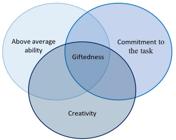

Above Average Ability
This ring refers to the demonstration of above average intellectual abilities. It involves the individual’s ability to perform cognitive tasks in an exceptional manner, such as logical reasoning, complex problem solving, creative thinking, and so on (Renzulli, 1978).
Commitment to the Task
The second ring focuses on the individual’s motivation and involvement in activities related to mastering their skills. Renzulli (1978) argues that true giftedness is not just about having skills, but also having the motivation and passion to apply these skills to challenging tasks.
Creativity
The third ring refers to the ability to generate original, creative, authentic, and relevant ideas, evidenced by fluency and flexibility of thought. For Renzulli (1978), creativity goes beyond art, manifesting itself in different areas and situations of everyday life, and is essential for productive giftedness and the practical application of new ideas.
This three-ring approach demonstrates the complexity of giftedness and emphasizes that true excellence goes beyond purely cognitive abilities, incorporating intrinsic motivation and external support.
Multiple Intelligences by Professor and Psychologist Howard Gardner
The Theory of Multiple Intelligences, proposed by psychologist Howard Gardner (1995), is a model that highlights the diversity of human cognitive abilities, going beyond the traditional view of a single intelligence measured by IQ tests. Gardner first proposed this theory in 1983, and since then it has been an influential approach in the field of educational psychology.
The fundamental premise of the Theory of Multiple Intelligences is that people possess different types of intelligence, which can be grouped into distinct categories. Gardner initially identified seven types of intelligence, and later added one more, for a total of eight. Gardner’s multiple intelligences are:
It is important to point out that, according to Gardner (1995), multiple intelligences are not independent from each other; they are often interconnected and can be combined in complex ways. Furthermore, he argues that traditional education tends to focus predominantly on linguistic and logical-mathematical intelligences, neglecting other forms of cognitive abilities. Therefore, he proposes a more holistic and diversified approach to education, adapting teaching methods to meet the different forms of intelligence present in each individual.
The Theory of Multiple Intelligences has significant implications for educational practice, highlighting the importance of recognizing and cultivating a variety of abilities rather than focusing exclusively on standardized measures of intelligence.
New Approaches and Contributions from Neuroscience
In addition to classical theories, contributions from neuroscience offer new perspectives on giftedness. Neuroimaging studies show that the brains of gifted individuals present more efficient neural connectivity patterns, especially in areas related to critical thinking and creativity (Jung; Haier, 2007). These advances reinforce the need to integrate neuroscientific discoveries into educational practices, providing a more personalized and effective approach to serving students with HA and GT.
Models such as the Dynamic Development model by Dai and Chen (2013) and others suggest that giftedness is an evolving characteristic, dependent on interactions between environment, personality and learning opportunities.
Giftedness should not be seen as static, but as a dynamic process that can manifest itself in different ways. The Positive Disintegration Theory (PDT), proposed by Dabrowski (1970), suggests that as a person reaches higher levels of development, corresponding changes occur in their nervous system. This model emphasizes growth through overcoming crises and emotional breakdowns, leading to higher psychological development (Oliveira et al., 2017).
Brazilian legislation and special education policies provide an important framework for serving students with HA and GT, but there are still gaps to be filled, especially with regard to teacher training and early identification. Classical theoretical approaches, such as those of Renzulli and Gardner, remain innovative, but it is essential that they be complemented by recent discoveries in neuroscience and contemporary models of intelligence in order to offer a more inclusive and effective education for these young people.
Material and methods
This research adopts an observational study critical analysis, of a quantitative nature and retrospective outline, based on public data from the School Census, made available in the Statistical Synopses of the National Institute of Studies and Educational Research Anísio Teixeira (INEP), encompassing the period from 2013 to 2023. The data used were extracted from the INEP open data platform, ensuring the transparency and reproducibility of the research.
The variable of this study was the number of students enrolled in Special Education in Regular Classes, identified as having high abilities and giftedness. The data were grouped according to the geographic regions of Brazil (Central-West, Northeast, North, Southeast and South) and subsequently stratified by state.
The data were collected, tabulated in a Microsoft Excel® spreadsheet. Next, graphs were constructed using the same software. Graphs were constructed to represent the distribution and evolution of enrollments over the years studied.
In addition to descriptive analysis, linear regression was used to identify growth trends over the period studied (2013-2023). The coefficient of determination (R2) was calculated for each region, seeking to assess the accuracy with which the data fit the trend line. This analysis allowed us to identify specific fluctuations, such as the anomaly observed in the Southeast region in 2019, and to infer possible causes for such variations.
A linear regression analysis was performed on the data stratified by geographic region, calculating the coefficient of determination R2 to assess how well the data fit the estimated line, as well as the equation of the line (y=ax+b) in order to understand, based on the analysis of the angular coefficient (a), whether there was a trend of increase (a>0), stability (a=0) or reduction in the number of cases (a<0) over the period analyzed. This study used public domain data, aggregated by region, without identifying the participants. Therefore, it was not mandatory to submit it to the Research Ethics Committee, pursuant article III of Resolution No. 510/2016 of the National Health Council (Brazil, 2016).
Results
In an attempt to understand how the number of enrollments of students with HA and GT in Regular Classes in the country evolved, a study was carried out for the period from 2013 to 2023, with the results presented in Table 01.
Number of total enrollments and of students with HA and GT in regular classes, according to geographic region, 2013-2023
It can be seen from the data presented in Table 01 that the average increase in enrollments varied over time, with significant peaks, and there was a significant fluctuation in the number of enrollments throughout the historical series analyzed in all geographic regions of the country. A significant discrepancy can also be seen in the Southeast region in 2019 (growth of up to 387%) with a significant increase in the number of enrollments of students with registered HA and GT, jumping to 31,212, an increase of more than five times as compared to the previous year. This anomaly suggests the possibility of a data error or a specific event in the national registration process for gifted students, carried out by the Ministry of Education, which temporarily increased enrollments, followed by a subsequent drop in 2020.
The total number of enrollments in Brazil decreased over the period, going from 50,042,448 in 2013, to 47,304,632 in 2023, which represents a drop of approximately 5.5%. This reduction may be related to demographic factors, such as the decrease in the young population, and socioeconomic changes. On the other hand, the number of students identified as having HA and GT increased from 12,149 in 2013, to 37,638 in 2023, showing growth of over 300% in ten years. This increase reflects a significant advance in the identification of these students, possibly the result of efforts to raise awareness in the educational community about the importance of serving these students. The percentage of students with HA and GT also showed significant growth, from 0.02% in 2013, to 0.08% in 2023. However, despite this progress, the percentages are still low, indicating that there is room for improvement in the identification of gifted students in Brazil.
In general, the South and Central-West regions have seen consistent growth, which indicates policies and practices for identifying HA and GT. The regions with the highest growth tend to have a more advanced educational infrastructure, with greater access to resources and training programs for teachers.
In contrast, the Northeast and North had lower percentages of HA and GT, which may reflect difficulties in implementing policies, lack of infrastructure or lack of adequate training to identify these students. These regions with lower growth may face structural challenges, such as lack of adequate training for teachers or shortage of material and human resources.
The low growth in some regions suggests the need for greater investment in the continuing education of teachers. Well-prepared teachers are essential for early identification of students with AD and GT. The disparity in regional trends suggests that policies for identifying AD and GT are being implemented unevenly across Brazil, possibly due to variations in educational resources, teacher training, and government support.
Figure 3 presents these data stratified by region.
The analysis of the graphs in Graphic 01 shows an upward trend in the number of enrollments of students with HA and GT throughout the historical series analyzed, in all regions of the country, which can be proven by the positive angular coefficients of the equations of the linear regression lines presented in each graph.

Graphical representation of the number of enrollments of students with High Abilities and Giftedness in Regular Classes, according to geographic region, 2013-2023

Graphical representation of the number of enrollments of students with High Abilities and Giftedness in Regular Classes, according to geographic region, 2013-2023, except 2019
While the South and Central-West regions show more consistent and progressive growth, the Northeast and North have lower percentages and a slower evolution in the number of enrollments of identified students. The Southeast, despite showing general growth, presented an anomaly in 2019, with a significant increase in the number of enrollments that was not maintained in subsequent years. The number of enrollments of students with HA and GT jumped to 31,212, compared to 6,406 in 2018 (an increase of 387.23% compared to the previous year), with São Paulo accounting for 26,616 (85.27%). However, this anomaly suggests that there was some error or specific event in the registration process, which led to a correction in subsequent years, with a drop to 7,566 in 2020.
The North and Northeast regions, which historically face greater economic and educational challenges, show lower percentages of HA and GT identification, which may reflect the deficiency of specific programs and the lack of adequate infrastructure to serve this population. This has serious implications for educational equity, as the lack of identification and adequate support prevents these students from fully developing their potential, perpetuating regional inequalities.
These variations can be attributed to factors such as educational infrastructure, regional public policies, and teacher training to identify and serve students with HA and GT. The South and Central-West regions, which lead the increase in enrollments, may be reaping the benefits of more consistent local policies and greater availability of resources for teacher training and specialized programs. This implies that early identification and adequate support for these students depend directly on the quality of ongoing teacher training and access to inclusive education programs, factors that greatly vary from one region to another.
More stable and continuous policies can help avoid these peaks of fluctuation. Continued growth is expected for most regions, with some projections being more pronounced, such as in the Southeast, where, after the significant fluctuation in 2019, enrollments continue to increase.
Thus, in order to verify whether the upward trend in the number of enrollments was also confirmed in the Southeast region, a graph was presented for the entire historical series from 2013 to 2023, in which the year 2019 was excluded, due to the discrepancy in the data (figure 04).
The exclusion of 2019 data provided a better adjustment of the linear regression line (R2=0.9002), with the slope coefficient remaining positive, thus confirming the upward trend in the number of cases in the historical series also seen in the Southeast region.
In fact, the Central-West, Northeast, North and South regions also showed fluctuations in the number of students enrolled with HA and GT (a drop in 2020 and 2021 compared to 2019), but apparently with a subsequent recovery trend, since, in 2022 and 2023, there was a further increase in the number of students enrolled with HA and GT throughout the country.
Regional differences suggest that some regions still need greater investment in teacher training and educational infrastructure. Planning needs to take these inequalities into account and provide specific resources for regions that historically have lower rates of HA and GT identification.
The analysis also suggests the need for greater collaboration between the federal government and state and municipal levels to develop strategies that promote early identification in all regions, considering the cultural and socioeconomic specificities of each location. Besides, it is essential to have higher investment in educational and neuroscientific technologies, which can improve the identification of students with HA and GT more efficiently, even in contexts with less infrastructural development.
Discussion
Based on the results presented, an anomaly can be seen in relation to the Southeast region in 2019, with São Paulo accounting for the majority of registered enrollments. These data led other researchers to reflect and seek answers that could explain this discrepant number. According to Brero and Rondini (2022), there are signs of some error in the release of Census data, since, in 2020, standard growth was resumed.
Reliability problems in the data available in the Census had already been pointed out previously, as cited by Souza and Delou (2016), when it was not possible to rely on the data existing up to the year 2008. One of the alternatives to reduce the data discrepancy is the registration of the national registry created by Law No. 13,234 of 2015, which is intended to supply the necessary information by providing identification, registration, and service for students with high abilities or giftedness (Souza; Delou, 2016). Consequently, the creation of this Law contributes to the possibility of cross-referencing data, and with the information generated, the development of awareness-raising actions in schools (Brero; Rondini, 2022).
Early identification of students should occur in a way that stimulates the development of their potential, with a view to ensuring that appropriate conditions are provided, but not by having the child unnecessarily skip stages of their childhood (Martins; Chacon, 2016). Based on this reflection, the importance of the teacher in this identification can be considered (Martins et al., 2020).
It is worth noting that, according to the World Health Organization (WHO), 5% of children and adolescents are in classrooms without their potential being recognized and without the benefit of their rights guaranteed by Brazilian legislation (Cardial, 2021). Furthermore, it is important to mention that, in 2022, 11% of children and adolescents between 11 and 19 years old were out of school in Brazil, representing around 2 million students. The situation is even more serious in economic classes D and E, where this percentage reached 17%, while in classes A and B, this percentage was 4%. (Unicef; Ipec, 2022)
Therefore, understanding the existence of a heterogeneous nature of HA and GT (Costa et al., 2022), it is relevant to report that some teachers, according to Mendonça et al. (2022), even knowing the conditions of these students, still ignored the identification and did not offer enrichment, which is a right of these subjects. Thus, it is important not only to identify but also to monitor students with HA and GT, aiming to obtain more than just data about this population, but also to create strategies that are consistent with the students’ profile (Basso et al., 2020).
It must be pointed out that a student with HA and GT demands a variety of enriching learning experiences that encourage their cognitive, emotional and social development, favoring the full realization of their potential (Fleith, 2007). This is because one of the characteristics of these students is creativity, which must be stimulated in order to develop (Remoli; Capellini, 2017).
It is known that, for the full development of these students’ skills, extracurricular enrichment is necessary, which can be achieved by developing actions in the counter-shift and by adopting pedagogical strategies for intracurricular enrichment, in the classroom (Péres; Freitas, 2011).
Furthermore, a significant change is needed in the education system, starting with the professional training of teachers (Martins et al., 2018), enabling them to identify students with HA and GT and guiding them to enhance their skills, in addition to offering educational support programs for people with HA and GT within regular schools, such as the use of supplementary resource rooms, individual or group guidance programs, development of curricular proposals with in-depth curricular content and supplementary and diversified special activities (Bahinse; Rossetti, 2014). In view of the considerations made, it is clear that in order to work with these students, the teacher needs, in addition to being sensitive, to have love for the profession, dedication, commitment and determination, among other characteristics (Azevedo; Mettau, 2010), but also dedicated to ongoing training to provide excellent service. It is noted that, sometimes, parents are unaware of what schools offer their children and how much the family can offer in terms of additional development activities, and there are schools that do not carry out differentiated activities for these students, activities that could benefit the entire class (Mendonça et al., 2022).
When these students with HA and GT are children, it should be borne in mind that the stimuli and incentives required for the full development of potential and skills cannot be separated from the care that ensures that the child enjoys their childhood, having time to play and being able to behave like any other child of the same age, always keeping in mind that a precocious child is, above all, a child (Martins; Chacon, 2016). Furthermore, despite the theoretical disagreements involving precocity and HA and GT, in practice, schools need to be prepared to meet the needs that encompass the development of talents at any age (Braz; Rangni, 2021).
It is also observed that children with HA and GT often suffer throughout their lives with mental and relationship problems and a feeling of not belonging due to the lack of diagnosis and care from specialists and, sometimes, indifference in schools (Cardial, 2021). Other times, these children are questioned by their own schools and peers whether they really have the HA and GT profile when they get an exercise wrong or when they are required to know things that have not yet been taught. It is important to be clear that the HA and GT profile brings with it an unparalleled ease in learning, not knowledge, especially before it has been taught (Virgolin, 2007). In this sense, these students may experience bullying situations, both as victims and as aggressors and witnesses, with the act of “teasing”/humiliating, gossiping/scheming, throwing objects and excluding children from games being present, with most of these behaviors manifested in a veiled way, which makes it difficult to identify these actions, requiring a more attentive look from the adult (Dalosto; Alencar, 2013). In view of the above considerations, it is clear how important it is to develop different actions to address this issue and improve the general scenario, such as, for example, i) including a module to work on the topic of HA and GT in training courses for specialized educational services, offered by the Ministry of Education (MEC), with guidance from the Centers for Activities of High Abilities and Giftedness (Naah-s), which are projects that aim to improve services for students with high abilities or giftedness in public schools, given that the deficiencies, both in initial education and in the continuing training of teachers, are as profound or even more profound in relation to this topic than in the area of disability; ii) including content and subjects in undergraduate courses, particularly in teaching degrees; and iii) providing opportunities to serve these students, considering the specificity of their particular interests (Pérez; Freitas, 2011). In addition to undergraduate degrees, psychology, although it already contributes significantly to the themes of HA and GT, Special Education and Inclusive Education, still requires more research that can disseminate knowledge in these fields. Academic production in this discipline must advance, especially by relating the themes of Special Education, Inclusion and HA and GT in a more integrated way, in order to broaden the understanding and development of educational and psychological practices (Oliveira et al., 2020). From the above, it is clear that, despite the upward trend in the number of enrollments of students with HA and GT, throughout the historical series analyzed (2013 to 2023), in all five regions of the country, there is still much to progress, not only in identifying such subjects but also in creating measures that enable actions that can enhance the process of construction of knowledge of these students so that they reach their maximum potential, without having to skip steps to escape bullying or to seek new challenges, preventing these children from enjoying a satisfactory, healthy school experience or remaining with the feeling of inadequacy or not belonging.
Conclusion
Given the above, there has been a noticeable increase in the number of students with HA and GT enrolled in basic education in Brazil, especially in recent decades. This growth reflects a greater awareness of the need to identify these students early in order to provide adequate support. However, despite the progress, there are still significant gaps in teacher training, implementation of effective policies, and equitable inclusion in all regions of the country.
Practical implications suggest the need for robust planning to ensure that education systems are prepared to meet this growth. This includes not only expanding early identification policies, but also creating specialized programs to ensure that these students receive the necessary support to reach their full potential.
The discrepancy observed between regions, particularly the anomalous growth in the Southeast region in 2019, reveals the need for improvements in data collection and verification mechanisms. In addition, it is urgent to create pedagogical strategies that contemplate both curricular and extracurricular enrichment, ensuring the comprehensive development of these students.
Regional variations highlight that while Brazil has made progress in identifying students with disabilities and disabilities, there is still a long way to go to ensure that all students have equitable access to development opportunities. Differences in the quality of teacher training and infrastructure across regions reinforce the importance of more inclusive policies and strategies that consider local needs, ensuring that all students with disabilities and disabilities can be identified and supported effectively.
Future studies should focus on exploring the causes of regional disparities and developing more effective methods for identifying and monitoring students with disabilities and disabilities. Integrating neuroscientific advances with inclusive educational practices will be essential to maximize the potential of these individuals and promote their full inclusion in society.
Acknowledgements:
We are grateful to the Tutorial Education Program of the Ministry of Education, the National Fund for the Development of Education (FNDE) and Fapemig (project APQ-04955-23) for their support in the development of this work.
Data availability:
The entire dataset supporting the results of this study was made available in the Statistical Synopses of the National Institute of Studies and Educational Research Anísio Teixeira (INEP) and can be accessed at https://www.gov.br/inep/pt-br/acesso-a-informacao/dados-abertos/sinopses-estatisticas/educacao-basica.
References
-
ALMEIDA, Maria Amélia; CAPELLINI, Vera Lúcia Messias Fialho. Alunos talentosos: possíveis superdotados não notados. Educação, Porto Alegre, v. 28, n. 1, p. 45-64, 2005. Disponível em: https://revistaseletronicas.pucrs.br/ojs/index.php/faced/article/view/404 Acesso em: 30 ago. 2023.
» https://revistaseletronicas.pucrs.br/ojs/index.php/faced/article/view/404 -
ANTIPOFF, Cecília Andrade; CAMPOS, Regina Helena de Freitas. Superdotação e seus mitos. Psicologia Escolar e Educacional, São Paulo, v. 14, n. 2, p. 301-309, jul./dez. 2010. https://doi.org/10.1590/S1413-85572010000200012 Disponível em: https://www.scielo.br/j/pee/a/cFcPTS7QRGqk9mKZsW5tWVz Acesso em: 10 out. 2023.
» https://doi.org/10.1590/S1413-85572010000200012» https://www.scielo.br/j/pee/a/cFcPTS7QRGqk9mKZsW5tWVz -
AZEVEDO, Sonia Maria Lourenço de; METTRAU, Marsyl Bulkool. Altas habilidades/superdotação: mitos e dilemas docentes na indicação para o atendimento. Psicologia: Ciência e Profissão, Brasília, DF, v. 30, n. 1, p. 32-45, 2010. Disponível em: http://pepsic.bvsalud.org/scielo.php?script=sci_arttext&pid=S1414-98932010000100004&lng=pt&nrm=iso&tlng=pt Acesso em: 10 out. 2023.
» http://pepsic.bvsalud.org/scielo.php?script=sci_arttext&pid=S1414-98932010000100004&lng=pt&nrm=iso&tlng=pt -
BAHIENSE, Taisa Rodrigues Smarssaro; ROSSETTI, Claudia Broetto. Altas habilidades/superdotação no contexto escolar: percepções de professores e prática docente. Revista Brasileira de Educação Especial, Marília, v. 20, n. 2, p. 195-208, abr./jun. 2004. https://doi.org/10.1590/S1413-65382014000200004 Disponível em: http://educa.fcc.org.br/scielo.php?script=sci_arttext&pid=S1413-65382014000200004&lng=en&nrm=iso Acesso em: 31 ago. 2023.
» https://doi.org/10.1590/S1413-65382014000200004» http://educa.fcc.org.br/scielo.php?script=sci_arttext&pid=S1413-65382014000200004&lng=en&nrm=iso -
BARROS, Bruna Louzeiro de Aguiar; FREIRE, Sandra Ferraz de Castillo Dourado. Desafios na escolarização da criança com altas habilidades/superdotação: um estudo de caso. Revista Educação Especial, Santa Maria, v. 28, n. 53, p. 709-720, set./dez. 2015. https://doi.org/10.5902/1984686X14479 Disponível em: https://periodicos.ufsm.br/educacaoespecial/article/view/14479 Acesso em: 31 ago. 2023.
» https://doi.org/10.5902/1984686X14479» https://periodicos.ufsm.br/educacaoespecial/article/view/14479 -
BASSO, Eduarda; RIECHI, Tatiana Izabele Javorski de Sá; MOREIRA, Laura Ceretta; VEIGA, Elizabeth Carvalho da. Identificação de estudantes com altas habilidades/superdotação no ensino superior. Revista Brasileira de Educação Especial, Marília, v. 26, n. 3, p. 453-464, jul./set. 2020. https://doi.org/10.1590/1980-54702020v26e0147 Disponível em: https://www.scielo.br/j/rbee/a/NYTWRyzvcHxYPQLVB6qcRtj/?lang=pt Acesso em: 31 ago. 2023.
» https://doi.org/10.1590/1980-54702020v26e0147» https://www.scielo.br/j/rbee/a/NYTWRyzvcHxYPQLVB6qcRtj/?lang=pt -
BRASIL. [Constituição (1988)]. Constituição da República Federativa do Brasil: texto constitucional promulgado em 5 de outubro de 1988, com as alterações determinadas pelas Emendas Constitucionais de Revisão nº 1 a 6/94, pelas Emendas Constitucionais nº 1/92 a 91/2016 e pelo Decreto Legislativo nº 186/2008. Brasília, DF: Senado Federal: Secretaria de Editoração e Publicações, Coordenação de Edições Técnicas, 2016. Disponível em: https://www2.senado.leg.br/bdsf/bitstream/handle/id/518231/CF88_Livro_EC91_2016.pdf Acesso em: 29 ago. 2023.
» https://www2.senado.leg.br/bdsf/bitstream/handle/id/518231/CF88_Livro_EC91_2016.pdf -
BRASIL. Casa Civil. Subchefia para Assuntos Jurídicos. Lei nº 9.394, de 20 de dezembro de 1996. Estabelece as diretrizes e bases da educação nacional. Diário Oficial da União, Brasília, DF, seção 1, ano 134, n. 248, p. 1-9, 23 dez. 1996. Disponível em: http://portal.mec.gov.br/seesp/arquivos/pdf/lei9394_ldbn1.pdf Acesso em: 29 ago. 2023.
» http://portal.mec.gov.br/seesp/arquivos/pdf/lei9394_ldbn1.pdf -
BRASIL. Ministério da Educação. Conselho Nacional de Educação (CNE). Resolução CNE/CEB n.º 2, de 11 de setembro de 2001. Institui Diretrizes Nacionais para a Educação Especial na Educação Básica. Diário Oficial da União, Brasília, DF, seção 1, ano 125, n. 177, p. 39-40, 14 set. 2001. Disponível em: http://portal.mec.gov.br/cne/arquivos/pdf/CEB0201.pdf Acesso em: 29 ago. 2023.
» http://portal.mec.gov.br/cne/arquivos/pdf/CEB0201.pdf -
BRASIL. Ministério da Educação. Secretaria de Educação Especial. Grupo de Trabalho da Política Nacional de Educação Especial. Política Nacional de Educação Especial na perspectiva da educação inclusiva. Brasília, DF: Ministério da Educação: Secretaria de Educação Especial, 2008. Disponível em: http://portal.mec.gov.br/arquivos/pdf/politicaeducespecial.pdf Acesso em: 29 ago. 2023.
» http://portal.mec.gov.br/arquivos/pdf/politicaeducespecial.pdf -
BRASIL. Ministério da Saúde. Conselho Nacional de Saúde (CNS). Resolução n.º 510, de 07 de abril de 2016. Diário Oficial da União, Brasília, DF, seção 1, ano 153, n. 98, p. 44, 24 maio 2016. Disponível em: https://www.in.gov.br/web/dou/-/resolucao-n-510-de-7-de-abril-de-2016-22917558 Acesso em: 29 ago. 2023.
» https://www.in.gov.br/web/dou/-/resolucao-n-510-de-7-de-abril-de-2016-22917558 -
BRASIL. Ministério da Educação. Secretaria de Modalidades Especializadas de Educação. PNEE: Política Nacional de Educação Especial: Equitativa, Inclusiva e com Aprendizado ao Longo da Vida/Secretaria de Modalidades Especializadas de Educação - Brasília, DF: MEC: Semesp, 2020. 124 p. Disponível em: https://www.gov.br/mec/pt-br/assuntos/noticias/mec-lanca-documento-sobre-implementacao-da-pnee-1/pnee-2020.pdf Acesso em: 06 out. 2023.
» https://www.gov.br/mec/pt-br/assuntos/noticias/mec-lanca-documento-sobre-implementacao-da-pnee-1/pnee-2020.pdf -
BRAZ, Paula Paulino; RANGNI, Rosemeire de Araújo. Enriquecimento para um aluno com altas habilidades/superdotação na educação infantil. Revista Brasileira de Estudos Pedagógicos, Brasília, DF, v. 102, n. 262, p. 802-820, set./dez. 2021. https://doi.org/10.24109/2176-6681.rbep.102i262.4448 Disponível em: http://rbep.inep.gov.br/ojs3/index.php/rbep/article/view/4448 Acesso em: 31 ago. 2023.
» https://doi.org/10.24109/2176-6681.rbep.102i262.4448» http://rbep.inep.gov.br/ojs3/index.php/rbep/article/view/4448 -
BRERO, José Guilherme Degásperi; RONDINI, Carina. Subnotificação censitária de estudantes com altas habilidades/superdotados 2020: desorganização ou descaso? Revista Teias, Rio de Janeiro, v. 23, n. 71, p. 476-486, out./dez. 2022. https://doi.org/10.12957/teias.2022.65416 Disponível em: https://www.e-publicacoes.uerj.br/index.php/revistateias/article/view/65416 Acesso em: 31 ago. 2023.
» https://doi.org/10.12957/teias.2022.65416» https://www.e-publicacoes.uerj.br/index.php/revistateias/article/view/65416 -
CARDIAL, Karen. O deleite e as dores da superdotação. Revista Educação, Porto Alegre, ed. 280, 18 nov. 2021. Disponível em: https://revistaeducacao.com.br/2021/11/18/deleite-e-dores-superdotacao/ Acesso em: 10 mai. 2023.
» https://revistaeducacao.com.br/2021/11/18/deleite-e-dores-superdotacao/ -
COSTA, Maria da; BIANCHI, Alessandra Sant’Anna; SANTOS, Márcia Melo de Oliveira. Características de crianças com altas habilidades/superdotação: uma revisão sistemática. Revista Brasileira de Educação Especial, Bauru, v. 28, e0121, p. 71-88, 2022. https://doi.org/10.1590/1980-54702022v28e0121 Disponível em: https://www.scielo.br/j/rbee/a/JHyhvxdYRZ4jnDs3JL3gHmG/?lang=pt Acesso em: 31 ago. 2023.
» https://doi.org/10.1590/1980-54702022v28e0121» https://www.scielo.br/j/rbee/a/JHyhvxdYRZ4jnDs3JL3gHmG/?lang=pt -
CUPERTINO, Christina Menna Barreto; ARANTES, Denise Rocha Belfort (org.). Um olhar para as altas habilidades: construindo caminhos. 2. ed. rev. atual. ampl. São Paulo: Secretaria da Educação do Estado de São Paulo, 2012. Disponível em: http://cape.edunet.sp.gov.br/cape_arquivos/Um_Olhar_Para_As_Altas_habilidades_2°_Edição.pdf Acesso em: 29 ago. 2023.
» http://cape.edunet.sp.gov.br/cape_arquivos/Um_Olhar_Para_As_Altas_habilidades_2°_Edição.pdf - DABROWSKI, Kazimierz. Desenvolvimento positivo e acelerado. In: DABROWSKI, Kazimierz; KAWCZAK, Andrzej; PIECHOWSKI, Michael Marian (ed.). Mental growth through positive disintegration. London: Gryf, 1970. p. 27-61.
-
DAI, David Yun; CHEN, Feiyan. Paradigms of gifted education: a guide to theory-based, practice-focused research. Roeper Review, v. 35, n. 4, p. 224-235, 2013. https://doi.org/10.1080/02783193.2014.945142
» https://doi.org/10.1080/02783193.2014.945142 -
DALOSTO, Marcília de Morais; ALENCAR, Eunice Maria Lima Soriano de. Manifestações e prevalência de bullyng entre alunos com altas habilidades/superdotação. Revista Brasileira de Educação Especial, Marília, v. 19, n. 3, p. 363-378, jul./set. 2013. https://doi.org/10.1590/S1413-65382013000300005 Disponível em: https://www.scielo.br/j/rbee/a/x3myhg9PbbqtfzLXSGB6s5J/?lang=pt Acesso em: 31 ago. 2023.
» https://doi.org/10.1590/S1413-65382013000300005» https://www.scielo.br/j/rbee/a/x3myhg9PbbqtfzLXSGB6s5J/?lang=pt -
FLEITH, Denise de Souza. Conceitos e práticas na educação de alunos com altas habilidades/superdotação. Revista Brasileira de Educação Especial, Marília, v. 13, n. 3, p. 479-480, set./dez. 2007. https://doi.org/10.1590/S1413-65382007000300012 Disponível em: https://www.scielo.br/j/rbee/a/Wv9ttZThDHVGDQcsXc3pwVF/?lang=pt Acesso em: 31 ago. 2023.
» https://doi.org/10.1590/S1413-65382007000300012» https://www.scielo.br/j/rbee/a/Wv9ttZThDHVGDQcsXc3pwVF/?lang=pt - GARDNER, H. Inteligências múltiplas: a teoria na prática. Tradução de: VERONESE, M. A. V. Porto Alegre: Artes Médicas, 1995.
-
INEP. Instituto Nacional de Estudos e Pesquisas Educacionais Anísio Teixeira. Educação básica: sinopses estatísticas da educação básica. [2013 a 2023]. Brasília, DF: INEP, 2024. Disponível em: https://www.gov.br/inep/pt-br/acesso-a-informacao/dados-abertos/sinopses-estatisticas/educacao-basica Acesso em: 22 fev. 2024.
» https://www.gov.br/inep/pt-br/acesso-a-informacao/dados-abertos/sinopses-estatisticas/educacao-basica -
JUNG, Rex Eugene.; HAIER, Richard. The parieto-frontal integration theory (P-FIT) of intelligence: converging neuroimaging evidence. Behavioral and Brain Sciences, v. 30, n. 2, p. 135-154, 2007. https://doi.org/10.1017/S0140525X07001185
» https://doi.org/10.1017/S0140525X07001185 -
MARTINS, Bárbara Amaral; CHACON, Miguel Claudio Moriel. Características de altas habilidades/superdotação em aluno precoce: um estudo de caso. Revista Brasileira de Educação Especial, Marília, v. 22, n. 2, p. 189-202, abr./jun. 2016. https://doi.org/10.1590/S1413-65382216000200004 Disponível em: https://www.scielo.br/j/rbee/a/XRPqczKXJt8ff6NschDcQ9R/?lang=pt Acesso em: 31 ago. 2023.
» https://doi.org/10.1590/S1413-65382216000200004» https://www.scielo.br/j/rbee/a/XRPqczKXJt8ff6NschDcQ9R/?lang=pt -
MARTINS, Bárbara. Amaral; CHACON, Miguel Claudio. Moriel. Identificação de estudantes precoces com indicadores de altas habilidades/superdotação no Pantanal Sul-Mato-Grossense. Educar em Revista, Curitiba, v. 39, p. e73266, 2023. https://doi.org/10.1590/1984-0411.73266
» https://doi.org/10.1590/1984-0411.73266 -
MARTINS, Bárbara Amaral; CHACON, Miguel Claudio Moriel; ALMEIDA, Leandro da Silva. Altas habilidades/superdotação na formação de professores brasileiros e portugueses: um estudo comparativo entre os casos da UNESP e da UMINHO. Educação em Revista, Belo Horizonte, v. 36, e212442, 2020. https://doi.org/10.1590/0102-4698212442 Disponível em: https://www.scielo.br/j/edur/a/PDbfzckQWGXym3kSxTBHv5h/?lang=pt Acesso em: 31 ago. 2023.
» https://doi.org/10.1590/0102-4698212442» https://www.scielo.br/j/edur/a/PDbfzckQWGXym3kSxTBHv5h/?lang=pt -
MARTINS, Bárbara Amaral; CHACON, Miguel Claudio Moriel; ALMEIDA, Leandro da Silva. Estudo comparativo luso-brasileiro sobre a formação inicial de professores em altas habilidades/superdotação com enfoque nos conteúdos curriculares. Revista Brasileira de Educação Especial, Marília, v. 24, n. 3, p. 309-326, jul./set. 2018. https://doi.org/10.1590/S1413-65382418000300001 Disponível em: https://www.scielo.br/j/rbee/a/BjsNxNZfz4yBkQMsWkT9GSB/?lang=pt Acesso em: 31 ago. 2023.
» https://doi.org/10.1590/S1413-65382418000300001» https://www.scielo.br/j/rbee/a/BjsNxNZfz4yBkQMsWkT9GSB/?lang=pt -
MENDONÇA, Lurian Dionizio; CAPELLINI, Lurian Dionizio; RODRIGUES, Olga Maria Piazentin Rolim. Atividades de enriquecimento vivenciadas por estudantes com altas habilidades/superdotação. Revista Brasileira de Educação Especial, Bauru, v. 27, e270127, p. 1-26, 2022. https://doi.org/10.1590/S1413-24782022270127 Disponível em: https://www.scielo.br/j/rbedu/a/sxgFxD3S7x65ktgPS46KVkJ/?lang=pt Acesso em: 31 ago. 2023.
» https://doi.org/10.1590/S1413-24782022270127» https://www.scielo.br/j/rbedu/a/sxgFxD3S7x65ktgPS46KVkJ/?lang=pt -
NAKANO, Tatiana de Cassia. Diferentes expressões das altas habilidades/superdotação e sua aplicação social: superdotação transformacional, transacional, inerte e tóxica. Revista Brasileira de Altas Habilidades/Superdotação, v. 5 n. 2. 2023. Disponível em: https://ojsconbra.conbrasd.org/index.php/revista/article/view/40/40 Acesso em: 19 set. 2024.
» https://ojsconbra.conbrasd.org/index.php/revista/article/view/40/40 -
OLIVEIRA, Ana Paula de; RODRIGUES, Olga Maria Piazentin Rolim; CAPELLINI, Vera Lucia Messias Fialho. Altas habilidades/superdotação no ensino superior: análise de dissertações e teses brasileiras. Psicologia Escolar e Educacional, v. 24, e. 193985, 2020. https://doi.org/10.1590/2175-35392020193985
» https://doi.org/10.1590/2175-35392020193985 -
OLIVEIRA, Juliana Celia de; BARBOSA, Altemir José Gonçalves; ALENCAR, Eunice Maria Lima Soriana de. Contribuições da teoria da desintegração positiva para a área de superdotação. Psicologia: Teoria e Pesquisa, Brasília, DF, v. 33, p. e 3332, 2017. http://dx.doi.org/10.1590/0102.3772e3332 Disponível em: https://www.scielo.br/j/ptp/a/mmVxpcHKnbZhcY6mh6JKFwL/abstract/?lang=pt#. Acesso em: 20 set. 2024.
» http://dx.doi.org/10.1590/0102.3772e3332» https://www.scielo.br/j/ptp/a/mmVxpcHKnbZhcY6mh6JKFwL/abstract/?lang=pt -
PÉREZ, Susana Graciela Pérez Barrera; FREITAS, Soraia Napoleão. Encaminhamentos pedagógicos com alunos com altas habilidades/superdotação na educação básica: o cenário Brasileiro. Educar em Revista, Curitiba, n. 41, p. 109-124, jul./set. 2011. https://doi.org/10.1590/S0104-40602011000300008 Disponível em: https://www.scielo.br/j/er/a/hv87YLFWx6BGY7C8JCNqWjP/?lang=pt Acesso em: 31 ago. 2023.
» https://doi.org/10.1590/S0104-40602011000300008» https://www.scielo.br/j/er/a/hv87YLFWx6BGY7C8JCNqWjP/?lang=pt -
PFEIFFER, Steven I. Modelo tripartite de superdotação e melhores práticas em avaliação de superdotados. Revista de Educação, Madrid, n. 368, p. 61-87, 2015. https://doi.org/10.4438/1988-592X-RE-2015-368-293
» https://doi.org/10.4438/1988-592X-RE-2015-368-293 -
PINHEIRO, Leandro da Nóbrega. A invisibilidade dos estudantes com características de altas habilidades/superdotação, na realidade educacional brasileira, com base em suas perspectivas. Revista da Escola De Enfermagem da USP, v. 31 n. 2, p. 92-109, 2021. Disponível em: https://www.revistas.usp.br/reeusp/article/view/191630 Acesso em: 19 nov. 2023.
» https://www.revistas.usp.br/reeusp/article/view/191630 -
REMOLI, Taís Crema; CAPELLINI, Vera Messias Fialho. Relação entre criatividade e altas habilidades/superdotação: uma análise crítica das produções de 2005 a 2015. Revista Brasileira de Educação Especial, Marília, v. 23, n. 3, p. 455-470, jul./set. 2017. https://doi.org/10.1590/S1413-65382317000300010 Disponível em: https://www.scielo.br/j/rbee/a/qXNfdBxLcXhjtqcfQVNhNfx/?lang=pt Acesso em: 31 ago. 2023.
» https://doi.org/10.1590/S1413-65382317000300010» https://www.scielo.br/j/rbee/a/qXNfdBxLcXhjtqcfQVNhNfx/?lang=pt -
RENZULLI, Joseph Salvatore. O que é esta coisa chamada Superdotação, e como a desenvolvemos? Uma retrospectiva de vinte e cinco anos. Educação, Porto Alegre, v. 27, n. 1(52), p. 75-131, jan./abr. 2004. Disponível em: https://www.marilia.unesp.br/Home/Extensao/papah/o-que-e-esta-coisa-chamada-superdotacao.pdf Acesso em: 30 set. 2024.
» https://www.marilia.unesp.br/Home/Extensao/papah/o-que-e-esta-coisa-chamada-superdotacao.pdf - RENZULLI, Joseph Salvatore. What makes giftedness? Re-examining a definition. Phi Delta Kappan, n. 60, p. 180-184, 1978.
-
SOUZA, Cecília Vanessa Alexandre de; DELOU, Cristina Maria Carvalho. Identificação de altas habilidades ou superdotação no censo escolar brasileiro: subnotificação? In: CONGRESSO INTERNACIONAL DE EDUCAÇÃO ESPECIAL E INCLUSIVA, 1. 2016, Marília; JORNADA DE EDUCAÇÃO ESPECIAL, 13., 2016, Marília. Anais [...]. Marília: Unesp, 2016. 5 f. Disponível em: http://jee.marilia.unesp.br/jee2016/cd/arquivos/108841.pdf Acesso em: 29 ago. 2023.
» http://jee.marilia.unesp.br/jee2016/cd/arquivos/108841.pdf -
STERNBERG, Robert J. Superdotação transformacional: repensando nosso paradigma para a educação de superdotados. Roeper Review, v. 42, n. 4, p. 230-240, 2020. https://doi.org/10.1080/02783193.2020.18152
» https://doi.org/10.1080/02783193.2020.18152 -
UNICEF. Fundo das Nações Unidas para a Infância; IPEC. Inteligência em Pesquisa e Consultoria Estratégica. Educação brasileira em 2022 - a voz de adolescentes. [S. l.]: IPEC, 2022. Disponível em: https://www.unicef.org/brazil/media/20186/file/educacao-em-2022_a-voz-de-adolescentes.pdf Acesso em: 29 ago. 2023.
» https://www.unicef.org/brazil/media/20186/file/educacao-em-2022_a-voz-de-adolescentes.pdf -
VIRGOLIM, Angela M. R. Altas habilidades/superdotação: encorajando potenciais. Brasília: DF, Ministério da Educação, Secretaria de Educação Especial, 2007. Disponível em: http://portal.mec.gov.br/seesp/arquivos/pdf/altashab1.pdf Acesso em: 31 ago. 2023.
» http://portal.mec.gov.br/seesp/arquivos/pdf/altashab1.pdf
-
Editor: Profa. Dra. Mônica Caldas Ehrenberg

 Source: Own elaboration
 Source: Prepared by the author.
 Source: Prepared by the author.
 Source: Prepared by the authors.