
 The training of social educators from Rio de Janeiro: between social representations and Social Pedagogy
Abstract
This research investigates the presence of social representations among social educators in an extension course at a public university in Rio de Janeiro. The Postdoctoral research in Educational Sciences aimed to understand how these social representations interfere in the formative processes, articulating the results with Baptista's (2005) concept of hospitality in Social Pedagogy. Using the psychosocial approach of Doise (2001) and Moscovici (2003), the research was carried out in the phenomenological-interpretative paradigm (Marques; Amendoeira, 2020) with 26 social educators participating in the continuing education course in Social Pedagogy. Their portfolios and forms were analyzed based on rhetorical-philosophical discourse analysis. The results indicate the presence of social representations with a figurative core in "School", covering themes such as school education, expanded teacher training, non-school educational practices, the role of the social educator, and subjects impoverished by their practices.
Keywords
social representations; Social Pedagogy; training; social educators.
Resumo
Esta investigação buscou averiguar a presença de representações sociais entre educadores sociais em um curso de extensão em uma universidade pública no Rio de Janeiro. A pesquisa de pós-doutorado em Ciências da Educação objetivou entender como essas representações sociais interferem nos processos formativos, articulando os resultados com o conceito de hospitalidade de Baptista (2005) na Pedagogia Social. Utilizando a abordagem psicossocial de Doise (2001) e Moscovici (2003), a pesquisa foi realizada no paradigma fenomenológico-interpretativo (Marques; Amendoeira, 2020) com 26 educadores sociais participantes do curso de formação continuada em Pedagogia Social. Seus portfólios e formulários foram analisados a partir da análise retórico-filosófica do discurso. Os resultados indicam a presença de representações sociais com núcleo figurativo sobre “Escola”, abrangendo temas como educação escolar, formação docente ampliada, práticas educativas não escolares, função do educador social e sujeitos empobrecidos de suas práticas.
Palavras-chave
Representações Sociais; Pedagogia Social; formação; educadores sociais.
Resumen
Este trabajo buscó investigar la presencia de representaciones sociales entre educadores sociales en un curso de extensión en una universidad pública de Río de Janeiro. La investigación postdoctoral en Ciencias de la Educación tuvo como objetivo comprender cómo estas representaciones sociales interfieren en los procesos formativos, articulando los resultados con el concepto de hospitalidad en la Pedagogía Social de Baptista (2005). Utilizando el enfoque psicosocial de Doise (2001) y Moscovici (2003), la investigación se realizó en el paradigma fenomenológico-interpretativo (Marques; Amendoeira, 2020) con 26 educadores sociales participantes del curso de formación continua en Pedagogía Social. Se analizaron sus portafolios y formas mediante el análisis del discurso retórico-filosófico. Los resultados indican la presencia de representaciones sociales con un núcleo figurativo en “Escuela”, abarcando temas como la educación escolar, la formación ampliada de profesores, las prácticas educativas no escolares, el papel del educador social y los sujetos empobrecidos por sus prácticas.
Palabras clave
representaciones sociales; Pedagogía Social; formación; educadores sociales.
1 Introduction
This article, the result of a post-Doctoral internship in Educational Sciences, aimed to investigate the existence of social representations among social educators undergoing training in an extension course at a public university in the state of Rio de Janeiro, Brazil, and to understand how the concept of hospitality, developed by Social Pedagogy, can be articulated with the contents of these representations, contributing to the future teaching training of social educators in Rio de Janeiro.
1.1 The formation of the social educator: a relevant research issue in Brazilian Education
In Brazil, there is no single and mandatory training for social educators. Since the end of the 20th century, the discussion on education has been based on the 1988 Constitution of the Federative Republic of Brazil (CRFB), which establishes education as a right for all and a duty of the State, family and society (Brasil, 1988, art. 205) Constitutional Amendment No. 108, of 2020, reinforces that the right to education in the country is carried out “throughout life”.
Therefore, the legislation understands that education must be integral, covering formal, non-formal and informal educational spaces. Social Education is guaranteed as a right and must be conducted by qualified professionals. However, profiling social educators is challenging due to the diversity of administrative specifications and reflections on their own work.
Authors such as Caliman (2010), Garrido, Grau and Sedano (2001) and Romans, Petrus and Trilla (2003) highlight the difficulty of defining the functions and organization of the work of social educators in Brazil, due to their multidisciplinary configuration, the lack of clarity about the limits of action and the relationships established with vulnerable groups. This situation fuels a continuous discussion about the recognition of the profession. The definition of specific and compulsory training is decisive, but depends on the implementation of mandatory national legislation.
In January 2009, social educators were recognized by the Ministry of Labor as a professional occupation and included in the Brazilian Classification of Occupations (CBO) under code 5153-05. However, national regulation with the status of “profession” depends on specific legislation to be passed by Congress and sanctioned by the president of the republic.
On June 3, 2009, Bill No. 5,346 was presented to create the profession of social educator in Brazil, based on the Law of Guidelines and Bases of National Education (LDBEN) of 1996. The proposal aimed to: (1) define their fields of action, (2) establish specific training and minimum education; and (3) organize public positions and career plans. There was, however, discontent among social educators due to the requirement of High School as a minimum education. According to Natali and Müller (2024) and Souza and Müller (2024), this bill does not meet the demands of Brazilian Social Education and devalues its professional.
On June 1, 2015, Bill No. 328, proposed by Senator Telmário Mota, sought to regulate the profession of social educator. Its main characteristics were: (1) to expand performance within and outside the school context; (2) to create public positions; (3) to require minimum higher education training; and (4) to define specific attributions. This project, however, was not accepted by high school social educators, claiming the lack of time to adapt to the new model, which could cause a collapse in the service of Social Education, especially in the interior of the country.
In 2019, the same senator presented a new wording for Bill No. 2,941, proposing higher education for social educators, but recognizing the "notorious knowledge" of those who already practice the profession with High School. These professionals will have ten years to qualify after the enactment of this law. Although still without consensus, the bill is seen as the most viable alternative and has been in progress in the Chamber of Deputies since November 1, 2023.
Concluding this part of the discussion, three important points can be highlighted about the relationship between the training of social educators and the constitution of their professionalism: (1) the regulation of the profession will contribute to the definition of the minimum training of social educators at the national level; (2) from the regulation, a specific and common code of ethics of the profession can be constituted, contributing to the quality of work and the protection of the rights of those served; and (3) regulation is essential to establish a national wage floor, strengthening the organization and defense of social educators through unions.
1.2 The problem posed in the National Curriculum Guidelines (DCN) for the training of social educators in undergraduate courses in the country
Based on the lack of consensus on the training of social educators in the Brazilian context, these professionals often opt for undergraduate courses in Human Sciences, especially Pedagogy, for their initial training. However, this has become problematic, since the DCNs that regulate these courses have begun to reduce reflections on non-school educational practices in their curricula, increasingly focusing on school curricular contents.
Following the logic of the 1988 CRFB on education, the 1996 LDBEN expands the concept of “teaching” beyond schools and includes non-school educational practices. Its article 3 highlights the importance of these practices, mentioning terms such as “out-of-school experiences” and “lifelong learning”. Thus, teaching should include reflection on the specific practices of educational situations outside school.
The 2006 DCN for the degree in Pedagogy, in accordance with the 1996 LDBEN, highlighted the training of educators for school and non-school contexts. They emphasized skills such as planning, executing and evaluating non-school educational projects and promoting learning at different stages of human development (Brasil, 2006). Pedagogy should prepare future pedagogues to contribute to the development of people, organizations and society and the integration between theory and practice would be promoted through internships, providing professional experience in various environments (Brasil, 2006).
The 2015 DCN for undergraduate degrees in Basic Education maintained the discussion about school and non-school environments in teacher education. The document recognized that education occurs in different contexts, such as family life, work and social movements (Brasil, 2015). It highlighted the importance of non-school educational practice in the training of pedagogues and other undergraduate courses, promoting training aligned with the Brazilian social reality. In addition, it emphasized the need for an interdisciplinary curriculum and the appreciation of all education professionals, ensuring their training and working conditions (Brasil, 2015).
From the second half of the 21st century, reality began to change. The 2019 DCNs for initial teacher education for Basic Education represented a setback in non-school educational practices, focusing on the 2018 National Common Curricular Base (BNCC) and excluding important terms such as “non-school spaces” and “diversity in the modalities of the educational process”. This resulted in the understanding of a more restricted teacher education, prioritizing formal school education and neglecting other socio-educational spaces. Although formal school education is crucial to combat Brazilian social exclusion, the 2019 DCN did not favor dialogue with the educational processes of vulnerable social groups, essential for more inclusive human development.
Some authors criticized the 2019 DCN for teacher education in Brazil. Portelinha (2021) pointed out the excessive emphasis on specific content and the disconnect between theory and practice in training to cover other socio-educational spaces. Ferreira and Cortela (2024) highlighted that the guidelines were prescriptive and did not encourage continuing education outside the school environment. Marques et al. (2021) observed a decrease in theoretical approaches and fundamentals of education aimed at the various educational contexts of society, impairing the training of broader reflective teachers. Fonseca and Lima (2024) stated that the changes negatively standardized training, especially in the Pedagogy course, limiting the development of critical and human skills.
Thus, since the criticisms of these authors, it is understood that the DCN of 2019, focused on school education, contributed to make social education practices invisible. The lack of reflection on non-school educational practices makes it difficult for social educators to be included in undergraduate degrees, leading them to seek parallel training of questionable quality and courses that do not offer essential pedagogical content for their socio-educational work.
Finally, the Resolution of the National Council of Education and Full Council (CNE/CP) No. 4/2024, of May 29, defined the new DCN for the initial training of Basic Education teachers, replacing those of 2019. The 2024 DCNs kept teacher training school-centered, focusing their concerns on the structure of undergraduate courses and excluding reflection on the social education system. Although some of his articles relate teacher education to themes of non-formal educational activities, there are no real incentives to integrate socio-educational instances into school practices. The responsibility of teaching-learning falls on the school and its agents, limiting the dialogue with other social realities and impairing the understanding of non-formal knowledge.
After this discussion, it is inferred that the DCN organized in the 21st century do not favor the training of social educators in undergraduate courses in Brazilian Higher Education. The exclusion of a reflection on non-school educational practices from curricula results in three immediate consequences: (1) the devaluation of non-formal and informal educational practices for initial teacher training; (2) a limited view on the production of knowledge of vulnerable groups in other social spaces; and (3) the lack of training for socio-pedagogical intervention in other social dynamics.
1.3 The justification for a discussion on Social Pedagogy as an important formative element for social educators in Rio de Janeiro
Social Pedagogy is a foundation of education that reflects on socio-pedagogical interventions in various instances of the social, as well as their potential for individuals and groups in contemporary times. Its main characteristics are research, systematization, training and transformation, covering individual and social dimensions and promoting specific Social Education interventions.
The investigative character of Social Pedagogy is presented by its ability to look at educational processes beyond formal structures, understanding how other social institutions also produce significant teaching-learning. Thus, the methodologies of the Human and Social Sciences are used. Its heuristic dimension emphasizes techniques to better understand individuals and their social groups. The knowledge produced results from the exploratory posture of the “educator-researcher”, relating daily practices, educational concepts and their results in the practical life of the subjects. Qualitative research aims to understand the value of education in socio-educational interventions and how this reality can bring necessary transformations, considering the social complexity of practices (Úcar, 2010).
Another characteristic of Social Pedagogy is to be systematizing as it strives to understand, from theoretical and conceptual matrices, transformative educational actions in different socio-historical-cultural contexts. According to Capdevila (2009), systematization focuses on the intentionality of education in non-formal and informal contexts, including its forms and areas of action. It is not just a matter of mapping socio-pedagogical work, but of articulating socio-educational actions with other social experiences, allowing the social educator to reflect on their practice and their advances with the communities.
Training is another characteristic intrinsic to Social Pedagogy. According to Carreras and Molinas (2009, p. 30), “[...] la Pedagogía Social es un campo de conocimiento teórico e práctico y una práctica docente, uno de cuyos objetivos fundamentales es la preparación y cualificación de los profesionales da la Educación Social”. The training does not focus on specific contents, but on the social, economic, cultural, educational and historical demands of subjects in social vulnerability. The articulation of the social educator with other fields of knowledge is fundamental for the exercise of their professionalism. Training, based on the concept of hospitality (Baptista, 2009), promotes “lifelong learning” and a “geography of proximity” (Baptista, 2005, p. 180), promoting an ethical posture of continuous effort of proximity to the other, recognizing and preserving their differences.
And, finally, the transforming character of Social Pedagogy aims at the emancipation of subjects and their relations with the environment. Socio-pedagogical actions promote two types of participation of subjects within social relations: as a right and as a social policy (Nuñez, 2009). Participation as a right allows the subject to integrate with cultural elements and social rules, while participation as a social policy creates channels of intervention to meet individual and collective demands. Participation is a strategy to transform social reality, promoting the emancipation of individuals in the face of contemporary vulnerabilities (Sanz, 2009).
Thus, from this conceptual framework of Social Pedagogy, it is understood that its characteristics (investigative, systematizing, formative and transformative) are relevant to the "know-how" of the social educator and its contents can be used in the formative processes to improve the organization of professionalism and the initial and/or continuing education of these social educators in the Brazilian context.
In view of the discussions presented so far, this essay, part of a postdoctoral research in Educational Sciences, in the specific field of Social Pedagogy, delimits the following question: to what extent can the understanding of Social Representations among social educators, in a continuing education course in Social Pedagogy offered by a public university in Rio de Janeiro, contribute to promote training processes that enable socio-pedagogical interventions, assisting in the emancipation and transformation of the communities served in their educational daily lives? This is the guiding question of the results to be discussed on Social Representations, Social Pedagogy and Continuing Education of Social Educators in the territory of Rio de Janeiro.
2 Methodology
This psychosocial research with a qualitative approach and within the phenomenological-interpretative paradigm (Marques; Amendoeira, 2020) had as its first criterion for selecting subjects their active participation in the continuing education course entitled “Theory and practice in Social Pedagogy”, promoted by a public university in the state of Rio de Janeiro, Brazil, between May and November 2023.
Since then, the research has included the participation of 26 social educators who, in addition to the first criterion mentioned above, fulfilled other criteria adopted by the research: (1) the voluntary adhesion of educators; (2) professional performance in municipalities in the state of Rio de Janeiro (Rio de Janeiro region); (3) initial training in Pedagogy courses (75%) and other degrees (25%); (4) participation in the collective writing of the Escridocências e-book as a final result of the course; and (5) the signing of the Informed Consent Form (ICF) for participation in the research.
For this psychosocial study in Social Education, in addition to the authors of Social Pedagogy and the Theory of Social Representations mentioned throughout the analysis and discussion of the results, two data collection instruments were used: portfolios and Google Drive forms, completed during the development of the course activities.
The portfolios, created by the participants during the course activities, reflected the knowledge, skills and their reflective and critical dispositions in relation to their training process. Amado and Ferreira (2017) and Bolívar, Domingo and Fernández (2001) highlight the relevance of these materials in educational research due to their reflective and creative dimension, in addition to their individual and collective experiences in the face of acquired knowledge.
Bortolozzi (2020) states that the forms and questionnaires complement data in the studies of Educational Sciences, especially in an onlineformat. Oliveira, Vieira and Amaral (2021) point out the advantages of these instruments, such as the speed in data collection and the less pressure on the participants, respecting the time and privacy of each one.
Both instruments are pertinent to the psychosocial approach of the Theory of Social Representations, central to this research. The data collected help to understand how social educators organize their training strategies based on the processes of objectification and anchoring organizers of Social Representations (Doise, 2001; Moscovici, 2003). These Social Representations influence the ways of thinking, attitudes, values, beliefs and socio-educational practices of social educators in their training and future practices of socio-educational intervention.
The data were organized as follows: (1) nine weeks (70%) of course activities written by participants on digital platforms (Google Forms, Classroom and Facebook forms) were collected in 2023; (2) from the e-book Escridocências, released in November 2024, 26 texts on the educators' formative experiences were collected; and (3) all content was transcribed, separated into digital documents, numbered and regrouped for the analysis of Social Representations.
After collecting and separating the data, all the material was submitted to a Rhetorical-Philosophical Discourse Analysis (ARFD), organized by Ferreira (2012, 2018), based on the studies of Mazzotti (2003, 2008) for the development of studies in the Theory of Social Representations. The ARFD, based on the rhetorical art of Aristotle and the studies on the Rhetoric of Perelman (2004) and Reboul (2004), analyzed the educators' material as a rhetorical discourse, seeking to understand the socio-cognitive relations of social educators in their groups. Thus, the educators' discourses constitute a collective argument about their reflections and training practices, revealing to the researcher the strategies used by educators in their daily decisions in the field of Social Education.
Ferreira (2012) and Mazzotti (2003) state that rhetorical discourse condenses and reveals the figurative core of Social Representations, mainly through metaphors and metonyms, demonstrating pedagogical choices and postures. These figures of meaning, shared among social educators, express the individual and collective effort of the processes of “objectification and anchoring” (Moscovici, 2003) that constitute Social Representations.
Finally, the research data were analyzed and reorganized into five thematic discursive forums common among social educators about their training. These forums are visible marks of the socio-educational content appropriated by the participants throughout the course, composing their Social Representations. These Social Representations present in the training of Rio de Janeiro educators function as a social anchoring (Doise, 2001) used by educators in relation to the Social Pedagogy content of the investigated course.
3 Results and Discussion
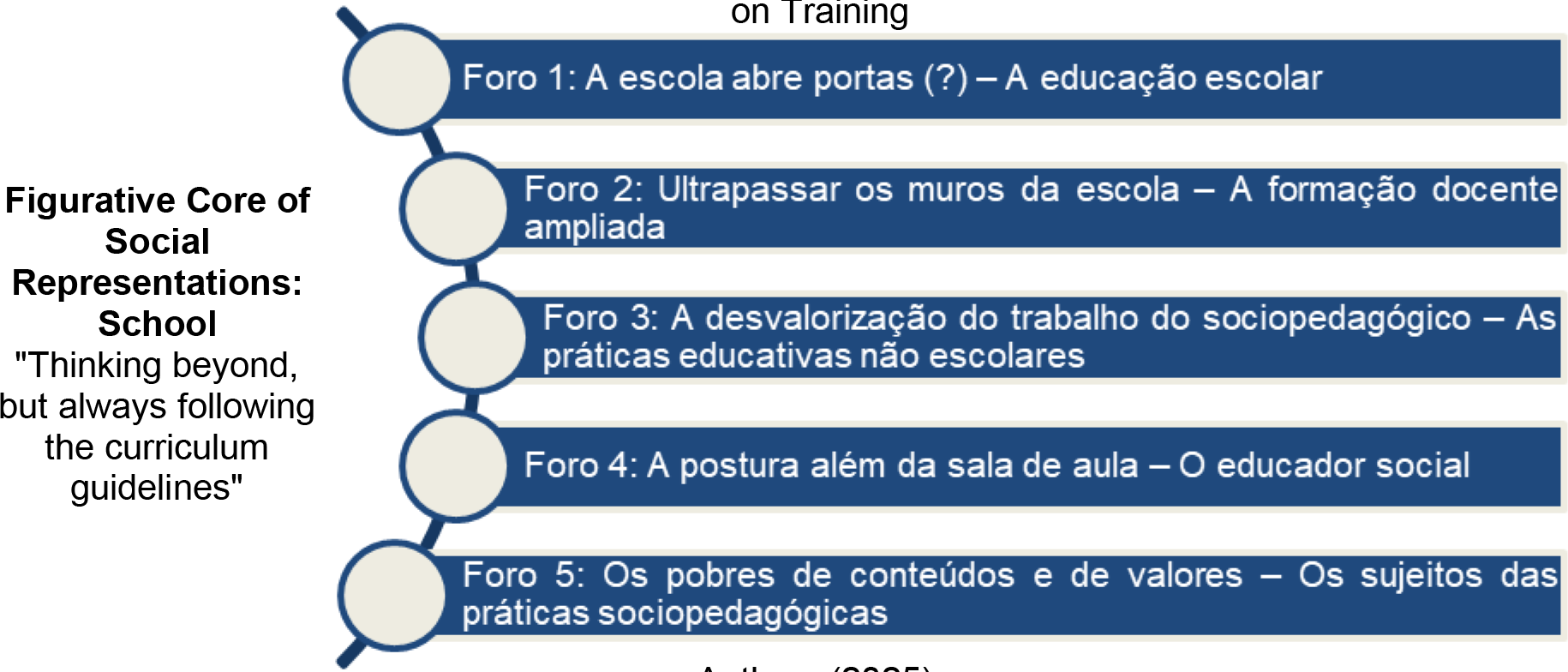
The results of the research indicate evidence of Social Representations of teacher training among social educators, organized around the figurative nucleus “School”, expressed in the metaphor “Thinking beyond, but always following the curricular guidelines”.
Figure 1 shows the five thematic forums that constitute the figurative core of the Social Representations of these educators. The forums were grouped based on the analysis of the rhetorical figures present in the discursive material produced by social educators during their training in Social Pedagogy, expressed in their activities, from portfolios and questionnaires carried out throughout the course in 2023.

The thematic forums and the figurative core of the Social Representations of social educators on Training
The investigation shows that the forums support the figurative-symbolic core of Social Representations through the metaphor "school", common to the group of social educators from Rio de Janeiro. The new knowledge about Social Pedagogy, acquired throughout the course, is organized from these Social Representations, causing interference in the formative processes of these educators. It is important to highlight some reflections from these thematic forums of Social Representations. The rhetorical speeches presented in the text were identified by the acronyms "ES", followed by a number to maintain the anonymity of the participants.
Forum 1 of Social Representations discusses the vision of social educators on education and its potential for social transformation. The metaphor “School opens doors to a better life. She can do this, yes. The student just wants to. For this reason, I am an educator, because I believe that education, school, it can change the social”, from ES14, exemplifies the discourse shared by the group. For them, the school is seen as having a “preferable” knowledge for the development of educational practices that transform social life in all its aspects.
Although the course addressed Social Pedagogy broadly, educators still attribute responsibility for social change to the school. At first, this seems to reflect the training of social educators from the experience of a curriculum organized according to the DCN for undergraduate courses and the reflective decrease on non-formal and informal educational practices in these formative contexts.
Garcia, Santos and Trindade (2024) reaffirm, in their studies on the training of teacher-researchers, that the critical reflection of the contents and social realities during the initial training of teachers is more focused on the school environment. Social, moral and human values issues are seen as school responsibilities, not societies’. The idea that socio-pedagogical practices need school validation is common among social educators.
Forum 2 presents how educators understand teacher education, thought of in an expanded way, for other spaces in society. The oxymoron of the ES11 discourse exemplifies well the idea shared by the group: “It is training that goes beyond school walls, as a desire to incorporate teaching practice into daily life. It serves outside the school, but always thinking also about what the school has to offer inside” (emphasis added).
The idea of "outside and inside" school education structures most of the discourses analyzed. This demonstrates that educators cannot understand Social Pedagogy as a field of knowledge producer independent of school contexts. All reflection is based on the understanding that socio-pedagogical intervention is complementary to school actions or should, at least, address aspects not affected by basic education. Thus, the formative process does not seem to help in the understanding of Social Education as a specific field of action of Social Pedagogy.
From here, the first consequence of Social Representations within the formation of this group of social educators is glimpsed: the silencing of Social Education. The centrality of school education, as a preference and driver of educational realities (Forum 1 of Social Representations), promotes the lack of recognition of a specific reflection on Social Pedagogy. In addition, it devalues socio-educational practices as autonomous to the school phenomenon (Forum 2 of Social Representations).
This “silencing” perpetuates the lack of clarity about the functions of the social educator in Brazil. The studies of Ferreira (2025) and Natali and Müller (2024) corroborate this absence on a substantial discussion on the minimum training and organization of the social educator's profession. It is essential, therefore, to discuss Social Education and Social Pedagogy as basic and independent concepts for the development of this Brazilian professional.
Forum 3 of Social Representations discusses how this group of educators perceives society's view of their socio-educational work: “It is difficult to make people understand that education takes place in any social space and that we do not need to constantly ‘measure’, ‘evaluate’ this learning traditionally. They like school, not us” (ES02).
The ellipse in the last sentence highlights feelings of lack of recognition and devaluation of socio-educational practices by society. This is reinforced by themes such as "lack of professional preparation", "low remuneration" and "instability at work", present in other speeches of the group. However, although educators talk about this devaluation, they do not propose concrete solutions to modify this reality and, therefore, intensify the accusations against the school as one that devalues social educational practices.
Therefore, when articulating the discourses of Forum 3 with the other two previous forums, we infer the emergence of another psychosocial consequence experienced by these social educators: the collective hypoacusis of socio-pedagogical work. Forum 3 of Social Representations brings together several discourses on the devaluation of the work of the social educator by society, but without any political proposition from educators to change this situation. On the contrary, it reinforces the discourse about the school (Forum 1) and conditions the organization of socio-educational practices to the demands not met by the school (Forum 2). The term “hypoacusis” is used to express the difficulty of the social educator in “listening” to the socio-educational needs present in their social realities, consequently interfering with their ethical-professional positioning.
Baptista (2005) points out that a reflection on the ethics of hospitality can be useful in this discussion. By understanding the importance of the development of professional ethics, socio-educational work would be inscribed “[...] in the dynamics of action, that is, in the consciousness of social educators themselves, valued in the fullness of their condition as authors, actors and narrators”. In this same line of thought, Ferreira and Bonfim (2024) highlight the importance of teacher training institutions preparing future teachers to understand the human reality and establish a praxis focused on the needs of students and the transformation of their social reality.
Forum 4 highlights the discourse on the main characteristics that this group points out as fundamental for acting in the field of Social Education in Rio de Janeiro.
In my experience, the educator needs resilience, either to get by in their thirties, because they have no material, or to deal with several different behaviors, or to have strength and come back renewed each day that begins. It has to have a posture beyond the traditional ones of the classrooms (ES23).
The metaphor “turn around in the thirties” and the anaphora “be for” highlight the resilience and adaptability that educators must have in socio-pedagogical spaces, in addition to the need for a differentiated educational posture. Training is seen as essential to build an ethical stance in socio-educational work. However, although 70% of the discourses mention the terms “autonomy” and “emancipation”, there is no disposition on the part of educators for a critical-social reflection of these concepts in relation to the vulnerable social groups served.
Another relevant aspect is the lack of concern with the organization of collective work. Although 85% of the discourses mention “empathy” and “active listening”, these concepts are seen as personal virtues of the social educator, and not as a collective posture to be learned, or worked on, throughout the socio-educational formative process.
Finally, Forum 5 reveals a complicated reality in a training in Social Pedagogy. The ES17 discourse exemplifies the thinking of 2/3 of the educators investigated: “Working with poor students the elements of forgiveness, respect, dialogue and kindness helps to promote empathy and compassion among them [...], because they do not have much. They are learning to be more and more human.”
Three rhetorical figures used by educators about students stand out: the enumeration, which highlights the values that students “lack” (such as forgiveness, respect, etc.); the ellipse, which reinforces how they are devoid of meaning and all kinds of goods; and the metaphor “learning to be human”, which indicates that they lack essential human qualities, thus understanding them of a different nature from social educators.
Students are seen as “empty”, “hostile” and “without values”, reflecting “pre-judgments” and negative representations by educators. The concepts of hospitality, conviviality and kindness, worked throughout the course, are not sufficiently worked out to establish differentiated interpersonal relationships and/or new intervention practices on their socio-educational realities.
Thus, the discourses of Forum 5, articulated with those of Forum 4, cause a psychosocial experience of Social Representations that can be called hyperopia of the educational other. According to this experience, these educators have difficulties in identifying the "others" served by their socio-pedagogical practices. Forum 5 of Social Representations reveals a conception of these subjects as “lacking” or “empty” of values and, therefore, it is necessary to teach them to “be human” (ES17 discourse).
This “hyperopia”, that is, this “distorted view” of the subjects of socio-educational practices justifies the discourses of Forum 4 on the posture of educators in Social Education. Training in Social Pedagogy seems to be considered unnecessary, as it is believed that being a social educator requires only personal virtues and innate skills (such as empathy, listening, etc.). The values of interpersonal relationships are not seen as something to be learned throughout your career and continuing education.
This reflection is corroborated by other research on Social Representations and education with populations in situations of social vulnerability. Ferreira (2012) showed that the experience of Social Representations among social educators in Southeast Brazil organized a “stagnation”, in which educational practices were based on the educators' perceptions of poverty, and not on the students' real needs. Dias and Ferreira (2022, p. 53) identified that teachers from the outskirts of Rio de Janeiro shared Social Representations of poor students that helped justify their difficulties with students due to poverty seen as part of the students' nature, coining the term “pathologization of poverty”.
5 Final considerations
After presenting the results and discussions on the contents of the Social Representations of teacher training of social educators in a training course in the state of Rio de Janeiro, the central question of this investigation is resumed: to what extent can the understanding of Social Representations among social educators, in a continuing education course in Social Pedagogy offered by a public university in Rio de Janeiro, contribute to promote training processes that enable socio-pedagogical interventions, assisting in the emancipation and transformation of the communities served in their educational daily lives?
To answer this question, it is essential to highlight the importance of the articulation between these two fields of knowledge and to present the contributions of Social Pedagogy to the developments identified in the investigation on the experience of the contents of these Social Representations among social educators in the Metropolitan Region of Rio de Janeiro.
Social Pedagogy is based on the paradigm of hospitality, as a socio-anthropological category referring to the experience of otherness lived in the interpersonal relationship. Social Pedagogy is understood as the pedagogy of the social bond and, therefore, a knowledge that promotes hospitality (Baptista, 2005). The ways in which we build the spaces of encounter with the other are essential to think about the practices of socio-educational intervention. This intrinsic relationship between Social Pedagogy, as a theory, and socio-educational intervention, as a practice, has relevance as an area of knowledge for social educators, since it promotes practices in the context of Social Education of a personal and social educability.
The study of Social Representations offers the opportunity to reveal how individuals, in the dynamics established by their social groups, incorporate “strange” social realities into their way of existence, in a network of categories that are more “familiar” to their daily lives. This psychosocial process of organizing group reality is known as objectification and anchoring.
Thus, it is understood that Social Representations are principles that organize symbolic relations between social subjects. Therefore, it can be understood that Social Representations function as relational principles that structure the symbolic relations between individuals and groups (Doise, 2002). This group psychosocial process takes place from historical, personal and social realities, linked to the present lived by the subjects and their previous social relations.
Based on the articulation between these two theoretical fields, this research on Social Representations and Social Pedagogy, carried out with social educators from Rio de Janeiro, showed realities experienced by these subjects in training. When investigating the “what” and the “how” these subjects organized the concepts of Social Pedagogy during the formative process, it was found that, from processes of objectification and anchoring of Social Representations, the “strange” content (Social Pedagogy) was anchored by these educators in a “familiar” knowledge (School). The latter is so rooted in the culture of this group that it prevented the recognition of Social Pedagogy as a field of knowledge, autonomous and independent, of school education.
Therefore, it is inferred that it is necessary to incorporate the paradigm of hospitality, according to Social Pedagogy, as a professional knowledge of reference for the training of these social educators from Rio de Janeiro. The concept of hospitality in Social Pedagogy refers to a theoretical-practical knowledge of an eminently ethical nature. The resumption of this concept in the training of social educators aims to organize, in a more effective way, future training in this area for these - and others - social educators. Thus, three possible contributions of the concept of hospitality to be organized in future training courses for social educators in Rio de Janeiro are presented.
(A) The discussion on the socio-pedagogical function of agents of human proximity (Baptista, 2006) highlights the importance of hospitality in Social Pedagogy. Social educators should focus on interpersonal relationships as the basis of teaching and the production of subjectivity. The educator's job is to bring together different subjectivities, making this intervention central in Social Education. By including this reflection in training, we seek to break with the silencing of Social Education.
(B) Reflection on the Anthropology of the Face (Baptista, 2010) highlights hospitality as an empathetic and respectful welcoming educator's capacity, considering the subjectivity of students. This ethical and political commitment involves the duty of advance and authority (Baptista, 2007), exercised firmly in professional skills. The formation of these concepts aims to resolve hypoacusis in socio-educational work.
(C) The practices of Social Education as an exercise of hospitality involve reflection on the needs of the other, who presents himself as a face (Baptista, 2009). The social educator must practice intersubjective election (Baptista, 2008), building human and social bonds by welcoming the other in the socio-educational context. This reflection helps to deconstruct the hyperopia of the educational other in the formative process.
By articulating Social Pedagogy, from the paradigm of hospitality, with the Theory of Social Representations, the limits of this research are also revealed. Limitations include: (1) the understanding of the social educator's teacher education from the symbolic field of a specific group in Southeast Brazil; (2) the delimitation of the study to a group with minimum higher education; and (3) the possibility of articulating these two fields of knowledge with other foundations of education also relevant to teacher education.
However, the contributions highlighted throughout the article show the relevance of psychosocial studies such as this, as well as the possible articulations with another knowledge present in Brazilian teacher education. Thus, it is intended for future trainers and researchers to evaluate the results presented and their possibilities of use in the organization of new training spaces for social educators in Rio de Janeiro and, possibly, Brazilians.
-
How to cite this article (ABNT):
FERREIRA, Arthur Vianna; BAPTISTA, Isabel. A formação de educadores sociais fluminenses: entre as Representações Sociais e a Pedagogia Social. Educação & Formação, Fortaleza, v. 10, e15004, 2025. Available at: https://revistas.uece.br/index.php/redufor/article/view/e15004
-
DATA AVAILABILITY
The entire dataset supporting the results of this study has been published in the article itself.
References
- AMADO, J.; FERREIRA, S. A entrevista na investigação em educação. In: AMADO, J. (coord.). Manual de investigação qualitativa em educação Coimbra: Imprensa da Universidade de Coimbra, 2017. p. 209-292.
- BAPTISTA, I. Capacidade ética e desejo metafísico: uma interpelação à razão pedagógica. Porto: Afrontamentos, 2007.
- BAPTISTA, I. Dar rosto ao futuro Porto: Profedições, 2005.
- BAPTISTA, I. Educabilidade e laço social - ética e política da alteridade. In: CONFERÊNCIA INTERNACIONAL - NOVOS DESAFIOS EDUCATIVOS E CIDADANIA SOCIAL, 2009, Porto. Revista Portuguesa de Investigação Educacional, Porto, p. 15-29, 2009.
- BAPTISTA, I. Estatuto filosófico e científico da pedagogia social. Especificidade epistemo-antropológica. In: CARVALHO, A. D. (coord.). Contemporaneidade educativa e interpelação filosófica Porto: Afrontamentos, 2010. p. 95-102.
- BAPTISTA, I. Hospitalidade e eleição intersubjectiva: sobre o espírito que guarda os lugares. Revista Hospitalidade, São Paulo, v. 5, n. 2, p. 5-14, 2008.
- BAPTISTA, I. Problemas, dilemas e desafios éticos na intervenção socioeducativa. In: SERAPICOS, A. M. Intervenção Social: saberes e contextos. Porto: ESSE Paula Frassinete, 2006.
- BOLÍVAR, A.; DOMINGO, J.; FERNÁNDEZ, M. La investigación biográfica narrativa en educación Madrid: La Muralla, 2001.
- BORTOLOZZI, A. C. Questionário e entrevista na pesquisa qualitativa: elaboração, aplicação e análise de conteúdo. Niterói: Pedro & João, 2020.
- BRASIL. Base Nacional Comum Curricular Brasília, DF: MEC, 2018.
- BRASIL. Classificação Brasileira de Ocupações: CBO-2009. Brasília, DF: MTE, 2009a.
- BRASIL. Conselho Nacional de Educação. Resolução CNE/CEB nº 2, de 1º de julho de 2015. Define as Diretrizes Curriculares Nacionais para a formação inicial em nível superior (cursos de licenciatura, cursos de formação pedagógica para graduados e cursos de segunda licenciatura) e para a formação continuada. Diário Oficial [da] República Federativa do Brasil, Poder Executivo, Brasília, DF, 2 jul. 2015.
- BRASIL. Constituição de 1988. Constituição da República Federativa do Brasil. Diário Oficial [da] República Federativa do Brasil, Poder Executivo, Brasília, DF, 5 out. 1988.
- BRASIL. Lei nº 9.394, de 20 de dezembro de 1996. Estabelece as Diretrizes e Bases da Educação Nacional. Diário Oficial [da] República Federativa do Brasil, Poder Executivo, Brasília, DF, 21 dez. 1996.
- BRASIL. Projeto de Lei nº 328, de 1º de junho de 2015 Dispõe sobre a regulamentação da profissão de educadora e educador social e dá outras providências. Brasília, DF: Senado Federal, 2015.
- BRASIL. Projeto de Lei nº 2.941, de 16 de maio de 2019 Substitutivo da Câmara dos Deputados ao Projeto de Lei do Senado nº 328, de 2015 - Regulamento a profissão de educador social. Brasília, DF: Câmara dos Deputados, 2019a.
- BRASIL. Projeto de Lei nº 5.346, de 3 de junho de 2009 Dispõe sobre a criação da profissão de educador e educadora social e dá outras providências. Brasília, DF: Câmara dos Deputados, 2009b.
- BRASIL. Resolução CNE/CP nº 1, de 15 de maio de 2006. Institui Diretrizes Curriculares Nacionais para o Curso de Graduação em Pedagogia, licenciatura. Diário Oficial [da] República Federativa do Brasil, Poder Executivo, Brasília, DF, 16 maio 2006.
- BRASIL. Resolução CNE/CP nº 2, de 20 de dezembro de 2019. Define as Diretrizes Curriculares Nacionais para a Formação Inicial de Professores para a Educação Básica e institui a Base Nacional Comum para a Formação Inicial de Professores da Educação Básica (BNC-Formação). Diário Oficial [da] República Federativa do Brasil, Poder Executivo, Brasília, DF, 23 dez. 2019b.
- BRASIL. Resolução CNE/CP nº 4, de 29 de maio de 2024. Dispõe sobre as Diretrizes Curriculares Nacionais para a Formação Inicial em Nível Superior de Profissionais do Magistério da Educação Escolar Básica. Diário Oficial [da] República Federativa do Brasil, Poder Executivo, Brasília, DF, 1º jul. 2024.
- CALIMAN, G. Pedagogia Social: seu pontencial crítico e transformador. Revista de Ciências da Educação, São Paulo, v. 7, n. 23, p. 341-368, 2010.
- CAPDEVILA, M. L. S. Ámbitos de intervención socioeducativa. In: CAPDEVILA, M. L. S. (coord.). Intervención en Pedagogía Social: espacios y metodologías. Madrid: Narcea, 2009.
- CARRERAS, J. S.; MOLINA, J. G. Pedagogía Social: pensar la educación social como profesión. Madrid: Alianza, 2006.
-
DIAS, T. S.; FERREIRA, A. V. As representações sociais das professoras sobre alunos-pobres em uma escola periférica no município de São Gonçalo-RJ. Revista Educação e Cultura Contemporânea, Rio de Janeiro, v. 19, n. 58, p. 35-55, 2022. DOI: https://doi.org/10.5935/2238-1279.20210143
» https://doi.org/10.5935/2238-1279.20210143 - DOISE, W. Atitudes e representações sociais. In: JODELET, D. (org.). As Representações Sociais. Rio de Janeiro: EdUERJ, 2001. p. 187-204.
- DOISE, W. Da Psicologia Social à Psicologia Societal. Psicologia: Teoria e Pesquisa, Brasília, DF, v. 18, n. 1, p. 27-35, 2002.
- FERREIRA, A. V. Desvelando imagens e práticas: o estudo das metáforas como ferramenta de análise de discurso na educação. Revista @mbienteeducação, São Paulo, v. 11, n. 3, p. 319-327, 2018.
- FERREIRA, A. V. Escridocências: os educadores sociais escrevem sobre as suas formações em Pedagogia Social. Porto Alegre: Livrologia, 2023.
- FERREIRA, A. V. Representações Sociais e identidade profissional: elementos das práticas educacionais com os pobres. Rio de Janeiro: Letra Capital, 2012.
-
FERREIRA, A. V. The Brazilian social educator in the 21st Century: A debate on professionalization and initial training based on national legislation. Revista de Gestão Social e Ambiental, São Paulo, v. 19, n. 1, e010828, 2025. DOI: https://doi.org/10.25053/10.24857/rgsa.v19n1-066
» https://doi.org/10.25053/10.24857/rgsa.v19n1-066 -
FERREIRA, G. A.; BONFIM, M. N. B. Relação pedagógica no ambiente universitário: representações sociais captadas. Educação & Formação, Fortaleza, v. 9, e12711, 2024. Disponível em: https://revistas.uece.br/index.php/redufor/article/view/e12711 Acesso em: 10 nov. 2024.
» https://revistas.uece.br/index.php/redufor/article/view/e12711 -
FERREIRA, L. G.; CORTELA, B. S. C. Diretrizes para a formação de professores: análise comparativa entre os documentos de 2015 e 2019. Revista Espaço do Currículo, [S. l.], v. 17, n. 1, p. e67317, 2024. DOI: https://doi.org/10.25053/10.15687/rec.v17i1.67317
» https://doi.org/10.25053/10.15687/rec.v17i1.67317 -
FONSECA, M. G. O.; LIMA, M. F. Base Nacional Comum para a Formação Inicial de Professores da Educação Básica: implicações para o curso de Pedagogia. Revista e--Curriculum, São Paulo, v. 22, p. 1-24, 2024. DOI: https://doi.org/10.23925/1809-3876.2024v22e65228
» https://doi.org/10.23925/1809-3876.2024v22e65228 - GARCIA, F. M.; SANTOS, S. O.; TRINDADE, M. A. S. Metodologia da pesquisa científica no curso de Pedagogia: reflexões sobre a formação de professores/as pesquisadores/as. Educação & Formação, Fortaleza, v. 9, e12802, 2024.
- GARRIDO, J. L. G.; GRAU, C. J. A.; SEDANO, A. R. Esquemas de Pedagogia Social Navarra: Eunsa, 2001.
- MARQUES, G.; AMENDOEIRA, J. A fenomenologia interpretativa como método para a compreensão da existência depois dos 80 anos. Revista da UIIPS, Santarém, v. 8, n. 1, p. 138-151, 2020.
-
MARQUES, N. L. R. et al. Novas Diretrizes Curriculares Nacionais para a Formação Inicial de Professores para a Educação Básica: avanços ou retrocessos?. Revista Educar Mais, Pelotas, v. 5, n. 3, p. 637-649, 2021. DOI: https://doi.org/10.15536/reducarmais.5.2021.2409
» https://doi.org/10.15536/reducarmais.5.2021.2409 - MAZZOTTI, T. B. Metáfora: figura argumentativa central na coordenação discursiva das Representações Sociais. In: CAMPOS, P. H. F.; LOUREIRO, M. C. S. (org.). Representações Sociais e práticas educativas Goiânia: UCG. 2003. p. 89-102.
- MAZZOTTI, T. B. Para uma pedagogia das Representações Sociais. Revista Educação & Cultura Contemporânea, Rio de Janeiro, v. 6, n. 11, p. 121-142, 2008.
- MOSCOVICI, S. Representações Sociais: investigações em Psicologia Social. Petrópolis: Vozes, 2003.
- NATALI, P. M.; MÜLLER, V. R. Educação Social no Brasil: formação profissional. Porto Alegre: Livrologia, 2024.
- NUÑEZ, V. Participación y educación social. In: SILVA, R.; SOUZA NETO, J. C. N.; MOURA, R. (org.). Pedagogia Social São Paulo: Arte e Expressão, 2009. p. 231-238.
- OLIVEIRA, A. L.; VIEIRA, C.; AMARAL, M. A. O questionário online na investigação em educação: reflexões epistemológicas, metodológicas e éticas. Lisboa: UAB, 2021.
- PERELMAN, C. Retóricas. São Paulo: Martins Fontes, 2004.
-
PORTELINHA, A. M. S. As DCN/2019 para a formação de professores: tensões e perspectivas para o curso de Pedagogia. Práxis Educacional, Vitória da Conquista, v. 17, n. 46, p. 216-236, 2021. DOI: https://doi.org/10.22481/praxisedu.v17i46.8925
» https://doi.org/10.22481/praxisedu.v17i46.8925 - REBOUL, O. Introdução à retórica São Paulo: Martins Fontes, 2004.
- ROMANS, M.; PETRUS, A.; TRILLA, J. Profissão: Educador Social. Porto Alegre: Artmed, 2003.
- SANZ, M. A. H. Dimensión integral de la acción socioeducativa. In: CAPDEVILA, M. L. S. (coord.). Intervención en Pedagogía Social: espacios y metodologías. Madrid: Narcea, 2009.
- SOUZA, C. R. T.; MÜLLER, V. R. Educação Social no Brasil: avaliação. Porto Alegre: Livrologia, 2024.
- ÚCAR, X. Pedagogias de lo social Barcelona: UOC, 2016.
Edited by
-
Chief Editor:
Lia Machado Fiuza Fialho
The entire dataset supporting the results of this study has been published in the article itself.

 Authors (2025).