 Faces of aging: children's perception of older adults and aging
Abstract
Objectives to identify children's perception of older adults and aging, through drawings.
Method this exploratory qualitative study was conducted with children from public schools. Data were collected from February to June 2024 in two elementary schools and three middle schools, totaling 320 children. Each child was asked to draw a picture expressing their perception of older adults and the aging process. Drawings from children whose parents authorized their participation were included in the study. Data were analyzed using the Gestalt therapy approach.
Results a total of 271 children participated in the study. The collected drawings were categorized in to 12 representative elements, and the most representative ones of aging were: nature, life cycle, happiness/love, as well as elderly people expressing pain, suffering and weakness. Few drawings showed older adults in functional activities.
Final considerations and implications for practice although children's perception of aging brings positive elements, the fragility and incapacity of older adults are strongly present. These findings may guide educational/social interventions with children in order to promote a more positive and inclusive view of the elderly in society.
Keywords:
Child; Population Dynamics; Aging; Older adult; Family Relations
Resumo
Objetivos identificar a percepção de crianças sobre a pessoa idosa e o envelhecimento por meio de desenhos.
Método pesquisa qualitativa exploratória desenvolvida com crianças de escolas públicas. Os dados foram coletados no período de fevereiro a junho de 2024 em duas escolas de ensino fundamental I e três de ensino fundamental II, totalizando 320 crianças. A cada criança foi solicitada a realização de um desenho expressando sua percepção da pessoa idosa e do processo de envelhecimento. Foram incluídos na pesquisa os desenhos das crianças cujos pais autorizaram a participação. Os dados foram analisados pela abordagem psicológica da Gestalt-terapia.
Resultados o total de 271 crianças participou do estudo. Os desenhos coletados foram categorizados em 12 elementos representativos. Dentre eles, os de maior representatividade sobre o envelhecimento foram: natureza, ciclo da vida, felicidade/amor, como também de pessoas idosas expressando dor, sofrimento e debilidade. Poucos desenhos mostraram a pessoa idosa em atividades funcionais.
Considerações finais e implicações para a prática embora a percepção infantil do envelhecer traga elementos positivos, a fragilidade e a incapacidade da pessoa idosa estão fortemente presentes. Esses achados oferecem subsídios para intervenções educacionais/sociais com as crianças de modo a promover uma visão mais positiva e inclusiva da pessoa idosa na sociedade.
Palavras-chave:
Crianças; Dinâmica Populacional; Envelhecimento; Idoso; Relações Familiares
Resumen
Objetivos identificar la percepción de los niños sobre las personas mayores y el envejecimiento, a través de dibujos.
Método este estudio cualitativo exploratorio se realizó con niños de escuelas públicas. Los datos se recopilaron entre febrero y junio de 2024 en dos escuelas primarias y tres de educación secundaria, con un total de 320 niños. A cada niño se le pidió que dibujara una imagen que expresara su percepción de las personas mayores y el proceso de envejecimiento. Se incluyeron en el estudio los dibujos de los niños cuyos padres autorizaron su participación. Los datos se analizaron mediante el enfoque de la terapia Gestalt.
Resultados participaron en el estudio 271 niños. Los dibujos recopilados se clasificaron en 12 elementos representativos, y los más representativos del envejecimiento fueron: la naturaleza, el ciclo vital, la felicidad/amor, así como las personas mayores que expresan dolor, sufrimiento y debilidad. Pocos dibujos mostraban a la persona mayor em actividades funcionales.
Consideraciones finales e implicaciones para la práctica aunque la percepción del envejecimiento por parte de los niños aporta elementos positivos, la fragilidad e incapacidad de las personas mayores están fuertemente presentes. Estos hallazgos ofrecen subsidios para intervenciones educativas/sociales con niños para promover una visión más positiva e inclusiva de las personas mayores en la sociedad.
Palabras-clave:
Niño; Dinámica Poblacional; Envejecimiento; Personas Mayores; Relaciones Familiares
INTRODUCTION
The population dynamics process has been occurring in Brazil and worldwide, where the accelerated ageing phenomenon has characterized the society’s demographic transition. This evidence can be observed through data from the Brazilian Institute of Geography and Statistics (IBGE), which points out that the elderly population above 65 years old went from 21 million in 2010 to 33 million in 2022.1,2
In the country itself, it is worth mentioning that, among the North, Northeast, Central-West, South, and Southeast regions, the highest concentration of elderly population is found in the South and Southeast regions, where almost 13% of the population is 65 years or older. It is worth emphasizing that the median age of the Brazilian population has reached 35 years in 2022, a 6-year increase since 2010. Moreover, the aging index has also presented a considerable increase, since in 2022, for 55.2 people aged 65 and over, there were 100 children aged from 0 to 14 years old, while in 2010 this index was 30.7. While considering the 60-year-old population, the index presented the ratio of 80 elderly people for every 100 children aged 0 to 14 years in 2022.2,3
The population dynamic phenomenon is also correlated to the population behavior changes, which is expressed by birth-rate and maternal and child mortality decline, which, linked to improvements in quality of life and the population's access to health services, reflect an increase in life expectancy.4
However, the new age structure of the population will cause challenges to public policies, mainly with regard to the relationship between young people and the elderly. For young people, the student population will include a population that is relatively smaller in face of the expectations for 2050. On the other hand, the elderly population, in full rise, will demand more needs with regard to resources destined to health and social security.5
Currently, the multigenerational coexistence in the same environment, whether in the family, at work, or even in leisure, is already considered a reality, which is reflected in several social challenges. The discussion of this complex process of multigenerational family longevity becomes vital when it comes to subsidies to favor good deals for this phenomenon.6,7
In this logic, society should be prepared to interact with the elderly population in different situations, since the elderly people are increasingly present in the social ambit, playing different roles. However, one can’t ignore that the new generation is uncomfortable with this process, and since this is the technology generation, one can infer that the elderly person must adapt to the new context of modern life. In this lack of understanding of the aging phenomenon and the expected functional decline, society echoes stereotypes associated with the elderly population, characterizing it as slow and weak persons.8,9
It is certain that the family ends up becoming the most direct source of informal and psychosocial support for elderly people, constituting a relationship of conflict and cooperation among members. The same process occurs with children in early life. It is known that the child’s immediate environments, like the coexistence in the family environment of regular attendance in the educational collective environment, will influence the course of child development. Therefore, the better the quality of the family environment, the better the child’s motor, psychosocial, and cognitive performance.10
However, where this coexistence of elderly people and children becomes scarce, the social representations between both may become distorted, strengthening in the child the distorted and stereotypical view of the elderly person.9 The appreciation of the social interaction of children with elderly persons, following premises of education in gerontology, depicts positive consequences with regard to the fight against prejudice towards old age. Therefore, researches that appreciate social transformation through child education corroborate social transformation in the elderly person coexistence in society.11
The exchange of experiences across generations is described in the literature as a powerful instrument to interrupt discrimination against the elderly. Thus, while considering that children are in the process of development, with new significant learning for their training as persons, while appreciating the life experience of an elderly person, they will certainly develop an enjoyable and respectful relationship, so as to reframe multigenerational.12 So, it is important to emphasize that the way the relationship between children and elderly persons is established will be vital with regard to the influence on the way such a child will consider these individuals in society, and, as a consequence, the adult/elderly person they will become in the future.13,14
So, considering the accelerated process of population aging, which is related to the fact that children and elderly persons will coexist more closely, as well as the importance of this interaction to break stereotypes towards the elderly person, the present study aims at identifying children’s perception of elderly people and aging, through drawings.
METHOD
Qualitative exploratory research was developed in Lower and Upper Elementary State Schools from a medium-sized municipality located in the countryside of São Paulo, which represents 34 schools of this level of teaching.
It is important to highlight that elementary school is classified as Elementary School I (EF I) and Elementary School II (EF II). Thus, EF I includes the 1st to the 5th year, with children from six to ten years old. EF II, on the other hand, comprises the 6th to the 9th year, with children from 11 to 14 years old. Among the 34 schools of the mentioned municipality, six offer only EF I, four offer EF I and EF II, and 24 offer only EF II. For this study, approximately eight schools were selected, in the north, south, east, and west of the municipality. Among them, five participated in the study, two EF I and three EF II. Data could not be collected from the other schools for private reasons of the teaching institutions.
The study participants included children enrolled in EF I and II of these public schools, comprising children from six to 14 years old. As an inclusion criterion, the minimum condition of being enrolled and having attended school regularly was adopted, regardless of sex. Exclusion criteria were cognitive impossibility to participate in the study, in case of children with disabilities, and children whose legal guardians did not authorize their participation. In this logic, all children from elementary school of the selected school were invited to participate in the study, and they were duly informed, as well as their parents or legal guardians, about the study’s objective. To participate in the study, the children had to present authorization from their parents or legal guardians through a signed Informed Consent Form (TCLE).
Contact with those responsible for the children, teachers, and school management was made in person by the study investigators, before data collection. Data collection occurred while the children were at school, in an organized way, adjusted to school activities, without affecting the teaching dynamics, as recommended by the school’s management.
Data were collected from February to June 2024, through playful drawings made by children participating in the study. The drawings were produced on bond paper provided by the investigators’ team. The children were guided about the filling of their sociodemographic data, like school year, age, and sex. Then, the children executed the following command: “Draw a picture of the image that comes to mind when you think about an elderly person and aging”. In addition to the standard sheet, school supplies like colored pencils (12 colors), black pencil, eraser, ruler, and sharpener were provided to ensure equal conditions.
After the delivery of the sheets, the children had approximately 40 to 50 minutes to execute and finish their drawings. Upon completion, the children were asked to write a sentence explaining what the drawings represent to them. During the whole activity, the investigators remained with the participants in order to assist in case of doubts or difficulties presented by the children. A total of 320 children participated in the study; however, 271 children returned the consent form signed by their parents or legal guardians, and their drawings were included in the study.
After the data collection, the drawings were organized into two groups: one represented by EF I, which comprised 137 drawings, and the other represented by EF II, totaling 134 drawings. Sociodemographic data were described according to each group (EF I and EF II) distribution.
The analysis of the drawings was also carried out according to each group: EF I and EF II. The analysis reference used was Gestalt therapy. This approach consists of a relational view of human nature, and its main focus is the idea that the human experience occurs through the interface between the individual and the environment where he is inserted.15 Therefore, the choice of the mentioned approach is justified by the fact that while working with children, since there is not just one prevailing way of dialogue with the child audience, communication is not restricted to verbal language. For children, the drawing goes beyond a recreational activity and represents a way to interact and connect to the surrounding environment. Lines and scribbles work as a kind of record to narrate stories, pranks, wishes, and thoughts.16
The analysis categories were built inductively, based on the recurring observation of themes and patterns in the drawings. Initially, preliminary tests were made in order to identify such patterns. Then, the drawings were grouped according to common dimensions identified in the representations. The categorization was carried out by researchers independently and later discussed until reaching a consensus, a way to ensure more reliability in the analysis.
The study was forwarded to the Research Ethics Committee for validation, according to Resolution 510/2016, and was approved under opinion 6.625.206. All participants who accepted to participate in the study received the relevant information through the Informed Consent Document for Minors/Legally Incapacitated Persons” (Assent Form). However, as previously described, only children whose parents/legal guardians signed the Informed Consent participated in the study. To preserve the anonymity of the children, they were identified with the letter P (participant) followed by the drawing number, as follows: P1 = Participant of drawing number 1.
RESULTS
Characterization of participants
The study sample was represented by a total of 271 drawings, considering the two EF I schools and the three EF II schools. Among the EF I children, most of them were eight years old, while among the EF II children, most of them were 11 years old. With regard to sex, 123 children were female and 148 were male. Table 1 presents the sample characterization with greater details.
Analysis of drawings
The analysis of the data collected was based on elements selected from the children’s drawings themselves, used as a projective technique in the Gestalt therapy context. In this psychological approach, projective techniques are tools that enable access to the individual’s internal contents, like emotions, perception, and behavior patterns, based on spontaneous and creative expression. With these techniques, the child can project, in a symbolic way, aspects of their emotional experience in an external environment, facilitating the identification and understanding of feelings, desires, and anguish. The drawing is specifically seen as a concrete representation of the child’s emotional state and internal processes, providing a playful means for them to express subjective experiences and anything that, many times, the child can’t view.17
So, starting from the analysis of the drawings presented by the children, 12 representative elements were listed to categorize the expressed findings. It is important to highlight that the same drawing sometimes presented different elements, which were then presented in more than one representative element. Table 2 shows the representative elements categorized, distributed according to the child’s school level.
Representative elements observed in the drawings of participant children distributed across EF I and EF II schools. Marília, 2024.
Figure 1 illustrates a representative drawing of each element decoded in the Gestalt therapy analysis. One can observe that the drawings of natural elements brought pictures of trees, flowers, and gardens. Sun and clouds were also present in this element. Drawings of houses/homes showed elderly people on sofas watching TV. Moreover, in this representative element, drawings of clocks and kitchenware were present. Elements of pain and/or weakness were represented by drawings with elderly people leaning on canes, in addition to the spine curvature always correlated with difficulty walking. Other drawings of this element showed elderly persons in wheelchairs.
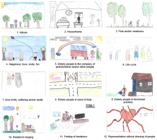
Representative drawings of each of the 12 elements categorized, made by the participant children. Marília, 2024.
Representative elements of happiness, love, smile, and fun brought drawings of elderly people smiling, expressing happiness and satisfaction, correlated to some activity developed at the moment, like harvesting fruits from a tree, for example. Elements of elderly persons in the company of grandchildren and/or other people, on the other hand, brought drawings that highlighted the company of the elderly person, demonstrating concern about not letting the elderly person be alone.
Elements of the life cycle were represented by drawings of babies, children, adults, and elderly persons, following the chronological order, from birth to aging. Elements involving end of life, suffering, and/or death were expressed with coffin figures and even a dead person, with eyes closed and the sign of the cross.
Elements of elderly persons needing help were represented by drawings of elderly persons crossing the street with the help of someone else, and also drawings where the elderly person received help to carry bags. Elements of elderly persons in functional activities depict elderly persons taking care of gardens or the house. Drawings of the element related to longing, on the other hand, presented elderly persons in gardens, sometimes symbolizing the death of a person; however, the children wrote sentences of love and longing related to the person drawn on the paper.
Elements of loneliness were represented by drawings of elderly persons alone, with sad expressions. In the drawings lacking people, it was observed that drawings of the heart, sometimes representing signs of rupture, as if it were something that is already worn.
DISCUSSION
The representative elements presented in Table 2 were listed according to the frequency expressed by the children as a projective technique based on the drawings, and prepared based on two relevant precepts of Gestalt therapy: contact and here-and-now.
The concept of contact refers to the process by which the individual interacts with the environment and the people around, and, through it, assimilates and provides meaning to his field of experiences.18 The here-and-now concept, on the other hand, highlights the importance of focusing on the present, both in time and space terms, enabling the child to focus on their current experiences. That will make possible the exploration of emotions, thoughts, sensations, and perceptions occurring at the moment, thus facilitating a personal interpretation of what happens in their internal world and the surrounding environment, promoting a deeper connection with the experience lived.19
The literature points out that, while making a prospective drawing of itself, the child expresses its projection of what that phenomenon represents to it.13 Thus, one can notice that the findings expressed in the drawings of children participating in this study presented perceptions about the aging process under different experiences, permeating aspects related to happiness and love, and also pain, weakness, and loneliness.
While correlating natural elements like clouds, trees, and flowers to the aging process, the child seeks to express a positive projection related to that phenomenon. However, a study carried out with the same proposal brought in the results, drawings considered happy, with natural elements associated with childhood or youth, highlighting sadness in facing aging.13
The company of elderly people with children expresses, through drawings that symbolize grandparents and grandchildren, an important meaning to the process of multigenerational relationships. The interactions between elderly people and children, which are influenced by feelings of well-being and satisfaction, favor a positive perception of the aging process. In this same logic, the picture of the house, for example, can be represented as a symbol of comfort and stability, rest and safety, and is a reflection of an environment built with memories, stories, and life experiences.12
Family is understood as a conglomerate of persons united by affective relations or a certain degree of parenthood that live in the same environment. So, intimate relations of care and protection are built, considering a harmonious and respectful environment. Under this perspective, to the elderly person, the contact with the family ends up generating a certain psychosocial well-being, where respectful and comfortable relations are established.20
A study conducted in Piauí described the perception of the elderly person about how his/her family sees him/her in old age. It was observed that even in face of family divergences, expressions of fellowship and care were outstanding in the speeches analyzed, which implies the welcoming and integrating purpose the family environment promotes, both to the elderly person and the other family members involved.21
For the aging process to develop in a respectful and harmonious way in the family life, multigenerational relations must happen considering safety, trust, and tranquility. Under this view, family relations will tend to be developed in a more positive and productive way for all generations. It is worth mentioning that the multigenerational coexistence is relevant to the aging process, and, especially, to the strengthening of a new perspective towards the elderly person in society. This relationship must be based on respect and appreciation of those involved, thus favoring the construction of different interpersonal relationships.14,22
Aging can cause feelings of insecurity and fear; so, the coexistence of elderly people and younger people in a healthy environment can favor the preservation of autonomy and independence of the elderly person, and can contribute to their life experience to the youngest.23
The drawings built from the idea of pain and/or weakness can be related to the way children internalize and express their perceptions and emotions, according to what they observe around. A study developed with adolescents depicted the perception of this audience about elderly people. Though the adolescents presented positive conceptions about the aging process and the elderly person, 50% of the sample mentioned negative aspects of old age, for example, the functional dependence of the elderly person.24
Historically, the elderly person is labeled as an individual opposed to youth, who is socially presented with functional, active, and productive dynamics. It means that the elderly person is strongly associated with dependence, unproductiveness, social isolation, illness, disability, decline, and death. Therefore, the elderly person suffers social rejection and is pejoratively seen as a dysfunctional being. This entire social heritage contributes to making children develop and sustain the statement that the person, once becoming old, no longer has any value to society.25 In the present study, these positions were expressed in drawings that represented the end of life of an individual, as well as suffering and death, illustrated as a cross and coffin, which could be internalized by animated cartoons and also by personal experiences of grief and loss.
Elderly persons were also represented by drawings showing dependence situations, correlating old age to a fragile, vulnerable, and weak person who uses a cane and even a wheelchair. These findings align with studies that also presented conceptions of elderly persons associated with functional decline and stereotypes that indicate physical and visual impairments, in addition to favoring loneliness and abandonment.13,25 The elderly person’s loneliness process is described in the literature as a picture of an individual who is less active to the sociey.26
The literature also highlights that, though the elderly person suffers with the prejudices imposed to their natural and organic dysfunction of the aging process, a good management of the coexistence among children and elderly people, aiming at the understanding of the importance of enjoying good life experiences for a teaching about personal conducts, will imply rupture of prejudiced and labeled concepts.14-27 Moreover, the solidification of new concepts on the aging process can be evidenced after the insertion of educational actions in gerontology, mainly for children, thus favoring welcoming, respectful, and inclusive attitudes towards the elderly person in society.13
FINAL REMARKS AND IMPLICATIONS FOR THE PRACTICE
This study generated significant data about the children’s perception of aging, revealing that children’s drawings reflect personal experiences and symbolize a complex network of meanings. After the analysis of the drawings made by the participating children, through Gestalt therapy, it was possible to evidence the children's projection towards old age or even their projection as they become older. Thus, the panorama found expresses positive aspects, like affection in intergenerational relations, but also themes like loneliness and death. The association between nature and aging points to the use of accessible metaphors, thus assisting in the playful understanding of the life cycle and suggesting pedagogical applications. The presence of themes like longing reinforces the interconnection between memory and child emotional identity, highlighting the influence of loss in this construction.
The present study has its applicability limited to a single municipality in the São Paulo countryside, and so new studies in different locations of Brazil are necessary. However, the study advances with regard to subsidies to educational policies that promote an inclusive and positive view of aging, since the results indicate the need for educational approaches that discuss aging and grief, challenging stereotypes that the elderly population still faces. Therefore, it is expected that this study will contribute to future research on the stereotyped process that aging has faced, as well as bodies of social responsibility, so as to inspire new proposals of educational policies that address the needs of elderly people in a welcoming and respectful way.
ACKNOWLEDGMENTS
Coordenação de Aperfeiçoamento de Pessoal de Nível Superior (CAPES) – Brazil.
DATA AVAILABILITY RESEARCH
The contents underlying the research text are included in the article.
-
FINANCIAL SUPPORT
This study was financed in part by the Coordenação de Aperfeiçoamento de Pessoal de Nível Superior - Brazil (CAPES) - Finance Code 001, part of a PDPG-POSDOC (PDPG – Strategic Postdoctoral Degree) CAPES Process nº 88887.799298/2022-00.
References
-
1 Oliveira AS. Transição demográfica, transição epidemiológica e envelhecimento populacional no Brasil. Hygeia; Rev Bras Geogr Med Saude. 2019;17(31):69-79. http://doi.org/10.14393/Hygeia153248614
» http://doi.org/10.14393/Hygeia153248614 -
2 Gomes I, Brito V. Censo 2022: número de pessoas com 65 anos ou mais de idade cresceu 57,4% em 12 anos. Agência IBGE Notícias [Internet], 1 nov. 2023 [citado 2023 nov 29]. Disponível em: https://agenciadenoticias.ibge.gov.br/agencia-noticias/2012-agencia-de noticias/noticias/38186-censo-2022-numero-de-pessoas-com-65-anos-ou-mais-de-idade-cresceu-57-4-em-12-anos
» https://agenciadenoticias.ibge.gov.br/agencia-noticias/2012-agencia-de -
3 Cardoso E, Dietrich TP, Souza AP. Envelhecimento da população e desigualdade. Rev Econ Polit. 2021;41(1):23-43. http://doi.org/10.1590/0101-31572021-3068
» http://doi.org/10.1590/0101-31572021-3068 -
4 Martins TCF, Silva JHCM, Máximo GDC, Guimarães RM. Transição da morbimortalidade no Brasil: um desafio aos 30 anos de SUS. Cien Saude Colet. 2021;26(10):4483-96. http://doi.org/10.1590/1413-812320212610.10852021 PMid:34730637.
» http://doi.org/10.1590/1413-812320212610.10852021 -
5 Nascimento MV, Diógenes VHD. Transição demográfica no Brasil: um estudo sobre o impacto do envelhecimento populacional na previdência social. Rev Evidenc Contab Finanç. 2020;8(1):40-61. http://doi.org/10.22478/ufpb.2318-1001.2020v8n1.45463
» http://doi.org/10.22478/ufpb.2318-1001.2020v8n1.45463 -
6 Freitas VS, Naiff LAM. Representações sociais sobre envelhecer com deficiência: um estudo com famílias. Estud Interdiscipl Envelhec. 2021;26(1):3-20. http://doi.org/10.22456/2316-2171.77280
» http://doi.org/10.22456/2316-2171.77280 -
7 Balduino Jr GC, Paiva NAA. Convivência familiar e vulnerabilidade da pessoa idosa: fundamentos para aplicação da Lei da Alienação Parental. Civilistica.com [Internet]. 2024; [citado 2025 jul 3];13(1):1-33. Disponível em: https://civilistica.emnuvens.com.br/redc/article/view/945
» https://civilistica.emnuvens.com.br/redc/article/view/945 -
8 Rabelo VRC, Arruda A. Representações em construção entre idosas e jovens expostos a novas práticas sociais na velhice. Psicol Rev. 2020;26(1):63-82. http://doi.org/10.5752/P.1678-9563.2020v26n1p62-81
» http://doi.org/10.5752/P.1678-9563.2020v26n1p62-81 -
9 Leal A. Jovens e velhos: representações sociais cruzadas – o contributo da animação socioeducativa na reconfiguração das representações sociais entre jovens e velhos: o projeto ‘entre nós: os livros’. Estud Interdiscipl Envelhec. 2021;25(3):295-312. http://doi.org/10.22456/2316-2171.118144
» http://doi.org/10.22456/2316-2171.118144 -
10 Morais RLS, Carvalho AM, Magalhães LC. O contexto ambiental e o desenvolvimento na primeira infância: estudos brasileiros. J Phys Educ. 2016;27(1):2714-6. http://doi.org/10.4025/jphyseduc.v27i1.2714
» http://doi.org/10.4025/jphyseduc.v27i1.2714 -
11 Todaro MA. Construção da Escala Todaro: atitudes de crianças em relação a idosos. Horizontes. 2017;35(1):141-50. http://doi.org/10.24933/horizontes.v35i1.313
» http://doi.org/10.24933/horizontes.v35i1.313 -
12 Silva RL, Medina P. Crianças pequenas e a pessoa idosa: contribuição intergeracional. Rev Eletrôn Esquis Educa [Internet].2019; [citado 2025 jun 28];10(22):618-33. Disponível em: https://periodicos.unisantos.br/pesquiseduca/article/view/808
» https://periodicos.unisantos.br/pesquiseduca/article/view/808 -
13 Todaro MA, Cachioni M. Representações da velhice: uma análise dos desenhos de crianças, antes e depois de uma ação educativa gerontológica. Horizontes. 2022;40(1):022045. http://doi.org/10.24933/horizontes.v40i1.1212
» http://doi.org/10.24933/horizontes.v40i1.1212 - 14 Todaro MA, Cachioni M. Literatura Infantil para “ouvisentir”: por uma educação anti-idadista. Oikos Fam Soc Debate. 2023;34(2):1-15.
-
15 Esch CF, Jacó-vilela AM. Gestalt-Terapia chega ao Brasil. Memorandum Mem Hist Psicol. 2019;36:1-29. http://doi.org/10.35699/1676-1669.2019.6847
» http://doi.org/10.35699/1676-1669.2019.6847 - 16 Velasco CS. O desenho como dispositivo terapêutico na Gestalt-terapia [trabalho de conclusão de curso]. Volta Redonda: Instituto de Ciências Humanas e Sociais, Universidade Federal Fluminense; 2018.
-
17 Oliveira EDF, Grubits S. O desenho na Gestalt-terapia: a versatilidade dos traços em interface com a prática clínica. Estud Pesqui Psicol. 2020;19(4):1036-50. http://doi.org/10.12957/epp.2019.49300
» http://doi.org/10.12957/epp.2019.49300 - 18 Furtado JR, Gaspar FP. As polaridades controle e confiança na sociedade contemporânea a partir da gestalt-terapia. Rev Abordagem Gestált. 2022;28(1):60-9.
-
19 Mesquita GRO. Aqui-e-agora na Gestalt-Terapia: um diálogo com a sociologia da contemporaneidade. Rev Abordagem Gestált. 2011;17(1):59-67. http://doi.org/10.18065/RAG.2011v17n1.8
» http://doi.org/10.18065/RAG.2011v17n1.8 -
20 Santana ES, Mendes FRP, Gobira NCMS, Oliveira AS, Lopes AOS, Xavier TT et al. O cuidado destinado ao idoso dependente: motivações de cuidadores do Brasil e de Portugal. Psicol Teor Prat. 2021;23(3):1-29. http://doi.org/10.5935/1980-6906/ePTPSP13428
» http://doi.org/10.5935/1980-6906/ePTPSP13428 -
21 Araújo LF, Castro JLC, Santos JVO. A família e sua relação com o idoso: um estudo de representações sociais. Psicol Pesqui. 2018;12(2):14-23. http://doi.org/10.24879/2018001200200130
» http://doi.org/10.24879/2018001200200130 -
22 Lima AOP, Silva RMD, Gonçalves JL, Cunha MMT, Capelo MRTF, Baixinho CRSL et al. Sentidos das relações intergeracionais de adolescentes no convívio com a pessoa idosa. Cien Saude Colet. 2025;30(5):e00642025. http://doi.org/10.1590/1413-81232025305.00642025 PMid:40465905.
» http://doi.org/10.1590/1413-81232025305.00642025 -
23 Melo LD, Arreguy-Sena C, Gomes AMT, Parreira PMD, Pinto PF, Rocha JCCC. Social representations elaborated by elderly people about being elderly or aged: structural and procedural approaches. Rev Enferm UFSM. 2020;10:e53. http://doi.org/10.5902/2179769238464
» http://doi.org/10.5902/2179769238464 -
24 Oliveira FM, Abreu DPG, Gomes GC, Silva BT, Oliveira SM, Figueiredo TR. A percepção de adolescentes sobre o envelhecimento velhice e o ser idoso. Res Soc Dev. 2022;11(13):e162111335150. http://doi.org/10.33448/rsd-v11i13.35150
» http://doi.org/10.33448/rsd-v11i13.35150 - 25 Lindolpho MC, Caldas CP, Silva MGM, Tavares TJPC, Carvalho RVC, Silva BMC. Personalidade e autocuidado de cuidadores de idosos: estudo transversal. Res Soc Dev. 2020;9(7):e760974537.
-
26 Martins JA, Watanabe HAW, Braga VAS, Jesus MCP, Merighi MAB. Idosos com deficiência física: vulnerabilidades em relação ao corpo, ambiente físico e social. Rev Bras Enferm. 2020;3(Suppl 3):e20190175. http://doi.org/10.1590/0034-7167-2019-0175 PMid:32667414.
» http://doi.org/10.1590/0034-7167-2019-0175 -
27 Silva IMD, Gonçalves JP. Os estudos das representações sociais sobre a velhice em contextos educacionais. Estud. interdiscipl. Envelhec. 2021;26(2):105-22. http://doi.org/10.22456/2316-2171.98322
» http://doi.org/10.22456/2316-2171.98322
Edited by
-
ASSOCIATED EDITOR
Márcia Assunção Ferreira https://orcid.org/0000-0002-6991-7066
-
SCIENTIFIC EDITOR
Marcelle Miranda da Silva https://orcid.org/0000-0003-4872-7252

