 Professional identity and limitation of autonomy of the Obstetric Nurse in a teaching hospital: a qualitative study
Abstract
Objective to analyze the work organization of obstetric nurses and their relationship with autonomy and professional identity.
Method descriptive research with a qualitative approach, using semi-structured interviews conducted between June and July 2023, with a total of 15 obstetric nurses from two federal hospitals managed by the Brazilian Hospital Services Company. Content analysis was performed according to Bardin’s method, divided into three stages: pre-analysis, material exploration and results treatment.
Results self-perception, associated with a lack of recognition and a sense of belonging, contributes to a fragile social identity, which directly impacts autonomy, personal fulfillment, and the recognition of Nursing as a profession.
Final considerations and implications for practice obstetric nurses face limitations in their role, with their decision-making power often being sidelined. Reflecting on the importance of these professionals in obstetric workspaces is crucial, emphasizing the need for greater appreciation and recognition as members of a multidisciplinary team. The maintenance of professional identity and the expression of autonomy in obstetric nursing face challenges due to various factors in the daily practice environment.
Keywords:
Professional Autonomy; Obstetric Nursing; Hospital Teaching; Social Identification; Humanized Childbirth
Resumo
Objetivo analisar a organização do trabalho da enfermeira obstetra em hospitais de ensino, com foco na relação entre identidade profissional e as limitações que afetam a autonomia dessa profissão.
Método pesquisa descritiva de abordagem qualitativa, com entrevistas semiestruturadas realizadas entre junho e julho de 2023, com 15 enfermeiras obstetras de dois hospitais federais administrados pela Empresa Brasileira de Serviços Hospitalares. A análise seguiu o método de Bardin, dividindo-se em três etapas: pré-análise, exploração do material e tratamento dos resultados.
Resultados a autopercepção das enfermeiras obstetras, associada à falta de reconhecimento e à ausência de um sentimento de pertencimento, resulta em uma identidade social frágil, impactando diretamente na autonomia, na realização profissional e no reconhecimento da Enfermagem como profissão.
Considerações finais e implicações para a prática a atuação das enfermeiras obstetras é frequentemente limitada, com seu poder decisório relegado a segundo plano. É fundamental refletir sobre o papel dessas profissionais, destacando a necessidade de valorização e reconhecimento como membros essenciais de uma equipe multiprofissional. A manutenção da identidade profissional e a expressão da autonomia das enfermeiras no contexto obstétrico enfrentam desafios devido a diversos fatores presentes no cotidiano da prática.
Palavras-chave:
Autonomia Profissional; Enfermagem Obstétrica; Hospitais de Ensino; Identificação Social; Parto Humanizado
Resumen
Objetivo analizar la organización del trabajo de enfermeras obstétricas y su relación con la autonomía y la identidad profesional.
Método investigación descriptiva con enfoque cualitativo, mediante entrevistas semiestructuradas realizadas entre junio y julio de 2023, a 15 enfermeras obstétricas, de dos hospitales federales administrados por la Empresa Brasileña de Servicios Hospitalarios. El análisis de contenido se realizó según el método propuesto por Bardin, dividido en tres etapas: preanálisis, exploración del material y tratamiento de resultados.
Resultados la autopercepción de las enfermeras obstétricas, asociada a la falta de reconocimiento y al ausente sentido de pertenencia, contribuye a una identidad social frágil, lo que impacta directamente en la autonomía, la realización personal y el reconocimiento de la Enfermería como profesión.
Consideraciones finales e implicaciones para la práctica el papel de la enfermería obstétrica está limitado, y su poder de decisión queda relegado a segundo plano. Es necesario reflexionar sobre la importancia de estos profesionales en los espacios de trabajo de obstetricia, destacando la necesidad de mayor valorización y reconocimiento como miembros esenciales del equipo multidisciplinario. El mantenimiento de la identidad profesional y la expresión de autonomía de las enfermeras en la práctica obstétrica se ve afectado por varios factores presentes en el cotidiano de la práctica profesional.
Palabras clave:
Autonomía Profesional; Enfermería Obstétrica; Hospitales de Enseñanza; Identificación Social; Nacimiento humanizado
INTRODUCTION
Since the 1920s, Brazilian nursing has sought to consolidate itself as a science, adopting the Anglo-American model for training nurses and promoting postgraduate studies in the United States. In the 1940s, the first specialization courses appeared in Brazil, such as Nursing and Obstetrics, followed by Lato Sensu programs at the Anna Nery Nursing School. The first profession regulation came with Law No. 2.604/1955, which defined six categories and competencies, including Nurse, Obstetrician and Midwife. In the following decades, progress was made with the creation of specialized courses at institutions such as the University of São Paulo (USP) and with the Education Guidelines and Bases Law, which structured training and postgraduate courses in the area, meeting the demands of the health sector.1,2
The training of midwives and obstetric nurses in Brazil reflects different trajectories. Midwives evolved from traditional midwifery practices to technical courses at the beginning of the 20th century and, later, specific degrees, such as the one at USP. Their work is regulated by the Ministry of Education (MEC), with an exclusive focus on reproductive and maternal and child health. Obstetric nurses, on the other hand, are regulated by the Federal Nursing Council (COFEN), with greater recognition after extensive discussion of the profession's advances under Law 7.498/86. They have a general degree in nursing followed by a Lato Sensu specialization in obstetrics, enabling them to conduct normal births in a variety of contexts.1,2
Over the following decades, various movements sought to promote and consolidate the work of obstetric nursing (ON). These include the Movement for the Humanization of Childbirth Care (MHAP), in 1984, which drove the creation of the Comprehensive Women's Health Care Program (PAISM); the founding of the Brazilian Association of Obstetricians and Obstetric Nurses (ABENFO), in 1992; the creation of the Normal Birth Centre (CPN) within the scope of the Unified Health System (SUS) in 1993, through Ordinance No. 985; the implementation in 2000 of the Prenatal and Birth Humanization Programme (PHPN); and the creation in 2011 of the Stork Network,1,3,4 a national policy developed by the Ministry of Health (MS).
The Stork Network aims to strengthen the obstetric nurse's role in childbirth care, guaranteeing women's reproductive rights, promoting humanized childbirth and introducing changes to the care model, with fewer interventions and more respect for the physiological process of parturition. This strategy has contributed to the appreciation and visibility of the category, highlighting nurses as specialized agents in maternal and childcare.5,6 In many institutions, however, care is still anchored in a technocratic model that delegitimizes the obstetric nurses' autonomy, as well as subjecting women to increased medicalization, unnecessary interventions and high rates of caesarean sections.7
Although there are theories that discuss decision-making in midwifery, many of them do not take into account the context and philosophy in which midwifery is practiced, nor the decision-making autonomy that should be granted to women.8,9 In addition, obstetric nurses' work is often marked by dilemmas related to the construction and maintenance of their professional identity. When they take on leadership, management or administrative roles, many of them move away from direct care of parturient and puerperal women, which leads them to reflect on the safety and quality of their care. This withdrawal can reduce their autonomy, making them rethink their beliefs and values. Not using the knowledge and skills they acquired during their training raises questions about their identification with the profession, compromising their sense of belonging and the construction of their professional identity.10 Developing this identity is a continuous process throughout your career.11-13
A scoping review carried out in high-income countries, with the aim of exploring obstetric nurses' orientation in the provision of care during hospital births, showed that continuity of care increased professional autonomy, as well as improving nurses' position to support women's well-being and facilitate decision-making, respecting their preferences.14 This demonstrates the importance of expressing autonomy and professional identity in the workplace, essential elements for obstetric nurses to be able to act effectively in assisting women, promoting quality care.15
Considering the recommendations of the World Health Organization16 and the Ministry of Health on national policies to protect safe motherhood and good practices in low-risk childbirth care, this study seeks to understand obstetric nurses' experiences and perceptions of autonomy and recognition of their professional identity in teaching hospitals. The aim was to analyze the organization of obstetric nurses' work in teaching hospitals, focusing on the relationship between professional identity and the limitations that affect the autonomy of this profession.
METHOD
This study followed a qualitative, descriptive and exploratory approach, with the aim of understanding the relationships and subjectivities associated with a specific phenomenon, based on the accounts of the experiences and perceptions of those involved.17 The report was prepared in accordance with the guidelines of the Consolidated Criteria for Reporting Qualitative Research (COREQ), ensuring methodological rigor.
The research was carried out in two federal public institutions run by the Brazilian Hospital Services Network (EBSERH): A) Hospital de Clínicas, located in Brazil's Southeast region; and B) University Hospital, in Brazil's South region. Initially, a total of 20 obstetric nurses who worked in the obstetric centers of these institutions were recruited to take part in the study. At the second stage, the inclusion criteria for the study were applied, namely: being an obstetric nurse with at least six months' experience in the obstetric center and having experience in monitoring puerperal women during all stages of childbirth, excluding obstetric nurses on sick leave, leave of absence or scheduled vacations, or those who were not effective in the sector. After applying the inclusion and exclusion criteria, the final sample comprised 15 participants (Southeast region - 5 participants); (South region - 10 participants).
The semi-structured interviews were carried out between June and July 2023, in a private and previously scheduled setting. The interview script was developed by the author and validated through a pilot test to assess its suitability. The questionnaire covered topics related to autonomy and professional identity, barriers and limitations, institutional culture, residency programs and work environment. The interviews lasted around 45 minutes, were recorded, transcribed in full and stored in Microsoft Word® via Google Drive® for organization and later analysis.
The data was analyzed using Bardin's Content Analysis technique,18 which included the following stages: 1) Pre-analysis: organization and floating reading of the material; 2) Material exploration: coding and categorization of the statements; 3) Results treatment: interpretation of the data and presentation of the findings.18
Results were discussed in the light of the Sociology of Professions, an appropriate theoretical framework for analyzing professionalization processes and the construction of specialized knowledge.19 The study followed the guidelines of Resolution No. 466/2012 of the National Health Council, guaranteeing the protection of the participants' rights, and was approved by the University's Research Ethics Committee, under opinion No. 5.954.607. All the participants signed the Informed Consent Form (ICF) and their information was guaranteed confidentiality. Speeches were identified in coded form, using the pattern: N (nurse), followed by the participant's number and the letter corresponding to the institution (A or B).
RESULTS
A total of 15 obstetric nurses with specialist qualifications took part in the study. The age range was divided into six participants aged between 20 and 39, and nine aged between 40 and 52. In terms of time working in the institution, three participants had between six months and two years' experience, 11 had between six and five years, and one had more than six years. Of the total, 14 worked under the Consolidated Labor Laws (CLT) and one under the Single Legal Regime (RJU). As for the work shift, eight worked during the day and seven at night. The weekly working hours vary between 30 and 36 hours, depending on the work regime and the schedules adopted (6x24, 12x36, 12x60).
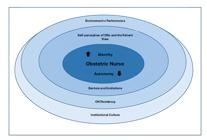
The following categories emerged from the thematic network analysis: 1) “Barriers and Limitations: Autonomy Subordination and Restriction”; 2) ‘Obstetric Nursing Residency: Need and Impact’; 3) ‘Biomedical Institutional Culture: A Limiting Model’; 4) ‘The Importance of Professional Identity and Valorization’; and 5) ‘Hospital Environment and Limiting Management’. Figure 1 shows the categories according to their proximity to the autonomy and professional identity thematic networks.
Barriers and limitations: autonomy subordination and restriction
The subordination of obstetric nurses to other professional categories, especially the medical profession, emerges as one of the main barriers to professional autonomy. This phenomenon is often related to gender issues, which result in disrespect and discrimination both in the workplace and in the community. The subordination of obstetric nurses reflects a historically consolidated hierarchy within the biomedical model, which favors medical supremacy over collaborative practices. This structure generates inequality between professional roles, as well as causing negative psychological impacts and feelings of devaluation.
This raises the question: how do barriers to autonomy affect the quality of care provided by obstetric nurses in hospital institutions?
[...] The nurse's autonomy, considering his or her development and ability to implement good practices in the care of normal-risk deliveries, in my opinion is quite limited. We only act as adjuncts in the childbirth scenario (N5A).
This curtailment of autonomy is exacerbated by the exclusivity of the practices associated with medical residency at the institutions studied. The lack of opportunities for a broader practice has negative repercussions, especially in relation to the quality of care, resulting in the loss of practical skills acquired during training.
We strive to provide the best possible care, always with the parturients in mind! However, when it comes to the use of autonomy, our role is very restricted, especially when it comes to assisting in labor, since the spaces are generally exclusive to the medical residency. This becomes a daily challenge, a constant struggle for recognition. When we are able to act, we do so to the best of our ability, but due to the limited opportunities, some of the skills we acquired during our training end up being forgotten, such as how to perform sutures in cases of laceration (N7B).
When asked about their feelings in relation to the restricted space in which they work in the care of normal risk births, the interviewees expressed feelings of impotence, frustration, demotivation and devaluation.
[...] My feeling is one of impotence! It's frustrating to know that we have the knowledge and time to provide more humanized care, but we're not given the space. This demotivates us and makes us feel undervalued. It's not a question of competing with other professionals, but of sharing, of guaranteeing our space (N6B).
It's frustrating! When I started working at the institution, I wasn't yet an obstetric nurse, but I fell in love with obstetrics, even with my own history of women's health, which led to personal conflicts. I felt challenged, so I specialized! Over time, the frustration of not seeing my autonomy respected and my role as an obstetric nurse diminished (N8B).
The clear definition of each professional's role in the childbirth process and the equitable distribution of care opportunities deserve to be highlighted, as they represent fundamental strategies for improving the spaces for action and promoting a more collaborative environment.
Residency in obstetric nursing: need and impact
During the interviews, the participants were asked how the implementation of a residency in Obstetric Nursing could change their autonomy. The answers highlighted positive implications for the work and recognition of the category.
Undoubtedly, a residency in Obstetric Nursing would train the nursing team, bring more knowledge and expand the spaces for our work. In other capitals, the participation of nurses in low-risk labor is already a reality. As our hospital is a university, the implementation of this residency would be fundamental for training new professionals (N8B).
Despite the existence of a residency in Women's Health at institution B, it is still very incipient, with the main focus on managerial and administrative areas, limiting the residents' learning in care practice.
The residency in Women's and Children's Health at the institution does not allow the nurse residents to work effectively in labor. They have a more observational and administrative role. This contrasts with the medical residency, where medical residents have ample autonomy to act directly in care (N6B).
The reports highlight dissatisfaction with the spaces offered to nursing residents, which are often limited compared to the opportunities offered to medical residents. Nurse residents often end up taking on more administrative or observational roles, while their medical colleagues enjoy a more autonomous and hands-on role.
We've had Women's Health nurse residents who really stood out, two in particular. They were exceptional, despite the institution's rules to the contrary, and took responsibility for deliveries. For the first time, we saw a real sharing of learning between medicine and nursing. They actively sought to learn and, when they didn't have opportunities to act, they questioned their limitations. This resulted in the institution reflecting on the need to respect the nurses' role (N10B).
The implementation of a residency in Obstetric Nursing would be a crucial strategy to strengthen the autonomy of the profession, promote the sharing of knowledge and broaden the scope of practice for obstetric nurses. Residency training would serve as a foundation for contextualizing the different macro-spaces of the profession and improving the organization of health services.
Biomedical institutional culture: a limiting model
The predominant biomedical model in the institutions analyzed shapes the organizational culture and reinforces barriers to professional autonomy. This model is characterized by medical hegemony, which not only harms obstetric nurses, but also limits the quality of care centred on women and humanized childbirth, as well as promoting a hierarchical culture that minimizes nurses' professional identity, placing them in a “subordinate” position.
Institution A, for example, adopts a culture that is still centered on medicine, which negatively influences the work of obstetric nurses and undermines the perception of their professional capacity.
Today, the hospital has a predominantly medical-centered institutional culture. This has a negative impact on the obstetric nurses' workforce, and many of them do not feel confident in taking on the responsibilities of normal-risk childbirth (N1A).
Institutional policy favors a model of care which, although accepted by society, delegitimizes the autonomy of obstetric nurses. The medical hierarchy and the view that doctors are the “owners” of the hospital perpetuate a culture of subordination, making it difficult to recognize and value the profession.
[...] There is a deep-rooted institutional culture in which the hospital is seen by society as an institution exclusively focused on medical practices. There is a strong predominance of a medical culture, where many of the doctors who work here also hold leadership positions in private institutions and have positions elsewhere. For this reason, many of them feel as if they own the hospital, adopting a 'boss who can, obey who has sense' attitude, and end up bringing this mentality into the environment, even though it is a public hospital (N2A).
The importance of professional identity and appreciation
The construction of professional identity is directly associated with the degree of autonomy in the workplace. The obstetric nurse's identity goes beyond technical mastery, incorporating humanized practices, welcoming and effective communication with parturients. Even in the face of limited space, patients recognize the value of the nurse's presence, especially with regard to the welcoming environment and the bond of trust established.
When we manage to work as obstetric nurses, the patients always praise our work very highly. Communication is effective, we are able to perform our duties with quality and we can see their satisfaction. However, few of them really want to experience labor, and most patients opt for a cesarean section (N1A).
I believe that our presence is fundamental for them, we make a difference. Before we enter the unit, we introduce ourselves, talk to them, clear up any doubts, introduce them to the maternity routine. In this way, we already create a bond with the patient before she enters (N4A).
However, the lack of clarity about the roles of the nursing team members is still a significant challenge. Professional identity is closely related to autonomy in the exercise of one's role. Acting in a welcoming and reassuring way, listening to patients' needs, defending breastfeeding and promoting female protagonism in childbirth are fundamental responsibilities of the obstetric nurse.
It is very common for patients not to be able to clearly identify the nurse in the delivery setting, confusing them with other members of the team, such as the nursing assistant or technician. This is due to a lack of clarity about the duties of each member of the team.
Patients are often unable to identify the nurse, confusing them with assistants or technicians. However, I believe that, in times of need, they see us as the main people responsible, mainly because of our empathetic and welcoming communication (N8B).
Even in scenarios with limitations, obstetric nurses' leading role must be recognized, especially in the care of low-risk deliveries. This role is fundamental for the implementation of evidence-based practices, as well as for the defense of female protagonism in childbirth.
Hospital environment and limiting management
Organizational culture and hospital management play a crucial role in creating barriers or opportunities for professional autonomy. The lack of leadership and institutional support hampers the defense of obstetric nursing demands, perpetuating inequalities between categories. In addition, bureaucratic overload limits the scope of action of these professionals.
Managing and organizing our team has become an arduous task. Most of the bureaucratic work, such as records, has been transferred to the nurse, which restricts our care time. If these tasks were shared, we would have more time for the team (N5A).
The lack of management qualifications was also a point raised by the interviewees. Nursing leadership, with little experience, has limited influence, especially in defending obstetric nursing within institutions.
There is a lack of management qualifications. The nursing leadership has little experience and little influence with managers, which hinders the defense of obstetric nursing in the institution (N10B).
DISCUSSION
The work of obstetric nurses in teaching hospitals involves significant challenges, arising from structural and cultural barriers that limit their autonomy and impact their role in childbirth care.20,21 Professional autonomy, characterized by freedom of action based on knowledge, technical competence and interdisciplinary interaction, faces practical restrictions, even though it is guaranteed by legislation such as Law 7.498/86 and other official documents.22
This study reveals that, despite the technical training, legal backing and scientific ability of obstetric nurses to attend normal risk births, their autonomy in the hospital environment is often curtailed. The limitations include fundamental actions such as suturing lacerations, monitoring the fetal heartbeat, performing vaginal touches and completing the partogram, which are essential for comprehensive and humanized care.23
Gender discrimination and the perpetuation of medical-centered hierarchical models appear as factors that reinforce obstetric nurses' subordination in relation to other professional categories, particularly doctors. International studies13,14 have also identified this pattern, highlighting that it not only affects the quality of care, but also compromises nurses' professional identity, generating demotivation and a sense of devaluation.
In Brazil, obstetric care is still a technocratic model in most institutions, although recent public policies have sought to strengthen the autonomy of obstetric nurses through humanized practices and non-invasive technologies.21-24 The introduction of Residency programs in Obstetric Nursing has been seen as a transformative strategy to promote recognition and appreciation of the profession.25,26 Despite structural limitations, positive experiences in residential programs show their potential for integrating multi-professional teams and sharing good practices.
The Multiprofessional Residency Programs and the Professional Health Area Residencies were established by Interministerial Ordinance No. 1077, of November 12, 2009, as a crucial strategy for training future professionals and expanding the country's specialized workforce.27
However, a marked inequality persists between nursing and medical residents. While the latter are widely involved in practical activities, nurses are often relegated to administrative duties or just observation. This disparity reflects the hierarchy and structural obstacles in the health system, compromising learning and collaborative practice.
The absence of an obstetric nurse during labour can lead to an increase in unnecessary interventions, as well as hindering humanized care. On the other hand, their presence represents a protective factor for parturient women, as they are seen as “defenders of care”, promoting individualized care and more favorable outcomes by reducing discomfort and prolonging labor.9,28
The biomedical institutional culture, often described as “doctor-centered”, is pointed out by the professionals as one of the main factors limiting their autonomy. This traditional model makes it difficult to value collaborative practices and delegitimizes the work of obstetric nursing, affecting not only the category, but also patients, who often don't recognize the specific role of this work field.7
The work environment's culture has a major influence on a professional's ability to act and on their freedom to use their initiative or judgment. In environments with a “culture of suspicion and exhaustion”, the exercise of autonomy can be seriously restricted.13
The maintenance of the technocratic model in public and university hospitals, which should encourage innovation, reinforces exclusionary practices and hinders humanized care. The study identified limitations to the obstetric nurses' work in habitual risk childbirth, related to institutional culture, the lack of protocols, managerial support and shared management, as well as interprofessional barriers, especially between obstetric nurses and doctors.
The obstetric nurse's professional identity is intrinsically linked to her autonomy and recognition of her role in the team. Despite the limitations, the interviewees reported a positive impact on the patients' experience. The construction of a welcoming environment and effective communication were recognized as differentiating factors of care, even in contexts of restricted performance. The use of non-pharmacological methods for pain relief, such as relaxation techniques, therapeutic baths and body massages, as well as audio-analgesia and aromatherapy, were highlighted as being well applied.28,29
Professional identity is organized through the roles played.18 In nursing, professional identity is fundamental to the work, since an understanding of the professional “I” underpins the construction of the profession, guaranteeing quality, dedication and organization in the performance of duties.29,30 Identity construction involves attention to role, connection with others and self-care.10,31,32
Various factors influence the social identification of the nursing professional's role, such as gender issues, the fragmentation of occupational categories (nurse, assistant and technician) and the centralization of decisions by the doctor.33 The social and technical division of labor in nursing has made it difficult to clearly define its activities, leading to frequent misunderstandings about its work.34
Another relevant challenge lies in bureaucratic overload and the lack of effective leadership. The centralization of administrative responsibilities reduces the time dedicated to direct care, while the lack of experienced leaders weakens the strength of midwifery within institutions.10
Considering the Sociology of Professions as a construct for the findings of this study, we can see that the power dynamics and institutional barriers faced by obstetric nurses highlight the need to break with exclusionary practices in favor of a more egalitarian and collaborative model of care. The professional identity of these nurses is deeply linked to the full exercise of their autonomy and the recognition of their contribution to the healthcare team.19
Finally, the construction of professional identity and the expression of autonomy are associated with self-perception and external recognition. Devaluation and lack of belonging contribute to a weakened professional identity, which has a negative impact on both personal fulfillment and the consolidation of obstetric nursing as an essential profession for humanized and quality care.31
FINAL CONSIDERATIONS AND IMPLICATIONS FOR PRACTICE
Given the challenging scenario faced by obstetric nurses in university hospitals, this study highlights the urgent need to overcome structural and cultural barriers that limit their work. These barriers include restrictions imposed by institutional culture, management difficulties and a lack of opportunities for professional development. Overcoming them requires a collective effort to implement appreciation policies, create and expand spaces for work and strengthen training programs. This will allow obstetric nurses to fully exercise their autonomy, promoting higher quality care during the childbirth process.
The expansion of Obstetric Nursing Residency programs is essential, offering learning and practice opportunities in environments that promote collaboration between multi-professional teams and reduce the hegemony of the biomedical model. In addition, the implementation of educational actions aimed at raising awareness among health professionals and society about the essential role of obstetric nursing is fundamental for its recognition and appreciation.
Despite the study's limitations - such as the restricted geographical scope and the limited number of institutions analyzed, even though both institutions have a similar profile in terms of management, economic and social conditions - the absence of multiple perspectives from institutional actors (managers, doctors and patients) which could provide a broader picture and help understand institutional dynamics - these conclusions offer relevant insights to guide future research. These should consider methodologies that combine qualitative and quantitative analysis, such as the use of questionnaires to measure the frequency of obstetric practices and indicators to assess the impact of barriers and possible improvements, with a focus on the number of deliveries, satisfaction levels and decisions shared between doctors and obstetric nurses.
It is hoped that this study will contribute to strengthening midwifery practices in Brazilian university hospitals, supporting public policies aimed at training professionals capable of working in an interprofessional and collaborative manner. By fostering institutional and cultural changes, it will be possible to increase the positive impact of obstetric nursing on the quality of maternal and childcare, promoting a more humanized and efficient model of care.
ACKNOWLEDGMENTS
Would like to express our gratitude to the Federal University of Santa Catarina and the faculty members of the Graduate Program in Nursing for their guidance and support throughout this academic journey. We also extend our thanks to the Santa Catarina Research and Innovation Support Foundation (FAPESC) for the essential funding that made this study possible. Special thanks go to the institutions and participants involved in the research, whose commitment and collaboration were fundamental to the development of this work.
References
-
1 Oliveira TSD, Galvão MLS, Ramos TO. Enfermagem obstétrica: assistência ao parto no Brasil reflexos da colonialidade do poder e do saber. Encantar. 2021;3:e021010. http://doi.org/10.46375/reecs.v3i.13124
» http://doi.org/10.46375/reecs.v3i.13124 -
2 Schreck RSC, Frugoli AG, Santos BM, Carregal FAS, Silva KL, Santos FBO. História da enfermagem obstétrica na Escola de Enfermagem Carlos Chagas: análise sob a perspectiva freidsoniana. Rev Esc Enferm USP. 2021;55:e03762. http://doi.org/10.1590/s1980-220x2020014703762 PMid:34190896.
» http://doi.org/10.1590/s1980-220x2020014703762 -
3 Carregal FAS, Schreck RSC, Santos FBO, Peres MAA. Resgate histórico dos avanços da Enfermagem Obstétrica brasileira. Hist Enferm Rev Eletron [Internet]. 2020 Oct 25; [citado 2023 nov 10];11(2):1-10. Disponível em: https://periodicos.abennacional.org.br/here/article/view/86
» https://periodicos.abennacional.org.br/here/article/view/86 -
4 Souza RAG, Silva TSA, Brito TBA, Nascimento CS, Santos LMA, Nery MTR et al. O processo de construção da enfermagem obstétrica: uma revisão narrativa. REAS. 2022 Feb 16;15(2):e9743. http://doi.org/10.25248/reas.e9743.2022
» http://doi.org/10.25248/reas.e9743.2022 -
5 Portaria n. 1.459, de 24 de junho de 2011 (BR). Institui, no âmbito do Sistema Único de Saúde - SUS - a Rede Cegonha. Diário Oficial da União [periódico na internet], Brasília (DF), 2011 [citado 2023 nov 10]. Disponível em: https://bvsms.saude.gov.br/bvs/saudelegis/gm/2011/prt1459_24_06_2011.html
» https://bvsms.saude.gov.br/bvs/saudelegis/gm/2011/prt1459_24_06_2011.html -
6 Arana LA, Lopes VC, Barbosa JSP. A Rede Cegonha e a atuação do enfermeiro obstetra: uma revisão da literatura. Braz J Hea Rev. 2023;6(4):14636-53. http://doi.org/10.34119/bjhrv6n4-054
» http://doi.org/10.34119/bjhrv6n4-054 -
7 Lopes GC, Gonçalves AC, Gouveia HG, Armellini CJ. Attention to childbirth and delivery in a university hospital: comparison of practices developed after Network Stork. Rev Lat Am Enfermagem. 2019;27:e3139. http://doi.org/10.1590/1518-8345.2643-3139 PMid:31038633.
» http://doi.org/10.1590/1518-8345.2643-3139 -
8 Vedam S, Stoll K, MacDorman M, Declercq E, Cramer R, Cheyney M et al. Mapping integration of midwives across the United States: Impact on access, equity, and outcomes. PLoS One. 2018;13(2):e0192523. http://doi.org/10.1371/journal.pone.0192523 PMid:29466389.
» http://doi.org/10.1371/journal.pone.0192523 - 9 Lima PC, Sabino KCV, Gouveia MT O. O processo de trabalho da enfermagem obstétrica: reflexão. Enferm Obstétrica. 2018 Dec 30;5:e30.
-
10 Melkamu E, Yetwale A. Attitude of nurses and midwives towards collaborative care with physicians in Jimma University medical center, Jimma, South West Ethiopia. Hum Resour Health. 2020;18(1):94. http://doi.org/10.1186/s12960-020-00531-6 PMid:33267832.
» http://doi.org/10.1186/s12960-020-00531-6 -
11 Mbalinda SN, Najjuma JN, Mubuuke AG, Kamoga L, Musoke D. Understanding and barriers to formation professional Identity among current and recent graduates of nurses and midwifery in two universities in a low resource setting: a qualitative study. Res Sq. 2023. http://doi.org/10.21203/rs.3.rs-3423723/v1 PMid:37886591.
» http://doi.org/10.21203/rs.3.rs-3423723/v1 -
12 Almeida MS, Rodrigues DP, Alves VH, Reis LC, Silva CA, Parente AT et al. A identidade da enfermagem obstétrica no centro de parto normal. Esc Anna Nery. 2023;27:e20230024. http://doi.org/10.1590/2177-9465-ean-2023-0024pt
» http://doi.org/10.1590/2177-9465-ean-2023-0024pt -
13 Clemons JH, Gilkison A, Mharapara TL, Dixon L, McAra-Couper J. Midwifery job autonomy in New Zealand: I do it all the time. Women Birth. 2021;34(1):30-7. http://doi.org/10.1016/j.wombi.2020.09.004 PMid:32962945.
» http://doi.org/10.1016/j.wombi.2020.09.004 -
14 Luegmair K, Ayerle GM, Steckelberg A. Midwives’ action-guiding orientation while attending hospital births: a scoping review. Sex Reprod Healthc. 2022;34:100778. http://doi.org/10.1016/j.srhc.2022.100778 PMid:36152453.
» http://doi.org/10.1016/j.srhc.2022.100778 -
15 Saad DEA, Riesco MLG. Autonomia profissional da enfermeira obstétrica. Rev Paul Enferm [Internet]. 2018; [citado 2023 nov 10];29(1-3):11-20. Disponível em: https://docs.bvsalud.org/biblioref/2019/02/970743/autonomia-profissional-da-enfermeira-obstetrica.pdf
» https://docs.bvsalud.org/biblioref/2019/02/970743/autonomia-profissional-da-enfermeira-obstetrica.pdf -
16 World Health Organization. World health statistics 2018: monitoring health for the SDGs, sustainable development goals [Internet]. Genebra: WHO; 2018 [citado 2022 abr 21]. Disponível em: https://iris.who.int/bitstream/handle/10665/272596/9789241565585-eng.pdf?ua=1
» https://iris.who.int/bitstream/handle/10665/272596/9789241565585-eng.pdf?ua=1 - 17 Minayo MC S. O desafio do conhecimento: pesquisa qualitativa em saúde. 14ª ed. Rio de Janeiro: Hucitec; 2014.
- 18 Bardin L. Análise de conteúdo. Lisboa: Edições 70; 2016.
- 19 Freidson E. Renascimento do profissionalismo. São Paulo: Universidade de São Paulo; 1998.
-
20 Costa MCMDR, Farias PHS, Santos FAPS, Enders BC, Erdmann AL. Living disorders in the practice of obstetric nurse care: the complex look at the phenomenon. Rev Pesqui. 2021 Jun;13:490-6. http://doi.org/10.9789/2175-5361.rpcfo.v13.9245
» http://doi.org/10.9789/2175-5361.rpcfo.v13.9245 -
21 Copelli FHS, Oliveira RJT, Santos JLGD, Magalhães ALP, Gregório VRP, Erdmann AL. Care management and nursing governance in a maternity ward: grounded theory. Rev Bras Enferm. 2017 Nov;70(6):1277-83. http://doi.org/10.1590/0034-7167-2016-0116 PMid:29160490.
» http://doi.org/10.1590/0034-7167-2016-0116 -
22 Lei n. 7.498, de 25 de junho de 1986 (BR). Dispõe sobre a regulamentação do exercício da enfermagem e dá outras providências. Diário Oficial da União [periódico na internet], Brasília (DF), 26 jun 1986 [citado 2023 nov 10]. Disponível em: https://www.planalto.gov.br/ccivil_03/leis/l7498.htm#:~:text=Art.,%C3%A1rea%20onde%20ocorre%20o%20exerc%C3%ADcio
» https://www.planalto.gov.br/ccivil_03/leis/l7498.htm#:~:text=Art.,%C3%A1rea%20onde%20ocorre%20o%20exerc%C3%ADcio -
23 Resolução COFEN n. 524/2016 (BR). Normatiza a atuação e a responsabilidade do Enfermeiro, Enfermeiro Obstetra e Obstetriz na assistência às gestantes, parturientes, puérperas e recém-nascidos. Diário Oficial da União [periódico na internet], Brasília (DF), 2018 [citado 2024 jul 21]. Disponível em: https://www.cofen.gov.br/resolucao-cofen-no-05242016/
» https://www.cofen.gov.br/resolucao-cofen-no-05242016/ -
24 Progianti JM, Moreira NJMP, Prata JA, Vieira MLC, Almeida TA, Vargens OMC. Precarização do trabalho da enfermeira obstétrica. Rev Enferm UERJ. 2018 Oct 24;26:e33846. http://doi.org/10.12957/reuerj.2018.33846
» http://doi.org/10.12957/reuerj.2018.33846 -
25 Maciel VDS, Dornfeld DA. A inserção da enfermeira obstétrica na assistência hospitalar ao parto. Enferm Foco. 2020 Feb 21;10(4). http://doi.org/10.21675/2357-707X.2019.v10.n4.979
» http://doi.org/10.21675/2357-707X.2019.v10.n4.979 -
26 Santana AT, Felzemburgh RDM, Couto TM, Pereira LP. Performance of resident nurses in obstetrics on childbirth care. Rev Bras Saúde Mater Infant. 2019 Jan;19(1):135-44. http://doi.org/10.1590/1806-93042019000100008
» http://doi.org/10.1590/1806-93042019000100008 - 27 Portaria interministerial MEC/MS n.º 1.077, de 12 de novembro de 2009 (BR). Dispõe sobre a Residência Multiprofissional em Saúde e a Residência em Área Profissional da Saúde, e institui o Programa Nacional de Bolsas para Residências Multiprofissionais em Área Profissional da Saúde e a Comissão Nacional de Residência Multiprofissional em Saúde. Diário Oficial da União [periódico na internet], Brasília (DF), 2009: Seção 1: 7.
-
28 Vieira BD, Backes MTS, Costa LD, Fernandes VMB, Dias HHZR, Backes DS. Applying best practices to pregnant women in the obstetric center. Rev Bras Enferm. 2019 Dec;72(suppl 3):191-6. http://doi.org/10.1590/0034-7167-2018-0422 PMid:31851253.
» http://doi.org/10.1590/0034-7167-2018-0422 -
29 Gama SGND, Viellas EF, Medina ET, Angulo-Tuesta A, Silva CKRTD, Silva SDD et al. Atenção ao parto por enfermeira obstétrica em maternidades vinculadas à Rede Cegonha, Brasil - 2017. Cien Saude Colet. 2021;26(3):919-29. http://doi.org/10.1590/1413-81232021263.28482020 PMid:33729347.
» http://doi.org/10.1590/1413-81232021263.28482020 -
30 Bogren M, Erlandsson K, Byrskog U. What prevents midwifery quality care in Bangladesh? A focus group enquiry with midwifery students. BMC Health Serv Res. 2018 Aug 15;18(1):639. http://doi.org/10.1186/s12913-018-3447-5 PMid:30111324.
» http://doi.org/10.1186/s12913-018-3447-5 -
31 Pimenta AL, Souza ML. The professional identity of nursing in the papers published by REBEN. Texto Contexto Enferm. 2017;26(1):e4370015. http://doi.org/10.1590/0104-07072016004370015
» http://doi.org/10.1590/0104-07072016004370015 -
32 Sun J, Wang A, Xu Q. Exploring midwifery students’ experiences of professional identity development during clinical placement: A qualitative study. Nurse Educ Pract. 2022 Aug;63:103377. http://doi.org/10.1016/j.nepr.2022.103377 PMid:35709550.
» http://doi.org/10.1016/j.nepr.2022.103377 -
33 Ribeiro AA, Giviziez CR, Coimbra EAR, Santos JDD, Pontes JEM, Luz NF et al. Interprofissionalidade na atenção primária: intencionalidades das equipes versus realidade do processo de trabalho. Esc Anna Nery. 2022;26:e20210141. http://doi.org/10.1590/2177-9465-ean-2021-0141
» http://doi.org/10.1590/2177-9465-ean-2021-0141 -
34 Santos SC, Almeida DB, Silva GTR, Santana GC, Silva HS, Santana LS. Identidade profissional da enfermeira: uma revisão integrativa. Rev Baiana Enferm. 2019;33:e29003. http://doi.org/10.18471/rbe.v33.29003
» http://doi.org/10.18471/rbe.v33.29003
Edited by
-
ASSOCIATED EDITOR
Marta Sauthier https://orcid.org/0000-0002-5153-0170
-
SCIENTIFIC EDITOR
Marcelle Miranda da Silva https://orcid.org/0000-0003-4872-7252
The contents underlying the research text are included in the article.

