
 Queer Visualities: The Fictionalization of Identities in Photography and Cinema
Abstract
This article discusses the production of non-normative gender identities in the field of visual culture. The methodology adopted is that of visual culture studies. Thus, the authors begin with pioneering self-portraits from the 1920s, placing photographic images by the artists Claude Cahun and Marcel Duchamp in dialogue with the queer cinematographic pieces Pink Flamingos; The Adventures of Priscilla, Queen of the Desert; and The Danish Girl. These works of art resort to the fictionalization and ambivalence of identities, a strategy that produces questions and subversions in relation to social norms. Finally, the authors argue that queer photography and cinema are characterized as fields of resistance in visual culture, serving as works of art that destabilize knowledge and social practices.
Visual culture; Queer photography; Queer cinema; Parody; Masks
Resumo
Este artigo discute a produção das identidades não normativas de gênero no campo da cultura visual. O ponto de vista metodológico adotado é aquele dos estudos de cultura visual, de modo que se parte de autorretratos pioneiros da década de 1920, colocando em diálogo as imagens fotográficas das artistas Claude Cahun e Marcel Duchamp com as obras cinematográficas queer Pink Flamingos; Priscilla, a rainha do deserto; e A garota dinamarquesa. Essas obras recorrem à ficcionalização e à ambivalência das identidades, estratégias que produzem questionamentos e subversões com relação às normatividades sociais. Afirma-se, por fim, que a fotografia e o cinema queer caracterizam-se como campos de resistência na cultura visual, constituindo-se como obras que desestabilizam saberes e práticas sociais.
Cultura visual; Fotografia queer; Cinema queer; Paródia; Máscaras
Introduction
In order to examine the production of non-normative identities within the field of gender studies, this article draws on works of photography and cinema as potent tools for examining the production of non-normative identities within the field of gender studies. Through a fictionalization of identities in the arts, it becomes possible to challenge the social sphere and interrogate the viability of gender production beyond binary frameworks. The theoretical perspective chosen for this article is rooted in queer studies and is based on the understanding that both queer theories and politics interrogate social normativities, revealing new forms of experience and world-making.
Initially, we will briefly present the context for the emergence and consolidation of queer perspectives, highlighting how this theory began alongside movements that turned to difference, that interrogated gender normativities, and that challenged absolutist identity-based theoretical approaches. Such context contributes to fostering a perspective that questions marginalized gender experiences.
The methodological framework utilized in this research follows the perspective adopted by the field of visual culture (Elkins, 2003; Mirzoeff, 1998; 1999), especially the approach to understanding visual representations proposed by Spanish scholar Fernando Hernández (2011; 2013). Using a transdisciplinary perspective, we examine the cultural practices of seeing and being seen, which are present in queer visual discourses and that marked a disruption in photography and cinema. It is worth noting that research on visual culture has an important and established history in Brazil (Barbosa, 2011) and presents, in its theoretical-methodological framework, intersections with post-structuralist studies, cultural studies, aesthetics, and feminist studies.
The authors we draw upon push us to consider visual representations as mediators of meanings and discursive positions, which enables us to think about the world and to reflect, specifically, on the visual construction of queerness through iconic representations. The selection of the photographs and films that serve as the backbone of our reflections was supported by the research of scholars in gender studies. We consider the constant engagement with gender studies thinkers to be an important theoretical-methodological aspect of this research, as they enable us to understand the ways in which these visual narratives break hegemonic patterns of queer visibility and point toward alternative ways of narrating subjectivities.
We examine Marcel Duchamp’s cross-dressed self-portrait as Rrose Sélavy, a historical milestone, before turning to Claude Cahun’s lesser-known self-representations. Cahun’s photographs serve as the guiding thread of our investigation, as their modes of self-presentation fictionalize alternative identities. The pioneering nature of Cahun’s work has been recognized by scholars in the field, such as Jennifer Blessing (1997) and Claude Summers (2004). Contemporary discursive strategies for producing queer visual narratives were already visible in Cahun’s work, allowing us to use this artist as a conceptual bridge between earlier forms and more contemporary modes of disruptive visual creation.
Our research extends beyond the field of photographic image. We accessed cinematographic works of art as these allowed us to recognize that queer visual representations are not specific to the photographic language but rather are part of cultural forms of queer visuality that are more comprehensive within the field of visual culture. The films under consideration were chosen for their alignment with pioneering ways of making gender constructs visible and for their recognized importance among researchers of gender.
Pink Flamingos (1972) is a film that historically marks the trash genre as a space for queer representation. The aspect of identity parody present in this work directly resonates with Cahun’s avant-garde productions. Historically, the film’s director, John Waters, inherits the filmmaking approach of Andy Warhol (who had already brought queer representation into the spotlight). However, Waters offers greater layers of complexity to queer representation when compared to Warhol, as Waters portrays drag not only as synonymous with “camp” but also as a celebration of political and social marginality.
Pink Flamingos developed a cult following in the queer community, which was focused on Divine’s character, as explained by Claude Summers (2005) and Jay Bernard (1993). The character’s success reverberates in subsequent films, also directed by John Waters, such as Polyester (1981) and Hairspray (1988), as well as in Lust in the Dust (1984), directed by Paul Bartel; and in Trouble in Mind (1985), directed by Alan Rudolph. Divine emerged as a celebrity in the 1970s and 1980s, appearing in talk shows, theater performances, and clubs in San Francisco, while also achieving fame in Australia, the Netherlands, and Israel.
Summers (2005) also identifies The Adventures of Priscilla, Queen of the Desert (1994) as a successful and seminal film of the 1990s, which offers a perspective on queer themes twenty years later through the lens of a musical comedy. Up to this point in our research, we have interwoven works of art that engage with alternative gender experiences through the fictionalization and the parodying of identities.
We further examine how queerness and the questioning of identities gain new meaning in contemporary times, arguing that our research would be incomplete without addressing a visual work of art from the 21st century. Once again, theories by gender scholars informed how we connected of The Danish Girl (2015) to the disruptive aspects of queer narrative previously observed in the photographic images central to our research: Claude Cahun’s self-representations.
The significance of The Danish Girl as a milestone in the recent history of queer representations has been extensively documented by scholars (Chare, 2016; Keegan, 2016; San Filippo, 2016; Dowerah; Nath, 2018; Hinton, 2021; Rodríguez-Salas, 2022). These scholars argue that while the piece partially reinforces Hollywood’s stereotypical trans representation, it nevertheless subverts the dominant perception of queerness, highlighting possibilities for identity fluidity in the construction of genders and sexes, as well as the inconclusive and always-in-transit nature of their production.
In its visual strategies for developing the theme of gender, the film exhibits, in a particularly interesting way, symbolic objects such as paintings, mirrors, and the transparency of glass. These visual codes allow us to connect The Danish Girl to elements present in Cahun’s photographs and to consider them as figures that question dominant forms of identity, critiquing the social masks used by subjects to conform to dominant social norms.
The diversity of cinematographic genres in the films discussed here serves as a methodological tool that allows us to diversify our perspective of the narrative forms in which the theme presents itself, in order to contemplate a transversal research perspective of visual culture studies. Thus, we consider the queer potentialities that, through the arts, express other realities that operate as catalysts for social transformations, allowing for less restrictive and violent social realities regarding gender expressions that diverge from binary models. Through the visual works of art discussed here, one can traverse through art and genders, imagining new realities, without the pretension of fixing ourselves into frozen identities, but rather always remaining open to the possibility of their reinventions.
Queer Politics and discourses
It is from the articulation of a certain modality of political intervention and a specific form of constructing theory in the field of gender and sexuality studies that one can delimit what comes to be defined as queer. This is a stance that emerged between the end of the 1980s and beginning of the 1990s, notably in the United States, as a response to a series of transformations that were occurring in the fields of LGBTQIA+, feminist, and HIV/AIDS activism (Córdoba; Sáez; Vidarte, 2007). In this sense, the relationship that this emerging form of doing politics and theory establishes, since its emergence, with experiences and social processes of subalternization is notable.
The strong link between queer theory and activism and the dynamics of subalternities appears in the term chosen to designate this new field, since, in English, queer is synonymous with “strange”, “bizarre”, “out of place”. The word is used as an insult commonly directed at subjects who locate themselves in non-normative experiences of gender and sexuality. In the Portuguese language the term queer is equivalent, although not restricted, to terms such as “bicha”, “viado”, “traveco”, “sapatão” (Pelúcio, 2014; Louro, 2001; Colling, n.d.).
By adopting what is initially an insult, the queer field reclaims the possibility of modifying the social field that produces exclusionary limits of intelligibility for sex-gender dissidence. This appropriation allowed for a form of resistance through discourses, as what queer activists and theorists proposed was the affirmation of the term. Furthermore, the term queer made possible the demarcation of a marginal space that did not intend to be assimilated by the norm, but to question it.
In this process, a subversion of normative expectations about activism related to bodies, gender, and sexualities occurs. This is because, in opposition to assimilationist perspectives, the queer perspective establishes itself as an affirmation of abjection. It serves as a political instrument in a movement for recognition without assimilation and resistant to cultural impositions (Louro, 2001; Miskolci, 2012). Within this path for constructing practice and thought, both the critiques of the general functioning of the heterosexual system and its repercussions in the field of dissidence were decisive.
Among the main critical dialogues carried out by queer politics and studies are the critique of gay and lesbian movements. The latter assumed a more normalized appearance focused on the idea of inclusion instead of claiming another lifestyle. Queer politics and studies further questioned traditional feminism, which consolidated itself as a movement of white middle and upper-class women, thereby invisibilizing the experiences of other women who advocated for an intersectional perspective within the feminist movement. Finally, queer politics and studies analyzed the discovery and subsequent crisis generated by AIDS, notably in homosexual and diverging sexual-generic divergence circles, which produced a context of moral panic that criminalized non-normative experiences (Còrdoba; Sáez; Vidarte, 2007).
The queer responses to issues related to AIDS and to gay, lesbian, and feminist movements were then constituted as subversive possibilities, while not configuring themselves as a total and simplistic refusal of what was already established in the field of relations and discussions about bodies, genders, and sexualities (Jagose, 2005). What is established, then, both in relation to the movements aforementioned – whether in a libertarian or assimilationist model – and regarding heterosexuality as a political regime (Wittig, 1980), is an intensification of resistances.
Thus, the construction of queerness as a space for political confrontation became materialized in the ambiguous relationship between injury and insult, in the encounter with the subversive affirmation of differences. Therefore, there was an intensification of the relationship between queerness and abjection. Miskolci (2012) states that the queer question is, before being a strict matter of sexualities, a question of abjection. The abject, according to Butler (2008), is the unnameable in culture, that which is seen as something to be eliminated, but which, paradoxically, constitutes the very space of the norm as the only legitimate one. Thus, the abject ends up being both the unthinkable and, at the same time, the indispensable constituent of the privileged space of normativities.
Therefore, queer is not only related to alternative sexualities, but constitutes itself as a space of polymorphic discursive production that interrogates both heterosexuality and other social normativities (Swain, 2001). For Miskolci (2011:58), “in political terms, the queer perspective constitutes a proposal that is based on the subjective and social experience of abjection as a privileged means for the construction of a collective ethics”, that is, the queer perspective appropriates the space imposed by the norm and reinvents it, so that, in the process of questioning norms, transformation may occur that allows for the construction of a less exclusive and violent ethics.
The production of discourses that produce confrontations regarding what is already established in the realms of gender and identities has, in arts, an important field of manifestation. Therefore, this article focuses on photographic and cinematographic works of art to reflect on the production of queer discourses. Next, we describe some of the pioneers of queer visualities to situate, in historical terms, the construction of ambivalent identities that show us diverse ways of being.
Fictionalizing other subjects
The production of visual discourses in the field of arts is an important means for cultural visibility and social recognition of queer identities. This is because the possibility of non-normative existences depends on the creation of stylized acts and images, as Butler (2008) emphasizes, among which photography and cinema emerge as discursive affirmations. Visual narratives have become the primary means through which the subversion of forms of sex-gender identities are made possible. There is a history of these productions that problematize the theme of heteronormativity through visual, narrative, and rhetorical strategies, which in turn guide the strategies for making the queer visible.
Our study starts from some emblematic works of art, which are from the beginning of the visual construction of non-normative identities, to discuss aspects that still appear today in the production of photographs and films with this theme. These are productions that spark our interest because they disturb the symbolic field of performances around subjects in the sphere of visual culture.
Photography allows for the theme of heteronormativity and binary representations of gender to rupture, which is evident in portraits made during the artistic avant-garde period. Marcel Duchamp is an important name for locating the beginning of photographic narratives with queer themes. In fact, Blessing (1997) emphasizes that the theme of gender stands out throughout Duchamp’s career, with an interplay between masculine and feminine serving as the cornerstone of his works, and which unfolds throughout his life. The French artist personifies a series of portraits taken by photographer Man Ray, in which he cross-dresses as his alter ego, Rrose Sélavy. The most emblematic of these (Figure 1) is the photograph in which Rrose Sélavy appears holding a fur collar around her neck, in a typically feminine gesture of modesty.

It is interesting to observe, as Blessing (1997) points out, that Duchamp’s playful subversion in this image would not work if the viewer did not have the information that the photo depicts a man wearing women’s clothes. The tension in the presentation of feminine markers (the body covered by the coat, the head by the hat, and the hands borrowed from Germaine Everling) allows for the construction of the image as a parody of the feminine portrait, exposing parts of the body and pieces of clothing that participate in the social marks of femininity.
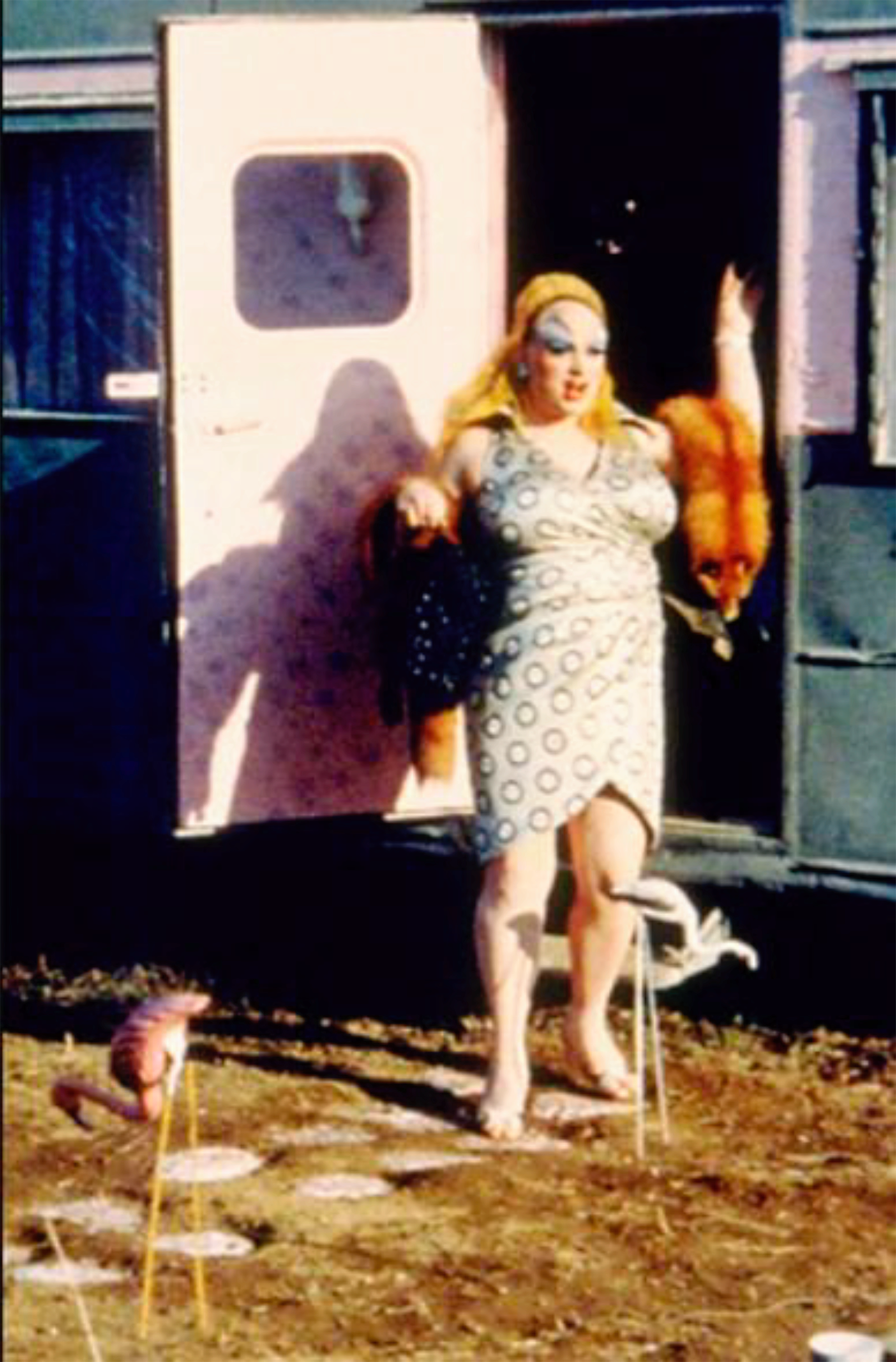
Duchamp’s photography presents a burlesque aspect of the constitution of the self-image that we recurrently find in other works of art that are not restricted to the photographic image. Cinema is an important area for investigating these ways of making oneself visible, since the dialogue between languages allows us to explore this visual rhetoric in a broader spectrum of visual culture. One audiovisual work of art that is worth turning to in order understand the construction of gender parody in visual discourses is Pink Flamingos. In the film, the protagonist, portrayed by the drag queen Divine, finds herself confronted by a couple of criminals who wish to prove themselves more filthy than Divine, who received the title of “filthiest person alive” in the police newspapers. Belonging to the American underground cinema circuit, Pink Flamingos, although it was produced long before the official emergence of queer cinema, is in dialogue with characteristics that became central to the queer universe, such as the lack of commitment to positive images and a destabilizing aesthetic appeal that, in the case of the film, borders on the grotesque.
The valorization of an exaggerated aesthetic, embodied by the drag queen in the film, goes beyond this main character and erupts both in the settings and in other characters, though the center of the narrative is primarily based on Divine and the film depicts scenes with no apparent intent. The estrangement that Divine’s figure may cause in viewers is paralleled in one of the film’s scenes, in which the protagonist goes shopping (Figure 2) and draws the attention of passersby on the streets where she circulates. Even though the character is not positioned, in the film’s narrative, as transgender, the exaggerated caricatured aspect operates as a gender parody.

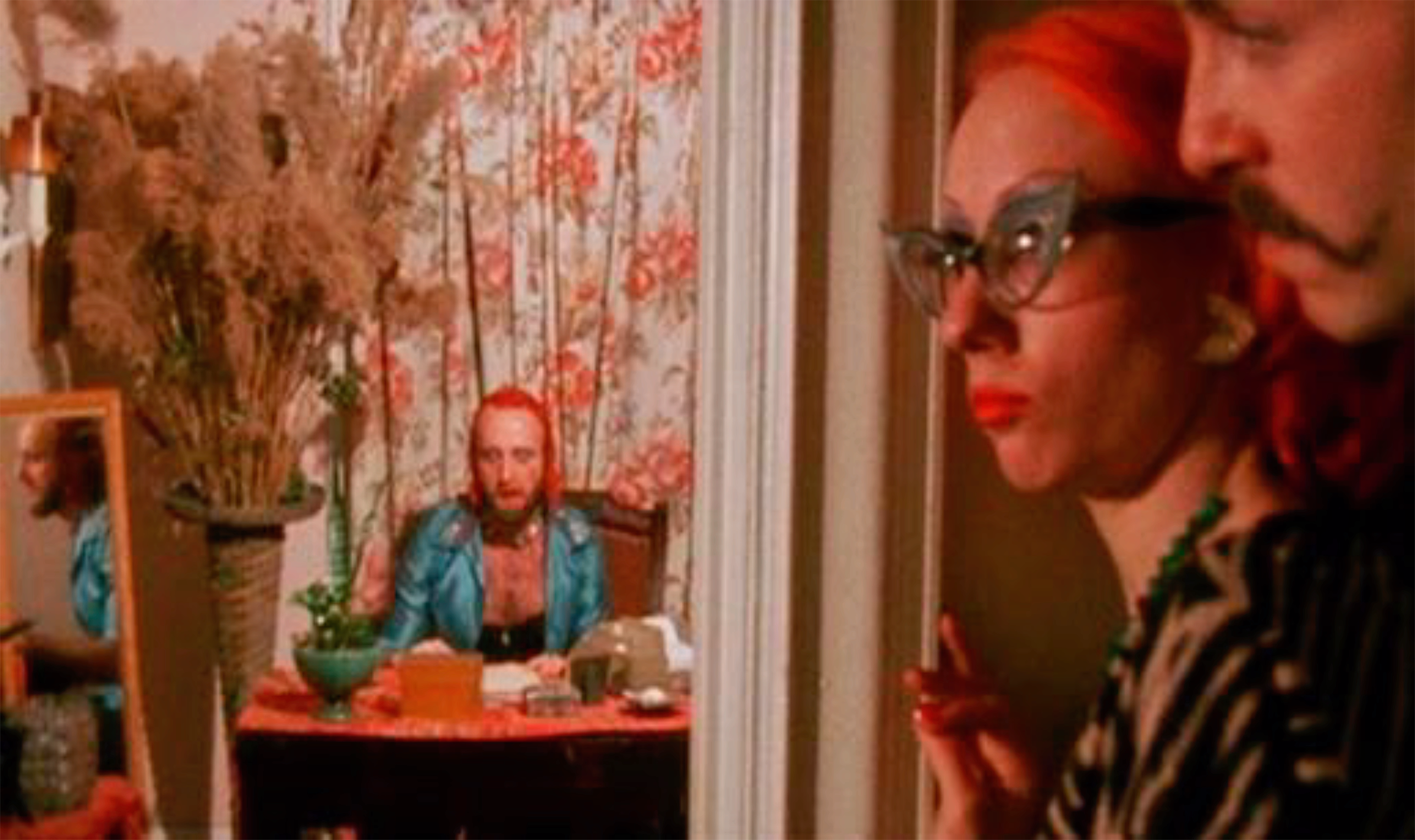
Beyond the evident confrontation of sex-gender norms that a female protagonist performed by a drag queen produces, another character in the film also allows us to think about gender as artifice. In one scene, Channing, the butler of the couple that is antagonistic to Divine, takes advantage of his employers’ absence to wear his mistress Connil’s clothes and makeup. He imitates Connil, repeating her lines from other scenes (Figure 3), thus reinforcing the constant resort to parodic logics in the work.

Gender parody is one of the most striking strategies for subverting the social coercions that act upon identities. Its rhetorical mechanism and functioning has been widely discussed in the field of literature, even though the concept of “parody” is considered, by linguistic and semiotic studies, as polysemic (Sangsue, 2002). The most usual meaning of the term “parody”, according to Mikhail Bakhtin (2002), is that a practice of imitation or a caricatural transformation composed of exaggeration or accentuation of thematic and aesthetic aspects of discourses, languages, and genres. In this sense, the designation of ‘parodic’ tends to become an adjective equivalent to “comic”, “ironic”, and “humorous”. But, in a more limited sense, parodic stylization is related to a polemic recreation that denounces aspects of the parodied theme. In parodic stylization, therefore, there is not only a divergence between the stylized discourse and the stylizing discourse, but also a denunciation and destruction of the first by the second.
In the specific field of gender studies, Butler (2008) exposes the artificiality and arbitrariness of gender expressions through the concept of ‘parody’. Such manifestation would be produced through the stylized repetition of acts from a binary matrix based on the distinction between masculine and feminine. Gender parodies would bring forth the disruptive potential in the parodied matrix of intelligibility. Parodies can produce the destabilization of sexual and gender identities, as we observe in the visual works of art being discussed in this article. This rhetorical resource enables the innovation of a discursive procedure of gender narratives, in such a way as to allow the artist to look at the theme of identity from the outside, constructing a greater diversity of possible styles of gender performances.
The fabricated nature of gender equally applies to sexes. For Butler (2008; 2019), it is from the recourse to sexual difference as natural that genders are constituted as binary, making it impossible to detach genders from the matrix of cultural intelligibility that locates in the body the justification for the binary distinction of both sexes and genders. For the philosopher, a metaphysics of substance forges a distinction between sex and gender, which is constituted, in reality, to sustain the direct normative connection between sex and gender, consolidating a restrictive model of human intelligibility.
It is through this understanding that the first photographic experiences of cross dressing stand out, present not only in Marcel Duchamp’s work but also in that of an artist who was his contemporary and who only recently had her pioneering gender performance recognized: Claude Cahun. While Duchamp needs no introduction in the art field, the French artist, born in 1894 as Lucy Schwob, remained unknown to the public for a long time. It was only in the 1990s that her work was brought to light by François Leperlier’s research (Leperlier, 1992). The only images published while the artist was alive were the 10 collages reproduced in her book of texts and images, titled Aveux non avenus, released in the 1930s. However, her work was quickly utilized in dialogue with contemporary questions about femininity, identity, and representation by numerous researchers (Knafo, 2001; Llabata, 2014; Doy, 2007; Brujeiro, 2016).
A Jewish, lesbian, and a surrealist revolutionary, Cahun lived as a marginal figure, influenced by equally boundary-pushing thought in her time. The artist was the translator of the writings of English theorist Havelock Ellis, who proposed the possibility of a third sex, neither masculine nor feminine, but the union of the capacities of both. In Cahun’s images, what stands out is the constant reimagining of herself, through self-parody as cultural characters. In her self-portraits, Claude Cahun was, for example, a buddha (Figure 4), a vampire, a man, a witch, and a sailor.

The theatrical reinvention of the self sets the tone for Cahun’s work, which makes visible the artist’s non-conformity to standardized social performances. Images such as those in Figure 4 make evident the ambiguous constructions of sexuality performed by the artist. Cahun’s practice of an ever-changing self-performance leads some researchers, such as Llabata (2014) and Brujeiro (2016), to attribute to her the title of precursor to queer theory. Cahun anticipates ways of narrating herself that are characteristic of visual and audiovisual works with queer themes.
Brujeiro (2016) comments on the variety of dynamics for making oneself visible to the world that has, at its essence, the construction of the self as character. The use of masks and makeup contributes to this end, transforming the artist into an other, and points to an identity at the margins of conventions. These are artistic works that give evidence to sexual gender as a role to be performed, a mask that is part of the plot of the great social theater. According to Cahun herself (2007:31): “Whatever refers to me, I will manipulate it, I will apply all my formulas to it, try all my names, all my tricks, I give it the place”.
Her pose and attire are some of the elements that appear in Figure 4 that redefine Cahun’s image against a system of gender norms, making the definition of a social self created by photography controversial. Cahun displays deviant stagings of heteronormative frameworks with such apparent ease that she is able to embody, in her images, the critique made in Bourdieu’s (2010) studies about photography and social representation, for which naturalness is nothing more than a cultural idea, to be continuously created before each imagetic work of art.
The pieces by Duchamp and Cahun mark the beginning of an awakening of consciousness about gender performance in the field of photography, as these artists search for the limits and controversial angles for identity construction. They resist the visual construction of gender of their time, and are constantly referenced (Blessing, 1997; Fabris, 2004) as an influence for contemporary photographers, such as Cindy Sherman and Yasumasa Morimura.
The aesthetic variability present in the above examples of the staging of identities denounces the performative character of sex and gender as cultural categories. In this sense, Butler (2008) proposes that one approach gender more as acts practiced by subjects, rather than as expressions of what these subjects are. This is a non-ontologizing reading of the ‘gender’ category. It allows for the process of stylized repetition of gender to slip beyond the restricted limits of a binary logic. This binary logic is supported by the metaphysics of substance that institutes sexual difference as a starting point for the justification of the arbitrary binary division of genders, which is interpreted as a reflection of an alleged natural difference of sexes (Butler, 2008; 2019).
From gender citationality, expressions that are performed in ways that are incompatible with hegemonic norms challenge the limits of normativity and sometimes rearticulate the boundaries between right and wrong in gender citation (Butler, 2008). Derrida (1991) had already pointed to the privileged place that error occupies in the reconfiguration of reality. Errors allows for the questioning of structures constructed based on presumptions about specific subject positions, intentionality, and citation contexts. Thus, the performative act, initially understood by Austin (1990) as a ritualized process that allows for the emergence of realities through speech acts, comes, with Derridean criticism, to have its main potency in out-of-context citation.
The aspect of criticism and citation present in parody does not go unnoticed in queer studies. Louro (2008:79) identifies this rhetorical strategy not only as a recurring aesthetic possibility, but as the “most effective form of criticism, insofar as it paradoxically implies both identification with and distancing from the parodied object or subject”. Linda Hutcheon (1987) further explains that parody has become common among artists belonging to groups traditionally placed at the margins, such as black people, women, and sexual and ethnic minorities. It becomes a strategy that reacts, critically and creatively, to predominantly white, heterosexual, and masculine culture. Hutcheon (1988:35) speculates that parody became this privileged form of criticism because “its paradoxical incorporation of the past into its own structures often points to these ideological contexts in a somewhat more obvious, more didactic way than other forms”. This paradoxical character is understood by Hutcheon through the term “ex-centric”, which seeks to designate that which is marginalized from dominant ideology and maintains an evident relationship with the very concept of “queer”.
Here, the figure of the drag queen presents itself again as iconic for thinking about the parodic and critical manifestation of binary gender structures operating in our social context. Butler (2008) turns to the drag experience to demonstrate how the artifice of the exaggerated production of the feminine denounces the fabricated character of any gender identity. A characteristic that, in the case of drag queens, through the resource of exaggeration and parody, can potentialize the subversive force of citations outside the frameworks in which certain contexts and subjects are considered correct.
The subversive potential of the drag figure can be observed in the film The Adventures of Priscilla, Queen of the Desert, in which a trio of friends ‒ comprised of two cisgender men who perform drag and a transsexual woman ‒ cross the Australian desert on a bus they name Priscilla. They travel so that Anthony (whose drag persona is Mitzi) can perform a show and reunite with his son. Throughout this journey, numerous challenges and adventures unfold, following the typical road movie structure. The film’s narrative is enhanced by queer elements that generate the climactic moments of the movie, such as Mitzi’s recurring rehearsal scenes, scenes with Adam’s drag persona Felicia, as well as the scenes depicting frequent acidic remarks made by Bernadette, the transsexual character.
Most likely because it was produced during the New Queer Cinema movement, The Adventures of Priscilla, Queen of the Desert brings to the forefront issues related to homophobia and transphobia, as evidenced in the scene where the three protagonists face verbal abuse from a woman in a bar and find their bus vandalized with the phrase “aids fuckers go home!” Furthermore, in one scene, the protagonists encounter a group of Indigenous Australian people and react with uncertainty to their presence. This is a moment where intersectionality comes into play in the film, demonstrating how the relationship with difference is not limited to aspects of gender and sexuality, but connects with other social markers of oppression, such as race and ethnicity (Collins; Bilge, 2021). The scene gets resolved when the Indigenous people assist Anthony, Adam, and Bernadette in repairing their stranded bus, leading to an impromptu celebration in the desert.
Works of art like those of Stephan Elliott deepen and intersect gender themes with aspects of race, culture, and social class. Meanwhile, our recovery of pioneering works ‒ such as those by Duchamp and John Waters, but especially those by Cahun ‒ allows us to analyze, in the next section, certain types of visual records that complexify the discussion about non-conformity in sex-gender performance construction. Such a theme is present in more recent cinematic works, such as The Danish Girl.
Visual Ambivalences in Gender Performance
Gender performance finds its most normative manifestation in photography situated within the realm of identification photography. The latter, like portraiture, can be considered a paradigmatic image of the ways social identity is constructed in the visual arts. These modes of identity representation are themes present both in books about Cahun and in contemporary photobooks (such as Domingues et al., 2017). They are part of questioning the crystallization of the idea of the self through the social image displayed in identification documents. The figure below (Figure 5) shows Claude Cahun’s identity document during the German occupation of the British island of Jersey.

It is known that identity photography has its origins in state identification practices and is aligned with practices of surveillance and the control of bodies. As visual discourses, these images must conform to a series of aesthetic rules of composition, created in the nineteenth century and that are aligned with the positivist and scientistic values that gained prominence at the end of that period. Such values unfold not only in document photography but also in criminal, medical, and ethnographic photography. The guidelines for such images are well exemplified in the figure above and encompass the subject captured in a frontal pose, tight framing, neutral background, brightness, sharpness, uniform lighting conditions, etc.
The identification portrait operates based on the idea of stability, coherence, and continuity of an individual’s social image. However, by the early twentieth century, the notion of a rational, coherent, and unified subject in the field of identity and sexuality studies was shaken by Freud. It was even more questioned through Lacan’s writings (1979), who considers the designated heterosexual roles of man and woman as part of the symbolic order and, therefore, socially produced. A tension between the individual and social norms has been present both in portraiture and in Psychology’s understanding of the identity construction process since the nineteenth century.
The notion that coherence is the main aspect of social image and identity would be problematized by postmodern thought, which points to the existence of a precarious self. Fabris (2004) brings this reflection to the realm of photography and discusses portraiture through the lens of artificial and fictional construction, even in its most normalized uses. The researcher starts from a definition of this genre of images, proposed by John Tagg (2005), to understand portraiture as a sign whose purpose is to both describe an individual and inscribe a social identity. Therefore, not only the unique physiognomy of a face gains relevance, but also other elements that accompany the subject’s insertion in the image. According to Bourdieu (2010), particularly relevant in portraiture are the framing, bodily gestures, and the clothing worn for the occasion.
These compositional elements expose how the social image, its theatricalization, and the creation of a fictionalized identity are continuously constructed. It is in this sense that Jean-Marie Schaeffer (1997) argues that portraiture, far from affirming the self-sufficiency of the self, points to the subject’s lack of plenitude. The alleged stability of these social images ultimately reveals, through its gaps, what Benedict Anderson (2008) argues: that an image, especially a coherent and unidimensional one, is always built upon the ruins of more complex ones, at the cost of their displacements, and the repressions and exclusions of dissident voices.
In the realm of cinema, a contemporary piece that is emblematic for considering fluidity and, paradoxically, the possibilities of identity fixity is the film The Danish Girl. It portrays the journey, based on true events, of Einar/Lili’s gender transition. The quest for feminine identity serves as the narrative thread, from the first moments of gender openness, initiated when Einar’s wife invites him to pose in feminine clothing for her paintings, to Lili Elbe’s decision to undergo gender confirmation surgery, which was still experimental during the film’s narrative timeframe.
It is interesting to note how, unlike the drag queen experiences previously discussed, the transsexual experience is not located in the realm of a character who is parodying gender without intending to constitute a narrative subject definitively fixed in the gender being parodied. Transsexuality constitutes a way of experiencing gender through a more permanent process of gender transition, employing various techniques that can range from clothing, as seen in the earliest records of this experience (Leite Jr., 2011), to contemporary hormonal and surgical techniques (Bento, 2006; 2012). Despite these distinctions, gender transit in the film in question occurs through both experiences (Damásio, 2021). Therefore, the film employs narratives that draw on both modes of transgenderity to explore the issue of non-normative sex-gender identities.
The body emerges as a space of identity production in both cases. In The Danish Girl, Lili’s identity is strengthened through various transformations, from clothing and makeup to surgical modifications. This body, beyond its material aspects, enables the symbolic consolidation of Lili’s experience, as well as opens the possibilities for social recognition, albeit not fully achieved, given the symbolic and physical violence that Lili is exposed to at various moments in the film’s narrative.
In analyzing the correlations between the assumption about bodies and entry into the symbolic sphere, Judith Butler (2019) emphasizes the performative character that bodily production carries. Thus, rather than thinking of the body as a culturally unmarked space upon which gender meanings would be produced, the philosopher proposes a reading that, questioning the paradigm of sexual difference, interweaves linguistic and political aspects with the materiality of bodies. In this approach, the body would not be something that could be analyzed as strictly materially constituted, since the production of subjects also involves the interpretations and meanings that this materiality acquires in culture.
The difficulties faced by Lili in asserting her feminine identity in The Danish Girl stem from a restricted understanding of bodily materiality. This produces a symbolic field that imposes a naturalized and dichotomous form of gender production, supposedly tied to what are understood as the species’ male and female genitalia. Butler (2019) demonstrates how identity formation in our symbolic field occurs through the production of intelligible genders, such that experiences that escape binarism are relegated to the margins of recognition and pushed into abjection.
However, far from endorsing the binary logic of gender production, what the author proposes is the radical notion of making the symbolic sphere more flexible. At this point Butler criticizes psychoanalytic theorizations from both Freud and Lacan. Butler argues that, in the process of allowing for the possibility of questioning the naturalization of the psychic realm, Freud and Lacan ended up naturalizing the psyche once again, particularly in regard to Lacan’s conception of the symbolic. The French psychoanalyst recognizes culture’s role in ego formation but ultimately reifies a certain binary symbolic structure by proposing an absolute distinction between masculine and feminine, ultimately based on genital difference (Butler, 2019).
Butler (2008; 2019), from a queer perspective, argues that psychoanalysis had the potential to denaturalize gender differences and yet ended up endorsing a normative binary sex-gender system, insufficiently questioning the mechanisms that produce abjection and, consequently, leaving little room for the recognition of dissident experiences.
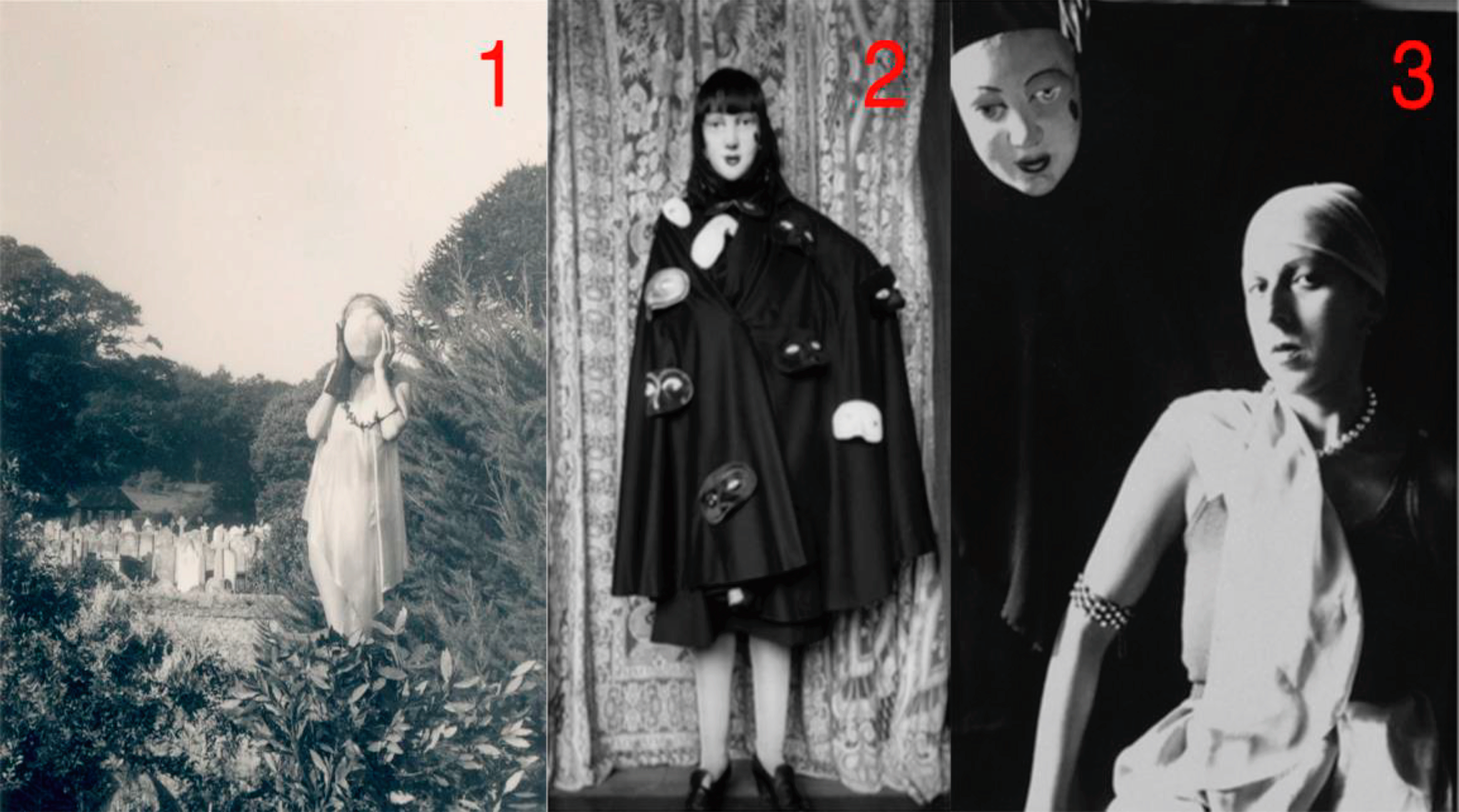
Visual narratives that center a queer identity bring these dissidences to light, pointing to the possibility of fictionalizing multiple appearances that move away from the representation of stable social identity. It is in this context that artists like Cahun are pioneers in photographic experiments that aim to fictionalize appearances. These images are part of a photographic movement from the early twentieth century, in which significant moments of social time (baptism, marriage, etc.) are set aside in favor of a more erratic and “existential” temporal scansion, as Schaeffer (1997) argues. The portrait begins to collaborate with the composition of a visual intimate diary, in which Cahun relies on accessories such as veils and masks to transform the self-image, as we can see in the set of images below.
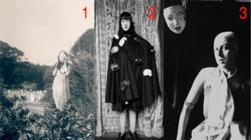
: 1- Claude Cahun, self-portrait, 1947. 2- Claude Cahun, Self-portrait with Masks on Cloak, 1928. 3- Claude Cahun, Self-portrait with Mask, 1928.
Masks and face coverings materialize the theme of the visual ambiguity of identities. Tseëlon (2001) indicates that masks are an amorphous and tolerant refuge from a world that appears hostile to the subject, due to being rigid and normatively structured in the field of gender identities. The use of masks is identified by the same author as an attractive artifice used by those who are stigmatized and marginalized.
It is known that Cahun’s works are influenced by Joan Riviere’s essay Womanliness as a Masquerade (2005), published in 1929, which presented the idea of the feminine as social performance, understood in terms of a ‘masquerade.’ The psychoanalytic sense of identity theatricalization is further amplified by Lacan (1979), who extends Riviere’s idea of masquerade to also encompass masculinity.
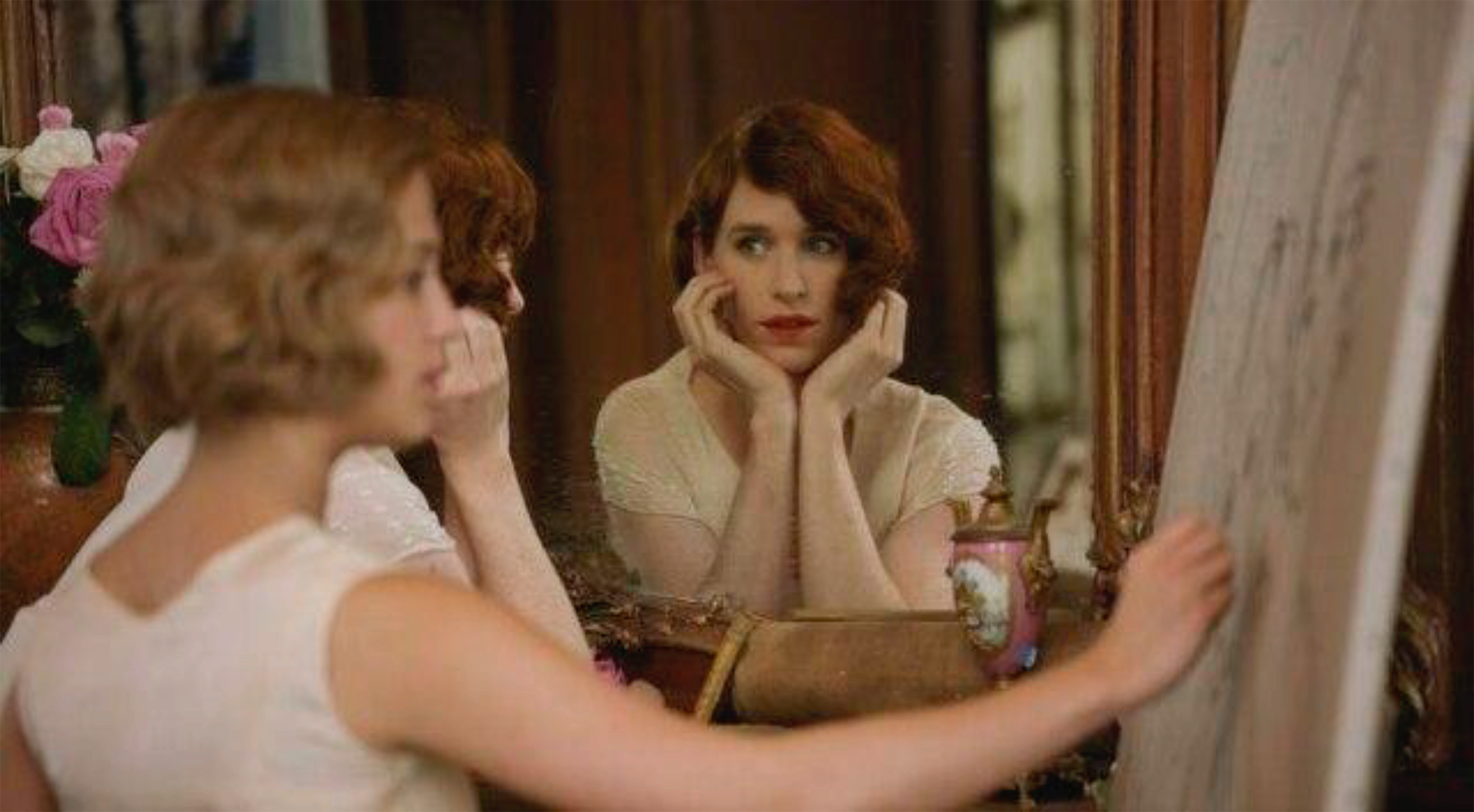
Through the concept of ‘masquerade,’ one can perceive the metaphorical use of masks as a significant covering connected to specific cultural contexts. This is how, in The Danish Girl, the transition of Einar/Lili’s identities occurs, in a process where gender masks enable the character’s transit. Notably such transit is made evident in the initial experiences of posing for his wife, Gerda, in feminine clothing, to which makeup and performance viewed as feminine gender are later added, through gestures and gazes (Figure 7).

The mask ceases to be merely something that can conceal a face and gains the potential to produce a new identity, whether parallel or exclusive. Thus, the mask does not present itself as that which conceals, but as that which enables the showing of oneself. This denotes the impossibility of establishing an ontology concealed by masks, but, instead, allows for the fabrication of new experiences that strain the identity boundaries of a supposedly univocal subject. In the image above, the presence of the mirror visually constructs another layer of meaning, unfolding the subject’s vision and assuming a metaphorical sense of ambiguity between the similar and the different, the same and the other. The reflection becomes, in this case, a metaphorical substitute for the mask, such that it can be understood as a concept.
The mask is both a literal and metaphorical notion. It is viewed by Napier (1986) as a means for exploring formal boundaries and modes of investigating the problems that appearances pose in the experience of change. As an inert object, the mask confuses boundaries, such as those between the living and the dead, the singular and the double, and is related to Freud’s idea of the uncanny.
A sign of ambiguity itself, of paradoxes and transitional states, masks question whether there is an essence to be covered. Like a disguise, these performances are the means through which artists demonstrate that everything is simultaneously true and false. Such performances become the signs of a versatile and provisional subjectivity.
The mask points to the presence of another face, functioning as a kind of discontinuous reflection of the subject. The effect of this ambiguous image of the face can be considered, moreover, in terms of producing a sense of unfolding in the field of identities. Once again, Cahun’s work (Figure 8) is a pioneer in the figuration of self-reinvention through the reflection of the portrayed figure in the photographic image.
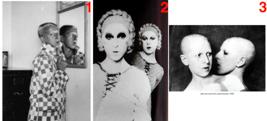
: 1- Claude Cahun, Self-portrait with mirror, 1928. 2- Claude Cahun, Self-portrait, 1929. 3- Claude Cahun, Que me veux tu? (What do you want from me?), 1929.
Cahun’s technical strategies for operating the duplicated appearance of the self include the use of mirrors and double exposure. The reflections seen in these images constitute a strategy traditionally used by philosophy to question appearances and the idea of a real world (Stoichita, 2000). The way these elements allow for the manifestation of the multiple is an important resource for deconstructing and critiquing identity as unique and cohesive. The photographs highlight the theme of ambiguity, undoing constraints that present themselves not only in the social understanding of gender and identities, but also those referring to the rules of photographic visual discourse. While the latter relies on the narrativization of the portrait of a subject in a single time and space, portraits like those in Figure 8 invite the viewer to linger on a multifaceted view of the other.
The double as a visual device that marks the disruption of the binary sex-gender can be further illustrated by the scene in The Danish Girl in which Lili attends a ball and publicly experiences her feminine identity for the first time. Lili’s stroll through the party, where few people know of her multiple identities, attracts many admiring glances and courtships. The character, by not being perceived as transgender, allows for an interrogation of the limits of gender. Additionally, there is the possibility of fabrication and reinvention through a duplicated subjective experience, given Einar’s not yet affirmed identity as a transgender person.
Lili’s “passing” in the ball scenes explicates the performative precarity of genders, installing indefinition and uncertainty that question binary sex-gender norms. The linguistic, material, and political formation of gender experiences is again highlighted, such that Lili’s character operates as a synthesis of the complex interplays between identification, identity, abjection, and difference.
Both in The Danish Girl and in Cahun’s photographic experiences, the deconstructive effect enabled by queer expressions in the field of gender identities is notable, as these pieces render expressions of gender malleable and fluid. They contribute, from the field of the arts, to glimpsing and questioning the normative apparatuses that make certain identity expressions intelligible. The notion of identity is problematized by making explicit the political aspects involved in the production of gender understanding, which allows for the production of focal points of resistance, expressed in the arts and in social reality, broadly speaking. Identities, as Butler (2019) proposes, begin to operate as a strategic marker for cultural and political transformation.
The presence of ambiguity, ambivalence, and multiplicity in photographic and audiovisual manifestations constitutes an important means for creating gaps in the norms for understanding modes of subject representation, which reveal themselves as transitory, precarious, ex-centric, and multiple. In this context, discussions around queer perspectives as a tool for identity questioning is consolidated. This is because it re-elaborates abjection through performative affirmations that intends not only to reverse processes of injury and invisibilization, but to call into question the entire cultural structure that defines the limits between the center and the margins.
Final considerations
In this article, we provided a kaleidoscopic view of queer visibilities in some photographic and cinematographic works of art, to better reflect on the non-assimilation of heteronormative identities. The characters discussed in the article were visually constructed through rhetorical games and modes of figuration, in which we perceive strategies such as the jocose employment of cross dressing, seen both in Duchamp’s portrait as Rrose Sélavy and in the film Pink Flamingos.
We consider these pieces to be visual discourses that exposed the artificiality and arbitrariness of the social construction of sex-gender binaries. Parody marked the modes for queer appearance in the photographs and films considered in the first part of this article. A different look at Claude Cahun’s images allowed us to broaden our critical perspective of more varied forms of self-fictionalization and to analyze the possibility of presenting oneself as multiple characters that exhibit ambiguous bodily, vestimentary, and behavioral gender characteristics.
The theatricalization of non-normative genders materializes the controversy surrounding the definition of the social self, which tends to present itself in a crystallized form in photography through identification portraits. In this way, specific works of photography and cinema allowed us to explore possibilities of fictionalizing appearance that occur beyond rigid social images and take place through various figures, amongst which the mask can be highlighted.
The mask is more than the accessory that enables the construction of ambiguous appearance and questioning of a subject’s essence through the pulverization of self-image. The mask is also a metaphor, understood as masquerade. Such a term led us to consider the existence of other performative layers of identities, which include elements like makeup, clothing, accessories, and gestures. These are components of a self-masking that interrogate the existence of binary and stable genders.
The importance of these new modes of revealing oneself is tremendous, as they exercise a role in questioning and create a clash between narratives, so as to allow for the visualization of other ways of being in the world. For this reason, we hope that studies like ours will strengthen a network of reflection on queer identities in the field of visual culture, aesthetic, and gender investigations. This is because artistic works push investigations of sex-gender determinations, which can be made visible to a broader public through fiction.
The modes of being and showing of visual works of art are often a pioneer in proposing ruptures in gender crystallizations. They perform the important exercise of imagining world possibilities to better comprehend gender, while simultaneously pointing to lines of flight. Photographs and films can be taken as places of passage in which one does not arrive at a fixed definition about the other, the subject, and gender, but rather are pieces of art that that destabilize knowledge. Artistic works point to other possibilities of desire and replace the presumed authenticity of fixed identities with transition, recreating possible paths for subjects.
References
- A GAROTA dinamarquesa. Direção: Tom Hooper. Produção: Working Title Films, Pretty Pictures, Revision Pictures e Senator Global Productions. EUA. 2015. 119 min. DVD.
- ANDERSON, Benedict. Comunidades imaginadas: reflexões sobre a origem e a difusão do nacionalismo. São Paulo: Companhia das Letras, 2008.
- AUSTIN, John Langshaw. Quando dizer é fazer palavras e ação. Porto Alegre: Artes médicas, 1990.
- BARBOSA, Anna Mae Tavares Bastos. A cultura visual antes da cultura visual. Educação, 34(3), Porto Alegre, 2011, p.293-301 [A cultura visual antes da cultura visual | Educação - acesso em 02 abr. 2025].
- BAKHTIN, Mikhail. Questões de literatura e estética: a teoria do romance. São Paulo: Hucitec, 2002.
- BENTO, Berenice. O que é transexualidade. 2ed., São Paulo: Brasiliense, 2012.
- BENTO, Berenice. A reinvenção do corpo: sexualidade e gênero na experiência transexual. Rio de Janeiro: Garamond, 2006.
- BERNARD, Jay. Not Simply Divine. Nova Iorque: Simon & Schuster, 1993.
- BLESSING, Jennifer (Org.). Rrose is a rrose is a rrose: gender performance in photography. Nova York, Guggenheim Museum, 1997.
- BOURDIEU, Pierre (org.). Un art Moyen: essai sus les usages sociaux de la photographie. Paris: Les Editions de Minuit, 2010.
- BRUJEIRO, Verónica. Claude Cahun: la máscara como nombre propio. Casa del Tiempo, 3(33), México, 2016 [casa_del_tiempo_eV_num_33_47_51.pdf - acesso em 02 abr. 2025].
- BUTLER, Judith. Corpos que importam: os limites discursivos do 'sexo'. São Paulo: n-1 edições, 2019.
- BUTLER, Judith. Problemas de gênero: feminismo e subversão de identidade. Rio de Janeiro: Civilização Brasileira, 2008.
- CAHUN, Claude. Disavowals or Cancelled Confessions. Cambridge: The MIT Press, 2007.
-
CHARE, Nicholas. Landscape into Portrait: Reflections on Lili Elbe and Trans* Aesthetics. Parallax, 22(3), 2016, p.347-365 [ https://doi.org/10.1080/13534645.2016.1201924 - acesso em 02 abr. 2025].
» https://doi.org/10.1080/13534645.2016.1201924 -
COLLING, Leandro. Mais definições em trânsito: teoria queer [ http://www.cult.ufba.br/maisdefinicoes/TEORIAQUEER.pdf - acesso em: 01 jun. 2023].
» http://www.cult.ufba.br/maisdefinicoes/TEORIAQUEER.pdf - COLLINS, Patricia Hill; BILGE, Sirma. Interseccionalidade. São Paulo: Boitempo, 2021.
- DAMÁSIO, Anne. Corporeidades trans: uma etnografia da construção do gênero por travestis e drag queens. Curitiba: Appris, 2021.
- DERRIDA, Jacques. Margens da Filosofia. São Paulo: Papirus, 1991.
- DOMINGUES, Bruno Rodrigo Carvalho; ERICK, Igor; CERVO, Matheus. Imagem, diversidade sexual e de gênero, decolonialidade: olhares ‘de fora do eixo’. Revista Fotocronografias, 7(15), 2017 [Imagem, diversidade sexual e de gênero, decolonialidade: olhares “de fora do eixo” — Apresentação | by Fotocronografias | Fotocronografias | Medium – acesso em 02 abr. 2025].
- DOWERAH, Swikrita; NATH, Debarshi Prasad. Exploring Selfhood through Performance in The Danish Girl. Journal of Creative Communications, 13(3), 2018, p.185-196 [Exploring Selfhood through Performance in The Danish Girl - Swikrita Dowerah, Debarshi Prasad Nath, 2018 - acesso em 02 abr. 2025].
- DOY, Gen. Claude Cahun, a sensual politics of photography. Nova Iorque: I.B. Tauris & Co. Ltd., 2007.
- ELKINS, James. Visual studies: a skeptical introduction. Nova Iorque: Routledge, 2003.
- EVANS, Jessica; HALL, Stuart (Org.). Visual Culture: the reader. Londres: SAGE Publications, 1999.
- FABRIS, Annateresa. Fotografia: usos e funções no século XIX. São Paulo: Edusp, 2008.
- FABRIS, Annateresa. Identidades Virtuais: uma leitura do retrato fotográfico. Belo Horizonte: Editora UFMG, 2004.
- HERNÁNDEZ, Fernando. Pesquisar com imagens, pesquisar sobre imagens. In: MARTINS, Raimundo; TOURINHO, Irene (Org.). Processos e práticas de pesquisa em cultura visual e educação. Santa Maria: Editora da UFSM, 2013, p.77-95.
- HERNÁNDEZ, Fernando. A cultura visual como um convite à deslocalização do olhar e ao reposicionamento do sujeito. In: MARTINS, Raimundo; TOURINHO, Irene (Org.). Educação da Cultura Visual: conceitos e contextos. Santa Maria: Editora UFSM, 2011, p.31-49.
- FREUD, Sigmund. O estranho. Edição standard brasileira das obras psicológicas completas de Sigmund Freud. Rio de Janeiro: Imago, 2006.
- GARCÍA, David Córdoba. Teoría queer: reflexiones sobre sexo, sexualidad e identidad. Hacia una politización de la sexualidad. In: CÓRDOBA, David; SÁEZ, Javier; VIDARTE, Paco (Org.). Teoría queer: políticas bolleras, maricas, trans, mestizas. Barcelona: Egales Editorial, 2007, p.21-66.
- HINTON, Kenneth. Breaking the Gender Barriers of Femininity and Masculinity: Developing a Trans/Queer Identity in The Danish Girl through a New Historicist Lens. International Journal of Arts, Humanities & Social Science, 2(9), 2021, p.52-60 [1631390903.pdf - acesso em 02 abr. 2025].
- HUTCHEON, Linda. A poetics of postmodernism: history, theory, fiction. Londres: Routlege, 1988.
- HUTCHEON, Linda. The Politics of Postmodernism: Parody and History. Cultural Critique (5), 1986, p.179-207 [(PDF) The Politics of Postmodernism: Parody and History - acesso em 02 abr.2025].
- JAGOSE, Annamarie. Queer theory: an introduction. Nova Iorque: New York University Press, 2005.
- KEEGAN, Cáel. History, Disrupted: The aesthetic gentrification of queer and trans cinema. Social Alternatives, 35(3), 2016, p.50-56 [keegan_soc_alt_vol_35_3.pdf - acesso em 02 abr. 2025].
-
KNAFO, Danielle. Claude Cahun: The Third Sex. Studies in Gender and Sexuality, 2(1), 2001, p.29-61. https://doi.org/10.1080/15240650209349169
» https://doi.org/10.1080/15240650209349169 - LACAN, Jacques. O Seminário, livro 11: os quatro conceitos fundamentais da psicanálise. Rio de Janeiro: Jorge Zahar Editor, 1979.
- LEITE JR., Jorge. Nossos corpos também mudam: a invenção das categorias 'travesti' e 'transexual' no discurso científico. São Paulo: Annablume, 2011.
- LEPERLIER, Franc¸ois. Claude Cahun: l'e´cart et la me´tamorphose. Paris: Jean-Michel Place, 1992.
- LLABATA, Carmen Senabre. Claude Cahun: el tercer sexo o la/s identidad/es al desnudo. Dossiers Feministas, Castellón de la Plana (28), 2014, p.79-92.
- LOURO, Guacira Lopes. Um corpo estranho: ensaios sobre sexualidade e teoria queer. Belo Horizonte: Autêntica, 2008.
-
LOURO, Guacira Lopes. Teoria queer: uma política pós-identitária para a educação. Revista Estudos Feministas, 9(2), Florianópolis, 2001, p.541-553. https://doi.org/10.1590/S0104-026X2001000200012
» https://doi.org/10.1590/S0104-026X2001000200012 - MISKOLCI, Richard. Teoria queer: um aprendizado pelas diferenças. Belo Horizonte: Autêntica & UFOP, 2012.
- MISKOLCI, Richard. Não ao sexo rei: da estética da existência foucaultiana à política queer. In: SOUZA, Luiz Antônio Francisco de; SABATINE, Thiago Teixeira; MAGALHÃES, Boris Ribeiro de (Org.). Michel Foucault: sexualidade, corpo e direito. Marília: Oficina Universitária; São Paulo: Cultura Acadêmica, 2011, p.47-68.
- MIRZOEFF, Nicholas. An introduction to Visual Culture. Londres: Routledge, 1999.
- MIRZOEFF, Nicholas (Org.). Visual culture reader. Londres: Routledge. 1998.
- NAPIER, David. Masks, transformation, and paradox Berkeley e Los Angeles: University of California Press, 1986.
- PELÚCIO, Larissa. Traduções e torções ou o que se quer dizer quando dizemos queer no Brasil?. Revista Periódicus, 1(1), Salvador, 2014, p.68-91 [Traduções e torções ou o que se quer dizer quando dizemos queer no Brasil? - acesso em 02 abr. 2025].
- PINK flamingos. Direção: John Waters. Produção: Dreamland. Baltimore, Maryland, EUA. 1972. 93min. DVD.
- PRISCILLA, a rainha do deserto. Direção: Stephan Elliott. Produção: MGM. São Paulo: Fox Filmes. 1994. 103 min. DVD.
- RIVIERE, Joan. A feminilidade como máscara. Traduzido por Ana Cecília Carvalho, Esther Carvalho. Psyche (Sao Paulo), v.9, n.16, p.13-24, 2005 [A feminilidade como máscara - acesso em 02 abr. 2025].
-
RODRÍGUEZ-SALAS, Gerardo. Frankenstein's Self-Portrait: Politicizing Transsexualism in The Danish Girl. ATLANTIS: Journal of the Spanish Association of Anglo-American Studies, 44(1), 2022, p.74-91 [ https://doi.org/10.28914/Atlantis-2022-44.1.05 - acesso em 02 abr. 2025].
» https://doi.org/10.28914/Atlantis-2022-44.1.05 - SÁEZ, Javier. El contexto sociopolítico de surgimiento de la teoria queer: de la crisis del SIDA a Foucault. In: CÓRDOBA, David; SÁEZ, Javier; VIDARTE, Paco (Org.). Teoría queer: políticas bolleras, maricas, trans, mestizas. Barcelona: Egales Editorial, 2007, p.67-76.
-
SAN FILIPPO, Maria. Female Trouble: Representing Transwomen in The Danish Girl and The New Girlfriend. Journal of Bisexuality, 16(3), 2016, p.403-407 [ https://doi.org/10.1080/15299716.2016.1199843 - acesso em 02 abr. 2025].
» https://doi.org/10.1080/15299716.2016.1199843 - SANGSUE, Daniel. Parody's Protean Guises: The Evolution of a Concept from Antiquity to Modern French Literature. Journal of the Australasian Universities Language and Literature Association, 97(1), 2002, p.01-21 [PARODY'S PROTEAN GUISES: THE EVOLUTION OF A CONCEPT FROM ANTIQUITY TO MODERN FRENCH LITERATURE. - acesso em 02 abr. 2025].
- SCHAEFFER, Jean-Marie. Portraits singulier pluriel 1980-1990: le photographe et son modèle. Paris: Éditions Hazan, Bibliothèque Nationale de France, 1997.
-
STEWART, Jay. The Danish girl. Journal of Family Planning and Reproductive Health Care, 42(2), 2016, p.163. DOI 10.1136/jfprhc-2016-101458
» https://doi.org/10.1136/jfprhc-2016-101458 - STOICHITA, Victor. Brève histoire de l'ombre Genebra: Droz, 2000.
- SUMMERS, Claude (Org.). The queer encyclopedia of film & television. São Francisco: Cleis Press, 2005.
- SUMMERS, Claude (Org.). The queer encyclopedia of the visual arts. São Francisco: Cleis Press, 2004.
-
SWAIN, Tania Navarro. Para além do binário: os queers e o heterogêneo. Gênero, 2(1), Niterói, 2001, p.87-97 [ https://doi.org/10.22409/rg.v2i1.287 - acesso em 02 abr. 2025].
» https://doi.org/10.22409/rg.v2i1.287 - TAGG, John. El peso de la representación: ensayos sobre fotografías e historias. Barcelona: Gustavo Gili, 2005.
- TSEËLON, Efrat. Masquerade and identities: essays on gender, sexuality, and marginality. Londres: Routledge/Harvard, 2001.
- WITTIG, Monique. La pensée straight. Questions féministes (7), 1980, p.45-53 [LA PENSÉE STRAIGHT on JSTOR - acesso em 02 abr. 2025].

 Source:
  Source: Pink Flamingos, 1972.
 Source: Pink Flamingos, 1972.
 Source: Shelley (1999:98).
 Source:
  Sources: 1-
  Source: The Danish Girl, 2015.
 Sources: 1-