
 Utopias and dystopias: the city we have and the city we want to age in
Abstract
By 2050, the global population over 60 years of age will have grown from 841 million to 2 billion. This raises the question: Are cities prepared to meet the biopsychosocial needs of aging? This study, based on the concepts of Dystopia and Utopia, and on the testimonies of 15 older adults from different regions of the city of São José dos Campos, state of São Paulo, Brazil, aims to analyze their perceptions of the current city and their vision of an ideal city to age. The findings show that the challenges are already significant and will intensify, demanding integrated public policies to ensure the rights of older people. In this context, projecting utopias means believing that a better world is not only imaginable, but also achievable.
Keywords:
urban planning; rights of older people; population aging; urban expansion
Resumo
Até 2050, a população mundial com mais de 60 anos passará de 841 milhões para 2 bilhões. Diante disso, questiona-se se as cidades estão preparadas para atender às demandas biopsicossociais do envelhecimento. Este estudo, baseado nos conceitos de distopia e utopia e em depoimentos de 15 idosos de diferentes regiões de São José dos Campos/SP, tem como objetivo analisar suas percepções sobre a cidade atual e a projeção de uma cidade ideal para envelhecer. Conclui-se que os desafios já são grandes e tendem a crescer, exigindo políticas públicas integradas que garantam os direitos da pessoa idosa. Projetar utopias, nesse contexto, é acreditar que um mundo melhor não é apenas pensável, mas realizável.
Palavras-chave:
planejamento urbano; direitos da pessoa idosa; envelhecimento populacional; expansão urbana
Introduction
Aging and urbanization are central issues of the twenty-first century. Currently, half of the world’s population lives in urban areas, a proportion expected to double by 2050, according to the United Nations (UN). At the same time, population longevity increased considerably throughout the twentieth century as a result of technological progress, improved basic sanitation, and advances in health care, leading to higher life expectancy and a growing number of people living beyond 100 years of age (Alves, 2017).
This study places the concepts of utopia and dystopia at the center of the interpretation of the narratives and lived experiences analyzed. The notion of utopia, formulated by Thomas More in 1516, refers to the projection of a “no--place,” idealized as a space of social harmony and justice. In contrast, dystopia designates contexts in which utopian ideals are distorted or corrupted, revealing inequalities, exclusions, and contradictions – a phenomena widely examined by contemporary thinkers such as Bauman (2009) in analyses of uncertainty and fragmentation in the modern world.
In Brazil, the elderly population currently exceeds 29 million people and is expected to reach 73 million individuals aged 60 years or older by 2060, representing an increase of 160% (Seade, 2019). According to the World Health Organization (WHO), as reported by the Brazilian Society of Geriatrics and Gerontology (SBGG, 2019), a country is considered aging when 14% of its population is aged 65 or older. While this threshold took 115 years to be reached in France and 85 years in Sweden, in Brazil this transition is expected to occur in little more than two decades. The country is projected to become an aging society by 2032, when approximately 32.5 million Brazilians will be 65 years of age or older.
São José dos Campos (SJC) has a population density of 178.5 inhabitants per km2 and a degree of urbanization of 96.4% (Seade, 2019). The municipality functions as a nodal point within the urban-regional system of the Vale do Paraíba, interconnecting three metropolitan regions in the state of São Paulo (São Paulo, Campinas, and Baixada Santista).
This study aims to highlight representations of the city articulated by older adults in both their real and utopian dimensions. Specifically, it examines the critiques expressed by elderly residents of SJC regarding the urban spaces they inhabit, as well as the desires for spaces and cities articulated within the utopian imaginary, in order to reflect on which cities can be built. The study1 includes life narratives from 15 older adults residing in different regions of the city. Inclusion criteria comprised individuals aged 65 years or older who were aging in SJC. Participant anonymity was ensured through the use of alphanumeric codes consisting of the letters “PP” (Research Participant) followed by the interview number (PP1, PP2, PP3, and so forth).
Narratives are not free from ideology, nor do they constitute a pure representation of reality; however, they offer a privileged means of accessing lived complexity, as they synthesize everyday experiences and perceptions that come closest to social reality. Several participants described the city as “inhumane” (PP1, PP5, PP6, PP14) and expressed dissatisfaction with local political dynamics, noting that “policies are not really aimed at workers” (PP5).
In light of these demographic transformations, a central question emerges: are cities prepared to meet the needs of a growing aging population? As longevity increases alongside accelerated urbanization, urban environments face the challenge of ensuring autonomy, accessibility, and quality of life for older adults through integrated public policies, services, and infrastructure.
The rights of the elderly in Brazil
In this study, public policy is understood in accordance with the conceptual framework proposed by Iamamoto (2007). For the author, public policies constitute fundamental mediations through which the State intervenes in the expressions of social issues. They do not emerge in a neutral manner; rather, they are products of power relations permeated by antagonistic interests that characterize capitalist sociability. As Iamamoto notes, “[…] social policies are mediations through which the State intervenes in social issues, expressing the interests under dispute in society” (ibid., p. 154).
From this perspective, public policies cannot be understood merely as administrative or technical responses, but rather as political and institutional instruments that incorporate contradictions, disputes, and competing social projects. They function simultaneously as mechanisms to mitigate the effects of inequality and as potential spaces for the expansion of citizenship and rights, depending on the political orientation adopted by the State at specific historical moments. Thus, public policy is no longer conceived as the simple provision of services, but as a concrete expression of how the State addresses the structural conflicts of society, particularly those related to class, gender, race, territory, and generation.
At the end of the 1980s, the aging of the population was the exclusive concern of professionals in the demographic, medical, and social fields who produced reflections, studies, and actions regarding aging, longevity and old age (Machado, 2010). They were concerned about aging, the lack of social protection and public investments for the segment. In turn, pensioners and retirees were already organized into associations of retirees and pensioners and federations that actively participated in the Constituent Assembly in 1988. In the professional aspect, courses in gerontology and geriatrics, universities open to the elderly and care programs for the elderly in private institutions were created. Laws were also created such as: the Organic Law of Social Assistance – Loas (Brasil, 1993); the National Policy for the Elderly – PNI (Brasil, 1994); the National Council for the Rights of the Elderly – CNDI (Brasil, 2022); the Statute of the Elderly, (Brasil, 2003) and other provisions.
On the one hand, although there are policies to support the elderly, on the other hand, there is no political culture to protect this segment. Between utopia and dystopia, the imaginary projection of a just society is opposed to the dystopian reality experienced, leading us to believe that regulatory frameworks, despite being considered social advances, are still far from promoting social justice.
Urban expansion and inequalities in SJC
The municipality of SJC is today one of the nodal points of the urban-regional system of the Paraíba Valley that interrelates, to the east of the state of São Paulo, its three metropolitan regions (São Paulo, Campinas and Baixada Santista) with the important axis of urban development that became the Dutra route after 1950.
In the context of a review of municipal legislation, carried out in 1951 to attract new industries, and the provision of the state government for an agreement signed with the Center for Urban Planning and Studies (CPEU) of the Faculty of Architecture and Urbanism and Design of the University of São Paulo (FAU-USP) in 1958, SJC has the first Master Plan (published in 1961), which sought to prepare the city for the socio-spatial and urban impacts on the urban fabric caused by the highway and large companies (Santos, 2006, p. 66).
At that time, in the 1950s, the headquarters of the Technological Center of Aeronautics (CTA) had already been installed; and in the 1960s, the National Institute for Space Research (Inpe), in 1961, as well as the Brazilian Aeronautics Company (Embraer) in 1969. New large industrial units began to be located in the vicinity of the via Dutra, with emphasis on the telecommunications, chemical and pharmaceutical, automotive, electronic, aeronautical and military sectors, and oil refining, with the installation of the Henrique Laje refinery in 1982 (ibid., pp. 50-55).
Rural properties, located on the banks of the Dutra highway, "[...] gradually became the object of intense real estate speculation, in particular, the land closest to the urbanized area" (ibid., pp. 50-51). In the countryside, new spaces were reserved for the expansions of urbanization. A new city emerged on both sides of the highway, a patchwork in a clearly fragmented urban fabric (ibid., p. 66). The process of urbanization caused by the economic dynamics since 1950 stimulated the arrival of people from the various regions of the country and, with it, the housing issue unfolded, with the emergence of clandestine subdivisions. At the same time that the city reaffirmed its national importance, consolidating itself as a diversified and specialized industrial park, in a broad process of verticalization (ibid., p. 68), the Integrated Master Plan, published in 1969-1970, already emphasized the need to control urban expansion.
In the 1980s, the country experienced a period of stagnation due to an aggressive retraction of industrial production. In this context, there was an expansion and predominance of the service sector, with significant consequences on the spatial restructuring of SJC. The growth of the urban area began to occur through discontinuous or sprawling forms of urbanization.
On the one hand, there was a tendency to approve high-standard closed subdivisions from the 1980s, with a clear concentration in the western region of the city and, recently, in the northern region (Maria, 2008). On the other hand, the eastern region of the city registered the highest concentration of clandestine subdivisions, while the southern region, more particularly the Chácaras Reunidas and Eldorado neighborhoods, tended to house a dispersed structure of microenterprises and small industries.
In a period marked by privatizations (telecommunications; Dutra; Embraer), due to the increase in large commercial and service units and the expansion of informal markets, the city became the object of new normative redefinitions, but it did not stop growing due to the same mechanisms of speculative retention and subsequent occupation of urban voids and expansion of its urbanized edges, as Costa's (2019) calculations show us.
In the early 2000s 43% of SJC households had monthly incomes of up to three minimum wages, with this percentage reaching 70% precisely in the areas of slums and irregular occupations in the extreme south and east of the city, as well as in some other more peripheral locations to the north. On the other hand, more than 60% of households with incomes above ten minimum wages were located, on the same date, in neighborhoods in the central-west axis of the city (Vila Adyana, Esplanada, Aquarius and Urbanova) and also in the neighborhoods of Vista Verde (east 2) and Jardim das Indústrias (west), both located in the vicinity of via Dutra (PMSJC, 2012).
Understanding urban transformations and socio-spatial inequalities in SJC requires considering recent demographic changes, which directly affect the demand for public policies, urban infrastructure and forms of land occupation. The evolution of population age composition reveals important structural trends, such as progressive aging and the relative reduction of younger groups, as described in Figure 1.

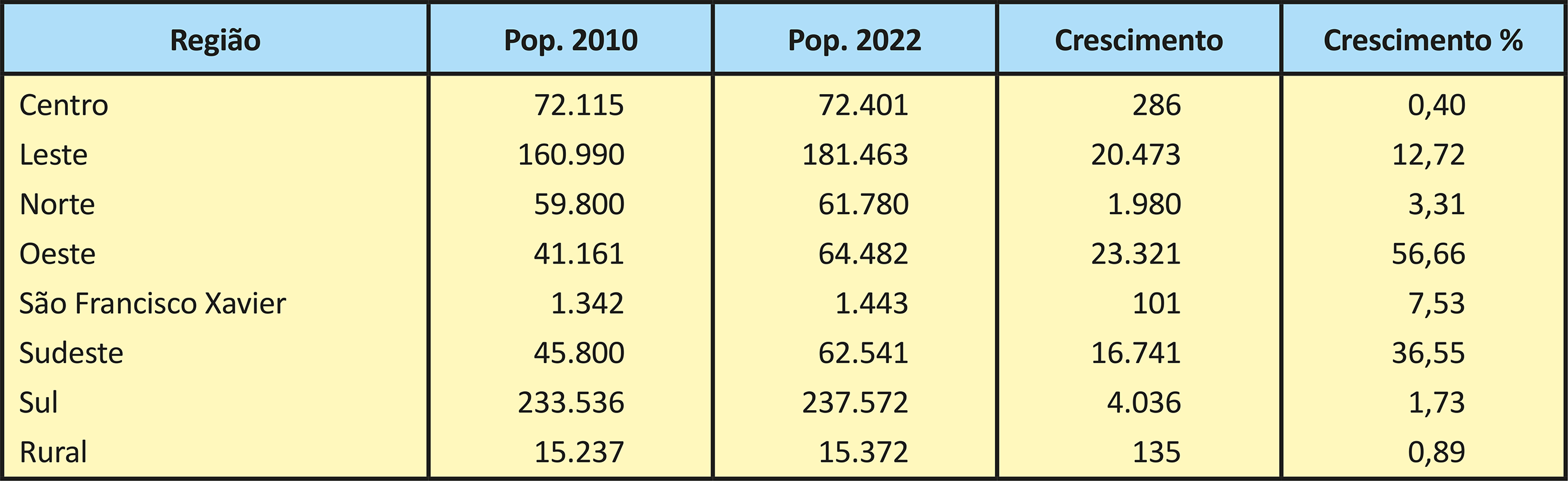
The joint analysis of population growth by regions between 2010 and 2022 (Figure 2) and the spatial distribution shown in Figure 3 allows us to identify structuring processes of the production of SJC urban space. It is noted that the western and southeastern regions registered the highest growth percentages, 56.66% and 36.55%, respectively, revealing areas boosted by the formal real estate expansion, especially by closed lots and medium and high standard projects, a phenomenon already pointed out by Maria (2008) as a mark of the "selective urbanization" of the municipality.


In contrast, regions such as the downtown (0.40%) and rural areas (0.89%) show stagnation or marginal growth, while the eastern region, with growth of 12.72%, remains as a territory marked by the historical presence of clandestine subdivisions and peripheral expansion, as already observed by Santos (2006).
Figure 3 shows the distribution of average income per household in the municipality, represented by a color scale ranging from the lowest to the highest values. Areas in darker shades correspond to higher income brackets, while lighter shades indicate lower average income. The representation allows visualizing the spatial variation of income between different neighborhoods or census sectors, highlighting areas of greater economic concentration and areas with less financial capacity of households.
Studying the spatial distribution of poverty in SJC, Borges (2003) concludes that, although it is a developed municipality, rich and home to high-tech companies, the urban poverty map reveals a great socio-spatial inequality and a “hidden city” of poor people, “[...] left to their own devices, living irregularly, outside the law, without access to infrastructure, in addition to having low education and low income” (ibid., p. 330). Considering the distribution of social facilities and urban parks of interest to the elderly, as shown in Figure 3, there is a relative better distribution of basic health units in regions with a relative absence of hospitals, or, in other words, there is a concentration of hospitals in the richest areas of the city, as well as the existence of Casa do Idoso in three locations and urban parks where living conditions are better.
Taking into account that interurban mobility for the poor and the elderly is structurally more difficult in cities that have grown according to a socially unequal and urbanistically spread and fragmented model, the concentration of equipment and parks happens precisely where the mobility conditions are the best, which, in the case of SJC, coincides with the regions where there is a greater presence of high-income elderly and, only in part, a greater predominance of elderly residents (downtown 2), not coinciding, therefore, with the regions where there is a greater presence of low-income elderly.
Thus, it is possible to verify the existence of socio-spatial segregation and admit its deliberate production by the government and other social agents who were somehow favored by it. The projected image of the city of SJC as a technological pole, with a high Human Development Index (HDI), is not consistent with the real needs of people who experience the aging process in its most varied places. In this sense, it is worth reflecting on whether there are, in fact, social and urban policies concerned with meeting the demands of the elderly and, above all, of a population that tends to age in the coming decades.

The ideal and real city for the elderly
The work Utopia, by the british More (2004), was written in 1516, a period of transformation from the feudal to the capitalist system. Disenchanted with the dystopian reality in which he lived, where the countryside was organized by another logic, one of exploitation of the workforce and expropriation of the peasant population, More, as chancellor of King Henry VIII, saw, through his lens coated with religiosity, the devastating cruelty of that transition scenario caused by land enclosure.
Utopia is a neologism that arises from the association of the word topos (of Greek origin), which means place, with the negative prefix “u”, would be something around no-place and resisted time, lending its meaning to idealized, implausible, impractical conditions.
About 350 years after More's work was published, another Englishman, the philosopher and economist John Stuart Mill, was one of the first to mention the word “dystopia” during a speech in the British parliament in 1868. His goal was to denounce the government's land policy in Ireland, whose officials, in his opinion, should be called “dys-topics”, for proposing something impractical, therefore bad (Geetha, 2014).
Dystopias are the disorders of the contemporary world, veiled by the supposed social asepsis. These are negative utopias that can seem true every time we recognize situations in our daily reality that seem to give reason to the dark pessimism of our reality (Eco, 2013, p. 310).
Based on the theoretical review and on discourse analysis, the construction of word clouds (Figures 5 and 7) elaborated from the main terms associated with the notions of utopia and dystopia discussed in this section is presented. The objective is to visually synthesize the conceptual axes that structure the analysis, highlighting the relationships between desire, projection of the future, social order, inequality, and criticism of urban forms.

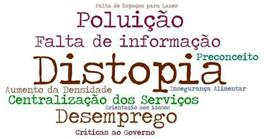
From the perspective of this study, utopia and dystopia will be treated as categories of analysis in the manner thought by Bobbio (1992), as a methodological resource to reflect on the certainty of a not so distant future.
Having as reference that utopia is limited to the desire for a better life (materialized in myths and imaginary projections) and that it was translated to think about social parameters, rules of city organization and city politics, this study aims to scrutinize the speeches and desires of the elderly, as well as the projections of cities, which carry subjective values.
Utopia means a rupture with the old standards of society and proposes, through a narrative goal, the search towards the ideal model of society, in which man is endowed with the capacity and strength not only to know reality, but above all to transform it (Chauí, 2016, p. 34).
The municipality of SJC is part of the first settlements in the region, created from a Jesuit settlement to reduce indigenous people. Its development was slow, as it did not have great expression in coffee production, an activity that enable the advancement of the region. Thus, its development leap took place in the mid-twentieth century, with the arrival of the Presidente Dutra highway, the Aerospace Technical Center (CTA) and the Technological Institute of Aeronautics (ITA), becoming, from the 1970s, a technological, scientific, and informational pole. Currently, SJC has important teaching and research centers, such as the Institute for Advanced Studies (IEAv). Figure 6 shows the geographic regions of the city.

In 2014, the municipal population was estimated by IBGE at 681,036 inhabitants, being this year the seventh most populous municipality in São Paulo and the twenty-seventh in the entire country. According to municipal data, 98% of the inhabitants live in the urban area. In 2010, the HDI was 0.807, considered high in comparison with the rest of the country, being the twelfth highest in the state (IBGE, 2010).
With projections of growth in the aging rate, it is worth reflecting on whether the public and social policies of the municipality meet the demands of this population. In this sense, this section discusses utopia and dystopia, based on narratives of the elderly, to assert the criticisms of real cities and the projections of the city that one wants to reach.
To the same extent that More (2004) used the emerging awareness of otherness to legitimize the invention of other spaces, with other people and different forms of organization, the narratives of common subjects will be validated as projecting, in the imagination, the dreams and hopes of other spaces loaded with subjectivities. To this end, the technique of collecting the life histories of the elderly from different regions of the city of SJC was used. The criterion for choosing participants was based on the snowball technique, in which one participant indicates another. As it is a life story, a pre-established script was used to guide the dialogue, with no intention of limiting the participants' narrative. Data collection was done after approval by the Research Ethics Committee (REC). Due to the covid-19 epidemic and social isolation, the interviews were conducted using the mobile phone and recorded with the consent of each participant. Although the research was carried out with 15 people, the most expressive statements on the points addressed in the analysis and interpretation of life stories were used in a qualitative way.
The analysis and interpretation of the (transcribed) narratives of the elderly were carried out in the light of the fundamental theories of this study, considering the possibility of agglutination of contents and articulation of the information made available, both with the theoretical foundation and with the socio--historical, political, economic and cultural contexts. We sought to understand the individual characteristics of the participants, without losing sight of the analysis of all the subjects involved in the research.
Knowing the socioeconomic profile of the research subjects contributed to the process of reflection on the narratives of the elderly people who participated in this research. Of the total of 15 interviewees, 73% were female and 27% were male. Regarding age, 20% of respondents are between 60 and 64 years old and 27% of respondents are between 65 and 69 years old. Those aged 70-74, as well as those aged 75-79, represent 20%; respondents aged 85-89 represent 13% of the total.
Regarding the education of the interviewees, most (27%) have completed higher education, followed by 20% who have incomplete higher education, in addition to 20% having incomplete elementary education. Those who declared themselves illiterate represent 7%, while 13% have completed elementary school, and 13% have completed high school.
Regarding the source of income, 87% of respondents say they are retired, while 13% maintain other income – mainly from commerce. Still on income, more than half (54%) receive above R$3,001.00 and 13% have an average income of around R$251.00 to R$1,000.00. 33% of the respondents claim to have income between R$1,001.00 and R$3,000.00.
The second word cloud concentrates the axes that guided the empirical analysis of the narratives of the elderly participants in the research. Here, terms related to the subjective and material dimensions of the urban experience appear, such as quality of life, access, income, segregation, perception of territory, urban memory and aging conditions. Unlike the first cloud (Figure 5), which operates in the abstract, it functions as a methodological organizer (Figure 7).
PP1, 70, highlighted in his testimony the cruel process of dehumanization caused by neoliberalism, which annihilated the trade union movement, class consciousness, and deteriorated the physical space of the city. PP1 is retired, with a higher education, was a factory worker and trade unionist, one of the founders of the Workers' Party (PT) and the Unified Workers' Central (CUT) in the region. Today, he lives in the city downtown, but he lived for a long time on the outskirts, where he militated for the union.
PP1's narrative expresses his life story, linked to the struggle for social rights. For him, although the city has important public universities in the area of dentistry and technology and has improved in terms of infrastructure, it lacks public courses in the area of Humanities and Social Sciences. For him, this issue – associated with the fact that the city is located in a national security area and is one of the largest technology poles and industrial center of significant neoliberal tendency – prevents class consciousness.
The issue of lack of awareness of reality also appears in the testimony of two black women (PP5, PP8), residents of peripheral neighborhoods in the southern region, who mentioned social differences, racism and social apartheid. PP5 had to change cities due to prejudice. Born in São Lourenço, she came from Minas Gerais to SJC to work, because she was troubled by the racism she was a victim of. For 30 years in the city, she has been retired, 61 years old, married, lives in a rented house, has incomplete higher education, worked in hospitals and public sectors of basic assistance toneighborhoods such as Campo dos Alemães and Santa Cruz, of SJC. The interviewee observed "there were many young people who had little education in terms of life, in terms of reality, conditions, public policies that did not exist" (PP5, 2020). She has created groups of underprivileged adolescents to provide specialized medical care, aimingfor them to become multipliers of awareness of access to public policies and social rights.
PP5's involvement with young people is an expression of her life history, as she was welcomed by charity sisters in exchange for work. Her work in the periphery made it possible to contact an adverse reality of the one she dreamed of in Minas Gerais, when she sought SJC to reside and found that “inequality is huge”:
[...] I left a world of difficulty, and arrived at one that seemed like everything was beautiful, wonderful and, when I returned, I said: "but here one cannot live, with such situations, with open sewage". This, at the time I went there [Campo dos Alemães Neighborhood, South Region], was still like that, with open sewage; when I went from the hood to downtown there was light, from downtown to the hood it was darkness, it bothered me a lot and it still bothers me, because the inequality was glaring. (PP5, 2020).
Also for PP8 (2020), “SJC is a racist city. It is a city that does not give much chance to black people”. This participant, a racial rights activist, laments the weakening of the black movement in the city. PP5, PP8 and PP6, all residents of low-income neighborhoods, mention the neglect of municipal power in relation to public policies to meet the demands of the poorest regions: “There [in the Campo dos Alemães neighborhood] it is very difficult. The government forgot us. It is as if to say: there is nothing else to do” (PP5, 2020).
PP6, community leader, former resident of Pinheirinho – an irregular occupation that suffered, in 2012, the most violent repossession in the country –, now a settled resident of the Pinheirinho dos Palmares neighborhood, says:
Our city is very inhumane. They [the mayors] leave these places unsecured. But it seems like it's done on purpose, right? Like an island. When the government goes to make houses for poor people, they make an island, they do it there at the outskirts. To work you have to take two trams, you have to go far, so it was very difficult. I think the neighborhoods had to be more integrated. I think the ideal city to live in would be a more humane city. (PP6, 2020)
PP6 is 62 years old, born in Paraná, where he worked with grassroots communities. Retired, he lives with his wife and two children in his own house, in the southeast region, where he took up residence after the request for repossession of the lands of Pinheirinho (southern region), where he lived. A national militant of the Homeless Movement (MST), he experienced the removal of the communities from Vidoca, a noble region that today accommodates the Colinas shopping mall, the Regaço and Pinherinho favelas. He worked in metallurgy and became director of the Metallurgists Union, where he stayed for 20 years. He helped found the Trade Union and People's Central and was the National Executive of the Unified Socialist Workers' Party (PSTU) after leaving the PT. In his testimony, PP6 mentions peripheral neighborhoods as urban islands, as non-places. They are sustained and reproduced through socio-political-economic processes that take into account the multiple particular interests, charged with a considerable dose of social control. It is, as Harvey (2009, p. 205) said, “... the supreme rationality of the market versus the foolish irrationality of everything other than the market. We, the people, do not have the right to choose the type of city we are going to inhabit.”
The statements of PP12 and PP14 are elucidating when it comes to the geography of exclusion. These research participants are residents of Jardim Nova Esperança, a non-regularized central neighborhood, located in Banhado, Environmental Preservation Area (APA) since 2002. PP12 and PP14, who have resided for more than two decades in an area considered a postcard of the city, are currently under pressure from the municipal administration to sell their homes.
Despite residing in the city downtown, PP12, a resident of Jardim Nova Esperança,feels isolated and forgotten by the government and brings us to the issue of the island mentioned by PP6, a former resident of Pinheirinho. It is evident that it is not the geographical distance that defines the condition of neglect of the public sector.
PP14 recalled the concept of equal rights and rights to the city, which leads us to think about how the city is produced unevenly. The right to the city, to which the elderly refer, has the same connotation discussed by Lefebvre (2009, p. 117), when he emphasizes that "the right to the city is affirmed as an appeal, as a demand" – and not in the legal sense –, in a moral demand based on principles of justice, but on the rights to housing, transportation, use of public facilities, participation in local decisions, among others.
Because they live in an unregulated neighborhood and do not have proof of residence, many residents of Nova Esperança do not get jobs and, when they do, the mere mention of the place of origin is a reason for declining the employment contract. PP12 reports: “I've already missed out on many jobs. Many young people do not get jobs because they live here and then employers give the excuse that they are not in need, but we know that, deep down, the issue is where you live” (PP12, 2020). PP14, a resident of Nova Esperança, adds: “We are completely forgotten by the government. The only thing the government wants from us here is to get us out of here and then turn this into a new city” (PP14, 2020).
The residents of Nova Esperança live the ambiguity of territorial inclusion and social exclusion, which accumulates diverse deficiencies and vulnerability. PP6 and other participants commented on the municipality's revenue and the government's prioritization of central areas. The high investments with the newly built Arc of Innovation, in a noble region of the city, were commented on by some deponents: “São José is one of the richest cities in the country; what is expected of the city is basic assistance for families,2 but they preferred to spend on a bridge, or 250 million reais for lighting3 (PP6, 2020).
Regarding elderly care services, PP7, a resident of the district of Eugênio de Mello, a neighborhood leader, believes that “SJC offers a lot to the elderly, but not everyone has the knowledge of the rights they have and what the city can offer, because they are isolated, they do not participate, they do not integrate” (PP7, 2020). For PP7, the city is well equipped with the Social Assistance Reference Center (Cras), the Guardianship Council, the supportive neighborhood. In her conception, the only thing that is missing in the city is a geriatric hospital, “because it would give greater support to the elderly” (PP7, 2020). PP7 is very active, attends the Casa do Idoso, participates in choir, theater, gypsy dance, and belly dance courses. She is 75 years old, retired and widowed, owns her own house and believes that "SJC is great to livein" and that the city does not do more for the elderly population because it receives many people from outside, which increases the demand for public services.
Regarding the expectations of an ideal city to live in, the desires do not go beyond those recommended in the Federal Constitution, in urban landmarks, in the City Statute and in the Elderly Statute (Brasil, 2003). PP14's biggest desire is to have proof of residence to get a job. She also desires for:
[...] the city hill to give us attention, to come here and legalize [the neighborhood] for us, to make a proper sewer for us. This is something that touches a lot on people's hearts, we are suffering, we depend on minimum wage, and we also have to go through such difficulty. (PP14, 2020)
PP6 speaks of social equity and equal opportunity for all, without distinction:
We can't be better than others, we have to be like others. What we want, is for the whole city. We want buses, we want security, we want work, for the whole city. That's why, when I talk about equality, I talk about employment, about a more humane city. (PP6, 2020)
PP6's speech is in line with what Harvey (2009, p. 207) says when he points out that “... the images of city and utopia have long been intertwined ... utopias were given an indistinctly urban form, and much of what passes for urban or city planning has been infected by utopian modes of thought”. It is, at the very least, disturbing to distance oneself from the cruel reality of the majority of the population, especially the elderly population, with the rights advocated by the regulatory frameworks.
For PP1 (2020), the ideal city to live in is one in which there is “distribution of social wealth”, universalization of education and public health and the commitment of governments to “serve the whole of society”, offering “model housing for all”.
With the exception of two deponents living in the western zone, a noble area of the city, the others complained about public transport, sometimes due to bus shortages, crowded lines, or disrespect for the elderly. PP6, a community leader, is outraged by mobility in the city and argues: “SJC is in a position to have much better public transport. I'm talking about the capacity that SJC has, the wealth that SJC has” (PP6, 2020). PP3, widow, 87 years old, retired, living in the northern region in her own house, also manifests: “today is becoming difficult to ride the bus, even for the elderly. People are criticizing the elderly” (PP3, 2020).
Most of the elderly complained about the health service offered by the municipality, as there is a delay in scheduling appointments, disrespect for the elderly, inefficient care, lack of investment. On this issue, the two residents of the western region who have health insurance did not complain. For them, the city is perfect for meeting the demands of the elderly: “SJC is the best city in the world, the most beautiful city, the most welcoming city, that's what we think. I think our city is great. I think it cannot change, any change will spoil it” (PP13, 2020). The contrasting perception of these residents about the city, in relation to the other participants, reveals to whom the rights to the city are destined.
The political activism of PP1 and PP6 is mixed with the personal history of each one and with the trajectory of the social movements (union and MST) in SJC. About his relationship with the city, for PP1, “my city is the world; I never had relatives here in SJC, but I raised a big family. I did not know the elite of the city, I did not attend the noble side of the city, my people was the people of unionism, of the popular movement, these were my people!” (PP1, 2020).
PP2, who had her life involved with the Catholic Church, is proud to have spiritually helped the northern region, where she resides, and to have served the priest of the headquarters: “In Santana, I helped the priest, I helped the pilgrims to organize the procession. The Church was my home. My life was serving the people” (PP2). The issue of mobility seems to be the biggest problem for PP2. In this sense, owning a car, or having someone from the family own a car, makes it easier to get around the city, especially when you need medical assistance.
PP3, widow, retired from Weiss pottery, disagrees with PP2 and says that growing old in the city of SJC was better in the past, as it was a quiet and peaceful city:
I have no doubt about that [...] There were no burglars [...] neighbors were few [...] no one would steal anything. The people rode, most of them, on bicycles, they didn't even have cars [...]. Now there are buses everywhere. But it's worse, because you already thought you would rush everywhere, getting old with all this rush is not easy, you see. So, the city grew, you know, it increased [the number of houses] a lot. Today [the neighborhood] it's a city itself. (PP3, 2020)
Regarding health care, PP4 says:
For me, it is very difficult [to grow old in SJC]! Because I have a lot of exams to do, the health service here sucks! Every Mayor who enters into office says that he will do this, he will do that, and does nothing! I "been" waiting to take this thing out [lump on the neck]. They don't call me, for me it's a make-believe job, they don't solve anything... so, I don't think São José is a good place to grow old, no. Because I don't have any perks, in terms of health, I really don't! (PP4, 2020)
Something interesting, in the narratives of the elderly, is how space, place, in the anthropological conception, links the individual with the references of their material conditions of existence. For PP1, life constitutes militancy as a factory worker and teacher. Abstract space, much more than geographical space, becomes a reference of the dimension of life. PP2 has made the Church space the extension of its home, as well as PP3, whose Weiss pottery space is also part of its geographical domain: “my land is that of the pottery below” (PP3, 2020). PP4 made Faculdade da Terceira Idade its “second home” (PP4, 2020).
The projections of the ideal city appeared tangential in the speeches of the elderly and became instruments to question whether or not the way we live could be improved, comparing life in the present with utopian life, pointing out the misconceptions of our way of living to then suggest what needs to be done to improve the picture of the real condition (Sargent, 2010).
Regarding the ideal city, PP1 states: “the ideal city would be a city where people could have the conditions to understand the world in which they live, the ability to intervene to build that world” (PP1, 2020).
The ideal city, for PP6, is the one that allows equal conditions for all and that manages to put an end to social invisibility:
I don't want the best. I want the same! That's why, when I talk about equality, I talk about employment. There are not enough jobs... In this pandemic, there are people who "is" going hungry, not only in Pinheirinho, in the entire city. These are people that the city does not see. They are invisible to the eyes of the executive and the legislature as well .... "You" have to have political will, if you don't have political will, it's no use! (PP6, 2020)
Here is a small reflection on the concept of community, an issue brought up by PP6. For Dardot and Laval (2017), the basis of the challenge is the political principle of the common, which radicalizes democracy and yearns for new ways of life in which women and men are fulfilled as human beings, since history has shown us that the State and liberal democracy cannot be trusted as a path to social justice. Thenarratives of the elderly are evidence that political democracy supported by legal instruments has been insufficient to achieve social democracy (Figure 8).

Regarding the government and the municipal power, PP5 manifests itself as follows:
[...] their policy is not really aimed at the worker, at the most destitute people. Looks like they're giving alms. There was an improvement [in the neighborhood] but I think it is still little for a population that suffered a lot, there in Campo dos Alemães, Dom Pedro. This is a people who do not yet live on the rights they would need to have, so the elderly there, for them, it is normal ... there is no public policy for these regions, there really is not. (PP5, 2020).
PP6, when criticizing the city of SJC, ends up speaking about the ideal city:
So our city is very inhumane. You end up not knowing your own neighbor, so it gets really hard. I think the ideal city to live in would be a more humane city, you know? With more “places” “for” people to go out, “for” people to have fun without having this concern. (PP6, 2020)
For PP2, the ideal city “[...] has to have doctors and city hall employees to serve people, because sometimes we arrive at the health center, anywhere, and there are not enough employees to care for the family” (PP2, 2020). PP4 also speaks on this:
I think the elderly should have, be more... how do you say? Be more respected. Especially on the buses, which are crowded. The buses, when you have the wheelchair ramp, they suck! Going out at night, only if you have company. So, I think at least here it's not great.
The entire struggle of PP6 for the right to housing was summed up in the conquest of the long-awaited space, when, in 2012, he was removed from the Pinheirinho community. Settled in the new space, PP6 is proud of the equipment won for the resettled community, but says that the conquest should extend to other precarious spaces in the city:
Here [Pinheirinho dos Palmares], we have the best school, one of the best "daycare"; we have a court [...] LED lights in the entire neighborhood. And when we got here there were four bus lines, now there are twelve bus lines here [...] we ‘have’ a quiet neighborhood [...] . We have our Cras here, we have the UBS [...]. Now, we can't be better than others, we have to be like others. What we want “for” Pinheirinho, we want “for” the whole city! (PP6, 2020)
Regarding the health system and the provision of public facilities in the city, as well as PP1 and PP2, PP5 also criticizes them:
I'm not going to tell you that it's a city that is bad at public service [...], but it could be much better. It takes time to make an appointment for an elderly person who has altered exams, if the elderly person has an altered exam, they should be seen tomorrow, they do not have this concern for the elderly person, they don't, they do it because it is mandatory to do it. (PP5, 2020).
By using the concept of utopia linked to the projection of an ideal world, we propose a rupture, an organizing and critical practice of the existing society; that is, the longevity data leads us to reflect on changes in the way we live in an urban environment and imposes on us the demystification of the ideas that surround old age, the marginalization of the segment and the neglect suffered by the elderly, challenging us to think about our own future. In this subsection, the real city, portrayed by the participants (Figure 8), intersects with the ideal city (Figure 9) and helps us to project the possibilities.
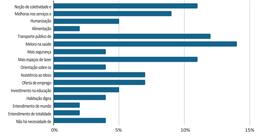
For the projection of the ideal city, the interviewees pointed out: improvement in health (14%); accessible and quality public transport (12%); more leisure spaces (11%); feeling of collectivity and respect (11%); improvements in public services and policies (9%); assistance to the elderly (7%); job offer (7%); investment in education (5%); humanization (5%); more security (4%); decent housing (4%); guidance on the services offered (4%); food (2%); understanding of the world (2%); understanding of totality (2%). Note that, for 4% of participants, the city of SJC is perfect and there is no need for change.
The demands raised by the interviewees show that the construction of an ideal city is directly linked to the concrete conditions of urban life and the guarantee of rights in the territory. By pointing out health, transportation, leisure, safety, public policies and assistance to the elderly as priorities, the interviewees reveal that the desire for a better city is linked to the possibility of living with autonomy, dignity and belonging. These elements do not appear only as specific improvements, but as structural dimensions that condition the use of the city and social participation throughout the life cycle. Urban design organizes who can circulate, belong and feel safe. For the elderly, uneven sidewalks, lack of lighting and inaccessible transportation make mobility an everyday challenge.
Conclusion
Drawing on historical and conceptual reflections on utopia, as well as on the narratives of older adults whose life stories are deeply intertwined with the history of the city, this study sought to examine the distance between the real and the ideal city from the perspective of diverse elderly subjects. Consciously or not, participants’ narratives reveal social struggles shaped by the capital – labor relationship and by unequal forms of spatial appropriation. Each participant carries a repertoire of memories, images, and experiences forged through historically situated struggles for survival and dignity.
The research participants highlighted the existence of initiatives and facilities aimed at older adults, particularly those focused on social interaction, coexistence, and leisure. However, they also emphasized the lack of priority given to fundamental needs associated with aging, especially access to health care and adequate housing. These shortcomings point to the limits of existing urban and social policies when confronted with the everyday realities of aging in the city.
Understanding utopia as the expression of a desire for a better life, it becomes evident that the utopian aspirations articulated by the participants are closely aligned with normative frameworks of rights and citizenship. This finding suggests that the imagination of an ideal urban space is not distant or abstract, but rather grounded in achievable conditions – provided there is political will and the implementation of public policies that guarantee effective access to civil, political, and social rights for all.
In an attempt to understand reality as a life experience and urban practices in their relations with the aging trend of the population, it was observed that each participant, in their own way, designs an ideal city to grow old. At the same time, this exercise of imagination promoted reflection on the space in which each of them lives. The divergent modes of thought of the participants were ordered by the facts of the experience , which, in turn, form different thought systems.
Ideal for some and unfair for others, the city of SJC, a classic example of the structural dynamics of neoliberal orientation, clearly outlines the hardships of the system of social contradictions. The different frames of reference of the elderly are not abstract constructions, but empirical reality, whose unique perceptions help in the task of reconstructing these dynamics and structural forms of our cities, thus collaborating to face the challenges of socio-spatial analysis and political propositions to urban planning.
We all, in some way, design the ideal place, city and society. The absence of this imagination would be a way to prevent new constructions about the future. Utopia, the vision of the future on which a civilization bases its projects, bases its ideal goals and hopes, is an exercise of socially necessary thinking.
It is considered that, in view of the narratives of the research subjects, deeply immersed in a dystopian reality, the utopia present in the discourses manifests itself, almost exclusively, in the desire to implement and guarantee the rights of the elderly. Those who translated a critical and broader reflection on the data of reality, glimpsed their statements directed to the need to exercise citizenship of those who grow old.
Amid the social inequalities inherent in the production of the urban phenomenon, the ideology of competitive neoliberalism directs the cultural production of a unique model of city, essentially utopian and authoritarian, through public and private institutions, for example, by the media, since it uses monotonic discourse to reproduce a conflictual view of the social world.
Diverse experiences of insurgency against the status quo – of a dystopian society that carries the stigma of colonial legacies in mentality, political power and daily life, without due consideration to the central problem of the social formation of strong individuals and citizens – tend to become increasingly evident along with evidence of a desirable future already under experimentation. In a period of global crisis of democracy, the rescue of the democratic ideal tends to become not only propagated but practiced, to some extent, throughout the world. Diverse social segments are allied to popular-based movements (originating in clear conditions of socioeconomic and moral disadvantage), expanding and dynamizing the social debate in other dialogical bases of social and political awareness.
If, nowadays, the challenges of public managers to deal with the aging of the population are already great, in the future, it is necessary to have integrated intervention policies that ensure the rights of the elderly population, which has been showing high rates of growth. Aging in the city of São José dos Campos is experiencing the aging process mediated by urban conditions, service networks and the unequal distribution of opportunities in the territory.
Between the city you have and the one you want, the challenges seem greater than the organized and coordinated social forces to overcome them. The dynamics of reorganization of society and space are carried out everywhere according to the most diverse guidelines and motivations. But what there is in fact is the uncertainty of the directions that they may take, in the counterpoint between utopia and dystopia, the social processes envisaged by more humanity, democratization and social justice, including here, specifically, the issue of aging, considering it by another urban planning, less committed to the perverse ideologies of neoliberal reason and more contemplated in the difficult step of what can be socially agreed upon and built.
References
-
ALVES, J. E. D. (2017). Envelhecimento e longevidade. Portal do Envelhecimento e Longeviver, 30 abr. Disponível em: https://www.portaldoenvelhecimento.com.br/envelhecimento-e-longevidade Acesso em: 24 ago 2020.
» https://www.portaldoenvelhecimento.com.br/envelhecimento-e-longevidade - BAUMAN, Z. (2009). Confiança e medo na cidade Rio de Janeiro, Zahar.
- BOBBIO, N. (1992). A era dos direitos Rio de Janeiro, Campus.
- BORGES, L. S. (2003). Mapa da pobreza urbana de São José dos Campos/SP - 2000. Dissertação de mestrado. São José dos Campos, Universidade do Vale do Paraíba.
- BRASIL (1988). Constituição. Constituição da República Federativa do Brasil. São Paulo, Saraiva.
- BORGES, L. S. (1993). Lei n. 8.742, de 7 de dezembro. Dispõe sobre a organização da Assistência Social e dá outras providências, e legislação correlata. Diário Oficial da União, Brasília, DF.
-
BORGES, L. S. (1994). Lei n. 8.842, de 4 de janeiro. Dispõe sobre a Política Nacional do Idoso. Diário Oficial da União, Brasília, DF. Disponível em: https://www.planalto.gov.br/ccivil_03/leis/l8842.htm Acesso em: 8 jul 2020.
» https://www.planalto.gov.br/ccivil_03/leis/l8842.htm -
BORGES, L. S. (2001). Estatuto da Cidade: Lei n. 10.257, de 10 de julho. Senado Federal. Disponível em: https://www2.senado.leg.br/bdsf/bitstream/handle/id/531047/000954805_Estatuto_Cidade.pdf?sequence=1&isAllowed=y Acesso em: 17 dez 2025.
» https://www2.senado.leg.br/bdsf/bitstream/handle/id/531047/000954805_Estatuto_Cidade.pdf?sequence=1&isAllowed=y -
BORGES, L. S. (2003). Lei n. 10.741, de 1º de outubro. Dispõe sobre o Estatuto do Idoso. Diário Oficial da União, Brasília, DF. Disponível em: https://www.planalto.gov.br/ccivil_03/LEIS/2003/L10.741compilado.htm Acesso em: 8 jul 2020.
» https://www.planalto.gov.br/ccivil_03/LEIS/2003/L10.741compilado.htm -
BORGES, L. S. (2022) Resolução nº 67, de 8 de dezembro. Conselho Nacional dos Direitos da Pessoa Idosa. Brasília, DF, 2022. Disponível em: http://www.lex.com.br/resolucao-cndi-no-67-de-8-de-dezembro-de-2022 Acesso em: 16 dez 2025.
» http://www.lex.com.br/resolucao-cndi-no-67-de-8-de-dezembro-de-2022 -
CHAUÍ, M. (2016). Notas sobre utopia. Ciência e Cultura. São Paulo, v. 60, n. spe1, pp. 7-12. Disponível em: http://cienciaecultura.bvs.br/scielo.php Acesso em: 8 jul 2020.
» http://cienciaecultura.bvs.br/scielo.php - COSTA, A. R. A. (2019). A seguridade social no Plano Beveridge: história e fundamentos que a conformam. Dissertação de mestrado. Brasília,Universidade de Brasília.
- DARDOT, P.; LAVAL, C. (2017). Comum: ensaio sobre a revolução no século XXI São Paulo, Boitempo.
- ECO, U. (2013). História das terras e lugares lendários. Rio de Janeiro, Record.
- GEETHA, M. (2014). Theory of dystopia unfolded. IOSR Journal of Humanities and Social Science (IOSR-JHSS), Gurugram, v. 19, n. 7, pp. 23-30.
- HARVEY, D. (2009). Espaços de esperança São Paulo, Edições Loyola.
- IAMAMOTO, M. V. (2007). Serviço social em tempo de capital fetiche São Paulo, Cortez.
-
IBGE - Instituto Brasileiro de Geografia e Estatística (2010). Censo demográfico: 1960-2010. Disponível em: https://www.ibge.gov.br/estatisticas/sociais/saude/9662-censo-demografico-2010.html Acesso em: 25 mar 2020.
» https://www.ibge.gov.br/estatisticas/sociais/saude/9662-censo-demografico-2010.html -
IBGE - Instituto Brasileiro de Geografia e Estatística (2022). Censo demográfico: 2022. Disponível em: https://cidades.ibge.gov.br/brasil/sp/sao-jose-dos-campos/panorama Acesso em: 6 nov 2025.
» https://cidades.ibge.gov.br/brasil/sp/sao-jose-dos-campos/panorama - LEFEBVRE, H. (2009). O direito à cidade São Paulo, Centauro.
-
MACHADO, M. A. N. (2010). O movimento dos idosos: um novo movimento social? Revista Kairós-Gerontologia, v. 10, n. 1. DOI: 10.23925/2176-901X.2007v10i1p%p. Disponível em: https://revistas.pucsp.br/index.php/kairos/article/view/2585 Acesso em: 30 jun 2025.
» https://doi.org/10.23925/2176-901X.2007v10i1p%p» https://revistas.pucsp.br/index.php/kairos/article/view/2585 - MARIA, M. G. (2008). Novas formas de ocupação urbana: os loteamentos fechados em São José dos Campos. Dissertação de mestrado. São José dos Campos, Universidade do Vale do Paraíba.
- MORE, T. (2004). Utopia Brasília, Editora Universidade de Brasília, Instituto de Pesquisa de Relações Internacionais. Edição original de 1516.
-
PMSJC - Prefeitura Municipal de São José dos Campos (2017). Revisão do Plano Diretor de São José dos Campos: cadernos de mapas temáticos - leitura técnica socioterritorial. Disponível em: https://planodiretor.sjc.sp.gov.br/resources/uploads/Link/Arquivo/Caderno_Mapas_Tematicos_rev05.pdf Acesso em: 27 jun 2020.
» https://planodiretor.sjc.sp.gov.br/resources/uploads/Link/Arquivo/Caderno_Mapas_Tematicos_rev05.pdf -
PMSJC - Prefeitura Municipal de São José dos Campos (2019). Lei Complementar n. 623, de 9 de outubro. Dispõe sobre o parcelamento, uso e ocupação do solo, em consonância com o Plano Diretor de Desenvolvimento Integrado do Município de São José dos Campos. Disponível em: https://servicos.sjc.sp.gov.br/Legislacao/Arquivos/LeisComplementares/2010/LC_2010_00000428.pdf Acesso em: 16 dez 2025.
» https://servicos.sjc.sp.gov.br/Legislacao/Arquivos/LeisComplementares/2010/LC_2010_00000428.pdf - SANTOS, A. P. (2006). Arquitetura industrial São José dos Campos, edição do autor.
- SARGENT, L. T. (2010). Utopianism Oxford, Oxford University Press.
-
SBGG - Sociedade Brasileira de Geriatria e Gerontologia (2019). Portal SBGG. Disponível em: https://sbgg.org.br/ Acesso em: 25 mar 2020.
» https://sbgg.org.br/ -
SEADE - Fundação Sistema Estadual de Análise de Dados. (2019). Perfil dos municípios paulistas Disponível em: https://perfil.seade.gov.br/ Acesso em: 10 set 2020.
» https://perfil.seade.gov.br/
Notes
-
1
This study is derived from Guedes' doctoral thesis (2020), Between utopia and dystopia: the city of São José dos Campos from the perspective of the elderly, developed in the Graduate Program in Urban and Regional Planning of the University of Vale do Paraíba (Univap).
-
2
The research participant refers to the difficulties of the population in a situation of social vulnerability in the context of the covid-19 epidemic.
-
3
PP6 used this amount to emphasize the government's disregard for the real needs of the population, however, according to the municipality's Transparency Portal, the amount used was R$50,356 million.
-
Data availability statement:
The entire dataset supporting the results of this study was published in the paper itself.
-
Editors:
Lucia BógusLuiz César de Queiroz Ribeiro
-
Organizers of this issue:
Ana Marcela Ardila PintoCarlos Fernando Ferreira LobNatália Villamizar Duarte
The entire dataset supporting the results of this study was published in the paper itself.

 Source:
  Source:
  Source:
  Source:
  Source: the author, in 2025.
 Source: the author, in 2025.
 Source:
  Source: the author, in 2020.
 Source: the author, in 2020.