BROKERING ACCESS TO PUBLIC SERVICES FOR PEOPLE EXPERIENCING HOMELESSNESS
ABSTRACT
This study analyzes the brokerage processes involved in granting access to public policies for disadvantaged social groups. It is based on field research conducted in downtown Brasília (Brazil), observing hundreds of interactions between people experiencing homelessness and the institutions providing public services for this population. The study questions the assumptions regarding direct relationships between street-level bureaucrats and users, connections often taken for granted in the literature on public policy implementation. By drawing on perspectives of policies as everyday experiences involving various third parties, the findings indicate: a) theoretical and methodological proposals for incorporating brokerage as a central object of study in policy implementation processes; and b) a deeper understanding of the underlying conditions of brokerage, the variations among brokers, and the consequences of these processes for people experiencing homelessness, offering valuable insights for actions aimed at promoting equitable access to public services.
Keywords:
brokerage; experiences; people experiencing homelessness; public policy implementation; access to public policies
RESUMO
O artigo analisa os processos de intermediação que definem o acesso de grupos sociais desfavorecidos a políticas públicas. Baseia-se em pesquisa de campo, realizada na região central de Brasília, envolvendo o acompanhamento de centenas de encontros entre pessoas em situação de rua e as instituições responsáveis pela provisão de serviços. O material põe em questão o pressuposto de relações diretas entre burocratas de linha de frente e usuários, frequentemente assumido pela literatura de implementação de políticas públicas. Mobilizando aportes que permitem enxergar as políticas como experiências cotidianas, que envolvem diversos terceiros, os achados apontam para: a) caminhos teórico-metodológicos para incorporação da intermediação como objeto central para o estudo de processos de implementação; e b) uma melhor compreensão das condições subjacentes à intermediação, dos diferentes intermediadores e das consequências desses processos para as pessoas em situação de rua, implicando conhecimento útil para ações com foco em acesso equitativo.
Palavras-chave:
intermediação; experiências; pessoas em situação de rua; implementação de políticas públicas; acesso a políticas públicas.
RESUMEN
El artículo analiza los procesos de intermediación que caracterizan el acceso de los grupos sociales desfavorecidos a las políticas públicas. Se basa en una investigación de campo realizada en Brasilia, que involucra la observación de cientos de interacciones entre personas en situación de calle y las instituciones responsables de la provisión de servicios. El estudio cuestiona el supuesto de relaciones directas entre los burócratas y los usuarios, que a menudo se da por sentado en la literatura sobre implementación de políticas públicas. A través de perspectivas que consideran las políticas como experiencias cotidianas que implican a diversos terceros, los hallazgos señalan: a) propuestas teórico-metodológicas para incorporar la intermediación como objeto central de estudio en los procesos de implementación; y b) una mejor comprensión de las condiciones subyacentes a la intermediación, de los diferentes intermediarios y de las consecuencias de esos procesos para las personas en situación de calle, ofreciendo valiosos conocimientos para la promoción de acceso equitativo.
Palabras clave:
intermediación; experiencias; personas en situación de calle; implementación de políticas públicas; acceso a políticas públicas
INTRODUCTION
In recent decades, significant advances have been made in research on public policy implementation, contributing to a better understanding of how government decisions are put into practice and moving beyond normative perspectives that are detached from local implementation contexts (Faria, 2012; Hill & Hupe, 2014; Lotta, 2019). In particular, theoretical perspectives that focus on interactions between citizens and frontline agents in public services (Hupe, 2019; Lipsky, 1980; Maynard-Moody & Musheno, 2003) have offered fruitful interpretive frameworks for explaining the dynamism and transformations that occur during implementation processes. Because frontline workers constitute the most concrete and visible interface of the state, and because they make critical decisions regarding the inclusion or exclusion of service users and the quality of services provided, the literature often describes them as gatekeepers or controllers of access to public services (Brodkin, 2015; Brodkin & Majmundar, 2010; Tummers et al., 2015).
Despite these invaluable contributions, it is important to note that a significant portion of this literature assumes that the relationships between citizens and public agents are direct. For example, the framework proposed by the theory of street-level bureaucracy (Brodkin, 2015; Lipsky, 1980; Maynard-Moody & Musheno, 2003) is based on a clear distinction between frontline workers and service users. Even the French sociologie du guichet (or a sociology of the bureaucratic encounters), which adopts a critical interactionist perspective and emphasizes encounters between citizens and public agents, relies on the metaphor of the “guichet” (or reception desk) to demarcate the two sides involved (Dubois, 1999; Pires, 2017; Siblot, 2006).
This assumption of direct relationships obscures the fact that such encounters do not occur in the same way for all social groups. It overlooks the processes and conditions that enable or hinder people’s ability to interact with service providers. Furthermore, analyses of frontline workers often focus on the effects of their actions on organizational structures, rules, and professional practices embedded in public policy. In other words, more traditional implementation studies tend not to analytically consider the other actors involved in these encounters or their lived experiences (Dubois, 2023).
This article aims to address that gap by asking: How is the interaction of vulnerable social groups with public services mediated by the involvement and actions of third parties? What are the implications of such brokerage for our understanding of the relationship between citizens and the state? Our objective, therefore, is to challenge the assumption of direct relationships and demonstrate the analytical value of recognizing brokerage processes as essential elements in implementation studies and initiatives designed to expand or enhance access to public services for historically disadvantaged social groups.
We begin with a theoretical discussion aimed at contributing to the development of an analytical perspective that prioritizes viewing public policy as an everyday experience (Naples, 1998) by shifting attention to the “other side of the street” (Spink & Burgos, 2019) and drawing on people-centered approaches (Dubois, 2023), in a genuine exercise of what Boullosa (2019) calls the “mirada ao revés” approach (where policies are seen as flows of values and actions that emerge from real-life situations). This shift and its various manifestations are grounded in the recognition that there are important analytical gains in thinking about public policies beyond the usual focus on institutions, actors, and processes typically situated within the state sphere. It also entails understanding people’s lived experiences and the role of other types of actors as inseparable components of public action (Lascoumes & Le Galès, 2012).
We then propose that this type of approach can be further enriched by incorporating concepts and debates from contemporary anthropology of brokerage. This literature draws attention to the multiplicity of actors involved in governmental processes, highlighting the role of brokers in connecting subaltern social groups to the elites who control access to goods and services. Examining implementation from this perspective helps problematize established concepts that assume direct relationships on the front lines of public services.
In the methodological section, we outline the field research conducted in downtown Brasília, which examined the experiences of homeless individuals seeking access to various public services. By observing the interactions between these individuals and public services related to documentation, health care, social assistance, housing, public security, and others, we were able to systematize qualitative evidence and gain new insights into how vulnerable groups access these services.
Our findings indicate that brokerage emerges in response to access barriers rooted in both institutional limitations and the challenges faced by vulnerable populations. In contexts marked by social diversity, extreme vulnerability, and institutional weakness in ensuring equitable access, a broad range of intermediaries come into play. We present a mapping of types of brokers and brokerage processes, based on variations in their degree of professionalization and proximity to the territory and the public studied. We also discuss the consequences of these brokerage processes, which may either promote greater autonomy and empowerment or deepen the dependence of homeless individuals on third parties.
In conclusion, we argue that analytical lenses that focus exclusively on direct interactions and the actions and decisions of street-level bureaucrats fail to capture the full range of processes that precede encounters at the reception desks. We highlight the value of reconceptualizing frontline work as part of an extended chain of brokerage. In addition to the traditional focus on the discretionary control exercised by frontline workers (as gatekeepers), we emphasize the importance of analytical attention to the pathways and entanglements that effectively enable vulnerable people to access the public services they need.
FROM THE STREETS TO THE RECEPTION DESK: THEORETICAL CONTRIBUTIONS ON EXPERIENCES AND BROKERAGE IN ACCESS TO PUBLIC SERVICES
Recent studies in the field of public policy have identified promising directions for expanding our perspective on the various actors involved in frontline encounters. In dialogue with the theory of street-level bureaucracy, the work of Spink and Burgos (2019) opens up a range of possibilities for analyzing interactions of individuals experiencing homelessness and public services. Dubois (2023) argues that analyses of frontline encounters can adopt a people-centered approach, moving beyond viewing individuals as passive recipients and instead emphasizing how they perceive, evaluate, and develop strategies to navigate public institutions, their agents, and the demands placed upon them. Boullosa (2019) proposes the “mirada ao revés” approach mentioned before, which establishes a critical dialogue with the state-centrism characteristic of more traditional approaches and advocates analytical angles capable of revealing the multiplicity of social actors involved in policy flows.
People’s engagement with public institutions occurs within the complex fabric of everyday life, intersecting with their care and support networks, employment and income relationships, and other local dimensions of experience (Spink, 2008). Thus, shifting the analytical focus to everyday experience can illuminate the gaps and contradictions between institutional expectations of individuals and what people actually experience and do when interacting with public policies.
In this regard, the study by Naples (1998) is particularly insightful. Based on an approach that centers on the perspectives of women who benefited from social policies for employability and education in the United States, Naples shows how institutional expectations were misaligned with the actual obligations and living conditions of these women, especially those who were university students with childcare responsibilities. By considering this policy through the lens of women’s lived experiences, the study reveals how the program’s design imposed contradictory demands that were difficult to reconcile and poorly adapted to the realities of its intended beneficiaries. In addition to highlighting these deficiencies, Naples uncovers the “hidden work” that women routinely carry out to balance motherhood, employment, studies, and bureaucratic requirements. These efforts were essential for maintaining their status as beneficiaries of a public policy originally intended to support them.
Access to and maintenance of relationships with public services thus come to depend not only on self-presentation strategies that align individual circumstances with institutional expectations but also on the mobilization of third parties who provide necessary support. Dubois et al. (2018) suggest that, especially for disadvantaged social groups whose experiences with institutions are often marked by fear of making mistakes, being poorly treated, feeling disoriented, or not understanding procedures, there is a tendency toward the deindividualization of interactions with public services. This is achieved through the frequent mobilization of others who can offer assistance.
By focusing on people’s everyday experiences with public policies, we are able to bring into view the role of other actors - individual or collective, formal or informal - that have remained largely invisible through the traditional lenses of implementation studies. This shift also replaces the assumption of direct relationships with the recognition of brokerage processes, in which access to public services is mediated and indirect, depending on the contribution of others in terms of resources, skills, time, and support. At this point, concepts and debates from the anthropology of brokerage (Lindquist, 2015) offer valuable contributions to the analysis.
This field of knowledge focuses on the connection between socially disadvantaged groups and social and political elites. Agents involved in these processes are commonly referred to as intermediaries, mediators, middlemen, brokers, and patrons, for example. The specific terminology is often linked to qualitative variations in their practices, which may involve differing levels of control over the resources involved in the brokerage, whether financial, material, or informational, as well as varying degrees of power to transform what is being intermediated. According to Latour (2005), for instance, “mediators transform, translate, distort, and modify the meaning or the elements they are supposed to carry” (p. 39). In contrast, intermediaries do not interfere with the content of transactions.
Brokerage processes tend to become more visible in contexts of rapid social change (Lindquist, 2015) or during transitions in governance modes (James, 2011). Social transformations that affect the relationship between the state and society, such as economic crises, political conflict, immigration, austerity-driven public sector reforms, the impoverishment of the middle classes, and the global expansion of social inequalities, create contexts that call for this type of analysis. In such settings, structures of social authority compete with one another, creating space for brokers to maneuver (Bierschenk et al., 2002). The competition for power at the local level opens up opportunities for intermediation activities, which do not necessarily indicate a retreat of the state but rather highlight the complexity of governance arrangements, which are increasingly entangled with civil society and the private sector (Matthews, 2012).
In these contexts, the broker is not simply a political representative of a collective subject’s experience. Their distinctiveness lies in their ability to inhabit multiple realities simultaneously, bridging separate worlds (James, 2011). The career of a broker is highly unstable, as this agent is caught between governmental rationalities and conflicting interests, performing the risky political task of forging bonds of trust to bridge asymmetries of power and knowledge among the various parties involved (Pollock, 2021). The broker embodies rationalities that are often contradictory and bears the moral and psychological burdens of this ambiguity (Björkman, 2021; James, 2011).
Several studies aim to understand the practices and work of brokers. In analyzing the counseling services offered by non-governmental organizations (NGOs) in the British context, Kirwan (2016) highlights the role of translation between complex legal entanglements and individuals facing specific, concrete problems. The work of brokers is often characterized by what McDermont (2013) called “acts of translation,” or acts that allow personal issues to be reframed as public concerns. However, expressing the lives and problems of those served in terms of prevailing legal categories requires significant communication and emotional skills. Thus, brokerage cannot be reduced to the mere provision of information or linguistic translation. It involves intensive emotional labor between the broker and the individuals being assisted, including the regulation of emotions during these interactions (Kirwan, 2016).
As Pollock (2021) suggests, an important factor in characterizing brokers is whether they perform these activities formally and professionally, as paid workers recognized for their role, or informally, as individuals who assume the role circumstantially, for example, to support a friend or family member. In studying immigrants’ access to health and social assistance policies in the United Kingdom, Pollock (2021) identifies a tension between the increasing professionalization of interpreters, driven by public contracts with multinational companies, and the traditional reliance on family and friends during interactions with services. On one hand, professional interpreters can promote greater equality in access and a presumed objectivity in professional conduct. On the other hand, informal interpretation by close contacts may enhance the credibility of demands due to shared cultural backgrounds and worldviews. These strategies carry different potentials and risks that must be evaluated according to each specific context.
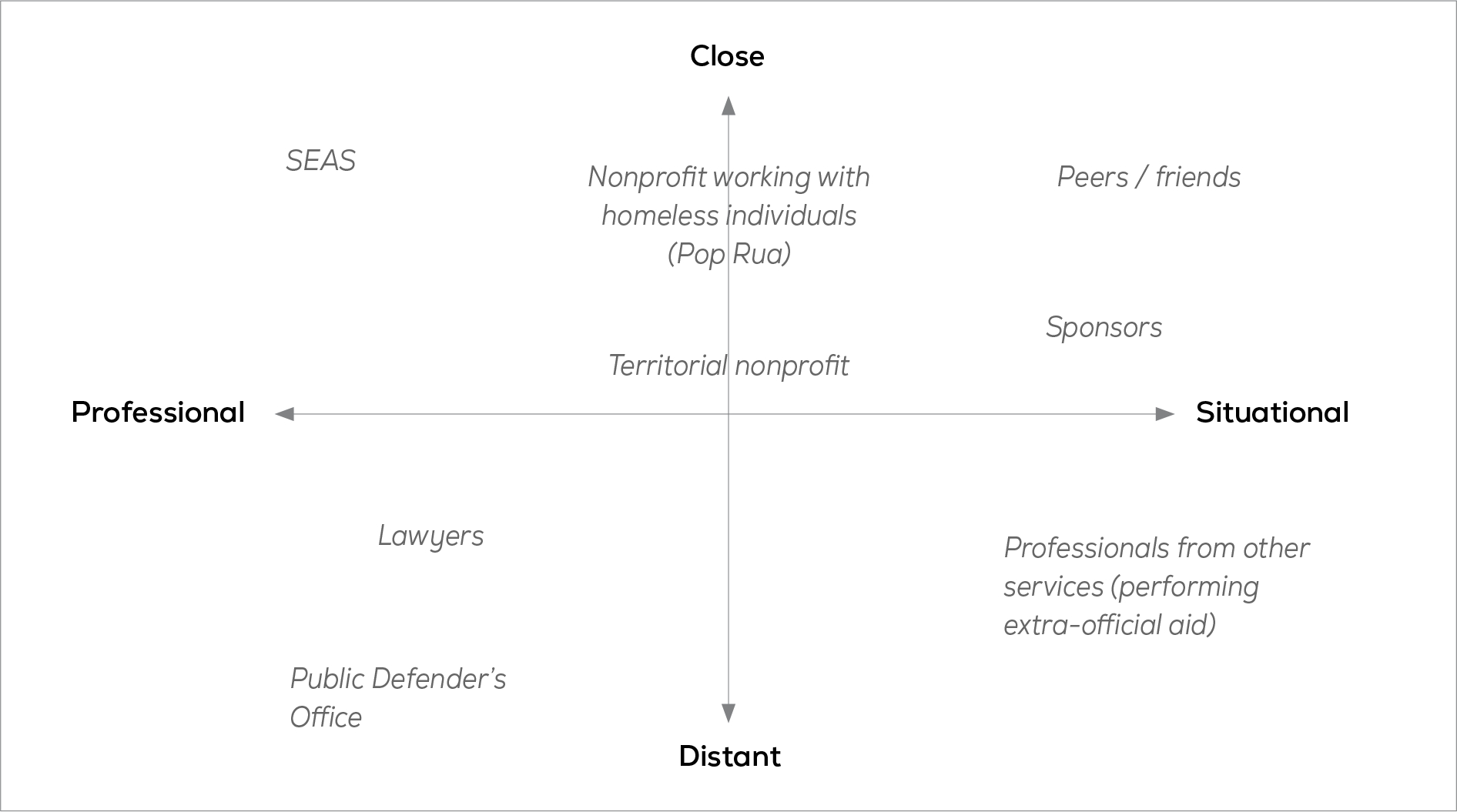
To systematize the discussion thus far, we present a typology of brokers (Table 1) based on two axes: (a) the position they occupy in relation to the individuals they assist, whether close or distant; and (b) whether they perform this role in a professional or situational setting. This typology adapts the original framework proposed by Dubois et al. (2018) to the context of research on homeless individuals in Brazil, drawing on the theoretical contributions outlined above.
Regarding the outcomes and consequences of brokerage processes, the literature identifies potential impacts on both the institutions and public services involved, as well as on the individuals served (Table 2). In terms of institutional outcomes, one notable point is how the actions of brokers can enhance the coordination of otherwise fragmented government efforts. As demonstrated by Koch and James (2022), brokers can promote more effective flows of information, communication, and resources between services.
Regarding the impact on individuals from disadvantaged social groups, several studies highlight how the actions of brokers can shape experiences with public policies and services. In general, by filling institutional gaps and establishing connections, brokers can contribute to a greater “humanization” of public services (Massicard, 2022). However, beyond facilitating access and enhancing the reach of services, the practices, behaviors, and values of brokers can also influence how individuals perceive and experience the state and its institutions.
For example, Kirwan et al. (2016) examine the effects on how citizenship itself is understood. The authors analyzed the daily operations of the UK Citizens Advice service, which emphasizes a volunteer peer-to-peer ethic. These brokers shape the imaginations and practices of service users by mobilizing different popular conceptions of citizenship, whether understood as a set of rights and duties, a matter of nationality, or a more egalitarian ideal. Users then receive these notions as the meanings capable of activating “access” in that specific context.
Finally, the actions of brokers also prompt reflection on their possible effects on relations of domination. As Dubois et al. (2018) argue, the involvement of brokers allows less-advantaged individuals to navigate institutions more easily. In some cases, this deindividualized access may even strengthen social cohesion within families, communities, or associations. However, brokerage can also carry the risk of a perverse combination: administrative domination based on institutional distance and deprivation, alongside domination rooted in personal dependence on the broker. As such, these intermediations may either expand opportunities and reinforce social bonds or restrict autonomy and contribute to disempowerment.
CONTEXT AND RESEARCH STRATEGIES
The field research was conducted in the central region of Brasília, specifically in the Southern Commercial Sector (SCS). This territorial delimitation is justified by the area’s high level of activity, with an estimated daily flow of 150,000 people. Additionally, the SCS hosts a significant number of public facilities and services, including some specifically designed to serve the homeless population.
The most recent census of the homeless population in the Brazilian Federal District, carried out in 2022 by Codeplan/IPEDF, identified 2,932 individuals in this situation. In contrast, the Brazilian Observatory of Public Policies with the Homeless Population reports 5,281 individuals, based on data from the 2021 national database Cadastro Único. The Codeplan/IPEDF census provides insight into the demographic profile of this population, which is predominantly Black (71.1%) and male (80.7%), with 47.2% aged between 31 and 49 years. In the SCS specifically, there is no exact data on the number of people living on the streets. According to estimates from the Serviço Especializado de Abordagem Social (SEAS) (specialized social outreach service), 134 individuals were approached in August 2020, of whom 35 spent most of their time in the area. These are primarily adult men and women with extended periods of street life; compared to other regions, there is a lower presence of families and children.
Fieldwork was conducted between June 2021 and March 2022, facilitated by a partnership with the nonprofit Tulipas do Cerrado. This organization focuses on harm reduction and supports homeless women, transgender women, and sex workers. The association’s founder and main leader has strong ties to the SCS, having spent most of her childhood, adolescence, and early adulthood on the streets of central Brasília.
During the research, we engaged with 51 homeless individuals and monitored 120 instances of contact between them and various public services, such as those related to documentation, health, social assistance, housing, and public safety. These interactions were recorded in 78 field diaries, which contained observations on the progression of encounters among individuals, services, and other involved agents. We fostered a closer relationship with 14 of these individuals, with whom we conducted several rounds of interviews, allowing for a deeper analysis of their life stories and experiences accessing public services.
The field diaries and interviews were transcribed and analyzed qualitatively using in vivo, axial, and thematic coding (Charmaz, 2006), followed by exploring co-occurrences (Saldaña, 2015), with the support of Atlas.ti software. This process facilitated the organization of observations and narratives of interactions between homeless individuals and public services into a matrix format. From this, we identified the brokers involved, their modes of engagement and action, and the outcomes and consequences of these brokerage processes.
RESULTS AND DISCUSSION
Since the beginning of the field research, the phenomenon of brokerage has proven essential for understanding the experiences of homeless individuals with public services. In this section, we analyze it in three parts: a) conditions that promote brokerage, b) types of brokers, and c) outcomes and consequences of the brokerage process.
Conditions that promote brokerage
There was a clear disconnection between the operation of public services and the homeless people in the Southern Commercial Sector (SCS) of Brasília. On the part of public institutions responsible for providing services, notable material deficiencies, insufficient resources, and incipient efforts at active search, accessibility, and simple communication were observed, in addition to instability and coordination problems between the different services.
We identified several limitations, including insufficient information about the services, challenges in traveling the necessary distances to access them, overcoming accessibility barriers, and meeting institutional requirements that ranged from presenting documents and attending appointments to mastering digital tools. Noel (all names are fictitious), an elderly Pardo man who has been homeless for over 10 years, expressed his discontent regarding the difficulties in dealing with the benefits offered:
This rent assistance covers the cost for one month but falls short the next. If we don’t get a job, the rent assistance is all we have. You get a house without a bed, without gas for cooking, and without food. If we buy a cell phone, it’ll likely get stolen because others will take it. They steal documents, and then everything gets complicated. There’s a lack of opportunities and a lack of coordination on the part of the government and these people... (Interview D19, August 16, 2021)
It was precisely in these mismatches, expressions of a transitory and precarious mode of governance (Bierschenk et al., 2002; James, 2011), that we observed brokers working to overcome barriers to service access. These barriers resulted from both institutional shortcomings and the precarious living conditions of the individuals involved (Bjorkman, 2021).
The situation described below (Field diary 73, June 23, 2021) illustrates some of these dynamics. André is an elderly Black man. When we met him, he had lost his ID and explained that he needed it to take an interstate bus trip to reunite with a family member. We asked if he had been to Na Hora (an integrated service center of the Federal District’s government located at the bus station) to request a duplicate. He replied that the service required a scheduled appointment and that there was no point in going without one. The harm reduction worker offered to secure a walk-in appointment, stating that she had known the service coordinator for six years and had an informal arrangement with him to facilitate access to the service. The following day, we went to the service center, but when we asked to speak with the coordinator, we were informed that he no longer worked there. When we inquired about continuing the arrangement, the new coordinator seemed surprised and explained that the service was limited to allowing only one walk-in appointment per day at specific times. Although we left with an appointment booked for André, the harm reduction worker now faced the challenge of re-establishing a relationship with the new coordinator - an ongoing effort to build and maintain partnerships with public institutions aimed at serving homeless individuals.
Additionally, the service required a fee to issue a duplicate ID. André was no longer eligible for the exemption granted to individuals in need, as it could only be used once. He also lacked the financial means to pay the fee. Ultimately, support for the payment was obtained through another nonprofit operating in the SCS. We arranged to meet André at 7 a.m. the next day at the service center. However, he did not show up. Later, he was seen sleeping in another part of the bus station. André sometimes drinks at night to cope with the experience of homelessness and tends to go to sleep early in the morning, when he feels safer due to increased public circulation.
This scenario reveals how institutional vulnerability, defined as the inability to see and adapt to the needs of people living on the streets (Spink et al., 2021), intersects with the vulnerabilities of those individuals in navigating institutional demands (such as procedures, wait times, and behavioral expectations). The resulting relational void, in which structures of social authority have not yet been stabilized, opens up space for the involvement of various other actors (Bierschenk et al., 2002).
Types of brokers
We observed the actions of several brokers facilitating connections between the homeless population and public services in the Southern Commercial Sector (SCS) of Brasília. The typology developed from the theoretical discussion supported the identification of eight types of brokers, characterized along two axes: position/link (close or distant) and form of action (professional or situational), as illustrated in Figure 1.

The left side of Figure 1 shows the professional types of brokers - institutions, services, and agents whose formal mission is to guarantee access to rights for homeless people. These can include public institutions or services such as the Public Defender’s Office and the Serviço Especializado de Abordagem Social (SEAS) (specialized social outreach service). The Public Defender’s Office represents a more distant professional action, mediated by formal procedures and protocols, and typically responding to demands brought by the homeless population. For example, this occurs when assistance is requested to handle interactions with security forces, especially during police approaches, which often involve episodes of physical violence or wrongful arrests.
SEAS represents a professional service characterized by its close relationship with individuals. It recruits individuals with lived experience of homelessness, and activities are conducted directly on the streets, engaging daily with the target population. SEAS professionals are organized into teams responsible for monitoring specific users. By maintaining a presence in the area and conducting daily outreach, the service helps citizens access various services, such as documentation, healthcare, and social assistance. As reported by Donizete, a middle-aged Pardo man who migrated from Maranhão and has been living on the streets of Brasília for five years:
[If] I need to get my ID, they [SEAS personnel] go there, schedule, make an appointment, get the car, take me there, and bring me back. If I need them to go to the hospital, they make it happen. They are here to make our day-to-day lives easier. (Interview D134, September 20, 2021)
Still regarding the professional setting, there are independent professionals or those from the private sector, such as lawyers, who file lawsuits against public institutions, services, or companies to secure rights for homeless individuals. The most common form of brokerage involves access to the justice system, but it also occurs in matters related to labor or social security rights. Generally, lawyers operate on a contingency basis, receiving a percentage of any social benefit, labor compensation, or retirement payment won through legal action. This was the case for Mário, a middle-aged White man, who began receiving the Continuous Benefit Payment (BPC) through a court ruling. His agreement with the lawyer stipulated that 25% of his benefit would be paid to the lawyer for 12 months: “For up to a year, BRL300 are his and 900 are mine” (Interview D128, September 15, 2021).
On the far right of Figure 1, we observe more informal brokers, reflecting situational settings involving homeless individuals. This occurs, for instance, when professionals from different public services sympathize with a homeless person’s urgent need and go beyond their official duties to help them access another service. Such contingent forms of brokerage are also performed by individuals with closer ties to the homeless people they support. In some cases, peers, friends, family members, or partners act as brokers, providing the necessary support to navigate access to public services.
We observed a case in which professionals from the Centro de Atenção Psicosocial - Álcool e outras Drogas (CAPS AD) (psychosocial care center for alcohol and other drugs) struggled to communicate with Daniel, an elderly, convalescent Black man. After being alerted by the “Street Clinic” (a program related to the health department) that Daniel was dehydrated, a doctor and psychologist from CAPS AD attempted, unsuccessfully, to persuade him to accept hospitalization. The situation changed when Mário, a friend who shared a sleeping spot with Daniel, convinced him to get up, sit in his wheelchair, and go to CAPS AD. Mário even admitted himself to the facility to ensure Daniel would remain in the infirmary. It was the emotional support and persuasive effort of someone close to him that ultimately ensured Daniel received the care he needed (Field diary 56, July 15, 2021).
Another important type of broker is the so-called “sponsor”-individuals in relatively better socioeconomic positions who work in the same area and gradually build close relationships with homeless individuals. These sponsors often mobilize their resources to help homeless individuals access goods, services, and rights. In one report, Felipe, a middle-aged Pardo man, shared that an engineer who works in the SCS and regularly plays soccer with homeless people had once paid the fee for him to obtain a personal document (Field diary 20, August 16, 2021). The significance of the intermediation provided by sponsors is captured in the words of Marcondes, who has lived on the streets of the SCS since childhood and works as a car guard:
It’s like I tell the people here, that money is good, but friendship is much more valuable than money. My sister is very fat, her bariatric surgery at the time was going to cost about BRL18,000 and I got it for free. My mother’s eye surgery was going to cost about BRL15,000, I got it at the clinic for free [...] All with the people here. I got my mother’s retirement [...] Do you see that black Corolla? It was the doctor who retired my mother. My sister did not pay INSS for four years, my mother was only going to retire next year. Last year I took my mother’s documents and photocopied them [to get a pension with the help of the lawyer] (Interview D23, August 18, 2021).
Finally, the research findings also highlight the importance of interpreting the axes of the typology as a continuum rather than as rigid quadrants or static categories. We observed that, between the two extremes represented in Figure 1, there are brokers whose actions cannot be strictly classified as professional, since they are neither regular nor remunerated, yet they are also not merely situational. This is the case with nonprofits operating in the territory, whether they focus on advocating for the rights of the homeless population or are locally rooted and closely connected to the region. In the first case, a higher degree of proximity was observed, as these organizations were often led or composed of individuals with lived experience of homelessness. In one such instance, we followed the case of Consuelo, a lesbian woman who sold cachaça and loose cigarettes, and who had repeatedly been harassed and had her equipment confiscated by a police officer. The nonprofit leader gathered the necessary information and volunteered to report the officer to the Public Prosecutor’s Office (Field diary 55, July 18, 2021).
Outcomes and consequences of the brokerage process
In addition to examining the types of brokers, we also sought to analyze the outcomes of the brokerage processes connecting homeless individuals to public services and to discuss their potential consequences.
Our first observation reveals that brokerage can lead to both successful and unsuccessful outcomes. In the former, we found that brokerage often contributed to resolving the demands, either through improved coordination amid fragmented government agents (Koch & James, 2022) or by fostering more humanized services that consider the specific needs of individuals (Massicard, 2022). In such cases, homeless individuals are effectively connected to public services and may gain access to benefits, update official documentation, or receive medical care, for instance.
However, brokers can also fail to offer guidance or solutions. Although this issue remains underexplored in the literature, our fieldwork suggests that such outcomes may stem from a combination of factors involving the individuals served, the institutions involved, and the brokers’ capabilities. Frustration often arises from excessive delays in establishing necessary connections. One illustrative example is Pedro, a Pardo man who had been living in the SCS area for over five years. When he received a response from a nonprofit regarding his request for treatment for premature ejaculation, he expressed disappointment: “They say they are trying to get this fixed, they have been telling me this for three years” (Field diary 119, September 8, 2021).
Frustration may also arise when individuals are not interested in the referrals provided. In one instance, Daniel, who was feeling unwell, was approached by first responders acting as brokers. They offered to take him to an emergency care unit located far from downtown Brasília, explaining that there was immediate availability for specialized care. Despite repeated offers, Daniel declined, preferring not to leave the SCS area and instead address his condition differently (Field diary 53, July 28, 2021).
Between successful and failed outcomes, we also observed partial results, which may precede either eventual resolution or ongoing frustration. These partial outcomes include services, support, or guidance provided by brokers to homeless individuals throughout the process of building necessary connections with public services. One such outcome involves the translation and communication of rights and available services, in which brokers help align institutional procedures with personal needs (Kirwan, 2016; McDermont, 2013). For example, while Raíssa, a cisgender woman and sex worker, was waiting for the team of the Street Clinic program to advise her on possible syphilis treatment, a harm reduction worker from a nonprofit recommended that she visit the Testing and Counseling Center: “It’s here at the bus station, just a second, you can walk, you can get there at any time during business hours and you can do that” (Field diary 91, October 11, 2021).
Another form of partial outcome involves creating a welcoming space and listening to people’s concerns. Being heard is often the first outcome when contact with a broker is newly established or while a specific demand is still being defined. In such cases, the brokerage operates through attentive listening, raising awareness, and assisting in formulating service-related demands. As Kirwan (2016, p. 463) suggests, this entails intensive “emotional work” in regulating feelings. Such was the case for Mônica, an elderly Black woman whose son was in prison. She had not been able to visit or hear from him for over two years due to being on parole herself. A harm reduction worker welcomed her, listened to her distressing story, attempted to reassure her, and advised her to request authorization from the judge - explaining that, as a mother and not a co-defendant in the same case, there was a good chance of resolving the issue.
Finally, the analysis of the material revealed that relationships between homeless individuals and brokers can lead to varied consequences. In many cases, brokers not only facilitate access to public services but also contribute to empowerment, capacity-building, and the encouragement of autonomy. These actions influence how homeless individuals imagine and pursue solutions to institutional challenges (Kirwan et al., 2016). However, echoing analyses that highlight citizens’ structural dependence on bureaucrats at public service desks (Dubois, 1999), we also observed potential risks in these relationships. The repeated reliance on brokers can lead to complacency and discourage individuals from developing the skills needed to navigate institutional demands independently. In this sense, brokerage can foster dependency and perpetuate access difficulties in the absence of intermediaries (Dubois et al., 2018). The leader of the nonprofit Tulipas do Cerrado voiced this concern when asked by the researchers why she had not immediately responded to a health care request made by Valter, a White man who frequently received support from the organization:
he doesn’t do anything about it, if he wanted to take care of himself he knows where he has to go, who he has to look for [...] we’re going to leave him there today to see if he can manage, if he does something, because that’s also important, we think that this excessive welfare is also preventing people from moving on, and on Wednesday, if we get here and he still has this problem, we’re going to put him in the car and take him to the health center at 612 Sul, which is the base of the street clinic [program]. (Field diary 108, October 18, 2021)
It is also important to emphasize that the opposition between promoting autonomy and fostering dependence is not absolute. The complexity of brokerage processes can result in the same service having a dual character: on one hand, encouraging autonomy, and on the other, reinforcing the idea that homeless individuals cannot exercise their rights independently (Dubois et al., 2018). Even within institutions, the approach adopted by brokers can promote learning and adaptation in how professionals engage with homeless populations. In sum, the analysis of the outcomes and consequences of brokerage reveals both the importance of this process in facilitating access and the risks of reinforcing subordination, dependence, and accommodation to existing configurations in the relationship between vulnerable individuals and public policies.
FINAL CONSIDERATIONS
In this article, we aim to develop an analysis of public policy implementation by focusing on the daily experiences of the people for whom these policies are intended (Naples, 1998). Recognizing the multiple actors involved in facilitating access to public policies and drawing on the anthropology of brokerage, we examine the processes and agents that connect vulnerable social groups to the state.
Brokerage emerges in response to access barriers formed by mutual mismatches between institutions and vulnerable individuals. Institutions often face difficulties in reaching people living on the streets, primarily due to limited resources, the absence of organizational frameworks for active outreach, insufficient preparation to address the psychosocial specificities of this population, and the persistence of prejudices and stereotypes. In addition, poor coordination among sectors results in a fragmented and scattered provision of services. People living on the streets face social challenges that prevent them from adapting their behaviors to align with institutional expectations.
In this context, brokerage is a mechanism for facilitating the constant and necessary alignments between people in vulnerable situations and institutions. It represents an assembling effort, in which brokers forge connections and compatibilities, redefining access to public services as the outcome of a complex amalgam of actors, objects, and institutions that “function together” in a productive entanglement (Koster & Leynseele, 2018). The types of brokers identified depend on their closeness to individuals experiencing homelessness and whether their involvement is professional or situational. The outcomes of brokerage also differ: it can produce effective responses that meet the demands of homeless individuals, but it can also be limited, partial, or even ineffective, reinforcing existing frustrations with access. Furthermore, brokerage may promote autonomy and the exercise of rights, but it can also foster dependency if it fails to address the underlying factors that hinder interactions between vulnerable individuals and institutions.
By placing brokers at the center of our analysis, we contribute to a research agenda that shifts the analytical focus beyond state institutions and the actors traditionally emphasized in public policy implementation studies (Brodkin, 2015; Lipsky, 1980). Supported by other studies that have taken a similar approach, we highlight the multiplicity of actors involved in enabling access through efforts of translation, reception, institutional networking, and overcoming various barriers. Expanding and improving access to public policies, especially for the most vulnerable, requires greater attention to the everyday experiences and social entanglements that arise in these intermediate zones between disadvantaged individuals and state institutions.
-
Evaluated through a double-anonymized peer review. Associated editor: Diogo Henrique Helal Reviewers: The first reviewer did not authorize disclosure of their identity. Cristiano Parra Duarte https://orcid.org/0000-0003-0924-4573, Universidade Federal de São Carlos, Departamento de Ciências Sociais, São Carlos, SP, Brazil
-
FUNDING
Funding from the National Council for Scientific and Technological Development (CNPQ) Process No. 402767/2021-7 - Project Subordinate Classes and Public Institutions in Brazil.
ACKNOWLEDGMENTS
The authors would like to thank Juma Santos, Joana Mostafa, Marcelo Galiza, Maria Paula Santos, Rogério Medeiros, Nínive Machado, Gabriela Lotta, and Giordano Magri for their discussions and collaborations throughout the research process.
References
- Bierschenk, T., Kapferer, B., & Ndofor-Tah, C. (2002). Local development brokers in Africa: The rise of a new social category (Working Paper N. 13). Johannes Gutenberg University.
- Bjorkman, L. (Ed.). (2021). Bombay brokers Duke University Press.
-
Boullosa, R. de F. (2019). Mirando ao revés as políticas públicas: O desenvolvimento de uma abordagem crítica e reflexiva para o estudo das políticas públicas. Publicações da Escola da AGU, 11(4), 89-105. https://revistaagu.agu.gov.br/index.php/EAGU/article/view/2639
» https://revistaagu.agu.gov.br/index.php/EAGU/article/view/2639 - Brodkin, E. Z. (2015). The inside story: Street-level research in the US and beyond. In Understanding street-level bureaucracy (pp. 25-42). Policy Press.
-
Brodkin, E. Z., & Majmundar, M. (2010). Administrative exclusion: Organizations and the hidden costs of welfare claiming. Journal of Public Administration Research and Theory, 20(4), 827-848. https://doi.org/10.1093/jopart/mup022
» https://doi.org/10.1093/jopart/mup022 - Charmaz, K. (2006). Constructing grounded theory: A practical guide through qualitative analysis Sage.
- Dubois, V. (1999). La vie au guichet: Relation administrative et traitement de la misère Économica, coll. « études politiques ».
-
Dubois, V. (2023). Classes subalternas e instituições públicas: Um programa de pesquisa internacional e sua aplicação no Brasil. Boletim de Análise Político-Institucional, 35, 9-18. http://dx.doi.org/10.38116/bapi35art1
» http://dx.doi.org/10.38116/bapi35art1 - Dubois, V., Burgy, G., & Ramadier, T. (2018). Accès aux services publics et rapport aux institutions des habitants des quartiers populaires Rapport. Université de Strasbourg.
-
Faria, C. A. P. (2012). Implementação: Ainda o “elo perdido” da análise de políticas públicas no Brasil? Revista Debates, 6(2), 13. https://doi.org/10.22456/1982-5269.26227
» https://doi.org/10.22456/1982-5269.26227 - Hill, M., & Hupe, P. (2014). Implementing public policy: An introduction to the study of operational governance SAGE Publications.
- Hupe, P. (Ed.). (2019). Research handbook on street-level bureaucracy: The ground floor of government in context Edward Elgar.
-
James, D. (2011). The return of the broker: Consensus, hierarchy, and choice in South African land reform. Journal of the Royal Anthropological Institute, 17(2), 318-338. https://doi.org/10.1111/j.1467-9655.2011.01703.x
» https://doi.org/10.1111/j.1467-9655.2011.01703.x -
Kirwan, S. (2016). The UK citizens advice service and the plurality of actors and practices that shape “legal consciousness”. The Journal of Legal Pluralism and Unofficial Law, 48(3), 461-475. https://doi.org/10.1080/07329113.2016.1203060
» https://doi.org/10.1080/07329113.2016.1203060 -
Kirwan, S., McDermont, M. A., & Clarke, J. (2016). Imagining and practising citizenship in austere times: The work of Citizens Advice. Citizenship Studies, 20(6/7), 764-778. https://doi.org/10.1080/13621025.2016.1180693
» https://doi.org/10.1080/13621025.2016.1180693 -
Koch, I., & James, D. (2022). The state of the welfare state: Advice, governance, and care in settings of austerity. Ethnos, 87(1), 1-21. https://doi.org/10.1080/00141844.2020.1863242
» https://doi.org/10.1080/00141844.2020.1863242 -
Koster, M., & Leynseele, Y. van. (2018). Brokers as assemblers: Studying development through the lens of brokerage. Ethnos, 83(5), 803-813. https://doi.org/10.1080/00141844.2018.1492776
» https://doi.org/10.1080/00141844.2018.1492776 - Lascoumes, P., & Le Galès, P. (2012). Sociologia da ação pública Editora da Ufal.
- Latour, B. (2005). Reassembling the social: An introduction to actor-network-theory Oxford University Press.
- Lindquist, J. (2015). Brokers and brokerage, anthropology of. In W. J. Wright (Ed.), International encyclopedia of social and behavioral science (2a ed., pp. 870-874). Elsevier.
- Lipsky, M. (1980). Street-level bureaucracy: Dilemmas of the individual in public service Russell Sage Foundation.
- Lotta, G. (Org.). (2019). Teorias e análises sobre implementação de políticas públicas no Brasil Brasília: Enap.
- Massicard, E. (2022). Street level governing: Negotiating the state in urban Turkey Stanford University Press.
- Matthews, F. (2012). Governance and state capacity. In D. Levi-Faur (Ed.), The Oxford handbook of governance Oxford University Press.
- Maynard-Moody, S., & Musheno, M. (2003). Cops, teachers, counselors: Stories from the front lines of public service University of Michigan Press.
-
McDermont, M. (2013). Acts of translation: UK advice agencies and the creation of matters of public concern. Critical Social Policy, 33(2), 218-242. https://doi.org/10.1177/0261018312468128
» https://doi.org/10.1177/0261018312468128 -
Naples, N. A. (1998). Bringing everyday life to policy analysis: The case of white rural women negotiating college and welfare. Journal of Poverty, 2(1), 23-53. https://doi.org/10.1300/J134v02n01_02
» https://doi.org/10.1300/J134v02n01_02 -
Pires, R. R. C. (2017). Sociologia do guichê e implementação de políticas públicas. BIB-Revista Brasileira de Informação Bibliográfica em Ciências Sociais, 81, 5-24. https://bibanpocs.emnuvens.com.br/revista/article/view/412
» https://bibanpocs.emnuvens.com.br/revista/article/view/412 -
Pollock, S. (2021). More than words can say: Why health and social care policy makers should reconsider their position on informal interpreters. Critical Social Policy, 41(1), 128-147. https://doi.org/10.1177/0261018320911837
» https://doi.org/10.1177/0261018320911837 - Saldaña, J. (2015). The coding manual for qualitative researchers Sage.
- Siblot, Y. (2006). Faire valoir ses droits au quotidien: Les services publics dans les quartiers populaires Lectures, Les Livres.
-
Spink, P., Lotta, G., & Burgos, F. (2021). Institutional vulnerability and trust in public agencies: Views from both sides of the street. Governance, 34, 1057-1073. https://doi.org/10.1111/gove.12549
» https://doi.org/10.1111/gove.12549 -
Spink, P. K. (2008). O pesquisador conversador no cotidiano. Psicologia & Sociedade, 20, 70-77. https://doi.org/10.1590/S0102-71822008000400010
» https://doi.org/10.1590/S0102-71822008000400010 - Spink, P. K., & Burgos, F. (2019). Os limites da abordagem de implementação: Vulnerabilidade urbana a partir do outro lado da rua. In G. Lotta (Org.), Teorias e análises sobre implementação de políticas públicas no Brasil (pp. 99). Brasília: Enap.
-
Tummers, L. L. G., Bekkers, V. J. J. M., & Steijn, B. (2015). Coping during public service delivery: A conceptualization and systematic review of the literature. Journal of Public Administration Research and Theory, 25(4), 1099-1126. https://doi.org/10.1093/jopart/muu029
» https://doi.org/10.1093/jopart/muu029