 The lined flat bark beetles (Coleoptera: Laemophloeidae) from Fernando de Noronha Archipelago, with the first record of Propalticinae Crowson, 1952 in the New World
Abstract
This paper records and illustrates the Laemophloeidae from the Brazilian oceanic archipelago of Fernando de Noronha. This family is represented in the region by two subfamilies and five genera, each of which includes a single species: Cryptolestes ferrugineus (Stephens, 1831), Dysmerus impolitusThomas, 2009, Lathropus parvulus Grouvelle, 1878, and Rhabdophloeus sp. (all Laemophloeinae); and Propalticus sp. (sole representative of Propalticinae). All the taxa are hereby newly recorded in Fernando de Noronha (except Rhabdophloeus sp.). Based on these findings, Propalticinae Crowson, 1952 represents a new record for the New World, while Lathropus Erichson, 1845 is recorded for the first time in Brazil. In addition, Propalticus sp. is briefly characterized and illustrated, including the female genital morphology. We also provide an illustrated key to subfamilies and genera of Laemophloeidae from Fernando de Noronha.
Keywords
Neotropical region 1; oceanic islands fauna 2; taxonomy 3; morphology 4; Cucujoidea 5
Resumo
Este artigo registra e ilustra os Laemophloeidae do arquipélago oceânico brasileiro de Fernando de Noronha. Esta família é representada na região por duas subfamílias e cinco gêneros, cada um dos quais inclui uma única espécie: Cryptolestes ferrugineus (Stephens, 1831), Dysmerus impolitusThomas, 2009, Lathropus parvulus Grouvelle, 1878 e Rhabdophloeus sp. (todos Laemophloeinae); e Propalticus sp. (único representante de Propalticinae). Todos os táxons são aqui registrados pela primeira vez para Fernando de Noronha (exceto Rhabdophloeus sp.). Com base nesses achados, Propalticinae Crowson, 1952 representa um novo registro para o Novo Mundo, enquanto Lathropus Erichson, 1845 é registrado pela primeira vez no Brasil. Além disso, Propalticus sp. é brevemente caracterizada e ilustrada, incluindo a morfologia genital feminina. Também fornecemos uma chave ilustrada para subfamílias e gêneros de Laemophloeidae de Fernando de Noronha.
Palavras-chave
Região Neotropical 1; fauna de Ilhas Oceanicas 2; taxonomia 3; morfologia 4; Cucujoidea 5
Introduction
Fernando de Noronha is an archipelago of the Brazilian state of Pernambuco, in the Atlantic Ocean, more than 350 km off Brazil’s northeastern coast. Renowned for its exceptional biodiversity, the archipelago hosts a considerable variety of insects, although limited by its size and isolation, nonetheless playing a crucial role in maintaining the local ecosystem’s health and balance. In recent decades, entomologists have made significant efforts to bridge the knowledge gaps of the island’s fauna by collecting and identifying various insect groups (Rafael et al. 2020, Costa-Pinto et al. 2021, Fernandes et al. 2021a, Fernandes et al. 2021b, Fernandes et al. 2022, Rafael et al. 2021a, Rafael et al. 2021b, Mahlmann et al. 2022, Rafael et al. 2022, Rafael et al. 2023, Soares et al. 2024, Vieira et al. 2024). To date, 21 orders have been recorded in Fernando de Noronha (Rafael et al. 2020). Regarding Coleoptera, 35 families have been identified, among which Laemophloeidae stands out.
The Laemophloeidae comprises a highly peculiar beetle family whose adults are primarily characterized by nearly flattened bodies and visible sublateral lines on the head and pronotum, distinctive traits that give rise to their English common name: “lined flat bark beetles”. In addition, members of this family possess distinct elytral cells, elongated antennae, and male genitalia with inverted aedeagus (Thomas 1993, Thomas 2002). Both adult and larval dorsoventrally flattened bodies have evolved due to adaptation to subcortical regions of dead wood, where the adults primarily feed on fungi, although the members of some species have secondarily adapted to predation on scolytid bark beetles, presenting subcylindrical bodies (Thomas 1993, Lawrence & Ślipiński 2013).
Little has been published concerning the biological and behavioral aspects of Laemophloeidae without economic importance (Thomas 2002, Lawrence & Ślipiński 2013). However, several genera, such as Cryptolestes Ganglbauer, 1899, Placonotus MacLeay, 1871, Planolestes Lefkovitch, 1958, Leptophloeus Casey, 1916 and Passandrophloeus Kessel, 1921, include some widespread species known to be important pests of stored food and dry plants (Howe & Lefkovitch 1957, Halstead 1993). For these, numerous studies are available relative to genetics, ecology, and behavior (Bishop 1959, Lefkovitch & Currie 1967, Banks 1979, Halstead 1993, Wang et al. 2014; Varadínová et al. 2015).
Laemophloeidae is currently composed of two subfamilies: Laemophloeinae, which includes almost 500 species distributed across 41 genera (McElrath et al. 2025); and Propalticinae, a small group of 44 species in two genera (Gimmel 2011), which was only recently transferred to Laemophloeidae to reflect the evolutionary history recovered in successive phylogenetic studies hypothesizing the former Propalticidae as derived from within Laemophloeidae (McElrath et al. 2015, Robertson et al. 2015). While Laemophloeinae is distributed in all biogeographical regions worldwide, reaching its greatest diversity in tropical areas (Thomas 2002), Propalticinae is known from the African, Oriental, Australasian, and Oceanian realms of the world (Gimmel 2011). In Brazil, Laemophloeidae is currently represented only by Laemophloeinae, with 56 species and 11 genera (Caron et al. 2024).
Thus, this study aims to reduce the lack of knowledge about the fauna of the Fernando de Noronha archipelago by inventorying the Laemophloeidae of this region. We provide an illustrated key to laemophloeid subfamilies and genera of Fernando de Noronha, taxonomic notes and illustrations of each species, and expanded distributional knowledge by supplying new geographical records.
Material and Methods
1. Study area
The specimens were collected in the Brazilian archipelago of Fernando de Noronha. The total land area is 18.4 km2, of which 16.9 km2 is the main island (Lopes and Ulbrich, 2015), and the remaining area is distributed among 20 smaller islands. The main archipelago’s island is called Fernando de Noronha, representing 85% of the archipelago (SECTMA 2006). The specimens were collected (under the license number 62.821 issued by the Instituto Chico Mendes de Conservação da Biodiversidade - ICMBio, Brazil) in the Golfinhos, Sancho, and Capim-Açu trails and the Xaréu dam (Figure 1), using the following passive methods: Malaise traps (Townes 1972) of two different sizes; and a Pennsylvania light trap equipped with 160-watt blended light lamp.

Map of the study area. A: South American continent; B: Fernando de Noronha archipelago, with colored squares indicating the trails where Laemophloeidae specimens were collected.
2. Specimens and label data transcription
The specimens studied in this work are deposited in the following entomological collections (collection acronym and curator name in parenthesis): Instituto Nacional de Pesquisas da Amazônia, Manaus, Brazil (INPA; Marcio de Oliveira), Museu de Zoologia da Universidade de São Paulo, São Paulo, Brazil (MZUSP; Sonia Casari), Coleção Entomológica Pe. Jesus Santiago Moure, Universidade Federal do Paraná, Curitiba, Brazil (DZUP; Lúcia Massutti Almeida), Museu Paraense Emilio Goeldi, Pará, Belém, Brazil (MPEG; Orlando Tobias), Museu Nacional do Rio de Janeiro, Rio de Janeiro, Brazil (Marcela Monné), Coleção Zoológica do Maranhão, Universidade Estadual do Maranhão, Caxias, Maranhão, Brazil (CZMA, Francisco Limeira-de-Oliveira), Coleção Entomológica do Departamento de Sistemática e Ecologia, Universidade Federal da Paraíba, João Pessoa, Paraíba, Brazil (DSEC; Alessandre Pereira Colavite). Regarding the transcription of labels in the examined material section, “//” indicates the start and end of an individual label, and “/” indicates a line break.
3. Photographs and map
Specimen photographs were taken using a Leica DFC295 camera attached to a Leica M205C stereomicroscope. The map (Figure 1) was created with QGIS 3.40.1 software (https://www.qgis.org/), using the geographic coordinate system Datum SIRGAS 2000 and the Cartographic bases of Google Satellite. The figures and map were edited using Helicon Focus and Adobe Photoshop software programs. The pink arrows in the figures indicate the morphological structures utilized in the identification key.
4. Classification, terminology and morphological study
This study follows the classification proposed by McElrath et al. (2015) and Robertson et al. (2015) that subsume the former family Propalticidae Crowson, 1952 within Laemophloeidae as a subfamily. Morphological terms follow Beutel and Lawrence (2005). The body length was measured from the anterior margin of the clypeus to the apex of the elytra, and the body width was measured at mid-elytra. Genera and species were identified using the available keys provided by: Gimmel (2011) for Propalticus, Thomas (2009) for Dysmerus, Thomas (2010) for Lathropus, Thomas (1988) and Halstead (1993) for Cryptolestes Ganglbauer, 1899, as well as comparison with type material of Rhabdophloeus Sharp, 1899 (following an ongoing revision of the genus).
Results
-
Body broadly ovate, twice or less as long as wide (Figure 2A). Eyes posteriorly convergent in dorsal view (Figure 2B). Pronotum with a median endocarina (Figure 2B). Protibiae larger than meso- and metatibiae (Figure 2C). Larger protibial spur spatulate (Figure 2D)…..……..........................Propalticinae...Propalticus sp.
-
1′. Body narrow, subparallel-sided, more than twice as long as wide (Figure 2G). Eyes not posteriorly convergent in dorsal view (Figure 2E). Pronotum without median endocarina (Figure 2E). Pro-, meso-, and metatibiae subequal in size (Figure 2F). Larger protibial spur acute ….…………….………………….. Laemophloeinae...2.
-
-
Head without lateral lines (Figure 2E, 2G). Pronotum and elytra not explanate laterally (Figures 2E, 2G). Elytra not carinate laterally, without distinct elytral cells (Figure 2G) ..………………….….… …………….……………….Lathropus parvulus Grouvelle, 1878.
-
Body subcylindrical (Figure 2I). Head strongly declivous and somewhat prolonged anteriorly (Figure 2H). Pedicel attached laterally to scape, which is enlarged and projected in males (Figure 2H) …………………. Dysmerus impolitusThomas, 2009.
-
Lateral margins of pronotum strongly undulating, forming irregular, barely defined teeth (Figure 2J). Intercoxal process of ventrite III acute to narrowly rounded apically (Figure 2K)…..……………………………………….…… Rhabdophloeus sp.
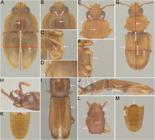
A-D, Propalticus Sharp, 1879: A, body, B, head and pronotum, C, tibiae, D, tibial spur; E-G, Lathropus Erichson, 1845: E, head and pronotum, F, tibiae, G, body; H, I, DysmerusCasey, 1884: H, head, I, pronotum and elytra; J, K, Rhabdophloeus Sharp, 1899: J, body, K, ventrites; L, M, Cryptolestes Ganglbauer, 1899: L, head and pronotum, M, ventrites.
Taxonomic treatment
Laemophloeidae
Laemophloeinae
Cryptolestes ferrugineus (Stephens, 1831)

Laemophloeidae (A, B, C and D: Laemophloeinae; E: Propalticinae) from Fernando de Noronha Archipelago, dorsal view. A: Cryptolestes ferrugineus (Stephens, 1831); B: Dysmerus impolitusThomas, 2009; C: Lathropus parvulus Grouvelle, 1878; D: Rhabdophloeus sp.; E: Propalticus sp. Scale bar: 0.2 mm: C; 0.5 mm: A, B, D and E.
Material examined. 1 male specimen (INPA), labeled: “BRASIL, PE, Fernando de Noronha, Açude Xareu/3°51´30´´S - 32°25´50´´W” // “1-9.vi.2019, Malaise/J.A.Rafael, F. Limeira-de-Oliveira, D.M.M. Mendes”.
Distribution. Cosmopolitan.
Taxonomic remarks. This species (type species of Cryptolestes) is taxonomically well-known and can be easily recognized by external characters. Although it belongs to a complex group of species with male antennal scapes unmodified, C. ferrugineus is unequivocally distinguished from its most similar congeners, C. pusillus (Schönherr, 1817) and C. pusilloides (Steel and Howe, 1952), by the head without a posterior transverse line, male mandibles externally expanded, elytral intervals with four setal rows, as well as the form of the male endophallus (Lefkovitch 1962, Halstead 1993, Thomas 1988). In opposition, C. pusillus and C. pusilloides share the head surface with a posterior transverse line present, and the male mandibles are simple, not laterally expanded (Halstead 1993).
Dysmerus impolitus Thomas, 2009
Material examined. 1 male specimen (INPA), labeled: “BRASIL, PE, Fernando de Noronha, Tr[trilha]. Golfinhos/3°51´17´´S - 32°26´26´´W”//“22.vii-5.viii.2019, Malaise gd[grande]/J.A.Rafael, F. Limeira-de-Oliveira, L.C.Castro”.
Distribution. BRAZIL: Rondônia, Minas Gerais, São Paulo, Rio de Janeiro (Thomas 2009), Fernando de Noronha: Golfinhos trail (new record) (Figure 1). PARAGUAY: Itapúa (Thomas 2009).
Taxonomic remarks.Dysmerus is Neotropical in distribution and was revised by Thomas (2009), who described 12 of the 15 species currently composing the genus. All of the known species exhibit a strong modification in the male antennal scape, which is extremely enlarged and inserted in an excavation on the frontal surface of the head. This is the only species of the genus so far found in Fernando de Noronha and can be easily distinguished from its congeners by the head with median carina, the dorsal integument dull and microreticulate, and the form of the male antennal scape, which is strongly curved internally (Figure 3B). Although the identification of female specimens of Dysmerus is problematic because of their unmodified antennal scapes, the female of D. impolitus can be readily associated with the male by the median, longitudinal carina of the head as well as the dull, microreticulate cuticular surface (Thomas 2009). However, caution is necessary when identifying Dysmerus females, as they are more reliably identified when collected with associated males.
Lathropus parvulus Grouvelle, 1878
Material examined. 7 specimens (INPA), labeled: “BRASIL, PE, Fernando de Noronha, Trilha Sancho/3°51´30´´S - 32°25´50´´W” // “28.I.2020, Luz mista,/Pensilvânia, D.M.M. Mendes & J.C. Oliveira”.
Distribution. MEXICO. CENTRAL AMERICA. BAHAMAS: Great Inagua. CAYMAN ISLANDS: Cayman Brac, Grand Cayman, Little Cayman. DOMINICAN REPUBLIC: Barahona, Monseñor Novel, Pedernales, Peravia, La Vega. TURKS AND CAICOS: Grand Turk. BOLIVIA: no locality (Thomas, 2010). BRAZIL: Fernando de Noronha: Sancho Trail (new record) (Figure 1).
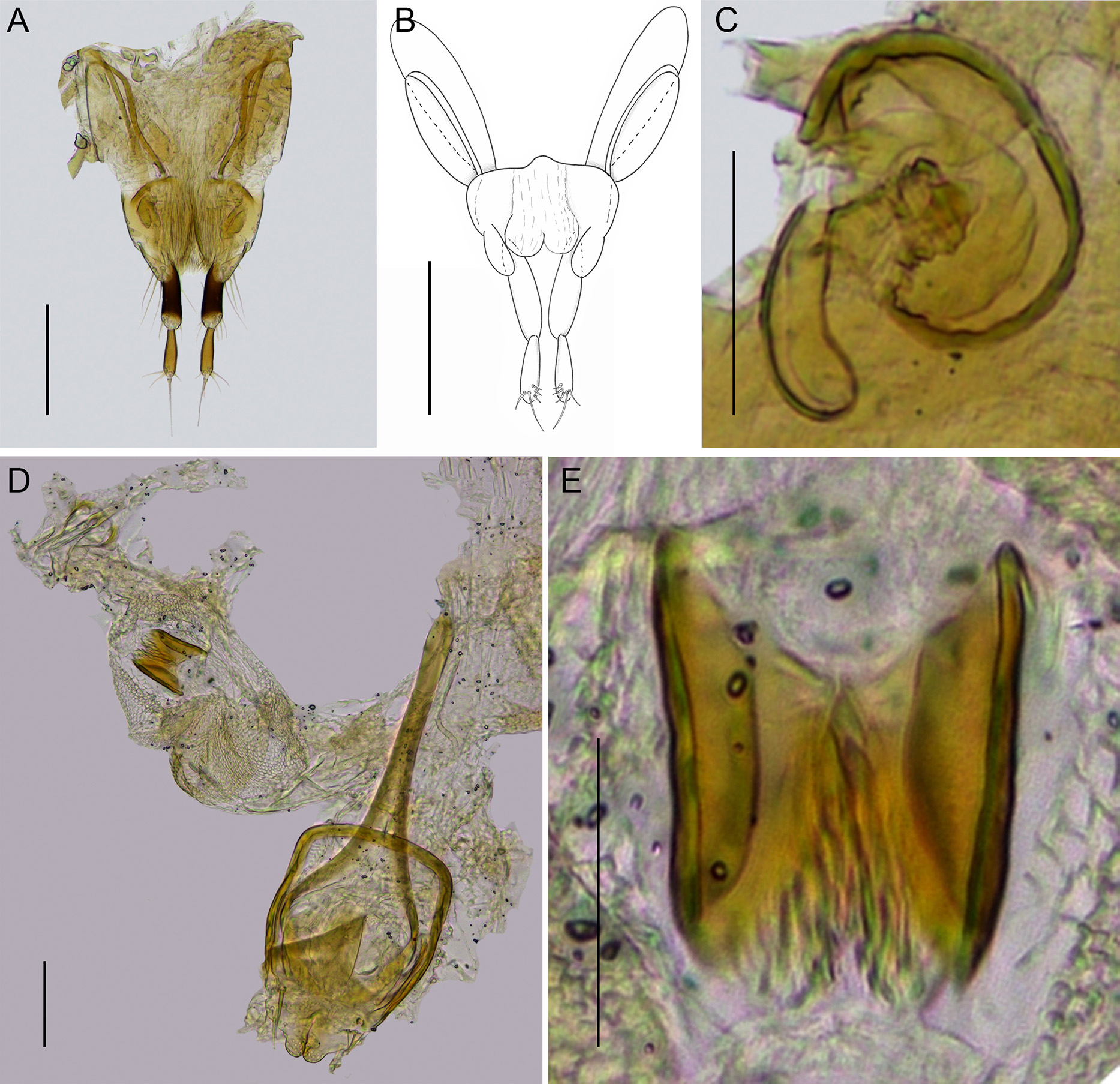
Taxonomic remarks.Lathropus parvulus (Figure 4D) resembles L. robustulus because of the rounded pronotum and the similar shape of the endophallic sclerite (Figure 4E), but L. parvulus is distinguished by the bicolored elytra, with pale transverse bands (dark elytra in L. robustulus, with no transverse bands). Another bicolored species, L. chickcharnieThomas, 2010, has an elytral color pattern similar to that of L. parvulus. However, both species are separated from each other by the shape of the endophallic sclerite, which is heavily sclerotized and much broader in L. parvulus (compare Figures 34 and 38 in Thomas (2010)). According to Thomas (2010), the West Indian individuals of this species are paler than the Central American population. This pattern can be seen in individuals of L. parvulus from Fernando de Noronha, which have lighter elytral surfaces and match those from the West Indies described by Thomas (2010: Figure 2).

A-C: Propalticus sp. female. A-B: external genitalia; C: spermatheca. D-E: Lathropus parvulus Grouvelle, 1878. Male. D: genitalia; E: endophallic apical sclerite. Scale bar, A, B: 0.1 mm; C: 0.05 mm; D: 0.05 mm; E: 0.025 mm
Rhabdophloeus sp.
Rhabdophloeus sp.; Rafael et al. (2020: 8).
Material examined. 326 specimens (INPA), labeled: “Brasil, PE. Fernando de/Noronha, Tr. Golfinhos/3°51´17´´S - 32°26´26´´W/ 23.i-12.ii.2020. Malaise Gd,/J.A.Rafael, F. Limeira-de-Oliveira, L.C. Castro” (29 indiv., INPA); same, but 25.xi-9.i.2019” (6, INPA); same, but “24.x-9.xi.2019” (5, INPA); same, but “Capim-Açu/27.xi-9.xii.2019” (14, DZUP, 13, MNRJ; 24, INPA); same, but “11-27.xi.2019” (14, MZUSP; 13, MPEG; 40, INPA); same, but “21.viii-8.ix.2019” (14, CZMA); same, but “24.ix-9.x.2019” (10, DSEC; 7, INPA); same, but no date (9, INPA); same, but “9-26.xi.2019” (6, INPA); same, but “9-24.xi.2019” (13, INPA); same, but “22.vii-5.viii.2019” (7, INPA); same, but 27.x-11.xi.2019” (11, INPA); same, but “9-27.xii.2019” (6, INPA); same, but “Tr. Golfinhos/12-27.ii.2020” (8, INPA); same, but “Capim-Açu/20.viii-8.xi.2020” (1, INPA); same, but “23.vii-7.viii.2019” (4, INPA); same, but 8-23.vii.2019” (3, INPA); same, but “8-27.x.2019” (9, INPA); same, but “25.ix.-8.x.2019” (7, INPA); same, but “Golfinhos/26.ix.-8.xii.2019” (3, INPA); same, but “23.vi-7.vii.2019” (5, INPA); same, but “7-22.vii.2019” (12, INPA); same, but “capim-açu/7-21.vii.2019” (4, INPA); same, but “golfinhos/1-15.iii.2020” (9, INPA).
Distribution. BRAZIL: Fernando de Noronha (Rafael et al., 2020) (Figure 1).
Taxonomic remarks. This is the only species of Laemophloeidae previously recorded from Fernando de Noronha (Rafael et al. 2020). Rhabdophloeus currently includes 10 obscure, poorly circumscribed species distributed from the southern region of the United States to the Brazilian state of Santa Catarina in the South (Casey 1884, Kessel 1926). The genus includes many synonymous species and requires revisionary work. One of us (MB) checked the types of all valid species of Rhabdophloeus, including the male genitalia of the Central and South American species, which enabled the comparison with the specimens from Fernando de Noronha treated in this paper. Through external and genital characters, our analysis showed that the Rhabdophloeus species collected in Fernando de Noronha is not conspecific with any of the Neotropical species. Instead, this species closely resembles two North American species, R. horni (Casey, 1884) and R. disseptus (Casey, 1916), the only species whose male genitalia of type specimens could not be analyzed. An ongoing revision of Rhabdophloeus (Bento, in prep.), including the study of male genital morphology of the North American species, will clarify the identity of the species from Fernando de Noronha, which could be an undescribed species.
Propalticinae
Propalticus sp.
Material examined. 5 female specimens, labeled: “BRASIL, PE, Fernando de Noronha, 3°51´17´´S-/32°26´26´´W, Capim-Açu” // “7-21.viii.2019, Malaise/G, J.A.Rafael, F. Limeira-/de-Oliveira, L.C.Castro” (♀, INPA); same, but “27.XII–10I.2020” (♀, INPA); same, but 9–27.XII.2019” (2♀, INPA); same, but “11–27.XI.2019” (♀, INPA).
Distribution. BRAZIL: Fernando de Noronha: Capim Açu trail (new record).
Taxonomic remarks. Propalticinae is divided into two genera, Propalticus Sharp, 1879 and Slipinskogenia Gimmel, 2011 (replacement name for Discogenia Kolbe, 1897). Propalticus is relatively diverse, currently comprising 33 described species, and is easily recognized by the antennal insertions on the top of the head, eyes posteriorly convergent dorsally, protibial spur large and spatulate, scutellum pointed behind, and body form narrow relative to the nearly circular body form in Slipinskogenia (Sen Gupta 1978, Gimmel 2011). The genus is represented in Fernando de Noronha by a single species whose identity is unclear from the literature, as its closest congeners are poorly defined and remain unrevised. Nevertheless, although undetermined in this paper, this species is shortly characterized below, thus making morphological information available for future comparisons with other Propalticus species and allowing for further identification.
The undetermined species collected in Fernando de Noronha is known only from female specimens, which are distinctive by the following features: length 1.6 to 1.83 mm; width 0.8 to 0.96 mm. Dorsal surface uniformly dark brown, bearing no spots or pattern of scale-like setae; ventral surface and legs light brown to yellow. Protibial spur large, with outer margin serrate. Female genitalia (Figure 4A–B) with distal gonocoxites cylindrical, dark brown, and well sclerotized; gonostylus slender, elongated, distinctly longer than half the distal gonocoxites, with long apical setae; spermatheca globose (Figure 4C), with a long, digitiform lateral projection.
Propalticus sp. is most similar to and may prove to be conspecific with P. sarawakensisJohn, 1960 from Southeast Asia (Borneo, Indonesia, and Palau) or P. sierraleonisJohn, 1960 from the Southwestern coast of West Africa (Sierra Leone) because of their superficial appearance, body size (1.6 mm long), dorsal surface uniformly dark brown, with no spots or pattern of scale-like setae. Despite being generally similar to these species, individuals of Propalticus sp. from Fernando de Noronha are distinguished by their general body form, which is somewhat slender, with uniform, less convex lateral sides (body stout, with lateral sides more rounded in P. sarawakensis and P. sierraleonis). The analysis of type specimens and comparison between male and female genitalia of these species will clarify the identity of Propalticus sp. as a described or undescribed species.
Checklist of the Laemophloeidae species from Fernando de Noronha
(Figure 3)
Laemophloeinae
Cryptolestes ferrugineus (Stephens, 1831)
Dysmerus impolitus Thomas, 2009
Lathropus parvulus Grouvelle, 1878
Rhabdophloeus sp.
Propalticinae
Propalticus sp.
Discussion
All of the laemophloeid species treated in this paper are currently the sole representatives of their respective genera within Fernando de Noronha, with only Rhabdophloeus sp. presenting a previous record from this locality (Rafael et al. 2020). Dysmerus impolitus is widely distributed across continental Brazil, with prior records extending to the North and Southeast regions, as well as Paraguay (Thomas 2009). This species is hereby recorded in Fernando de Noronha for the first time, representing the first record from Northeast Brazil. Lathropus was previously recorded in Mexico and Central America (Thomas 2010). In addition, Thomas (2010) stated: “I have also seen undescribed South American species from as far south as Bolivia”. Based on the new record of L. parvulus in Fernando de Noronha presented hereby, the genus is recorded from Brazil for the first time.
Cryptolestes ferrugineus is one of the most common secondary pests of a range of stored products, causing a significant loss to stored grains and dry plants (Howe & Lefkovitch 1957, Thomas 1988, Halstead 1993, Bharathi et al. 2022). Although more abundant in drier and cooler areas of the globe, this species may be considered cosmopolitan in distribution (Howe & Lefkovitch 1957, Thomas 1988). It has been recorded on every continent and numerous islands worldwide, including the Maltese Islands (Halstead & Mifsud 2003), Réunion Island and Mauritius (Lefkovitch 1964), Hawaii (Loschiavo & Okumura 1979), and the island regions of New Zealand (Chapman et al. 2016). The widespread distribution of C. ferrugineus, including its occurrence in Fernando de Noronha, was likely facilitated by international trade, which has played a significant role in its dispersal worldwide.
The genus Cryptolestes includes 9 species recorded from stored products (Halstead 1993): C. capensis (Waltl, 1834), C. cornutus Thomas and Zimmerman, 1989, C. divaricatus (Grouvelle, 1898), C. ferrugineus, C. klapperichiLefkovitch, 1962, C. pusilloides, C. pusillus, C. turcicus (Grouvelle, 1876), and C. ugandae Steel and Howe, 1955. It is plausible to assume that other economically important species with nearly worldwide distributions (e.g. C. turcicus, C. pusillus, and C. pusilloides) may have already been introduced in Fernando de Noronha over time and could have established populations within the archipelago like many other insect species (see Rafael et al. 2020).
According to Sen Gupta (1978), members of Propalticinae (formerly Propalticidae) seem confined to the warmer regions of the Old World. While Slipinskogenia is restricted to continental Africa, the genus Propalticus is widely distributed throughout the African, Oriental, Australasian, and Oceanian regions, including many Indian and Pacific islands (John 1960, Gimmel 2011, Pal & Baraik 2012). In this respect, the subfamily Propalticinae is recorded in the New World for the first time as a result of the new record of the genus Propalticus from Fernando de Noronha, which is represented by a single species in this region. Although Propalticus sp. shows a distributional disjunction with the rest of Propalticinae, which might indicate introduction in the archipelago, the status of this species as invasive or native remains uncertain and pending future studies to clarify its identity as well as to confirm or reject the previous hypothesis by Sen Gupta (1978).
Adults of most laemophloeid genera are predominantly attracted to lights at night, and large numbers of individuals of most Neotropical species are collected using blacklight traps (Thomas 1988, 2009, 2010, 2013, 2014, 2015, M. Bento, pers. observation). The new records of Cryptolestes ferrugineus and Dysmerus impolitus from Fernando de Noronha presented hereby are based on only one male individual for each species, potentially reflecting the limited efficiency of flight interception methods for trapping members of these genera. In contrast, Rhabdophloeus sp. was abundantly collected using Malaise traps (330 individuals), suggesting that this method may be particularly effective for this genus. These findings underscore the need for targeted sampling of Laemophloeidae in Fernando de Noronha. This would expand our knowledge of the archipelago’s species diversity, which should be significantly greater than presently recorded, including many other economic and non-economic species of Laemophloeidae.
Acknowledgments
We thank the Instituto Nacional de Pesquisas da Amazônia (INPA) for the research support. To the Conselho Nacional de Desenvolvimento Científico e Tecnológico (CNPq, process number 170142/2023-0), the Coordenação de Aperfeiçoamento de Pessoal de Nível Superior (CAPES, Finance Code 001), and the Fundação de Amparo à Pesquisa do Estado do Amazonas (FAPEAM, Programa Posgrad) for financial support. To Instituto Chico Mendes de Conservação da Biodiversidade (ICMBio) for the Collecting License (number 62.821). To Conselho Nacional de Pesquisas (CNPq), for financial support through edital Universal 01/2016 – MCTI/CNPq (process number 405.630/2016-6) and for research fellowships to JAR. (process number 300019/2017-3). To the staff at the Parque Nacional Marinho Fernando de Noronha, Ricardo Araújo, Viviane Vilella and Carolina Fonseca for administrative help. To the Autarquia Territorial do Distrito Estadual de Fernando de Noronha (ATDEFN), for the administrative facilities. To Layane Carvalho de Castro for field support. Thomas McElrath and an anonymous reviewer are acknowledged for their valuable comments and suggestions, which helped us to improve this manuscript.
Data Availability
The datasets generated during and/or analyzed during the current study are available at: https://data.scielo.org/dataset.xhtml?persistentId=doi:10.48331/scielodata.1JKNE0.
References
- BANKS, H.J. 1979. Identification of stored product Cryptolestes spp. (Co1eoptera: Cucujidae): A rapid technique for preparation of suitable mounts. Journal of the Australian Entomological Society, 18: 217–222.
-
BHARATHI, V.S.K., JAYAS, D.S., & JIAN, F. 2022. Effects of Insect Density, Movement Period, and Temperature on Three-Dimensional Movement and Distribution of Adult Cryptolestes ferrugineus (Coleoptera: Laemophloeidae). Journal of Insect Science, 22(3): 1–9. https://doi.org/10.1093/jisesa/ieac020.
» https://doi.org/10.1093/jisesa/ieac020 - BISHOP, G.W. 1959. The comparative bionomics of American Cryptolestes (Coleoptera-Cucujidae) that infest stored grain. Annals of the Entomological Society of America, 52: 657–665.
-
CARON, E., MONNÉ, M.L., FERREIRA, V.S. et al. 2024. Coleoptera of Brazil: what we knew then and what we know now. Insights from the “Catálogo Taxonômico da Fauna do Brasil”. Zoologia, 41: e23072. https://doi.org/10.1590/S1984-4689.v41.e23072.
» https://doi.org/10.1590/S1984-4689.v41.e23072 - CASEY, T.L. 1884. Revision of the Cucujidae of America North of Mexico. Transactions of the American Entomological Society, 11: 69–112.
-
CHAPMAN, R.B., MARRIS, J.W.M., & DRUMMOND, J.B. 2016. Survey of insect pests of stored grain in New Zealand. New Zealand Plant Protection, 69: 285–289. https://doi.org/10.30843/nzpp.2016.69.5898.
» https://doi.org/10.30843/nzpp.2016.69.5898 -
COSTA-PINTO, P.J., OLIVIER, R.S., & RAFAEL, J.A. 2021. The first species of Embioptera (Insecta) from the archipelago of Fernando de Noronha (Pernambuco: Brazil). Zootaxa, 4941 (1), 142–150. https://doi.org/10.11646/zootaxa.4941.1.9.
» https://doi.org/10.11646/zootaxa.4941.1.9 -
FERNANDES, D.R.R., RAFAEL, J.A., SOBRAL, R., & DOS SANTOS, E.F. 2021a. A new combination for Pompilus nesophilus Kirby, 1890 (Hymenoptera: Pompilidae): a forgotten spider wasp from archipelago of Fernando de Noronha (Pernambuco: Brazil). Zootaxa, 5047(2), 197–200. https://doi.org/10.11646/zootaxa.5047.2.10.
» https://doi.org/10.11646/zootaxa.5047.2.10 -
FERNANDES, D.R.R., ARAUJO, E.L., MARQUES, D.W.A., LIMEIRA-DE-OLIVEIRA, F., & RAFAEL, J.A. 2021b. First report of Anastrepha obliqua (Macquart) and Ceratitis capitata (Wiedemann) (Diptera: Tephritidae) and the parasitoid Doryctobracon areolatus (Szépligeti) (Hymenoptera: Braconidae) in the oceanic archipelago of Fernando de Noronha, Brazil. Revista Brasileira de Entomologia, 65(4), e20210114. https://doi.org/10.1590/1806-9665-RBENT-2021-0114.
» https://doi.org/10.1590/1806-9665-RBENT-2021-0114 -
FERNANDES, D.R., DANTAS, K.S., LIMA, K.G., CAVALHEIRO, D.O., & Rafael, J.A. 2022. A new native host for Erythrina gall wasp Quadrastichus erythrinae Kim, 2004 (Hymenoptera: Eulophidae) in the oceanic archipelago of Fernando de Noronha, Brazil. Entomological Communications, 4, ec04034-ec04034. https://doi.org/10.37486/2675-1305.ec04034.
» https://doi.org/10.37486/2675-1305.ec04034 -
GIMMEL, M.L. 2011. World Catalogue of Propalticidae, with a replacement name for Discogenia Kolbe (Coleoptera: Cucujoidea). Insecta Mundi, 0155: 1–12. https://doi.org/10.5281/zenodo.5174156.
» https://doi.org/10.5281/zenodo.5174156 - HALSTEAD, d. G.H. 1993. Keys for the identification of beetles associated with stored products – ii. Laemophloeidae, Passandridae and Silvanidae. Journal of stored products research, 29(2): 97-197.
- HALSTEAD, D.G., & MIFSUD, D. 2003. Silvanidae and Laemophloeidae (Coleoptera: Cucujoidea) from the maltese islands (central mediterranean). The central Mediterranean Naturalist, 4(1): 41-46.
- HOWE, R.W., & L.P. LEFKOVITCH. 1957. The distribution of the storage species of Cryptolestes (Col., Cucujidae). Buletin of. Entomological Research, 48: 795–809.
- JOHN, V.H. 1960. Eine übersicht über die familie Propalticidae (Col.). Pacific Insects, 2 (2): 149–170.
- KESSEL, F. 1926. Synopse geral do gênero Laemophloeus Cast. (Col.) com a descrição de algumas novas especies Sul-Americanas. Archivos do Museu Nacional do Rio de Janeiro, 26: 59–93.
-
LAWRENCE, J., & SLIPINSKI, A. 2013. Australian beetles, volume 1: morphology, classification and keys. In Choice Reviews Online. CSIRO Publishing, Clayton, Australia. https://doi.org/10.1071/9780643097292.
» https://doi.org/10.1071/9780643097292 - LEFKOVITCH, L.P. 1962. A revision of African Laemophloeinae (Coleoptera: Cucujidae). Bulletin of the British Museum (Natural History) Entomology, 12 (4): 165–245.
- LEFKOVITCH, L.P. 1964. A review of Laemophloeinae (Coleoptera: Cucujidae) from Réunion and Mauritius. Proceedings of the Royal Entomological Society of London, 33(7–8): 125–130.
- LEFKOVITCH, L.P., & CURRIE, J.E. 1967. Some morphological, biological and genetical differences between Cryptolestes pusillus fuscus ssp. n. and C. pusillus pusillus (Schonherr) (Coleoptera, Cucujidae). Journal of Stored Products Research, 3: 311–320.
-
LOPES, R.P., & ULBRICH, M.N.C. 2015. Geochemistry of the alkaline volcanic-subvolcanic rocks of the Fernando de Noronha Archipelago, southern Atlantic Ocean. Brazilian Journal of Geology, 45 (2), 307–333. http://dx.doi.org/10.1590/23174889201500020009.
» https://doi.org/10.1590/23174889201500020009 - LOSCHIAVO, S.R., & OKUMURA, G.T. 1979. A survey of stored product insects in Hawaii. Proceedings of the Hawaiian Entomological Society, 8(1): 95–118.
-
MAHLMANN, T., LIMEIRA-DE-OLIVEIRA, F., & RAFAEL, J.A. 2022. The sweat bees from Fernando de Noronha Archipelago, Brazil (Hymenoptera: Halictidae). Biota Neotropica, 22(03), e20221353. https://doi.org/10.1590/1676-0611-BN-2022-1353.
» https://doi.org/10.1590/1676-0611-BN-2022-1353 -
MCELRATH, T.C., THOMAS, M.C., & YOSHIDA, T. 2025. Cucujoidea World Catalog: family Laemophloeidae. Available from https://tmcelrath.github.io/cucujoideaworldcatalog (accessed 11 January 2025).
» https://tmcelrath.github.io/cucujoideaworldcatalog -
MCELRATH, T.C., ROBERTSON, J.A., THOMAS, M.C., OSBORNE, J., MILLER, K.B., MCHUGH, J.V., & WHITING, M.F. 2015. A molecular phylogenetic study of Cucujidae s.l. (Coleoptera: Cucujoidea). Systematic Entomology. https://doi.org/10.1111/syen.12133.
» https://doi.org/10.1111/syen.12133 - PAL, T.K., & BARAIK, B. 2012. Fauna of Andaman and Nicobar Islands. Insecta: Coleoptera: Propalticidae. Zoological Survey of India, 19(1): 133–135.
-
RAFAEL, J.A., ALE-ROCHA, R., & LIMEIRA-DE-OLIVEIRA, F. 2022. Insect (Hexapoda) Diversity in the Oceanic Archipelago of Fernando de Noronha, Brazil: Scenopinidae (Diptera). Biota Neotropica, 22(02), e20211282. https://doi.org/10.1590/1806-9665-RBENT-2020-0052.
» https://doi.org/10.1590/1806-9665-RBENT-2020-0052 -
RAFAEL, J.A., LIMEIRA-DE-OLIVEIRA, F., HUTCHINGS, R.W., et al. 2020. Insect (Hexapoda) diversity in the oceanic archipelago of Fernando de Noronha, Brazil: updated taxonomic checklist and new records. Revista Brasileira de Entomologia, 64(3), e20200052. https://doi.org/10.1590/1806-9665-RBENT-2020-0052.
» https://doi.org/10.1590/1806-9665-RBENT-2020-0052 -
RAFAEL, J.A., MARQUES, D.W., SILVA-NETO, A.M., & LIMEIRA-DE-OLIVEIRA, F. 2021a. Insect (Hexapoda) diversity in the oceanic archipelago of Fernando de Noronha, Brazil: Pipunculidae (Diptera). Entomological Communications, 3, ec03008-ec03008. https://doi.org/10.37486/2675-1305.ec03008.
» https://doi.org/10.37486/2675-1305.ec03008 -
RAFAEL, J.A., MARQUES, D.W.A., SILVA-NETO, A.M., & LIMEIRA-DE-OLIVEIRA, F. 2021b. Insect (Hexapoda) diversity in the oceanic archipelago of Fernando de Noronha, Brazil: seasonality and populational density of Tabanidae (Diptera). Biota Neotropica, 21(3), e20211211. https://doi.org/10.1590/1676-0611-BN-2021-1211.
» https://doi.org/10.1590/1676-0611-BN-2021-1211 -
RAFAEL, J.A., MARQUES, D.W., & LIMEIRA-DE-OLIVEIRA, F. 2023. Insect (Hexapoda) Diversity in the Oceanic Archipelago of Fernando de Noronha, Brazil: Clusiidae (Diptera). Zootaxa, 5353(4), 332–350. https://doi.org/10.11646/zootaxa.5353.4.2.
» https://doi.org/10.11646/zootaxa.5353.4.2 -
ROBERTSON, J.A., SLIPINSKI, A., MOULTON, M., SHOCKLEY, F.W., GIORGI, A., LORD, N.P., MCKENNA, D.D., TOMASZEWSKA, W., FORRESTER, J., MILLER, K.B., WHITING. M.F., & MCHUGH, J.V. 2015. Phylogeny and classification of Cucujoidea and the recognition of a new superfamily Coccinelloidea (Coleoptera: Cucujiformia). Systematic Entomology 40: 745–778. https://doi.org/10.1111/syen.12138.
» https://doi.org/10.1111/syen.12138 - SECTMA. 2006. Secretaria de Ciência Tecnologia e Meio Ambiente. Atlas de bacias hidrográficas de Pernambuco. Recife: SECTMA, 2006. 104p.
- GUPTA, T.S. 1978. Discovery of the family Propalticidae (Coleoptera) from India, with description of a new species of Propalticus Oriental Insects, 12:1, 81–83.
-
SOARES, M.M., GAIMARI, S.D., CORRÊA-NETO, J.D.J., LIMEIRA-DE-OLIVEIRA, F., & RAFAEL, J.A. 2024. Insect (Hexapoda) diversity in the oceanic archipelago of Fernando de Noronha, Brazil: Lauxaniidae (Diptera). Zootaxa, 5537(1), 1–23. https://doi.org/10.11646/zootaxa.5537.1.1.
» https://doi.org/10.11646/zootaxa.5537.1.1 - THOMAS, M.C. 1988. A revision of the New World species of Cryptolestes Ganglbauer (Coleoptera: Cucujidae: Laemophloeinae). Insecta Mundi, 2(1): 43–65.
- THOMAS, M.C. 1993. The flat bark beetles of Florida (Coleoptera: Silvanidae, Passandridae, Laemophloeidae). Arthropods of Florida and Neighboring Land Areas, 15: viii, 93 pp.
- THOMAS, M.C. 2002. Laemophloeidae Ganglbauer 1899. Pp. 331–334. In: R. H. Arnett, Jr., M. C. Thomas, P. E. Skelley and J. H. Frank (eds). American Beetles. Volume 2. CRC Press, New York, NY.
- THOMAS, M.C. 2009. A review of the genus Dysmerus Casey (Coleoptera: Laemophloeidae). Insecta Mundi, 0074: 1–30.
- THOMAS, M.C. 2010. A review of Lathropus Erichson (Coleoptera: Laemophloeidae) in Florida and West Indies, excluding the Lesser Antilles. Insecta Mundi, 0120: 1–21.
- THOMAS, M.C. 2013. A review of New World Laemophloeus Dejean (Coleoptera: Laemophloeidae): 1. Species with antennal club of more than three antennomeres. Insecta Mundi, 0294, 1–23
- THOMAS, M.C. 2014. A review of New World Laemophloeus Dejean (Coleoptera: Laemophloeidae): 2. Neotropical species with antennal club of three antennomeres. Insecta Mundi, 0363, 1–38.
- THOMAS, M.C. 2015. A review of New World Laemophloeus Dejean (Coleoptera: Laemophloeidae): 3. Nearctic species. Insecta Mundi, 0450, 1–35.
- TOWNES, H. 1972. A lightweight Malaise trap. Entomolical News, 83: 239–247.
-
VARADÍNOVÁ, Z., WANG, Y.J., KUCEROVÁ, Z., STEJSKAL, V., OPIT, G., CAO, Y., LI, F.J., & LI, Z.H. 2015. COI barcode based species-specific primers for identification of five species of stored product pests from genus Cryptolestes (Coleoptera: Laemophloeidae). Bulletin of Entomological Research, 105: 202–209. doi:10.1017/S0007485315000024
» https://doi.org/10.1017/S0007485315000024 -
VIEIRA, G.S., BRAVO, F., LIMEIRA-DE-OLIVEIRA, F., & RAFAEL, J.A. 2024. The Psychodidae (Diptera) of Fernando de Noronha, Brazil, with a records overview of volcanic islands fauna. Zootaxa, 5538(4), 322–338. https://doi.org/10.11646/zootaxa.5538.4.2.
» https://doi.org/10.11646/zootaxa.5538.4.2 -
WANG, Y.J., LI, Z.H., ZHANG, S.F., VARADÍNOVÁ, Z., JIANG, F., KUCEROVÁ, Z., STEJSKAL, V., OPIT, G., CAO, Y., & LI, F.J. 2014. DNA barcoding of five common stored product pest species of genus Cryptolestes (Coleoptera: Laemophloeidae). Bulletin of Entomological Research, 1–8. doi:10.1017/S0007485314000224.
» https://doi.org/10.1017/S0007485314000224