
 Epistemological status of bioethics: state of the proposed issue
Abstract
This article deals with the epistemological status of bioethics. It starts from the vision of Van Rensselaer Potter, who proposed bioethics as a bridge between sciences and humanities. Throughout the text, we analyze how different authors have conceptualized multidisciplinarity, interdisciplinarity and transdisciplinarity in bioethics, highlighting their implications for the generation of knowledge. In view of this debate, it is proposed to define bioethics as a branch of ethics with an interdisciplinary methodology. This interdisciplinary methodology is understood, in the first place, as an integration of knowledge from experimental, human and philosophical sciences. In the latter we find the worldview, a concept on which the proposal for understanding the interdisciplinary nature of bioethics is based. Finally, the paper concludes that the interdisciplinary nature of bioethics allows the articulation of knowledge and values in a coherent ethical framework, enhancing its ability to respond to contemporary ethical challenges.
Keywords
Bioethics; Ethical theory; Knowledge
Resumo
Este artigo trata do status epistemológico da bioética. Parte-se da visão de Van Rensselaer Potter, que propôs a bioética como uma ponte entre as ciências e as humanidades. Ao longo do texto, analisamos como diferentes autores conceituaram a multidisciplinaridade, a interdisciplinaridade e a transdisciplinaridade na bioética, destacando suas implicações para a geração de conhecimento. À luz desse debate, propõe-se definir a bioética como um ramo da ética com uma metodologia interdisciplinar. Essa metodologia interdisciplinar é entendida, em primeiro lugar, como uma integração de conhecimentos das ciências experimentais, humanas e filosóficas. Nesta última, encontramos a visão de mundo, conceito no qual se baseia a proposta de compreensão do caráter interdisciplinar da bioética. Por fim, o artigo conclui que a natureza interdisciplinar da bioética permite a articulação de conhecimentos e valores em um quadro ético coerente, aumentando sua capacidade de responder aos desafios éticos contemporâneos.
Palavras-chave
Bioética; Teoria ética; Conhecimento
Resumen
Este artículo aborda el estatuto epistemológico de la bioética. Se parte de la visión de Van Rensselaer Potter, quien planteó la bioética como un puente entre ciencias y humanidades. A lo largo del texto, se analiza cómo diferentes autores han conceptualizado la multidisciplinariedad, la interdisciplinariedad y la transdisciplinariedad en la Bioética, destacando sus implicaciones para la generación de conocimiento. Ante este debate se propone definir la Bioética como una rama de la ética con metodología interdisciplinar. Esta metodología interdisciplinar se entiende, en primer lugar, como una integración de saberes de ciencias experimentales, humanas y filosóficas. En estas últimas se encuentra la cosmovisión, concepto sobre el cual va a pivotar la propuesta de comprensión de la naturaleza interdisciplinar de la bioética. Finalmente, este trabajo concluye que el carácter interdisciplinar de la bioética permite articular saberes y valores en un marco ético coherente, lo cual potencia su capacidad para responder a los retos éticos contemporáneos.
Palabras clave
Bioética; Teoría Ética; Conocimiento
In 1971, Van Rensselaer Potter wrote the book that is considered the landmark of Bioethics, to which he gave the subtitle “A bridge to the future.” According to the book, there are two cultures—sciences and humanities—that seem unable to communicate and if that is part of the reason why the future of humanity is uncertain, then we could possibly build a bridge to the future by building the discipline of Bioethics as a bridge between two cultures. (...) The book is not the bridge, but a call for that bridge to be built 1.
On the one hand, Potter’s words reflect that he was also not comfortable with the thesis of the axiological neutrality of science, since ethical values cannot be separated from biological facts 1,2. On the other hand, he asked for something more: an effort to build a science allied to ethics—a novel discipline.
Since then, Bioethics studies continue to try to define this bridge that should unite science and the humanities. Although it has been more than fifty years since the official introduction of Bioethics, there has been continued efforts to explain its definition and nature, in addition to its method. That is, the epistemological status of bioethics.
Thus, the objective of this work is to analyze the dialogical nature of the epistemological status of bioethics, which in the specialized literature is described, as the case may be, as multidisciplinary, interdisciplinary or transdisciplinary. To this end, we adopted a systematic review of the specialized literature on this issue as a methodology.
The selection of sources was based on criteria of thematic relevance, considering books, book chapters, articles and reference works on bioethics, with special attention to those that explicitly address the epistemological status of bioethics. The analysis was based on a critical and comparative reading. Through this work, there is the introduction of a systematic proposal based on the concept of interdisciplinarity.
Epistemology before the complex reality
Epistemology contributes to making judgments about how to proceed in the construction of knowledge, in order to provide a criterion of truth in the rupture of common knowledge and scientific knowledge to approach a knowledge closer to reality 3. That is, it is a branch of the philosophy of knowledge that seeks to explain the identity and structure of each science to understand how it observes reality, formulates its hypotheses, verifies laws, builds theories and issues its judgments.
Well, in the last decades of the 20th century, epistemology underwent a change that also affected bioethics: The discovery of the limits of analytical methodologies that contributed to the fall of the mechanism 4 and forced us to seek new epistemological models 5.
Analyzing and decomposing reality into smaller elements until reaching the ultimate reality or the essence of problems has proven an almost infinite path that, far from helping to understand the material object of a given science, has shown its limits. A single science with its analytical method never seems to reach a deep understanding of its object.
Hence, in recognizing the complexity of reality, we choose to consider the whole instead of considering the parts—that is, a holistic view. This holism, or integral view, refers not only to the object but also to the sciences that study it. A single science cannot cover the entire object of study and needs the help of other sciences that must work in conjunction. This explains the need to talk about multidisciplinarity, interdisciplinarity and transdisciplinarity.
A first distinction between these terms is provided by Olga Pombo. According to this author, if we talk about pluridisciplinarity or multidisciplinarity: We would be thinking about that first level that implies putting in parallel, establishing a minimum of coordination 6 between sciences. If we talk about interdisciplinarity, we would refer to a convergence of points of view 6. And, finally, transdisciplinarity would refer to anything of the order of unifying fusion, a final solution that, depending on the concrete circumstances and the specific field of application, may or may not be desirable 6.
In other words, multidisciplinarity occurs when diverse sciences study the same object in parallel and reach conclusions in a coordinated manner. Interdisciplinarity, in turn, happens when diverse sciences converge on the same object and combine their knowledges to formulate their conclusions. While transdisciplinarity refers to the case in which various sciences merge their knowledges and give rise to a qualitatively different new science 6.
Debate on the epistemological status of bioethics
Several authors have addressed the issue of the epistemological status of bioethics, and it is common to find contradictions between them or, even, in them. Potter himself said that interdisciplinarity should be understood as the special path that unites the sciences and the humanities 7. We present the opinions of seven authors.
The bioethics encyclopedia explains very systematically the difference between multidisciplinarity and interdisciplinarity and provides very solid reasons for either positions. Multidisciplinarity is often described [as] a collective effort where different disciplines address the same issue within their own disciplinary parameters 8. In turn, interdisciplinarity adopts a combination of disciplines to address an issue in conjunction, which produces new knowledge that cannot be achieved by any discipline in isolation; as that requires shared methods, theories, frameworks and standards for the creation and interpretation of moral values 8.
In the end, it chooses to affirm that bioethics is a multidisciplinary research, and that the interdisciplinary methodology is a field with major ambiguity. By focusing on contemporary bioethics, it highlights that interdisciplinary study requires diverse disciplines to answer its questions with a great diversity of empirical and normative methods 8. Although there is a fine line between these methods, especially if limited to empirical research, multidisciplinary teams and mixed research methods are able to answer certain questions 8. Thus, true integration and interdisciplinarity are desirable in the field of bioethics; however, the field remains little clear 8.
Javier Sábada states directly that bioethics is part of ethics 9, but he deals with both terms in a confusing way, to end up concluding that bioethics is, by definition, interdisciplinary and multidisciplinary 9.
In turn, Carlos Simón Vázquez, in addressing the issue, does not clarify the meaning of the different terms. Thus, he states that the method of bioethics science is a transdisciplinary method. The need to solve multiple and diverse issues raised by physicians, biologists, legislators, philosophers, and others requires a method that can act, a coherent convergence between the diverse knowledges and capable of offering a synthesis. Multidisciplinarity requires interdisciplinarity 10. However, it seems to lean towards transdisciplinarity, as it ends up claiming a large and synthetic science, referring to the existence of a new science.
Jorge Ferrer states that bioethics uses a transdisciplinary or interdisciplinary approach to deal with issues 11, although a little earlier he mentions that bioethics would be transdisciplinary 11. He also explains the difference between the two terms.
Nicolescu focuses on the pluridisciplinary approach, since this method encompasses a combination of diverse disciplines 12. To illustrate, he mentions that, for example, a Giotto painting can be studied through history, geometry and chemistry, thus achieving a more complete knowledge of the object of study. Interdisciplinarity alludes to the transfer of methods from one science to another, giving rise to new disciplines. For example, nuclear physics methods can be applied to clinical medicine, leading to new cancer therapies and the entire field of nuclear medicine. Finally, transdisciplinarity seeks to know what transcends all disciplines, what is “simultaneously” (…) between disciplines, across different disciplines and beyond any discipline 12.
However, he expresses doubts about the transdisciplinary or interdisciplinary designation of Bioethics. After defining it as transdisciplinary, he notes that the reading of these explanations would lead the reader initiated in the history of philosophy to the following questioning: Is this not, ultimately, what the Western philosophical tradition wanted to do, at least to a large extent? (…) Would not, perhaps, the discourse of transdisciplinarity be a necessary “rediscovery of the Mediterranean”? (…) 11.
In turn, Julio Martínez tries to make a distinction between the terms interdisciplinary and transdisciplinary . The latter term refers to the issue of meaning and the issue of science and society. The term interdisciplinarity corresponds to a methodological issue in response to the issue of how to prepare ourselves to face the growing complexity and challenge of jointly building a “human” society and world; if reality is multidimensional, we cannot understand it from a single perspective. Therefore, there is increasing necessity for a multidimensional education or, better still, interdisciplinary education (productive dialogue between disciplines) and transdisciplinary education (openness to society and the depth of meaning) . Based on these distinctions, the author chooses to define the status of bioethics as inter(trans)disciplinary 13.
In one of the most successful works on the issue, the result of a meeting held in Montevideo in 2004, of UNESCO’s Latin American and Caribbean Bioethics Network, dedicated to the epistemological status of bioethics, Volnei Garrafa makes an important distinction based on the work of Nicolescu.
This author states that multidisciplinarity (also called pluridisciplinarity) refers to the study of an object of a same and single discipline by various disciplines at the same time 14,15. The result is the enrichment of the matrix science, but the result still belongs to it.
In turn, interdisciplinarity refers to the transfer of methods from one discipline to another 16, and there are three degrees of interdisciplinarity: the application (the methods of one science apply to another, but the result continues to belong to the first); the epistemology (the transfer of methods is dialectical and produces new results in the sciences involved); and the generation of new disciplines 16 (when various knowledges are combined to create another discipline) of which it is stated that the example is as if tailor-made for bioethics 16.
According to this author, transdisciplinarity refers to what is at the same time between disciplines, across disciplines and beyond any discipline. Its goal is the comprehension of reality, for which one of the imperatives is the unity of knowledge 16.
According to Garrafa, transdisciplinarity will be the legitimate daughter of the complexity paradigm formulated by Morín. That is, behind transdisciplinarity is the concept of concrete totality, which presupposes a comprehension of the totality of reality, a metaphysics. Thus, According to Kosik, concrete totality does not constitute a method that, naively, intends to achieve knowledge of all aspects of reality, and offer a “full” picture of this reality with its infinite angles and properties, but rather constitutes a theory of reality and of its knowledge as such. If reality comes to be understood as a concrete whole, which has its dynamics and is in constant transformation, through its study, description, comprehension and explanation we can reach conclusions about certain particular or specific subjects of reality 17.
In the conclusion of his work, Garrafa does not affirm anything concrete about the epistemological status of bioethics. However, based on the above, we can conclude that, for this author, bioethics is interdisciplinary, but at the level of the new disciplines, that is, it is a science distinct from those that compose it.
Finally, in an interesting study on the epistemology of bioethics, Manuel Trevijano applied to bioethics the conditions that the general theory of science uses to define it.
From the point of view of the theory of science, a science, to be considered as such, must have independence in the axioms, coherence and completeness. With respect to the axioms, these are the propositions that we take as true and evident. They are the core and basis of everything else. Theorems are those consequences that are logically derived from axioms 18. Coherence implies that there is no contradiction between the axioms themselves or between the various results of science 19. And completeness consists in that within a system all formulas (…) have to either be theorems, that is, they can be deduced from the general axioms, or not be theorems in the sense that their contradictory can be proved as theorem 20. Therefore, a science must be able to reach its conclusions without any external contribution other than that from the axioms and theorems.
In the case of bioethics, as Trevijano shows, none of the conditions are met. There is no independence in the axioms, as they are taken from other sciences, such as medicine, biology or ethics itself. It also has no coherence, since in bioethics these axioms often oppose one another, as often occurs when the principles of bioethics conflict with one another. Finally, it lacks completeness, for, as indicated, it needs something more than its own axioms.
All the above leads Trevijano to affirm that bioethics is a human science, or if we want a multidisciplinary activity, since we extract auxiliary hypotheses from several sciences 21 and, in addition, we have no other verification capacity beyond temporary corroboration, that is, to affirm that, at the moment, such affirmation acts as certain.
Bioethics
Science (trans-), scope of issues (multi-) or branch of ethics (inter-)?
Considering the above, the objective is to know below what is the epistemological status of bioethics. That is, whether it is trans-, multi- or interdisciplinary according to Olga Pombo’s proposal on the definition of these terms.
a. Is it a transdisciplinary science?
According to Pombo’s proposal, the prefix trans- (transdisciplinary) would imply the birth of a new science. To test this hypothesis, it would be necessary to answer to which scope of science this new science would belong. Trevijano notes the possibility that, if it were a new science—a hypothesis that proved to be discarded—it would belong to the scope of the social sciences.
This type of science, compared to sciences such as physics, chemistry, biology, etc., differs mainly in methodology. Its experimentation is radically different, since, in the former ones, experiments can be repeated as many times as necessary, while, in the latter ones, that is not the case, since human beings are constantly changing and the experimental conditions cannot be repeated at will. Hence, the quantitative methodology is combined with the qualitative methodology. It is evident that the bioethics methodology is more similar to that of social sciences than to that of natural sciences.
As for the advancement of knowledge, in human sciences this occurs in the presentation of results: the explanation is where the new contribution is highlighted in terms of scientific knowledge, or in terms of validation of previous knowledge; therefore, the conclusions must include the proposed issue, the formulated questions or the hypotheses, the theories used to explain the data in close connection so they reflect the issue, the theory and the new knowledge in relation to the object of study 22.
If bioethics were a human science different from the previous ones, that is, if it were transdisciplinary, its results would imply knowledges of a nature different from the sciences that compose it. However, its result is an ethical formulation, which does not represent a radical novelty as to the nature of knowledge. Therefore, it can be concluded that bioethics is not transdisciplinary.
b. Is it a multidisciplinary study?
This approach defines bioethics as a “field of research,” a “scope of issues” and a “set of questions.” Thus understood, this field would be a scope in which converge data from different sciences, which were obtained by applying their different epistemologies. Such that, properly, bioethics would propose evaluation criteria or standards for ethically correct decision-making in concrete situations 23 taking into consideration the different data provided.
If it were multidisciplinary, says Agassi, the task of bioethics would seem to consist in a rigorous analysis of the different aspects and factors of the situation, in a kind of metatheoretical view. However, it is not clear how this analysis can lead to a synthesis that encompasses the specificities of bioethics 23.
In other words, understanding bioethics as a simple convergence of knowledge, among which ethics is one more, is not compatible with what it really is: the formulation of ethical judgments, which are more a synthesis than a simple analysis, whether they are moral absolutes or prudential judgments 24. Accordingly, the criticism of the understanding of bioethics as a multidisciplinary activity is the same as that of bioethics understood as a transdisciplinary activity in the form of human or social science.
c. Is it a branch of ethics with interdisciplinary methodology?
The most plausible hypothesis is to understand bioethics as an ethics with interdisciplinary methodology. One of the most important definitions of bioethics was proposed by Warren T. Reich in the introduction to the second edition of the Encyclopedia of Bioethics. The author explains that bioethics is the systematic study of the moral dimensions—including the moral view, decisions, conducts and policies—of life sciences and health care, adopting various ethical methodologies and in an interdisciplinary context 25. To this definition we can add many others that confirm the ethical nature of bioethics 26. Well, what kind of ethics is that? What is its specificity?
Most definitions find specificity in two places: in the object and in the method. Among those who claim that bioethics is a branch of ethics that differs from the others by its object, there are two positions.
The first position, the most classic, is to think that bioethics is heir to medical ethics and must reinvent itself in the face of the huge multitude of new ethical issues that have been arising with the application of new biomedical techniques and the advances in knowledge and technology.
However, this understanding of bioethics is inconsistent with its origin. Potter’s works—and previously Jahr’s—seem to indicate that his intention was to include the ecological issue and the relation of human beings with the environment. They are the two souls of bioethics represented in the operation of the first two Bioethics centers: the Kennedy Institute of Ethics in Georgetown, founded by André Hellegers, and the Hastings Center, founded by Daniel Callahan.
The second position considers that bioethics differs from ethics because its proper object is life. Bioethics is the ethics of life in its biological, non-biographical sense, lived not only by humans, but also by animals, ecosystems, etc. 27.
Well, Bioethics can be understood as a branch of ethics that differs from the others by its method. This is the old controversy about the nature of bioethics as applied ethics 28.
In 2007, Robert Veatch published—in an issue of the Kennedy Institute of Ethics Journal—an article that addressed this issue 29. In general, he understood that applied ethics is an ethics with a deductive methodology, that is, the application of general principles to a particular situation. And he concluded that Bioethics is not an applied ethics, as it has a more inductive method. In this controversy, the uniqueness of this field is perceived precisely because of its particular method, which differentiates it from applied ethics and ethics in general. The presence of diverse knowledge in bioethics and its deliberative processes prove that Bioethics, being a branch of ethics, does not proceed in a deductive or inductive manner, but in an interdisciplinary manner.
Therefore, it seems to be fundamentally the methodology—more than the object—the element that differentiates bioethics from other branches of ethics. This methodology is what has been called interdisciplinary.
Interdisciplinary functioning of bioethics
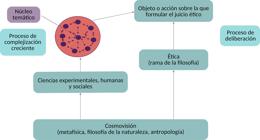
Accepting the fact that bioethics is a branch of ethics with an interdisciplinary methodology, the issue concerning the specific nature of interdisciplinarity in bioethics remains to be solved. To this end, it is necessary to proceed in two stages: firstly, it is necessary to know the sciences involved in this interdisciplinary process and, secondly, it is necessary to propose a specific model of articulation, that is, how to understand what Olga Pombo calls “combination of knowledges.”
The work of Bioethics involves sciences in, at least, three scopes: experimental sciences, human/social sciences, and philosophy. Among the first ones, we can include biology, biotechnology, medicine, pharmacy, etc. Among the second ones, psychology, sociology, etc. Finally, philosophy in its various branches: firstly, ethics, which plays a fundamental role; and also metaphysics, philosophy of nature and anthropology.
The sciences of each of these fields of knowledge have a different nature. Different methods: some inductive and others deductive. Different falsification criteria: verification by trial and error and verification by corroboration, etc. Some are descriptive sciences for specific phenomena of reality—experimental and human sciences; others are interpretive, seeking to explain the totality of reality in its deepest causes—metaphysics, philosophy of nature and anthropology; and others are normative, trying to provide standards for human action, such as ethics.
Thus, experimental and human sciences contribute to bioethics by describing the facts, the elements on which an action must be carried out, or by describing the very action that should be considered. Philosophy, in turn, makes two types of contributions. On the one hand, it provides the worldview that supports experimental science and ethics. On the other hand, it provides the ethical principles and the methodology for the elaboration of the prudential judgment.
The idea of worldview deserves special mention. According to Urbano Ferrer, the worldview nominally designates a certain overview of the world in which man acts and, being composed of a series of convictions that allow man to orient themself in some way in it 30-32, it also has an function of interpreting reality and its meaning.
The nature of the worldview and its proximity to other terms such as cosmology and paradigm is a widely discussed issue 33. Well, it seems clear that its content justifies, among other things, questions such as: What is understood as reality? How is understood the ultimate essence of nature and, therefore, of life? How is answered the question about the definition of being human? The answers to these questions create a basis, a worldview, that determines the scientific options and ethical options. In the worldview, at least, there are questions relative to metaphysics, the nature of matter, the comprehension of the causal system, etc. That is, to elements of metaphysics, anthropology and philosophy of nature, among others.
The Copernican revolution—as described by T.S. Kuhn 34—is a clear example of the role of the worldview. A specific scientific approach can transform the way we understand the world and even the values that govern a society.
At this point, the articulation of knowledges commonly called interdisciplinary character of Bioethics can be described as follows. This is a three-step explanation.
The first step in the elaboration of a bioethical judgment will be to determine the worldview in which the one or those who deliberate are situated. What particular understanding of reality, nature, and man do they share? This will influence the scientific data obtained or chosen 35 and also the ethical model chosen: ethics is always dependent on metaphysics, philosophy of nature and anthropology.
The second step is the contribution of experimental and human sciences, once assumed the perspective derived from the worldview in which they are built. This contribution, according to Cobo Suero, must take into consideration two elements: on the one hand, the relations and interactions between the methods of the various disciplines, as well as the languages and other instruments necessary to the input of information 36.
How to conduct this relation? Cobo Suero proposes the conception of a process of progressive complexification 37 that would be carried out as follows: 1) seek the sciences that question about this object and expose the questions that are asked about this object; 2) seek among them those disciplines whose thematic cores correspond to the main object of study 38; 3) start the process of increasing complexification of participation 39. That is, some disciplines must ask the others about the information they need, acting as primum inter pares that which was identified as that to which corresponds the thematic core of the main object of study. This process will become more complex, that is, it will expand in a network to the most distant sciences.
Well, these mutual questions are gradually enriched in the very development process, as questions will emerge that no longer correspond strictly to each of the sciences involved, but which will originate simultaneously in diverse sciences. Thus will be concluded the definition, as exact as possible, of the object on which the action will be carried out, or the description of the action itself, which must be submitted to an ethical judgment.
The third step of the bioethical interdisciplinarity will be the moment of ethics, the normative, which in turn requires two moments. First, that which arises from the relation of ethics with the other philosophical sciences that intervene in the process. It is choosing, coherently with the paradigm, the ethical option that is part of the worldview. Different ethical models cannot be chosen at the same time, or switched from one to the other at will. There must be coherence between the chosen ethical model, metaphysics, philosophy of nature and anthropology, which configure our worldview.
The second moment is the normative, the elaboration of the ethical judgment. To develop this moment, it is necessary to use deliberative models, which are also not unique, as there is a plurality of them, and which must also be coherent with the chosen ethical model and the worldview that supports it.
The result is an ethical judgment that illuminates the conscience of each person who acts, each physician or nurse who establishes a health-patient relationship, the professional or family member who takes care of another person, the researcher who uses one technique or another. Ultimately, the decision as to appropriating or not this judgment and acting accordingly rests with each person. This is the true nature of the normativity of Bioethics: it is not imposed, but proposed to the individual conscience.
Now, when a society decides its minimum ethics, it acquires a new normativity and forms the ethos of the society that can come to be expressed in the form of law. Thus arises biolaw.
Final considerations
Considering the above, the bridge Potter envisioned seems to take the form of an interdisciplinary structure. That is, bioethics does not constitute a simple conglomerate of knowledges in parallel, nor a novel science in the strict sense, as perhaps supposed; but rather, it can be understood as a branch of ethics that has a specific methodology.
The proposal developed in this article sought to clarify the terminological ambiguity present in the specialized literature. Based on a systematic literature review, it was argued that the concept of interdisciplinarity is the appropriate manner of describing the epistemological status of bioethics if the concept of worldview is incorporated into it—as was done in this work. Thus, there rise at least three implications that are relevant for the development of bioethics.
The first is the form of complementarity of the diverse knowledge and sciences involved in bioethical work. All of them are necessary, but each in its place. Some define the object, others develop the normative judgment and others configure the worldview.
The second is the necessary consonance between the worldview and the ethical model chosen for the judgment. Ethics should be consistent with the worldview. Sometimes, perhaps for pedagogical reasons, the various ethical models are presented in Bioethics manuals and courses as if they were a catalog of products to choose from. It can even give the impression that everyone can choose the one that pleases them the most. The ethical choice should be coherent with the metaphysics, philosophy of nature and anthropology that configure the worldview. Otherwise, the result will lack internal logic.
The third—and perhaps the most useful for the bioethical dialogue—is that the proposal made enables understanding the places where the points of divergence originate, which enables directing the dialogue efforts to the most precise points.
The first of these points is the worldview. Often, the bioethical dialogue resembles a dialogue of deaf persons, in which the opposite positions are irreconcilable and the necessary openness for the dialogue is not seen. However, there is a possibility: to dialogue about the elements of the worldview, which are not limited to anthropology, nor even to metaphysics, but also include the philosophy of biology—the major absence of bioethics. This dialogue will enable finding points of divergence and some points of convergence, even in positions that seem to be more contrary.
The second point is the formulation of the thematic core. The inclusion of the worldview as an element of the interdisciplinary epistemology enables understanding that scientific data are not as neutral or objective as previously thought. The worldview acts as a filter that leads us to see certain things and ignore others; and to interpret them in different ways. Thus, bioethics, which must start with data, must first know the worldview from which it obtains these data.
The third point is the choice of the ethical model. If it is consistent with logic, the ethical model chosen for the formulation of the ethical judgment must be not only compatible, but consistent with the worldview. Well, a worldview does not give rise to a single ethical model, but it can accommodate several. Thus, a bioethical judgment is often rejected or considered insufficient, because an ethical model that is not of its own choice was used in its elaboration, without considering that the model used may be compatible with it.
In short, the study of the epistemological status of bioethics is an exercise of major importance and utility for a fruitful bioethical work.
References
- 1 Potter VR. Bioethics: bridge to the future. Englewood Cliffs, NJ: Prentice-Hall; 1971. p. 7.
-
2 Miller B. Is technology value-neutral? Sci Technol Human Values [Internet]. 2021 [acesso 4 abr 2024];46(1):53-80. DOI: 10.1177/0162243919900965
» https://doi.org/10.1177/0162243919900965 -
3 Juárez Núñez JM, Comboni Salinas S. La epistemología en las ciencias sociales. In: Mejía Montes de Oca P, Juárez Núñez JM, Comboni Salinas S, coordenadores. El arte de investigar [Internet]. México: Universidad Autónoma Metropolitana; 2010 [acesso 4 abr 2024]. p. 103. Disponível: https://tinyurl.com/2p8s33t
» https://tinyurl.com/2p8s33t - 4 Amo Usanos R. Vida y ética. Madrid: Síntesis; 2017. p. 203-6.
-
5 Pombo O. Epistemología de la interdisciplinariedad. La construcción de un nuevo modelo de comprensión. Interdisciplinaria [Internet]. 2013 [acesso 4 abr 2024];1(1):21-50. p. 27. DOI: 10.22201/ceiich.24485705e.2013.1.46512
» https://doi.org/10.22201/ceiich.24485705e.2013.1.46512 - 6 Pombo O. Op. cit. p. 26.
- 7 Potter VR. Op. cit. p. 4.
- 8 DeCamp M, Sugarman J, Sulmasy DP. Voz Bioethics. In: Jennings B, editor. Bioethics. 4ª ed. Farmington Hills: Gale Cengage Learning; 2014. p. 362.
- 9 Garay JS. Voz multidisciplinariedad e interdisciplinariedad. In: Romeo Casanoba CM, diretor. Enciclopedia de bioderecho y bioética. Granada: Comares; 2011. p. 1159.
- 10 Vázquez CS. Voz epistemología bioética. In: Simón Vázquez C, director. Diccionario de Bioética. Burgos: Monte Carmelo; 2006. p. 308.
-
11 Ferrer JJ. La bioética como quehacer filosófico. Acta Bioeth [Internet]. 2009 [acesso 4 abr 2024];15(1):35-41. p. 39. DOI: 10.4067/S1726-569X2009000100004
» https://doi.org/10.4067/S1726-569X2009000100004 - 12 Ferrer JJ. Op. cit. p. 38.
- 13 Martínez J. Inter(trans) disciplinariedad y ética. In: Caamaño JM, editor. La tecnocracia. Madrid: Sal Terrae-Comillas; 2018. p. 102.
-
14 Garrafa V. Multi-inter-transdisciplinariedad, complejidad y totalidad completa en bioética. In: Garrafa V, Kottow M, Saada A, editores. Estatuto epistemológico de la bioética [Internet]. México: Universidad Nacional Autónoma de México; 2005 [acesso 4 abr 2024]. p. 69. Disponível: https://tinyurl.com/2ra4htvh
» https://tinyurl.com/2ra4htvh -
15 Prieto y Schwartzman U, Martins VCS, Souto Ferreira L, Garrafa V. Interdisciplinariedad: referencia indispensable del proceso de enseñanza-aprendizaje de la bioética. Rev. bioét. (Impr.) [Internet]. 2017 [acesso 4 abr 2024];25(3):536-43. DOI: 10.1590/1983-80422017253210
» https://doi.org/10.1590/1983-80422017253210 - 16 Garrafa V. Op. cit. p. 70.
- 17 Garrafa V. Op. cit. p. 80.
- 18 Trevijano Etcheverria M. ¿Qué es la bioética? Salamanca: Ediciones Sígueme; 1998. p. 138.
- 19 Trevijano Etcheverria M. Op. cit. p. 140.
- 20 Trevijano Etcheverria M. Op. cit. p. 136.
- 21 Trevijano Etcheverria M. Op. cit. p. 147.
- 22 Juárez Núñez JM, Comboni Salinas S. La epistemología en las ciencias sociales. In: Mejía Montes de Oca P, Juárez Núñez JM, Comboni Salinas S, coordenadores. El arte de investigar. México: Universidad Autónoma Metropolitana; 2010. p. 115.
-
23 Agazzi E. El estatuto epistemológico de la bioética. Arbor [Internet]. 2019 [acesso 4 abr 2024];195(792):9. DOI: 10.3989/arbor.2019.792n2001
» https://doi.org/10.3989/arbor.2019.792n2001 -
24 Ferrer U. Interdisciplinariedad de la bioética: su posibilidad y sus límites. Cuad Bioet [Internet]. 2013 [acesso 4 abr 2024];24:265-274. p. 268. Disponível: https://tinyurl.com/2ysxszsx
» https://tinyurl.com/2ysxszsx - 25 Reich WT. Encyclopedia of Bioethics. New York: Macmillan Library Reference; 1995. p. 21.
- 26 Amo Usanos R. Op. cit. p. 21-2.
- 27 Agazzi E. Op. cit. p. 2-5.
- 28 Ferrer JJ. Op. cit. p. 37.
-
29 Veatch RM. Is bioethics applied ethics? Kennedy Inst Ethics J [Internet]. 2013 [acesso 4 abr 2024];17(1):1-2. DOI: 10.1353/ken.2007.0007
» https://doi.org/10.1353/ken.2007.0007 -
30 Ferrer Santos U. Filosofía y cosmovisión. Anuario Filosófico [Internet]. 2018 [acesso 4 abr 2024];14:173-82. p. 173. Disponível: https://tinyurl.com/ye9zzscz
» https://tinyurl.com/ye9zzscz - 31 Artigas M. La mente del universo. 2ª ed. Barañain: EUNSA; 2000. p. 115.
- 32 Montserrat J. Hacia el nuevo Concilio: el paradigma de la modernidad en la Era de la Ciencia. Madrid: Editorial San Pablo; 2010. p. 147.
-
33 López AM. Cosmovisión y cosmología: fundamentos histórico-metodológicos para un uso articulado. Cosmovisiones / Cosmovisões [Internet]. 2021 [acesso 4 abr 2024];3(1):66-115. Disponível: https://tinyurl.com/y574r7ct
» https://tinyurl.com/y574r7ct - 34 Kuhn TS. La revolución copernicana. Barcelona: Orbis; 1984. p. 23-5.
- 35 Trevijano Etcheverria M. Op. cit. p. 141.
- 36 Cobo Suero JM. Interdisciplinariedad y universidad. Madrid: Universidad Pontificia Comillas; 1986. p. 38.
- 37 Cobo Suero JM. Op. cit. 1986. p. 41.
- 38 Cobo Suero JM. Op. cit. 1986. p. 45.
- 39 Cobo Suero JM. Op. cit. 1986. p. 43.
Edited by
-
Editor in charge:
Dilza Teresinha Ambrós Ribeiro

 Source: prepared by the author