
 Bioethics knowledge between students and professors
Abstract
The medical program curriculum includes bioethics and deontology courses, aiming to prepare students for the professional future, to make them understand and deal with the biopsychosocial aspects of situations that will arise in professional practice. This is a descriptive, observational, cross-sectional study with 105 participants, divided into three groups: students who have completed the course, students who have not completed the course, and professors/preceptors. After applying a questionnaire, the groups were compared using the chi-square test. Students who had not completed the bioethics course had a lower percentage of correct answers in all questions. Being a physician and having practical experience was significant only in one question, demonstrating that the course was effective in providing students with bioethics knowledge and that medical practice can lead to automatism, which requires reflection.
Keywords
Bioethics; Ethics theory; Medicine
Resumo
A grade curricular do curso de medicina tem na matriz a disciplina de bioética e deontologia, que visa preparar o aluno para o futuro profissional, com intuito de fazê-lo compreender e lidar com os aspectos biopsicossociais de situações que surgirão no exercício de sua profissão. Trata-se de estudo descritivo, observacional, de corte transversal, com 105 participantes, divididos em três grupos: alunos que já tiveram a disciplina, alunos que não tiveram a disciplina e professores/preceptores. Após aplicação de questionário, os grupos foram comparados por meio do teste qui-quadrado. Alunos que não haviam tido a disciplina de bioética apresentaram menor porcentagem de acertos em todas as questões. Ser médico, e ter a vivência prática, foi significativo apenas em uma questão, demonstrando que a disciplina foi efetiva em prover esse conhecimento a alunos e que a prática médica pode levar a um automatismo, o que demanda reflexão.
Palavras-chave
Bioética; Teoria ética; Medicina
Resumen
El currículo de la carrera de medicina contiene en su matriz la asignatura de bioética y deontología, que tiene como objetivo preparar al estudiante para el futuro profesional para hacerlo comprender y abordar los aspectos biopsicosociales de situaciones que se presentarán en el transcurso de su profesión. Se trata de un estudio descriptivo, observacional, de corte transversal, con 105 participantes, divididos en tres grupos: estudiantes que ya tomaron la asignatura, alumnos que no la tomaron y profesores/preceptores. Tras la aplicación del cuestionario, se compararon los grupos mediante la prueba de chi-cuadrado. Los estudiantes que no habían tomado la asignatura de bioética presentaron un menor porcentaje de aciertos en todas las preguntas. Ser médico, y tener la vivencia práctica, fue significativo solo en una pregunta, lo que demuestra que la asignatura fue efectiva en proporcionar este conocimiento a los estudiantes, y que la práctica médica puede llevar a un automatismo, que requiere reflexión.
Palavras clave
Bioética; Teoría ética; Medicina
Medical student training requires a humanistic approach to subjects; therefore, the program curricular structure includes the bioethics and deontology courses. This aims to prepare students for the professional future, in order to make them understand and deal with the biopsychosocial and spiritual aspects of situations that arise in professional practice. In the context of medical education, the best method to teach bioethics to students is widely discussed, considering society’s major demand that they become morally competent professionals.
On the other hand, the medical curriculum in Brazil neglects bioethics education, emphasizing technical training more exclusively. This affects the students 1 medical training, as important issues such as medical secrecy, abortion and medical advertising are addressed in the course. These issues will pose dilemmas that will arise in medical practice, and decision-making requires knowing the bioethical principles and values.
Currently, during professional practice physicians are accountable in three spheres—criminal, civil and ethical-professional—and avoiding involvement in bioethical issues requires, beyond theoretical-practical knowledge, other skills, such as prudence and capacity for moral judgment of actions. Otherwise, physicians are subject to punishment, which is necessary, from an ethical point of view, to ensure patient protection. In 2020, the Regional Council of Medicine of the State of São Paulo (CRM) had 3,995 ongoing ethics processes, of which 666 were filed, and 355 physicians were found guilty. This reinforces the importance of learning the basic aspects of bioethics during academic training 1-7.
Most studies address the students’ knowledge of the Code of Medical Ethics; however, there are no studies comparing medical professionals and students. Thus, the objective of this study was to assess the perception of medical students and medical professors from a school in the São Paulo state’s nonmetropolitan area and to understand the need to create methods for transmission of bioethics knowledge.
Method
This is a descriptive, observational, cross-sectional study, with a quantitative and qualitative approach, carried out at the School of Medical Sciences of São José dos Campos – Humanitas, located in the São Paulo state’s nonmetropolitan area.
The research was carried out from September to December 2022, and the study population comprised medical students, professors and preceptors linked to the institution. According to the study objective, students were separated between those who had completed the bioethics course (starting from the ninth semester) and those who had not completed it (from first to seventh semester). As per the exclusion criteria, the following were excluded: students attending the bioethics course at the time of the research; medical professionals not linked to the institution, and those who refused to sign the informed consent form (ICF). The initial sample was 107 individuals, randomly selected. After applying the exclusion criteria, a final sample of 105 individuals was obtained, including 35 university students who had completed the bioethics course, 35 students who had not completed it, and 35 professors. The ICF and a questionnaire were applied to all participants, in person. The questionnaire contained ten objective questions with the main bioethics issues that are commonly observed in practice. The answers were of the true or false type.
In the statistical analysis, the frequency and percentage of correct answers per group were calculated for each question. The groups were compared using the chi-square test, and the significance level adopted was 5%. The results were compiled and formatted in tables and graphs.
Results and discussion
In total, 105 individuals participated in the study, all agreeing with the use of their answers for scientific purposes. As for student profile, most students were in the fifth year of the medical program, corresponding to 48.5% (n=34) of the participants; secondly, in the second year, 25.7% (n=18); then, in the third year, 12.8% (n=9); in the first year, 8.57% (n=6); in the fourth year, 2.85% (n=2); and finally, in the sixth year, 1.42% (n=1), as shown in Figure 1.

Statistically significant differences between the groups were found in the following questions. The group that had not completed the course had the lowest number of correct answers among all groups in the following questions:
-
“For an abortion after rape, victims must file a police report before the procedure” (p<0.001);
-
“If a rape victim is admitted to a hospital setting and wishes to have an abortion, it is necessary to report it to the police authorities” (p<0.001);
-
“In case of conscientious objection, physicians may choose not to perform an abortion, provided that there is another professional to perform the procedure and the patient is not at imminent risk of death” (p=0.002);
-
“Posting results of aesthetic procedures such as ‘before and after’ on social networks is allowed, provided that patient authorization is obtained” (p=0.004).
In the question “The physician who diagnoses the brain death of a patient must belong to the same transplantation team to ensure the veracity of the diagnosis” (p=0.018), the group of professors presented a higher number of correct answers.
No statistically significant differences were found between the groups in the following questions:
-
“If a family member, up to the second degree, does not agree with the organ donation of a deceased family member, the transplant cannot be performed, even if the deceased patient has a document proving that their organs could be donated” (p=0.190);
-
“Medical publications on social networks must contain only the professional’s name, CRM number and office address” (p=0.684);
-
“For research with human beings, depending on the complexity, it is not necessary to submit the work to a research ethics committee” (p=0.230);
-
“Omission of help is a penalty intended exclusively for health care professionals” (p=0.402);
-
“In Brazil, if a patient is in a severe clinical condition due to terminal illness, physicians may hasten death, as they will be respecting the ethical principles of autonomy, beneficence and non-maleficence” (p=0.695).
Table 1 shows the percentage of correct answers of each group, by question.
Figure 2 below shows the percentage of correct answers by question and group. Questions followed by * and with colored bars present statistically significant difference between the groups.
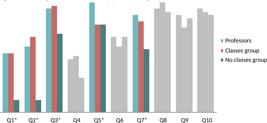
As for the three questions on abortion, there was statistical significance between the groups; therefore, having completed the bioethics course or having had practical experience helped choose the correct answer. As for the question on brain death and organ transplantation, medical professionals scored better than students, probably due to the thoroughness of medical practice on teams of the question. As for the question on social media, which obtained statistical significance, those who had completed the bioethics course or were physicians excelled in correct answers, demonstrating that, before attending the course, few students knew about the prohibition on posting procedures.
The bioethics course is taught in the eighth semester, in lectures with active methodology through problem-based learning (PBL) and team-based learning (TBL), based on real cases or possible situations of practice involving bioethical conflict. Silva, Leão and Pereira 8 corroborate that changing the ethics and bioethics teaching methodology can modify the students’ perception and interest through new strategies (introduction of debates, participation of professionals from other areas, etc.), even enabling them to deal with ethical dilemmas. Studies indicate that the methodologies that proved better for the acquisition of knowledge—such as small group teaching and TBL—are not able to measure the result of the training process, which is the long-term acquisition of competencies and skills 9.
In the study of Almeida and collaborators 10, of the 331 students asked about the most appropriate semester for the study of bioethics, 28.7% indicated the first semester and 21.4% indicated all semesters, which shows the importance of teaching bioethics constantly and early in the medical curriculum. However, one point still lacking consensus is the year in which the course should be taught. There is an inclination to teach it in the first year of the medical program or from it onward, and then contextualize it in the other courses of the program 11.
Medical professionals that have graduated and are working in practical settings often consider themselves holders of the wisdom of medical ethics. However, studies that assess student and professor knowledge of the Code of Medical Ethics show similar scores between the groups. Even considering that students may have similar knowledge due to having recently attended bioethics classes, it should be noted that professors deal daily with bioethics issues, which need to be addressed in practice. Thus, they need to be updated professionals and examples for students in the ethical aspect 11.
Final considerations
In all questions, not having completed the bioethics course reduced the percentage of correct answers, which indicates that attending bioethics classes before the eighth semester—or at least having some kind of contact during the semesters—can be beneficial. Thus, the aim is that students know and respect the Code of Medical Ethics, as they will experience practical scenarios and deal with patients from the beginning of the training.
Being a physician and having practical experience was significant in only one question, demonstrating that the bioethics course is effective in providing students with bioethics knowledge and that medical practice will not always be superior to the knowledge acquired in the classroom. In any case, further studies with larger samples are needed to assess whether the impact of classes is in fact superior to practice.
Acknowledgement
We thank Denise Carvalho da Silva Serrano – Librarian who contributed to the organization and technical standardization of the article.
References
-
1 Ferrari AG. Ensino de bioética nas escolas de medicina da América Latina. Rev. bioét. (Impr.) [Internet]. 2018 [acesso 18 out 2024];26(2):228-34. DOI: 10.1590/1983-80422018262
» https://doi.org/10.1590/1983-80422018262 - 2 Júnior WAN, Serpa LZ, Rego S. Ensino de bioética nas faculdades de medicina no Brasil. Rev. bioét. (Impr.) [Internet]. 2016 [acesso 8 jan 2022];24(1):98-107. DOI: 10.1590/1983-80422016241111
-
3 D'Avila RL. A codificação moral da medicina: avanços e desafios na formação dos médicos. Rev Bras Saúde Matern Infant [Internet]. 2010 [acesso 9 jan 2022];10(Supl. 2):S399-S408. DOI: 10.1590/S1519-38292010000600019
» https://doi.org/10.1590/S1519-38292010000600019 - 4 Marques Filho J, Hossne WS. Análise bioética dos processos de cassação do exercício profissional médico no estado de São Paulo. Rev Assoc Med Bras [Internet]. 2008[acesso 9 jan 2022];54(3):214-9. DOI: 10.1590/S0104-42302008000300013
- 5 Graças VBA, Souza JF, Santos JGMS, Almeida MFA, Oliveira EVG, Santos NVMO et al. Conhecimento sobre ética médica e resolução de conflitos na graduação. Rev. bioét. (Impr.) [Internet]. 2019[acesso 9 jan 2022];27(4):643. DOI: 10.1590/1983-8042201927434
- 6 Silva Filho CSME. Os princípios bioéticos. Resid Pediatr [Internet]. 2017 [acesso 9 jan 2022];7(1):39-41. DOI: 10.25060/residpediatr-2017.v7n1-09
-
7 Conselho Regional de Medicina do Estado de São Paulo. Processos éticos-profissionais [Internet]. 2022 [acesso 9 jan 2022]. Disponível: https://transparencia.cremesp.org.br/?siteAcao=processos_etico_profissionais
» https://transparencia.cremesp.org.br/?siteAcao=processos_etico_profissionais -
8 Silva J, Leão MHM, Pereira ACAC. Ensino de bioética na graduação de medicina: relato de experiência. Rev. bioét. (Impr.) [Internet]. 2013 [acesso 9 jan 2024];21(2):338-43. Disponível em: https://revistabioetica.cfm.org.br/revista_bioetica/article/view/824
» https://revistabioetica.cfm.org.br/revista_bioetica/article/view/824 -
9 Tavares ACALL, Travassos AGA, Tavares RS, Pojal MFM, Nunes RML. Teaching of ethics inmedical undergraduate programs. Acta bioeth [Internet]. 2021 [acesso 9 jan 2022];27(1):101-17. DOI: 10.4067/S1726-569X2021000100101
» https://doi.org/10.4067/S1726-569X2021000100101 - 10 Almeida AM, Bitencourt AGV, Neves NMBC, Neves FBCS, Lordelo MR, Lemos KM et al. Conhecimento e interesse em ética médica e bioética na graduação médica. Rev Bras Educ Méd [Internet]. 2008 [acesso 7 nov 2017];32(4):437-44. DOI: 10.1590/S0100-55022008000400005
-
11 Vieira PSPG, Neves NMBC. Ética médica e bioética no curso médico sob o olhar dos docentes e discentes. O Mundo da Saúde [Internet]. 2009 [acesso 31 jul 2023];33(1):21-5. DOI: 10.15343/0104-7809.200933.1.2
» https://doi.org/10.15343/0104-7809.200933.1.2
Edited by
-
Editor in charge:
Dilza Teresinha Ambrós Ribeiro
All data used or generated in this study are described and presented in full in the body of the article.


