
 The Influence of Social Isolation on the Relationships Among Emotion, Impulse Buying, Purchase Value, and Ego Depletion in Indulgent Purchase Intention
ABSTRACT
The main objective of this study was to identify the influence of social isolation on the relationships between positive and negative emotions, impulse buying tendency, hedonic and utilitarian purchase values, and ego depletion, in indulgent consumption. The data collected from 311 university students were analyzed using structural equation modeling, and the correlation matrix with partial least squares estimation. The results revealed that the perception of social isolation, currently observed at higher levels due to the COVID-19 pandemic, alters the relationships among negative emotions, impulse buying, hedonic and utilitarian purchase values, and ego depletion regarding both the intention to indulge and the intention to not indulge. At the end, we point out theoretical contributions to managers.
KEYWORDS:
Emotions; impulse buying; purchase value; ego depletion; consumer behavior
RESUMO
O objetivo central neste estudo foi identificar a influência do isolamento social nas relações entre emoções positiva e negativa, tendência de compra por impulso, valores de compra hedônico e utilitário e depleção do ego no consumo indulgente. Os dados coletados de 311 estudantes universitários, por meio de uma plataforma de coleta de dados online, foram analisados por meio de modelagem de equações estruturais, com uso da matriz de correlação e estimação por mínimos quadrados parciais. Os resultados relevaram que a percepção de isolamento social, observada atualmente em maiores níveis, em decorrência da pandemia da COVID-19, altera as relações entre emoções negativas, compra por impulso, valores de compra hedônico e utilitário e depleção do ego, tanto com a intenção de compra indulgente como a não indulgente. Ao final, contribuições teóricas aos gestores são apontadas.
PALAVRAS-CHAVE:
Emoções; compra por impulso; valor de compra; depleção do ego; comportamento do consumidor
1 INTRODUCTION
Social isolation occurs when opportunities for social relationships are not taken advantage of due to a lack of capacity or lack of power for social connection (Kahneman et al., 2004). Social isolation is considered a problem for society. Most children (80%) _experience periods of loneliness at school because of passive behaviors regarding social interactions, boredom, and inactivity. Children with few friendships are more likely to be socially isolated and, consequently, be bullied (68%) (Larsen et al., 2022). A study carried out with a sample of 3,858 elderly people in Finland indicates that 49% of them suffered from social isolation. The mortality rate identified for socially isolated individuals was double compared to those who were not isolated (Tilvis et al., 2012).
In everyday life, we spend more time amongst individuals in our social networks than in isolation. We spend around 80% of our hours with other people, such as co-workers, relatives, friends, spouses, and children. These relationships are typically classified as time spent in a more rewarding way (Kahneman et al., 2004). Human beings are social animals and need social connections; that is, we need to belong to available social groups (Hughes et al., 2004).
The COVID-19 pandemic has altered traditional consumer patterns. The stress and uncertainty at that time of crisis led to irrational consumption. These purchases were not made under normal conditions because if they were, they would have been made at different times and in different volumes (Li et al., 2021). Furthermore, mental health problems associated with the COVID-19 pandemic, such as increased anxiety, depression, and post-traumatic stress, have been identified in several regions of the world (Xiong et al., 2020). Higher levels of burnout during the pandemic were observed due to changes in work routines in several areas (Taylor & Frechette, 2022). Economic damage and concerns about psychological discomfort resulting from social isolation arose during the COVID-19 pandemic (Lu et al., 2022). Ego depletion (reduced self-regulation) negatively influences common everyday decisions in people’s lives (Inzlicht & Schmeichel, 2012). Taking into account the increase in interactions in people’s daily lives which are facilitated by the use of digital environments, and the other disorders caused by the COVID-19 pandemic, the depletion of the ego, a result of excessive use and exacerbation of self-control, has become a very common psychological phenomenon.
Emotion directly affects the consumer’s purchasing decision, especially impulse purchases (Rook & Gardner, 1993) and unplanned purchases (Donovan et al., 1994; Sherman et al., 1997). The store environment awakens positive emotions in consumers, affecting consumption (Sherman et al., 1997). Thus, hedonic consumption, as it is related to the positive emotions of pleasure and fun, is also responsible for altering the consumer’s emotions (Griffin et al., 2000). Since social isolation affects hedonic purchase intention and indulgent consumption (Rauch et al., 2015), and emotion affects impulsive consumption, it is relevant to research positive and negative emotions, impulse buying, and purchase values. We are studying hedonic and utilitarian purchases and how these constructs affect indulgent and non-indulgent purchase intentions in the context of social isolation.
The variables ego depletion and social isolation are associated with studies of the “self” and, more specifically, studies on self-regulation. There is theoretical and empirical evidence that positive emotion (Cavanaugh, 2014; Donovan et al., 1994), the tendency to buy on impulse associated with pleasure (Verplanken & Herabadi, 2001), hedonic purchase value (Griffin et al., 2000), and ego depletion would make the individual more susceptible to indulgent consumption (Baumeister et al., 1998, 2007), while isolation distorts these effects in different ways (Cacioppo & Cacioppo, 2014; Hawkley & Cacioppo, 2010). Given the scientific gap identified in the influence of social isolation on emotion, impulse buying, purchase value, ego depletion, and intention to purchase indulgent products, this research proposed relationships among these constructs.
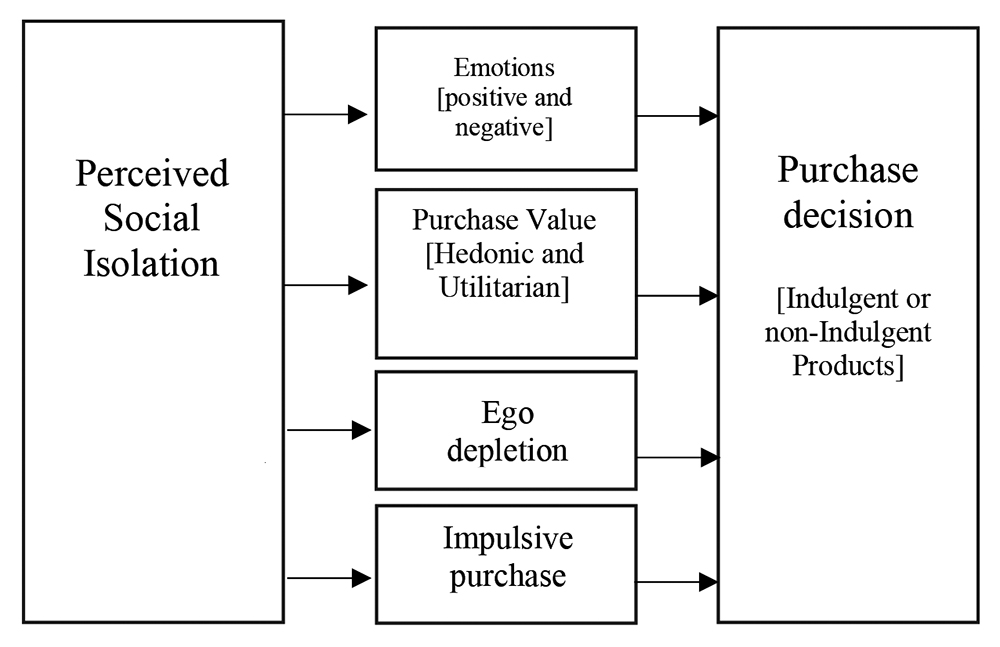
The theoretical originality of this research lies in the relationships established in the conceptual model. Based on the scientific gap initially presented, the constructs were related to establish the following research question: what is the effect of emotions, impulse buying tendency, purchase values, and ego depletion on indulgent consumption in a condition of perceived social isolation? This research has an empirical-positivist approach, with quantitative research evaluation and strategy using structural equation modeling with partial least squares adjustment estimation (Ringle et al., 2014).
Figure 1 presents the theoretical model of this study.
2 SOCIAL ISOLATION
Social isolation is perceived when opportunities for social relationships are not taken advantage of due to a lack of capacity or power for social connection. Individuals with chronic social isolation are characterized by impairments in cognition, attention, and affect (Kahneman et al., 2004). Too much vigilance alters psychological processes and influences physiological functioning, reducing sleep quality and increasing morbidity and mortality. Social connections with family, spouse, and social groups promote social behaviors such as altruism and cooperation. Individual and collective social connections increase the likelihood of integration in difficult and hostile environments (Kahneman et al., 2004).
The socially isolated individual may experience negative emotions such as rejection, exclusion, marginalization, boredom, and passivity (Larson, 1990). Support from a partner when the individual goes through adversity is useful for solving external problems but not sufficient, making support from other people in the social cycle indispensable (Jong-Gierveld & Tilburg, 1987).
Social isolation causes ego depletion (reduced self-regulation). Self-regulation of behaviors and feelings leads the individual to comply with social norms and achieve their personal goals. Ego depletion negatively influences the fulfillment of social norms, personal goals, and other behaviors and feelings (Hawkley & Cacioppo, 2010). Thus, social isolation influences emotions, ego depletion, and purchasing behaviors.
3 POSITIVE AND NEGATIVE EMOTIONS
An individual’s dissatisfaction, lack of achievement in their goals, or inability to avoid a threat are characteristics of a negative affect feeling state (Vandenbos, 2010). Emotions such as unpleasant involvement and distress and aversive moods such as guilt, contempt, fear, nervousness, anger, and disgust form the negative emotion dimension. An individual who presents a state of serenity and calm has low levels of negative emotion (Watson et al., 1988).
The literature considers it a state of feeling positive affect when the individual is satisfied, a goal has been achieved, or a threat has been avoided (Vandenbos, 2010). Positive emotion can be observed when an individual feels alert, enthusiastic, and active, that is when they are in a state of high pleasurable involvement, energy, and concentration. Elements such as apathy and sadness are characteristics of low levels of positive emotion identified in the individual (Watson et al., 1988).
The decision to make unplanned purchases is affected by emotion (Donovan et al., 1994; Sherman et al., 1997). When consumers visit stores and are looking for desired products, previously established in the purchase objective, affective reactions occur, and these emotions stimulate unplanned (Donovan et al., 1994) and impulsive purchases (Rook & Gardner, 1993). The influence of positive emotions aroused in the store or the pre-consumption moment, until the moment of purchasing behavior, is so important that it can even change the consumer’s mood. Thus, once he or she arrives at the store in a negative mood, the store environment and pre-consumption contribute to changing that consumer’s emotion to a positive mood (Sherman et al., 1997).
Rauch et al. (2015) stated that high social isolation leads to compensatory or indulgent consumption. Positive emotions, such as pleasure, increase intentions to spend more, impulsive consumption, and consequently, increase purchasing intentions (Donovan et al., 1994). However, high social isolation is responsible for the increase in several negative emotions, such as rejection, exclusion, marginalization, boredom, passivity (Larson, 1990), suffering (Thoits, 1983), stress, pessimism, anxiety, insecurity, and low self-esteem (Cacioppo et al., 2006). Negative emotions resulting from high perceived social isolation mitigate the positive effect of positive emotions on the intention to purchase indulgent products. In this way, we have the following:
H1a. Positive emotion leads to greater intention to purchase indulgent products in the condition of low perceived social isolation, compared to the condition of high perceived social isolation.
In the argument developed for the previous hypothesis, social isolation affects hedonic purchasing intention and indulgent consumption (Rauch et al., 2015). It is valid to infer that the consumption of products with non-indulgent or utilitarian characteristics is done through the rational motivation of natural human need (Babin et al., 1994; Griffin et al., 2000), with low correlation with positive emotion or pleasure in consumption (Babin et al., 1994; Griffin et al., 2000) and social isolation. Considering the literature, no difference is expected between levels of perceived social isolation and the relationship between positive emotion and consumption of non-indulgent products. Therefore:
H1b There is no difference between the conditions of low and high perceived social isolation for the relationship between positive emotion and intention to purchase non-indulgent products.
A consumer’s negative emotions can significantly influence their consumption behavior. The study of consumer behavior explores how individuals select, purchase, use, and dispose of products and services, and emotions play a crucial role in this process. Negative emotions, such as stress, anxiety, or sadness, can lead to impulsive decisions. Consumers may seek immediate relief from these emotions through impulsive purchases, often irrationally considering the need to obtain the product (Shemeis et al., 2021).
Negative emotions can also influence the choice of specific products. For example, a consumer may turn to comfort or indulgence products to deal with stress, such as comforting foods - not always healthy - or emotional purchases (Romeo-Arroyo et al., 2020; Chakraborty & Chattaraman, 2022). Furthermore, negative emotions can also lead to compulsive buying behaviors. Consumers may attempt to fill an emotional void through excessive purchasing, which they may later regret (Chakraborty & Chattaraman, 2022).
High social isolation increases a series of negative emotions (Cacioppo et al., 2006; Larson, 1990; Thoits, 1983). Therefore, we state that:
H2 In the condition of high (versus low) perceived social isolation, negative emotion leads to greater (versus lower) purchase intention for any type of product...
…being: H2a indulgent and H2b non-indulgent.
3.1 Impulse buying tendency
The tendency to buy on impulse can be defined as a characteristic of consumers, which can trigger unintentional, immediate purchases not thought about or reflected on by consumers (Parsad et al., 2021). High levels of impulse buying tendency cause ego depletion and encourage impulsive purchases, with a positive association between impulse buying tendency and impulse buying behavior (Iyer et al., 2020).
Impulse buying tendency is a construct based on the individual’s personality (trait) (Goel et al., 2022) and considers affective aspects, such as pleasure, excitement, compulsion, ego depletion, and regret, in addition to cognitive aspects, such as lack of planning and deliberation (Verplanken & Herabadi, 2001). Thus, the tendency to buy on impulse is reflected in unintentional, immediate, and thoughtless purchases by a consumer (Jones et al., 2003).
The impulse buying tendency considers emotions such as pleasure (Verplanken & Herabadi, 2001). In confluence, indulgent consumption is also related to pleasure in consumption (Cavanaugh, 2014). Social isolation creates more anxious individuals (Cacioppo et al., 2006), leading to a tendency to buy on impulse. Alternatively, non-indulgent consumption is related to utilitarian and rational motivation (Nenkov & Scott, 2014) without any association with the emotion of pleasure in consumption. Therefore, we expect that:
H3a. Impulsive purchase tendency leads to greater purchase intention for indulgent products in the condition of high perceived social isolation compared to the condition of low perceived social isolation.
H3b. No difference is expected between the conditions of low and high perceived social isolation for the relationship between impulsive purchase tendency and intention to purchase non-indulgent products.
3.2 Hedonic and utilitarian purchase values
Utilitarian purchase value is characterized as a rational purchase by the consumer, focused on the necessary utility of a product or service (Griffin et al., 2000), and it is a conscious consumption to achieve an intended objective (Babin et al., 1994). Conversely, the purchasing process aimed at the consumer’s pleasure and fun is classified as hedonic purchasing value (Griffin et al., 2000), mainly emotionally driven (Longoni & Cian, 2022). Much research relates emotion to purchase value, and in this sense, emotion related to shopping is linked to hedonic purchase value and not to utilitarian purchase value (Griffin et al., 2000). Purchasing values are distinguished between purchasing behavior to obtain a product or service, in the case of utilitarian value, and purchasing behavior because the consumer loves the product or service, in the case of hedonic value (Babin et al., 1994).
Social isolation leads individuals to have problems with cognition, attention, and emotions, such as pleasure. Perceptions of social isolation increase the perception of threats and feelings of vulnerability, increasing vigilance, which alters psychological processes, increasing tension, and decreasing sleep quality (Kahneman et al., 2004). To mitigate the feeling of vulnerability, the individual increases the consumption of non-indulgent products. Indulgent consumption is related to hedonic motivation, pleasure, and merit (Cavanaugh, 2014). Hedonic consumption is motivated by pleasure and fun in consumption (Griffin et al., 2000), and social isolation can lead to indulgent consumption (Rauch et al., 2015). From an empirical point of view, several experimental researchers manipulated indulgent consumption, using products with hedonic characteristics (Nenkov & Scott, 2014). Therefore:
H4. In the condition of high (versus low) perceived social isolation, hedonic purchase value leads to higher (versus lower) purchase intention for any type of product… …being: H4a. indulgent and H4b. non-indulgent.
The literature on indulgent consumption classifies non-indulgent products as utilitarian; that is, the consumer starts from a utilitarian motivation to consume non-indulgent products (Nenkov & Scott, 2014). Increased vigilance and tension, in addition to dysfunctions in cognition such as attention and emotions, when caused by perceived social isolation (Kahneman et al., 2004), alter the utilitarian purchase value, which becomes related to the indulgent purchase intention. Through the compensation of social needs (Martin, 1999), individuals who experience a high level of perceived social isolation may likely seek products or services that compensate for the lack of social interaction. This may include purchasing products that provide comfort, convenience, or well-being to compensate for the absence of social support. Therefore, we formulated the following hypothesis:
H5a. Utilitarian purchase value leads to greater purchase intention for indulgent products in the condition of high perceived social isolation compared to the condition of low perceived social isolation.
In the relationship between utilitarian purchase value and intention to purchase non-indulgent products, perceived social isolation does not predict any change, therefore:
H5b. There is no difference between the conditions of perceived social isolation (low or high) and the relationship between utilitarian purchase value and intention to purchase non-indulgent products.
3.3 Ego depletion
Ego depletion is the state of diminished ego resources following effort on self-regulatory tasks (Baumeister et al., 2007). The term was used for the first time in the literature in experiments that sought to understand the existence of this phenomenon, which proved the causal relationship between self-regulation and ego depletion. The results inferred that the “self” (ego) is a scarce resource and that decreased self-regulation causes ego depletion (Baumeister et al., 1998). The initial definition of ego depletion, made by Baumeister et al. (2007), indicates this is the decrease in the state of the ego’s resource after effort in sequential self-regulation tasks.
The evolution of this approach is the ego depletion process model, which consists of the effort of self-control in aversive events, causing a shift in motivation and attention towards signals of rest or reward, avoiding additional efforts. The ego depletion process model, developed and presented in the study by Inzlicht & Schmeichel (2012) and improved in Inzlicht et al. (2014), predicts that a self-control effort at time 1 leads to a motivated change of task priorities. In this state, mental work becomes increasingly aversive and mental leisure increasingly attractive (a self-control failure at time 2) (Inzlicht et al., 2014).
Positive emotions, such as humor and laughter, monetary incentives, implementation intentions, plans or goals, and social objectives, such as wanting to help others or being a good partner can neutralize the harmful effects of ego depletion (Baumeister et al., 2007). Ego depletion has potential applications in managing human behavior. It is studied by marketing in consumer behavior to understand both different consumption situations and the variables that can influence consumption (Tangney et al., 2004).
Individuals exposed to social isolation present impairments in cognition and attention, and perceptions of social isolation increase vigilance to threats (Kahneman et al., 2004). Perceived social isolation-motivated by the COVID-19 pandemic-increases ego depletion and activates attention and vigilance, reducing the intention to purchase indulgent products, therefore:
H6. Ego depletion leads to greater purchase intention for indulgent products under the condition of low perceived social isolation compared to high perceived social isolation.
4 METHOD
This research performed statistical analyses using structural equation modeling with partial least squares adjustment estimation (Ringle et al., 2014). Data collection was done through a cross-sectional online survey using the QuestionPro platform.
We established the minimum sample size, following the criteria according to the proposed model with six predictors, average effect size f2 = 0.15 and power of 80%, through a priori analysis in G*Power (https://g- power.apponic.com/), in accordance with literature recommendations (Hair et al., 2009; Ringle et al., 2014). Following this indication, a minimum sample of 98 participants would be adequate. However, to obtain a more consistent model, the literature (Hair et al., 2009; Ringle et al., 2014) recommends doubling or even tripling the sample size considered in G*Power, which is an ideal sample of 294 individuals.
In November 2021, we invited university students from a large Brazilian higher education institution to participate in the study. Respondents’ participation was optional and took a maximum of 10 minutes. To incentivize students to participate, they were entered into a drawing for a shopping voucher worth R$ 100.00. In total, 1,139 students accessed the survey link, of which 774 (67.9%) started and only 373 (32.7%) respondents completed the survey, composing the final sample. This high rate of adherence can be explained by the nature of the sample, as even if it was not a mandatory activity, university students are quite collaborative in participating in field research (Lopes et al., 2019).
Given the guarantee of confidentiality and anonymity given to participants at the beginning of the activity, we did not record any sensitive data, and participants could abandon the research at any stage of the data collection instrument. Since this procedure guarantees total confidentiality of data and the rights of participants (General Data Protection Law) and does not require prior analysis by Research Ethics Committees (according to CNS Resolution no. 510/2016), it is not possible to analyze non-respondents, due to lack of sociodemographic data. Duplicate responses were controlled by analyzing and eliminating repeated IPs (network protocol) (this process only eliminated seven observations in this phase).
With the research collection completed and the database compiled, we conducted descriptive and demographic statistical tests, outlier analysis, verification of normality, and multicollinearity of the constructs using SPSS statistical software. To achieve the research objectives, we used the SmarlPLS2.0 statistical software utilizing structural equation modeling using partial least squares. This multivariate data technique analyzes latent variables (constructs), observable variables (items), and the structural model itself (Ringle et al., 2014).
4.1 Scales and Measurements
The collection instrument used consisted of 42 items in total, 38 items relating to the study’s independent variables and four items relating to purchase intention, relating to eight different products. To measure perceived social isolation, we used the DJGELS scale, consisting of five items (Jong-Gierveld & Tilburg, 2006). We also used 10 items from the reduced PANAS-VRP emotion scale (Galinha et al., 2014), five statements to estimate the tendency to buy on impulse (Weun et al., 1998), seven items from the purchase value scale hedonic, six utilitarian purchase value items (Lopes et al., 2012; Griffin et al., 2000), and five items from the ego depletion scale (Viacava et al., 2016). We also used four statements to estimate the purchase intention (Dash et al., 2021) of the sample, relating to eight different products, four products considered indulgent and the other four non-indulgent. A 10-point scale measured all items, ranging from 1-totally disagree to 10-totally agree. The choice for these scales is justified by the relevance and impact of the journals in which they were published and by their wide use in previously conducted consumer behavior studies. The items from the original scales were translated by the study authors and by a translator fluent in English. The two translations were then compared and the differences were resolved by a third fluent translator.
In the end, the research instrument included some demographic questions for further characterization of the sample.
4.2 Choice of products
The images of the products presented to respondents, such as meals with filet mignon parmigiana, a mixed salad, a hamburger, and a healthy sandwich, were chosen based on a pre-test to determine which types of food are considered indulgent versus non-indulgent. A selection of 12 dishes and snacks were presented to a group of ten university students (who did not participate in the main research) so that they could indicate the most (versus least) pleasurable foods. The ice cream and fruit salad dessert products were based on Hagen et al. (2019) and Huyghe and Kerckhove (2013), respectively. The paper clips product was chosen based on Nenkov and Scott (2014).
5 RESULTS
In this section, we present the results of the data analysis conducted.
5.1 Initial Analyses
The univariate outlier analysis indicates that the responses of the independent variables investigated did not contain deviant observations, as the maximum indicators of asymmetry and kurtosis that indicate the trend (> 2) and existence (> 3) of univariate outliers were not found (Hair et al., 2009). We then performed a multivariate outlier analysis. For this, Mahalanobis distance analysis was conducted with a significance level of 1%. In this analysis, 62 biased questionnaires were found and discarded from the following analyses. Therefore, the final sample consisted of 311 respondents.
The next step was to verify the normality of the distribution of the dependent variables. As the sample of this study is considered large (n>30), we conducted verification using the Kolgomorov-Smirnov Z test. After analyzing the results of this test, we found that the p-values of all dependent variables were significant (p<0.01), indicating that the distribution of the variables does not meet the assumption of normality. In this way, our option for structural equation modeling using the correlation matrix and partial least squares estimation was reinforced (Hair et al., 2009; Ringle et al., 2014).
Subsequently, we ensured the absence of multicollinearity by identifying appropriate variance inflation factors (VIF<10). Finally, to control for common method bias (Podsakoff et al., 2003), we conducted Harman’s single test, which presented a total explained variance of 34.2%.
5.2 Final sample
The final sample (n = 311) is made up of 58.2% female participants (n = 181), aged between 18 and 58 years (average = 23 years; standard deviation = 5 years), most of them in paid professional work (85.5%), gross family income between one and three minimum wages (46.6%), single (86.5%), and without children (87.8%).
5.3 Multigroup analysis
To enable multigroup analysis based on perceived social isolation, we validated the internal consistency of the five items used (Cronbach’s =0.811) and dichotomized (by average) the sample into two groups, one with high perceived social isolation and the other of low perceived social isolation. The literature supports this procedure (see Iacobucci et al., 2015). Table 1 presents the distribution of group divisions.
After dividing the sample into two groups, low and high perceived social isolation, we ran a post hoc analysis in G*Power with each of these groups, low perceived social isolation (n = 169) and high perceived social isolation (n = 149), considering a medium effect size f2 = 0.15, probability of error 5% and with six predictors, according to our model. The resulting power for the sample with low perceived social isolation is 97.67%, while the resulting power for the sample with high perceived social isolation is 95.53%. This post hoc analysis demonstrates a high power of the test, greater than predicted in the a priori analysis.
To demonstrate that groups with high and low perceived social isolation are equivalent, we present descriptive data and a comparison between them (Table 2).
5.4 Model fit analysis
Analysis of the measurement model identified suitable indicators for both the low group (Table 3) and the high group (Table 4) perceived social isolation.
The coefficient of determination (R2) for the intention to purchase indulgent products for the group with low perceived social isolation is 25%, and for the group with high perceived social isolation, it is 27%. These effects are considered large for applied social sciences (Ringle et al., 2014). It is possible to state that the explanatory power of the model for the intention to purchase indulgent products is slightly greater for the group with high perceived social isolation when compared to the group with low perceived social isolation.
The R2 observed for purchase intention for non-indulgent products is 16.8% for the group with low perceived social isolation and 9.3% for the group with high perceived social isolation. These results can be considered as having a medium to large effect and a medium effect, respectively.
At the end, we checked the model’s goodness-of-fit indicators. The predictive validity, identified through the Stone-Geisser indicator (Q2), was satisfactory, as all indices are > 0. As the name suggests, this indicator evaluates the model’s predictive power. Another indicator of model fit quality, effect size, also known as Cohen’s indicator (f2), evaluates the usefulness of each construct for model fit. In this case, all indicators are considered large for model adjustment (Hair et al., 2014).
The next step was to analyze the discriminant validity of the constructs. We checked the discriminant validity, following the criterion of Fornell and Larcker (1981), in which the square roots of the AVEs must be greater than the correlations between the constructs. For both the low and high perceived social isolation groups, the discriminant validity results were adequate. Based on this, we analyzed the structural paths and, consequently, the testing of the hypotheses, through bootstrapping resampling, which was performed with the sample number of each condition of perceived social isolation and with the total number of repetitions equal to the size sample. The result can be seen in Table 5.
As shown in Table 5, only three hypotheses were rejected (H1a, H2a, and H4a). The results rejected hypothesis 1a, which predicted that positive emotion would lead to greater intention to purchase indulgent products, in the condition of low perceived social isolation, compared to the condition of high perceived social isolation. Even though this trend exists ( low isolation= 0.112; t=2.172; p<0.05 versus high isolation= 0.069; t=1.239; p=n.s.), the difference between the two groups was not statistically significant at the level 10% (t=1.629; p=n.s.).
The data shows the same phenomenon in the test results of Hypothesis 2a. Even if there is a difference in the relationship between negative emotions and the intention to purchase indulgent products (low isolation= 0.075; p=n.s. versus high isolation= 0.115; p<0.10), this is also not statistically significant (t=1.392; p=n.s.).
Finally, we observed the same effect in the relationship between hedonic purchase value and intention to purchase indulgent products (H4a). In the low perceived social isolation condition (=0.161; t=2.624; p<0.05), the relationship between the variables was weaker when compared to the high perceived social isolation group (= 0.194; t=3.706; p<0.01). However, this difference is also not statistically significant (t= 1.203; p=n.s.).
6 DISCUSSIONS
With the analyses of structural equation modeling using partial least squares, we consider that the objective of this research was achieved. The results indicate that in a natural social condition for human beings (low perceived social isolation), positive emotion leads to the intention to purchase indulgent products, since pleasure, for example, can increase impulsive consumption and intentions to spend more (Donovan et al., 1994). This same relationship is not found in the condition of high perceived social isolation. With these results, it is possible to infer that the relationship between positive emotion and indulgent purchase intention is mitigated by the negative emotions observed in individuals with high perceived social isolation, as observed in the literature (Cacioppo et al., 2006; Larson, 1990; Thoits, 1983).
For the intention to purchase indulgent products, there was no significant difference between the conditions of low and high perceived social isolation, contrary to what had been hypothesized. Despite this, there is an evident tendency for the condition of high perceived social isolation to lead to greater intention to purchase indulgent products. In this case, we recommend that there be more empirical research to confirm whether the trend continues or becomes significant. The negative emotions of perceived social isolation (Cacioppo et al., 2006; Larson, 1990; Thoits, 1983) seem to enhance the negative emotion that predicts purchase intention. In this case, there are significant effects for indulgent and non-indulgent products (H2b). The negative effects of perceived social isolation interfere with the relationship between negative and positive emotions with indulgent and non-indulgent consumption, neutralizing or enhancing aspects of positive and negative emotions, respectively.
Impulse buying tendency predicts purchase intention for indulgent products. This relationship considers pleasure in both the impulsive buying tendency (Verplanken & Herabadi, 2001) and indulgent consumption (Cavanaugh, 2014). As for the intention to purchase non-indulgent products (H3b), as expected, the effect of the tendency to buy on impulse is not observed, as it is a utilitarian and rational purchase (Nenkov & Scott, 2014). With the results, it is possible to infer that high perceived social isolation interferes with the relationship between the tendency to buy on impulse and the tendency to purchase indulgent products.
Our research confirmed the relationship between hedonic purchase value and indulgent purchase intention in the natural human condition of social relationships (low perceived social isolation). However, despite the tendency for a greater relationship for the condition of high perceived social isolation, the difference between the conditions of low and high perceived social isolation was not significant.
Compared to low perceived social isolation, high perceived social isolation more influenced the relationship between hedonic value and the intention to purchase non-indulgent products. One possible justification is that in the condition of high perceived social isolation, there is confusion between the positive emotions observed in hedonic value (Griffin et al., 2000) and indulgent consumption (Cavanaugh, 2014), in addition to the negative emotion of perceived high social isolation (Cacioppo et al., 2006; Larson, 1990; Thoits, 1983) and the utility and rationality found in the intention to purchase non-indulgent products (Nenkov & Scott, 2014).
There is a difference between the conditions of low and high perceived social isolation in the relationship between the utilitarian purchase value and the intention to purchase indulgent products. Otherwise, we found no such difference for purchase intention for non-indulgent products. The findings of this research confirm the influence of high perceived social isolation on hedonic and utilitarian purchasing values. High perceived social isolation somehow deregulates the predicted effects of hedonic and utilitarian purchasing values, which further research should explore.
As predicted, ego depletion is only related to indulgent purchase intention in the condition of low perceived social isolation. Ego depletion causes a change in the individual’s motivation, from “need to do” goals to “want to do” goals, and it leads the individual to pleasant and rewarding goals (Inzlicht et al., 2014). There is a difference between the conditions of low and high perceived social isolation in the relationship between ego depletion and the intention to purchase indulgent products, as expected. With post hoc analysis, we found that positive and negative emotions influence ego depletion. Thus, it is possible to infer that the low positive emotion and high negative emotion found in the ego depletion group, in the condition of perceived social isolation, mitigate the positive effect of ego depletion on the intention to purchase indulgent products in the perceived high isolation condition.
Finally, after analyzing the results and verifying the hypotheses, we performed a post hoc analysis of ego depletion in relation to positive and negative emotions. The results demonstrate that positive emotion is greater for the group with low levels of ego depletion (M = 7.62) than for the group with ego depletion (M = 6.51).
The student’s t-test was performed and confirmed the significant difference (t(309) = 5.28, p < 0.01). We performed the same test for ego depletion in relation to negative emotion. Negative emotion is greater for the ego-depleted group (M(ego-depletion) = 4.53) than for the group with low levels of ego-depletion (M(low ego-depletion) = 3.49), with a significant difference (t(309) = -4.24, p < 0.01). Positive emotion decreases in the ego depletion group and negative emotion increases. The relationship between ego depletion and indulgent purchase intention is explained via emotion and not ego depletion.
6.1 Contributions obtained and final considerations
Through the results obtained, it was possible to answer the question posed by the research. This study contributes theoretically to the Marketing literature, especially that around consumer behavior, regarding the influence of perceived social isolation on consumption. High perceived social isolation influences purchase intention differently compared to low perceived social isolation. The effects of positive and negative emotions, hedonic and utilitarian purchase values, and ego depletion were altered in different ways.
Future research can continue to study the influence of perceived social isolation on consumption, considering, in addition to the theoretical contribution, the practical contribution and public policies, considering the context of the COVID-19 pandemic, which generated levels of unprecedented social isolation perception.
Managers should take into account that sales tools that rely on emotional communication using positive emotions (Buy today! You’re getting a great deal) and negative (Not buying today will make you lose out!) may not be effective in situations of high perceived social isolation and indulgent products.
Surprisingly, the relationships of negative emotions with indulgent and non-indulgent purchase intention increased with greater levels of perceived social isolation. Managers must consider negative emotions when creating sales tools and strategies to increase their sales. The pleasure consumers feel regarding consumption, approached through the hedonic value construct, begins to have greater intentions to purchase non-indulgent products under conditions of high perceived social isolation. Likewise, the utilitarian purchase value becomes related to the intention to purchase indulgent products under conditions of high perceived social isolation. Managers should consider that in situations of high perceived social isolation, marketing tools to increase sales, based on hedonic and utilitarian purchasing values, will increase the purchase intention of indulgent and non-indulgent products. In the case of sales made with insistent negotiation strategies, which reduce self-regulation, causing ego depletion, managers must be aware that, in conditions of high perceived social isolation, the relationship with the intention to purchase indulgent products does not exist.
Some research suggestions should be considered, based on the results of this study. High perceived social isolation increases purchase intention for non-indulgent products when preceded by hedonic purchase value. This relationship can be tested in future research to understand whether this effect remains and the reasons for this occurring. Likewise, the effect of ego depletion on the intention to purchase indulgent products is mitigated in the condition of high perceived social isolation, differently from what was published in the literature and predicted in this research. Future research can go beyond online collection and test the relationships investigated in this research through in-person research, in addition to extrapolating the collection to different regions of the world, to increase external validity and consolidate the effects found.
AGRADECIMENTOS
We thank the BBR editors and reviewers for their excellent suggestions for improvements made during the study evaluation process.
REFERENCES
- Babin, B. J., Darden, W. R., & Griffin, M. (1994). Work and/or fun: measuring hedonic and utilitarian shopping value. Journal of Consumer Research, 20(4), 644-656.
- Baumeister, R. F., Bratslavsky, E., Muraven, M., & Tice, D. M. (1998). Ego depletion: Is the active self a limited resource? Journal of Personality and Social Psychology, 74(5), 1252-1265.
- Baumeister, R. F., Vohs, K. D., & Tice, D. M. (2007). The strength model of self-control. Current Directions in Psychological Science, 16(6), 351-355.
- Cacioppo, J. T., & Cacioppo, S. (2014). Social relationships and health: The toxic effects of perceived social isolation. Social and personality psychology compass, 8(2), 58-72.
- Cacioppo, J. T., Hawkley, L. C., Ernst, J. M., Burleson, M., Berntson, G. G., Nouriani, B., & Spiegel, D. (2006). Loneliness within a nomological net. Journal of Research in Personality, 40(6), 1054-1085.
- Cavanaugh, L. A. (2014). Because I (don’t) deserve it: How relationship reminders and deservingness influence consumer indulgence. Journal of Marketing Research, 51(2), 218-232.
- Chakraborty, S., & Chattaraman, V. (2022). Acculturative stress and consumption‐based coping strategies among first‐generation Asian‐Indian immigrants in the United States. International Journal of Consumer Studies, 46(3), 831-849.
- Dash, G., Kiefer, K., & Paul, J. (2021). Marketing-to-Millennials: Marketing 4.0, customer satisfaction and purchase intention. Journal of Business Research, 122, 608-620.
- Donovan, R. J., Rossiter, J. R., Marcoolyn, G., & Nesdale, A. (1994). Store atmosphere and purchasing behavior. Journal of Retailing, 70(3), 283-294.
- Fornell, C., & Larcker, D. F. (1981). Evaluating structural equation models with unobservable variables and measurement error. Journal of Marketing Research, 18(1), 39-50.
- Galinha, I. C., Pereira, C. R., & Esteves, F. (2014). Versão reduzida da escala portuguesa de afeto positivo e negativo - PANAS-VRP. Psicologia, 28(1), 53-65.
- Goel, P., Parayitam, S., Sharma, A., Rana, N. P., & Dwivedi, Y. K. (2022). A moderated mediation model for e-impulse buying tendency, customer satisfaction and intention to continue e-shopping. Journal of Business Research, 142, 1-16.
- Griffin, M., Babin, B. J., & Modianos, D. (2000). Shopping values of Russian consumers: the impact of habituation in a developing economy. Journal of Retailing, 76(1), 33-52.
- Hagen, L., Krishna, A., & McFerran, B. (2019). Outsourcing responsibility for indulgent food consumption to prevent negative affect. Journal of the Association for Consumer Research, 4(2), 136-146.
- Hair, J. F., Black, W. C., Babin, B. J., Anderson, R. E., & Tatham, R. L. (2009). Análise Multivariada de Dados (6ª ed.). Bookman Editora.
- Hair Jr, J., Sarstedt, M., Hopkins, L., & G. Kuppelwieser, V. (2014). Partial least squares structural equation modeling (PLS-SEM) An emerging tool in business research. European business review, 26(2), 106-121.
- Hawkley, L. C., & Cacioppo, J. T. (2010). Loneliness matters: A theoretical and empirical review of consequences and mechanisms. Annals of Behavioral Medicine, 40(2), 218-227.
- Hughes, M. E., Waite, L. J., Hawkley, L. C., & Cacioppo, J. T. (2004). A short scale for measuring loneliness in large surveys: Results from two population-based studies. Research on Aging, 26(6), 655-672.
- Huyghe, E., & Kerckhove, A. van (2013). Can fat taxes and package size restrictions stimulate healthy food choices?. International Journal of Research in Marketing, 30(4), 421-423.
- Iacobucci, D., Posavac, S. S., Kardes, F. R., Schneider, M. J., & Popovich, D. L. (2015). Toward a more nuanced understanding of the statistical properties of a median split. Journal of Consumer Psychology, 25(4), 652-665.
- Inzlicht, M., & Schmeichel, B. J. (2012). What is ego depletion? Toward a mechanistic revision of the resource model of self-control. Perspectives on Psychological Science, 7(5), 450-463.
- Inzlicht, M., Schmeichel, B. J., & Macrae, C. N. (2014). Why self-control seems (but may not be) limited. Trends in cognitive sciences, 18(3), 127-133.
- Iyer, G. R., Blut, M., Xiao, S. H., & Grewal, D. (2020). Impulse buying: a meta-analytic review. Journal of the Academy of Marketing Science, 48(3), 384-404.
- Jones, M. A., Reynolds, K. E., Weun, S., & Beatty, S. E. (2003). The product-specific nature of impulse buying tendency. Journal of Business Research, 56(7), 505-511.
- Jong-Gierveld, J. de, & Tilburg, T. G. van (2006). A 6-Item Scale for Overall, Emotional, and Social Loneliness: Confirmatory tests on survey data. Research on Aging, 28(5), 582-598.
- Jong-Gierveld, J. de, & Tilburg, T. G. van (1987). The partner as source of social support in problem and non-problem situations. Journal of Social Behavior and Personality, 2(2), 191-200.
- Kahneman, D., Krueger, A. B., Schkade, D. A., Schwarz, N., & Stone, A. A. (2004). A survey method for characterizing daily life experience. Science, 306(5702), 1776-1780.
- Larsen, L., Helland, M. S., & Holt, T. (2022). The impact of school closure and social isolation on children in vulnerable families during COVID-19: a focus on children’s reactions. European child & adolescent psychiatry, 31(8), 1-11.
- Larson, R. W. (1990). The solitary side of life. Developmental Review, 10(2), 155-183.
- Li, S., Zhang, Z., Liu, Y., & Ng, S. (2021). The closer I am, the safer I feel. Psychology & Marketing, 38(11), 2006-2018.
- Longoni, C., & Cian, L. (2022). Artificial intelligence in utilitarian vs. hedonic context. Journal of Marketing, 86(1), 91-108.
- Lopes, E. L., Teixeira, J. M., & Moretti, S. L. (2012). Valor de compra hedônico ou utilitário e sua influência no varejo: resultados de um survey no setor de construção civil. Organizações & Sociedade, 19(60), 87-108.
- Lopes, E. L., Herrero, E., Pinochet, L. H. C., & Freire, O. B. D. L. (2019). Test and validation of data collection strategies used in applied social sciences: a marketing study. BASE-Revista de Administração e Contabilidade da Unisinos, 16(3), 432-463.
- Lu, L., Lee, L., Wu, L., & Li, X. (2022). Healing the pain: does COVID-19 isolation drive intentions to seek travel and hospitality experiences? Journal of Hospitality Marketing & Management, 31(3), 1-20.
- Martin, L. L. (1999). ID compensation theory: Some implications of trying to satisfy immediate-return needs in a delayed-return culture. Psychological Inquiry, 10(3), 195-208.
- Nenkov, G. Y., & Scott, M. L. (2014). Priming effects of cute products on indulgent consumption. Journal of Consumer Research, 41(2), 326-341.
- Parsad, C., Prashar, S., Vijay, T. S., & Kumar, M. (2021). Do promotion and prevention focus influence impulse buying. Journal of Retailing and Consumer Services, 61, 1-11.
- Podsakoff, P. M., MacKenzie, S. B., Lee, J. Y., & Podsakoff, N. P. (2003). Common method biases in behavioral research: a critical review of the literature and recommended remedies. Journal of applied psychology, 88(5), 879-903.
- Rauch, A., Deker, J. S., & Woodside, A. G. (2015). Consuming alone: Broadening Putnam’s “bowling alone” Thesis. Psychology & Marketing, 32(9), 967-976.
- Ringle, C., Da Silva, D., & Bido, D. (2014). Structural equation modeling with the SmartPLS. Brazilian Journal of Marketing, 13(2), 56-73.
- Romeo-Arroyo, E., Mora, M., & Vázquez-Araújo, L. (2020). Consumer behavior in confinement times: Food choice and cooking attitudes in Spain. International journal of gastronomy and food science, 21, 100226
- Rook, D. W., & Gardner, M. P. (1993). In the mood: Impulse buying’s affective antecedents. Research in Consumer Behavior, 6(7), 1-28.
- Sherman, E., Mathur, A., & Smith, R. B. (1997). Store environment and consumer purchase behavior: mediating role of consumer emotions. Psychology & Marketing, 14(4), 361-378.
- Shemeis, M., Asad, T., & Attia, S. (2021). The effect of big five factors of personality on compulsive buying: the mediating role of consumer negative emotions. American Journal of Business and Operations Research, 2(1), 5-23
- Tangney, J. P., Baumeister, R. F., & Boone, A. L. (2004). High self‐control predicts good adjustment, less pathology, better grades, and interpersonal success. Journal of Personality, 72(2), 271-324.
- Taylor, D. G., & Frechette, M. (2022). The Impact of Workload, Productivity, and Social Support on Burnout Among Marketing Faculty During the COVID-19 Pandemic. Journal of Marketing Education, 44(1), 1-15.
- Thoits, P. A. (1983). Multiple identities and psychological well-being: A reformulation and test of the social isolation hypothesis. American Sociological Review, 48(2) 174-187.
- Tilvis, R. S., Routasalo, P., Karppinen, H., Strandberg, T. E., Kautiainen, H., & Pitkala, K. H. (2012). Social isolation, social activity and loneliness as survival indicators in old age. European Geriatric Medicine, 3(1), 18-22.
- Vandenbos, G. R. (2010). Dicionário de Psicologia da APA Artmed.
- Verplanken, B., & Herabadi, A. (2001). Individual differences in impulse buying tendency: Feeling and no thinking. European Journal of Personality, 15(1), S71-S83.
- Viacava, J. J. C., Francisquetti, J. Q., Lima, L. R., & Junior, E. O. (2016). Preciso mexer no celular: a influência do autocontrole e da depleção do ego no uso de smartphones. Revista Brasileira de Marketing, 15(1), 113-132.
- Watson, D., Clark, L. A., & Tellegen, A. (1988). Development and validation of brief measures of positive and negative affect: the PANAS scales. Journal of Personality and Social Psychology, 54(6), 1063-1070.
- Weun, S., Jones, M. A., & Beatty, S. E. (1998). Development and validation of the impulse buying tendency scale. Psychological Reports, 82(3), 1123-1133.
- Xiong, J., Lipsitz, O., Nasri, F., Lui, L. M., Gill, H., Phan, L., Chen-Li, D., Iacobucci, M., Ho, R., Majeed, A., & McIntyre, R. S. (2020). Impact of COVID-19 pandemic on mental health in the general population: A systematic review. Journal of Affective Disorders, 277, 55-64.
Edited by
-
EDITOR IN CHIEF
Talles Vianna Brugni https://orcid.org/0000-0002-9025-9440
-
ASSOCIATE EDITOR
Emerson Mainardes https://orcid.org/0000-0003-2525-275X

 Source: the authors