 Facing Difficulties in Culinary SMES: Innovative Performance and Digital Marketing as Mediators
ABSTRACT:
This study investigates the interplay between entrepreneurial marketing, digital marketing, innovation performance, and marketing outcomes in the culinary SMEs (small and medium enterprises) in Palu, Indonesia. Employing a quantitative approach and purposive sampling, 5830 SMEs were surveyed via questionnaires between August and September 2021. Structural Equation Modeling (SEM) facilitated analysis. Results reveal significant relationships: entrepreneurial marketing correlates with digital marketing and innovative performance; digital marketing positively influences marketing performance; and innovative performance is linked to marketing performance. Digital marketing serves as a mediator between entrepreneurial marketing and marketing performance, while innovative performance mediates the connection between entrepreneurial marketing and marketing outcomes. These findings suggest that culinary SMEs should constantly use digital marketing to promote their products as well as showing the value of putting new products on the market that are specifically catered to the needs of the target market.
Keywords:
Culinary; SMEs; Digital Marketing; Marketing Performance
RESUMO:
Este estudo investiga a interação entre o marketing empresarial, o marketing digital, o desempenho da inovação e os resultados de marketing nas PMEs culinárias de Palu. Empregando uma abordagem quantitativa e amostragem intencional, 5830 PMEs foram pesquisadas por meio de questionários entre agosto e setembro de 2021. A modelagem de equação estrutural (Structural Equation Modeling - SEM) facilitou a análise. Os resultados revelam relações significativas: o marketing empresarial está correlacionado ao marketing digital e ao desempenho inovador; o marketing digital influencia positivamente o desempenho de marketing; e o desempenho inovador está vinculado ao desempenho de marketing. O marketing digital serve como mediador entre o marketing empresarial e o desempenho de marketing, enquanto o desempenho inovador medeia a conexão entre o marketing empresarial e os resultados de marketing. Essas descobertas sugerem que as PMEs do setor culinário devem usar constantemente o marketing digital para promover seus produtos, bem como o valor de colocar novos produtos no mercado que atendam especificamente às necessidades do mercado-alvo.
Palavras-chave:
Culinária; PMEs; Marketing digital; Desempenho de marketing
1. INTRODUCTION
In all countries, MSMEs (micro, small, and medium enterprises) are the pillars of the people's economy, absorbing large numbers of formal and informal workers and contributing to the GDP of a country. In Indonesia, from 2010 to 2018, MSMEs absorbed an average of 95 million workers annually. Just in 2015, MSMEs were able to absorb 123.2 million workers. The MSME sector is the pillar of the economy that contributes most to the country when a crisis occurs. However, when the COVID-19 pandemic hit, the economic sector became sluggish and many economic activities stopped, with no exception for the the MSME sector. Regional quarantines limited the mobility of community activities (Caballero-Morales, 2021) and could cause economic depression (Irawan, 2020; Madeira et al., 2021; Lu et al., 2021; Burhan et al., 2021).
On the other hand, these challenges can trigger SMEs to seek various strategic mechanisms as part of the crisis (Klyver & Nielsen, 2021). The Covid-19 pandemic has limited people's mobility, triggering changes in consumer behavior. Marketing experts Inventure Consulting explained that the Covid-19 pandemic had caused major changes to consumer behavior or Megashift Consumer Behavior 10x10, where changes in consumer behavior are 10 times greater at a rate 10 times faster. Thus, every business actor faces a new world in running his business (Fajrian, 2021). Central Sulawesi, one of Indonesia´s provinces, experienced growth of 15.39% in the second quarter of 2021 when compared to the second quarter of 2020 (BPS, 2021); this condition gives hope for business actors and is a fairly good indicator for comparing the growth in the fourth quarter of 2020 with the fourth quarter of 2019, where growth was only 4.45% (BPS, 2019). In era of the new normal, MSMEs in Palu City also experience the same difficulties and challenges as other MSMEs in Indonesia.
However, innovative changes and improvements in marketing, namely, product, price, promotion, distribution, people, process, and visualizations, might stem from SMEs' marketing communication tools. This is because the developments created through internet platforms (Horvath et al., 2021). For instance, in terms of technology-enabled marketing communication, social media has become a trendy communication tool that enables firms to explore and find opportunities (Dima & Vasilache, 2015; Tekin & Turhan, 2020), thus improving firms' innovativeness (Papa et al., 2018). Furthermore, social media platforms also make businesses create new goods and services and improve their quality (Wardati & Mahendrawathi, 2019). Moreover, communication tools improve the marketing performance of enterprises (Pisicchio & Toaldo 2020). The first area of marketing innovation, namely product/service innovation, consists of certain innovative activities that enable businesses to introduce new products and services (Matúš et al., 2015). Furthermore, innovations in services and products satisfy customers' expectations (Khan et al., 2021) and thus increase firms' competitiveness (Kovanoviene et al., 2021). In this regard, the effectiveness of using marketing communication tools determines the performance of businesses regarding their product innovation process (Zaušková et al., 2015).
Utilization of digital resources can be done by implementing digital marketing, better known as social media marketing, which allows companies to find and reach target markets quickly, more accurately, and more cost-effectively, increase customer retention and find competitive advantages (Kimura et al., 2016). In its implementation, digital marketing uses various web-based media such as blogs, websites, e-mail, AdWords, and social media to build and maintain customer retention by increasing knowledge about consumer profiles, behavior, values, and loyalty levels (Madaan et al., 2023; Filyushina et al., 2023). Then synchronize communication and online services according to customer needs.
Entrepreneurial marketing is a combination of the entrepreneurial spirit, synonymous with passion, risk-taking, proactive seeing opportunities, with marketing techniques identical to efforts to market and introduce a product and service to the community. However, in reality, food and beverage MSME actors experience confusion (ambiguity) in dealing with changes in business activities in the post-pandemic era. Innovation has helped SMEs survive during the pandemic, and the role of digital resources is identified as a facilitator in building the range of innovative products in the context of pandemic era social restrictions (Caballero-Morales, 2021; Rakshit et al., 2021). In particular, the role of digital technology can increase innovation, especially in value creation (Scheidgen et al., 2021). This study discusses in detail the role of digital marketing and innovation in improving marketing performance by adding the entrepreneurial marketing variable as a predictor variable that makes it different from previous research and focuses more on how culinary SMEs survive during a pandemic. Researchers have underlined the important role of digital marketing in improving the performance of SMEs. However, evidence shows that still too few SMEs implement it (Papadopoulos et al., 2020). The main purpose of this study is to find out that digital marketing and entrepreneurial marketing can mediate the relationship between entrepreneurial marketing and the marketing performance of culinary SMEs in Palu City.
2. LITERATURE REVIEW
2.1 Entrepreneurial Marketing (EM)
Entrepreneurial marketing comes from two words in English, namely Entrepreneurial and Marketing. Entrepreneurial means entrepreneurship, and Marketing means marketing. Entrepreneurial is defined as the process of creating something new (a business, a product) by bringing together a unique package of resources to exploit opportunities. It has resulted in the creation of new things and renewed of the company's strategies around strategic growth. This process includes a series of activities necessary to identify the opportunity, define a business concept, assess it, acquire the necessary resources, and then manage and seize a business opportunity (Morris et al., 2002; Whalen et al., 2016).
Marketing and entrepreneurship are two different disciplines. In general, entrepreneurship can be described as the process of identifying and starting a business venture, taking on the risks and rewards associated with that venture. Meanwhile, marketing initially focused on understanding the general practices and processes in large companies, but with the increasing interest in the small and medium business sector. The importance of marketing for small and medium enterprises is also increasing, and the relationship between entrepreneurship and marketing in small and medium enterprises is what is called entrepreneurial marketing. This term is used to describe the marketing process of companies pursuing opportunities in uncertain market conditions, often in conditions of constrained resources (Rashad, 2018). Entrepreneurial marketing is defined as “A combination of innovative, proactive, and risk-taking activities that create, communicate, and deliver value to and by customers, entrepreneurs, marketers, their partners, and society at large.” Or, a combination of innovative, proactive, and risk-taking activities to create, communicate, and deliver value to customers, entrepreneurs, marketers, business partners, and society at large (Sadiku-Dushi et al., 2019). Entrepreneurial marketing includes marketing activities specifically defined by SMEs (Morris et al., 2002). In this study, the implementation of entrepreneurship marketing is used to see the extent to which SMEs in Palu City currently compete to improve their marketing performance. According to Morris et al., (2002), entrepreneurial marketing consists of 7 (seven) dimensions, namely; proactiveness, calculated risk-taking, innovativeness, opportunity focus, resource leveraging, customer intensity, and value creation (Daeng, 2023).
2.2 Digital Marketing
Digital marketing is a solution and a new approach in marketing that has its own characteristics and dynamics, which must be understood to be a tactic in an effective marketing strategy. Digital channels can be classified in several ways, one of which is from the perspective of communication, whether one-way or two-way, between companies and customers (Taiminen & Karjaluoto, 2015). Another thing revealed by Ritz et al. (2019) is that digital marketing is defined as a marketing channel that is transformed as a way for companies to communicate current customer needs. Business actors make digital marketing one of the mediums that are often used because of their ability to reach consumers who continue to follow the flow of digitalization; companies are gradually starting to leave conventional marketing models and switch to modern marketing. With digital marketing at any time (real-time), transactions and communications can be made and can be accessed by consumers from all over the world; most of the information about various products is already available on the internet so that consumers can see and learn about the goods and services offered, and can compare one product. With other products, what is no less important is that consumers get convenience in ordering through digital facilities (Pasharibu et al., 2018). In its implementation, digital marketing uses various web-based media such as blogs, websites, e-mail, AdWords, and social media to build and maintain customer retention by increasing knowledge about consumer profiles, behavior, values, and loyalty levels. Then synchronize communication and online services according to customer needs. When marketers and consumers have the same objective, they can interact and communicate in two directions so that customer satisfaction with services can be fulfilled (Febriyantoro & Arisandi, 2018). Marketing performance itself is defined as a business performance level measurement including sales volume, number of customers, profits and sales growth (Voss & Voss, 2000; Fitria et al., 2016; Bachri et al., 2016). Marketing performance itself contains various essential things, including customer growth, sales growth, and market share. In addition, digital marketing has a positive and significant relationship with marketing performance (Hendrawan et al., 2019; Bachri, 2018; Sidi & Yogatama, 2019). Nowadays, digital marketing is felt to be a common thing to do because, most of all, sales take advantage of the role of e-commerce (Wati et al., 2020). It is important to research because the breadth of digital marketing activities may actually raise the idea that digital marketing is not a thing which is exciting and new, even though it is. Therefore, the first hypothesis of the study is:
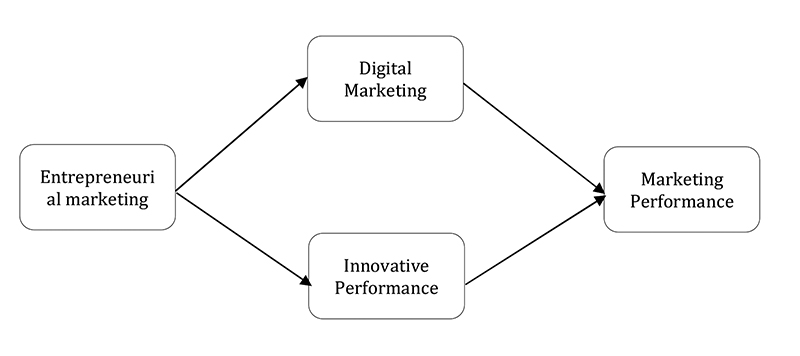
H1. Entrepreneurial marketing has a significant relationship with digital marketing.
2.3 Innovation Performance
The innovation performance of companies has been studied quite extensively and over a long period. However, the results of many studies have not led to a broad range of generally accepted innovative performance indicators or a common set of indicators (Hagedoorn & Cloodt, 2003). Research on innovation has proceeded differently across many disciplines. Some are suitable to the field of marketing, and others are considered non-marketing topics. However, all can be enriched through a marketing perspective, as shown by empirical research, which reveals that (Riyadh et al., 2022; Samsuddin, 2023) organizations need to continuously innovate to improve performance and sustain their competitive advantage (Chae, 2012). The concept of innovation describes a very broad meaning. The term innovation is widely applied by many organizations, both profit-oriented and non-profit organizations (Ridha et al., 2020). The concepts of innovation and novelty became an integral part of entrepreneurship in the mid-twentieth century. The act of innovation introduces something new and relevant for entrepreneurs (Hisrich & Ramadan, 2017). It is required not only to create and conceptualize, but also to understand all the forces that work in the corporate environment. Innovation is one of the fundamental instruments of a business growth strategy to enter new markets, increase existing market share, and provide a competitive advantage for companies (Gunday et al., 2011).
Furthermore, innovation is a core element for business competitiveness when it is embedded in organizational structures, products, services, and processes. The literature shows that innovation positively impacts performance by supporting a firm's innovative capacity and, therefore, its ability to adapt to evolving customer needs and preferences (Santos-vijande et al., 2013). Innovation has become the cornerstone of sustainable development and sustainable competitive advantage in the business cycle (Friedrich et al., 2016). Innovation generates value for the company, leading to the development of new products and services, technologies, and markets (Cui & Connor, 2012; Miron-spektor, 2014). Therefore, all efforts need to be supported by marketing and organizational measures. Innovative performance is a combination of overall organizational achievements, resulting from renewal and improvement efforts made by considering various aspects of the company's innovation, namely processes, products, organizational structure, and others. Therefore, innovative performance is a composite construction (Hagedoorn & Cloodt, 2003) based on various related performance indicators, for example, creating patents, or the announcements of new products, new projects, new processes, and new organizational arrangements. Innovative performance, especially in the form of new product success, is associated in the literature with increased sales and market share, as it makes a major contribution to the satisfaction of existing customers, and gaining new customers (Pelham, 2016; Wang & Wei, 2007). Afriyie et al. (2019) stated that, in business, adopting more innovative marketing activities is necessary to use that strategy appropriately. Innovative Performance is necessary for the survival of corporate organizations and to improve marketing performance. Therefore, the second hypothesis of the study is:
H2. Entrepreneurial marketing has a significant relationship to innovative performance.
2.4 Marketing Performance
Marketing performance is a business process that provides feedback for organizational performance that refers to the results of marketing business performance (Clark et al., 2014). Marketing performance is an important element of company performance in general because a company's performance can be seen from the marketing performance that has been carried out so far and is used as an indicator of a company's marketing achievement (Yasa et al., 2020). To measure business achievements and company success rates, such as achieving sales turnover, increasing the number of customers, increasing market share, sales, and profitability growth, the company must be able to improve its marketing performance. Marketing performance is a key indicator of business success due to market strategies for customers, markets, and finance. Good marketing performance expresses three main focuses: sales growth, market share growth, and customer satisfaction, which ultimately can increase company profits. Marketing has an important role in mapping the company's resources and capabilities in determining a competitive advantage over competitors. Based on this definition, marketing performance is defined as an indicator of the achievement of company performance by looking at customer satisfaction, sales levels, and profit growth.
H3. Digital marketing has a significant relationship to marketing performance.
Innovation in terms of marketing, for example, can be done by carrying out sales promotions for the results of products owned (Amelia et at., 2018), or by implementing a green marketing strategy focusing on the environmental friendliness of a product or service (Rahman et al., 2017). MSME actors expect assistance to obtain more detailed information regarding regulations or policies and the introduction of the latest innovation models (Kumala & Ahmad, 2020). According to (Afriyie et al., 2019), in determining policies taken for innovative performance, it is necessary to build marketing performance. Therefore, the third hypothesis of the study is:
H4. Innovative performance has a significant relationship to marketing performance.
It is generally difficult to achieve the expected results with entrepreneurial marketing. Hudha et al. (2022) found that digital marketing affects marketing performance. Meanwhile, the research results of Aristiyo & Murwatiningsih, (2017) state that entrepreneurial orientation, and market orientation to marketing performance have significant value. Based on this, entrepreneurial marketing requires the most up-to-date market orientation to achieve the expected performance. Digital marketing is needed in the context of promotion and market research through online digital media by utilizing various means such as social networks. On the one hand, digital marketing makes it easier for businesses to monitor and provide for all the needs and wants of potential customers. On the other hand, potential customers can also search for and obtain product information simply by exploring cyberspace, thereby facilitating the search process. Shoppers are now more independent in making purchasing decisions based on their search results. Digital marketing can reach all people anywhere without geographic or time boundaries. (Purwana et al., 2017). Therefore, the fifth hypothesis of the study is:
H5. Digital marketing has a significant mediating effect between entrepreneurial marketing and marketing performance.
The potential for entrepreneurial orientation and its impact on business performance depends on the role of entrepreneurial orientation as a driver, or pioneer, for organizational capabilities and innovation. Based on previous research conducted by Riyadh & Yasa (2016), Parkman et al. (2012), found that the influence of invention mediates entrepreneurial orientation and has a positive and significant effect on marketing performance. Entrepreneurial orientation is also the key to corporate success, including marketing and and achieving profitability. Profitability is also obtained through well-designed entrepreneurial marketing strategies. Companies that adopt an entrepreneurial orientation will perform better than those that do not assume (Taylor, 2013). Therefore, the sixth hypothesis of the study is:
H6. Innovative performance has a significant effect, mediating between entrepreneurial marketing and marketing performance (Figure 1).

3. METHODS
This study uses a quantitative approach with the method of causality. The population in this study was taken from 5830 SMEs in the culinary sector in Palu City, Indonesia. In addition, culinary UKM actors who are also the sample are taken using the purposive sampling technique. The questionnaire is a data collection tool used in this study and is carried out individually offline, implementing strict health protocols, and online with the help of a google form. This questionnaire was designed with a Likert scale of 1-5 to explain the influence of digital marketing and innovation performance in influencing the marketing performance of culinary SMEs. The data collection process is carried out with an interval of two months, starting with August to September 2021. The collected data is then analyzed using a structural equation modeling (SEM) tool with the help of Smart-PLS software. The approach taken when analyzing this research is Structural Equation Model Partial Least Square (SEM-PLS) using SmartPLS software. The reason for using this program is because this research is more predictive and explains latent variables rather than testing a theory. In this study, the data analysis used was the validity test reliability and hypothesis testing with SEM-PLS on 4 (four) variables. The formation of latent variables in this study are all reflective in nature, that is means the four latent variables affect the indicators.
4. RESULTS
In this study, the influence between variables was tested by SEM PLS analysis. The stages in the PLS SEM analysis consist of (1) Drawing a path diagram according to the research model framework; (2) Performing outer model tests to assess the validity and reliability of indicators in measuring the variables (constructs); (3) Assessing the goodness of fit of the model to ensure that the processed data is fit with the estimated model so that the sample used can provide an overview of the actual condition of the population and (4) Performing inner model testing, which is the stage of testing the effect of inter-variables as a tool for testing research hypothesis (Hair et al., 2017). The convergent validity test is carried out by looking at the loading factor value of each indicator against the construct. For confirmatory research, the loading factor limit used is 0.7, while for exploratory research the loading factor limit used is 0.6 and for development research, the loading factor limit used is 0.5. Because this research is a confirmatory study, the loading factor limit used is 0.7. The loading factor values for all indicators in this research model are based on the estimation results of the PLS model with algorithm techniques, and are shown in Table 1:
Apart from looking at the loading factor value of each indicator, convergent validity must also be assessed from the Average Variance Extracted (AVE) value of each construct, all constructs in the PLS model are declared to have fulfilled convergent validity if the AVE value of each construct is > 0.5 , details can be seen in Table 2.
Based on the results of the PLS analysis in Table 2, all indicators are valid in measuring the construct, then assessed from the Average Variance Extracted (AVE) value, and all constructs also have an AVE value that exceeds 0.5, which means that all indicators in each construct have meet the required convergent validity criteria. From the convergent validity test analysis phase, then proceed to the discriminant validity testing stage. Discriminant validity is carried out to ensure that each concept of each latent variable is different from other variables. The model has good discriminant validity if the AVE squared value of each exogenous construct exceeds the correlation between that construct and other constructs. The discriminant validity test results in Table 3 are obtained as follows:
Based on the results of the discriminant validity test in Table 3, the result is that the AVE square root value of all constructs exceeds the correlation coefficient of these constructs with other constructs so that it can be concluded that all constructs in the PLS model have met the required discriminant validity.
Composite reliability measures the level of constructs that can be shown by two indicators: internal consistency and Cronbach Alpha (Ghozali, 2006). The Cronbach Alpha test gives an expected value greater than 0.6 for all types of constructs. At the same time, the AVE method can be used to measure component scores at the variable confidence level and compare the results with the aggregate confidence level. The AVE value must be greater than 0.50 (Ghozali, 2006).
Based on the data presented in Table 2, it is known that the AVE value of all variables is > 0.5 or greater than 0.5. Thus, it can be stated that each variable has a good discriminant validity value. Furthermore, it is also shown in the data presented in the Table 4; the Composite Reliability value of all variables is > 0.7 or greater than 0.7. Thus, it can be concluded that each variable has a high-reliability value. The following is a presentation of the validity and reliability test data. Hypothesis testing is used as a tool in deciding whether the hypotheses that have been made can answer the existing problems. The results of the direct effect hypothesis testing are presented in Table 5, while the indirect effect results are shown in Table 6.
Based on the results in the Table 5, it is shown that entrepreneurial marketing has a significant effect on digital marketing. It follows the P-Value obtained, equal to (0.000) or <0.05, so H1 is accepted. Then the second hypothesis shows that entrepreneurial marketing has a significant effect on innovation performance. It is indicated by the P-Value value of (0.000) or <0.05 so that H2 is accepted. Next, the results of the third hypothesis test have the same effect where digital marketing affects marketing performance with a P-Value value (0.001) so that the third hypothesis is accepted. Then in the fourth hypothesis, the results obtained are also significant where the P-Value value is (0.000) so that it can be concluded that all hypotheses have a significant direct effect.
5. DISCUSSION
Based on the results of Table 6, the indirect effect is that digital marketing and innovation performance can significantly mediate the relationship between entrepreneurial marketing and marketing performance. These results follow the P-Value obtained, namely (0.000) or less than <0.05, so that hypotheses 5 and 6 are accepted. Based on the results of testing the first hypothesis, it was found that entrepreneurial marketing has a significant effect on digital marketing with a P-Value of (0.000) or <0.05. This agrees with that expressed by Aftab et al. (2021), which states that entrepreneurial marketing has a significant effect on social media marketing. Furthermore, Patma et al. (2021) stated that the role of internet/e-business and social media marketing could significantly impact SMEs’ sustainability in Indonesia. This has the effect that when business actors want to improve company performance, they must use marketing social media such as consumer communication channels, product pages, and information to increase sales of culinary SMEs, which correlates with marketing performance.
The results of testing the second hypothesis found that entrepreneurial marketing has a significant effect on innovation performance. These results are supported by the opinion of Rezvani & Fathollahzadeh (2018). which reveals that all dimensions of entrepreneurial marketing correlate with innovation performance. It also indicates that value creation, which includes creating value for customers through products and services, and marketing and technology activities, has the greatest impact on innovative performance. The same thing was expressed by Hamali et al. (2016) who said that entrepreneurial marketing has a significant impact on marketing performance in the SME industry. This also follows the research conducted by Hacioglu et al. (2012). Therefore, the dimensions of entrepreneurial marketing significantly influence the innovation performance of SMEs in Turkey. These results have implications for culinary SMEs, always to implement the entrepreneurial marketing dimension to be able to compete and be able to create value for customers continuously so that they can improve marketing performance by being oriented towards new and unique product innovations so that they are difficult to imitate by competitors.
The results of the third hypothesis obtained a P-Value value of (0.001) which means that digital marketing has a significant effect on marketing performance. These results are following those expressed by Bampo et al. (2008), in a paper entitled "The Effects of the Social Structure of Digital Networks on Viral Marketing Performance". This research revealed that the social structure of digital networks has a vital role concerning the spread of viral messages. Therefore, business actors must be able to optimize the use of digital media in spreading viral messages before designing and implementing viral marketing campaigns to improve marketing performance. Another thing was revealed by Ritz et al. (2019), that small businesses' use of digital marketing is motivated by economic gain. Utilization of digital resources in the form of digital marketing is believed to be able to improve marketing performance with market access and a wide range of customers; digital marketing can be a strategy to increase traffic, from this traffic, customers can make purchasing decisions either online or by visiting physical places of buisiness. Digital marketing can also build customer satisfaction through two-way interactions between customers and MSME business actors, can provide direct input to business actors, and allows for sharing with other customers. Therefore, digital marketing is the right strategic choice during the Covid-19 pandemic, so that food and beverage MSMEs could survive and even continue to grow.
The results of the fourth hypothesis tested obtained a significant effect between innovation performance on marketing performance with a P-Value value of (0.000). These results followed those disclosed by Fard and Amiri (2018), showing the results of the positive and significant influence of entrepreneurial marketing on the market and innovation performance of Halal Food SMEs in Iran. However, the influence of entrepreneurial marketing on the company's production performance has no significant effect. The findings of this study also show that the production, marketing, and innovation performance of Halal Food SMEs have a significant impact on their financial performance. It follows what was revealed by Ridha et al. (2020), who revealed that the performance of innovation has a significant effect on the performance of Culinary MSMEs in Bogor and Depok. The same thing was revealed by Lee et al. (2016) based on the PLS-SEM analysis that found that there is restaurant innovation activity and the owner's ESE has a positive effect on restaurant performance. Following this, innovation or novelty is needed both in terms of products, promotions, marketing activities, and technology used by culinary SMEs to adapt to uncertain situations and conditions such as during the Covid-19 pandemic.
The results of the fifth hypothesis test show a significant effect where the P-Value value is (0.000), which means that digital marketing variables can mediate a significant influence between entrepreneurial marketing on marketing performance. These results follow the opinion of Aftab et al. (2021). Although entrepreneurship marketing cannot directly and significantly affect marketing performance, through mediation, with the help of social media variables, entrepreneurial marketing has a significant influence on marketing performance. These results indicate to culinary SMEs that product marketing activities through digital marketing media effectively and efficiently reach consumers in order to increase sales growth. These results also have a significant impact on the marketing performance of culinary SMEs.
The results of the sixth hypothesis test indicate that innovation performance can mediate a significant relationship between entrepreneurial marketing and marketing performance with a P-Value value of (0.000). These results are consistent with the research of Jones and Rowly (2011), which states that, indirectly through innovation activities, entrepreneurial marketing can have a significant effect on the marketing performance of SMEs. Furthermore, these results illustrate that in order to improve the marketing performance of culinary SMEs, business actors must also pay attention to consumer needs by continuously improving skills in entrepreneurial marketing to encourage business actors to innovate products that are following current consumer needs, and this can also have a significant impact the marketing performance of culinary SMEs.
The results of this study provide consideration to the Batu City Culinary MSMEs so that in the future, Palu City MSMEs carry out varied and continuous digital marketing. In addition, innovation, which is an orientation in the MSME work ethic, is also vital to be improved sustainably. It can be done through various training initiatives in order to increase competitiveness to increase the meaning and target of MSME marketing achievements. The local government of the city of Palu also needs to consider various marketing supplies for culinary MSMEs in the city of Palu. It is based on the fact that the role of digital marketing is currently very influential in the market. In addition, the government can also focus on MSME training to be more developed and sustainably increase innovation.
6. CONCLUSION
Based on the results of the hypothesis testing that has been carried out, it can be concluded that the role of digital marketing and innovation performance is vital in improving SMEs' marketing performance at this time. It is due to the consumption pattern of consumers always undergoing various changes in meeting their needs. Therefore, the Covid-19 pandemic provided various valuable lessons for culinary business actors always to improve marketing performances that are oriented towards consumer satisfaction through a digital marketing strategy and product innovation offered in the form of technology, strategies, and products offered. This result is also closely related to entrepreneurial marketing as a predictor in improving skills for SME business actors. With these results, it is hoped that this research can be applied as a reference in making decisions for business actors in running a business in the culinary field. From the results of this study, it can be said that developing MSMEs does not rule out the movement of technology-based global economic variations. These results are expected to provide implications related to the economic stability of MSMEs. MSMEs that are also moving forward dynamically with the world of the digital economy tend to survive in difficulties both in terms of competition and the decline in economic activity. This research has limitations in that it was conducted in the city of Palu. Therefore, it is recommended to enlarge the scope of research so that generalization results are more complex.
References
- Aftab, M., Aziz, A., Abdullah, B., Rehman, A. U., Sarwar, H., Majid, B., & Nawal, A. (2021). Modeling Entrepreneurial Marketing , Social Media Marketing , Product Innovation and SME ’ s Performance, Psychology And Education, 58(5), 1615-1629.
- Afriyie, S., Du, J., & Musah, A.-A. I. (2019). Innovation and marketing performance of SME in an emerging economy: The moderating effect of transformational leadership. Journal of Global Entrepreneurship Research, 9(1), 40.
- Amelia, A., Suharno, S. & Asnawati, -. (2018). Pengaruh promosi penjualan dan store atmosphere terhadap impulse buying. Jurnal Ilmu Manajemen Mulawarman, 2(4), 2017.
- Aristiyo, R., & Murwatiningsih, -. (2017). Meningkatkan Kinerja Pemasaran Melalui Keunggulan Bersaing Dengan Orientasi Kewirausahaan, Orientasi Pasar, Dan Kemitraan. Management Analysis Journal, 6(1), 44.
- Bachri, N., Lubis, A. R., Nurdasila, -, & Majid, M. S. A. (2016). Credibility and Consumer Behavior of Islamic Bank in Indonesia: A Literature Review. Expert Journal of Marketing, 4(1), 20-23.
- Bachri, N. (2018). Credibility-Profit Chain in Indonesian Islamic Banking Industry. Indian Journal of Public Health Research & Development, 9(12), 321-326.
- Bampo, M., Ewing, M. T., Mather, D. R., Stewart, D., & Wallace, M. (2008). The Effects of the Social Structure of Digital Networks on Viral Marketing Performance. Information Systems Research, 19(3), 0152.
- BPS, S. (2019). Pertumbuhan Ekonomi Sulawesi Tengah Semester I-2019. BPS Provinsi Sulawesi Tengah, 45, 1-13.
- BPS, S. (2021). Pertumbuhan Ekonomi Sulawesi Tengah Semester I-2021. BPS Provinsi Sulawesi Tengah, 45, 1-13.
- Burhan, M., Salam, M. T., Hamdan, O. A., & Tariq, H. (2021). Crisis management in the hospitality sector SMEs in Pakistan during COVID-19. International Journal of Hospitality Management, 98(June 2020), 103037.
- Caballero-Morales, S. O. (2021). Innovation as recovery strategy for SMEs in emerging economies during the COVID-19 pandemic. Research in International Business and Finance, 57(February), 101396.
- Chae, B. K. (2012). An evolutionary framework for service innovation : Insights of complexity theory for service science. International Journal of Production Economics, 135(2), 813-822.
- Clark, B. H., Abela, A. V, & Ambler, T. (2014). An Information Processing Model of Marketing Performance. Journal of Marketing Theory and Practice, 14(3), 191-208.
- Cui, A. S., & Connor, G. O. (2012). Alliance Portfolio Resource Diversity and Firm Innovation, Journal of Marketing, 76(July), 24-43.
- Dima, A.M, Vasilache, S. (2015). Social Network Analysis for Tacit Knowledge Management in Universities. Journal of the Knowledge Economy, 6(4), 856-864.
- Daeng, E. (2023). Analysis of Factors Inhibiting the Implementation of Fire Hazard Management Policies by the Fire Department of Kupang City. Journal of Tourism Economics and Policy, 3(1), 49-61.
- Fajrian, H. (2021). Pandemi Covid-19 Memicu Empat Perubahan Besar Perilaku Konsumen Katadata.
- Febriyantoro, M. T., & Arisandi, D. (2018). Pemanfaatan digital marketing bagi usaha mikro, kecil dan menengah pada era masyarakat ekonomi ASEAN. JMD: Jurnal Riset Manajemen & Bisnis Dewantara, 1(2), 61-76.
- Filyushina, K., Gusakova, N., Bakrunov, Y., & Dyadkova, E. (2023). Sustainable Development Of The Construction Industry Through The Rational Utilization Of Autonomous Heat Supply Sources Based On Climate Zoning. Journal of Law and Sustainable Development, 11(1), 1-20.
- Fitria, D., Abubakar, R., & Bachri, N. (2016). Pengaruh Kualitas Jasa terhadap Kepuasan dan World of Mounth Pengguna Jasa Taman Penitipan Anak di Kota Lhokseumawe. Jurnal Manajemen Indonesia (J-MIND), 1(1), 85-94.
- Friedrich, T. L., Mumford, M. D., Vessey, B., Beeler, C. K., & Eubanks, D. L. (2016 Leading for Innovation: Reevaluating Leader Influences on Innovation with Regard to Innovation Type and Complexity. International Studies of Management & Organization, 40(2), 6-29.
- Ghozali, I. (2006). Analisis Multivate Denngan Program SPSS (Edisi keem). Penerbit Undip.
- Gunday, G., Ulusoy, G., Kilic, K., & Alpkan, L. (2011). Effects of innovation types on firm performance. International Journal of Production Economics , 133(2), 662-676.
- Hacioglu, G., Eren, S. S., Eren, M. S., & Celikkan, H. (2012). The Effect of Entrepreneurial Marketing on Firms’ Innovative Performance in Turkish SMEs. Procedia - Social and Behavioral Sciences, 58(February 2016), 871-878.
- Hagedoorn, J., & Cloodt, M. (2003). Measuring innovative performance: Is there an advantage in using multiple indicators? Research Policy, 32(8), 1365-1379.
- Hair, J. F., Hult, G. T. M., Ringle, C. M., Sarstedt, M., & Thiele, K. O. (2017). Mirror, mirror on the wall: a comparative evaluation of composite-based structural equation modeling methods. Journal of the academy of marketing science, 45, 616-632.
- Hamali, S., Suryana, Y., Effendi, N., & Azis, Y. (2016). Influence of entrepreneurial marketing toward innovation and its impact on business performance: A survey on small Industries of Wearing Apparel in West Java, Indonesia. International Journal of Economics, Commerce and Management, 4(8), 101-114.
- Hendrawan, A., Sucahyowati, H., Cahyandi, K., Rayendra, A., & Nusantara, A. M. (2019). Pengaruh Marketing Digital Terhadap Kinerja. Jurnal Administrasi Dan Kesekretarisan, 4, 50-61.
- Hendijani Fard, M., & Seyyed Amiri, N. (2018). The effect of entrepreneurial marketing on halal food SMEs performance. Journal of Islamic Marketing, 9(3), 598-620.
- Hisrich, R. D., & Ramadan, V. (2017). Efective Entrepreneurial Management Springer.
- Horvath, J., Gavurova, B., Bacik, R. & Fedorko, R. (2021). Identification of uncertainty factors in the consumer behavior of the new generation of customers at the e-commerce level. Journal of Tourism and Services, 22(12), 168-183.
- Hudha, N., Rahadhini, M. D., & Sarwono, A. E. (2022). Keunggulan Bersaing Sebagai Mediator Antara Digital Marketing dan Kinerja Pemasaran (Survei Pada UKM Tenun Lurik di Desa Mlese, Cawas, Klaten). BA LANCE: Economic, Business, Management and Accounting Journal, 19(1), 11516.
- Irawan, A. (2020). Challenges and Opportunities for Small and Medium Enterprises in Eastern Indonesia in Facing the COVID-19 Pandemic and the New Normal Era. The International Journal of Applied Business), 4(2), 79.
- Jones, R., & Rowley, J. (2011). Entrepreneurial marketing in small businesses: A conceptual exploration. International Small Business Journal, 29(1), 25-36.
- Khan, M. A., Yasir, M. & Khan, M. A. (2021). Factors affecting customer loyalty in the services sector of Pakistan. Journal of Tourism and Services , 22(12), 184-197.
- Kovanoviene, V., Romeika, G., & Baumung, W. (2021). Creating value for the consumer through marketing communication tools. Journal of Competitiveness, 13(1), 59-75.
- Kimura, R. K., Pinochet, L. H. C., & Azevedo, M. C. (2016). digital analytics tools and their predictive power on performance: An analysis of the Brazilian auto market. Revista Brasileira de Marketing, 15(2), 220-236.
- Klyver, K., & Nielsen, S. L. (2021). Which crisis strategies are (expectedly) effective among SMEs during COVID-19? Journal of Business Venturing Insights, 16(June), e00273.
- Kumala, R., & Ahmad, J. (2020). Strategi Bisnis Dan Pemanfaatan Kebijakan Pajak Di Masa Pandemi COVID-19 Dan Era New Normal (Studi Kasus Pelaku UKM Marketplace). Prosiding Seminar STIAMI, 7(2), 960.
- Lee, C., Hallak, R., & Sardeshmukh, S. R. (2016). Innovation, entrepreneurship, and restaurant performance: A higher-order structural model. Tourism Management, 53, 215-228.
- Lu, L., Peng, J., Wu, J., & Lu, Y. (2021). Perceived impact of the Covid-19 crisis on SMEs in different industry sectors: Evidence from Sichuan, China. International Journal of Disaster Risk Reduction, 55(24), 102085.
- Matúš, J., Matúšová, J. G., & Findra, S. (2015). Innovation in marketing-marketing innovation. European Journal of Science and Theology, 11(6), 147-154.
- Madeira, A., Palrão, T., & Mendes, A. S. (2021). The impact of pandemic crisis on the restaurant business. Sustainability (Switzerland), 13(1), 40.
- Miron-spektor, E., Erez, M., & Naveh, E. (2014). The Effect of Conformists And Attentive-To-Detail Members On Team Innovation: Reconciling The Innovation Paradox. Academy of Management Journal, 54(4), 64870100.
- Morris, M. H., Schindehutte, M., & LaForge, R. W. (2002). Entrepreneurial Marketing: A Construct for Integrating Emerging Entrepreneurship and Marketing Perspectives. Journal of Marketing Theory and Practice, 10(4), 19.
- Madaan, G., Maninder, Kaur, Kavitha R, Gowda, Rashmi, G., & Hayri, U. (2023). Business Responses Towards Corporate Social Responsibility And Sustainable Development Goals During Covid-19 Pandemic. Journal of Law and Sustainable Development , 11(1), e0309.
- Papa, A., Santoro, G., Tirabeni, L., & Monge, F. (2018). Social media as tool for facilitating knowledge creation and innovation in small and medium enterprises. Baltic Journal of Management, 13(3), 329-344.
- Papadopoulos, T., Baltas, K. N., & Balta, M. E. (2020). The use of digital technologies by small and medium enterprises during COVID-19: Implications for theory and practice. International Journal of Information Management, 55(June), 102192.
- Pasharibu, Y., Paramita, E. L., & Febrianto, S. (2018). Price, service quality and trust on online transportation towards customer satisfaction. Jurnal Ekonomi dan Bisnis, 21(2), 241-266.
- Patma, T. S., Wardana, L. W., Wibowo, A., Narmaditya, B. S., & Akbarina, F. (2021). The impact of social media marketing for Indonesian SMEs sustainability: Lesson from Covid-19 pandemic. Cogent Business and Management, 8(1), 1953679
- Parkman, I. D., Holloway, S. S., & Sebastiao, H. (2012). Creative industries: Aligning entrepreneurial orientation and innovation capacity. Journal of Research in Marketing and Entrepreneurship, 14(1), 95-114.
- Pelham, A. M. (2016). Mediating Influences on the Relationship between Market Orientation and Profitability in Small Industrial Firms. Journal of Marketing Theory and Practice, 5(3), 55-76.
- Pisicchio, A. C., & Toaldo, A. M. M. (2020). Integrated marketing communication in hospitality SMEs: analyzing the antecedent role of innovation orientation and the effect on market performance. Journal of Marketing Communications, 27(1), 1-20.
- Purwana, D., Rahmi, R., & Aditya, S. (2017). Pemanfaatan Digital Marketing Bagi Usaha Mikro, Kecil, Dan Menengah (UMKM) Di Kelurahan Malaka Sari, Duren Sawit. Jurnal Pemberdayaan Masyarakat Madani, 1(1), 1-17.
- Rahman, F., Siburian, P. S., & Noorlitaria, G. (2017). Pengaruh Green Marketing Mix terhadap Keputusan Pembelian Konsumen Produk Tupperware di Samarinda. Forum Ekonomi, 19(1), 119.
- Rakshit, S., Mondal, S., Islam, N., Jasimuddin, S., & Zhang, Z. (2021). Social media and the new product development during COVID-19: An integrated model for SMEs. Technological Forecasting and Social Change, 170(April), 120869.
- Rashad, N. M. (2018). The Impact of Entrepreneurial Marketing Dimensions On The Organizational Performance Within Saudi SMEs, 6(3), 61-71.
- Rezvani, M., & Fathollahzadeh, Z. (2018). The impact of entrepreneurial marketing on innovative marketing performance in small- and medium-sized companies. Journal of Strategic Marketing, 28(2), 136-148.
- Ridha, R., Hidayat, N. K., Ridha, R., & Hidayat, N. K. (2020). Impact of Innovation & Certification To Sme Performance In F & B Sector, EasyChair Preprint, 4280, 337-360.
- Ritz, W., Wolf, M., Mcquitty, S., & Ritz, W. (2019). Digital marketing adoption and success for small businesses: The application of the do-it-yourself and adoption. Journal of Research in Interactive Marketing, 13(2), 179-203.
- Riyadh, N. A., & Yasa, N. N. K. (2016). Kemampuan Inovasi Memediasi Pengaruh Orientasi Kewirausahaan terhadap Kinerja Produk IMK Sektor Industri Makanan di Kota Denpasar. E-Jurnal Apresiasi Ekonomi, 5(3), 1915-1941
- Riyadh, H. A., Al-Shmam, M. A., & Firdaus, J. I. (2022). Corporate Social Responsibility and Gcg Disclosure on Firm Value With Profitability. International Journal of Professional Business Review, 7(3), e655.
- Samsuddin, A. (2023). The Influence Of Electronic Word Of Mouth And Brand Image On Purchasing Decisions At Shopee. Journal of Entrepreneurial and Business Diversity, 1(1), 27.
- Sadiku-Dushi, N., Dana, L. P., & Ramadani, V. (2019). Entrepreneurial marketing dimensions and SMEs performance. Journal of Business Research, 100(March), 86-99.
- Santos-vijande, M. L., Belén, A., Suárez-álvarez, L., & Díaz-martín, A. M. (2013). The brand management system and service fi rm competitiveness. Journal of Business Research , 66(2), 148-157.
- Scheidgen, K., Gümüsay, A. A., Günzel-Jensen, F., Krlev, G., & Wolf, M. (2021). Crises and entrepreneurial opportunities: Digital social innovation in response to physical distancing. Journal of Business Venturing Insights , 15(December 2020), e00222.
- Sidi, A. P., & Yogatama, A. N. (2019). Mediasi Intellectual Capital atas Pengaruh Digital Marketing Terhadap Kinerja Pemasaran. Iqtishoduna, 15(2), 129-152.
- Taiminen, H. M., Karjaluoto, H. (2015). The usage of digital marketing channels in SMEs. Journal of Small Business and Enterprise Development, 22(1), 1-5.
- Taylor, P. (2013). The effect of entrepreneurial orientation on the internationalization of SMEs in developing countries. African Journal of Business Management, 7(19), 1927-1937.
- Tekin, Ö. A., & Turhan, A. A. (2020). Does social media addiction differ by personality traits? A study on undergraduate tourism students. Journal of Tourism and Services , 22(12), 23-41.
- Voss, G. B., & Voss, Z. G. (2000). Strategic orientation and firm performance in an artistic environment. Journal of Marketing, 64(1), 67-83.
- Wang, E. T. G., & Wei, H. (2007). The importance of market orientation, learning orientation, and quality orientation capabilities in TQM: An example from Taiwanese software industry. Total Quality Management & Business Excellence, 16(10), 1161-1177.
- Wardati, N. K., & Mahendrawathi, E. R. (2019). The impact of social media usage on the sales process in small and medium enterprises (SMEs): A systematic literature review. Procedia computer science, 161, 976-983.
- Wati, A.P., Martha, J.A., & Indrawati, A. (2020). Digital Marketing. Literindo Berkah Karya.
- Whalen, P., Uslay, C., Pascal, V. J., Omura, G., McAuley, A., Kasouf, C. J., Jones, R., Hultman, C. M., Hills, G. E ., Hansen, D. J., Gilmore, A., Giglierano, J., Eggers, F., & Deacon, J. (2016). Anatomy of competitive advantage: Towards a contingency theory of entrepreneurial marketing. Journal of Strategic Marketing, 24(1), 5-19.
- Yasa, N. N. K., Ketut Giantari, I. G. A., Setini, M., & Rahmayanti, P. L. D. (2020). The Role of Competitive Advantage in Mediating The Effect of Promotional Strategy on Marketing Performance. Management Science Letters, 10(12), 2845-2848.
- Zaušková, A., Bezáková, Z., & Grib, L. (2015). Marketing communication in eco-innovation process. Procedia Economics and Finance, 34, 670-675.
Edited by
-
ASSOCIATE EDITOR
Emerson Wagner Mainardes emerson@fucape.br Fucape Business School, Vitória, ES, Brasil. https://orcid.org/0000-0003-2525-275X
-
EDITOR IN-CHIEF
Bruno Felix bfelix@fucape.br Fucape Business School, Vitória, ES, Brasil. https://orcid.org/0000-0001-6183-009X
Not applicable.