 The Power to Change the World: A Call for a Children’s Crusade
ABSTRACT
The purpose of this text is to analyse a children’s book published initially in Portugal in 2015, entitled A cruzada das crianças (vamos mudar o mundo) [The Children’s Crusade (Let’s Change the World)], by Afonso Cruz. Our twofold objective is: i) to reflect upon the hybrid and multimodal genre of this book, since it includes characteristics of theatrical/performative, lyric and narrative genres, combining them with references or excerpts from other discourses and arts; and ii) to analyse how it promotes and encourages children’s activism, in order to change the world as we know it, in terms of the core values of the society. By addressing issues related to child activism and by depicting children as self-aware, proactive and demanding citizens, The children’s crusade allows children to express their claims and illustrates a growing trend in contemporary children’s literature by combining literary elements with non-fictional ones.
KEYWORDS:
Children’s literature; Activism; Hybridism; Multimodal; Afonso Cruz
RESUMO
O objetivo deste texto é analisar um livro infantil publicado inicialmente em Portugal em 2015, intitulado A cruzada das crianças (vamos mudar o mundo), de Afonso Cruz. O estudo tem um duplo objetivo: i) refletir sobre o formato híbrido e multimodal deste livro, uma vez que inclui características dos géneros teatral/performativo, lírico e narrativo, combinando-os com referências ou excertos de outros discursos e artes; e ii) analisar o modo como promove e incentiva o ativismo infantil, a fim de mudar o mundo como o conhecemos, em termos dos valores fundamentais da sociedade. Ao abordar questões relacionadas com o ativismo infantil e ao retratar as crianças como cidadãos autoconscientes, proactivos e exigentes, A cruzada das crianças permite que as crianças expressem as suas reivindicações e ilustra uma tendência crescente na literatura infantil contemporânea, ao combinar elementos literários com elementos não ficcionais.
PALAVRAS-CHAVE:
Literatura infantil; Ativismo; Hibridismo; Multimodal; Afonso Cruz
Introduction to Portuguese Children’s Literature: A Brief Approach on Contemporary Trends
The current Portuguese literary scene for children and young adults is still dominated by the work of several authors who, since the 70s and 80s of the 20th century, have been publishing assiduously for children, such as Alice Vieira, Álvaro Magalhães or António Mota, just to give some examples. Other relevant voices were revealed in the last decade of the 20th century, such as Ana Saldanha, who helped diversify and enrich the Portuguese literary panorama.
In recent years, however, new authors have emerged, because of Literary Awards - such as Branquinho da Fonseca / Expresso / Gulbenkian or Maria Rosa Colaço Award, given by the Municipality of Almada -, and began to write, more or less exclusively, for children and young adults. Included in this group of award-winning authors, who display some generational unity among them, since they were all born in the 70s, are names such as Rita Taborda Duarte, David Machado, Isabel Minhós Martins, Ana Pessoa or Afonso Cruz, for instance. Other relevant creators, born in the 1980s and even 1990s, are also worthy of mention, either for being responsible for original literary productions, such as the unique picturebook creators Catarina Sobral or Joana Estrela, but also for more timid literary creations, such as the ones of Madalena Moniz, Gonçalo Viana, Eduarda Lima or Jaime Ferraz. With little tradition in Portugal, except for the unique creative figure of Manuela Bacelar, the creation of single authored picturebooks, with and without text, has been established in recent years, bringing fresh originality to the genre.
Moreover, in the last decades, despite all the difficulties faced, due to the severe economic crisis, the production of children’s books in Portugal has increased in terms of quantity and quality, resulting also in its international visibility. The presence of independent publishers in international book fairs, such as Bologna, the participation of illustrators in international awards and exhibitions, the government support to translation of Portuguese books, among other initiatives, have helped promoting Portuguese children’s books, now perceived as innovative and original.
In recent years, the quality and diversity of Portuguese children’s literature have been mainly associated to illustration and the creation of picturebooks, but it is possible to identify interesting creations in the young adult fiction segment as well. The book under analysis in this text - A cruzada das crianças (vamos mudar o mundo) [The Children’s Crusade (Let’s Change the World)], by Afonso Cruz, published for the first time in 2015 (and reprinted in 2023 in a different publishing house) -, illustrates the innovation, experimentation and sophistication of the contemporary Portuguese children’s literature in the way it combines different literary genres and even art forms, promoting a reflection on social change. By giving voice to children’s claims and ideals, it proposes a different way for ruling the world, an alternative to the adult one, dominated by injustice and inequality. Therefore, the originality of this book results not only of the themes depicted and of its literary structure, which includes characteristics of theatrical/performative, lyrical and narrative genres, combining them with references or excerpts from other discourses and arts; but also of the way it promotes and encourages children’s activism, in order to change the world as we know it, in terms of society’s core values.
Inspired by the Children’s Crusade topic of the Middle Ages, the author updates children’s claims to a better and more harmonious world, by creating a sequence of dialogues between children and adults, taking place in different contexts, in which children present their claims in an original and sometimes unusual way. Besides the illustrations, also by Afonso Cruz, the book includes real news regarding children’s rights, underlining the need for an authentic change in the organisation of society. By addressing issues related to child activism and depicting children as self-aware, proactive and demanding citizens, capable of questioning adults’ choices, A cruzada das crianças (vamos mudar o mundo) not only allows children to express their claims and points of view, but it also illustrates a growing trend in contemporary children’s literature, in relation both to the content of the book and to its form and genre, by combining literary and artistic elements with non-fictional ones.
1 Afonso Cruz and Its Literary Work
Afonso Cruz (Figueira da Foz, 1971), known as a musician, designer, and illustrator, has a vast literary production aimed at adults and available to an international audience. He began his literary activity with a young adult novel, after winning, in 2009, the Maria Rosa Colaço Literary Prize. The novel entitled Os livros que devoraram o meu pai [The Books that Devoured my Father] (Caminho, 2010), published a year later, reveals already a maturity and an originality that the author’s later literary production would confirm. This metafictional narrative, built on the intertextual game with some classic literary works, addresses the importance of reading and shows the central role that books play in the lives of the characters of the novel, functioning as a form of atonement for the guilt and remorse of the protagonist. The plot crosses several diegetic levels and, using the metalepsis, places the characters of the first narrative level to interact with the characters of novels such as The Island of Doctor Moreau, Strange Case of Dr. Jekyll and Mr. Hyde and Crime and Punishment, among others. The novella Vamos Comprar um Poeta [Let’s Buy a Poet] (Caminho, 2016) seems to some extent to take up elements of the aforementioned book, as it re-engages readers in the threads of metafiction and intertextual references, this time inscribing poetry and its urgency - always countable and measured - in today’s everyday life. The book, open to several interpretations, functions as a kind of poetic manifesto as well, without forgetting its social critique (and lyrical) dimension, even if embedded in the crisis, in the accounts, in the numbers and in the questions of productivity.
The quality of the literary work by Afonso Cruz, which includes short stories, picturebooks and theatrical texts, for both children and adults, has been underlined by several critics (Navas e Ramos, 2016), which also stress its innovation and complexity, particularly in genre reinvention and the blurring of boundaries between reality and fiction, constantly challenging readers’ interpretation and abilities. It is also frequent in Afonso Cruz books to find themes with social implications, linked to the condemnation of injustices and inequalities, combined with a lyrical perspective of the world, intersecting poeticism and irony. These trends are visible in picturebooks such as: i) A contradição humana [The Human Contradiction] (Caminho, 2010), a journey into the world of adults through the innocent questioning and perceptive gaze of a child, the only one capable of identifying the contradictions and paradoxes of the human existence, a kind of contemporary (and postmodern) recreation of the tale of O fato novo do Imperador [The Emperor’s New Suit]; and ii) Assim, mas sem ser assim [Like that, but not Exactly like that] (Caminho, 2013), a volume that seems to follow on from the previous one, now insisting on the issue of social inequality and the unfair distribution of goods. In Capital (Pato Lógico, 2014), a wordless picturebook, the author depicts the consequences and implications of the capitalist economy model, using the example of the adventures of a child and his piggy bank.
O livro do ano [The book of the year] (Alfaguara, 2013) and Paz traz paz [Peace Brings Peace] (Companhia das Letras, 2019), in turn, mark the crossover dimension of Afonso Cruz’s literary production, for the way they combine the childish and inaugural perspective of the world, dominated by some innocent amazement, with the poetry that results from a special attention to the word selection and combination.
Afonso Cruz’s novels aimed at adults have been the subject of many studies and theoretical approaches (Escourido, 2018, 2020; Hopkinson, 2022). These studies focus on two main areas: the identification of prominent thematic lines, and the analysis of formal and compositional elements, particularly the use of metafiction, the questioning of genre conventions, and the exploration of the possibilities that emerge from the book’s materiality itself.
2 Analysis of the Book A Cruzada das Crianças (vamos mudar o mundo)
Having established Afonso Cruz’s significance in Portuguese children’s literature and his tendency toward genre experimentation, we now turn to examining The Children’s Crusade specifically. This analysis focuses on two key aspects: the book’s representation of children’s activism and its innovative hybrid form combining theatrical, narrative, and multimodal elements.
Initially published in 2015 by Alfaguara, and republished1 in 2023 by Fábula, with text and illustrations by Afonso Cruz, A cruzada das crianças consists of a sequence of several dialogues between children and adults that take place in different scenarios. Organised in a large group, children decide to present their claims, through two main speakers, in different contexts, surprising and shocking adults. More or less practical, in some cases clearly nonsensical, expressing the way children perceive the world, the claims address a variety of questions, centred in real and relevant topics such as hunger, child labour, poverty, health and family love. The path taken by the children, from office to office, is not random, but results from a certain logic connected to the answers obtained (or lack of them). It is a path that, little by little, seems to approach the levels of power and decision, and it is not innocent that it ends up at the police station, with the suggestion that growth and adulthood do not bring wisdom, but rather the loss of dreams, childish illusions and the hope of changing the world.
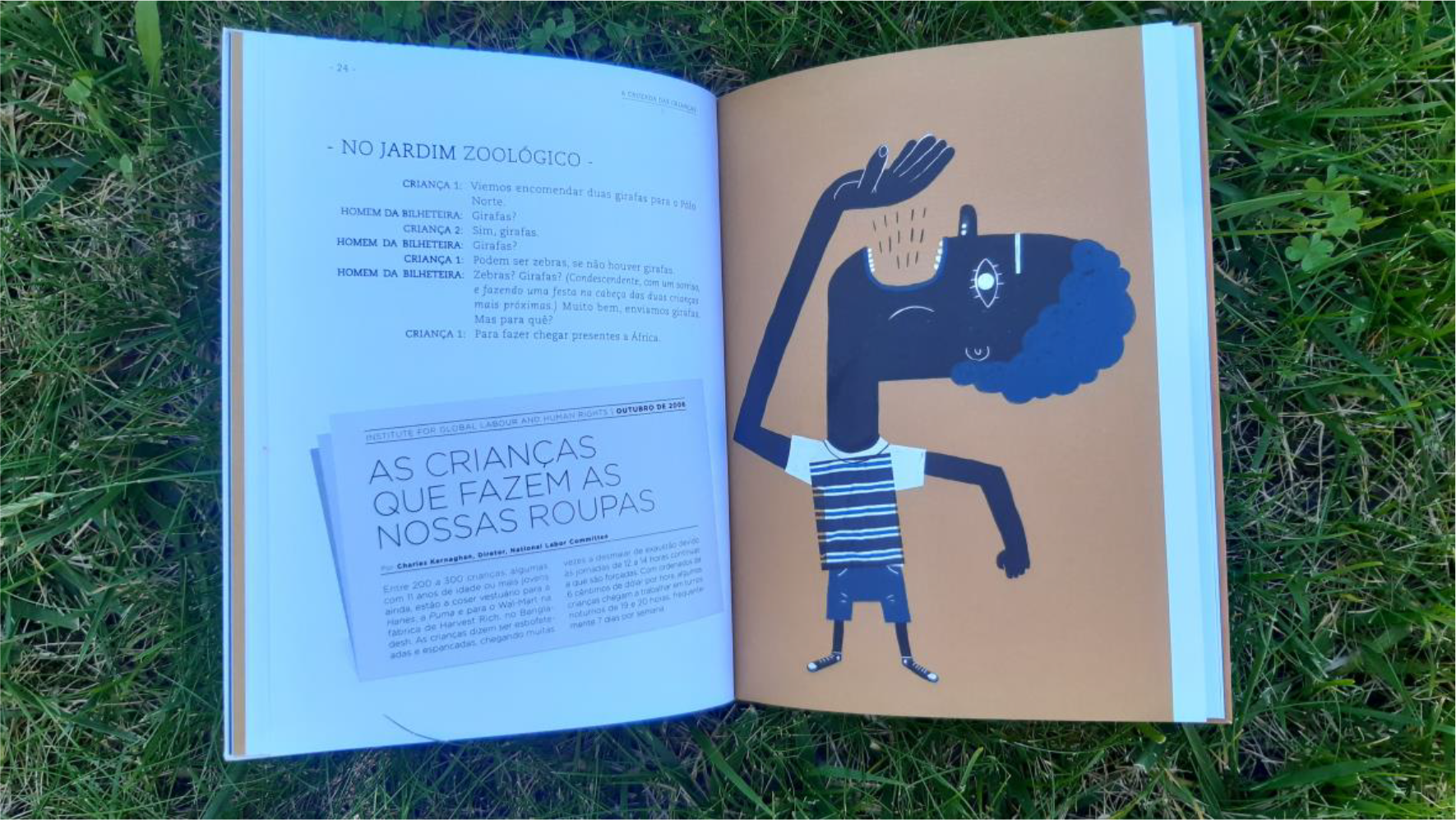
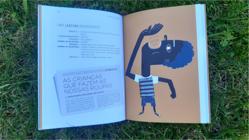
To establish the relationship between some of the most utopic claims and reality, seven dialogues (corresponding to seven different scenes) are complemented by seven non-fiction texts, articles from newspapers or conclusions from a study or a survey, reinforcing the validity of the claim at issue. Those fragments are included in the pages (Fig. 1), maintaining their distinctive visual appearance, which make them like illustrations as well. Therefore, they can be read entirely or not, but they stand out especially in terms of the distinctive lettering used in the titles.
Being the verbal support for a theatrical performance that initially took place in the Cultural Centre of Belém, in Lisbon, the book also includes didascalias and a song - “Blá, Blá, Blá” - that appears on different occasions. The song directly criticises the inaction and inertia of adults, including the main political decision makers, who seem to be unable to improve people’s quality of life. The brevity and apparent simplicity of the text, however, do not overlap the depth and seriousness of the topics covered, even if the humour, resulting from the comic situation and the nonsense, is always present. This is, in fact, the great asset of the book and of the theatrical show it embodies: it stimulates, through an apparently simple and light proposal, reflection on the world we live in, its contradictions and problems.
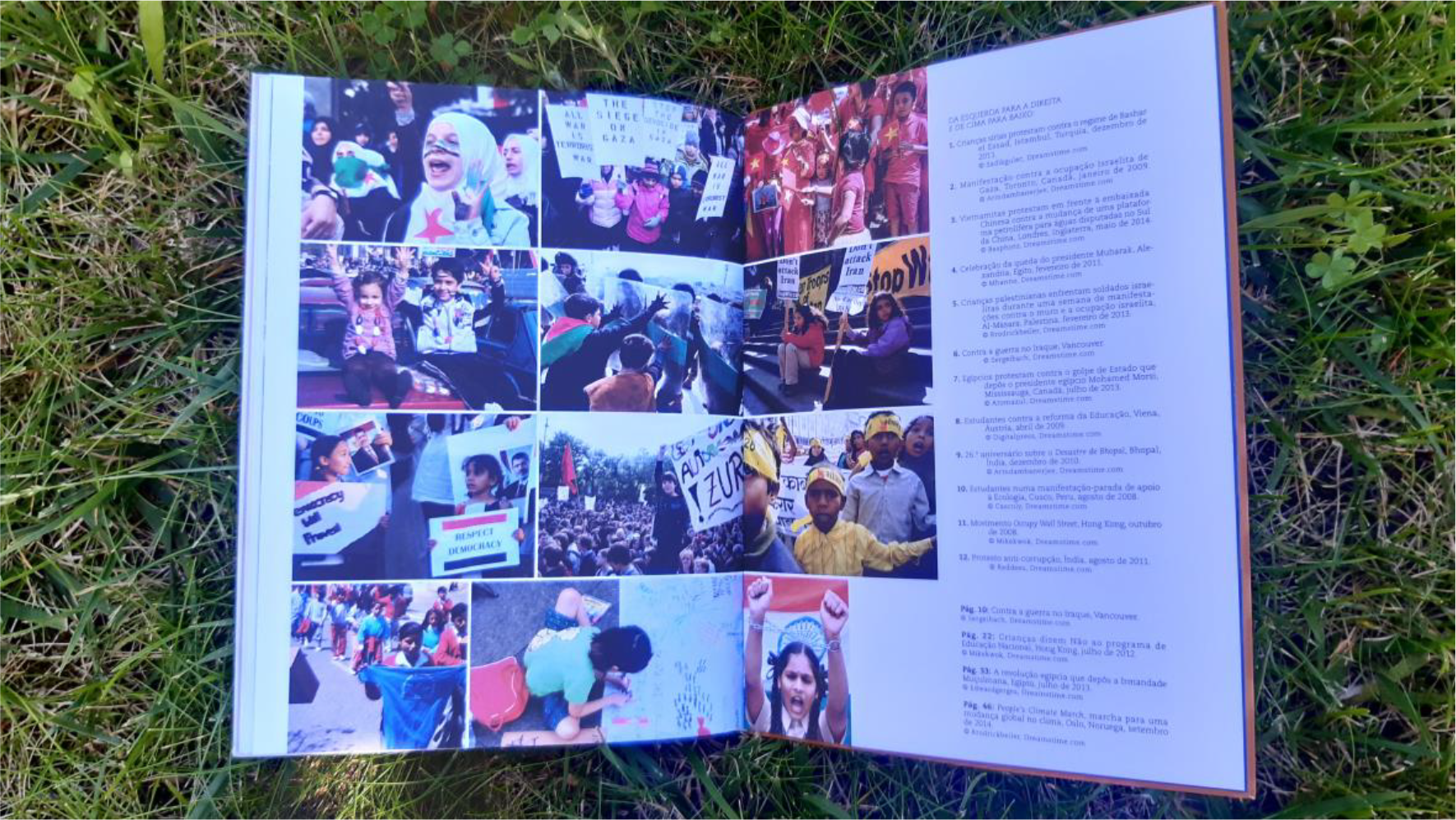
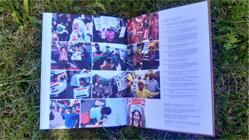
Inspired by the medieval tradition of a popular and somehow spontaneous crusade, which took place in 1212, associated to the need to ethically and morally purify the Crusade spirit, this volume re-enacts and modernizes this motif, by bringing it to contemporaneity. In a world in moral and ethical crisis, such as the medieval one, children seemed to symbolise and incorporate a sort of germ of change, inspiring the principles and ideals of a most needed revolution. In a way, the author suggests that this revolution has already started, by presenting photos of social, political and cultural events where children participate and took relevant part in.
Dated from 2009 until 2014, these events include anti-war (Iraq), anti-occupation (Israel) and anti-totalitarian (Syria) demonstrations, as well as movements against specific laws, reforms and political decisions, among others (Climate March; Occupy Wall Street Movement). Taken in different countries and continents around the world, the photos (Fig. 2) depict children’s protest actions (in same cases facing directly authorities or forces of law) and also their claims, written in posters. The diversity of children, political contexts and geographic scenarios reinforces the main common element: children are fighting around the world for freedom, democracy, justice, peace, and a better environment. Some photos are used
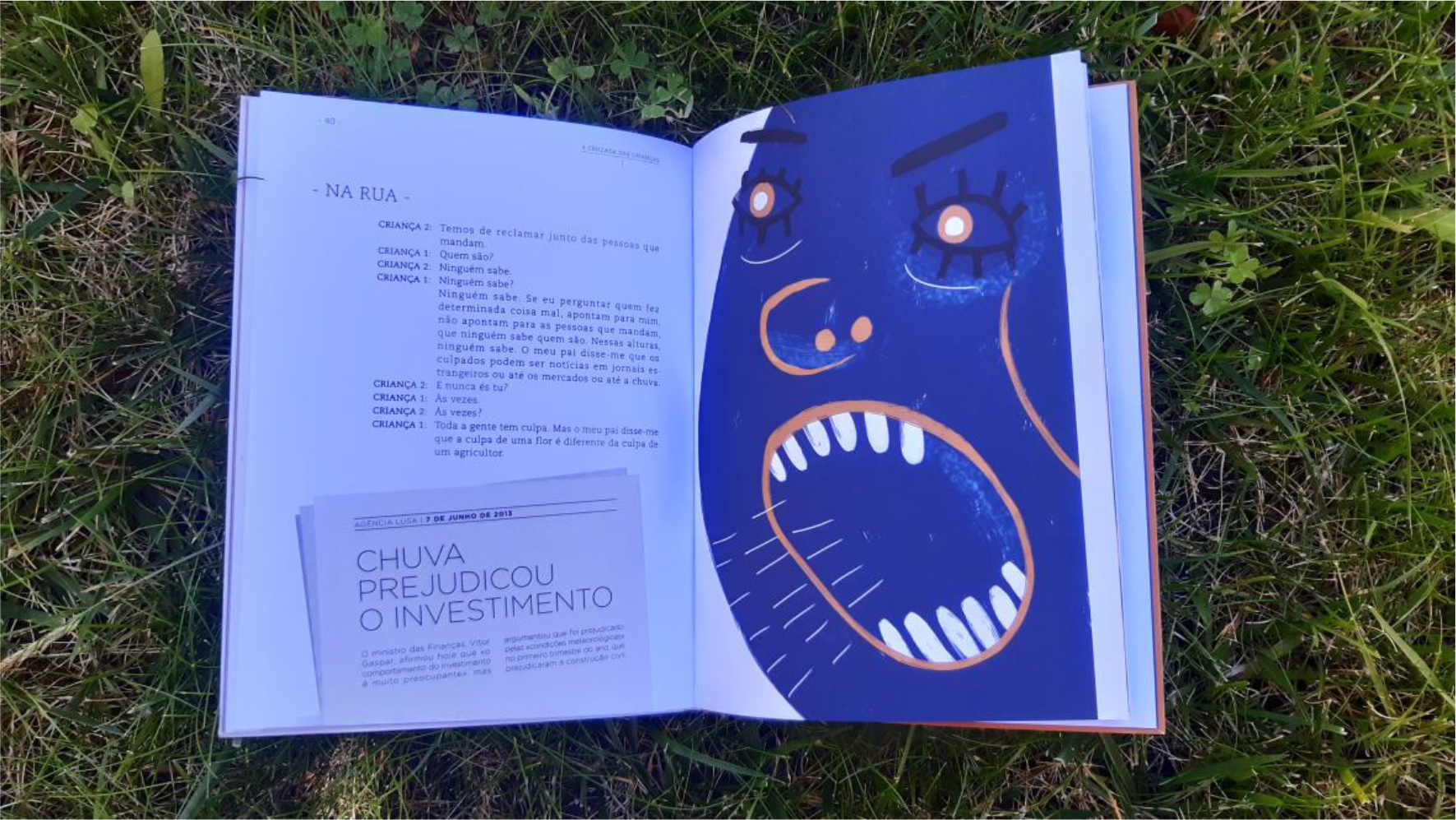
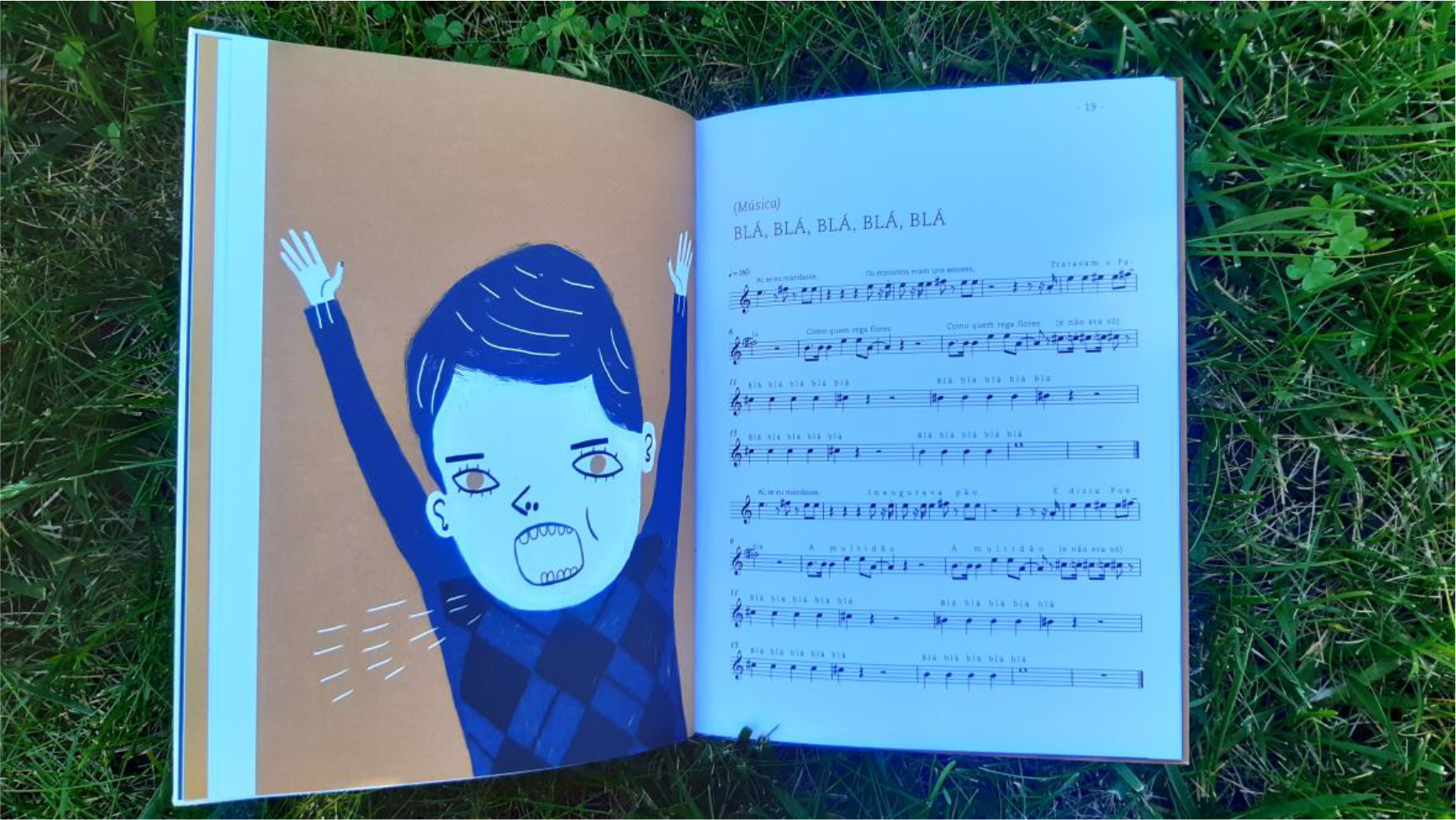
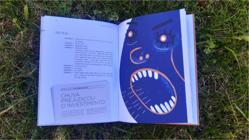
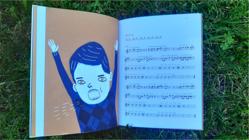
Besides photos, the book also includes a few illustrations by Afonso Cruz, the majority depicting children that also seem to be raising their voices and expressing their claims and concerns (Fig. 3). The relevance of voice, even in symbolic terms, is also underlined in some illustrations where only mouths are depicted, stressing the importance of verbal and facial expression. The visual style, characterised by a certain naiveté in the use of proportion and form, emphasizes the relevance of the voice, symbol of freedom and agency, since children express their claims in their own words and ways. The inclusion of the lyrics and musical sheet of a song (Fig. 4), which is sung in different moments of the text, also reinforces the suggestion of sound, creating a sort of a consistent soundtrack that expresses, with melody and rhythm, the main claims throughout the text, much like a chorus in classic theatre.
The presence of a “Prefácio” [Forword] and an “Posfácio” [Afterword] by other authors is not frequent in Portuguese children’s books, raising questions about the main audience of this particular volume. If the writer and philosopher Miguel Real, in the “Prefácio,” contextualises and explains the cultural and literary tradition of the reference of the Children’s Crusade, the actress and visual artist Marta Bernardes, in the “Posfácio,” reflects on the symbolic meaning of the childhood and its imaginary in the fight for the construction of a better world. Both texts, however, address the profound and significant question of the need of change that only children can operate by reinventing the world and its laws and dynamics. Therefore, in these texts, childhood is presented as the ultimate hope for the world and humankind, reinforcing the main idea of the volume.
2.1. Children’s Activism
In recent years, as a result of various social and political movements, there has been growing attention to children’s activism and its representation in children’s literature. The publication of biographies of children who have stood out for their individual action, giving rise to more global phenomena of demanding rights, such as Malala Yousafzai, Greta Thunberg or Bana Alabed, is just one example, among many, of the valorisation of children’s voices in a context that is still strongly dominated by adults. Theory and criticism have also been attentive to the increased visibility of children and their agency in contemporary literary texts, with the publication of various studies on different related issues, especially in recent years (Mathis, 2015; Short, 2017; Nance-Carroll, 2021; Fletcher & Holyoke, 2023; Taft & O’Kane, 2024).
However, themes related to social injustice, poverty and social inequality have long been present in several children’s books by Afonso Cruz, and therefore these themes are familiar in his literary work. In the book under analysis, however, the social themes are presented in a clearer way, since they are, in fact, the centre of the text, though, in some cases, they are presented in original ways.
The originality of this particular book lies in the way in which these ideas are exposed, since children present them in a very particular way, according to their clearly alternative vision of the world. By doing so, children are not limited to echoing old ideas from adults, but seem to express alternative and personal views, even if not completely shaped by the limits of reality and plausibility. In a way, the absurdity and contradiction of some requests, which are impossible to satisfy, reinforce their legitimacy and authenticity, giving voice and agency to children to say what comes to their mind.
The sequence begins at the Institute of Geography, asking to change the maps to keep people closer to each other; then it moves into the library, in order to change the type of superheroes included in books, so that ordinary people can be superheroes as well. The next stops are the Post Office and the Zoo. In the first one, children want a new Santa Claus, since the current one is too fat and does not go to all the places in the world; in the second place, they ask for a giraffe or a zebra, so that Santa Claus can also deliver presents in Africa. These two claims seem intertwined with Santa Claus being criticizing for representing the injustice and inequality of the world, where few have all and the majority has almost nothing. In fact, the figure of Santa Claus is often present in other literary texts by Afonso Cruz as a symbol of consumerism and Capitalism, including novels for adults such as Para onde vão os guarda-chuvas [Where Do the Umbrellas Go].
Children also visit the Hospital, where they ask for bigger hearts, to correct aging and to increase the contagious rate of kisses, in order to spread love around easily. In the Clothing Store, children demand the replacement of mirrors by windows, so that people could communicate more and stop being selfish and self-centred. In Parliament, however, the request is, initially, the opposite, with the replacement of windows with mirrors, so that politicians realise their responsibilities. But children also mention the need for windows, in this case so that politicians could see the reality of the people they represent.
The Bank scene stands as one of the most important and extensive episodes, questioning both the value of money and its inability to purchase happiness. Children argue that money should always suffice to meet basic living needs-a direct critique of a financial system that fails to ensure universal access to necessities. The scene advocates for more equitable wealth distribution while challenging the purpose of wealth accumulation in a world where many struggle to survive. Through their arguments, children embody an uncorrupted purity of values, untainted by societal conventions. Their commitment to fundamental principles drives them to champion happiness as a universal right, advocating for its full implementation.
The final scene takes place in the Police Station where children are informed that they cannot claim important things until they grow up, but they realise that, once adults, they will stop caring for the necessary change of the world, as the previous scenes illustrated. Therefore, the urgency of change - and the call to action that the book promotes - is underlined, with children seeming to be the ones capable of transforming the world.
Among these nine different places where children interact with adults there are also five street scenes, shorter and simpler, where children talk to each other and determine the next move to make, in order to present their claims. The main purpose is always the same: to create a fairer and friendlier world, where people can be happy.
Throughout the text, children are not named.2 Instead, the two main protagonists are just identified by numbers - child 1 and child 2 - and all the other kids mentioned, including through reported speech, are identified as complainers and recognised by generic characteristics such as physical features (brown hair, braids, standing hair, missing teeth), clothes (purple sweater, green and yellow shirt, yellow coat, ragged clothes) and accessories (glasses). In a way, this strategy intensifies the idea of a bigger and wider movement, uniting all children, despite their origin or background.
By presenting a sequence of dialogues between children and adults, the book considers children as interlocutors, valuing their questions, opinions and claims. Children are depicted in a role of power, challenging adults and demanding changes. Their interrogations have a major role in terms of agency, functioning as a surprising “weapon” that reveals the contradictions of the world. The adults, on the other hand, are presented in an inferior position, “attacked” by a succession of questions that they do not understand or have difficulty answering. Even if protected by the formality of the official functions and the conventional discourse, they struggle to defend themselves and seem nervous, stressed or condescending, frequently repeating the same sentences: “I am not understanding. Where are you parents?” (p. 13); “There is nothing that can be done.” (p. 14); “But where are your parents?” (p. 15); “What a nonsense!” (p. 21); “Where are your parents?” (p. 28); “What a nonsense” (p. 32); “It doesn’t work like that.” (p.37, p. 39); “Where are your parents?” (p. 42).3
This opposition between child and adult characters expresses a wider dichotomy between two visions of the world, one progressive and idealist, clearly dominated by humanism, committed to the creation of a fairer society, the other conservative and conventional, aiming to maintain the current state of things. In a certain way, the book shows that the revolution is already underway. The question is whether the reader will choose a side in this children’s crusade and be willing to participate in it.
2.2 Hybridism and Multimodal Narrative
The formal innovation of this book is related not only to the difficulty in including it in a unique literary genre, but also to the presence of elements from different arts and discourses, including literature, theatre, music, illustration, photography and fragments from news and non-fiction texts (Hallet, 2009; Gibbons, 2012, 2015; Nørgaard, 2010, 2019). The multimodal dimension of children’s literature, already established in formats such as the picturebook (Tsapiv, 2022) or the hybrid novel (Sadokierski, 2010), for instance, seems increasingly present in other genres (Ramos, 2020a, 2020b), challenging the traditional way of writing and telling stories as well as the reading process. These challenging literary proposals are either defined as hybrid formats, “in which graphic devices like photographs, drawings and experimental typography are integrated into the written text. Within hybrid novels, word and image combine to create a text that is neither purely written nor purely visual” (Sadokierski, 2010, p. ix), or multimodal ones, characterised by “integration of the narrative novelistic mode along with other written modes, as well as various non-verbal modes such as (the reproduction of) visual images like photographs or paintings, graphics, diagrams and sketches or (the reproduction of) handwritten letters and notes” (Hallet, 2009, p. 129).
The hybridism4 of contemporary proposals, such as A cruzada das crianças, corresponds not only to a specific trend in the Portuguese context, but also to a personal literary and creative project of Afonso Cruz, a multifaceted artist, characterised by his ability to cross genres, publics, formats and artistic languages.
Fiction and non-fiction are combined and, in some way, intertwined, with the inclusion of real photos and factual information (in some cases presented through journalistic pieces), reinforcing the legitimacy of the children’s demands. It is quite relevant that some absurdity or even nonsense that characterises the children’s requests (some impossible to fulfil, like improving maps to make places less distant from each other) is supported by pieces of information that stress the relationship of those claims with reality. In the case of maps, the theme focuses on the relationship of children with grandparents. Children ask for better maps in order to be closer to those who protect and love them. The combination of fantastic and even poetic elements with realistic ones is also present in the visual component of the book, where real photos from real events divide the available space with artistic illustrations, creating a surprising mixture of visual references. Though diverse in visual style and purpose, all images emphasize children’s central role by highlighting their agency and visually representing their ‘voices.’ With a restrained colour palette, the illustrations also play with forms and shapes, creating an alternative image of the protagonists.
Besides the relationship between fiction and non-fiction, this book also combines elements of a theatrical text, such as the dialogical structure, with more narrative ones, since the sequence of dialogues and places seems to follow a narrative pattern, based on the search of the children and their movement in the public space. The progression between more common places and services, including public ones, such as the Library, the Post Office or the Hospital, to more powerful ones, such as the Bank, the Parliament or the Police Station, seems to follow a specific order, with an inclusion of transitional elements between the scenes.
But the poetic dimension of the text is not absent as well, evident not only in the children’s provocative and utopic claims, but also in the recurring song that appears in four different moments of the story. In the first appearance of this song, there is even a page with the musical notes, which establish another interartistical connection. The poem expresses the children’s wish to govern the country and to improve it, instead of just talking, idea suggested by the repetition of the word “Blá, blá, blá,” which means talking without saying or doing nothing relevant or concrete. But it also promotes an alternative way of leading the country, by “inaugurating bread” and “giving poetry to the people,” where ministers are transformed into gardeners and rule the country as if watering flowers. The repetition of the poem in four different moments of the story functions as a chorus, stressing the idea of transformation or revolution in terms of ruling. A slightly longer version of the song “Blá, Blá, Blá” (lyrics and music also by Afonso Cruz) was recorded in 2021 and included in the album Two to Two (2021), by the group The Soaked Lambs, a Portuguese band of roots music with strong influences of pre-war blues and jazz, which also includes Afonso Cruz among its musicians. The video5 of this song, created by Tiago Albuquerque and Eva A., includes children’s drawings and animations, in a particular connection to a children’s point of view.
Conclusion
A cruzada das crianças exemplifies innovative trends in Portuguese children’s literature through its hybrid format, which seamlessly integrates theatrical, lyrical, and narrative elements with multiple artistic forms. By giving voice to children’s perspectives on social change, the book advances both formal experimentation and social engagement, marking a significant evolution in contemporary Portuguese children’s literature. Afonso Cruz’s literary production, aimed at both adults and children, distinguishes itself by exploring and pushing boundaries, mainly in terms of genre and editorial format, challenging traditional ways of telling (and reading) stories. Difficult to classify due to the author’s creation of new hybrid formats that combine elements from different genres, this particular book serves multiple purposes: it functions as both a support for theatrical performance and as a fictional narrative dominated by dialogue and complemented with factual elements.
Either way, the book stands firmly on its own, as an openly multimodal, interartistic, questioning proposal, while remaining playful, challenging the limits and conventions of various genres. The variety and diversity of references and sources, popular and erudite, recent and very old, is a characteristic of Afonso Cruz’s writing that that merits emphasis for the way in which he promotes and values sophisticated reading skills. The text’s performative matrix, tied to theatrical representation, is evident in the prominence of dialogues and inclusion of stage directions (didascalias), yet it doesn’t overshadow a more conventional reading that attends to the text’s interventional dimension and poetic potential, arising from its challenging nonsensical proposal.
The critiques of the capitalist economic model, present in several of the author’s books, are clearly reinforced by the presentation of “proofs” of its consequences, namely through pictures and real news, all focused on the children’s context. The inclusion of different geographic, cultural and political contexts broadens the interpretive possibilities, since the call to action cannot be associated with a specific political regime or cause. Nevertheless, the ideals of freedom, justice, peace and democracy seem dominant and capable of uniting different struggles around the world, expressing humanity’s core values.
The recognition of children’s perspective, seen as naive and innocent, pure and uncorrupted, runs throughout this and other books by Afonso Cruz. This viewpoint serves as a foundation for his call for an urgent and necessary change in the social and economic paradigm.
The transformation of the text into a theatrical spectacle, through performance, with the inclusion of sound, music, movement, light, scenery and wardrobe, further reinforces the issue of child activism, since it offers the spectator the possibility to watch and “live” this desire for change, by being part of it. The social and political interventional dimension of theatre, with relevant cultural and literary roots, from medieval forms to epic theatre, has had an important tradition in Portugal, with a special impact during the dictatorship (1926-1974).
The book’s uniqueness lies in its constant balance between fact and fiction, reality and dream, carrying a utopian resonance that draws readers into a spiral of hope and urges them to join children’s crusade of crucial demands.
-
1
Apart from the change in format from paperback to hardcover, there are no other significant changes to the two editions.
-
2
Adults are also identified by their occupation/profession.
-
3
In Portuguese: “Não estou a perceber. Onde estão os vossos pais?” (p. 13); “Não há nada que se possa fazer.” (p. 14); “Mas onde estão os vossos pais?” (p. 15); “Que disparate!” (p. 21); “Onde estão os vossos pais?” (p. 28); “Que disparate” (p. 32); “Não funciona assim.” (p. 37, p. 39); “Onde estão os vossos pais?” (p. 42).
-
4
According to Bromley, “a hybrid text is that which includes elements from different genres or blurs genre distinctions. Innovative and multimodal texts borrow, adapt, and refashion genres through creative play with form and conventions, challenging and often defying standard classification systems” (Bromley, 2014, p. 2).
-
5
See the video here: https://www.youtube.com/watch?v=DVHjxOG4gwo.
-
Reviews
Due to the commitment assumed by Bakhtiniana. Revista de Estudos do Discurso [Bakhtiniana. Journal of Discourse Studies] to Open Science, this journal only publishes reviews that have been authorized by all involved.
Research Data and Other Materials Availability
The contents underlying the research text are included in the manuscript.
References
-
BROMLEY, Chelsea Marie. Brave New Forms: Adaptation, Remediation, and Intertextuality in the Multimodal World of Hugo Cabret Tese de Mestrado. Eastern Michigan University, 2014. Disponível em: https://commons.emich.edu/cgi/viewcontent.cgi?article=1942&context=theses Acesso 02 de maio de 2024.
» https://commons.emich.edu/cgi/viewcontent.cgi?article=1942&context=theses - CRUZ, Afonso. A cruzada das crianças (vamos mudar o mundo) Lisboa: Fábula, 2023.
- CRUZ, Afonso. A cruzada das crianças (vamos mudar o mundo) Lisboa: Alfaguara. 2015.
-
ESCOURIDO, Sofia Madalena G. A página como possibilidade hiperficcional da nova literatura portuguesa: Patrícia Portela, Afonso Cruz e Joana Bértholo. Revista de Estudos Literários, v. 8, pp. 45-74, 2018. Disponível em: https://impactum-journals.uc.pt/rel/article/view/6169 Acesso 02 de maio de 2024.
» https://impactum-journals.uc.pt/rel/article/view/6169 -
ESCOURIDO, Sofia Madalena G. A página como possibilidade: Patrícia Portela, Joana Bértholo & Afonso Cruz, PhD Thesis, Coimbra University, 2020. Disponível em: http://hdl.handle.net/10316/94390 Acesso 02 de maio de 2024.
» http://hdl.handle.net/10316/94390 -
FLETCHER, Lauren, & HOLYOKE, Erica. Reading the Word and World: Portrayals of Activism in Children's Literature. The Reading Teacher, v. 76, n. 6, pp. 713-723, 2023. D.O.I: https://doi.org/10.1002/trtr.219 Acesso 02 de maio de 2024.
» https://doi.org/10.1002/trtr.219 - GIBBONS, Alison. Creativity and Multimodal Literature. In: The Routledge Handbook of Language and Creativity. New York: Routledge, 2015. pp. 293-307.
- GIBBONS, Alison. Multimodal Literature and Experimentation. In: The Routledge Companion to Experimental Literature New York: Routledge, 2012. pp. 420-434.
- HALLET, Wolfgang. (2009). The Multimodal Novel: The Integration of Modes and Media in Novelistic Narration. In: Narratology in the Age of Cross-disciplinary Narrative Research Berlin: Walter de Gruyter, 2009. pp. 129-53.
-
HOPKINSON, Amanda. Guises and Dolls: A Story of Art, Objects and Ideas, with a Language All Its Own. TLS. Times Literary Supplement, v. 6198, pp. 17-18, 2022. Disponível em: https://go.gale.com/ps/i.do?p=AONE&u=anon~5166c7c9&id=GALE%7CA691009515&v=2.1=r&sid=googleScholar&asid=8e560455 Acesso 02 de maio de 2024.
» https://go.gale.com/ps/i.do?p=AONE&u=anon~5166c7c9&id=GALE%7CA691009515&v=2.1=r&sid=googleScholar&asid=8e560455 -
MATHIS, Janelle B. Demonstrations of Agency in Contemporary International Children’s Literature: An Exploratory Critical Content Analysis Across Personal, Social, and Cultural Dimensions. Literacy Research and Instruction, v. 54, n. 3, pp. 206-230, 2015. D.O.I: https://doi.org/10.1080/19388071.2015.1027021 Acesso 02 de maio de 2024.
» https://doi.org/10.1080/19388071.2015.1027021 -
NANCE-CARROLL, Niall. Children and Young People as Activist Authors. International Research in Children's Literature, v. 14, n. 1, pp. 6-21, 2021. Disponível em: https://www.euppublishing.com/doi/abs/10.3366/ircl.2021.0374?journalCode=ircl Acesso 02 de maio de 2024.
» https://www.euppublishing.com/doi/abs/10.3366/ircl.2021.0374?journalCode=ircl -
NAVAS, Diana; RAMOS, Ana Margarida. Textos que se (des) constroem: metaficção e intertextualidade na ficção juvenil contemporânea. Acta Scientiarum. Language and Culture, v. 38, n. 3, pp. 223-232, 2016. D.O.I: https://doi.org/10.4025/actascilangcult.v38i3.31138 Acesso 02 de maio de 2024.
» https://doi.org/10.4025/actascilangcult.v38i3.31138 - NØRGAARD, Nina. Multimodal Stylistics of the Novel: More than Words New York and London: Routledge Taylor & Francis Group, 2019.
- NØRGAARD, Nina. Multimodality and the Literary Text: Making Sense of Safran Foer’s ‘Extremely Loud and Incredibly Close’. In: New Perspectives on Narrative and Multimodality New York, London: Routledge Taylor & Francis Group, 2010. pp. 115-126.
- RAMOS, Ana Margarida. Hibridismos e contaminações: a propósito do livro-álbum como formato omnívoro. In: Mix & Match: Poéticas do Hibridismo Vila Nova de Famalicão: Húmus Editores, 2020a, pp. 173-194.
-
RAMOS, Ana Margarida. Picturebook Format: Beyond the Relationship between Words and Pictures An Overview of the Portuguese Editorial Panorama. Libri & Liberi, v. 9, n. 1, pp. 61-64, 2020b. Disponível em: https://www.ceeol.com/search/article-detail?id=933083 Acesso 02 de maio de 2024.
» https://www.ceeol.com/search/article-detail?id=933083 -
SADOKIERSKI, Zoë. Visual Writing: A Critique of Graphic Devices in Hybrid Novels from a Visual Communication Design Perspective PhD Thesis. University of Technology Sydney. 2010. Disponível em: https://opus.lib.uts.edu.au/handle/10453/20267 Acesso 02 de maio de 2024.
» https://opus.lib.uts.edu.au/handle/10453/20267 - SHORT, Kathleen. G. (2017). The Right to Participate: Children as Activists in Picturebooks. In: Critical Content Analysis of Children’s and Young Adult Literature New York/London: Routledge, 2017, pp. 147-164.
-
TAFT, Jessica. K., & O'KANE, Claire. Questioning Children's Activism: What is New or Old in Theory and Practice?. Children & Society, v. 38, n. 3, pp. 744-758, 2024. D.O.I: https://doi.org/10.1111/chso.12742 Acesso 02 de maio de 2024.
» https://doi.org/10.1111/chso.12742 -
TSAPIV, Alla. Multimodal Imagery in Picture Books for Children. Cognition, Communication, Discourse, v. 25, pp. 80-88, 2022. D.O.I: https://doi.org/10.26565/2218-2926-2022-25-06 Acesso 02 de maio de 2024.
» https://doi.org/10.26565/2218-2926-2022-25-06
-
Editors in Charge
Adriana Pucci Penteado de Faria e SilvaBeth BraitBruna LopesMaria Helena Cruz PistoriPaulo Rogério StellaRegina Godinho de Alcântara