
 Actions to combat student dropout in higher education
Abstract
The phenomenon of dropout presents a significant challenge to higher education institution managers, as it is influenced by various aspects, making it complex and difficult to understand. Therefore, the objective was to analyze actions and interventions to combat dropout rates in Brazilian public federal universities. Regarding methodological procedures, the research is classified as descriptive, applied, qualitative and quantitative, bibliographic, and a multiple case study. The data used were primarily from a study conducted by the Brazilian Federal Court of Accounts (TCU, 2023). It was found that 60% of the institutions have an institutional policy related to combating student dropout. Although most have access to student profile data, few use this information in a more proactive and predictive manner. Concerning actions, a survey was conducted based on theory and research with all federal universities through the TCU. With this data, it was possible to verify that a wide variety of actions are carried out, with 43 being compiled.
Keywords:
student dropout; actions; public universities
Resumo
O fenômeno da evasão apresenta-se como um grande desafio aos gestores de instituições de ensino superior, uma vez que, por ser influenciado por aspectos diversos, torna-se complexo e de difícil entendimento. Com isso, traçou-se o objetivo de analisar as ações e intervenções de combate à evasão nas universidades federais públicas brasileiras. Quanto aos procedimentos metodológicos, a pesquisa classifica-se como descritiva, aplicada, qualitativa e quantitativa, bibliográfica e estudo multicaso. Os dados utilizados foram, principalmente, a partir de pesquisa realizada pelo Tribunal de Contas da União (TCU, 2023). Pode-se perceber que 60% possuem uma política institucional relacionada ao combate à evasão estudantil. Apesar de grande parte ter acesso aos dados de perfil dos estudantes, poucas instituições utilizam essas informações de forma mais proativa e preditiva. Quanto às ações, foi feito o levantamento com base na teoria e na pesquisa com todas as universidades federais, por meio do TCU. Com esses dados, foi possível constatar que há uma grande diversidade de ações realizadas, sendo compiladas 43.
Palavras-chave:
evasão estudantil; ações; universidades públicas
Resumen
El fenómeno de la deserción se presenta como un gran desafío para los gestores de Instituciones de Educación Superior, ya que, al ser influenciado por diversos aspectos, se vuelve complejo y difícil de entender. Con esto, se trazó el objetivo de analizar las acciones e intervenciones para combatir la deserción en las universidades federales públicas brasileñas. En cuanto a los procedimientos metodológicos, la investigación se clasifica como descriptiva, aplicada, cualitativa y cuantitativa, bibliográfica y estudio multicaso. Los datos utilizados fueron principalmente a partir de una investigación realizada por el Tribunal de Cuentas de la Unión (TCU, 2023). Se puede percibir que el 60% posee una política institucional relacionada con el combate a la deserción estudiantil. A pesar de que gran parte tiene acceso a los datos del perfil de los estudiantes, pocas utilizan esta información de forma más proactiva y predictiva. En cuanto a las acciones, se hizo el levantamiento basado en la teoría y en la investigación con todas las universidades federales, a través del TCU. Con estos datos, fue posible constatar que hay una gran diversidad de acciones realizadas, siendo que se compilaron 43.
Palavras clave:
deserción estudiantil; acciones; universidades públicas
1 Introduction
Academic management is part of all undergraduate and postgraduate courses. Efficient academic management can reflect in positive evaluation indices for these programs. Actions focused on dropout control, student retention, and alumni management contribute to the efficiency of academic management.
The phenomenon of dropout presents a major challenge for managers of Higher Education Institutions since it is influenced by various factors, making it complex and difficult to comprehend. In the Brazilian context, dropout rates have reached nearly 60%.
As stated by Silva Filho et al. (2007, p. 642):
[…] student dropout in higher education is an international problem that affects the outcomes of educational systems. The loss of students who start but do not finish their courses represents social, academic, and economic waste. In the public sector, these are public resources invested without the expected return. In the private sector, it is a significant loss of revenue. In both cases, dropout leads to underutilization of teachers, staff, equipment, and physical space.
The difference between the number of incoming students and the number of graduates in higher education is an indicator that can be referred to as dropout. Dropout can occur at the cohort, course, institution, or educational system level. Each of these types of dropout requires actions from different actors within university management.
Supporting this point, Gilioli (2016, p. 10) states):
Each institution needs to effectively monitor its students to detect various difficulties, ranging from academic to operational and those related to the students' socioeconomic conditions. In this sense, it can be observed that some anti-dropout measures depend on assistance and guidance programs that should be implemented, developed, or improved by the higher education institutions themselves.
The context of universities is complex, and the solutions to this problem are equally so. Each Higher Education Institution (HEI) will adopt its own policies and strategies to mitigate this issue. This raises the following question: What are the actions and interventions carried out by Brazilian federal public universities?
The objective was set to analyze the actions and interventions to combat dropout in Brazilian federal public universities, aiming to: a) characterize dropout in Brazilian universities; b) examine the actions adopted both nationally and internationally; c) identify existing dropout management structures in Brazilian universities; d) compile possible actions and interventions for dropout management.
2 Theoretical framework
Dropout is a complex and multifactorial problem. Tinto (1975) defines dropout as the act of voluntarily leaving, even though it is not typically the desired path for the student.
This decision is influenced by various factors, with consequences for both students and Higher Education Institutions (HEIs). Santos et al. (2017) further highlight that these consequences are individual, social, academic, and economic.
Although the number of studies on this issue has been growing, concern about student dropout has been part of the educational system for a long time, as demonstrated by a study conducted by the Ministry of Education (Brasil, 1996). Precisely because of this, its complexity and scope have been, in recent years, the subject of studies and analyses, especially in First World countries. Such studies have demonstrated not only the universality of the phenomenon but also the relative homogeneity of its behavior in certain areas of knowledge, despite differences between educational institutions and the socioeconomic and cultural peculiarities of each country (Brasil, 1996, p. 13). These studies and analyses are crucial for aiding the development of public and institutional policies to combat student dropout. Supporting this statement, it is observed that these policies require significant resource allocation to provide the necessary multiple forms of support (Vargas; Heringer, 2017).
In this regard, Silva et al. (2018, p. 102) emphasize the need for more studies and analyses for the formulation of such policies.
The high dropout rates, which have been observed even after overcoming the barriers to entering undergraduate programs, reveal the need to also consider public policies aimed at minimizing the various losses involved, such as personal, social, and financial losses. When exploring the characteristics of students who drop out of higher education, it becomes apparent that certain population groups are recurrent in this context, raising suspicions that some groups are more easily influenced by the dynamics of university life, thus having a higher tendency to drop out.
This scenario is common to both public and private HEIs. Even with free education, students in public institutions are also affected by various factors leading to dropout (Paula, 2017).
Many studies have been conducted to identify the main factors influencing student dropout. One noteworthy recent study is that of Silva (2021), which identified 90 categories related to the motivations that lead undergraduate students to leave their courses. These categories resulted in 112 variables. These factors were categorized into the following perspectives: individual, sociocultural, economic, academic, and institutional.
The model proposed by Silva (2021) introduces new stages beyond those of previously published models: student context, prior experience, entry, and progression, thereby characterizing the Student Dropout Flow. This allowed for the identification of when each dropout motivator occurs and which variables are most important to monitor. The author adds that the most relevant variables (as they are associated with all perspectives and stages of the flow) were: current course load, academic performance, attendance, failures, failures due to attendance, and failures due to grades.
But if we already know the causes and some policies, why does the problem still persist? The issue is longstanding, but the solutions cannot remain outdated. It is necessary to continuously think about actions to manage dropout in HEIs.
In this regard, Simon (2022) points out that few studies have examined the effectiveness of tracking and controlling the phenomenon within university administration.
Moreover, increasing the number of available spots is not necessarily the solution to increasing the number of graduates. Freitas (2009, p. 261) warns that “it is pointless to fill institutions with students if no proper measures are taken to ensure and encourage successful persistence”.
Many institutions address student dropout through retention policies, particularly with the National Student Assistance Plan (PNAES). But is this alone sufficient? Simon (2022) raises this question.
The operationalization of PNAES requires institutions to invest significantly in maintaining structures and qualified professionals. Therefore, the transfer of resources from the Ministry of Education (MEC) to federal institutions of higher education (IFES) to fund their student support actions is a very important aspect of the student assistance policy, which is not limited to providing financial support to students. In this sense, creating structures for student service, support, and monitoring throughout the course, both academically and administratively, as well as continuously reviewing processes, is crucial for university management to intervene and control dropout rates (p. 87).
According to Bardagi and Huntz (2009), the university must take a leading and responsible role, focusing on actions aimed at student retention and satisfaction, identifying academic problems at an earlier stage, and offering preventive intervention. If this is not possible, remedial measures should be provided to address students' careerrelated issues and psychological well-being.
2.1 Actions to combat student dropout
There are various strategies that Higher Education Institutions (HEIs) can employ to combat dropout. This chapter addresses some of these actions in both national and international institutions.
In this context, Bar-Am (2017) highlights that organizational strategies are crucial in preventing student dropout from universities. Furthermore, psychological, social, economic, and interactional factors also have a direct relationship with this educational issue. Some of the most effective strategies for preventing student dropout include monitoring and mentoring, family engagement, problem-solving, community-based programs, alternative service delivery methods, improving preparation for post-school employment, enhancing interpersonal relationships, individualized support, tiered intervention models, financial aid, creating meaningful student-faculty connections, academic assistance, smaller classes, attitude development, career preparation, case management/mentorship, positive incentives, and access to mental health services (Naseer; Shahida; Fouzia, 2023).
The authors also emphasize raising awareness, community support, addressing socioeconomic factors, improving student-teacher relationships, implementing extracurricular activities, and developing comprehensive prevention plans (Naseer; Shahida; Fouzia, 2023).
Rincón et al. (2023) conducted research in Colombia, where financial factors had the greatest correlation with dropout rates. Therefore, the suggested actions were expanding educational loans, providing financial support, and increasing family income subsidies to prevent student withdrawal.
Ramsdal and Wynn (2022) present the experience of the Guttas Campus, which consists of immersion camps aimed at learning and skills development. According to the authors, participation in such activities helps prevent school dropout. Another important point highlighted in the research concerns the support for mental health and emotional well-being. Strategies focused on these aspects were effective in reducing student dropout rates (Enguídanos et al., 2023).
A study was also analyzed that addresses the Six Sigma theory for reducing dropout. As a result, the most effective strategies to prevent dropout in higher education include defining the problem, conducting feasibility analyses, and reallocating resources based on factors that influence dropout decisions (Gupta, 2020).
In the research by Smimk and Reimer (2005), the most effective strategies were orientation, tutoring, service learning, alternative education, and post-graduation opportunities.
Many authors emphasize the need for a system to help identify students who are more likely to drop out. Fossatti and Jung (2019) report the Uplift modeling, which focuses on student retention and offers tutorials for target students to improve their academic performance and increase retention.
Katsuragi and Tanaka (2022) discuss prediction using machine learning theory. In their research, the effective strategies for preventing higher education dropout include communication, coordination, cooperation, and partnership between schools and communities, aligning goals, optimizing resources, and implementing changes that benefit student success.
The results of studies using predictive models for dropout collectively highlight the efficiency and effectiveness of these models, aiding in early intervention and supporting strategies to mitigate dropout rates. In a study conducted in Nigeria, six classifiers were used, achieving performance averages ranging from 90.4% to 98.9%, with logistic regression selected as the best model for implementation (Osemwegie; Amadin; Uduehi, 2023). Similarly, a study in Lebanon developed a prediction system using classification algorithms, with artificial neural networks achieving 98.1% accuracy in predicting student dropout (Mouchantaf; Chamoun, 2023). Additionally, a hybrid model applied in South Korea showed a precision value of 0.963, surpassing other existing models in the accuracy of dropout prediction while analyzing the reasons for this dropout (Kim et al., 2023).
This comparison with other existing models is also reported in other studies, which indicate that predictive models using pre-trained language models for predicting university student dropout show significant improvements in efficiency compared to existing techniques (Kim et al., 2023).
Another study with high accuracy rates was conducted by Melo and Souza (2023), in which the predictive model developed with semi-supervised learning achieved 90% accuracy and 86% Macro-F1, demonstrating high efficiency in predicting student dropout in undergraduate courses. A similar result was obtained by Barthès (2023), who also provided possible justifications for the dropout. Studies by Tan and Shao (2015); Kemper, Vorhoff, and Wigger (2020); Prenkaj et al. (2020); Chung and Lee (2019) employ machine learning models, including Decision Trees, logistic regression, deep learning, and gradient boosting.
Nunes (2013) reports on the necessary policies and actions to combat dropout in Brazilian federal higher education institutions: programs in partnership with high schools, career fairs, attention to freshmen, leveling and content recovery programs, support programs for undergraduate courses, continuous teacher training, pedagogical adjustments, new internal evaluation processes, expansion of student support programs, expansion of student assistance programs, inclusion policies, academic indicators aimed at course coordination, and incentives for students to remain within the IFES environment.
Lobo (2012) research presents seven key points for reducing dropout:
-
a) Establish a task force focused on reducing dropout: assess student satisfaction levels and implement academic integration and recovery programs for new students;
-
b) Evaluate dropout statistics: identify critical periods for dropout and create actions based on these findings;
-
c) Determine the causes of dropout: compare student priorities with the evaluation of educational, administrative, and community services;
-
d) Promote a student-centered vision at the institution: involve coordinators, professors, and staff in a committed way to ensure the success and well-being of students;
-
e) Create conditions that meet the goals that attracted students: not disappointing freshmen is essential, and all successful institutions prioritize this;
-
f) Make the campus environment and traffic pleasant for students: a clean, organized campus with good working conditions and climate is also part of the institutional culture;
-
g) Create a proactive and ongoing student counseling and guidance program.
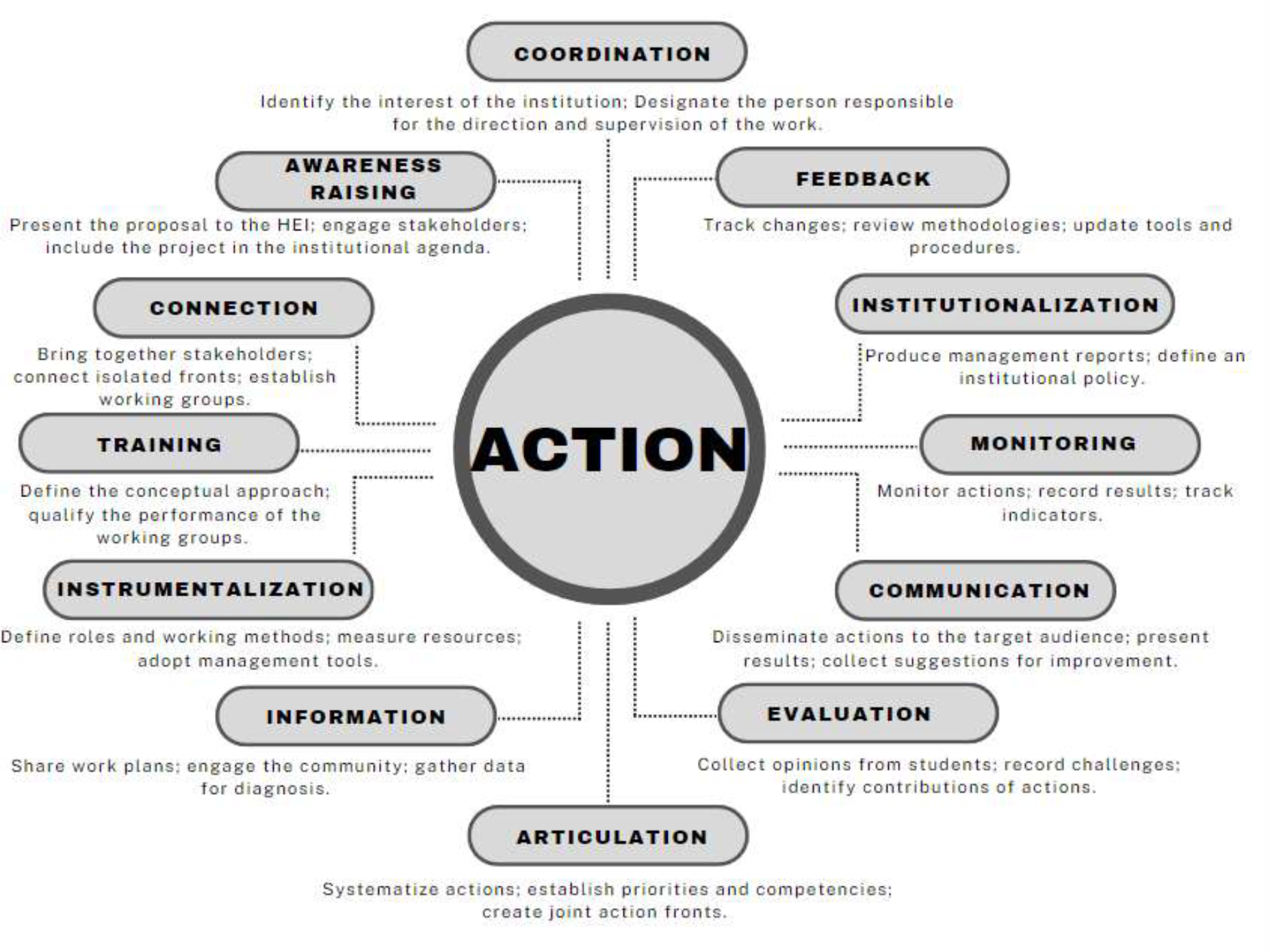
Finally, Simon (2022) model presents the dimensions of dropout management in higher education.

The author emphasizes in her model that each key stage of the action plan is connected in various ways to the other stages. While the first five stages follow a logical sequence, there are significant intersections among all stages, according to the twelve dimensions observed throughout the execution of the action plan. These dimensions emerged during one or more stages. However, it was noted that each dimension is part of at least two stages, as they permeate the development of the plan and do not end with the completion of the stage that introduced them into the model (Simon, 2022).
3 Methodological procedures
The methodological characterization is presented in the table below:
Based on this characterization, the methodological path was outlined to achieve each research objective.
For data collection, both primary and secondary data were used. The main secondary data refer to the Higher Education Census, data from the National Institute for Educational Studies and Research Anísio Teixeira (Inep, 2024), reports from the Federal Court of Accounts, and the websites and reports of public and private HEIs.
These data were supplemented by a bibliographic analysis of the topic, thus generating the final data for triangulation, which was used for the final data analysis.
As secondary data, a survey conducted by the Federal Court of Accounts (2023) was used, involving Brazilian federal universities, with the aim of investigating dropout and alumni issues in 2023 (TCU Operational Audit on teaching, research, alumni, and costs). All 63 Brazilian federal universities responded to the survey, thus constituting a census. Data collection occurred through process TC 033.956/2023-5. The data will be used solely for research purposes, and respondents will not be identified.
4 Results
The data on dropout rates in Brazilian higher education have increasingly shown worrying indicators. After the COVID-19 pandemic, dropout rates have become significantly impactful in both public and private higher education institutions (HEIs) in Brazil.
The latest Higher Education Census released data that reflect these concerning trends, as shown in the following information.

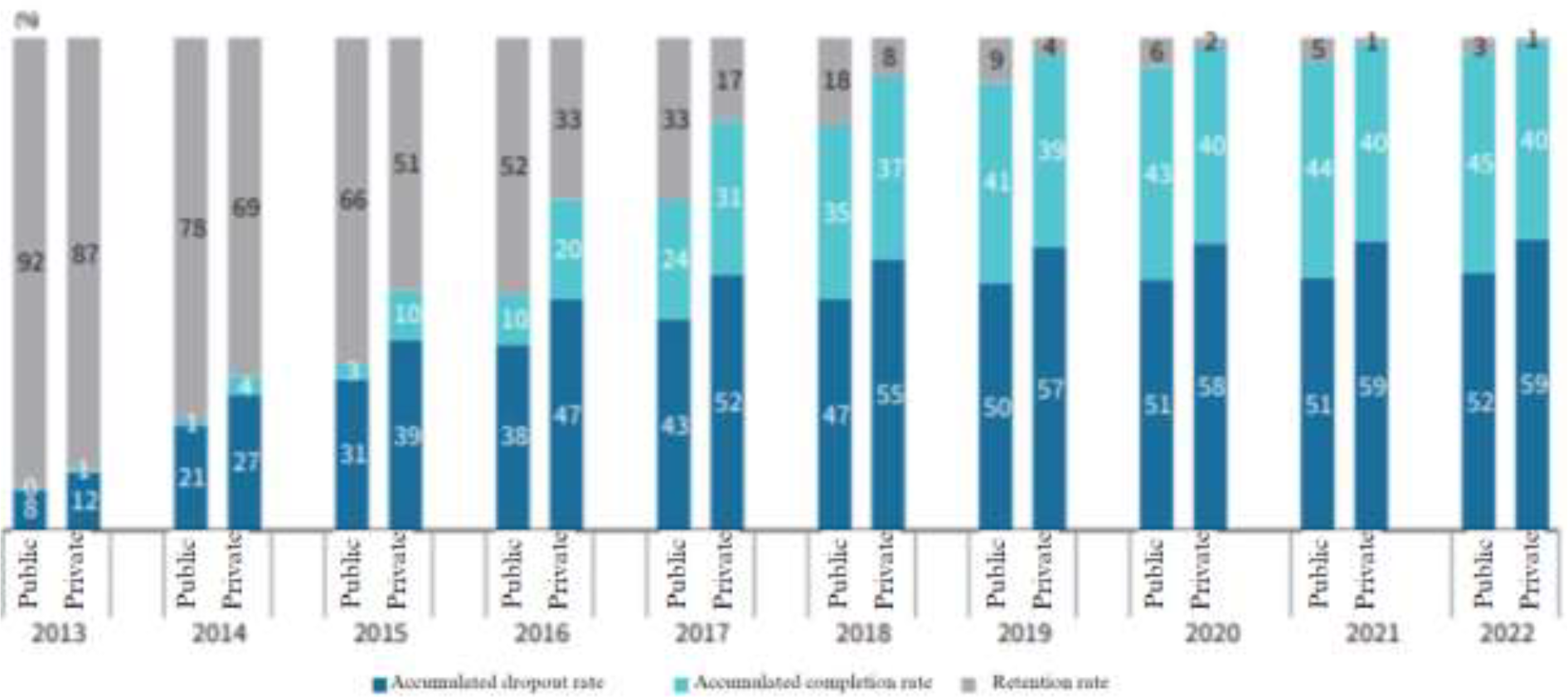
Analyzing the comparative data between public and private HEIs, it is observed that although private institutions have a higher cumulative dropout rate, public institutions are not far behind. "At the end of ten years of monitoring students who enrolled in 2013, the cumulative dropout rate (TCA) is 45% in the public category and 40% in the private category; the annual dropout rate (TDA) is 59% in the private category and 52% in the public category, and the graduation rate (TAP) is 3% in the public category and 1% in the private category" (Inep, 2024). This is shown in Figure 2.


Although these data reflect the 2013 cohort, the analysis of recent years does not show much difference, with dropout rates in Brazilian higher education nearing 60%. As a result, HEIs have had to become more proactive in their efforts to combat dropout. Thus, we begin the analysis of the TCU's research involving all Brazilian federal universities between 2022 e 2023.
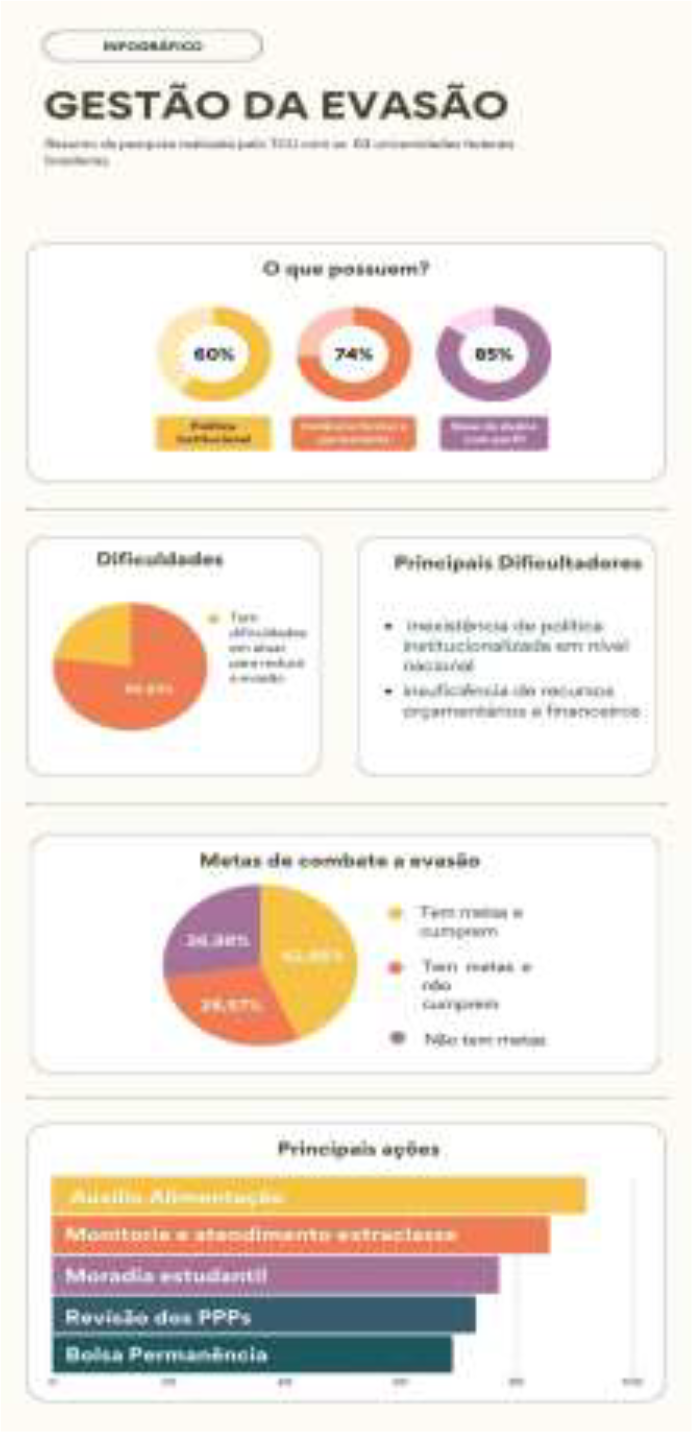
One of the questions posed to the universities was whether they had an institutionalized policy for preventing and combating student dropout. The results showed that 59.97% have such a policy, while 46.03% do not. This indicates that nearly half of the universities still do not have established policies, despite this being a widespread issue. Some of these policies are linked to the universities' Institutional Development Plans (PDI), while others are specific documents.
It is also noteworthy that 74% of the universities have a formal and permanent body responsible for implementing actions to prevent and combat dropout, with most focusing solely on undergraduate programs, typically associated with the pro-rectories of undergraduate education. In terms of structure, the observed types included departments, commissions, committees, observatories, and study groups, corroborating Lobo's (2012) suggestion.
Regarding dropout prevention goals, 42.86% reported having goals and meeting them, 28.57% have goals but are not meeting them, and 26.98% have no defined goals in this area.
In terms of technology, 85.71% of the universities have a database containing information about student profiles, with some even using dashboards to visualize this data. Others also use the Andifes Ecograd system. However, predictive models for dropout were found in only two universities (UFG and UFSM).
The diagnosis of the profile of students who drop out is conducted by 49.21% of universities, meaning that half of the institutions do not analyze this profile or the causes of dropout. This analysis could be crucial in developing retention strategies within the university.
It is also worth noting that 96.83% of federal universities report having difficulties in addressing and reducing dropout rates, highlighting the importance of research and projects in this area. Among the factors hindering these efforts are the lack of a nationally institutionalized policy and insufficient budgetary and financial resources.
Regarding actions to combat dropout and encourage student retention, the following measures have been implemented:
-
a) Tutoring and extracurricular assistance (used by 85.71% of institutions);
-
b) Student housing through the National Student Assistance Program (PNAES) (used by 77.78%);
-
c) Food services through PNAES (used by 92.0692,06%);
-
d) Transportation through PNAES (used by 67.98%);
-
e) Health care through PNAES (used by 58.73%);
-
f) Digital inclusion through PNAES (used by 55.56%);
-
g) Pedagogical support through PNAES (used by 66.67%);
-
h) Access, participation, and learning for students with disabilities, developmental disorders, high abilities, and giftedness (used by 61.90%);
-
i) Revision of Political-Pedagogical Projects (PPPs) (used by 73.03%);
-
j) Psychopedagogical support (used by 61.90%);
-
k) Permanence Grant Program (PBP/MEC) (used by 69.84%).
Additional actions are related to culture, sports, childcare, promoting spaces for discussions about career, the job market, and professional development options, as well as continuous training for teaching staff and technical staff. These actions are based on the main causes of student dropout at the university. Other specific actions include programs for Indigenous and quilombola students, summer courses, integration events, academic performance recovery programs, dialogue and guidance for students at the time of course withdrawal or request for disenrollment, the use of internationalization to break down borders and engage in the global reality, thus mitigating dropout and retention issues, as well as policies and actions to prevent and combat violence.
Main Results of the TCU Research on Dropout Rates can be summarized in the following infographic:
It can be observed from the TCU research that Brazilian federal universities undertake various actions to combat dropout, with the majority of these actions being linked to the National Student Assistance Program (PNAES), which was recently approved as a national policy for student assistance in higher education.
Another point to highlight is that, although universities have student data, there was no noticeable intensive use of this information in their actions, such as in the planning and evaluation of interventions. These data could support the formulation of goals and indicators, as well as help prevent dropout through predictive models. An example is the Integrated System for Academic Success Support (SISSA) program at UFG, which utilizes predictive model algorithms, strategic data analysis, and tutor engagement (SISSA, 2024), corroborating various authors who have demonstrated the effectiveness of such initiatives.
Based on the studied theory and the researched experiences, a compilation of actions to combat student dropout in higher education is presented.
With this table, one can observe the diversity of actions (43) that can be adopted by HEIs. It is important to emphasize that the selection of these actions should be guided by a structured institutional policy, with continuous diagnosis and monitoring of the situation, ensuring that the chosen actions are more effective, especially considering the limited resources available for retention efforts.
Finally, it is worth noting that many of the identified actions align with Lobo's (2012) recommendations: establishing a task force focused on reducing dropout; evaluating dropout statistics; determining the causes of dropout; promoting a studentcentered vision at the institution; creating conditions that meet the goals that attracted students; making the university environment welcoming and pleasant for students; and creating a proactive and permanent student counseling and guidance program.
5 Final considerations
In conclusion, it can be observed that the dropout situation in Brazilian higher education presents alarming figures.
In the context of Brazilian federal universities, 60% have an institutional policy related to combating student dropout. Regarding existing structures, most are linked to undergraduate programs, organized in formats such as departments, commissions, and sectors.
Although many institutions have access to student profile data, few use this information proactively and predictively to assist in decision-making regarding dropout strategies and actions.
As for the actions, a survey was conducted based on theory and research with all federal universities, through the TCU. From this data, it was found that many actions are tied to activities foreseen and funded by the National Student Assistance Program (PNAES), corroborating Simon's (2022) findings. Furthermore, a triangulation was made with the actions presented in the theory, resulting in a compilation of 43 actions to combat student dropout.
Finally, as a suggestion for future research, beyond the issue of dropout, it is crucial to address the occupancy of higher education seats. Data from INEP (Brazil, 2024) show that seat occupancy is around 20% of the total offered. Besides being a concerning figure, these data are directly related to student dropout and retention issues.
References
-
BAR-AM, R. A low-cost intervention for reducing costs from higher education dropout: the dropout reduction model. Contemporary Economy Journal, Brăila, v. 2, n. 4, p. 84-98, 2017. Disponível em: https://ideas.repec.org/a/brc/brccej/v2y2017i4p84-98.html Acesso em: 16 out. 2024.
» https://ideas.repec.org/a/brc/brccej/v2y2017i4p84-98.html -
BARDAGI, M. P.; HUTZ, C. S. Não havia outra saída: percepções de alunos evadidos sobre o abandono do curso superior. Psico-USF, Campinas, v. 14, n. 1, p. 95-105, jan./abr. 2009. Disponível em: https://www.scielo.br/j/pusf/a/v74yVrtsghWs7HNPjzPN5VF/abstract/?lang=pt Acesso em: 16 out. 2024.
» https://www.scielo.br/j/pusf/a/v74yVrtsghWs7HNPjzPN5VF/abstract/?lang=pt -
BARTHÈS, J.-P. A. An explainable machine learning approach for student dropout prediction. Expert Systems with Applications, Curitiba, p. 120933-120933 30, jun. 2023. Disponível em: https://www.ppgia.pucpr.br/~jean.barddal/assets/pdf/2023_ESWA_ABEC_JOAO_KRUGER.pdf Acesso em: 16 out. 2024.
» https://www.ppgia.pucpr.br/~jean.barddal/assets/pdf/2023_ESWA_ABEC_JOAO_KRUGER.pdf -
BRASIL. MEC. Diplomação, retenção e evasão nos cursos de graduação em instituições de ensino superior públicas Brasília: Comissão Especial de Estudos sobre a Evasão nas Universidades Públicas Brasileiras, 1996. Disponível em: http://www.andifes.org.br/wp-content/files_flutter/Diplomacao_Retencao_Evasao_Graduacao_em_IES_Publicas-1996.pdf Acesso em: 17 out. 2023.
» http://www.andifes.org.br/wp-content/files_flutter/Diplomacao_Retencao_Evasao_Graduacao_em_IES_Publicas-1996.pdf -
CHUNG, J.; LEE, S. Dropout early warning systems for high school students using machine learning. Children and Youth Services Review, Amsterdã, v. 96, p. 346-353, jan. 2019. Disponível em: https://www.sciencedirect.com/science/article/abs/pii/S0190740918309721?via%3Dihub Acesso em: 16 out. 2024.
» https://www.sciencedirect.com/science/article/abs/pii/S0190740918309721?via%3Dihub -
ENGUÍDANOS, D. et al Academic emotions and regulation strategies: interaction with higher education dropout ideation. Neveléstudomány, Suiça, 2023. Disponível em: https://www.mdpi.com/2227-7102/13/11/1152 Acesso em: 16 out. 2024.
» https://www.mdpi.com/2227-7102/13/11/1152 -
FOSSATTI, P.; JUNG, H. S. Estratégias para a permanência na educação básica e na educação superior. Perspectiva, Florianópolis, v. 37, n. 2, p. 654-672, jun. 2019. Disponível em: https://periodicos.ufsc.br/index.php/perspectiva/article/view/2175795X.2019.e51925 Acesso em: 16 out. 2024.
» https://periodicos.ufsc.br/index.php/perspectiva/article/view/2175795X.2019.e51925 -
FREITAS, K. F. Alguns estudos sobre evasão e persistência de estudantes. EccoS - Revista Científica, São Paulo, v. 11, n. 1, p. 247-264, jul. 2009. Disponível em: https://periodicos.uninove.br/eccos/article/view/1062 Acesso em: 16 out. 2024.
» https://periodicos.uninove.br/eccos/article/view/1062 -
GILIOLI, R. S. P. Evasão em instituições federais de ensino superior no Brasil: expansão da rede, SISU e desafios. Brasília: Câmara dos Deputados, 2016. Disponível em: https://bd.camara.leg.br/bd/items/038a4d46-9fe0-40c1-81a8-05d702f29595 Acesso em: 16 out. 2024.
» https://bd.camara.leg.br/bd/items/038a4d46-9fe0-40c1-81a8-05d702f29595 -
GUPTA, S. K. et al Lean six sigma for reducing student dropouts in higher education: an exploratory study. Total Quality Management & Business Excellence, Londres, v. 31, n. 1-2, p. 178-193, 2020. Disponível em: https://www.tandfonline.com/doi/full/10.1080/14783363.2017.1422710 Acesso em: 16 out. 2024.
» https://www.tandfonline.com/doi/full/10.1080/14783363.2017.1422710 -
INEP. Instituto Nacional de Estudos e Pesquisas Educacionais Anísio Teixeira. Resumo técnico do censo da educação superior 2022 Brasília: INEP, 2024. Disponível em: https://download.inep.gov.br/publicacoes/institucionais/estatisticas_e_indicadores/resumo_tecnico_censo_educacao_superior_2022.pdf Acesso em: 16 out. 2024.
» https://download.inep.gov.br/publicacoes/institucionais/estatisticas_e_indicadores/resumo_tecnico_censo_educacao_superior_2022.pdf -
KATSURAGI, M.; TANAKA, K. Dropout prediction by interpretable machine learning model towards preventing student dropout Amsterdã: IOS Press, 2022. Disponível em: https://ebooks.iospress.nl/doi/10.3233/ATDE220700 Acesso em: 16 out. 2024.
» https://ebooks.iospress.nl/doi/10.3233/ATDE220700 -
KEMPER, L.; VORHOFF, G.; WIGGER, B. Predicting student dropout: a machine learning approach. European Journal of Higher Education, London, v. 10, n. 1, p. 28-47, 2020. DOI: https://doi.org/10.1080/21568235.2020.1718520 Acesso em: 16 out. 2024.
» https://doi.org/10.1080/21568235.2020.1718520 -
KIM, S. et al Student dropout prediction for university with high precision and recall. Applied Sciences, Suiça, v. 13, n. 10, p. 6275, 2023. Disponível em: https://www.mdpi.com/2076-3417/13/10/6275 Acesso em: 16 out. 2024.
» https://www.mdpi.com/2076-3417/13/10/6275 - LOBO, M. B. C. M. Panorama da evasão no ensino superior brasileiro: aspectos gerais das causas e soluções. Mogi das Cruzes: Instituto Lobo para Desenvolvimento da Educação, da Ciência e da Tecnologia, 2012.
-
MELO, E. C.; SOUZA, F. S. H. Improving the prediction of school dropout with the support of the semi-supervised learning approach. Brazilian Journal of Information Systems (iSys), Porto Alegre, v. 16, n. 1, 2023. Disponível em: https://journalssol.sbc.org.br/index.php/isys/article/view/2852 Acesso em: 17 out. 2024.
» https://journalssol.sbc.org.br/index.php/isys/article/view/2852 -
MOUCHANTAF, N.; CHAMOUN, M. Predicting student dropout with minimal information. Iraqi journal of science, Iraque, v. 64, n. 10, p. 5265-5279, 2023. Disponível em: https://ijs.uobaghdad.edu.iq/index.php/eijs/article/view/6994 Acesso em: 17 out. 2024.
» https://ijs.uobaghdad.edu.iq/index.php/eijs/article/view/6994 -
NASEER, A.; SHAH, S. S.; REHMAN, F. Causes and prevention of dropouts of students in higher secondary schools of quetta. Journal of Social Sciences and Media Studies, [s. l], jun. 2023. Doi: https://10.58921/jossams.07.01.0249
» https://10.58921/jossams.07.01.0249 -
NUNES, R. C. Panorama geral da evasão e retenção no ensino superior no Brasil (IFES). In: ENCONTRO NACIONAL DE PRÓ-REITORES DE GRADUAÇÃO, 16., 2013, Recife. Anais [...]. Recife: Unioeste, 2013. p. 1-33. Disponível em: https://www.studocu.com/pt-br/document/universidade-estadual-do-oeste-do-parana/politica-educacional/fichamento-panorama-geral-da-evasao-e-retencao-no-ensino-superior-nobrasil-ifes/4747735 Acesso em: 17 out. 2024.
» https://www.studocu.com/pt-br/document/universidade-estadual-do-oeste-do-parana/politica-educacional/fichamento-panorama-geral-da-evasao-e-retencao-no-ensino-superior-nobrasil-ifes/4747735 -
OSEMWEGIE, E. E.; AMADIN, F.; UDUEHI, O. M. Student dropout prediction using machine learning. Fudma Journal of Sciences, [s. l.], v. 7, n. 6, p. 647-353, dec. 2023. Disponível em: https://www.researchgate.net/publication/377210513_STUDENT_DROPOUT_PREDICTION_USING_MACHINE_LEARNING Acesso em: 17 out. 2024.
» https://www.researchgate.net/publication/377210513_STUDENT_DROPOUT_PREDICTION_USING_MACHINE_LEARNING -
PAULA, M. F. C. Políticas de democratização da educação superior brasileira: limites e desafios para a próxima década. Avaliação, Campinas; Sorocaba, v. 22, n. 2, p. 301-315, jul. 2017. Disponível em: https://www.scielo.br/j/aval/a/KYs6H9L5YpppTCZHpHGd8SK/?format=pdf⟨=pt Acesso em: 17 out. 2024.
» https://www.scielo.br/j/aval/a/KYs6H9L5YpppTCZHpHGd8SK/?format=pdf⟨=pt -
PRENKAJ, B. et al A survey of machine learning approaches for student dropout prediction in online courses. ACM Computing Surveys, [s. l.], v. 53, n. 3, p. 1-34, 2020. Disponível em: https://dl.acm.org/doi/10.1145/3388792 Acesso em: 17 out. 2024.
» https://dl.acm.org/doi/10.1145/3388792 -
RAMSDAL, G. H.; WYNN, R. Theoretical basis for a group intervention aimed at preventing high school dropout: the case of guttas campus. International Journal of Environmental Research and Public Health, [s. l.], v. 19, 2022. Disponível em: https://www.researchgate.net/publication/366391383_Theoretical_Basis_for_a_Group_Intervention_Aimed_at_Preventing_High_School_Dropout_The_Case_of_'Guttas_Campus'. Acesso em: 17 out. 2024.
» https://www.researchgate.net/publication/366391383_Theoretical_Basis_for_a_Group_Intervention_Aimed_at_Preventing_High_School_Dropout_The_Case_of_'Guttas_Campus -
RINCÓN, A. G. et al Prevention and mitigation of rural higher education dropout in Colombia: a dynamic performance management approach. F1000Research, Reino Unido, p. 412-497, v. 2, jun. 2023. Disponível em: https://f1000research.com/articles/12-497 Acesso em: 16 out. 2024.
» https://f1000research.com/articles/12-497 -
SANTOS, B. S. et al Educação superior: processos motivacionais estudantis para a evasão e a permanência. Revista Brasileira de Política e Administração da Educação - RBPAE, Brasília, v. 33, n. 1, p. 73-94, jan./abr. 2017. Disponível em: https://seer.ufrgs.br/index.php/rbpae/article/view/64630/41186 Acesso em: 17 out. 2024.
» https://seer.ufrgs.br/index.php/rbpae/article/view/64630/41186 -
SILVA, F. C. Variáveis para modelos preditivos à evasão na educação superior 2021. Tese (Doutorado em Administração) - Programa de Pós-Graduação em Administração, Universidade Federal de Santa Catarina, Santa Catarina, 2021. Disponível em: https://repositorio.ufsc.br/xmlui/handle/123456789/231181 Acesso em: 17 out. 2024.
» https://repositorio.ufsc.br/xmlui/handle/123456789/231181 -
SILVA, L. G. et al Dinâmicas de evasão na educação superior brasileira. Revista Examen, Brasília, v. 2, n. 2, p. 100-127, jan./jun. 2018. Disponível em: https://examen.emnuvens.com.br/rev/article/view/67/37 Acesso em: 17 out. 2024.
» https://examen.emnuvens.com.br/rev/article/view/67/37 -
SILVA FILHO, R. L. L. et al A evasão no ensino superior brasileiro. Cadernos de Pesquisa, São Paulo, v. 37, n. 132, p. 641-659, set./dez. 2007.Disponível em: https://www.scielo.br/j/cp/a/x44X6CZfd7hqF5vFNnHhVWg/?format=pdf⟨=pt Acesso em: 26 out. 2024.
» https://www.scielo.br/j/cp/a/x44X6CZfd7hqF5vFNnHhVWg/?format=pdf⟨=pt -
SIMON, L. W. Não é chegada a hora de dizer adeus: um modelo de gestão para a evasão no ensino superior. 2022. Tese (Doutorado em Administração) - Programa de Pós-Graduação em Administração, Universidade Federal de Santa Catarina, Santa Catarina, 2022. Disponível em: https://repositorio.ufsc.br/bitstream/handle/123456789/247336/PCAD1193-T.pdf Acesso em: 17 out. 2024.
» https://repositorio.ufsc.br/bitstream/handle/123456789/247336/PCAD1193-T.pdf -
SISSA. Sistema Integrado de Suporte ao Sucesso Acadêmico. Goiás: UFG, 2024. Disponível em: https://sissa.ufg.br/ Acesso em: 17 out. 2024.
» https://sissa.ufg.br/ -
SMINK, J.; REIMER, M. S. Fifteen effective strategies for improving student attendance and truancy prevention. Clemson: Dropout Prevention, 2005. Disponível em: https://www.escneo.org/Downloads/National%20Dropout%20Prevention%20Council.pdf Acesso em: 17 out. 2024.
» https://www.escneo.org/Downloads/National%20Dropout%20Prevention%20Council.pdf -
TAN, M.; SHAO, P. Prediction of student dropout in e-learning program through the use of machine learning method. Int. J. Emerg. Technol. Learn., Alemanha, v. 10, n. 1, p. 11-17, 2015. Disponível em: https://online-journals.org/index.php/i-jet/article/view/4189 Acesso em: 17 out. 2024.
» https://online-journals.org/index.php/i-jet/article/view/4189 - TCU. Tribunal de Contas da União. Auditoria operacional do TCU sobre ensino, pesquisa, egressos e custos Brasília: TCU, 2023.
-
TINTO, V. Dropout from higher education: a theoretical synthesis of recent research. Review of Educational Research, EUA, v. 45, n. 1, p. 89-125, 1975. Disponível em: https://www.jstor.org/stable/1170024 Acesso em: 17 out. 2024.
» https://www.jstor.org/stable/1170024 -
VARGAS, H.; HERINGER, R. Políticas de permanência no ensino superior público em perspectiva comparada. Education Policy Analysis Archives, Arizona, v. 25, n. 72, jul. 2017. Disponível em: https://www.redalyc.org/pdf/2750/275050047114.pdf Acesso em: 17 out. 2024.
» https://www.redalyc.org/pdf/2750/275050047114.pdf
-
Section editor: André Pires | Layout editor: Silmara Pereira da Silva Martins
-
Translated by: Lesy Editorial, E-mail: lesyeditorial@gmail.com

 Source:
  Source:
  Source: Brasil (2024).
 Source: Prepared by the authors based on TCU data (2023).