 The effect of mindfulness-based psycho education on adolescents’ ınternet addiction
Abstract
Objective This study was aimed to determine the internet addiction levels of nursing students in the adolescent group studying at a university, and to determine the effect of the mindfulness-based psycho education program applied to students with high levels of addiction on internet addiction and awareness.
Methods This research was conducted with adolescent nursing students from a nursing faculty in the fall semester of 2023-2024 in Northern Cyprus. This research was conducted in two stages. The first stage was descriptive and the second stage was quasi-experimental with a one-group pretest and posttest design. In the first stage, the students whose ‘Internet Addiction (IA) Scale’ mean scores were in the ‘dependent’ and ‘risk’ group were included in the quasi-experimental study by forming the study group (n=26). Then, 8 sessions of the mindfulness-based psycho education program were applied to the students once a week in a classroom. The data were analyzed with SPSS 25.0 program after the post-test.
Results There was a statistical difference between the mean pre-test score and the mean post-test score of the ‘internet addiction scale’ (IA Scale p=0.001; Cohen’s d=0.39; MAAS p=0,001; Cohen’s d=0,52). It was concluded that mindfulness education given by students was effective in reducing internet addiction.
Conclusion It was concluded that mindfulness education given by nurses was effective in reducing internet addiction.
Keywords:
Mindfulness; Internet addiction disorder; Adolescent; Students, nursing; Psychology; educational; Faculty, nursing
Resumo
Objetivo Determinar os níveis de vício em internet em estudantes de enfermagem adolescentes em uma universidade e determinar o efeito do programa de psicoeducação baseado em atenção plena sobre àqueles com altos níveis de vício em internet e na sua consciência do momento presente.
Métodos Estudo conduzido com estudantes de enfermagem adolescentes de uma faculdade de enfermagem no semestre de outono de 2023-2024 no Chipre do Norte e realizado em duas etapas. A primeira foi descritiva e a segunda foi quase-experimental, com um delineamento de pré-teste e pós-teste de grupo único. Na primeira etapa, os estudantes com pontuação média da Escala de Vício Em Internet classificadas nos grupos ‘dependente’ e ‘risco’ foram incluídos no estudo quase-experimental, formando o grupo de estudo (n = 26). Em seguida, oito sessões do programa de psicoeducação baseado em atenção plena foram aplicadas aos estudantes uma vez por semana em sala de aula. Os dados foram analisados com uso do programa SPSS 25.0 no pós-teste.
Resultados Houve diferença estatística entre a pontuação média no pré-teste e pós-teste da Escala de Vício em Internet (Escala AI p=0,001; d de Cohen=0,39; MAAS p=0,001; d de Cohen=0,52).
Conclusão Concluiu-se que a educação em atenção plena ministrada por estudantes foi eficaz na redução do vício em internet.
Descritores:
Atenção plena; Transtorno de adição à internet; Adolescente; Estudantes de enfermagem; Psicologia educacional; Docentes de enfermagem
Resumen
Objetivo Determinar los niveles de adicción a internet en estudiantes de enfermería adolescentes en una universidad y determinar los efectos del programa de psicoeducación basado en la atención plena sobre aquellos con altos niveles de adicción a internet y su conciencia del momento presente.
Métodos Estudio llevado a cabo con estudiantes de enfermería adolescentes de una facultad de enfermería durante el semestre de otoño de 2023-2024, en Chipre del Norte y realizado en dos etapas. La primera fue descriptiva y la segunda cuasi experimental, con un diseño de pretest y postest de grupo único. En la primera etapa, los estudiantes con puntaje promedio en la Escala de Adicción a Internet clasificados en los grupos “dependiente” y “riesgo” se incluyeron en el estudio cuasi experimental y formaron el grupo experimental (n=26). Luego, los estudiantes participaron de ocho sesiones del programa de psicoeducación basado en atención plena, una vez por semana en el aula. Los datos se analizaron con el programa SPSS 25.0 en el postest.
Resultados Hubo diferencia estadística en el puntaje promedio en el pretest y postest de la Escala de Adicción a Internet (Escala AI p=0,001; d de Cohen=0,39; MAAS p=0,001; d de Cohen=0,52).
Conclusión Se concluyó que la educación en atención plena de los estudiantes fue eficaz en la reducción de la adicción a internet.
Descriptores:
Atención plena; Trastorno de adicción a ınternet; Adolescente; Estudiantes de enfermería; Psicología educacional; Docentes de enfermería
Introduction
The internet is present in every field where human beings are actively involved, from education to health, from entertainment to the investment sector. The integration of the Internet into many areas of human life leads to its intensive use.(1)According to the Global Digital Report, at the beginning of 2024, the number of individuals with access to the Internet worldwide is estimated at 5.35 billion, which is more than 66% of the total world population.(2)
Nowadays, “internet addiction” has started to be widely characterized as a new type of addiction.(3)The term of internet addiction, which was first defined by Goldberg in 1996, is defined as “spending more time on the internet than necessary, not being able to prevent the desire to use it excessively (postponing basic needs such as eating and sleeping), losing the importance of life for the person when the internet is not available, being nervous, irritable and aggressive when deprived, and in this context, gradual deterioration of the person’s social, work and family life”.(4)Internet addiction (IA), also known as “problematic internet use”, is defined by the American Psychological Association (APA) as “a pattern of behavior characterized by excessive or obsessive online and offline computer use that leads to distress and impairment”.(5)
IA is a type of digital addiction. Digital addictions are defined as a type of addiction that is based on human-machine interaction and does not involve the intake of any chemical substance.(6)IA or other technological addictions are basically handled under the title of behavioral addictions. Behavioral addiction is the inability to resist impulses and motives that lead to behaviors that harm both oneself and the environment.(7)
One of the pioneering studies on IA was conducted by Young, Pistner, O’mara, and Buchanan (1999). In this study, five subtypes of IA were defined ascybersex addiction (obsessive use of adult sites such as cybersex and cyberporn), cyberrelationship addiction (excessive immersion in online relationships), net compulsions (online gambling, shopping and trading), information overload (continuous surfing of websites and databases) and computer addiction (playing computer games). When the sub-dimensions of IA are examined, it is stated that it affects many areas of life from family life, interpersonal relationships, social life to economic life.(8)
IA is considered as a public health problem by the World Health Organization (WHO). IA was evaluated within the scope of “mental health problem/behavioral disorder” at the “Effects of Addictive Behaviors on Public Health” meeting attended by WHO experts.9IA in adolescents is rapidly increasing in many countries around the world.(10-12)During adolescence, adolescents turn to the internet more for reasons such as social approval and peer acceptance. On the other hand, it is known that the social isolation experienced with the Covid-19 pandemic also increases internet use (Ismail, 2024). As a result, adolescents at risk are known to experience negative physical and psychological health consequences.(10,13,14)Some studies have shown that stress and anxiety are associated with IA.(15,16)Stress is an important risk factor in internet, alcohol and gambling addiction. Stress is a condition that occurs when the physical and mental limits of the organism are threatened and forced. Stress has significant effects on people’s physical and psychological well-being.(17)Song and Park revealed in their study in 2019 that mindfulness and self-control reduce stress levels and that this has a mediating effect in reducing IA.(18)
Mindfulness is the awareness of one’s inner state and environment. Mindfulness can help people avoid destructive or automatic habits and reactions by learning to observe their thoughts, feelings, and other immediate experiences without judgment or reaction.(19) Mindfulness-based behavior is a way of life that is very different from the autopilot approach in which individuals perform their daily routines and activities. Internet addiction among nursing students emerges as a current healthcare education problem, and considering these students’ unique conditions and professional requirements, there is a need for specific studies focusing on this group. In studies, mindfulness is examined not only to prevent the relapse of addiction, but also as a long-term, continuous health behavior that supports the recovery of addiction.(20)A study on mindfulness intervention with adolescents reported that it was effective on smartphone addiction and anxiety.(21)
When the literature was examined, there was no research aiming to determine the effect of mindfulness-based intervention program on IA in adolescents. Therefore, it is thought that this study will shed light on the gap in the literature.
This study was aimed to determine the internet addiction levels of nursing students in the adolescent group studying at a university, and to determine the effect of the mindfulness-based psycho education program applied to students with high levels of addiction on internet addiction and awareness.
Research question:
What are the MAAS and IA scale levels’ of adolescent students in the faculty of nursing?
Research hypotheses:
H01: The mindfulness-based psycho education program applied to nursing students in the adolescent group has no effect on IA.
H02: The mindfulness-based psycho education program applied to nursing students in the adolescent group has no effect on MAAS.
Methods
This research was conducted in two stages. The first stage was descriptive and the second stage was quasi-experimental with a one-group pretest and posttest design.
The study was conducted at the Faculty of Nursing of X University in the Northern Cyprus between December 2023 and March 2024.
Inclusion criteria: Being university student; Being maximum 19 years old.
Exclusion Criteria: Being illiterate in Turkish; Diagnosed with medical mental illness; Refusing to participate in the research.
In the first stage, which was conducted as a descriptive study, the population of the study consisted of Turkish students (N=605) studying at X Universty Faculty of Nursing in the fall semester of 2023-2024. At this stage of the study, no sample selection was made and it was aimed to reach the entire population and n=390 (65%) students who were voluntary participants constituted the sample.
Second stage, after the descriptive research, students (n=27) in the ‘dependent’ and ‘risk’ group with an average score of 120 points and above according to the ‘Internet Addiction Scale’ were included in the quasi-experimental study by taking them into the intervention program. Since 1 student did not accept to participate in the study, the quasi-experimental study was completed with n=26 students.
The data were collected with Introductory Data Form which is prepared by the researchers, the ‘Internet Addiction Scale’ and the ‘The Mindful Attention Awarness Scale’.
The data form prepared by the researchers consisted of 13 questions such as age, gender, income status, and family type etc.
The scale developed in Turkish by Günüç and Kayri (2009) consists of 35 items. The scale consists of four sub-dimensions. These dimensions are “Deprivation”, “Control Difficulty”, “Impairment in Functioning” and “Social Isolation”. The minimum score to be obtained from the scale is 35 and the maximum score is 175. On the scale, 35-91 points are considered as non-dependent group, 92-119 as threshold group, 120-147 as risk group and 148-175 as dependent group. The Cronbach alpha internal consistency coefficient of this scale was found to be 0.94.(22)
The Mindful Attention Awareness Scale (MAAS) was developed by Brown and Ryan (2003) and adapted into Turkish by Özyeşil et al. (2011). This scale measures the tendency to be aware of momentary experiences in daily life. It is a unidimensional scale of 15 items with 6-point likert type. As a result of the reliability analysis of the Turkish scale, the Cronbach alpha internal consistency coefficient of the scale was calculated as 0.86. A minimum score of 15 and a maximum score of 90 can be obtained from the scale. As the total scale score increases, the level of mindfulness increases.(23)
In the first stage, the study design was explained to the adolescent students at the beginning of the study. At this stage, students were asked to provide their information. It was also verbally explained that students with high levels of IA (addicted and risk group) would be invited to the second stage. The ‘Consent Form’, ‘Descriptive Data Form’, ‘Internet Addiction Scale’ and ‘The Mindful Attention Awareness Scale’ were delivered face to face to the adolescent students (n=390) who agreed to participate in the study and were completed in an average of 10 minutes.
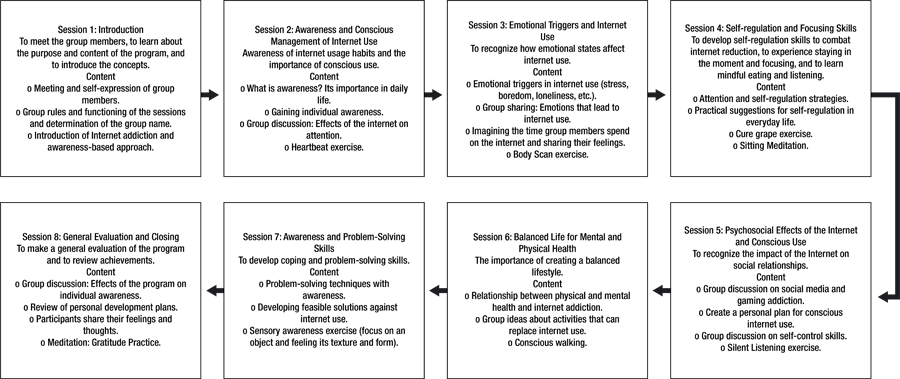
In the second stage according to the results measured in the first stage, the students whose ‘Internet Addiction Scale’ mean scores were in the ‘dependent’ and ‘risk’ group were included in the quasi-experimental study by forming the study group (n=26) in the mindfulness-based psycho education intervention program. Then, 8 sessions of the mindfulness-based psycho education program were applied to the students once a week in a classroom. In the sessions, theoretical training about internet addiction and its psychological and behavioral effects and mindfulness exercises were applied. Thus, it aimed to help participants develop mindfulness-based coping skills while enabling them to understand internet addiction. Each session lasted approximately 60-90 min. The sessions were conducted by the university lecturer (S.E.), who has competence in the field of mental health nursing. Lecture, question and answer, discussion and visual methods and homework assignments were used. In the first session, introductions were made, the program was introduced, group awareness was established and general information about the concepts was provided. Each session used a mindfulness exercise. At the sessions, the implementation of the home exercises was evaluated and the previous session was summarised. In the session, information was given about focusing on the mindful moment, noticing the moment, breathing exercises, noticing the body, noticing the effect of emotions and thoughts, discovering the place and importance of the senses in mindfulness, noticing how to cope with automatic thoughts, noticing feelings of compassion and gratitude, making use of leisure time, taking advantage of opportunities, and thus, methods of coping with IA were taught.
In the last session, termination and general evaluation were made. After the completion of the sessions, ‘Internet Addiction Scale’ and ‘MAAS’ were completed face-to-face as a post-test (Figure 1).
The independent variables of the study consisted of the adolescents’ descriptive data, while the dependent variable was the mean scores obtained from the ‘Internet Addiction Scale’ and the ‘MAAS’.
Data were analyzed in IBM SPSS Statistics Version 25.0 (IBM Inc., Amonk, NY, USA) package program, 95% confidence interval and number and percentage tests were used for descriptive statistics. The conformity of dependent and independent variables to normal distribution was tested with the Kolmogorov Smirnov Test. Paired Samples t Test was used to compare categorical variables. p-value of 0.050 was considered to represent statistical significance.
Necessary written permission was obtained from the authors to use the scales. “Ethics Committee Permission” (X/2022/101-1524) was obtained from faculty of nursing and X University Ethics Committee for the implementation of the data collection forms. Written informed consent was obtained from the participants.
Results
In this study, 59% of the participants in the study group are female, 63.1% are 18 years old. 37.7% live alone. 74.4% use the internet for 3-4 hours, 12.3% spend 4 hours or more on the internet a day. 91.3% of the participants use the internet on their smartphones (Table 1).
The mean scores of the students were 78.79±24.17 on the ‘internet addiction scale’ and 59.24±12.76 on the ‘MAAS’. When the distribution of students’ IA was analyzed, 75.1% (n=293) were in the non-addicted group, 17.9% (n=70) in the threshold group, 5.9% (n=23) in the risk group and 1.0% (n=4) in the addicted group (Table 2).
Descriptive characteristics of the students in the risk and addicted group in terms of ınternet addiction
Table 3 shows the descriptive characteristics of the students in the risk and dependent group according to the mean score of the internet addiction scale. 69.2% of the students were in the age range of 19 years and 69.2% were in the male gender group. 76.1% of the students use their smartphones to access the internet.
There was a statistical difference between the mean pre-test score (135.15±12.45) and the mean post-test score (130.80±9.50) of the ‘internet addiction scale’ (p = 0.001; Cohen’s d = 0.39). There was a statistical difference between the mean pre-test score (42,15±8,51) and the mean post-test score (46,56±8,29) of the ‘MAAS’ (p = 0,001; Cohen’s d = 0,52).
Dıscussıon
Although IA is a problem affecting the general population, it can be said that children, adolescents and young people are the most affected.(24)The fact that these vulnerable groups are under serious risk and the existence of IA makes the studies to be carried out on this subject important. In order to cope with IA, firstly, the existence of internet addiction should be established according to scientific criteria. Since IA is a type of addiction based on behavior rather than chemistry, tests, scales and measurement tools applied to the person and data collected from the environment through observation and interviews are used for its diagnosis.(25) The ‘internet addiction scale’ used in this study is a measurement tool with validity and reliability for Turkish culture. In the study conducted by Dost et al. in Turkish culture, the average score of nursing students from the Internet Addiction Scale was determined as medium level.(26) However, in many countries of the world, the level of IA in adolescents is at medium and high levels.(10-12)It was determined that the students in the study scored 78.79±24.17 points from the ‘internet addiction scale’ and their IA level was at a medium level. The reason for the average score being at medium levels is interpreted as the fact that the participants in the group are adolescents and that it is an expected result of easy access to technological devices and the internet.
There was a statistical difference between the pre-test mean score (135.15±12.45) and post-test mean score (130.80±9.50) of the ‘internet addiction scale’ of the students (n=26) included in the intervention study (p=0.001). When the literature was examined, there was no study that aimed to determine the effect of mindfulness-based intervention program on IA in young people. This study will shed light on the gap in the literature and discussions. When similar studies in the literature are examined, there are studies in which the effect of logotherapy-based mindfulness intervention program applied to adolescents on IA (p<0.05).(27) and the effect of mindfulness-based cognitive-behavioral intervention on smartphone addiction (p<0.05).(28)The results of this study showed that the mindfulness-based 8-sessions intervention applied to university students had a moderate positive effect on IA.
In the literature, it was found that problematic internet use in young people causes mental disorders, which is associated with depression, eating disorders, sleep disorders, physical problems and deterioration in social relationships.(29,30)The mindfulness-based intervention applied to university students to reduce IAhad a positive and statistically significant effect on the sub-dimensions of ‘withdrawal’, ‘control difficulty’ and disorder in functionality’ (p<0.05). The increase in students’ momentary awareness with the mindfulness intervention led to positive results. However, the intervention did not have an effect on ‘social isolation’ (p>0.05). ‘Social isolation’ experienced in addiction is behaviorally based and appears as a psychological effect. In the literature, it has been found that addictions make people lonely and loneliness already causes internet use.(31)Thus, it is evaluated that increasing IA and developing social isolation is a social problem and social solutions should be found in its struggle. It is thought that offering various opportunities in the social field for adolescents in the risk group and making these opportunities easily accessible may be beneficial.
Mindfulness has positive effects on both psychological health and behavioral regulation. Mindfulness is effective in developing and recognizing one’s ability to regulate behavior, which is the main problem behind IA.(31)Previous studies support the hypothesis that mindfulness has a positive impact on excessive internet use and other problematic behaviours such as pathological gambling.(32)In studies examining the awareness levels of nursing students in the literature, it was reported as 53.03 in the study conducted by Yaman et al.; 60.51 in the study conducted by Erkin et al.; 62.87 in the study conducted by He et al.(33-35)The mean score of the students in this study (n=390) from the ‘MAAS’ was 59.24, which was determined as an intermediate level. A statistical difference was found between the mean pretest score (42.15) and the mean posttest score (46.56) of the students (n=26) in the intervention study (p=0.001). The mindfulness intervention program increased students’ mindfulness levels and resulted in a moderate effect size.
There are some limitations in this study. The limitations of the study are; it could not be planned as a randomized controlled experimental study since interaction could not be prevented and that it was conducted as a single group pretest and posttest design study. One of the limitations of the study is the selection of adolescent nursing students, as it is easy to reach the population. The generalisability of the results of this study is limited due to the fact that the sample consisted of nursing faculty students of only one university. Also, due to the short-term follow-up, more research is needed on the long-term effects of mindfulness training.
Conclusıon
The mean scores of the nursing students in the adolescent group from the ‘Internet Addiction Scale’ and the ‘MAAS’ were at a moderate level. However, 5.9% of these participants were in the risk group and 1.0% were in the dependent group. There was a statistical difference between the mean pretest and posttest scores of the students in the risk and dependent group (n=26) who were included in the intervention. There was a statistical difference between the mean pretest and posttest scores of these students on the ‘MAAS’. The H0 hypothesis of this study is rejected. In line with these results, it is recommended to create healthy internet use training and IA prevention programs for adolescents. It is also recommended that mindfulness-based studies with high level of evidence should be conducted for researchers and health professionals.
Data availability
: The authors did not make the data from this article available in repositories prior to submission.
References
- 1 McNicol ML, Thorsteinsson EB. Internet addiction, psychological distress, and coping responses among adolescents and adults. Cyberpsychol Behav Soc Netw. 2017;20(5):296-304.
-
2 Digirtal 2024: Global Overview Report. Data Reportal Digital; 2024 [cited 2024 Mar 5]. Available from: from: https://datareportal.com/reports/digital-2024-global-overview-report
» https://datareportal.com/reports/digital-2024-global-overview-report - 3 American Psychiatry Association (APA). Diagnostic and statistical manual of mental disorders. 5th ed. APA; 2013. p. 591-643.
- 4 Goldberg I. Internet addiction disorder. Procedia: Procedia - Social and Behavioral Sciences. 1996;3(4):403-12.
-
5 American Psychological Association. Internet addiction. [cited 2024 Mar 5]. Available from: https://dictionary.apa.org/internet-addiction
» https://dictionary.apa.org/internet-addiction - 6 Meng SQ, Cheng JL, Li YY, Yang XQ, Zheng JW, Chang XW, et al. Global prevalence of digital addiction in general population: A systematic review and meta-analysis. Clin Psychol Rev. 2022;92:102-28.
- 7 Bickham DS. Current research and viewpoints on internet addiction in adolescents. Curr Pediatr Rep. 2021;9(1):1-10.
- 8 Young K, Pistner M, O'Mara J, Buchanan J. Cyber disorders: the mental health concern for the new millennium. Cyberpsychol Behav. 1999;2(5):475-9.
-
9 World Health Organization (WHO). Public health implications of excessive use of the Internet and other communications and gaming platforms. Geneva: WHO; 2028 [cited 2024 Mar 5]. Available from: https://www.who.int/news/item/13-09-2018-public-health-implications-of-excessive-use-of-the-internet-and-other-communication-and-gaming-platforms
» https://www.who.int/news/item/13-09-2018-public-health-implications-of-excessive-use-of-the-internet-and-other-communication-and-gaming-platforms - 10 Ismail A. The relationship between internet addiction and stress, anxiety, and depression in adolescents in Saudi Arabia. J Pediatr Nurs. 2024;77:111-6.
- 11 Rathi M, Guha P, Neogi R. Internet addiction in adolescents: role of family, personality and comorbid psychopathology in school children in Eastern India. Indian J Psychiatry. 2022;64(4):408-14.
- 12 Ben Thabet J, Ellouze AS, Ghorbel N, Maalej M, Yaich S, Omri S, et al. [Factors associated with Internet addiction among Tunisian adolescents]. Encephale. 2019 ;45(6):474-81. French.
- 13 Veisani Y, Jalilian Z, Mohamadian F. Relationship between internet addiction and mental health in adolescents. J Educ Health Promot. 2020;9(1):303.
- 14 Xiao W, Wu J, Yip J, Shi Q, Peng L, Lei QE, et al. The Relationship between physical activity and mobile phone addiction among adolescents and young adults: systematic review and meta-analysis of observational studies. JMIR Public Health Surveill. 2022;8(12):e41606.
- 15 Zhang X, Li C. Predictors of adolescents' psychological distress and internet addiction: the role of interpersonal stress and school burnout. J Child Fam Stud. 2024;33(4):1070-82.
- 16 McKenna KY, Bargh JA. Plan 9 from cyberspace: The implications of the Internet for personality and social psychology.In: Brewer MB, editor. Personality and social psychology at the interface: New directions for interdisciplinary research: a special issue of personality and social psychology review New Yor: Psychology Press; 2014. p. 57-75.
- 17 Greenberg JS. Coping with stress: A practical guide. Brown & Benchmark; 1990. p. 50-6.
- 18 Song WJ, Park JW. The influence of stress on internet addiction: mediating effects of self-control and mindfulness. Int J Ment Health Addict. 2019;17(4):1063-75.
-
19 American Psychological Association (APA). Mindfulness. APA; 2024. [cited 2024 Mar 5]. Available from: https://www.apa.org/topics/mindfulness
» https://www.apa.org/topics/mindfulness - 20 Erzincanli Y, Tas HG. [A bibliometric analysis on the relationship between technology addiction and conscious awareness]. J Human Rights. 2023;1(2):69-82. Turkish.
- 21 Yang X, Zhou Z, Liu Q, Fan C. Mobile phone addiction and adolescents' anxiety and depression: the moderating role of mindfulness. J Child Fam Stud. 2019;28(3):822-30.
- 22 Kayri M, Günüç S. [The adaptation of Internet Addiction Scale into Turkish: the study of validity and reliability]. J Faculty Educ Sci (JFES). 2009;42(1):157-75. Turkish.
- 23 Özyesil Z, Arslan C, Kesici S, Deniz ME. [Adaptation of the Mindful Attention Awareness Scale into Turkish]. Educ Sci. 2011;36(160). Turkish.
- 24 Chemnad K, Alshakhsi S, Al-Harahsheh S, Abdelmoneium AO, Al-Khalaf MS, Baghdady A, et al. Is it contagious? Does parents' internet addiction impact their adolescents' internet addiction? Soc Sci Comput Rev. 2023;41(5):1691-711.
- 25 Tas I. [Internet Addiction Scale for Adolescents: Validity and Reliability Study]. J Kirsehir Education Faculty. 2019;20(2):875-905. Turkish.
- 26 Dost A, Dogan AK, Aslan D. [Internet Addiction in Nursing]. J Nurs Stud. 2021;4(3):393-401. Turkish.
- 27 Liu X, Jiang J, Zhang Y. Effects of logotherapy-based mindfulness intervention on internet addiction among adolescents during the COVID-19 pandemic. Iran J Public Health. 2021;50(4):789-97.
- 28 Lan Y, Ding JE, Li W, Li J, Zhang Y, Liu M, et al. A pilot study of a group mindfulness-based cognitive-behavioral intervention for smartphone addiction among university students. J Behav Addict. 2018;7(4):1171-6.
- 29 Zheng J, Zang X, Xu X, Zhang H, Shah WU. Impact of Mindfulness on sleep quality in innovative corporate employees: A chain mediation of Social Interaction Anxiety and bedtime procrastination. PLoS One. 2024;19(5):e0302881.
- 30 Sousa GM, Lima-Araújo GL, Araújo DB, Sousa MB. Brief mindfulness-based training and mindfulness trait attenuate psychological stress in university students: a randomized controlled trial. BMC Psychol. 2021;9(1):21.
- 31 Arslan G, Coskun M. Social exclusion, self-forgiveness, mindfulness, and internet addiction in college students: A moderated mediation approach. Int J Ment Health Addict. 2022;20(4):2165-79.
- 32 Calvete E, Gámez-Guadix M, Cortazar N. Mindfulness facets and problematic Internet use: A six-month longitudinal study. Addict Behav. 2017;72:57-63.
- 33 Erkin Ö, Senuzun Aykar F. The effect of the yoga course on mindfulness and self-compassion among nursing students. Perspect Psychiatr Care. 2021;57(2):875-82.
- 34 He FX, Turnbull B, Kirshbaum MN, Phillips B, Klainin-Yobas P. Assessing stress, protective factors and psychological well-being among undergraduate nursing students. Nurse Educ Today. 2018;68:4-12.
- 35 Yaman Z, Bogahan M, Türkles S, Ak E, Ekti H, Özalp D. [Determining the relationship between social media addiction with mindfulness and selfcompassion among nursing students]. YOBU Faculty of Health Sciences Journal. 2022;3(2):219-29. Turkish.
Edited by
-
Associate Editor:
Thiago da Silva Domingos (https://orcid.org/0000-0002-1421-7468) Escola Paulista de Enfermagem, Universidade Federal de São Paulo, São Paulo, SP, Brazil