 Psychological symptoms in family members of critically ill patients during the pandemic: a prospective cohort
Abstract
Objective To assess psychological symptoms in family members of critically ill patients during the pandemic.
Methods This is a prospective cohort study with adult family members of patients admitted to the Intensive Care Unit (ICU) of a university hospital, from July 2020 to April 2022, via telephone contact immediately, six and 12 months after discharge from the ICU, collecting sociodemographic data and assessing symptoms of anxiety, depression and post-traumatic stress. To assess symptoms of anxiety and depression, the Hospital Anxiety and Depression Scale was used and for symptoms of post-traumatic stress disorder, the Impact of Event Scale-6 was used. Descriptive and bivariate statistical analyses were performed.
Results After discharge, 37.7% of family members presented symptoms of anxiety and 32.5% of depression. After six months, these rates reduced to 33.3% and 21.9%, respectively, and after one year, to 12.3% and 6.1%, respectively. Moreover, 30.7% of family members reported symptoms of post-traumatic stress after six months, falling to 12.3% at the end of 12 months. The family nucleus experienced higher percentages of anxiety (p<0.001) and depression (p=0.02) in two or more phases of the study. Family members with a previous diagnosis of anxiety/panic (p=0.002) or depression/bipolar disorder (p=0.01) presented higher percentages of depressive symptoms in two or more phases.
Conclusion Female family members experienced more intense psychological symptoms, especially at the time of discharge from the ICU, lasting for up to 12 months in some individuals.
Keywords:
Pandemics; COVID-19; Critical care; Intensive care units; Family relations; Psychic symptoms; Surveys and questionnaires
Resumo
Objetivo Avaliar sintomas psíquicos em familiares de pacientes críticos na pandemia.
Métodos Coorte prospectiva com familiares adultos de pacientes admitidos no Centro de Tratamento Intensivo (CTI) de um hospital universitário, de julho de 2020 a abril de 2022, via contato telefônico imediatamente, seis e 12 meses após a alta do CTI, coletando-se dados sociodemográficos e avaliando sintomas de ansiedade, depressão e estresse pós-traumático. Para avaliar os sintomas de ansiedade e depressão, foi utilizada a Hospital Anxiety and Depression Scale e para sintomas de transtorno de estresse pós-traumático, utilizou-se a Impact of Event Scale-6. Realizadas análises estatísticas descritivas e bivariadas.
Resultados Após a alta, 37,7% dos familiares apresentaram sintomas de ansiedade e, 32,5%, de depressão. Após seis meses, esses índices reduziram para 33,3% e 21,9%, respectivamente, e, após um ano, para 12,3% e 6,1%, respectivamente. Além disso, 30,7% dos familiares relataram sintomas de estresse pós-traumático após seis meses, caindo para 12,3% ao final de 12 meses. O núcleo familiar experienciou percentuais mais elevados de ansiedade (p<0,001) e depressão (p=0,02) em duas ou mais fases do estudo. Familiares com diagnóstico prévio de ansiedade/pânico (p=0,002) ou depressão/bipolaridade (p=0,01) apresentaram maiores percentuais de sintomas depressivos em duas ou mais fases.
Conclusão Familiares do núcleo familiar e do sexo feminino experienciaram sintomas psíquicos mais intensos, especialmente no momento da alta do CTI, perdurando por até 12 meses em alguns indivíduos.
Descritores:
Pandemia; COVID-19; Cuidados críticos; Unidades de terapia intensiva; Relações familiares; Sintomas psíquicos; Inquéritos e questionários
Resumen
Objetivo Evaluar síntomas psíquicos en familiares de pacientes críticos en pandemia.
Métodos Cohorte prospectiva con familiares adultos de pacientes ingresados al Centro de Tratamiento Intensivo (CTI) de un hospital universitario, de julio de 2020 a abril de 2022, mediante contacto telefónico inmediatamente después del alta del CTI y 6 y 12 meses después. Se recopilaron datos sociodemográficos y se evaluaron síntomas de ansiedad, depresión y estrés postraumático. Para evaluar los síntomas de ansiedad y depresión, se utilizó la Hospital Anxiety and Depression Scale y para los síntomas de trastorno de estrés postraumático, se utilizó la Impact of Event Scale-6. Se realizaron análisis estadísticos descriptivos y bivariados.
Resultados Después del alta, el 37,7 % de los familiares presentó síntomas de ansiedad y el 32,5 % de depresión. Luego de seis meses, los índices se redujeron a 33,3 % y 21,9 % respectivamente, y después de un año, a 12,3 % y 6,1 %. Además, el 30,7 % de los familiares relataron síntomas de estrés postraumático después de seis meses, que se redujo a 12,3 % al concluir 12 meses. El núcleo familiar tuvo porcentajes más elevados de ansiedad (p<0,001) y depresión (p=0,02) en dos o más fases del estudio. Familiares con diagnóstico previo de ansiedad/pánico (p=0,002) o depresión/bipolaridad (p=0,01) presentaron mayores porcentajes de síntomas depresivos en dos o más fases.
Conclusión Familiares del núcleo familiar y de sexo femenino presentaron síntomas psíquicos más intensos, especialmente en el momento del alta del CTI, que perduraron durante 12 meses en algunos individuos.
Descriptores
Pandemias; COVID-19; Cuidados críticos; Unidades de Cuidados Intensivos; Relaciones familiares; Symptômes psychiques; Encuestas y cuestionarios
Introduction
Family members of patients admitted to an Intensive Care Unit (ICU) may experience psychological changes, leading to the development or worsening of symptoms of post-traumatic stress disorder (PTSD), anxiety and depression. This phenomenon is characterized as post-intensive care syndrome-family (PICS-F), and brings distress and disruption to the daily lives of these families.(1)
During the COVID-19 pandemic, social distancing protocols were implemented to prevent new cases of the disease, given the overcrowding of units, lack of personal protective equipment and uncertainty about the risks of infection.(2) A Turkish study with family members of patients hospitalized in ICUs showed that these visiting restrictions were an aggravating factor in the development of symptoms of depression, just as hospitalization during the pandemic scenario accentuated symptoms of anxiety.(3)
In this context, Dutch authors, although they did not assess the first six months after discharge, highlighted that, one year after the hospitalization of critically ill patients, some of their family members still experienced psychological symptoms related to anxiety, depression and PTSD.(4) However, in the Brazilian literature, there are few cohort studies related to PICS-F in the 12-month follow-up,(5)and none to date have considered the pandemic period.
Thus, there is a gap in national and international literature regarding the late impacts that ICU admission has on family members of critically ill patients in the context of the COVID-19 pandemic. Having this knowledge is crucial for designing health professionals’ practice, who can mitigate the symptoms of companions, both in pandemics and in times of health crises. Therefore, this study aimed to assess psychological symptoms in family members of critically ill patients during the pandemic.
Methods
This is a prospective cohort study, carried out in southern Brazil, developed according to STrengthening the Reporting of OBservational studies in Epidemiology (STROBE) guidelines, a checklist for observational studies.(6)
The prospective cohort study was conducted from July 2020 to April 2022 at a large public university hospital located in the city of Porto Alegre, Rio Grande do Sul, Brazil. The institution is a high-complexity health center in the south of the country and was a reference for the care of critically ill patients during the COVID-19 pandemic, reaching 105 ICU beds.
Family members aged 18 years or older of patients requiring hospitalization in an adult ICU for more than 48 hours and using mechanical ventilation during the COVID-19 pandemic were included.
Family members aged ≥18 years who were close to patients admitted to the ICU (family member with legal power of attorney, primary caregiver, responsible family member, preferably in this order: spouse, adult child, father/mother, brother/sister, grandfather/grandmother, grandchild) were included. If patients had more than one eligible family member, the one who had the closest bond with patients and the healthcare team was selected. Family members of patients who died during their ICU stay were also included in the study and were monitored by the hospital’s clinical psychology team.
Family members with communication difficulties (aphasia, severe hearing loss, not speaking Portuguese) of a patient discharged from the ICU more than 96 hours ago were excluded.
Sociodemographic data (age, sex, degree of kinship, marital status, years of education, family income and number of dependents, employment status, responsibility for patient care decisions, patient residence and follow-up, religion) and clinical data (previous diagnoses of depression or bipolar disorder, anxiety or panic, psychotherapy treatment, drug treatment) were collected from family members, in addition to clinical data from patients (classification of functional capacity and daily activities). The outcomes analyzed in this study were anxiety, depression and PTSD.
To assess symptoms of anxiety and depression, the Hospital Anxiety and Depression Scale (HADS) was used, in its Brazilian version.(7) It consists of two subscales - one for anxiety and one for depression -, and each consists of seven Likert-type questions graded from 0 to 3. The overall score in each subscale ranges from 0 to 21, with 0 to 7 being unlikely, 8 to 11 being possible, and 12 to 21 being probable. The cut-off points indicated during the scale validity in Brazil for both subscales were ≥ 9.(7)
For PTSD symptoms, the Impact of Event Scale-6 (IES-6) was used, with a total range of 0 to 24 points. The score for each question ranges from 0 to 4 points, and the score is calculated by adding the scores for each of the questions that make up the scale, disregarding those that were not answered. There is no consensus in the national and international literature regarding a definitive cut-off point for IES-6,(8-13) which may vary between the different populations and outcomes studied. Therefore, the cut-off point used was ≥ 12.5, according to the Portuguese validity(13) of the scale. This version was considered the most appropriate, since this score is applicable to investigate PTSD in family members who have lost loved ones, with death being an outcome investigated in the present study.
Data collection was carried out through telephone calls by academics previously trained by the research team, from July 2020 to April 2022, with family members of patients who met the eligibility criteria. The study consisted of three phases.
In the first phase (phase 1), eligible family members were identified 48 hours after admission through daily screening using the list of hospitalizations in the COVID-19 ICUs and general units. Subsequently, selected family members were contacted by telephone within 96 hours after patients’ discharge or death from the ICU for inclusion in the study. The Informed Consent Form (ICF) was sent to the family member electronically. Data collection was performed by telephone by a trained team, assessing symptoms of anxiety and depression through HADS.
After the first stage, monitoring was carried out through telephone calls in the segments of six (phase 2) and 12 months (phase 3) after discharge from the ICU. During these calls, symptoms of anxiety and depression were verified according to the same scale applied in phase 1. In addition, in phases 2 and 3, the development of PTSD symptoms was also assessed using the IES-6.
One of the possible biases in this study was a typing error in the database creation. To reduce the risk of bias, all study participants were coded, and the data were double-entered. In addition, the data obtained between the phases were paired, ensuring adequate monitoring of respondents in the different segments.
Family members of patients admitted to the ICU for more than 48 hours during the COVID-19 pandemic were included through consecutive sampling. A two-tailed α of 0.05 and a power of 80% were considered, in addition to a 10% segment loss, with an outcome prevalence of 32% for anxiety symptoms, 16% for depression, and 15% for PTSD.(14) Given this calculation, the minimum sample for conducting the cohort would be 41 family members of patients admitted to the ICU in each of the three phases. The final sample of this study, however, was 114 family members per phase.
The data were entered into an Excel® spreadsheet and analyzed using the Statistical Package for the Social Sciences (SPSS) v.18 statistical program. Family members were divided into two groups according to their degree of kinship with patients: the nuclear family (father, mother, and child) and other family members (spouse, sibling, grandchild). The Shapiro-Wilk test was used to analyze data distribution. Continuous variables were expressed by measures of central tendency and dispersion. Categorical variables were presented as absolute and relative numbers. A Sankey diagram was created using the SankeyMATIC® website to better present the comparison of the distribution of family members according to the study outcomes. The chi-square test or Fisher’s exact test was used to determine the association between categorical variables when a cell had an expected frequency lower than five, and the McNemar test was used to compare dependent groups. Data with a two-tailed p-value less than 0.05, or with a 95% Confidence Interval, were considered statistically significant differences.
The project was approved by the institution’s Research Ethics Committee, under Certificate of Presentation of Ethical Appreciation 31773420.3.0000.5327 (Opinion: 4.090.877). The ICF was applied in the first telephone call, with a copy to the family member by email.
Results
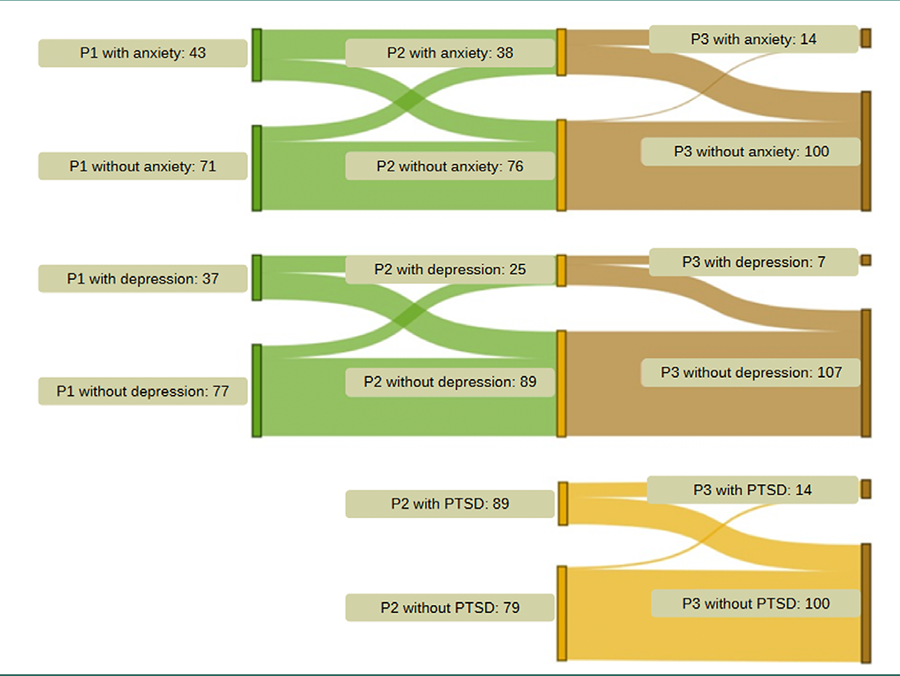
The sample from the first collection included 199 participants. During the second collection, 25 of these did not respond and 60 dropped out. In the third phase, all 114 remaining participants responded and completed the survey, making a total sample of 114 family members. The sample was predominantly composed of females (75.4%, n=86), with a median age of 42.5 years (32-55.25). Among participants, 40% (n=46) were children of patients who had been admitted to the ICU. Approximately 50% (n=58) did not have a partner; 87.7% (n=100) were religious; and 54.4% lived with patients. Family members who had a previous diagnosis of bipolar disorder/depression accounted for 22.8% (n=26) of the sample, and 19.3% (n=22) had a previous diagnosis of anxiety/panic. Furthermore, the median levels of education and income were, respectively, 11 years of study and R$3,000.00. In the first phase, 37.7% (n=43) of family members presented symptoms of anxiety, and 32.5% (n=37) manifested symptoms of depression. In the second phase, these numbers fell to 33.3% (n=38) and 21.9% (n=25), respectively. In the third phase, percentages reduced even further, with 12.3% (n=14) presenting anxiety, and 6.1% (n=7), depression. As for PTSD, 30.7% (n=35) of participants presented symptoms in the second phase, and 12.3% (n=14) in the third. These data are displayed graphically and dynamically in the Sankey diagram (Figure 1).
From the analysis of Figure 1, it is observed that the highest percentages of anxiety and depression occurred immediately after patients’ discharge. Table 1 presents the data regarding the association between sociodemographic and clinical variables with anxiety symptoms.
Bivariate analysis of sociodemographic and clinical variables with anxiety symptom scores in family members
Among the variables analyzed, it was noted that the degree of kinship of family members with patients presented a statistically significant difference for anxiety symptoms (p<0.001), showing that fathers, mothers and children were family members who experienced more anxiety symptoms. Table 2 presents the data related to the bivariate analyses of variables with the outcome of depression.
Association of sociodemographic and clinical variables with depression scores in family members
Regarding symptoms of depression, it was observed that female family members, family nucleus members and/or with a previous diagnosis of mental disorder presented more symptoms of depression. Finally, the bivariate analyses of variables with the PTSD outcome did not show a statistically significant association (p>0.05).
Discussion
This prospective cohort study showed that a high percentage of family members of patients who were admitted to the ICU during the COVID-19 pandemic experienced negative psychological symptoms related to PTSD, depression, and anxiety. It is noteworthy that the highest percentages of feelings of anxiety and depression occurred shortly after discharge from the ICU, when the first call was made to family members.
One of the possible explanations for this fact may be the anxiety-inducing nature of the moment of discharge from the ICU, since transition of care to patients’ family begins while still in the inpatient unit and completely after hospital discharge. Sometimes, critically ill patients return home with significant after-effects. Therefore, it is up to the multidisciplinary team to ensure that family members are properly included and prepared for care, especially by the nursing team, whose guidance reduces family members’ anxiety levels.(15) International studies have shown that training for appropriate discharge was impaired during the pandemic, due to the suspension of in-person visits, moments that are extremely important for providing guidance and training to family members.(16) These data support the findings of this study.
Even six months after being admitted to the ICU, family members still presented symptoms of anxiety, especially mothers, fathers and children. In literature, it is noted that the presence of children accompanying patients admitted to the ICU is common, and these are often the ones who suffer the most from symptoms of anxiety and depression.(17) Usually, family members are responsible for caring for patients during hospitalization using Integrative and Complementary Health Practices, changing patients’ lifestyle and impacting the work and leisure routine, since it is necessary to meet family members’ care demands. Thus, returning home ends up generating stress and anxiety in family members.(18)
Furthermore, the majority were women with a median age of 42.5 years, a frequent profile in investigations involving companions of hospitalized patients, the most frequent being caregivers.(19,20) In the current study, an association between female family members and higher prevalence of depression symptoms was evidenced. Other authors, however, did not find such a relationship, although they also had a predominantly female sample,(4)highlighting the need for greater attention to female family members.
Another interesting finding is the fact that family members who had a previous diagnosis of psychological disorder were associated with greater symptoms of depression, probably because they already had a diagnosis and needed specialized care, making them more vulnerable to imbalances and the development of these symptoms during stressful periods such as the hospitalization of a family member in the ICU.(17)
There was no difference in psychological symptoms between family members with and without religion, supporting Brazilian studies.(21,22) However, internationally, there may be a positive or negative influence, depending on demographics and family beliefs.(23) Furthermore, there may be emotional distress when spiritual needs are not met, requiring attention from the multidisciplinary team to this area of care.(23)
No associations were found between death and the disorders assessed. However, the literature indicates that the death of a patient causes anguish and distress in family members,(24)who may develop psychological sequelae after death in the ICU.(25) Furthermore, it was identified that social-family support and the quality of the family-team bond provided resilient behavior in families.(24) In this way, by identifying the grieving process, professionals can mitigate the consequences for family members through guidance and emotional support.(26)
Families also faced PTSD six months after discharge. In literature, a study related the development of PTSD symptoms with the sex of family members and the use of mechanical ventilation, which may be a difference in the study sample, highlighting the need for further research on the subject to clarify associated factors.(27)
It is noted that family members face negative symptoms that can persist for months after discharge, with the lack of communication between staff and family members being one of the potential factors,(28)especially when there is inaccessible language, inadequate location, and limited time.(29)During the pandemic, communication was further impacted due to rapid changes in patients’ clinics and restrictions on visits, limited to telephone contact, which did not meet family members’ needs.(30)Therefore, it is understood that it is essential to encourage the timely and safe presence of companions during the hospitalization of their loved ones, aiming at improving communication and preparation for discharge, which can mitigate negative symptoms in family members.(28)
Finally, PICS-F is studied internationally with a view to promoting support for family members.(20) In literature, it is evident that negative psychological symptoms arise from a multifactorial process linked to aspects of individuals, the institution and the team as well as external aspects.(31) In this study, it was possible to identify family member variables that influenced their experience, in line with those observed in international studies.(32) It is also essential to revisit the impact that the pandemic has had on the physical and mental health of family members, patients and healthcare professionals themselves, as this is a phenomenon that can have repercussions for a long period of time.(33)
Conclusion
A significant group of family members of critically ill patients admitted to the ICU during the pandemic experienced depression, anxiety, and PTSD, especially immediately after discharge from the ICU. It is noteworthy that female participants belonging to patients’ family nucleus (mother, daughter) presented more intense psychological symptoms, lasting up to 12 months in some family members. These data highlight the need to monitor these family members and prepare them for patient care after ICU admission. We suggest conducting intervention studies that aim to prepare family members for care after discharge from the ICU, verifying potential protective factors for promoting mental health and quality of life of family members.
Acknowledgements
To the Brazilian National Council of Science and Technology (In Portuguese, Conselho Nacional de Desenvolvimento Científico e Tecnológico - CNPq) and the Coordination for the Improvement of Higher Education Personnel (In Portuguese, Coordenação de Aperfeiçoamento de Pessoal de Nível Superior - CAPES), for promoting, respectively, scientific initiation and master’s scholarships to the author.
References
- 1 Pšenicka O, Krížová J. Syndrom post-intenzivní péce [Post-intensive care syndrome]. Vnitr Lek. 2021 Winter;67(E-6):8-12. Czech.
- 2 Sola PP, Souza C, Rodrigues EC, Santos MA, Oliveira-Cardoso EA. Family grief during the COVID-19 pandemic: a meta-synthesis of qualitative studies. Cad. Saúde Pública. 2023;39(2):e00058022
- 3 Kosovali BD, Mutlu NM, Gonen CC, Peker TT, Yavuz A, Soyal OB, et al. Does hospitalisation of a patient in the intensive care unit cause anxiety and does restriction of visiting cause depression for the relatives of these patients during COVID-19 pandemic? Int J Clin Pract. 2021;75(10):e14328.
- 4 Heesakkers H, van der Hoeven JG, Corsten S, Janssen I, Ewalds E, Burgers-Bonthuis D, et al. Mental health symptoms in family members of COVID-19 ICU survivors 3 and 12 months after ICU admission: a multicentre prospective cohort study. Int. Care Med. 2022;48(3):322-31.
- 5 Viana DR, Santana LB, Azzolin KO, Berto PP, Tavares JP, Teixeira C, et al. Quality of Life and Satisfaction of Relatives of Patients Admitted to Intensive Care Units. Cogitare Enferm. 2023;28(1):e91079.
- 6 Malta M, Cardoso LO, Bastos FI, Magnanini MM, Silva CM. STROBE initiative: guidelines on reporting observational studies. Rev Saude Publica. 2010;44(3):559-65.
- 7 Botega NJ, Bio MR, Zomignani MA, Garcia Jr C, Pereira WA. Mood disorders among medical in-patients: a validation study of the hospital anxiety and depression scale (HAD). Rev Saude Publica. 1995;29(5):359-63.
- 8 T'ng K, Kenardy J, Hartanto A. Evaluating mental health outcomes in COVID-19 ICU survivors: a scoping review of measurement tools. J Clin Med. 2024;13(11):3191.
- 9 Rosa RG, Dietrich C, Valle ELT, Souza D, Tagliari L, Mattioni M, et al. The 6-Minute Walk Test predicts long-term physical improvement among intensive care unit survivors: a prospective cohort study. Rev Bras Ter Intensiva. 2021;33(3):374-83.
- 10 Urzal M, Donas- Boto I, Moreira M, Nogueira P, Vian J. Prevalence and associated factors of symptoms of anxiety, depression and post-traumatic stress disorder in healthcare workers during the COVID-19 pandemic. RPSO - Rev Port Saúde Ocup. 2021;11(1)1-23.
- 11 Thoresen S, Tambs K, Hussain A, Heir T, Johansen VA, Bisson JI. Brief measure of posttraumatic stress reactions: Impact of Event Scale-6. Soc Psychiatry Psychiatr Epidemiol. 2009;45(3):405-12.
- 12 Jeong J, Kim AR, Hilton C, Hong I. Impact of Event Scale-6 (IES-6) for U.S. adults who experienced the COVID-19 pandemic. BMC Psychiatry. 2022;22(1):490.
-
13 Lopes AL. Validity of Impact of Event Scale-Revised and Impact of Event Scale-6 Portuguese Version [thesis]. Portugal. Instituto Superior de Ciências da Saúde Norte - Psicologia Clínica e da Saúde; 2013 [cited 2025 Mar 24]. Available from: https://repositorio.cespu.pt/bitstream/handle/20.500.11816/280/Tese%20de%20Mestrado%20-%20Ana%20Luisa%20Teixeira%20da%20Cunha%20Lopes.pdf?sequence=1&isAllowed=y
» https://repositorio.cespu.pt/bitstream/handle/20.500.11816/280/Tese%20de%20Mestrado%20-%20Ana%20Luisa%20Teixeira%20da%20Cunha%20Lopes.pdf?sequence=1&isAllowed=y - 14 Beesley SJ, Hopkins RO, Holt-Lunstad J, Wilson EL, Butler J, Kuttler KG, et al. Acute physiologic stress and subsequent anxiety among family members of ICU patients. Crit Care Med. 2018;46(2):229-35.
- 15 Cuzco C, Torres-Castro R, Torralba Y, Manzanares I, Muñoz-Rey P, Romero-García M, et al. Nursing Interventions for patient empowerment during intensive care unit discharge: a systematic review. International J Environ Res Pub Health. 2021;18(21):11049.
- 16 Mottaghi K, Hasanvand S, Goudarzi F, Heidarizadeh K, Ebrahimzadeh F. The role of the ICU liaison nurse services on anxiety in family caregivers of patients after ICU discharge during COVID-19 pandemic: a randomized controlled trial. BMC Nursing. 2022;21(1):253.
- 17 Souza LM, Freitas KS, Silva AM, Teixeira JR, Souza GS, Fontoura EG, et al. Prevalence and factors associated with symptoms of depression in family members of people hospitalized in the intensive care unit. Rev Bras Ter Intensiva. 2022 ;34(4):499-506.
- 18 Tejero-Aranguren J, García Del Moral R, Poyatos-Aguilera ME, Colmenero M. Family burden after critical illness: the forgotten caregivers. Med Intensiva (Engl Edition). 2024;48(2):69-76.
- 19 Moreira MM, Silva NE, Araújo GH, Fiorini NC, Oliveira MD, Júdice WA, et al. Common mental disorders in patients caregivers in short and midterm hospital admission, a cross-sectional study. Rev Multidebates 2020;4(2):189-97
- 20 Putowski Z, Rachfalska N, Majewska K, Megger K, Krzych LJ. Identification of risk factors for post-intensive care syndrome in family members (PICS-F) among adult patients: a systematic review. Anaesthesiol Intensive Ther. 2023 ;55(3):168-78.
- 21 Matias LC, Resende MC. Ansiedade e religiosidade de familiares de pacientes internados em unidade de terapia intensiva. Perspect Psicol. 2018 ;22(1):38-53.
- 22 Schleder LP, Parejo LS, Puggina AC, Silva MJ. Spirituality of relatives of patients hospitalized in intensive care unit. Acta Paul Enferm. 2013;26(1):71-8.
- 23 Badanta B, Rivilla-García E, Lucchetti G, Diego-Cordero R. The influence of spirituality and religion on critical care nursing: an integrative review. Nurs Crit Care. 2022;27(3):348-366.
- 24 Monteiro MC, Magalhães AS, Machado RN. Death on stage in the ICU: family facing terminal condition. Trends Psychol. 2017 ;25(3):1285-90.
- 25 La IS, Scharf B, Zhu S, Mooney-Doyle K, Friedmann E, Wiegand DL. Family bereavement adaptation after death of a loved one in an intensive care unit. J Hosp Palliat Nurs. 2020;22(6):512-22.
- 26 DeSanto-Madeya S, Willis D, McLaughlin J, Boslet A. Healing experience for family caregivers after an intensive care unit death. BMJ Support Palliat Care. 2019;12(4):578-84.
- 27 Andresen M, Guic E, Orellana A, Diaz MJ, Castro R. Posttraumatic stress disorder symptoms in close relatives of intensive care unit patients: Prevalence data resemble that of earthquake survivors in Chile. J Crit Care. 2015;30(5):1152.e7-11.
- 28 Ostermann M, Vincent JL. ICU without borders. Crit Care. 2023;27(1):186.
- 29 Cezar AG, Del Castanhel F, Grosseman S. Needs of family members of patients in intensive care and their perception of medical communication. Crit Care Sci. 2023;35(1):73-83.
- 30 Boulton AJ, Jordan H, Adams CE, Polgarova P, TRIC Network (Corporate Author), WMTRAIN (Corporate Author), Morris AC, Arora N. Intensive care unit visiting and family communication during the COVID-19 pandemic: a UK survey. J Intensive Care Soc. 2022;23(3):293-6.
- 31 Ripardo WJ, Silva SR, Cardoso DM, Cárdenas AM, Mello MV. The family through hospitalizations in the intensive care unit. Enferm Foco. 2021;12(1):86-92.
- 32 Lee M, Kang J, Jeong YJ. Risk factors for post-intensive care syndrome: A systematic review and meta-analysis. Aust Crit Care. 2020;33(3):287-94
- 33 Moore B. Dying during Covid-19. Hastings Center Report. 2020;50(3):13-5.
Edited by
-
Associate Editor:
Thiago da Silva Domingos (https://orcid.org/0000-0002-1421-7468) Escola Paulista de Enfermagem, Universidade Federal de São Paulo, São Paulo, SP, Brasil