 Education in Primary Health Care: expressions of advanced nursing practice
Abstract
Objective to describe the educational actions developed by nurses in primary health care and identify those that converge with Advanced Nursing Practices (ANP).
Methods Qualitative study with deductive content analysis, based on transcripts of interviews with 831 PHC nurses from across the country, using MAXQDA® software, which produced a report with excerpts from the interviews, representative of the domains analyzed. The analysis of the “Educational Actions” competency was guided by predefined categories (six domains) constructed based on ICN framework and three other validated instruments.
Results the educational actions of the six domains analyzed were expressed in part of the interviews analyzed, with greater frequency in domain six, referring to education for patients and family members. Facilitating factors and weaknesses for the development of educational actions in the scope of nursing practice were identified: health education, continuing education, and preceptorship. Traditional practices predominated, with little planning and institutional weaknesses, especially in the dimensions of continuing education and preceptorship. The lack of protected time, management support, and coordination with educational institutions hindered the strengthening of these practices, compromising their alignment with the competencies expected for APN.
Conclusion the educational practices of nurses in PHC remain sporadic, fragmented, and with limited systematization, distancing themselves from the APN model. There is a clear need for institutional investments, support for pedagogical training, and protected time to consolidate the educational dimension as a strategic component of advanced care.
Descriptors:
Advanced nursing practice; Education; Primary Health Care
Resumo
Objetivo Descrever as ações educativas desenvolvidas pelo enfermeiro na atenção primária à saúde e identificar aquelas convergentes às Práticas Avançadas em Enfermagem (PAE).
Métodos Estudo qualitativo com análise de conteúdo dedutiva, a partir de transcrições de entrevistas de 831 enfermeiros da APS de todo o território nacional, com apoio do software MAXQDA®, que produziu um relatório com trechos de fala das entrevistas, representativos dos domínios analisados. A análise da competência “Ações de Educação” foi guiada por categorias pré-definidas (seis domínios) construídas com base nos referenciais do ICN e outros três instrumentos validados.
Resultados As ações educativas dos seis domínios analisados foram expressas em parte das entrevistas analisadas, com maior frequência no domínio seis, referente à educação para pacientes e familiares. Foram apontados pontos facilitadores e fragilidades para o desenvolvimento das ações educacionais no âmbito da prática do enfermeiro: educação em saúde, educação permanente e preceptoria. Houve predominância de práticas tradicionais, com pouco planejamento e fragilidades institucionais, especialmente nas dimensões de educação permanente e preceptoria. A ausência de tempo protegido, de apoio da gestão e de articulação com instituições de ensino dificultou o fortalecimento dessas práticas, comprometendo sua aproximação das competências esperadas para a PAE.
Conclusão As práticas educativas dos enfermeiros na APS permanecem pontuais, fragmentadas e com limitada sistematização, distanciando-se do modelo de PAE. Evidencia-se a necessidade de investimentos institucionais, apoio à formação pedagógica e tempo protegido para consolidar a dimensão educativa como componente estratégico do cuidado avançado.
Descritores:
Prática avançada de enfermagem; Educação; Atenção Primária à Saúde
Resumen
Objetivo describir las acciones educativas desarrolladas por el profesional de enfermería en la atención primaria de salud e identificar aquellas que convergen con las Prácticas Avanzadas en Enfermería (PAE).
Métodos Estudio cualitativo con análisis de contenido deductivo, a partir de transcripciones de entrevistas a 831 profesionales de enfermería de APS de todo el territorio nacional, con el apoyo del software MAXQDA®, mediante el cual se generó un informe con fragmentos de las entrevistas, representativos de los dominios analizados. El análisis de la competencia «Acciones de Educación» se guio por categorías predefinidas (seis dominios) construidas sobre la base del marco de referencia del ICN y otros tres instrumentos validados.
Resultados las acciones educativas de los seis dominios analizados se expresaron en parte de las entrevistas analizadas, con mayor frecuencia en el ámbito seis, relativo a la educación de pacientes y familiares. Se señalaron puntos facilitadores y obstáculos para el desarrollo de acciones educativas en el ámbito de la práctica de enfermería: educación en salud, educación permanente y preceptoría. Predominaron las prácticas tradicionales, con poca planificación y debilidades institucionales, especialmente en las dimensiones de educación permanente y preceptoría. La falta de tiempo protegido, el apoyo insuficiente de la gestión y la escasa articulación con las instituciones educativas dificultaron el fortalecimiento de estas prácticas, comprometiendo su aproximación a las competencias esperadas para la PAE.
Conclusión las prácticas educativas de los profesionales de enfermería en la APS siguen siendo puntuales, fragmentadas y con una sistematización limitada, alejándose del modelo de PAE. Se evidencia la necesidad de inversiones institucionales, apoyo a la formación pedagógica y tiempo protegido para consolidar la dimensión educativa como componente estratégico de la atención avanzada.
Descriptores:
Práctica avanzada de enfermería; Educación; Atención Primaria de Salud
Résumé
Objectif Décrire les actions éducatives menées par les infirmiers dans le cadre des soins de santé primaires et identifier celles qui convergent vers les pratiques avancées en soins infirmiers (PIA).
Méthodes Étude qualitative avec analyse de contenu déductive, à partir des transcriptions d›entretiens avec 831 infirmiers de la SSP (soins de santé primaires) de tout le territoire national, avec le soutien du logiciel MAXQDA®, qui a produit un rapport avec des extraits des entretiens, représentatifs des domaines analysés. L’analyse de la compétence « Actions éducatives » a été guidée par des catégories prédéfinies (six domaines) construites sur la base des références du Conseil International des Infirmières et de trois autres instruments validés.
Résultats Les actions éducatives des six domaines analysés ont été exprimées dans une partie des entretiens analysés, avec une fréquence plus élevée dans le domaine six, relatif à l’éducation des patients et des familles. Des points facilitateurs et des faiblesses ont été soulignés pour le développement des actions éducatives dans le cadre de la pratique infirmière: éducation à la santé, formation continue et préceptorat. Les pratiques traditionnelles prédominaient, avec peu de planification et des faiblesses institutionnelles, en particulier dans les dimensions de la formation continue et du préceptorat. L’absence de temps protégé, de soutien de la direction et d’articulation avec les établissements d’enseignement a rendu difficile le renforcement de ces pratiques, compromettant leur rapprochement des compétences attendues pour la PIA.
Conclusion Les pratiques éducatives des infirmiers dans les soins de santé primaires restent ponctuelles, fragmentées et peu systématisées, s’éloignant du modèle de PIA. Il est évident qu’il est nécessaire d’investir au niveau institutionnel, de soutenir la formation pédagogique et de consacrer du temps protégé afin de consolider la dimension éducative en tant que composante stratégique des soins avancés.
Descripteurs:
Pratique infirmière avancée; Éducation; Soins de santé primaires
Introduction
In Primary Health Care (PHC), nurses act strategically to ensure compliance with the guiding principles and guidelines for this level of care. To this end, they must integrate various skills, being assigned clinical care, managerial, and educational activities.(1-3) The educational role of nurses has three complementary dimensions: health education, continuing education, and preceptorship for different levels of training.
Health education actions are understood as critical, participatory, and emancipatory educational processes that favor the construction and appropriation of knowledge by the population, valuing popular knowledge, dialogue, and community agency in the production of care.(4-6) Continuing Health Education (CHE) refers to learning incorporated into the daily lives of workers, integrating teaching and practice with the aim of continuously improving care and strengthening health teams.(2,7) Preceptorship, on the other hand, corresponds to pedagogical activities aimed at training new professionals, promoting teaching-service partnerships and the development of critical, reflective, and collaborative professional skills.(8)
Given the complexity of nurses’ work in PHC, strategies for strengthening the professional workforce have been discussed at the national and international levels, with an emphasis on Advanced Nursing Practices (ANP) as an innovation in health systems, as they expand autonomy, scope of practice, and professional qualifications.(9,10)A review of the competencies of Advanced Practice Nurses (APN) highlighted the importance of educational practices, pointing out that this dimension is still an under-explored field that requires further study.(11)
Based on the potential of APNs to strengthen educational actions, this study proposes to answer: what educational actions do PHC nurses perform in their daily lives that are similar to the competencies of APNs? Thus, the objective is to describe the educational practices developed by nurses in Primary Health Care and identify those that converge with advanced practices.
Methods
Qualitative study with secondary data analysis, using the research database “Nursing practices in the context of Primary Health Care (PHC): national study of mixed methods,” developed by the partnership between the Federal Nursing Council (COFEN) and the University of Brasília (UNB) between 2019 and 2020.(12) This analysis is part of the activities of COFEN’s Advanced Practices Commission, together with the working group created for its implementation.(13) The study followed the guidelines established in the Consolidated Criteria for Reporting Qualitative Research, referring to domain three (COREQ).(14)
For this analysis, excerpts from statements in which activities related to the competence under study were identified were considered: Nurse Education Activities in PHC.
The data were collected in the five Brazilian regions, covering 26 states and the Federal District, totaling 108 municipalities.(12) A total of 831 nurses working in PHC participated,(12) selected by the National Register of Health Establishments (CNES), considering those linked to health centers, family health units, and traditional basic units, constituting a purposive sample. The following inclusion criteria were adopted: nurses who perform care or management practices in PHC. The following exclusion criteria were adopted: nurse preceptors, consultants, among others who do not have a formal employment relationship with the health service, and those absent due to vacation or leave of any kind.
For data collection, semi-structured interviews were conducted virtually (remotely) by a network of researchers formed for the purpose of conducting the study, composed of researchers, scholarship recipients, and undergraduate and graduate volunteers. The interviews were recorded and transcribed in full, generating the database analyzed in the primary study and in this study.(12)
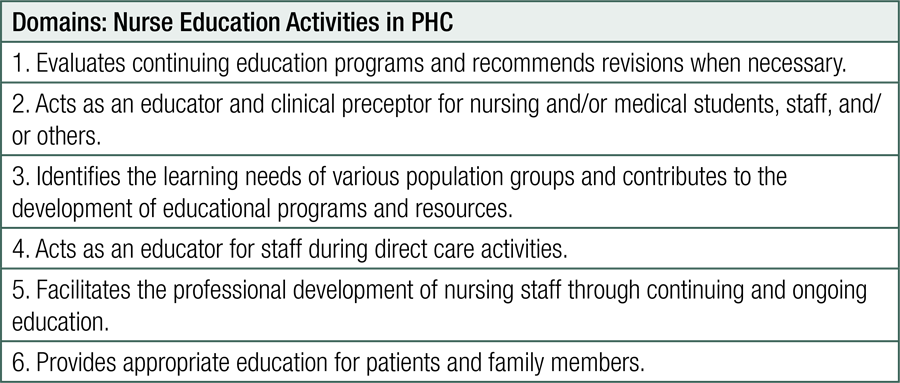
The categories of analysis (domains) were predefined using the ICN framework (2020)(10), which presents essential characteristics for the APN, as well as three other instruments available and validated for Brazilian Portuguese: Modified Scale for Delineating the Role of Advanced Practice Nurses (EMDF/APN) – Brazilian Version;(9) Inventory for the evaluation of competencies in advanced practice nurses (IECAPN) for Brazilian culture;(15)and Competencies for the training of advanced practice nurses for primary health care,(16)including the domains presented below (Figure 1).

For data processing, which took place between July and December 2024, MAXQDA® 2024 software was used, following these steps:
-
Structuring of a coding tree with main categories adapted from the referenced instruments;
-
Axial coding and definition of specific subcategories by region;
-
Integration of cases into a unified categorical system.
As a result, a report was obtained with representative statements from each of the six domains of competence analyzed. Bardin’s content analysis was conducted using a deductive coding process.
The excerpts were identified based on criteria of similarity and meaning in relation to the established categories, being classified as “performs” (when they demonstrated compliance with the APN domain), “partially performs” (when they presented partial elements), and “does not perform” (when there was explicit denial of the practice). In addition, there were interviews without mention of the analyzed theme. To present the frequency of occurrences related to the domains, the categories “performs” and “partially performs” were grouped as “yes”; and “does not perform” or “no mention” as “no.”
Subsequently, analytical generalization was applied to identify recurring patterns and perceptions that contributed to a broader understanding of the phenomenon. To ensure the anonymity of the participants, the interviews were identified by a code, beginning with “ENF” for nurses, followed by the abbreviation of the region of professional practice (e.g., “S” for South and “NE” for Northeast), and then a number.
The primary study was approved by the UNB Research Ethics Committee, under opinion No. 3,619,308 and Certificate of Ethical Review: 20814619.2.0000.0030.
Results
The following is a description of the frequency of occurrences related to the domains that comprise the competence under analysis (Chart 1).
In general, the activities in the six domains were performed infrequently, with regional variations. Domain one was the least mentioned, while domain six stood out as the most recurrent, especially in the North region, which exceeded 50% of mentions. The qualitative findings for each domain are presented below, expressing representative statements extracted from the interviews:
Evaluates continuing education programs and recommends revision when necessary
One of the reports highlighted facilitators for this practice: the provision of weekly hours for professional qualification and the incorporation of CHE into the team’s routine, with team meetings as a space to address topics, conducted through the discussion of complex cases.
The others reported weaknesses, such as lack of time, absence of structured planning by management, and a curative culture: “We could have the time to do this, right? But unfortunately, we live in a curative medicine environment, it seems that the most important thing is to prescribe for the patient (ENF_NE_784).”
Acts as an educator and clinical preceptor for nursing and/or medical students, staff, and/or others
The nurses reported acting as preceptors for undergraduate and residency students in nursing and other health courses, in the context of supervised internships, covering the monitoring of practical activities, clinical guidance, and support in collective educational actions: “I do preceptorship [...], not limited to nursing consultations, but all activities such as health surveillance, active search for patients, prenatal care, hypertension, diabetes, leprosy, tuberculosis, well-child care, vaccines, all lines of care that we have (ENF_SE_351).”
In addition, the interviewees highlighted the opportunity for mutual learning and the strengthening of interprofessional practice as positive aspects of preceptorship: “It’s very good because it’s an exchange of information, experiences, and learning. So the student comes with new things, we have the knowledge, the practice, we learn from them and they also learn from us (ENF_NE_679).”
However, they also mentioned difficulties, such as a lack of training for preceptorship and overlapping activities, with no protected time or formal recognition for being a preceptor: “I don’t receive it because it ends up interfering with my care, I really want to assist the student, especially the nursing technician student, but at the same time I can’t because I have my own appointments to fulfill (ENF_NE_583).”
Identifies the learning needs of various population groups and contributes to the development of educational programs and resources
Participants reported actions with different audiences (pregnant women, children, the elderly), some of which were planned in response to the learning needs of the territories and health indicators. For example, considering the increase in cases related to mental health, such as anxiety, depression, and suicide attempts, a mental health group was created: “There were a lot of people using psychotropic drugs [...] we conducted a survey and created this group to try to reduce their use (ENF_NE_80).”
Actions were also tailored to specific territorial characteristics, such as fishing communities, rural populations, and areas with a high degree of vulnerability. One professional highlighted the challenges faced in rural communities with high rates of workplace accidents: “People work a lot with tractors [...] there are many cuts that require stitches and a lot of trauma (ENF_S_043).”
On the other hand, many excerpts do not detail the action planning process, and no excerpts were identified that indicated the development of educational resources.
Acts as an educator for the team during direct care activities
Reports identified that nurses provide supervision and technical-pedagogical support to the nursing team, Community Health Agents (ACS), and other team members during their professional practice. Topics such as immunization, tuberculosis, dressings, and others were mentioned: “training the nursing team... a lot of things with CHAs end up being done by me and the doctors themselves [...], a lot of things we have to pass on to them (ENF_S_92).”
Meetings are often used as training spaces, employing case discussions, indicator analyses, and surveillance actions. Nurses are assigned the role of matrix supporter, providing backup to support decisions and, often, serving as a technical reference for the multidisciplinary team: “The team also puts me, at times, as a reference—the medical team—to discuss cases of patient injuries and define therapy (ENF_S_90).”
Among the key challenges, the high turnover of professionals, overload, lack of institutional support, and lack of scheduled time for training activities stand out: “We discuss things informally, but unfortunately, there is no time to sit down, go into detail, study, and provide continuing education among ourselves (ENF_NE_621).”
Facilitates the professional development of the nursing team through continuing/permanent education
Actions for the development of nurses, technicians, and assistants include topics such as vaccination, syphilis, dressings, leprosy, tuberculosis, and others. Meetings, case discussions, supervision, and training exemplify continuing education at and for work: “We supervise the nursing technicians who are working in the field, all the procedures they are performing, if they have any difficulties, if they need any help (ENF_S_88).”
Although nurses play a leading role in these initiatives, some pointed out as a challenge the concentration of educational actions around the professional initiative, in addition to a lack of encouragement from management: “Yes, I was even doing it weekly, but then I was called by the coordinator who said it meant one less shift of patient care, that it was to be done only monthly, [...] weekly I was able to address more topics, and monthly I can only address one (ENF_NE_549).”
Provides adequate education for patients and family members
Health education actions are mainly developed in educational groups. Several topics were addressed: women’s health, men’s health, elderly health, healthy eating, smoking, and well-child care: “In the group of pregnant women, where we provide more guidance, they come with many questions: questions about prenatal care itself, its importance, follow-up, childbirth, which they were very afraid of, birthing positions, and also breastfeeding (ENF_S_169).”
These actions were also often linked to the Ministry of Health’s campaign calendar, such as Pink October, Blue November, and others. The view of health education as synonymous with groups predominates, with few reports associating this practice with expanded clinical care, nursing consultations, or family approaches.
Other difficulties were also mentioned: structural limitations of services, lack of adequate physical space and scarcity of material resources; lack of encouragement from management; and low user adherence: “we improvise. The physical structure leaves something to be desired in this regard, it is often necessary for us to form small groups or talk in the waiting room itself (ENF_NE_81).” To overcome some of these difficulties, nurses reported intersectoral coordination with schools, churches, and other institutions in the territory.
The importance of the involvement of the multidisciplinary team and other facilities—CAPS and CRAS—in the planning and execution of educational activities was also highlighted: “every month we make a schedule, we request the participation of NASF, if we need CAPS we request it (ENF_NE_792).”
However, few reports mentioned the systematic planning of educational actions based on the diagnosis of local needs or analysis of health indicators.
Discussion
For this study, which aimed to describe the educational actions developed by nurses in PHC in their daily lives and identify those convergent with APN, the results indicate that, although present, such actions remain sporadic, poorly systematized, and point to the need for investment to strengthen them and align them with APN competencies.
In health education actions, there was a predominance of traditional collective practices, such as lectures and groups, many linked to the Ministry of Health’s campaign calendar, which, although they increase the visibility of relevant topics, lose their educational power when carried out episodically and in an uncoordinated manner.(19) The lack of continuity and the assistance-based logic also reflect historical challenges in health education in Brazil, marked by vertical practices inherited from health campaigns in the 20th century.(20,21)
Few reports indicated systematic planning based on the needs of the territory, often disregarding its specificities, although some statements point to the adaptation of actions to the specificities of vulnerable populations. In this sense, one of the focuses for implementing the APN in Brazil relates to meeting the needs and expanding access for vulnerablized populations, strengthening the principles of equity and comprehensiveness.
Overcoming these challenges requires incorporating health education as a structuring axis of healthcare practice, in line with the principles of the National Policies for Health Promotion and Popular Education in Health.(1,4,5,23) The need to strengthen community ties, foster intersectoral coordination, and institutionally recognize educational actions as part of comprehensive care, beyond the fulfillment of programmatic goals and actions, is reaffirmed.(24) The absence of references to the production and use of educational resources authored by nurses indicates a gap, since this represents a skill of nurses at the interface between care and education.
Furthermore, when considering the role of nurses as educators, the interviews revealed that they develop CHE actions aimed at the nursing and multidisciplinary teams. However, these practices are non-standardized and, in general, result from individual initiatives, without institutional planning or systematic insertion in the work process. Among the challenges identified, overload, lack of management support, and lack of protected time stand out, corroborating indications in the literature about the fragility of the institutionalization of CHE in PHC related to work management and the dissociation between planning, education, and health.(25-30)
The persistence of an assistance-based culture to the detriment of critical and continuous training also appeared as a barrier to the consolidation of CHE as a strategy for transforming care, in line with the National Policy for Continuing Education in Health(7) and studies on meaningful learning at work.(27,30) In the context of APN, leading CHE processes is an essential skill for improving care, strengthening teamwork, and enhancing collaborative practice.(10) To consolidate CHE in PHC, it is essential to integrate it into local planning, ensuring spaces that go beyond sporadic actions and produce critical reflection, with participatory methodologies, such as matrix support, shared consultations, and the construction of unique therapeutic projects.(25)
In this scenario, nurses emerge as articulators of interprofessional practices, although only 2.8% of the teams’ time is devoted to meetings.(29) The findings reinforce this context by highlighting the recognition of nurses as a reference among professionals and the potential of team meetings as strategic spaces for CHE. Thus, management support is essential to guarantee and protect these spaces.
Preceptorship actions place nurses as directly responsible for training new generations of professionals, strengthening the integration of teaching, service, and community, and are perceived positively by the interviewees, who highlighted the exchange of knowledge, innovation, and mutual growth as enriching aspects, consistent with other scientific studies.(8)
However, challenges remain, such as the lack of pedagogical training to act as a preceptor, overlap with care activities, and lack of formal recognition by the institution, facts also demonstrated in previous studies.(8,33) The lack of structure/materials in the services can lead to improvisation that impairs the care and learning of those being supervised and highlights the lack of coordination between preceptors and educational institutions.(8) A recent study reinforces the need to expand dialogue between services and educational institutions, with spaces for joint planning and investments in didactic-pedagogical training for preceptors, as a strategy to consolidate health training in the SUS.(32) Discussions point to residency as the gold standard for APN training in Brazil, reinforcing the need for this discussion.
A scoping review that mapped the essential competencies of APN in PHC found three interrelated competencies, including academic-educational skills.(33) Therefore, the lack of institutional policies that ensure protected time for teaching and qualified educational support compromises both the quality of student training and the development of these competencies by nurses themselves.
Although educational activities are carried out in PHC, their low frequency and lack of structured planning make it difficult to characterize them as advanced practices, according to international criteria and the most recent discussions in the Brazilian context. For an educational action to be recognized as an ANP, it must be systematic, based on local diagnosis, and evidence-based—which is not yet widely observed in Brazil. Thus, strengthening the educational dimension, encompassing health care, continuing education, and preceptorship, is essential for nurses to generate the desired impact in the territories and advance in recognition as an APN.
Conclusion
The study showed that the educational health actions developed by PHC nurses still lack the power to align with advanced nursing practices. The predominance of sporadic, fragmented, and traditional practices was evident, as well as the absence of structured planning. Continuing education and preceptorship initiatives were also found to be incipient and limited, particularly due to the lack of institutional support and protected time in the work process. These findings indicate the need to strengthen the educational dimension in nursing practice, focusing on: responding to local health needs; promoting the use of innovative and participatory methodologies; integrating actions into the work process in an organized manner; and prioritizing actions with management support. Thus, the consolidation of educational practices needs to be coordinated with higher education institutions responsible for lato sensu (specialization) and stricto sensu (master’s and doctoral) courses. These are the essential conditions for the recognition of nurses as Advanced Practice professionals in PHC, expanding their autonomy, leadership, and capacity to transform territories and the health of the population.
Acknowledgments
To the Federal Nursing Council (COFEN), for its institutional support of the qualitative secondary analysis of the database from the research project “Nursing practices in the context of Primary Health Care (PHC): a national study using mixed methods.” To the University of Brasília (UnB), for releasing the qualitative database, of which UnB and COFEN hold the intellectual property rights.
References
- 1 Lopes OC, Henriques SH, Soares MI, Celestino LC, Leal LA. Competências dos enfermeiros na estratégia Saúde da Família. Esc Anna Nery. 2020;24(2):e20190145.
- 2 Brasil. Ministério da Saúde. Política Nacional de Atenção Básica (PNAB). Brasília (DF): Ministério da Saúde; 2017.
-
3 Brasil. Presidência da República. Lei nº 7.498, de 25 de junho de 1986. Dispõe sobre a regulamentação do exercício da enfermagem e dá outras providências. Brasília (DF): Presidência da República; 1986 [citado 2025 Jun 17]. Disponível em: https://www.planalto.gov.br/ccivil_03/leis/l7498.htm
» https://www.planalto.gov.br/ccivil_03/leis/l7498.htm - 4 Brasil. Ministério da Saúde. Recomendações para a operacionalização da Política Nacional de Promoção da Saúde na Atenção Primária à Saúde. Brasília (DF): Ministério da Saúde; 2022.
- 5 Brasil. Ministério da Saúde. Política Nacional de Educação Popular em Saúde no SUS - PNEPS-SUS. Brasília (DF): Ministério da Saúde; 2022.
- 6 Freire P. Pedagogia do oprimido. Rio de Janeiro: Paz e Terra; 1987.
- 7 Brasil. Ministério da Saúde. Política Nacional de Educação Permanente em Saúde (PNEPS). Brasília (DF): Ministério da Saúde; 2009. (Série Pactos pela Saúde 2006, v. 9).
- 8 Ferreira FD, Dantas FC, Valente GS. Nurses' knowledge and competencies for preceptorship in the basic health unit. Rev Bras Enferm. 2018;71(Suppl 4):1564-71.
- 9 Minosso KC, Toso BR. Transcultural validation of an instrument to evaluate Advanced Nursing Practice competences in Brazil. Rev Bras Enferm. 2021;74:e20210165.
- 10 International Council of Nurses (ICN). Guidelines on Advanced Practice Nursing. Geneva: ICN; 2020 [cited 2025 June 17]. Available from:
- 11 Laurant M, van der Biezen M, Wijers N, Watananirun K, Kontopantelis E, van Vught AJ. Nurses as substitutes for doctors in primary care. Cochrane Database Syst Rev. 2018;7:CD001271.
- 12 Sousa MF. Práticas de enfermagem no contexto da Atenção Primária à Saúde (APS): estudo nacional de métodos mistos (Relatório final). Núcleo de Estudos em Saúde Pública, Centro de Estudos Avançados Multidisciplinares (CEAM), Universidade de Brasília (UnB), Conselho Federal de Enfermagem (COFEN). Brasília (DF): Editora ECoS; 2022.
- 13 Conselho Federal de Enfermagem (COFEN). Portaria Cofen nº 1075 de 10 de junho de 2024. Institui Grupo de Trabalho - GT para análise de dados da etapa qualitativa da pesquisa "Práticas de Enfermagem no contexto da Atenção Primária à Saúde (APS): estudo nacional de métodos mistos". Brasília (DF): COFEN; 2024.
- 14 Souza VR, Marziale MH, Silva GT, Nascimento PL. Tradução e validação para a língua portuguesa e avaliação do guia COREQ. Acta Paul Enferm. 2021;34:eAPE02631.
- 15 Días FC, Baitelo TC, Toso BR, Sastre-Fullana P, Oliveira-Kumakura AR, Gasparino RC, et al. Adaptation and validation of the Advanced Practice Nursing Competency Assessment Instrument. Rev Bras Enferm. 2022;75(5):e20210582.
- 16 Cassiani SH, Silva FA, Ferreira MA, Peduzzi M, Haddad MC, Pires DE, et al. Competencies for training advanced practice nurses in primary health care. Acta Paul Enferm. 2018;31(6):572-84.
-
17 Peres EM,Toso BR, Freire NP, Palha PF, Miranda Neto MV, Siqueira EF, et al. Glossário: Competências Centrais da EPA. Brasília (DF): Cofen; 2024 [citado 2025 Abr 17]. Disponível em: https://conteudos.cofenplay.com.br/itens/133948/glossario-competencias-centrais-da-epa
» https://conteudos.cofenplay.com.br/itens/133948/glossario-competencias-centrais-da-epa - 18 Bardin L. Análise de conteúdo. Lisboa: Edições 70; 2000.
- 19 Costa DA, Cabral KB, Teicheira CC, Rosa RR, Mendes JL, Cabral FD. Enfermagem e a educação em saúde. Rev Cient Esc Estadual Saúde Pública Goiás. 2020;6(3):e6000012.
- 20 Falkenberg MB, Mendes TP, Moraes EP, Souza EM. Educação em saúde e educação na saúde: conceitos e implicações para a saúde coletiva. Cienc Saude Colet. 2014;19(3):847-52.
- 21 Costa JS, Carneiro-Leão AM. Campanhas sanitárias como instrumentos da educação em saúde no Brasil: algumas reflexões para uma educação popular em saúde. Sustinere. 2021;9(1):333-51.
- 22 Brasil. Ministério da Saúde. Secretaria de Gestão do Trabalho e da Educação na Saúde. Departamento de Gestão e Regulação do Trabalho em Saúde; Departamento de Gestão da Educação na Saúde. Relatório do Grupo de Trabalho de Práticas em Enfermagem no Brasil. Brasília (DF): Ministério da Saúde; 2024.
- 23 Pedrosa JI. A Política Nacional de Educação Popular em Saúde em debate: (re) conhecendo saberes e lutas para a produção da Saúde Coletiva. Interface (Botucatu). 2021;25:e200190.
- 24 Ferreira DS, Ramos FR, Teixeira E. Nurses' educational practices in family health strategy. Rev Bras Enferm. 2021;74(2):e20200045.
- 25 Silva CL, Jorge TM. Educação Permanente em Saúde na atenção primária: percepções de trabalhadores sobre conceito e prática. Med (Ribeirão Preto). 2023;56(2):e196780.
- 26 Oliveira NM, Alencar CD, Batista Neto JB, Souza AC, Silva Filho JA, Ferreira HS, et al. Educação permanente em saúde no processo de trabalho do enfermeiro da atenção primária à saúde. Rev Enferm. UFPI. 2024;13:e4235.
- 27 Ferreira L, Barbosa JS, Esposti CD, Cruz MM. Educação Permanente em Saúde na atenção primária: uma revisão integrativa da literatura. Saúde Debate. 2019;43(120):223-39.
- 28 Vendruscolo C, Silva KJ, Araújo JA, Weber ML. Educação permanente e sua interface com melhores práticas em enfermagem na atenção primária à saúde. Cogitare Enferm. 2021;26:e72725.
- 29 Roecker S, Budó ML, Marcon SS. Trabalho educativo do enfermeiro na Estratégia Saúde da Família: dificuldades e perspectivas de mudanças. Rev Esc Enferm USP. 2012;46(3):641-9.
- 30 Leonello VM, Vieira MP, Duarte TC. Competencies for educational actions of Family Health Strategy nurses. Rev Bras Enferm. 2018;71(3):1072-8.
- 31 Rewa T, Souza Gonçalves GC, Varela AL, Leonello VM, Peduzzi M, Almeida LY, et al. Shared practices among primary health care workers: a time-motion study. BMC Health Serv Res. 2025;25:317.
- 32 Araújo JA, Vendruscolo C, Adamy EK, Zanatta L, Trindade LL, Khalaf DK. Strategies for changing the nursing preceptorship activity in Primary Health Care. Rev Bras Enferm. 2021;74:e20210046.
- 33 Søndergaard SF, Andersen AB, Frederiksen K. APN nurses' core competencies for general clinical health assessment in primary health care: a scoping review. Scand J Caring Sci. 2024;38(2):258-72.
-
Data availability:
The authors did not make the data from this article available in repositories prior to submission.
Edited by
-
Guest associate editor:
Marcia Barbieri (https://orcid.org/0000-0002-4662-1983) Escola Paulista de Enfermagem, Universidade Federal de São Paulo, São Paulo, SP, Brazil
The authors did not make the data from this article available in repositories prior to submission.