
 Nursing care management in the COVID-19 pandemic context : a qualitative study
Abstract
Objective To describe the management of nursing care in Primary Health Care in the COVID-19 pandemic context in some municipalities in the Brazilian Amazon region.
Methods A qualitative study based on content analysis was conducted with 31 nurses working in Primary Health Care in municipalities in the states of Acre, Pará, Rondônia, and Roraima. Between October 2020 and January 2021, semi-structured individual interviews were conducted and the Iramuteq software was used in their processing.
Results The average age of participants was 40.8 years. Difficulties in personnel management were identified, with incomplete teams. The interruption of in-person work in care management required the use of technological resources. Despite the shortage of materials, care continued without interruption. Participants perceived the change in the profile of care in Basic Health Units as a challenge.
Conclusion The absence of the elements that make up the “administering/management” work processes has a direct impact on the “care” work process, which is the basic structure of nursing care management. These aspects make the provision of care in the Amazon region more complex.
Keywords:
Primary Health Care; Nurses; COVID-19; Nursing care; Health management; Health services administration
Resumo
Objetivo Descrever a gerência do cuidado de enfermagem na Atenção Primária à Saúde no contexto da pandemia de COVID-19 em alguns municípios da região amazônica brasileira.
Métodos Realizou-se um estudo qualitativo, fundamentado na análise de conteúdo, com 31 enfermeiros que trabalhavam na Atenção Primária à Saúde em municípios do Acre, Pará, Rondônia e Roraima. As entrevistas individuais semiestruturadas foram conduzidas entre outubro de 2020 e janeiro de 2021. O software Iramuteq foi empregado para processar as entrevistas.
Resultados A média de idade dos participantes foi de 40,8 anos. Identificaram-se dificuldades na gestão de pessoal, com equipes incompletas. A interrupção do trabalho presencial na gerência do cuidado demandou a utilização de recursos tecnológicos. Apesar da escassez de materiais, os atendimentos continuaram sem descontinuidades. A mudança no perfil de atendimento nas Unidades Básicas de Saúde apresentou-se como um desafio para os participantes.
Conclusão A ausência dos elementos que compõem os processos de trabalho “administrar/gerenciar” tem impacto direto no processo de trabalho “assistir”, sendo a estrutura base da gerência do cuidado do enfermeiro. Esses aspectos tornam a prestação do cuidado na região amazônica mais complexa.
Descritores:
Atenção Primária à Saúde; Enfermeiras e enfermeiros; COVID-19; Cuidados de enfermagem; Gestão em saúde; Administração de serviços de saúde
Resumen
Objetivo Describir la gestión del cuidado de enfermería en la Atención Primaria de Salud en el contexto de la pandemia de COVID-19 en algunos municipios de la región amazónica brasileña.
Métodos Se realizó un estudio cualitativo, fundamentado en el análisis de contenido, con 31 enfermeros que trabajaban en la Atención Primaria de Salud en municipios de los estados de Acre, Pará, Rondônia y Roraima. Las entrevistas individuales semiestructuradas se llevaron a cabo entre octubre de 2020 y enero de 2021. Se empleó el software Iramuteq para procesar las entrevistas.
Resultados El promedio de edad de los participantes fue de 40,8 años. Se identificaron dificultades en la gestión del personal, con equipos incompletos. La interrupción del trabajo presencial en la gestión del cuidado demandó la utilización de recursos tecnológicos. A pesar de la escasez de material, la asistencia continuó sin interrupción. El cambio del perfil de asistencia en las Unidades Básicas de Salud se presentó como un desafío para los participantes.
Conclusión La ausencia de los elementos que componen los procesos de trabajo de “administrar/gestionar” tiene un impacto directo en el proceso del trabajo de “atender”, que es la base de la gestión del cuidado de los enfermeros. Estos aspectos hacen que la prestación del cuidado sea más compleja en la región amazónica.
Descriptores:
Atención Primaria de Salud; Enfermeras y Enfermeros; COVID-19; A Gestión en Salud; tención de enfermeira; Administración de los servicios de salud
Introduction
The COVID-19 pandemic has created new challenges for the organization of the work process and case management in Primary Health Care (PHC), resulting in weaknesses in its attributes such as first contact, longitudinality, comprehensiveness, and coordination.( 1 - 3 )Primary care is the level of entry into the health system for all new needs and problems, providing care for the person over time and coordinating or integrating the care provided elsewhere or by third parties.( 3 )
The concept of nursing care management will be adopted for actions of nurses in PHC. It is defined as “the micropolitical action of the nurse in the health service through the adoption of local-regional and network strategies aimed at the organization of their sector of activity; it occurs through the mobilization of skills of an essentially strategic-administrative nature”.( 4 )
In Sweden, nurses perceived significant changes in their daily work routine at the beginning of the pandemic, as well as care-related inadequacies.( 5 )In the state of Amazonas, Brazil, telehealth was a strategy for serving the population, and obstetrics and pediatrics were the areas of greatest nursing activity.( 6 )In this context, the individual practices of nurses suffered a significant impact that was reflected in the provision of individualized care.( 5 - 8 )Fragmented care, loss of contact with users, reduction of groups, and the need to reorganize the service were observed in the city of Rio de Janeiro, Brazil.( 9 )
The crisis in the Brazilian health system during the COVID-19 pandemic had repercussions on PHC and was aggravated by the national coordination of the Unified Health System (Brazilian SUS).( 1 , 2 )In the Brazilian Amazon, the challenges imposed by the COVID-19 pandemic and poor management of the health crisis were greater due to the geographic context of the region and specificities of PHC.( 1 , 10 - 12 )It is the only region with two specific PHC team models, including nurses, riverside family health, and river health. These techno-care models reduce barriers related to difficulties in access of populations living in the Amazon.( 12 , 13 )
The nurse’s work process involves several areas that have been impacted by the pandemic and difficulties in managing the health crisis.( 10 , 11 )There is no single work process in nursing and health. In nursing, there is the “care” work process, the “administering” work process, the “teaching” work process, the “research” work process, and the “participating politically” work process, and these various processes may or may not be performed concomitantly. The framework for analyzing the work process in health and nursing with an emphasis on the “care” and “administering” work processes will be adopted in this study, as these are at the essence of nursing care management.( 14 )Nurses’ work in PHC is complex and involves two dimensions: the production of care/management of the therapeutic process; and the management activities of the health service and the nursing team.( 15 )
Although the objective of nurses’ work in PHC is centered on the individual, family and community, changes in the process and workflow occur in the Amazon region in order to mitigate specific difficulties regarding the geographic characteristics and way of life of populations in rural and remote areas.( 12 , 13 , 16 )In this region, there are several types of structures for the provision of PHC services, such as conventional Basic Health Units, small health units, river units and mobile land units.( 12 )The formation of a minimum team for accreditation and transportation to the urban area of the municipality are performed with difficulty, which is a limiting factor for the continuity of care when the person needs a referral to a specialized professional.( 13 )Nurses describe a daily work routine with several organizational barriers, including the team’s journey to the workplace and the implementation of health actions.( 16 )
The epidemiological scenario of COVID-19, the health system management, and the social and geographic context of the Brazilian Amazon region led to the collapse of the health system and further aggravated the existing disparities in this region.( 6 , 11 )Consequently, nurses faced different challenges during the first year of the COVID-19 pandemic compared to other territories.( 10 , 11 )Considering the peculiarities of the region and asymmetries regarding the provision of health services in relation to other regions of Brazil, this study advances as an innovation by addressing PHC in states in the Northern region of Brazil. The aim was to describe the management of nursing care in PHC in the context of the COVID-19 pandemic in some municipalities in the Brazilian Amazon region.
Methods
A descriptive, qualitative study guided by the methodological framework of content analysis, and the nursing work process as theoretical framework. The COnsolidated criteria for REporting Qualitative research (COREQ)( 17 )checklist was adopted in the report of qualitative research. This study is based on a section of the macroproject “Nursing practices in the context of primary health care: a national mixed methods study”, coordinated by the Universidade de Brasília and funded by the Federal Nursing Council.
The study was conducted in Rio Branco (capital city), state of Acre; in Belém (capital city) and in two other municipalities classified as remote rural, state of Pará; in Porto Velho (capital city) and three adjacent intermediate municipalities, state of Rondônia; and in Boa Vista (capital city), state of Roraima. These are four out of the seven states that make up the North region of Brazil. In 2022, the population in Acre was 830,018 inhabitants, with 253 Family Health Teams (eSF) and 21 Primary Care Teams (eAP). Pará had 8,120,131 inhabitants, 2,027 eSF and 149 eAP. In Rondônia, there were 1,581,196 inhabitants, 431 eSF and nine eAP. In Roraima, 636,707 inhabitants, 151 eSF and 1 eAP.( 18 , 19 )
The data collection period was between October 2020 and January 2021.
Participants were nurses who had worked in PHC for at least three years in the municipalities of the states studied, both in PHC care and in management. Nurses who worked as preceptors, consultants, and did not have a formal employment relationship with the health service were excluded, as well as those who were absent on vacation or on leave of any kind.
The selection of all municipalities was intentional; capitals were selected because they are urban, and the remote rural municipalities chosen were from the state of Pará. The municipality of Melgaço, ranked last place on the national list of the Human Development Index, was initially selected .( 18 )After telephone contact with the health department and nurses from the municipalities of Melgaço, Prainha, and Jacareacanga (remote rural municipalities in Pará), three nurses showed no interest in participating in the study and two others did not answer the video call on the day of the interview. The municipalities of Salvaterra and Curralinho, Pará, were selected because they had nurses who met the inclusion criteria. In Rondônia, although the municipality of Presidente Médici was selected, the number of nurses who met the inclusion criteria was lower than that defined, and other municipalities with the same classification were selected until reaching the sample defined for this classification. The municipalities of Cujubim and Alta Floresta D’Oeste were also included.
In the state of Pará, 11 nurses were selected; eight from Belém, one from Curralinho, and two from Salvaterra. In Acre, four nurses from Rio Branco were selected. In Roraima, three nurses from Boa Vista were included. In Rondônia, 13 nurses were selected; four from Porto Velho, one from Cujubim, one from Alta Floresta D’Oeste, and seven from Presidente Médici.
Authorization to conduct the interviews was requested to the health departments by researchers. The interviews were scheduled in advance by the health department or by the telephone number that was provided by the department, and conducted in person at a location defined by participants, such as their home, the health department or health unit. Confidentiality, anonymity, and privacy were guaranteed at the chosen locations. One interview was conducted by video. The practices carried out by nurses in PHC were investigated during the semi-structured interviews.
The consent of participants for audio recording was requested (one interview was video recorded), as well as the signature of the Image, Voice Sound Authorization Form, and the Informed Consent Form. Interviews lasted, on average, 30 minutes, and received an alphanumeric code determined by the macroproject. The national coordination of the macroproject together with the regional coordinators prepared a manual with guidelines on the procedures for collection, conduction and transcription of interviews. Nursing master’s students, and professors from federal universities were interviewers. They received training on collection and transcription techniques by the national coordination of the macroproject and followed a manual prepared by the national research coordination.
The data collection instrument was developed in face-to-face and remote meetings by the macroproject’s team of coordinators with members from all Brazilian states, university professors with experience in research, PHC, and management. A pilot test was carried out in the Federal District and in Vitória, capital of the state of Espírito Santo, and the nurses who participated were not included in the study sample.
The following open-ended questions from the macroproject were selected: What activities have you performed during the pandemic period? What challenges or limitations did you face or still face as a nurse in the context of the pandemic? After the pandemic, what has changed in your practices? [Tell me about the potential for action that you observe in your post-pandemic work].
The interviews were transcribed by a researcher, reviewed by two other researchers and subsequently analyzed by a third researcher. The content analysis data processing technique was used, consisting of three stages; pre-analysis, exploration of the material and treatment of results (inference and interpretation).( 20 )
The software Interface de R pour les Analyses Multidimensionnelles de Textes et de Questionnaires (Iramuteq) , version 0.7 alpha 2 was used in the processing of interviews.( 21 ). It included the stages of corpus preparation (initial text), Descending Hierarchical Classification and, finally, interpretation of the classes. The p-value was analyzed using the chi-square test to identify the statistical significance of the frequency of each word in each class formed. There is a grouping of words in each class, and Reinert’s Descending Hierarchical Classification method was chosen for this purpose. The grouping of words between classes and interviews was analyzed and interpreted to produce thematic categories. The project was approved by the Research Ethics Committee of the Faculdade de Ciências da Saúde at the Universidade de Brasília, approved under Certificate of Presentation of Ethical Appreciation No. 20814619.2.0000.0030 and Opinion No. 4.263.831, and by the Research Ethics Committee of the Instituto de Ciências Saúde at the Universidade Federal do Pará, approved under Certificate of Presentation of Ethical Appreciation No. 20814619.2.3033.0018 and Opinion No. 4.520.68.
Results
The study included 31 nurses, average age of 40.8 years, and 77.4% (24) were women. Regarding race, 66.7% (20/30) declared themselves to be brown, 30% (9/30) white, 3.3% (1) black, and one (1) did not declare race. We included 61.3% (19) of nurses working in capital cities (urban), 87.1% (27) live in the municipality where they work, and 58.1% (18) do not have a postgraduate degree in the PHC area. Regarding monthly income as a nurse, 41.9% (13) have an income greater than or equal to R$5,001.00, 32.3% (10) have an income between R$3,001 and R$4,000, 12.9% (4) have an income between R$2,001 and R$3,000, and 12.9% (4) have an income of R$4,001 to R$5,000 (R$ - reais). The exploration of interviews through the Iramuteq software (second stage of the qualitative analysis) generated 651 text segments from 31 interview texts, which represented an 84.94% use of interviews (553 segments), originating four classes. The analysis and interpretation of these classes, based on the central theme and objective of the study, originated three categories, as shown in figure 1 .
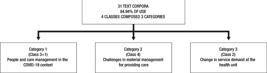
People and care management in the COVID-19 context
Nurses indicated that team illness and deaths were not considered in the dimensioning of nursing staff.
This is the main difficulty related to the issue of human resources, because teams are incomplete. Look, I was fired during the pandemic because I have asthma. (NURSE.03)
... so that we can support our professionals to work safely and healthily, because when they end up getting sick or dying, there is no way to replace them. (NURSE.05)
The work process of nurses in PHC was changed or completely interrupted. Nurses in urban areas used information and communication technology resources to maintain and ensure continuity of care. However, a unit outside the capital was closed.
Our activities were literally via cell phone, WhatsApp, because we did video consultations. We adopted [...] when the patient was very ill, we had many of these video consultations. (NURSE.01)
So, with the pandemic, since it is a Basic Health Unit in a rural area, they ended up closing it [...] now that the physician returned, she is once again seeing older adults who have diabetes and receive monthly care, she continues with scheduled appointments, but unfortunately childcare has not returned, nor preventive care. (NURSE.20)
I’ve paid visits to the priorities of priorities, and the rest stayed at the Basic Health Unit and did evaluations every week. I called the community health agents, then I passed on the information, there was always something new and we kept passing it on. (NURSE.29)
Challenges in material management for providing care
Nurses reported a failure in the pandemic scenario regarding the necessary supplies for personal protection and provision of nursing care, which became a challenge, given the need to continue providing care to the population. Interviewees also mentioned situations of dependence on donations to acquire materials and/or the purchase with their own resources, in addition to changes in protective equipment parameters in the PHC, given the risk of coronavirus infection.
Our difficulties were very great during the pandemic. We did not offer care due to lack of materials. But still, for a while, the physicians managed, I managed to get materials and we used it. (NURSE.01)
There was no personal protective equipment to work with, there is no way, and even so we did not stop, we continued every day. (NURSE.07)
Another point is the personal protective equipment. We did not use to work with that here, it was not our standard. The most we had was a lab coat, and if we wanted to use it, we’d buy it, if not, we did not use it. (NURSE.02)
So, I would put on a gown, I would put on the face shield that we got through donations, a mask, a cap, and I would get dressed there, in front of the patient’s house, I’d put on everything. (NURSE. 08)
Change in service demand at the health unit
Nurses describe support in dealing with the municipal health management and other nurses. There were challenges regarding changing the service profile of the Basic Health Unit and continuity of the service based on people management.
Our unit became a reference Basic Health Unit for COVID and stopped providing everything. So, for the nursing staff, the biggest challenge was managing the entire unit for this specific type of care. (NURSE.17)
I felt like giving up, but at the same time, I received a lot of support here, from the health secretary, from our coordinator, from other nurses in other Basic Health Units. (NURSE.27)
And the biggest challenge was also trying to make our team of community health agents aware that our work had to continue and we are the front line and we are the ones who have to reach that family first, and they were very afraid of getting infected. (NURSE.31)
Discussion
The study showed that nurses working in PHC in urban and rural areas of the Amazon faced challenges related to managing the health crisis during the COVID-19 pandemic, which consequently impacted on nursing care management. Changes occurred in the work process of nurses in PHC, with changes in practices and use of technological resources for continuity of care.
The results of the study demonstrated there were impacts on the work process of “administering” or “nursing management”, since the objects of this process are the agents of care and the resources used in nursing care.( 14 ). The composition of health teams was affected by the lack of human resources during the pandemic due to illnesses and deaths of team members. Initially, human resources management during the health crisis did not anticipate the lack of this resources caused by absenteeism due to illness among professionals.( 22 )
During the COVID-19 pandemic, the staff dimensioning to expand beds and create new services, such as field hospitals, was considered in the planning.( 23 , 24 )Subsequently, several strategies were used to meet the demand for personnel, such as anticipating the graduation of nurses and other higher education professionals and moving professionals to areas of greater need.( 24 , 25 )
A previous study shows that the Brazilian Amazon region recorded an increase in health professionals and beds during the COVID-19 pandemic, although the distribution across the territory was not uniform and still well below that of other regions in Brazil. There was also a small increase in the number of nurses after the first quarter of 2020.( 26 )The results of the study show that different scenarios should be considered in people management during crisis situations. The precariousness of employment relationships with temporary contracts, structural barriers and access barriers in the Amazon region exert impact on the restructuring of staff, especially for physicians on teams.( 12 , 13 , 15 , 27 )
Therefore, current methods for calculating the size of nursing staff in Brazil are not suitable for a pandemic scenario in which the main workforce in the health sector may become ill and/or die.( 28 )Another aspect that should be considered is the professionals’ interest in working in areas without basic social facilities and/or accessed only by small boats called rabetas .( 12 , 13 )
Nurses in PHC highlighted the management of material resources as another challenge in the Brazilian Amazon. This aspect radically affected the work process of these professionals and was related to difficulties due to the lack of appropriate materials and personal protective equipment. According to a study, an increase of 200 million reais per month was granted to the Basic Health Units of the Previne Brasil Program .( 29 )However, the results of the study show that professionals depended on donations to ensure personal protection. The explosive demand for these items led to interruptions in the supply chain, leaving many nurses exposed to the risk of infection. Nursing councils carried out inspections and highlighted precarious situations or lack of availability of material resources and personal protective equipment.( 24 )Nonetheless, professionals used protective measures against infections.( 30 )
The telephone with internet access was a material resource widely used in care provision, since continuity of care was another aspect that suffered impact. This shows that nursing uses work processes simultaneously. The work process of “nursing care” focuses on the care required by individuals, families, social groups, communities, and collectives.( 14 )
Nurses used instant messaging apps on their personal cell phones and video calls for the care management. However, the use of telehealth resources or other information and communication technologies managed by the municipal administration is not evident in nurses’ statements. The TeleSUS was created by the Ministry of Health during the pandemic with the objective to track, diagnose, treat, and monitor patients with influenza-like syndrome and COVID-19, offering four access options: telephone; chatbot; cell phone app; and WhatsApp.( 29 )Brazil’s national health system is universal, free, and has information and communication technologies that can be used in PHC. However, given the regional characteristics in the Amazon,( 10 , 12 )the internet may not be a resource available to all nurses working in PHC.
Although the use of consultation with information and communication technology resources was a strategy adopted for care management in professional individual care practices during the COVID-19 pandemic,( 29 , 31 )in the interviews, it was found that some health units were closed during the pandemic period. The change in the work process affected groups that require more nursing care in PHC, such as people with chronic diseases, older adults, children, and women. Prioritization of care began to depend on the nurse’s decision-making capacity.
In Brazil, the decentralized model of the system allowed states and municipalities to develop strategic plans to manage the public health emergency( 32 , 33 )due to the difficulty of the Ministry of Health in managing the health crisis, especially in the Amazon region.( 10 , 11 )There are records of the production and dissemination of clinical protocols, “fast track” summary charts, and materials for preventive and care guidance against COVID-19.( 26 )
Another aspect highlighted in the results of this study was the change in the profile of demand at the PHC unit that stopped providing services offered by PHC in order to care for people with COVID-19, which constitutes a major challenge. This aspect concerns the management of physical, material, and human resources. Like PHC, other levels of health care were also affected due to the change in the care profile to prioritize people with COVID-19.( 26 , 34 , 35 )In 2020, in the Amazon region and in Brazil, there was a reduction in screening and diagnostic procedures, medical consultations, low, medium and high complexity surgeries, transplants, clinical treatments and procedures due to external injuries, irrepressible procedures and childbirth.( 26 )In England, there was a reduction in referrals and diagnoses in 2020.( 34 )
For nursing, the study provides reflections on the need to develop plans for public health emergency situations in terms of dimensioning of staff, material resources and care protocols that guide nurses to provide care safely and without risks to users. These plans should consider the peculiarities of regions with long distances, lack of regular transportation and geographical barriers, which increase costs in comparison to easy-access regions.
For an in-depth and contextualized understanding of this manuscript, it is essential to be aware of its limitations. The number of professionals interviewed and the predominance of interviewees from urban areas stand out. The main interview modality adopted in the study limited a greater participation of nurses from remote areas. These approaches are based on timeframes developed during the COVID-19 pandemic. Another limitation is the exclusive focus on scenarios of the Brazilian public health system. This methodological choice may restrict the applicability of results to the private sector, since the complexities and challenges may vary substantially between the two contexts.
Conclusion
In the context of a pandemic management crisis in Brazil and the Amazon, nurses realized that the challenges were in terms of incomplete teams, continuity of remote care, closure of health units, prioritization of in-person activities that cannot be resolved remotely, lack of materials and personal protective equipment, and changes in the profile of demand at the Basic Health Unit. The absence of the elements that make up the “administering” and “management” work processes has a direct impact on the “care” work process, and these are the basic structure of nursing care management. These aspects make the provision of care in the Amazon region more complex.
Data availability
: The authors did not make the data from this article available in repositories prior to submission.
Acknowledgements
Funding agreement COFEN/UNB – Multicenter research project “Nursing practices in the context of primary health care: a national mixed methods study”, coordinated by the Faculdade de Ciências da Saúde at the Universidade de Brasília. Qualified production support program – UFPA 2025 (PAPQ 2025). Emergency Consolidation Program 2022 – CAPES.
References
- 1 Nunciaroni AT, Cunha FT, Vargas LA, Corrêa VA. New Coronavirus: (Re)thinking the care process in Primary Health and Nursing. Rev Bras Enferm. 2020;73 (Suppl 2):e20200256.
- 2 Gleriano JS, Fabro GC, Tomaz WB, Goulart BF, Chaves LD. Reflections on the management of the Unified Health System for coordination in the fight against COVID-19. Esc Anna Nery. 2020; 24(spe):e20200188.
-
3 Starfield B. Atenção primária: equilíbrio entre necessidades de saúde, serviços e tecnologia. Brasília (DF): UNESCO, Ministério da Saúde; 2002 [ [cited 2023 Sep 10]. Disponível em https://www.nescon.medicina.ufmg.br/biblioteca/imagem/0253.pdf
» https://www.nescon.medicina.ufmg.br/biblioteca/imagem/0253.pdf - 4 Barros AC, Menegaz JD, Santos JL, Polaro SH, Trindade LL, Meschial WC. Nursing care management concepts: scoping review. Rev Bras Enferm. 2023;76(1):e20220020.
- 5 Mattsson J, Hedlund E, George-Svahn L, Scheers-Andersson E, Mazaheri M, Björling G. Nurses' experiences of caring for patients with suspected or confirmed COVID-19 in the initial stage of the pandemic. SAGE Open Nurs. 2022;8:23779608221114981.
- 6 Sachett JA, Gonçalves IC, Santos WO. Experience report of the contributions of telehealth in riverside communities of Amazonas in the pandemic. Rev Bras Enferm. 2022; 75(Suppl 2):e20210820.
- 7 Halcomb E, McInnes S, Williams A, Ashley C, James S, Fernandez R, et al. The experiences of primary healthcare nurses during the COVID-19 pandemic in Australia. J Nurs Scholarsh. 2020;52(5):553-63.
- 8 Ashley C, Halcomb E, James S, Calma K, Stephen C, McInnes S, et al. The impact of COVID-19 on the delivery of care by Australian primary health care nurses. Health Soc Care Community. 2022;30(5):e2670-7.
- 9 Rocha NL, Marinho GL, Paz EP. O impacto da Covid-19 nas práticas de enfermeiras da Atenção Primária à Saúde no município do Rio de Janeiro. Tempus Actas De Saúde Coletiva. 2023;16(4):25-35.
- 10 Taylor L. Covid-19: is Manaus the final nail in the coffin for natural herd immunity? BMJ. 2021;372:n394.
- 11 Ferrante L, Almeida AC, Leão J, Steinmetz WA, Vassão RC, Vilani RM, et al. Misinformation caused increased urban mobility and the end of social confinement before the second wave of COVID-19 in Amazonia. J Racial Ethn Health Disparities. 2023;11(3):1280-5.
- 12 Fausto MC, Giovanella L, Lima JG, Cabral LM, Seidl H. Primary Health Care sustainability in rural remote territories at the fluvial Amazon: organization, strategies, and challenges. Cien Saude Colet. 2022;27(4):1605-18.
- 13 Figueira MC, Marques D, Vilela MF, Pereira JA, Bazílio J, Silva EM. Fluvial family health: work process of teams in riverside communities of the Brazilian Amazon. Rural Remote Health. 2020;20(3):5522.
- 14 Sanna MC. Os processos de trabalho em enfermagem. Rev Bras Enferm. 2007;60(2):221-4.
- 15 Ferreira SR, Périco LA, Dias VR. The complexity of the work of nurses in Primary Health Care. Rev Bras Enferm. 2018;71 (Suppl 1):704-9.
- 16 Oliveira AR, Sousa YG, Diniz ÍV, Medeiros SM, Martiniano C, Alves M. The daily routine of nurses in rural areas in the Family Health Strategy. Rev Bras Enferm. 2019;72(4):918-25.
- 17 Souza VR, Marziale MH, Silva GT, Nascimento PL. Translation and validation into Brazilian Portuguese and assessment of the COREQ checklist. Acta Paul Enferm. 2021;34:eAPE02631.
-
18 Brasil. Instituto Brasileiro de Geografia e Estatística. Cidades. 2024 [citado 2024 nov 10]. Disponível em: https://cidades.ibge.gov.br/brasil/pa/panorama
» https://cidades.ibge.gov.br/brasil/pa/panorama -
19 Brasil. Ministério da Saúde. E-gestor atenção primária à saúde.Brasília (DF):Ministério da Saúde; 2024 [citado 2024 Nov 10]. Disponível em: https://egestoraps.saude.gov.br/
» https://egestoraps.saude.gov.br/ - 20 Erlingsson C, Brysiewicz P. A hands-on guide to doing content analysis. Afr J Emerg Med. 2017;7(3):93-9.
- 21 Souza MA, Wall ML, Thuler AC, Lowen IM, Peres AM. The use of IRAMUTEQ software for data analysis in qualitative research. Rev Esc Enferm USP. 2018;52:e03353.
- 22 Gómez-Ochoa SA, Franco OH, Rojas LZ, Raguindin PF, Roa-Díaz ZM, Wyssmann BM, et al. COVID-19 in health-care workers: a living systematic review and meta-analysis of prevalence, risk factors, clinical characteristics, and outcomes. Am J Epidemiol. 2021;190(1):161-75. Erratum in: Am J Epidemiol. 2021;190(1):187.
- 23 Conz CA, Braga VA, Reis HH, Silva S, Jesus MC, Merighi MAB. Role of nurses in a field hospital aimed at patients with Covid-19. Rev Gaucha Enferm. 2021;42(spe):e20200378.
- 24 Peres MA, Brandão MA, Aperibense PG, Lacerda AC, Paim L, Ferreira MA. Facing up covid-19: what cannot be relativized in nursing higher education. Texto Contexto Enferm. 2020;29:e20200236.
- 25 Vedovato TG, Andrade CB, Santos DL, Bitencourt SM, Almeida LP, Sampaio JFS. Health workers and COVID-19: flailing working conditions. Rev Bras Saude Ocup. 2021; 46:e1.
- 26 Bigoni A, Malik AM, Tasca R, Carrera MB, Schiesari LM, Gambardella DD, et al. Brazil's health system functionality amidst of the COVID-19 pandemic: an analysis of resilience. Lancet Reg Health Am. 2022;10:100222.
- 27 de Sousa Carneiro P, de Lima Dias AL, Christiane Correa Pinho E, Amanda Nunes da Cunha T, Lemos M, Henrique Costa Pinheiro H, et al. Análise do processo de trabalho na atenção primária à saúde em região Amazônica. J Manag Prim Health Care. 2021;13:e015.
- 28 Nishiyama JAP, Moraes RM, Magalhães AMM de, Nicola AL, Trevilato DD, Oliveira JLC de. Labour, ethical and political dimensions of nursing staff sizing in the face of COVID-19. Esc Anna Nery. 2020; 24(spe):e20200382.
- 29 Harzheim E, Martins C, Wollmann L, Pedebos LA, Faller LA, Marques MD, et al. Federal actions to support and strengthen local efforts to combat COVID-19: primary Health Care (PHC) in the driver's seat. Cien Saude Colet. 2020;25 (Suppl 1:2493-7.
- 30 Bojaj G, Tahirbegolli B, Beqiri P, Alloqi Tahirbegolli I, Van Poel E, Willems S, et al. Health Service Management and Patient Safety in Primary Care during the COVID-19 Pandemic in Kosovo. Int J Environ Res Public Health. 2023;20(4):3768.
- 31 Caetano R, Silva AB, Guedes ACCM, Paiva CCN, Ribeiro GDR, Santos DL, Silva RMD. Challenges and opportunities for telehealth during the COVID-19 pandemic: ideas on spaces and initiatives in the Brazilian context. Cad Saude Publica. 2020;36(5):e00088920
- 32 Aleluia ÍR, Vilasbôas AL, Pereira GE, Nunes FG, Pereira RA, Nunes CA, et al. State management of primary health care in response to COVID-19 in Bahia, Brazil. Cien Saude Colet. 2023;28(5):1341-53.
- 33 Tasca R, Martins Carrera MB, Malik AM, Schiesari LMC, Bigoni A, Costa CF. Massuda A. Managing Brazil's Health System at municipal level against Covid-19: a preliminary analysis. Saúde Debate. 2022; 46(spe1):15-32.
- 34 Morris EJ, Goldacre R, Spata E, Mafham M, Finan PJ, Shelton J, et al. Impact of the COVID-19 pandemic on the detection and management of colorectal cancer in England: a population-based study. Lancet Gastroenterol Hepatol. 2021;6(3):199-208.
- 35 Frota AC, Barreto IC, Carvalho AL, Ouverney AL, Andrade LO, Machado NM. Longitudinal link of the Family Health Strategy at the frontline of the Covid-19 pandemic. Saúde Debate. 2022; 46(spe1):131-51.
Edited by
-
Associate Editor:
Paula Hino ( https://orcid.org/0000-0002-1408-196X ) Escola Paulista de Enfermagem, Universidade Federal de São Paulo, São Paulo, SP, Brazil

