
 Use of virtual reality in nursing education: a scoping review
Abstract
Objective To map in literature the application of virtual reality (VR) in teaching undergraduate nursing students.
Methods This is a scoping review prepared according to the JBI framework, guided by the PRISMA-ScR checklist. The articles were selected in January 2024 from 12 data sources. The results were analyzed descriptively and summarized in charts.
Results Twenty-three articles were selected for the research synthesis. The included research was conducted between 2020 and 2024, with a notable concentration of publications in 2023. Concerning the geographical origin, most of the studies originated in Asia. Furthermore, it was noted that 69.6% of studies adopted VR glasses with the intervention groups. It was noted that most of students who participated in the interventions generally experienced a positive feeling towards VR.
Conclusion It was possible to map the use of VR in the context of the teaching-learning process in undergraduate nursing courses. The technology has proven to be an innovative tool that complements traditional methodologies in nursing education, promoting greater interactivity. Its positive impact is reflected in the improvement of skills, although challenges such as cost and technological adaptation still need to be overcome. Thus, the planned integration of VR can contribute to more dynamic and effective training.
Keywords:
Virtual reality; Nursing education; Teaching
Resumo
Objetivo Mapear na literatura a aplicação da realidade virtual (RV) no ensino de estudantes de graduação em enfermagem.
Métodos Trata-se de revisão de escopo elaborada de acordo com o referencial do JBI, guiada por meio do checklist PRISMA-ScR. A seleção dos artigos foi realizada em janeiro de 2024 em 12 fontes de dados. Os resultados foram analisados de forma descritiva e sintetizados em quadros.
Resultados Foram selecionados 23 artigos para a síntese da pesquisa. As pesquisas incluídas foram conduzidas no período de 2020 a 2024, sendo notável a concentração de publicações em 2023. No que tange à origem geográfica, a maioria dos estudos se originou no continente asiático. Ademais, notou-se que 69,6% dos trabalhos adotaram os óculos de RV com os grupos de intervenção. Notou-se que a maioria dos alunos que participaram das intervenções experimentou, em geral, um sentimento positivo em relação à RV.
Conclusão Foi possível mapear o uso da RV no contexto do processo de ensino-aprendizagem nos cursos de graduação em enfermagem. A tecnologia demonstrou ser uma ferramenta inovadora e complementar às metodologias tradicionais no ensino de enfermagem, promovendo maior interatividade. Seu impacto positivo reflete-se no aprimoramento de habilidades, embora desafios como custo e adaptação tecnológica ainda precisem ser superados. Assim, a integração planejada da RV pode contribuir para uma formação mais dinâmica e eficaz.
Descritores:
Realidade virtual; Educação em enfermagem; Ensino
Resumen
Objetivo Mapear en la literatura la aplicación de la realidad virtual (RV) en la enseñanza de estudiantes de la carrera de enfermería.
Métodos Se trata de una revisión de alcance elaborada de acuerdo con el marco referencial del JBI, guiada mediante el checklist PRISMA-ScR. La selección de los artículos se realizó en enero de 2024 en 12 fuentes de datos. Los resultados fueron analizados de forma descriptiva y sintetizados en cuadros.
Resultados Se seleccionaron 23 artículos para la síntesis del estudio. Los trabajos incluidos fueron realizados entre 2020 y 2024, donde se observó la concentración de publicaciones en el año 2023. En lo que atañe al origen geográfico, la mayoría de los estudios se originó en el continente asiático. Además, se observó que en el 69,6 % de los trabajos se utilizaron los anteojos de RV con los grupos de intervención. También se percibió que la mayoría de los alumnos que participó en las intervenciones experimentó un sentimiento positivo en general con relación a la RV.
Conclusión Fue posible mapear el uso de la RV en el contexto del proceso de enseñanza-aprendizaje en las carreras de grado de enfermería. La tecnología demostró ser una herramienta innovadora y complementaria de los métodos tradicionales en la enseñanza de enfermería, lo que promueve una mayor interactividad. Su impacto positivo se refleja en la mejora de las habilidades, aunque aún existen desafíos, como el costo y la adaptación tecnológica, que deben ser enfrentados. De esta forma, la integración planificada de la RV puede contribuir a una formación más dinámica y eficaz.
Descriptores:
Realidad virtual; Educación en enfermería; Enseñanza
Introduction
Virtual reality (VR) has revolutionized the way we interact with knowledge and experience learning. This emerging technology enables the creation of highly immersive three-dimensional environments in which users not only observe but can actively interact, significantly expanding the possibilities for teaching and training.( 1 )By integrating advanced computing systems with sensory devices, VR provides a high level of immersion and presence, simulating realistic scenarios that favor the development of technical and cognitive skills.( 1 )
In the healthcare field, for instance, the use of VR has demonstrated great potential by allowing students and professionals to train procedures in a controlled environment, reducing risks and improving clinical decision-making.( 2 )Thus, it is observed that VR has been consolidating itself as an innovative tool for education and professional training, and its potential to transform traditional paradigms and open new perspectives for teaching based on interactive experiences is believed.
This advancement is largely due to its ability to offer different levels of immersion, adapting to the specific needs of the educational context. Thus, technologies such as high-immersion VR glasses, for instance, allow for more realistic interaction, as they integrate movement tracking and spatial mapping, thus providing students or professionals/users with an enhanced sense of presence in the virtual environment.( 2 )In contrast, simulations accessed via computer screens or mobile devices, although still effective and widely used in classrooms, present a lower degree of immersion. These technological variations directly influence student or professional/user experience, making it essential to choose the most appropriate resource for each application in teaching and/or clinical practice.( 2 )
The adoption of VR was significantly boosted by the advent of the Fourth Industrial Revolution, a transformational milestone characterized by the convergence of technologies in the physical, digital and biological spheres.( 3 )This new era is characterized by the interconnection of systems and integration of innovative technologies, transforming various sectors of society and driving advances in the field of virtual experience. Industry 4.0 has driven several changes in the education sector, and one of the transformations observed is integration of VR as part of the teaching-learning process in various institutions, including universities.( 4 )
In the context of undergraduate nursing courses, the importance of teaching methods that incorporate new technologies, such as VR, is evident in working with students on real-life situations in the profession. The use of VR in teaching is presented as a strategy that can provide practical and immersive learning aligned with the principles of andragogy, since it favors active and meaningful learning and allows students to actively participate in knowledge construction.( 3 )From this perspective, it contributes to the improvement of technical skills, promoting the development of behavioral and attitudinal skills that are fundamental for professional practice.( 3 )
In this regard, integration of VR into nursing education is considered to comprehensively prepare students for the challenges of a healthcare environment, enabling the simulation of complex scenarios and decision-making in a safe and controlled context, as well as leading students to develop clinical reasoning, attitudes and skills essential to professional practice, preparing them for the challenges of a clinical environment. In this sense, in addition to improving technical and cognitive skills, VR also meets the growing demand for more dynamic and interactive teaching strategies, aligning with students’ expectations regarding learning.
In order to better illustrate this need highlighted by students, a study by Chan, Chang and Huang( 1 )highlighted the implementation of VR in teaching chemotherapy administration, in which students seek a diversity of approaches to fill the gaps in the traditional teaching-learning methodology. As a result, the recommendation of adopting a combination of different teaching methods is widely recommended as an effective strategy to achieve more significant and comprehensive results in the educational process.( 1 )
Given the above, VR analysis as an educational tool plays a crucial role in the search for efficient andragogical approaches adapted to the contemporary demands of nursing practice.( 3 )In this context, the research is justified by the growing demand for innovation in teaching-learning methodologies, allowing the exploration of VR as a technological resource that aims to improve the quality of nursing training. Therefore, the aim is to map in literature the application of VR in the teaching of undergraduate nursing students.
Methods
This is a scoping review prepared in accordance with the JBI framework and guided by the Preferred Reporting Items for Systematic reviews and Meta-Analyses extension for Scoping Reviews (PRISMA-ScR) checklist.( 5 )
To avoid conducting duplicate reviews, protocols and scoping reviews with the same objective as this research were tracked in May 2023, and a search was carried out on the Open Science Framework, International Prospective Register of Systematic Reviews, The Cochrane Library and Database of Abstracts of Reviews of Effects registration platforms. Subsequently, this study was entered into the Open Science Framework platform for scientific work registration, under registration osf.io/yz7tj.
In order to formulate the question that guides the scope review, the mnemonic strategy PCC (Population, Concept and Context) was used, with undergraduate nursing students indicated as Population, VR as Concept, and teaching as Context.( 6 )In view of this, the following research question was defined: How is VR being applied in the teaching of undergraduate nursing students? To answer this question, three specific questions were developed: (1) What strategies have been used to integrate VR into nursing education?; (2) How does the adoption of VR impact the experience and academic performance of nursing students?; and (3) What topics are being addressed with VR in nursing education?
Initially, the following descriptors were defined according to the Health Science Descriptors (DeCS) and Medical Subject Headings (MeSH): Universities; Virtual Reality; Nursing Education; Nursing. After this definition, the Boolean operators AND and OR were used to cross-reference the descriptors and develop the search syntax in information sources.
The search and identification of articles for the research scope were carried out in January 2024. The databases and portals searched were Cochrane Library, Scientific Electronic Library Online (SciELO), Web of Science, Scopus, Science Direct, Virtual Health Library (VHL) and PubMed Central. The search in gray literature included the Coordination for the Improvement of Higher Education Personnel Thesis and Dissertation Catalog, Biblioteca Digital Brasileira de Teses e Dissertações (BDTD), Repositório Científico de Acesso Aberto de Portugal (RCAAP), Europe E-Theses Portal (DART) and Theses Canada.
The search strategies were adjusted according to the particularities of each database and portal researched, as shown in Chart 1 . Despite this, the combinations between descriptors were preserved. For greater comprehensiveness in the search, time and language restriction filters were not used.
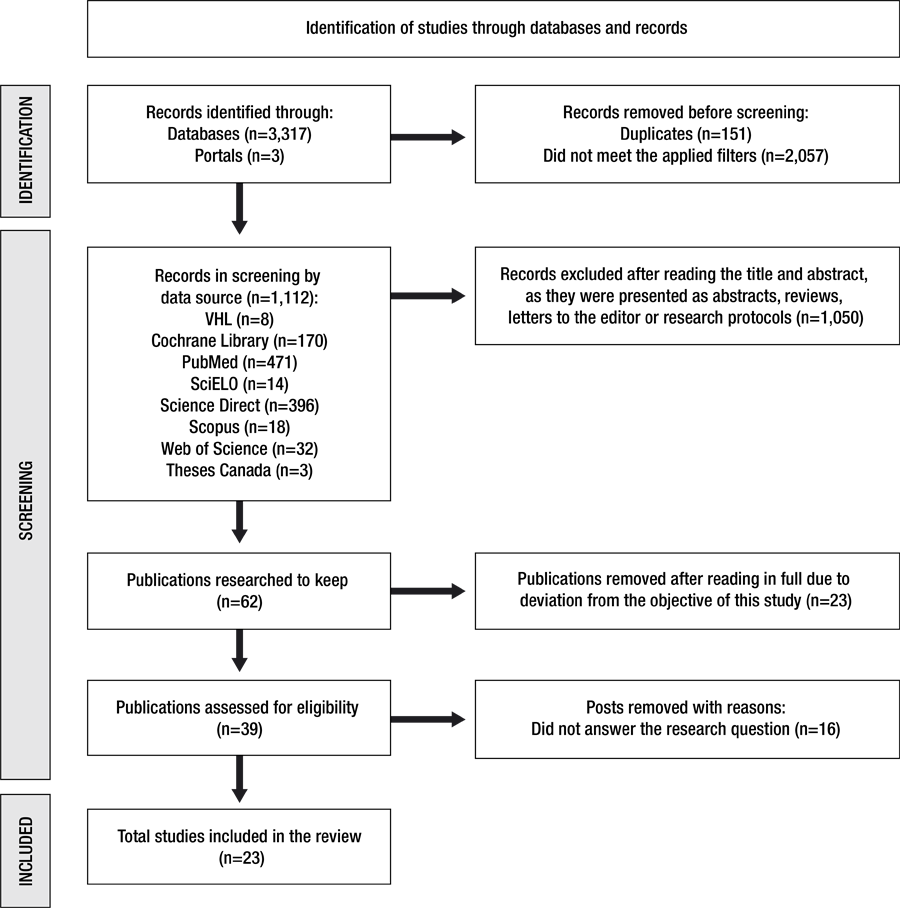
Complete studies available online that addressed the use of VR in higher education in nursing were included. Articles that did not answer the research question or deviated from the study objective as well as abstracts, reviews, letters to the editor, and research protocols were excluded. Duplicate studies were considered only once. Study assessment and preliminary selection were conducted systematically by two independent collaborators, simultaneously during the data collection period. This stage involved screening studies based on specific criteria, including title and abstract analysis. In situations of disagreement among evaluators, a third reviewer was consulted to resolve any divergences. Only after this initial phase of preliminary analysis were the studies subjected to a complete reading for final selection. A total of 3,320 studies were identified in the searches of data sources; however, after applying the open access filter, 1,263 remained. The collected articles were imported into the EndNote Web reference management software. The programs identified duplicates, of which the duplicate was excluded from the analysis, resulting in 1,112 studies for the selection process, including those from VHL, Cochrane Library, PubMed, SciELO, Science Direct, Scopus, Web of Science and Theses Canada. The other sources did not yield results. After checking the titles and abstracts, a total of 62 studies were selected for further analysis by reading their full texts. Subsequently, a detailed selection resulted in the selection of 23 articles to guide the scope of this research. Figure 1 presents a flowchart that illustrates the paper eligibility process, in accordance with PRISMA-ScR guidelines.

Flowchart of literature search and inclusion of articles according to the Preferred Reporting Items for Systematic reviews and Meta-Analyses extension for Scoping Reviews
It is worth noting that it was not necessary to submit this study to the Research Ethics Committee, as the data included in it are secondary and publicly accessible.
Results
This study included 23 studies published between 2020 and 2024, with a concentration of publications in 2023 representing 39.1% of the selected sample. Regarding the geographical origin, most studies originated in Asia, covering approximately 69.6% of the findings. This geographical distribution included countries such as China (n=1), Hong Kong (n=1), Singapore (n=1), Taiwan (n=2), and South Korea (n=11), reflecting a diversity of contexts and approaches in the application of VR in nursing education. The most predominant study design design in the sample was the experimental one, corresponding to 91.3% of selected articles. The preference for this type of design can be attributed to its ability to provide robust evidence on the effectiveness and effects of VR-related interventions in the educational context in nursing. Chart 2 provides a description of the authors, year, country and study design, in addition to offering a mapping of the various subjects addressed using VR, together with the main results derived from the studies selected for this review.
Based on the information presented in Chart 2 , it is possible to highlight the variety of topics covered in the interventions, such as anatomy and physiology, respiratory diseases, assessment of critically ill patients, neurological assessment, mental health, nasogastric tube placement, dressings, neonatal resuscitation, endotracheal aspiration and mechanical ventilation, insertion of fully implanted catheters and intravenous puncture, blood transfusion, extracorporeal membrane oxygenation, effective communication, and nursing care for the LGBTQIA+ population. In addition, there are studies in which VR was applied through the use of high-immersion VR headsets. These data reveal that 69.6% of them chose to use the high-immersion feature in intervention groups. This choice indicates a significant preference for technologies that provide a more engaging and immersive experience for study participants.
Discussion
The 23 selected studies considered that the use of VR in teaching environments can be advantageous as a complement to conventional pedagogical approaches already adopted in undergraduate nursing courses. This finding is also supported by a systematic review that investigated the effectiveness of VR practice as a means of improving undergraduate nursing students’ knowledge. The results of this analysis indicated that practice combined with the use of this technology was significantly more successful compared to traditional simulation methods. This idea highlights the potential of VR as a valuable tool to enrich the academic training of nursing students.( 30 )
Given the results presented, there is a predominance of works from Asia, especially from South Korea. This finding can be explained, in part, by the significant investment in education, science and technology observed in several Asian countries in recent decades.( 31 )For this reason, different countries can implement different policies and programs to support the progress of innovation in multiple sectors of society, with a particular focus on the educational sphere.
Among the studies assessed, two ways of applying VR were identified: (A) using high-immersion VR glasses; and (B) using only computer or cell phone screens. VR is divided into immersive and non-immersive categories.( 2 )Some studies based their intervention on non-immersive application, using a computer or cell phone.( 12 , 17 , 19 , 21 , 23 , 24 , 27 )The remaining articles (n=16) used VR glasses and resulted in greater immersion in their use and more active student participation.
The topics covered in the study interventions varied greatly, from the review of theoretical knowledge and the development of practical skills to the effective interdisciplinary communication assessment. Several topics were covered in the research, and this fact demonstrates the numerous possibilities for implementing VR in nursing education.
Considering the negative aspects of immersive VR, in some studies, the target audience reported discomfort with VR glasses and feelings of dizziness and nausea during the immersive experience.( 7 , 11 , 17 )These results can be attributed to the requirement of additional devices in the immersive approach, such as the VR headsets themselves and other sensory devices, which promote a more intense physical interaction. Some sensitive individuals may experience nausea and/or dizziness when using immersive devices due to the discrepancy between body signals and visual stimuli. The body at rest contrasts with virtual movement; the balance informed by the vestibular system does not match VR; and ocular convergence conflicts with the immersive display, triggering discomfort or uneasiness as a natural reflex.( 32 )
Regarding the limitations identified by students in relation to the use of VR, the issue of lack of familiarity with the new technology and its interface stands out.( 9 , 10 , 19 )This aspect created a difficulty in adapting to VR, since students faced challenges when dealing with an unknown virtual environment and a user interface that was not very intuitive. Other studies also highlight technical failures due to dependence on equipment and the possibility of difficulties in use due to lack of knowledge of the means used.( 33 )Therefore, this can negatively impact the interest and continuity of training.
Furthermore, the lack of tactile sensation and limited realism in simulation scenarios are also aspects to be considered.( 11 , 15 , 17 , 26 , 33 )These studies indicated that VR simulators are not advantageous in the development of maneuvers and tactile sensations, since the equipment only provided interaction through mouse clicks or other controls, finding that these simulators would be more useful for cognitive or procedural learning in clinical teaching than in the development of practical manual skills.
Given the problems mentioned above, it is also possible to highlight financial obstacles to implementing the VR strategy in the context of education, since VR may have higher initial costs to acquire equipment and develop teaching software, particularly for the health area.( 34 )For a thorough analysis of the costs of this strategy, further studies are needed to assess the cost-benefit ratio of implementing VR.
Despite some negative points mentioned, there is a consensus that VR contributes to the teaching-learning process, providing high levels of attention, interest and motivation among students, as highlighted in most studies. Some authors have highlighted the opportunity to understand ideas that are conceptually complex through visualization in VR.( 7 , 22 , 28 )Furthermore, they emphasized free access to simulation, regardless of time and place, as long as the equipment is available.( 8 , 16 , 27 )In this area, some studies have pointed to the possibility of experiencing rare and high-risk clinical cases and situations without there actually being a real imminent risk.( 9 , 29 )
Implementing VR encourages motivation and academic performance by encouraging students to make active decisions in their learning and to explore the virtual environment independently, which enhances the development of skills. Real-time interaction and immersion reduce distractions, placing students as protagonists of the educational process.( 35 )However, the effectiveness of this approach may depend on factors such as accessibility to technology and the adaptation of each student, limiting its universal application.
In the context of healthcare, VR also presents notable improvements in technical skills and consolidation of theoretical knowledge.( 35 )This way, students gain greater confidence to perform technical procedures in real clinical settings. Despite this, it is essential to balance the use of this technology with traditional methods and practical experiences in the real environment, ensuring training that prepares students for the complexity and unpredictability of clinical care.
During the study, some limitations were pointed out: (A) publication bias, since the inclusion of only published studies can lead to a bias, with positive studies being more likely to be published than studies with negative results; and (B) the diversity of interventions and results in the included studies made it difficult to synthesize the results and identify clear patterns or trends.
Conclusion
The research provided an analysis of the use of VR in the context of the teaching-learning process in undergraduate nursing courses. The results suggest that VR can be an innovative resource that complements traditional methodologies, expanding the pedagogical possibilities in nursing education. This approach can enhance the development of essential skills for professional practice, promoting more interactive and contextualized learning. Based on the results presented, two main strategies for integrating technology stood out: the use of immersive systems, with VR glasses, and non-immersive platforms, accessed via computers or mobile devices. While immersive tools offer greater engagement and realism in simulation, non-immersive tools present advantages in terms of accessibility and reduced cost. The adoption of VR has demonstrated a positive impact on nursing students’ experience and academic performance. The technology promotes greater motivation and engagement, allowing students to explore simulated clinical environments without the risks inherent to real practice. However, challenges such as lack of familiarity with the technology, high implementation costs, and potential side effects such as dizziness and discomfort still represent limitations to be considered. The topics addressed in the VR interventions offered a wide range of learning opportunities, including training in specific technical skills, such as medication administration and invasive procedures, and the development of interpersonal skills, such as interdisciplinary communication. In addition, the technology was used to simulate complex clinical scenarios, allowing students to safely experience high-risk cases. However, it was not possible to identify a pattern in the results presented. By recognizing the role of VR as a complementary resource, this research reinforces the importance of a comprehensive approach in improving health education. However, for its implementation, structured planning that considers the benefits and limitations of technology is essential, ensuring a balance between digital methods and practical face-to-face experiences. Therefore, it is essential to continue exploring the theme of VR in the context of nursing education, aiming to improve its potential in professional training.
Data availability
: The authors did not make the data from this article available in repositories prior to submission.
References
- 1 Chan HY, Chang HC, Huang TW. Virtual reality teaching in chemotherapy administration: randomised controlled trial. J Clin Nurs. 2021;30(13-14):1874-83.
- 2 Liaw SY, Sutini, Chua WL, Tan JZ, Levett-Jones T, Ashokka B, et al. Desktop virtual reality versus face-to-face simulation for team-training on stress levels and performance in clinical deterioration: a randomised controlled trial. J Gen Intern Med. 2023;38(1):67-73.
- 3 Hwang S, Kim HK. The effects of maternal-child nursing clinical practicum using virtual reality on nursing students' competencies: a systematic review. Korean J Women Health Nurs. 2022;28(3):174-86.
-
4 Jambassi D. Metaverso no ensino superior: possibilidades e desafios. Painel Metaverso. 2023 Jan 5 [cited 2023 Jul 20];2(1). Available from: https://painelmetaverso.com.br/ojs/index.php/home/article/view/11
» https://painelmetaverso.com.br/ojs/index.php/home/article/view/11 - 5 Tricco AC, Lillie E, Zarin W, O'Brien KK, Colquhoun H, Levac D, et al. PRISMA Extension for Scoping Reviews (PRISMA-ScR): checklist and Explanation. Ann Intern Med. 2018;169(7):467-73.
- 6 Peters MD, Marnie C, Tricco AC, Pollock D, Munn Z, Alexander L, et al. Updated methodological guidance for the conduct of scoping reviews. JBI Evid Synth. 2020;18(10):2119-26
- 7 Hardie P, Darley A, Carroll L, Redmond C, Campbell A, Jarvis S. Nursing & Midwifery students' experience of immersive virtual reality storytelling: an evaluative study. BMC Nurs. 2020;19(1):78.
- 8 Smith S, Farra SL, Hodgson E. Evaluation of two simulation methods for teaching a disaster skill. BMJ Simul Technol Enhanc Learn. 2020;7(2):92-6.
- 9 Lo YT, Yang CC, Yeh TF, Tu HY, Chang YC. Effectiveness of immersive virtual reality training in nasogastric tube feeding education: A randomized controlled trial. Nurse Educ Today. 2022;119(1):105601.
- 10 Yang SY, Oh YH. The effects of neonatal resuscitation gamification program using immersive virtual reality: A quasi-experimental study. Nurse Educ Today. 2022;117:105464.
- 11 Choi KS. Virtual reality simulation for learning wound dressing: acceptance and usability. Clin Simul Nurs. 2022;68:49-57.
- 12 Liaw SY, Tan JZ, Lim S, Zhou W, Yap J, Ratan R, et al. Artificial intelligence in virtual reality simulation for interprofessional communication training: mixed method study. Nurse Educ Today. 2023;122:105718.
- 13 Jeong Y, Lee H, Han JW. Development and evaluation of virtual reality simulation education based on coronavirus disease 2019 scenario for nursing students: A pilot study. Nurs Open. 2022;9(2):1066-76.
- 14 Liu Y, Butzlaff A. Where's the germs? The effects of using virtual reality on nursing students' hospital infection prevention during the COVID-19 pandemic. J Comput Assist Learn. 2021;37(6):1622-8.
- 15 Jung AR, Park EA. The Effectiveness of Learning to Use HMD-Based VR Technologies on nursing students: chemoport insertion surgery. Int J Environ Res Public Health. 2022;19(8):1-11.
- 16 Lee H, Han JW. Development and evaluation of a virtual reality mechanical ventilation education program for nursing students. BMC Med Educ. 2022;22(1):775.
- 17 Plotzky C, Loessl B, Kuhnert B, Friedrich N, Kugler C, König P, Kunze C. My hands are running away - learning a complex nursing skill via virtual reality simulation: a randomised mixed methods study. BMC Nurs. 2023;22(1):222.
- 18 Oh JW, Kim JE. Effectiveness of a virtual reality application-based education programme on patient safety management for nursing students: A pre-test-post-test study. Nurs Open. 2023;10(12):7622-30.
- 19 Lee JS, Son HK. Evaluation of a virtual reality simulation to improve problem-based learning for neurologic examination in nursing students. Iran J Public Health. 2023;52(10):2128-37.
- 20 García-Pazo P, Pol-Castañeda S, Moreno-Mulet C, Pomar-Forteza A, Carrero-Planells A. Virtual reality and critical care education in nursing: A cross-sectional study. Nurse Educ Today. 2023;131:105971.
- 21 García-Acosta JM, Castro-Molina FJ, Delgado N, Díez-Fernández O, Rodríguez-Novo N, de Castro-Peraza ME, et al. Virtual reality and simulation videos as effective training tools for creating safe and inclusive environments for transgender people. Nurs Rep. 2023;14(1):42-55.
- 22 Lee JJ, Tsang VW, Chan MM, O'Connor S, Lokmic-Tomkins Z, Ye F, et al. Virtual reality simulation-enhanced blood transfusion education for undergraduate nursing students: A randomised controlled trial. Nurse Educ Today. 2023;129:105903.
- 23 Andreasen EM, Berg H, Steinsbekk A, Høigaard R, Haraldstad K. The effect of using desktop VR to practice preoperative handovers with the ISBAR approach: a randomized controlled trial. BMC Med Educ. 2023;23(1):1-13.
- 24 Kim GM, Lim JY, Kim EJ, Yeom M. Impact of virtual reality mental health nursing simulation on nursing students' competence. J Multidiscip Healthc. 2024;17:191-202.
- 25 Lee H, Han JW, Park J, Min S, Park J. Development and evaluation of extracorporeal membrane oxygenation nursing education program for nursing students using virtual reality. BMC Med Educ. 2024;24(1):92.
- 26 Chang YY, Chao LF, Chang W, Lin CM, Lee YH, Latimer A, et al. Impact of an immersive virtual reality simulator education program on nursing students' intravenous injection administration: A mixed methods study. Nurse Educ Today. 2024;132:106002.
- 27 Kang KA, Kim SJ, Lee MN, Kim M, Kim S. Comparison of learning effects of virtual reality simulation on nursing students caring for children with asthma. Int J Environ Res Public Health. 2020;17(22):1-11.
- 28 Lee E, Baek G, Hwang Y. Effectiveness of the patient's severity classification competency promotion virtual reality program of nursing students during the COVID-19 pandemic period. Healthcare (Basel). 2023;11(8):1-14.
- 29 Lee Y, Kim SK, Eom MR. Usability of mental illness simulation involving scenarios with patients with schizophrenia via immersive virtual reality: A mixed methods study. PLoS One. 2020;15(9):e0238437.
- 30 Woon AP, Mok WQ, Chieng YJ, Zhang HM, Ramos P, Mustadi HB, et al. Effectiveness of virtual reality training in improving knowledge among nursing students: A systematic review, meta-analysis and meta-regression. Nurse Educ Today. 2021;98:104655.
- 31 Campolina Diniz C. Corrida científica e tecnológica e reestruturação produtiva: impactos geoeconômicos e geopolíticos | The science and technology race and productive restructuring: geoeconomic and geopolitical impacts. Rev Bras Estud Urbanos Reg. 2019;21(2):241-57.
- 32 Tori R, da Silva Hounsell M, Kirner C. Realidade virtual. introdução a realidade virtual e aumentada. Porto Alegre: Editora SBC; 2018. p. 9-25.
- 33 Talya Dos Santos Sousa V, Freire De Vasconcelos P, Talya Dos Santos Sousa V, Freire De Vasconcelos P. Educación en enfermería basada en simulación de realidad virtual: ¿futuro o presente? Cienc Enferm. 2022;28:1-3.
- 34 Kiegaldie D, Shaw L. Virtual reality simulation for nursing education: effectiveness and feasibility. BMC Nurs. 2023;22(1):488.
-
35 Rodrigues PM. Performance, satisfação e autoconfiança dos estudantes de Enfermagem com a prática simulada com realidade virtual aumentada [tese]. Coimbra: Escola Superior de Enfermagem; 2022 [cited 2023 Aug 30]. Available from: https://repositorio.esenfc.pt/rc/
» https://repositorio.esenfc.pt/rc/
Edited by
-
Associate Editor:
Alexandre Pazetto Balsanelli ( https://orcid.org/0000-0003-3757-1061 ) Escola Paulista de Enfermagem, Universidade Federal de São Paulo, SP, São Paulo, Brasil

 Source: Adapted from the Preferred Reporting Items for Systematic reviews and Meta-Analyses extension for Scoping Reviews.