 Resilience of mothers of preschool children: analysis in light of salutogenesis
Abstract
Objective To analyze the resilience of mothers of preschool children in light of salutogenesis.
Methods This cross-sectional study was conducted in early childhood education centers in the city of Fortaleza, Ceará, Brazil, with 152 mothers of preschool children. Data collection used an instrument related to socioeconomic characteristics and the Connor-Davidson Resilience Scale (CD-RISC-10) to assess resilience. Descriptive and inferential statistical analyses were performed using the chi-square test to analyze associations among categorical variables. The concepts addressed in the Salutogenesis Theory were potential stressors and general resilience resources, with the variables organized according to these dimensions.
Results There was a predominance of women with complete high school/incomplete higher education (45.9%) and who were primary caregivers of their children (96.7%). The level of resilience was high (58.6%), however, with a mean of 24.69 (SD±3.47), highlighted by the statements “Coping with stress can strengthen me” (75.7%) and “Can achieve goals despite obstacles” (77.6%). There was an association between resilience and mothers who received financial assistance from the Bolsa Família Program as a general resource for resistance (p<0.001).
Conclusion The general resilience resource of receiving Bolsa Família had positive effects on mothers’ resilience.
Keywords:
Pediatric nursing; Resilience, psychological; Mothers; Child, preschool: Health promotion
Resumo
Objetivo Analisar a resiliência de mães de crianças pré-escolares, à luz da salutogênese.
Métodos Estudo transversal, realizado em centros de educação infantil da cidade de Fortaleza-CE, Brasil, com 152 mulheres, mães de crianças pré-escolares. Para coleta de dados, utilizou-se de instrumento relacionado às características socioeconômicas e da Escala de Connor-Davidson (CD-RISC-10) para avaliação da resiliência. Realizaram-se análises estatística descritiva e inferencial, com utilização do teste qui-quadrado para análise de associação entre as variáveis categóricas. Os conceitos trabalhados na Teoria da Salutogênese foram os potenciais estressores e os recursos gerais de resistência, sendo as variáveis organizadas nessas dimensões.
Resultados Houve predomínio de mulheres com ensino médio completo/superior incompleto (45,9%) e principal cuidadora dos filhos (96,7%). O nível de resiliência prevaleceu alto (58,6%), entretanto, com média de 24,69 (DP±3,47), com destaque nas afirmações “me considero uma pessoa forte” (75,7%) e “acredito que posso atingir os objetivos” (77,6%). Houve associação entre a resiliência e as mães que receberam como recurso geral de resistência a ajuda financeira do Programa Bolsa Família (p<0,001).
Conclusão O recurso geral de resistência do recebimento do Bolsa Família apresentou efeitos positivos na resiliência das mães.
Descritores:
Enfermagem pediátrica; Resiliência psicológica; Mães; Pré-Escolar; Promoção da saúde
Resumen
Objetivo Analizar la resiliencia de las madres de niños en edad preescolar, de acuerdo con la salutogénesis.
Métodos Estudio transversal, realizado en centros de educación infantil de la ciudad de Fortaleza, estado de Ceará, Brasil, con 152 mujeres, madres de niños en edad preescolar. Para la recopilación de datos se utilizó un instrumento relacionado con las características socioeconómicas, y para evaluar la resiliencia, la Escala de Connor-Davidson (CD-RISC-10). Se realizaron análisis estadísticos descriptivos e inferenciales, mediante la prueba de ji cuadrado para analizar la relación entre las variables categóricas. Los conceptos trabajados en la Teoría de la Salutogénesis fueron los estresantes potenciales y los recursos generales de resistencia, y las variables fueron organizadas en estas dimensiones.
Resultados Predominaron las mujeres con estudios secundarios completos/superiores incompletos (45,9 %) y cuidadoras principales de los hijos (96,7 %). El nivel de resiliencia fue alto (58,6 %), con un promedio de 24,69 (DP ± 3,47), donde se destacaron las afirmaciones “me considero una persona fuerte” (75,7 %) y “creo que puedo alcanzar los objetivos” (77,6 %). Se observó una relación entre la resiliencia y las madres que recibieron ayuda financiera del Programa Bolsa Família como recurso general de resistencia (p<0,001).
Conclusión El recurso general de resistencia que supone recibir el Programa Bolsa Família tuvo efectos positivos en la resiliencia de las madres.
Descriptores:
Enfermería pediátrica; Resiliencia psicológica; Mothers; Preescolar; Promoción de la salud
Introduction
Resilience is a dynamic process that involves individual, emotional, and social factors, in which an individual is able to adapt positively after facing moments of adversity that can cause harm to psychological well-being.(1,2) Social support, self-knowledge, and coping skills are factors that strengthen resilience.(2)
The study of resilience in mothers has stood out as a field of research, as there are various stressful situations since pregnancy, which, in some cases, is configured as a period of risk, adaptation to motherhood(3) and child care.(4) During the COVID-19 pandemic, in addition to these scenarios mentioned, there were challenges imposed on mothers, such as increased stress and perceptions of parental incompetence.(5,6) However, resilience can only be observed and assessed when facing these situations in order to plan and implement health promotion actions.
For mothers of preschool children, assessing resilience is important, as this period presents greater challenges, such as the beginning of their children’s education in daycare and the need for closer care when illness strikes. During periods of illness, for instance, mothers experience lower levels of resilience, but it is essential that this context be addressed with the woman, as resilient parents better facilitate resilience in their children, who, in turn, overcome difficulties more easily and are able to envision the future positively.(7)
There are a variety of scales available to assess resilience, and one of them is the Connor-Davidson Scale (CD-RISC-10), a shorter version of the original scale, consisting of ten items, making it more practical for research and clinical assessments. The scale has been used in several languages, including Spanish(8) and Chinese.(9) In Brazil, the scale was translated into Portuguese and its psychometric characteristics were assessed.(10)
Similar to resilience assessment, the Salutogenesis Theory, developed by Aaron Antonovsky in 1979, seeks to explain how people manage their lives despite adverse conditions. Based on the reflections generated by the creator of this theory, it was noted that people who overcome difficulties and maintain their health share a common characteristic: positive coping skills in the face of adversity.(11-13)
This theory emphasizes the study of health resources and their origins, contrasting with previous models that emphasized disease and risk factors. It lists several concepts, such as sense of coherence (SC), life experience, general resilience resources (GRR), specific resilience resources (SRR), and potential stressors.(14) The aspects established in this theory have overlapping concepts with the components assessed in resilience.(15)
Potential stressors, as the theory’s starting point, are directly linked to disease, as physical and biochemical factors interact with pathogens, generating stress that affects health. However, successful stress management maintains health and strengthens SC, GRR, and SRR. Consequently, the mobilized GRR interact with the state of tension and manage the actions of retaining and overcoming stressors. Like these other resources, SC buffers stressors, allowing a person to maintain and advance toward health, even amid trauma and change. This mechanism is strengthened by life experiences and has an inversely proportional relationship with stressors.(5,11,14)
In this study, maternal resilience and bonding were analyzed in relation to potential stressors conceptualized by the creator of the Salutogenesis Theory as a stimulus that establishes a demand for which there is no ready, immediately available and adequate response, and to GRRs that refer to personal, group or environmental characteristics that can facilitate effective tension management, such as financial resources, religion, social support, and emotional intelligence.(14,16)
Thus, the objective was to analyze the resilience of mothers of preschool children in light of salutogenesis.
Methods
This is a cross-sectional study that followed STrengthening the Reporting of OBservational studies in Epidemiology (STROBE) recommendations to report research reports carried out in six Early Childhood Education Centers (ECEC) in Fortaleza, Ceará, chosen from the selection of territories with contexts of regional vulnerability in the city, marked by social and economic disparity, although the human development index is 0.754, according to data available from the Brazilian Institute of Geography and Statistics.(17)
The population consisted of mothers of preschool-age children residing in the municipality. The sample of 152 mothers was selected by convenience, meeting the inclusion criteria: being over 18 years of age; with their child regularly enrolled; and attending daycare in preschool I, II, or III classes. Mothers who were unavailable to complete the interview with the researchers were excluded.
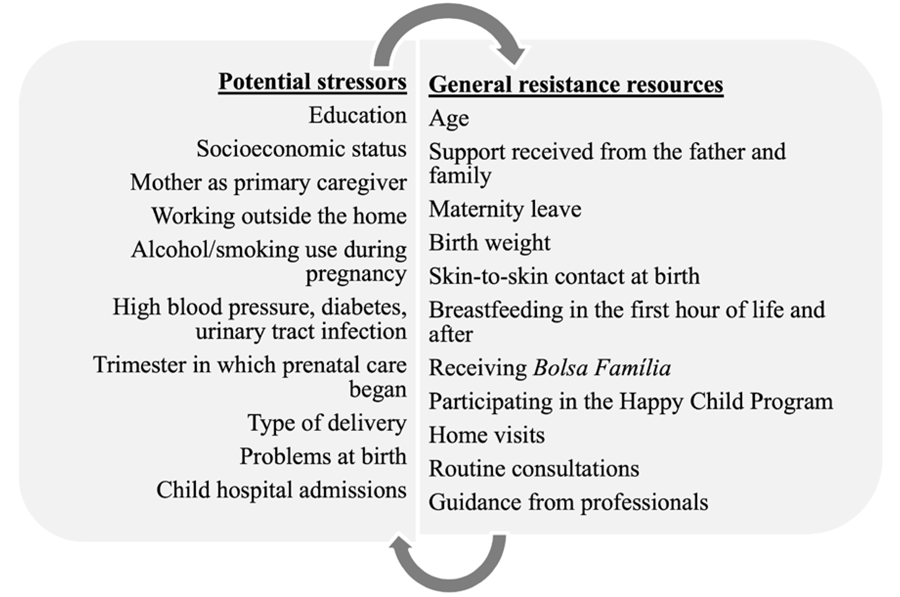
Data were collected using two instruments: 1) characteristics related to mothers, children, and health care, in which variables were organized into potential stressors and GRR, according to the Salutogenesis Theory developed by Aaron Antonovsky (Figure 1); and 2) the Connor-Davison Resilience Scale CD-RISC-10, adapted to Portuguese,(10) and with three response options (rarely true, sometimes true, and often true). The criterion for allocating variables into potential stressors or GRR was based on the representation of effective disease management.

The CD-RISC-10 Scale consists of ten questions, with characteristics of resilience: 1 - Able to adapt to change; 2 - Can deal with whatever comes; 3 - Tries to see humorous side of problems; 4 - Coping with stress can strengthen me; 5 - Tends to bounce back after illness or hardship; 6 - Can achieve goals despite obstacles; 7 - Can stay focused under pressure; 8 - Not easily discouraged by failure; 9 - Thinks of self as strong person; and 10 - Can handle unpleasant feelings.(10)
The results were calculated by adding up the scores given by participants on each item, which could range from zero to 30 points. Higher scores correspond to high resilience. Resilience was categorized based on the mean score obtained from all survey participants.(18) In this study, the mean score was 24. Thus, resilience was classified as low when mothers achieved scores less than or equal to 24 points and high when they achieved scores greater than or equal to 25 points on the CD-RISC-10.
Data collection took place from December 2022 to June 2023. Initially, contact was made with the ECEC managers to invite them to participate in the research. Then, the proposal was presented to parents during monthly follow-up meetings held at the daycare centers. Finally, mothers were spoken to individually to schedule the interviews.
During the interview, the objective, research stages, benefits, and collection instruments were explained, and the Informed Consent Form (ICF) was signed. Data collection took place in the morning or afternoon, lasting an average of one hour, on the premises of each ECEC, while children were waiting. In cases of absence on the scheduled day and time, children were contacted by phone to reschedule. If in-person attendance was not possible, data collection was performed via cell phone for up to three attempts.
Data were analyzed using the Statistical Package for the Social Sciences (SPSS) version 27.0. Variables were categorized into two response options at the time of analysis, although the data collection instrument offered more than two options and were described according to absolute and relative frequencies. Resilience level was associated with the other predictor variables using the chi-square test of independence. The effect of this association was assessed using the Phi parameters and categorized as small, medium, or large. For all tests, significance levels were set at p<0.05 and a 95% Confidence Interval. Missing data were treated as missing.
This study was approved by the Universidade Federal do Ceará Research Ethics Committee, according to the Certificate of Presentation of Ethical Consideration (In Portuguese, Certificado de Apresentação de Apreciação Ética - CAAE) 58075922.8.2004.5054 and Opinion 5.755.168.
Results
Of the 152 participating mothers, there was a prevalence of women in the age group of 30-39 years (47.4%, n=72), with complete high school/incomplete higher education (45.9%, n=68), in low socioeconomic strata classified as C2 (n=56; 36.8%) and DE (n=63; 41.4%). The support received during pregnancy/puerperium was mainly from the child’s father (n=134; 88.7%) and family (n=129; 85.4%). Almost all reported being the child’s primary caregiver (n=147; 96.7%), and some of these women were entitled to maternity leave (n=57; 38%) because they worked outside the home (n=61; 40.1%).
Concerning health characteristics, positive results were observed, since the majority, during pregnancy/puerperium, did not consume alcoholic beverages (n=140; 92.7%), did not smoke (n=145; 96%), did not develop hypertension (n=128; 85.3%), diabetes mellitus (DM) (n=139; 93.3%) or urinary tract infection (n=112; 76.2%). The prevalent trimester of prenatal care initiation was the first, with 73.8% (n=96), and the most common type of delivery was cesarean section (n=89; 59.7%).
Regarding preschool children’s characteristics, it was observed that they weighed > 3,000 g (n=98; 68.1%) and the majority were born without apparent problems (n=113; 77.9%). Skin-to-skin contact with their mothers was experienced by children (n=95; 62.9%). There was breastfeeding in the first hour of life of children (n=84; 55.6%) as well as breastfeeding after this first hour (n=133; 88.1%). Among the social programs aimed at child development and poverty alleviation, Bolsa Família (Family Allowance) stands out, received by the mothers of these children (n=119; 79.3%). However, the majority of preschool children were not part of the Happy Child Program (n=145; 96.7%). As for child health, some of them were never hospitalized (n=101; 66.9%).
Healthcare was assessed in terms of home visits by Primary Health Care professionals in the first week of life, and it was observed that the majority did not receive this type of care (n=121; 80.1%). In routine follow-up consultations, they reported having access to prior scheduling (n=98; 64.9%), and stated receiving guidance from healthcare professionals about child growth and development (n=106; 69.7%).
Good levels of resilience were observed among mothers, with a prevalence of high resilience, with scores above 24 points, with a mean of 24.69 ± 3.47 (n = 89; 58.6%). Mothers’ responses focused on the often true category for all statements on the CD-RISC-10. The prevalence of these responses was: able to adapt to change (n = 101; 66.4%); can deal with whatever comes (n = 76; 50.0%); tries to see humorous side of problems (n = 77; 50.7%); coping with stress can strengthen me (n = 68; 44.7%); tends to bounce back after illness or hardship (n = 113; 74.3%); can achieve goals despite obstacles (n = 118; 77.6%); can stay focused under pressure (n=61; 40.1%); not easily discouraged by failure (n=87; 57.2%); thinks of self as strong person (n=115; 75.7%); and can handle unpleasant feelings (n=93; 61.2%).
According to Table 1, there was no statistically significant relationship between resilience (p>0.05) and potential stressors, considering education level, main caregiver, maternal work activity outside the home, unhealthy children at birth, and hospital admissions. Other data, in addition to those shown in Table 1, indicated higher means and percentages of high resilience in those who consumed alcoholic beverages (n=9; 81.8%; M:26.36 ±4.06) and smoked (n=4; 66.7%; M:25.83 ±2.56) during pregnancy or postpartum and who did not have DM (n=83; 59.7%; M:24.80±3.34) and infection (n=70; 62.5%; M:24.93 ±3.26) during pregnancy.
In the assessment of the relationship between resilience and GRR, in Table 2, an association was found (X2(1)=13.640, p<0.001) for mothers who received financial aid from the Bolsa Família Program as a means of resistance. The other GRR listed did not statistically influence resilience. However, it was noted that mothers who started prenatal care after the first trimester had a higher percentage of high resilience (n=24, 70.6%), as well as among those who received home visits (n=18, 60.0%), monitoring (n=60, 61.2%), and information on child development (n=64, 60.4%). However, non-participation in the Happy Child Program had a higher percentage of high resilience (n=85, 58.6%).
Discussion
Resilience has emerged as a health outcome for mothers of preschoolers, as adverse situations can interfere with the care and support provided to the mother-child dyad. In line with this, the Salutogenesis Theory seeks to elucidate how people manage life despite the conflict and stress commonly present in their daily lives. It is noted that resilience has overlapped with the Salutogenesis Theory concepts as both address positive health constructs.
When analyzing the variables considered potential stressors, it was observed that mothers’ education level influences their own and their children’s health outcomes. A study of mothers of children up to five years old showed that mothers with more than eight years of education are a key factor in ensuring their children’s health; however, resilience was not associated with health outcomes.(19) In contrast, in this study, the highest proportion of resilience occurred in groups of mothers with less than eight years of education. This result motivates reflection on how resilience impacts women’s self-care and their participation in promoting their children’s health.
The absence of diseases such as DM and infection during pregnancy boosted maternal resilience, demonstrating that they can better cope with the adversities of daily life. The presence of a chronic disease, in addition to the negative effects related to the disease itself, can lead to lifestyle changes, including modifications to physical and emotional state.(20) Identifying the level of resilience in pregnant women can help them face the difficulties inherent to the period, such as bodily changes and adaptations.(21)
The results revealed no statistically significant difference among mothers who played the primary role as caregivers for their children, compared to those who did not have this predominant responsibility. A study aimed to assess whether resilience could mitigate the consequences of caregiver burden on the quality of life of parents of children with type 1 DM. It found that resilience plays a protective role in reducing workload and improving quality of life, as parents who demonstrated high resilience appeared to have better mental health.(22)
Another study designed to assess sleep quality, caregiver burden, and individual resilience among parents of children with epilepsy found that the greater a child’s individual resilience, the lower a caregiver’s burden.(23) To better support mothers in potentially stressful situations, it is necessary to understand the factors that contribute to maternal resilience.(5) These findings suggest that low resilience can directly impact caregiver burden. This connection highlights the importance of developing support strategies and interventions aimed at strengthening the resilience of mothers who take over the primary role of caregivers for preschool children.
For mothers who were employed and those who were not, similar means and percentages of resilience were observed. This finding may be associated with the birth of healthy children who are exclusively breastfed.(24) The concept of sustainable family caregivers demonstrates that families continue to perform their functions, despite adversity, since they have strengths and resources that reinforce functioning, role performance, problem-solving, and enable family sustainability. Therefore, it is considered that they may be alluding to the family resilience concept.(25)
Another study revealed that mothers who experience their children’s health problems and hospitalizations after birth face a range of emotions, including sadness, pain, anguish, and despair. Initially, these mothers experience feelings of helplessness and suffering. However, when they recognize the need for hospital care for their children, they are able to confront the situation, resulting in a shift from negative feelings to positive expectations.(26) This phenomenon may explain the results of this study, in which mothers who experienced such stressors did not demonstrate a significant difference in resilience levels when compared to mothers of children who did not face adverse health conditions or hospitalizations.
Regarding GRR, their presence can enhance resilience levels, thus moving individuals toward health. Mothers who possess greater amounts of these resources may be more resilient to the problems and potential stressors they encounter throughout life and more likely to adopt better well-being and health promotion practices.
The “father’s support” variable was not statistically significant. However, mothers who reported receiving this support from their partner had higher mean resilience scores. A study of mothers of children with congenital heart disease showed that mothers who received social support from family and friends had higher levels of resilience.(27)
Late initiation of prenatal care is a concern for healthcare professionals. The findings among women who initiated prenatal care after the first trimester, although not significant, showed slightly better resilience rates, attributed to the fact that they had faced challenging circumstances. These experiences motivated them to develop effective coping strategies, thus contributing to these higher levels of resilience.
A connection was identified between several socioeconomic factors and late prenatal care initiation. Among these factors, low education level, maternal age, unfavorable economic conditions, unemployment, and substance abuse, such as alcohol and drugs, emerged as factors that negatively influence early access to prenatal care.(28) It is important to emphasize that this late onset can have negative health implications for both mother and child. Early and easily accessible prenatal care is necessary for these more vulnerable populations, as it can reduce potential stressful events and maximize the health of both mother and child.(29)
Despite the association being limited to mothers receiving Bolsa Família, this characteristic was observed at high levels, regardless of the groups analyzed. It is important to highlight that income transfer programs, such as Bolsa Família, work to mitigate poverty in the country, as they establish retention criteria for maintaining good health indicators, such as attending prenatal care, having up-to-date vaccinations, and monitoring children’s nutritional status.(30) Therefore, expansion is necessary, as it has positive effects on the resilience of mothers who receive it, with the aim of improving the social protection network.
Brazil has the Happy Child Program, which seeks to improve the comprehensive development of children through weekly home visits, providing guidance on health, culture, social services, education, human rights, and other topics. The beneficiaries are pregnant mothers and children under three years of age enrolled in the Bolsa Família Program. Although the study did not include a significant number of children enrolled in this program to determine its relationship with resilience, some studies have shown that home visits improve child development and vaccination coverage, which is associated with healthy children.(31)
In relation to home visits in the first week of life, most studies focus on premature babies, due to the high level of maternal stress. Home visits are a positive resource for increasing mothers’ resilience and improving the baby’s development. Likewise, nurses’ support during the visit promotes mothers’ confidence in caring for the baby much more than other professionals.(32) Although in the present study there was no significant sample of people who received home visits, it was noted that the number of mothers with high resilience was greater among those who received the visits, pointing to the favorability of these as a general resilience resource.
Regarding children’s follow-up appointments, the first appointment is expected at 15 days of age, and subsequent appointments are at 30 days of age; 2 months; 4 months; 6 months; 9 months; 12 months; 15 months; 2 years; 4-6 years; 7-9 years; and 12 years. During these appointments, interdisciplinary monitoring is essential to provide information on children’s development at this stage to support neuropsychomotor development and to detect, in time, possible delays in growth or development that may affect health. Therefore, it is part of the Primary Health Care program and child health surveillance. Studies show that parents of healthy children have more salutogenic resources than those who do not. This is due to the high levels of stress in parents when children have deficiencies in motor or mental development,(33)conditions that can be prevented with continuous, progressive and interdisciplinary support, and, as observed, there is greater resilience in parents who take their children to support consultations and who receive information about children’s development.
It is important to recognize that some women may have personal characteristics that make them naturally more resilient, even in the face of challenges. Resilience can act as a protective element, helping to overcome barriers and potential stressors. Developing strategies targeted at women in vulnerable situations can help increase resilience and improve their quality of life,(34)as the connection with motherhood denotes certain qualities or facets of resilience that are distinct in this period of life, conceptualized in three ways: a trait, considered a protective factor; a process, which has effects on well-being and mental health; and a trajectory, exemplified by temporal patterns. In this context, this shifts the study from pathogenic models to protective mechanisms and other factors, such as socioeconomic and psychosocial factors and positive adaptation to periods of stress.(35)This interpretation is supported by the Salutogenesis Theory, based on a positive health perspective.
Furthermore, women, especially mothers of preschool children, are not accustomed to being asked about resilience mechanisms, and, therefore, their responses may not have been as precise as expected. This characterized social acceptance bias, as well as the fact that the interviews occurred mostly within ECECs, thus constituting limitations of the study. However, resilience is central to maternal care, and it is believed that the results revealed relevant data for addressing protective factors that increase resilience.
Conclusion
The group of mothers who received federal government assistance through the Bolsa Família Program, compared to those who did not, demonstrated better levels of resilience and, therefore, are considered a general resilience resource that impacts maternal health. Therefore, hypotheses must be tested to determine whether government incentives affect or contribute to individuals’ resilience, especially mothers, and what the respective effects are.
References
- 1 Vanmeter F, Cicchetti D. Resilience. Handb Clin Neurol. 2020;173:67-73.
- 2 Troy AS, Willroth EC, Shallcross AJ, Giuliani NR, Gross JJ, Mauss IB. Psychological resilience: an affect-regulation framework. Annu Rev Psychol. 2023;74(1):547-76. Review.
- 3 Davis EP, Narayan AJ. Pregnancy as a period of risk, adaptation, and resilience for mothers and infants. Dev Psychopathol. 2020;32(5):1625-39. Review.
- 4 Jamali A, Ghaljaei F, Keikraei A, Jajalodini A. Effect of peer education on the resilience of mothers of children with leukemia: a clinical trial. Med Surg Nurs J. 2019;8(2):1-9.
- 5 Jones LB, Kiel EJ, Luebbe AM, Hay MC. Resilience in mothers during the covid-19 pandemic. J Fam Psychol. 2022;36(6):815-26.
- 6 Zhang S, Aquino GA, Tian Z, Hazen N, Jacobvitz D. Mothers' resilience and potential for disrupted parenting in COVID-19: the protective effect of cognitive reappraisal. J Fam Psychol. 2023;37(5):603-13.
- 7 Lukács A, Zagraj VB, Kovács AB, Soós A, Torok A, Barkai L. Health-related quality of life of preschool-aged children with type 1 diabetes in the context of family and maternal functioning. J Child Health Care. 2022;26(1):31-41.
- 8 Lean MA, Gómes AG, Ortega HR, Padilha JL, Ramírez MI. Propiedades psicométricas de la Escala de Resiliencia de Connor y Davidson (CD-RISC) en población española. Anal Psicol. 2019;35(1):33-40.
- 9 Tu Z, He J, Wang Z, Song M, Tian J, Wang C, et al. Psychometric properties of the 10-item Connor-Davidson resilience scale in Chinese military personnel. Front Psychol. 2023;14:1-12.
- 10 Lopes VR, Martins MC. Validação fatorial da escala de resiliência de Connor-Davidson (Cd-Risc-10) para Brasileiros. Rev Psicol Organ Trab. 2011;11(2):36-50.
- 11 Antonovsky A. The salutogenic perspective: toward a new view of health and illness. Advances. 1987;4(1):47-55.
- 12 Hovland JF, Skogvang BO, Ness O, Langeland E. Development of salutogenic coping skills: experiences with daily challenges among young adults suffering from serious mental illness. Int J Qual Stud Health Well-being. 2021;16(1):1-11.
- 13 Drageset S, Ellingsen S, Haugan G. Salutogenic nursing home care: Antonovsky 's salutogenic health theory as a guide to wellbeing. Health Promot Int. 2023;38(2):1-11.
- 14 Mittelmark MB, Sagy S, Eriksson M, Bauer GF, Pelikan JM, Lindstrom B, et al. The handbook of Salutogenesis. Springer; 2017.
- 15 Kase T, Ueno Y, Endo S. Association of sense of coherence and resilience with distress and infection prevention behaviors during the coronavirus disease pandemic. Curr Psychol. 2023;42:1-10.
- 16 Antonovsky A. Health, stress, and coping. San Francisco (CA): Jossey-Bass; 1979.
-
17 Instituto Brasileiro de Geografia e Estatística (IBGE). Cidades e Estados do Brasil - Índice de Desenvolvimento Humano [citado 2024 Mar 11]. Disponível em: https://cidades.ibge.gov.br/brasil/ce/fortaleza/pesquisa/37/0?ano=2010
» https://cidades.ibge.gov.br/brasil/ce/fortaleza/pesquisa/37/0?ano=2010 - 18 Román F, Fores A, Calandri I, Gautreaux R, Antúnez A, Ordehi D, et al. Resiliencia en docentes en distanciamiento social preventivo obligatorio durante la pandemia de COVID-19. J Neuroeducation. 2020;1(1):76-87.
- 19 Paula JS, Rodrigues PA, Mattos FF, Abreu MH, Chalub LL, Zina LG. Mother's education and family relations protect children from dental caries experience: a salutogenic approach. Braz Oral Res. 2022;36:e111.
- 20 Tavares BC, Barreto FA, Lodetti ML, Silva DM, Lessmann JC. Resiliência de pessoas com diabetes mellitus. Texto Contexto Enferm. 2011;20(4):751-7.
- 21 Alves AC, Cecatti JG, Souza RT. Resilience and stress during pregnancy: a comprehensive multidimensional approach in maternal and perinatal health. ScientificWorldJournal. 2021;2021:1-7.
- 22 Luo D, Gu W, Ba YB, Cai X, Lu Y, Li R, et al. Resilience outstrips the negative effect of caregiver burden on quality of life among parents of children with type 1 diabetes: an application of Johnson-Neyman analysis. J Clin Nurs. 2021;30(13-14):1884-92.
- 23 Zhang Q, Song D, Liu Y, Chang L, Li C, Li Y. Sleep quality, caregiver burden, and individual resilience among parents of children with epilepsy. Epilepsy Behav Rep. 2022;135:1-5.
- 24 Canga A, Esandi N. La familia como objeto de cuidado: hacia un enfoque integrador en la atención de enfermeira. An Sist Sanit Navar. 2016;39(2):319-22.
- 25 Picón NJ, Sánchez MA, Martín MR. La resiliencia familiar como activo en salud. An Sist Sanit Navar. 2019;42(1):121-4.
- 26 Exequiel NP, Milbrath VM, Gabatz RI, Vaz JC, Silva LL, Klumb MM, et al. Sentimentos vivenciados pelas mães na hospitalização neonatal. Enferm Foco. 2021;12(1):73-8.
- 27 Sanayeh M, Nourian M, Tajalli S, Fomani FK, Heidari A, Nasiri M. Resilience and associated factors in mothers of children with congenital heart disease: a cross-sectional study. Int J Community Based Nurs Midwifery. 2021;9(4):336-45.
- 28 Nascimento JW, Barbosa LM, Lima SS, Lucena ML, Andrade DV. Principais fatores associados ao tardiamento do pré-natal: uma revisão sistemática. B J Of Health Review. 2021;4(6):28273-286.
- 29 Demarco N, Twnystra J, Ospina MB, Darrington M, Whippey C, Seabrooke JA. Prevalence of low birth weight, premature birth, and stillbirth among pregnant adolescents in Canada: a systematic review and meta-analysis. J Pediatr Adolesc Gynecol. 2021;34(4):530-7.
- 30 Silva MO. Contemporaneidade dos programas de transferência monetária no Brasil: proteger ou mitigar a pobreza? Serv Soc. 2022;(145):53-71.
- 31 Santos IS, Munhoz TN, Barcelos RS, Blumenberg C, Bortolotto CC, Matijasevich A, et al. Avaliação do Programa Criança Feliz: um estudo randomizado em 30 municípios brasileiros. Cien Saude Colet. 2022;27(12):4341-63.
- 32 Ghazi M, Zare M, Ramezani M, Heidarzadeh M, Bahnam H. The effect of home visit program based on the continued kangaroo mother care on maternal resiliency and development of premature infant: a randomized clinical trial. Int J Community Based Nurs Midwifery. 2021;9(1):64-75.
- 33 Alpi SV, Quiceno JM, Salcedo MD, Arias LD, Ortiz JC, Herrera C. Factores salutogénicos y patogénicos en padres de niños saludables con dificultad motora. Informes Psicológicos. 2016;16(1):101-15.
- 34 Taghizadeh F, Assaroudi M, Farajisani M, Fazeli A, Mohammadi S, Ghanbarzadeh E, et al. Ways to promote resilience of vulnerable children and mothers. 2022;13(3):177-83.
- 35 Hannon SE, Daly D, Higgins A. Resilience in the perinatal period and early motherhood: a principle-based concept analysis. Int J Environ Res Public Health. 2022;19(8):2-29. Review.
-
Data availability:
The authors did not make the data from this article available in repositories prior to submission.
Edited by
-
Associate Editor:
Myriam Aparecida Mandetta (https://orcid.org/0000-0003-4399-2479) Escola Paulista de Enfermagem, Universidade Federal de São Paulo, São Paulo, SP, Brasil
The authors did not make the data from this article available in repositories prior to submission.