 Nursing diagnoses in the care of children with disabilities
Abstract
Objective To construct and validate nursing diagnoses for consultation with children with disabilities based on the International Classification for Nursing Practice (ICNP®) and based on the Theory of Goal Attainment.
Methods This is a methodological study operationalized in two stages: 1) Identification of terms and development of nursing diagnoses for consultation with children with disabilities based on ICNP®, at which time the ISO 12.300/2016 standard was used, knowledge of the field of rehabilitation nursing and the Theory of Goal Attainment concepts to construct operational definitions; 2) content validity of nursing diagnosis statements by experts.
Results A total of 111 nursing diagnoses were developed, structured according to the personal, interpersonal and social systems inherent to the Theory of Goal Attainment. The process of content validity, categorization and standardization resulted in 36 validated nursing diagnoses, of which 25 were categorized in the personal domain, seven in the interpersonal and four in the social.
Conclusion a set of 36 nursing diagnoses was validated, and is expected to enable the nursing process documentation during nurses’ consultation with children with a disability, enabling a language specific to rehabilitation nursing based on an internationally recognized classification system and anchored in a theoretical nursing framework.
Nursing diagnosis; Standardized nursing terminology; Classification; Disabled children; Nursing process; Validation study
Resumo
Objetivo Construir e validar Diagnósticos de Enfermagem para a consulta à criança com deficiência com base na Classificação Internacional para a Prática de Enfermagem (CIPE®) e fundamentados na Teoria do Alcance de Metas.
Métodos Estudo metodológico operacionalizado em duas etapas: 1) Identificação de termos e desenvolvimento dos Diagnósticos de Enfermagem para a Consulta à criança com deficiência com base na CIPE® momento em que se utilizou a Norma ISO 12.300/2016, conhecimentos do campo da Enfermagem em Reabilitação e os conceitos da Teoria do Alcance de Metas para construção das definições operacionais; 2) Validação de conteúdo dos enunciados de Diagnósticos de Enfermagem por especialistas.
Resultados Foram desenvolvidos 111 Diagnósticos de Enfermagem, estruturados conforme os Sistemas Pessoal, Interpessoal e Social inerentes a Teoria do Alcance de Metas. Do processo de validação de conteúdo, categorização e normalização, resultaram 36 Diagnósticos de Enfermagem validados, dos quais 25 foram categorizados no domínio pessoal, sete no interpessoal e quatro no social.
Conclusão um conjunto de 36 Diagnósticos de Enfermagem foi validado e espera-se possibilitar a documentação do Processo de Enfermagem durante a Consulta da enfermeira à criança com deficiência, possibilitando uma linguagem própria da Enfermagem em Reabilitação baseada num Sistema de Classificação reconhecido internacionalmente e ancorado em um referencial teórico da Enfermagem.
Diagnóstico de enfermagem; Terminologia padronizada em enfermagem; Classificação; Crianças com deficiência; Processo de enfermagem; Estudo de validação
Resumen
Objetivo Construir y validar Diagnósticos de Enfermería para la consulta de niños con discapacidad basados en la Clasificación Internacional para la Práctica de Enfermería (ICNP®) y fundamentados en la Teoría del Logro de Objetivos.
Métodos Estudio metodológico realizado en dos etapas: 1) Identificación de términos y elaboración de Diagnósticos de Enfermería para la consulta de niños con discapacidad basados en la CIPN®, para lo cual se utilizó la Norma ISO 12.300/2016, el conocimiento del campo de la Enfermería de Rehabilitación y los conceptos de la Teoría del Logro de Objetivos para construir las definiciones operacionales; 2) Validación de contenido de los enunciados de los Diagnósticos de Enfermería por especialistas.
Resultados Se elaboraron 111 Diagnósticos de Enfermería, estructurados según los Sistemas Personal, Interpersonal y Social inherentes a la Teoría del Logro de Objetivos. El proceso de validación de contenido, categorización y estandarización dio como resultado 36 diagnósticos de enfermería validados, 25 de los cuales se categorizaron en el ámbito personal, siete en el interpersonal y cuatro en el social.
Conclusión Se validó un conjunto de 36 Diagnósticos de Enfermería y se espera que esto permita documentar el Proceso de Enfermería durante la consulta de la enfermera con un niño con discapacidad, posibilitando un lenguaje propio de la Enfermería de Rehabilitación basado en un Sistema de Clasificación reconocido internacionalmente y anclado en un marco teórico de Enfermería.
Diagnóstico de enfermería; Terminología normalizada de enfermería; Clasificación; Niños con discapacidad; Proceso de enfermería; Estudio de validación
Introduction
A person with a disability (PwD) is someone over the age of two who reports difficulty or inability to perform activities involving the functional domains of seeing, hearing, walking and climbing stairs,1 as well as those related to the functioning of the upper limbs, cognition (difficulty learning, remembering things or concentrating), self-care and communication (difficulty understanding and being understood).2,3
In the Brazilian National Household Sample Survey (In Portuguese, Pesquisa Nacional por Amostra de Domicílios - PNAD), carried out in 2022, the results indicate that PwD account for 18.6 million of the Brazilian population, which is equivalent to 8.9% of people aged two or over with some type of disability. Rehabilitation nursing is included in the care of this clientele, indicating the possibility of nurses’ incursion into various spaces, with emphasis on Specialized Rehabilitation Centers (SRC).4These centers are part of the specialized care component in auditory, physical, intellectual, visual, ostomy and multiple disabilities rehabilitation of the PwD Care Network.5
Thus, the role of rehabilitation nurses has been consolidated in multiple spaces. However, there is a gap in the recording of this professional’ practice in medical records of children monitored in SRC, which demanded the present research based on the use of Standardized Nursing Language Systems (SNLS) and based on the International Classification for Nursing Practice (ICNP®) and Imogene King’s Theory of Goal Attainment.
ICNP® stands out for being a standardized terminology that names, classifies and links phenomena that describe the essential elements of nursing practice (diagnoses/outcomes and nursing interventions). It can be applied in nurses’ daily routine to document the nursing process based on clinical reasoning, enabling the organization of conditions for carrying out adequate nursing care.5
As a theoretical foundation to support nursing care practices in rehabilitation, the Theory of Goal Attainment allows us to understand that disability is the result of the interaction between PwD and the barriers imposed by society, thus establishing a social approach to disability and a proposal for interaction centered on the interpersonal relationship between the mother-child dyad and professional nurses.6 It is worth noting that the dyad is the essence of the study’s clientele, given that, historically, the mother is the one who takes care of CwD on a daily basis, even knowing that the father or other family members should not be excluded from the responsibility of care.5
It is worth highlighting that when considering nursing diagnoses, concepts from the Modified Brazilian Functionality Index (In Portuguese, Índice de Funcionalidade Brasileiro Modificado - IFBr) were taken into consideration, which aims to measure the degree of functionality of PwD, as well as concepts from the World Health Organization (WHO) International Classification of Functioning, Disability and Health (ICF).1These are references that adopt the social model of disability, considering the environment in which the person is inserted.
In this regard, the present study aims to construct and validate nursing diagnoses for consultation with children with disabilities (CwD) based on ICNP® and based on the Theory of Goal Attainment.
Methods
This is a methodological study carried out in accordance with the protocol for reporting the development of methodological studies MISTIC (MethodologIcal STudy reportIng Checklist). 7 Methodological studies aim to assess the design, conduct, analysis, or reporting of other health research studies, addressing various facets of health research, including data collection techniques, differences in approaches to analysis, quality of reporting, adherence to guidelines, or publication bias. As a result, methodological studies can help identify knowledge gaps in health research methodology and strategies for improving research practices.7
It was operationalized in two stages, namely: 1) Identification of terms and development of nursing diagnoses for nursing consultation with CwD based on ICNP®, at which time the ISO 12.300/2016 standard was used, knowledge of the field of rehabilitation nursing and the concepts of the Theory of Goal Attainment to construct operational definitions; 2) content validity of nursing diagnosis statements by experts.
The study, in a retrospective approach, was carried out at a SRC II between March 2023 and March 2024. After approval by the Research Ethics Committee, data collection was carried out using a nursing consultation instrument as documented in electronic medical records, serving as an empirical basis for identifying terms relevant to nurses’ practice and subsequent development of nursing diagnoses.
The time frame for searches in medical records was from 2019, the period when electronic medical records were implemented in the service, to May 2023. Thus, from a population of 1040 electronic medical records of children aged zero to 11 years, samples of 132 medical records were analyzed, containing nursing assessments of children diagnosed with intellectual disability, autism spectrum disorder (ASD), cerebral palsy, Down Syndrome and motor disabilities.
The sample calculation (Chart 1) was based on the total universe of 1,040 electronic medical records, considering a 95% confidence level and an 8% inferential error, resulting in a sample of 132 medical records.8
After data collection, the diagnostic development process phase was carried out based on clinical terms extracted from medical records, followed by content validity of the respective statements.
A total of 111 nursing diagnoses were developed based on the ISO 18104:2023 standard9,10, for which operational definitions were constructed for subsequent content validity by experts. The construction of operational definitions was based on knowledge from the field of rehabilitation nursing and the Theory of Goal Attainment concepts for operational definitions based on a literature narrative review and consultation of official documents in the field.11,12
In the content validity stage by experts, Brazilian nurses who met the selection criteria participated, such as specialist nurses working in rehabilitation nursing in the national territory, in the care of CwD in some SRC or foundations such as APAEs, Pestalozzi and Rede Sarah with a minimum of one year of experience in the care of CwD, who had developed research with ICNP® Terminology Subsets and were part of research groups of Graduate Programs in Rehabilitation Nursing.
For the validity process, a form was created on Google Forms® and sent via email to 93 nurses throughout the country in December 2023. Initially, these nurses were contacted via a WhatsApp® group that brings together professionals who were organized around rehabilitation nursing based on research groups of Graduate Programs in Nursing. After a period of 45 days, a response was obtained from 25 experts who agreed to participate in the research and carry out the content validity of the 111 nursing diagnoses. The email sent consisted of an Invitation Letter to participate in the study, the Informed Consent Form (ICF) and a link to the instrument for characterizing experts and the 111 nursing diagnoses for content validity with respective judgments of the degree of agreement or disagreement on the concept of the nursing diagnosis presented. For the judgment, a five-point Likert Scale13 was adopted, namely: Very Relevant (05); Very Relevant (04), Relevant (03); Slightly Relevant (02); Not at all Relevant (01), in addition to the possibility for participants to make suggestions for changes to the concepts of the statements.
With the answers in hand, to quantify experts’ judgments, three indexes were adopted in this study: Content Validity Ratio (CVR); Content Validity Index (CVI); and Modified Kappa Concordance Coefficient (inter-observer reliability).13,14
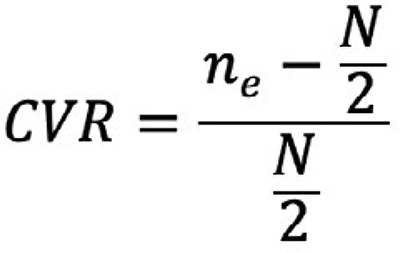
The CVR, also known as the Lawshe method, is an index used to assess content validity that involves a panel of experts considering the relevance of individual items within an instrument. CVR values can range from 1 (perfect agreement) to -1 (perfect disagreement), and a value of 0 indicates that half of experts on the panel agree that an item is essential.14 The CVR is calculated according to the equation below (Figure 1), in which ne is the number of experts who consider an item essential and N is the total number of experts.13

The CVI is based on expert ratings for each item based on the relevance of the content or representativeness of an instrument or, further, it is the proportion of agreement on the content validity of an item13 according to the following equation (Figure 2), where nr is the number of experts who considered an item relevant and N is the total number of experts.

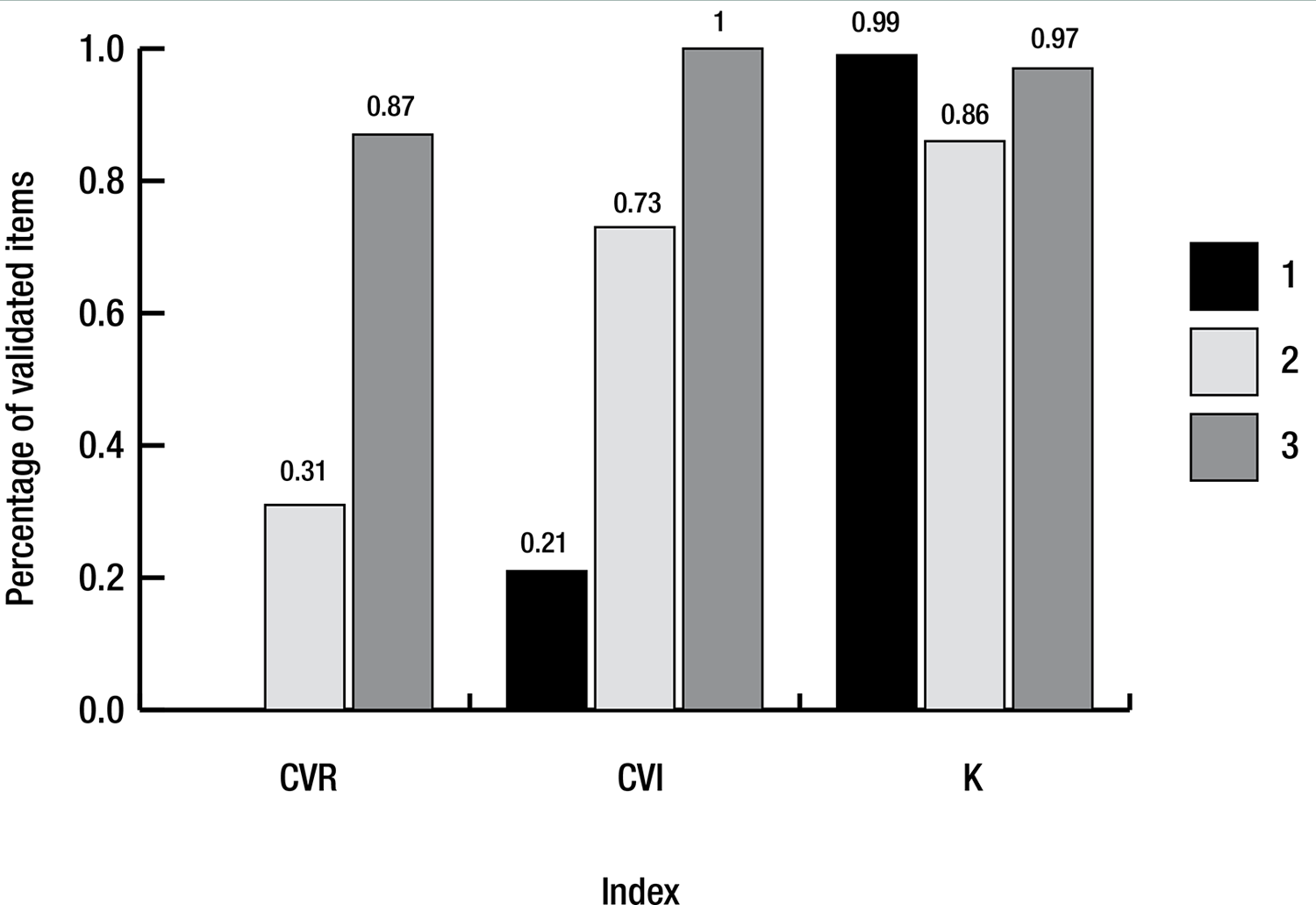
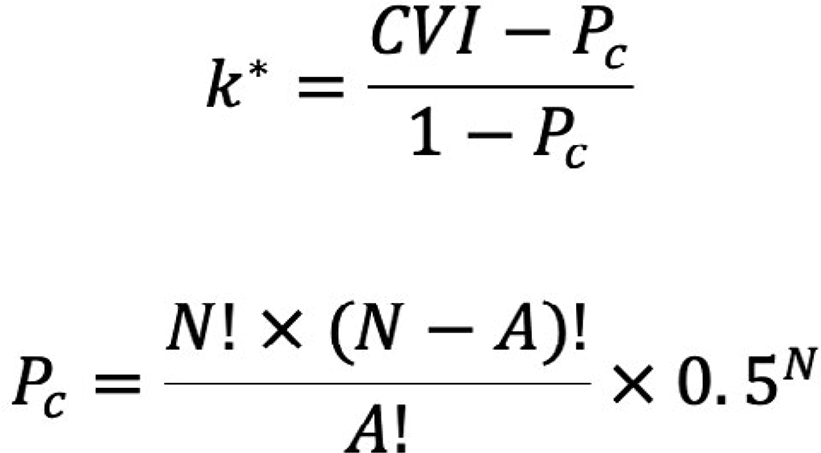
Thus, these indexes were calculated for the scores attributed by experts to each nursing diagnosis based on a Likert-type scale. The validity percentage was analyzed based on three criteria: considering only the items scored with 5 as relevant (criterion 1), only those scored with 4 or 5 as relevant (criterion 2) and those scored as 3, 4 or 5, considering points 3, 4 and 5 as relevant (criterion 3). Nursing diagnoses that achieved CVI ≥ 0.80 were validated. Finally, the Modified Kappa Concordance Coefficient (κ*) is a measure used for interobserver assessment applied to categorical variables.14 This is a measure of agreement among evaluators and assumes a maximum value of 1.00. The higher the Kappa value, the greater the agreement among observers. Values close to or below 0.00 indicate no agreement. κ* value is calculated according to the equations below, where Pc, in the first, is the probability of random agreement, which is calculated according to the second equation, where N is the total number of experts and A the number of experts who considered the item relevant.
The study was conducted under the standards of the Research Ethics Committee of the Universidade Federal da Bahia School of Nursing, with the Certificate of Presentation for Ethical Consideration 64677522.5.0000.5531 and Protocol 5.876.9031.
Results
Expert characterization
Of the 25 experts who participated in the study, 80% of them (20) were female, aged between 29 and 58 years old, and the majority (56% - 14) reported more than a decade of experience in rehabilitation nursing. Regarding graduate courses, 32% reported having a lato sensu specialization (08) and 68% stricto sensu - master’s degree (40% - 10) and doctoral degree (28% - 07). As for institutional affiliation, 72% worked in public institutions (18) and 28% in private institutions (07). Concerning participants’ experiences in relation to the use of SNLS, 52% of them had experience in teaching (13), 48% in research (12) and 80% in more than one of the fields (teaching, research and/or care) (20). Regarding the use of ICNP®, only two (8%) of experts reported having no knowledge.
Content validity
Of the 111 nursing diagnoses analyzed, 36 were validated (Chart 2), 25 of which were categorized in the personal system, seven in the interpersonal system and four in the social system. Based on the calculations of the CVR, CVI and modified Kappa, the percentage of validated items was analyzed considering three criteria: Criterion 1: considering validated only items assessed as “Very relevant” (5 on the Likert scale); Criterion 2: considering validated items assessed as “Very relevant” and “Very relevant” (5 and 4 on the Likert scale); Criterion 3: considering validated items assessed as “Very relevant”, “Very relevant” and “Relevant” (5, 4, and 3 on the Likert scale). Table 1 presents the criteria and the validity percentage considered in this study, and, based on them, criterion 3 was adopted as it was the one that achieved the highest number of valid items (Figure 4).

Since only nursing diagnoses that achieved CVI ≥ 0.80 were validated, this study supports the values found in other studies on content validity. 15-17
Of the 111 nursing diagnoses sent to experts, 75 diagnoses were excluded because they did not meet the cut-off point required in the assessment of the three applied indexes of statistical analysis and also in categorization, normalization and because they were recurrent within the same IFBr domain, thus leaving 36 nursing diagnoses. Some of the nursing diagnoses removed can be observed below: nursing diagnosis 22: Breastfeeding, insufficient breast milk; nursing diagnosis 23: Ineffective breastfeeding; nursing diagnosis 40: Colostomy; nursing diagnosis 49: Ineffective impulse control; nursing diagnosis 52: Seizures due to hyperthermia; nursing diagnosis 56: Sleeping with parents; nursing diagnosis 60: Gnosis; nursing diagnosis 74: Ineffective childbearing process.
Discussion
Imogene King postulated the Theory of Goal Attainment, which states that nurse-person interaction should be encouraged through three open systems, such as personal, interpersonal and social, with the aim of improving health and incorporating autonomous behaviors. To this end, the systems behave dynamically as interdependent and interrelated variables with the purpose of achieving the proposed goals.11,12
Through the use of the adopted theoretical model, it can be inferred that the proposed nursing diagnosis statements aim to bring a greater range of care demands to CwD in an unprecedented way.5 Nursing does not yet use these nursing diagnoses in its daily practice.
The nursing process, if used efficiently, will bring contributions and enhance care with the possibility of co-responsibility: the mother-child dyad and the interaction with the nurse in the Health Care Network (In Portuguese, Rede de Atenção à Saúde - RAS) of the Brazilian Health System (In Portuguese, Sistema Único de Saúde - SUS), taking into account health literacy and literacy.18 This may allow the practical application of this theoretical framework in the context of care of CwD, potentially enhancing, together with the professionals of the nursing team, the relevance of the nursing process, granting greater visibility and appreciation of nursing science.11
Personal system nursing diagnoses stand out, with emphasis on mental and body structures and functions, such as: 1) global mental functions: consciousness, orientation (time, place, person), intellectual (including intellectual disability and dementia), global psychosocial, temperament and personality, energy and drive, sleep; 2) specific mental functions: attention, memory, psychomotor, emotional, perceptual, thought, higher-level cognitive, language, calculation, sequencing of complex movements (includes apraxia), experience of self and time.
In addition to these, there are: 3) sensory functions and pain: vision; 4) related functions: visual acuity, visual field, functions of the internal and external muscles of the eye, eyelid, lacrimal glands; 5) auditory functions: detection, discrimination, localization of sound and speech; vestibular functions: related to position, balance and movement; pain: unpleasant sensation that indicates potential or real injury to some part of the body. Generalized or localized; 6) additional sensory functions: gustatory, olfactory, proprioceptive, tactile, pain, temperature. this presentation takes into account the IFBr as well as the ICF.1
Regarding nursing diagnoses related to the interpersonal system, communication is the most affected domain. From this perspective, sensory integration dysfunction represents a difficulty that the brain develops in receiving and responding to information coming through the senses. Sensory integration, a process that is influenced by genetic, biological, environmental factors and life experiences, is, therefore, what organizes and analyzes sensations in order to allow the body to be used in the environment effectively.6,19
Although the senses are responsible for capturing information from the environment, it is sensory processing (SP) that gives meaning to what is received. Considering that SP is the way a person processes sensory information received through the senses, it is what organizes the information received from the environment, and without an adequate SP, there would only be a cluster of meaningless information.20
In this regard, understanding the world around them involves, in addition to all the senses, the body’s sense, proprioception. When feeling the world through the senses, there must be processes capable of responding to what is seen, heard, and felt. CwD do not have the appropriate SP compatible with their stage of development. They see, hear, and feel, but do not present adequate responses due to incorrect processing or high sensory demands, for instance.
Thus, as one registers what one learns around oneself, a person modulates the intensities, discriminates and distinguishes the characteristics, relevance and specific qualities of each stimulus, such as sound, color, appearance, shape. From there, one integrates everything into a single response to communicate, relate, move the body and hands. And everything has a strict relationship with the temporal markers so that a response is given at the appropriate time, without impacting neuropsychic development.
Therefore, nurses’ experience with the mother-child dyad, here considering CwD, expands the interaction repertoire of this dyad and inserts it in spaces where it can be capable of responding to these stimuli through the mechanisms worked on from the perspective of nursing care.
There are also social system nursing diagnoses, another system established in the Theory of Goal Attainment, such as the interactions between CwD and access to school, recreation, and social interaction as impaired or deficient.11,12 These diagnoses are consistent with the reports in medical records in which children go to school, but they do not remain in school, nor do they continue with activities specific to school settings, causing frustration and early departure from this environment because they do not, unconsciously, adhere to the school inclusion process appropriately.
When children are not in school, social interactions are reduced and the chances of making friends and sharing knowledge are reduced. The best places for these moments are social organizations where there are suitable and adapted leisure fields where they can socialize and learn. This is a reality that needs to change. CwD should be everywhere where other children are.
Therefore, it is essential for nurses to understand this scenario, considering the need to identify the social structure in which the mother-child dyad is inserted as well as the relationships established within it. This will facilitate awareness of their social role in achieving the established goals that contribute to the health of such dyad, since interactions between nurse and patient are fundamental for adherence to health actions.21It is therefore up to nurses to employ realistic goals, as established by the Theory of Goal Attainment, in the most appropriate way so that they can be integrated into health care practices.6In this way, nurses increases patients’ confidence in their ability to manage their own health in the most appropriate way.22
Conclusion
In this study, 36 nursing diagnoses were validated. Seven were related to the interpersonal system, 25 to the personal system, with the sensory domain being the most contemplated, and the social system with four validated diagnoses, aiming to contribute to the nursing consultation operationalization for CwD based on the Theory of Goal Attainment and ICNP®, whose operational definitions are based on the principles of rehabilitation nursing.

References
-
1 Índice de Funcionalidade Brasileiro Modificado (IFBrM): Formulário de Identificação da Pessoa Avaliada e da Avaliação. Brasília (DF): Ministério dos Direitos Humanos e da Cidadania; 2020 [citado 2024 Mai 25]. Disponível em: https://www.gov.br/mdh/pt-br/navegue-por-temas/pessoa-com-deficiencia/publicacoes/PropostadeInstrumentodeAvaliaoIFBrMcomajustesversorelatriofinaldoGTI.pdf
» https://www.gov.br/mdh/pt-br/navegue-por-temas/pessoa-com-deficiencia/publicacoes/PropostadeInstrumentodeAvaliaoIFBrMcomajustesversorelatriofinaldoGTI.pdf -
2 Instituto Brasileiro de Geografia e Estatísticas (IBGE). Pesquisa Nacional por Amostra de Domicílio Contínua - PNAD Contínua: pessoas com deficiências. Divulgação dos resultados gerais.IBGE; 2023 [citado 2024 Mar 10]. Disponível em: https://agenciadenoticias.ibge.gov.br/media/com_mediaibge/arquivos/0a9afaed04d79830f73a16136dba23b9.pdf
» https://agenciadenoticias.ibge.gov.br/media/com_mediaibge/arquivos/0a9afaed04d79830f73a16136dba23b9.pdf -
3 Washington Group on Disability Statistics. Como criar indicadores de severidade de deficiências usando o conjunto resumido de perguntas sobre funcionalidade do Grupo de Washington (WG-SS). Hyattsville: National Center for Health Statistics - NCHS; 2021 [citado 2023 Jun 1]. Disponível em: https://www.washingtongroupdisability.com/fileadmin/uploads/wg/WG_Document__5E_-_Analytic_Guidelines_for_the_WG-SS__Severity_Indicators__Portuguese_Brazil.pdf
» https://www.washingtongroupdisability.com/fileadmin/uploads/wg/WG_Document__5E_-_Analytic_Guidelines_for_the_WG-SS__Severity_Indicators__Portuguese_Brazil.pdf -
4 Conselho Federal de Enfermagem (COFEN). Resolução COFEN nº 728, de 9 de novembro de 2023. Normatiza a atuação da Equipe de Enfermagem de Reabilitação. Diário Oficial da União. 2023; Nov 13;(217 217(seção 1):137. Disponível em: https://www.cofen.gov.br/wp-content/uploads/2023/11/Publicacao-Diario-Oficial-Resolucao-728-2023.pdf
» https://www.cofen.gov.br/wp-content/uploads/2023/11/Publicacao-Diario-Oficial-Resolucao-728-2023.pdf - 5 Silva HC, Acioli S, Fuly PD, Nóbrega MM, Lins SM, Menezes HF. Construction and validation of nursing diagnoses for people with diabetic foot ulcers. Rev Esc Enferm USP. 2022;56:e20220022.
- 6 Rivera-Rojas F, Valencia-Contrera M, Villa-Velasquez J, Reynaldos-Grandon K, González-Palacios Y. Análisis crítico de la teoría de la consecución de objetivos de Imogene King. Revista de Enfermagem Referência (Coimbra). 2023; Serie 6(2):e29335.
- 7 Lawson DO, Puljak L, Pieper D, Schandelmaier S, Collins GS, Brignardello-Petersen R, et al. Reporting of methodological studies in health research: a protocol for the development of the Methodological STudy reportIng Checklist (MISTIC). BMJ Open. 2020;10(12):e040478.
- 8 Bruni AL. Estatística aplicada à gestão empresarial. 3rd ed. São Paulo: Atlas; 2011.
- 9 Cubas MR, Silva RS, Primo CC, Brandão MA, Félix ND, Jensen R. Contributions of representing the elements of nursing practice in the ISO 18.104:2023 standard: a theoretical study. Rev Esc Enferm USP. 2024;58:e20230358.
- 10 International Organization for Standardization (ISO). ISO 18104: Health informatics - Categorial structures for representation of nursing practice in terminological systems. Geneva: ISO; 2023. 35p.
- 11 King IM. A theory for nursing: systems, concepts, process. New York: Wiley Medical Publications; 1981.
- 12 Sieloff Evans CL. Imogene King: a conceptual framework for nursing. California: Sage Publications; 1991 (Notes on nursing theories: vol. 2).
- 13 Almanasreh E, Moles R, Chen TF. Avaliação de métodos utilizados para estimar a validade de conteúdo. Pesq Farmácia Soc Adm. 2019;15(2):214-21.
- 14 Salmond SS. Evaluating the reliability and validity of measurement instruments. Orthop Nurs. 2008;27(1):28-30.
- 15 Scolari GA, Lucena AC, Carreira L. Construção e validação de protocolo assistencial a idosos em Unidades de Pronto Atendimento. Acta Paul Enferm. 2022;35:eAPE01707.
- 16 Scaratti M, Johann GR, Argenta C, Zanatta EA. Validação de conteúdo e semântica de aplicativo para adolescentes com diabetes mellitus. Acta Paul Enferm. 2023;36:eAPE021031.
- 17 Duarte FH, Araújo NM, Silva SO, Leal NT, Costa TM, Alencar IG, et al. Validação do conteúdo de um recurso audiovisual para pessoas vivendo com HIV. Acta Paul Enferm 2024;37: eAPE01361.
- 18 Quemelo PR, Milani D, Bento VF, Vieira ER, Zaia JE. Literacia em saúde: tradução e validação de instrumento para pesquisa em promoção da saúde no Brasil. Cad Saude Publica. 2017;33(2):e00179715.
- 19 Bernal Rivas F, Avello-Sáez D. Efectos del apego y procesamiento sensorial en el desarrollo de niñas y niños. Una revisión sistemática. Cad Bras Ter Ocup. 2023; 31:e3527.
- 20 Machado AC, Oliveira SR, Magalhães LC, Miranda DM, Bouzada MC. Processamento sensorial no período da infância em crianças nascidas pré-termo: revisão sistemática. Rev Paul Pediatr. 2017;35(1):92-101.
- 21 Silva VG, Melo LG, Silva BN, Souza NL. Nursing care in serodifferent relationships: an analysis in the light of Imogene King. Esc Anna Nery. 2024;28:e20240016.
- 22 Heron R. Imogene King's Theory of goal attainment: empowering nurses to facilitate patient wellness. J Nurs Health Sci. 2023;9(5):1-2.
Edited by
-
Associate Editor:
Camila Takao Lopes (https://orcid.org/0000-0002-6243-6497) Escola Paulista de Enfermagem, Universidade Federal de São Paulo, São Paulo, SP, Brasil
-
Conflicts of interest:
article extracted from the doctoral thesis “Consulta de Enfermagem à criança com deficiência fundamentada na Teoria do Alcance de Metas: Subconjunto Terminológico CIPE®”, presented to the Universidade Federal da Bahia, EEUFBA, PPGENF, BA, Brazil.