 Promotion and prevention in nursing practices in Primary Health Care
Abstract
Objective To identify the promotion and prevention actions of Advanced Nursing Practices by nurses within Primary Health Care (PHC).
Methods Qualitative study, secondary analysis from the database “Nursing practices in the context of Primary Health Care (PHC): national study of mixed methods”, from 2019 to 2022. A total of 831 nurses were selected and participated in in-depth interviews. The analysis was performed using validated instruments with MAXQDA® software from July to December 2024. The methodological framework used was content analysis, instrumentalized by MAXQDA®, reducing the sample to 22 respondents by selecting interviews that contained at least nine coded statements, corresponding to the number of questions.
Results Twenty-two participants, average age 41.9 years, mostly female, workplace urban units, Family Health Strategy, with Specialization in Family Health and from the Southeast region of Brazil. Code Relationship Matrix with 320 co-occurrences, in five code intersections: Operational groups and the recognition of self-care; The rainbow in health promotion actions and active search; Care for the elderly and the sheltered or homeless population; Adoption of healthy behaviors through health education; and Group actions are not limited to lectures.
Conclusion There is potential and convergence between the actions of PHC nurses in this study and APN competencies, but these actions are mainly related to health education as a form of health promotion, but without configuring APN and without qualifying them as Advanced Practice Nurses.
Descriptors:
Advanced practice nursing; Health promotion; Disease prevention; Primary health care
Resumo
Objetivo Identificar as ações de promoção e prevenção de Práticas Avançadas de Enfermagem de enfermeiros na Atenção Primária à Saúde (APS).
Métodos Estudo qualitativo, de análise secundária a partir do banco de dados “Práticas de enfermagem no contexto da Atenção Primária à Saúde (APS): estudo nacional de métodos mistos”, de 2019 a 2022. Foram selecionados 831 enfermeiros, que participaram de entrevistas em profundidade. A análise ocorreu a partir de instrumentos validados, com o software MAXQDA®, de julho a dezembro de 2024. O referencial metodológico utilizado foi análise de conteúdo, instrumentalizada pelo MAXQDA®, reduzindo a amostra para 22 respondentes, ao selecionar as entrevistas que tivessem codificado, pelo menos, nove falas, correspondendo ao quantitativo de perguntas.
Resultados Vinte e dois participantes, média de idade 41,9 anos, maioria sexo feminino, local de trabalho unidades urbanas, Estratégia Saúde da Família, com Especialização em Saúde da Família e da região Sudeste do Brasil. Matriz da Relação de Códigos com 320 coocorrências, em cinco cruzamentos de códigos: Grupos operativos e o reconhecimento do autocuidado; O arco-íris nas ações de promoção da saúde e a busca ativa; Atenção ao idoso e à população abrigada ou em situação de rua; Adoção de comportamentos saudáveis através da educação em saúde; e Ações em grupos não se resumem a palestras.
Conclusão Há potencialidades e convergências das ações dos enfermeiros da APS neste estudo com competências de PAE, contudo principalmente relativas à educação em saúde como forma de promoção da saúde, mas sem configurar PAE e sem qualificá-los como Enfermeiros de Práticas Avançadas.
Descritores:
Prática avançada de enfermagem; Promoção da saúde; Prevenção de doenças; Atenção primária à saúde
Resumen
Objetivo Identificar las acciones de promoción y prevención propias de la Práctica Avanzada de Enfermería (PAE) realizadas por los profesionales de enfermería en la Atención Primaria de Salud (APS).
Métodos Estudio cualitativo, de análisis secundario a partir de la base de datos «Prácticas de enfermería en el contexto de la Atención Primaria de Salud (APS): estudio nacional de métodos mixtos», de 2019 a 2022. Se seleccionaron 831 profesionales de enfermería, que participaron en entrevistas en profundidad. El análisis se realizó a partir de instrumentos validados, con el software MAXQDA®, de julio a diciembre de 2024. El marco metodológico utilizado fue el análisis de contenido, instrumentalizado por MAXQDA®, reduciendo la muestra a 22 encuestados, al seleccionar las entrevistas que tenían al menos nueve respuestas codificadas, correspondientes al número de preguntas.
Resultados Veintidós participantes, con una edad media de 41,9 años, en su mayoría mujeres, lugar de trabajo en unidades urbanas, Estrategia de Salud Familiar, con especialización en Salud Familiar y de la región sudeste de Brasil. Matriz de la relación de códigos con 320 coocurrencias, en cinco cruces de códigos: Grupos operativos y el reconocimiento del autocuidado; El arcoíris en las acciones de promoción de la salud y la búsqueda activa; Atención a las personas mayores y a la población alojada o en situación de calle; Adopción de comportamientos saludables a través de la educación en salud; y las acciones en grupo no se limitan a charlas.
Conclusión Existen potencialidades y convergencias entre las acciones de los profesionales de enfermería de APS en este estudio y las competencias de la PAE, sin embargo, principalmente en relación con la educación en salud como forma de promoción de la salud, pero sin constituir PAE y sin calificarlos como EPA.
Descriptores:
Enfermería de práctica avanzada; Promoción de la salud; Prevención de enfermedades; Atención primaria de salud
Résumé
Objectif Identifier les actions de promotion et de prévention des pratiques infirmières avancées des infirmiers dans les soins de santé primaires (SSP).
Méthodes Étude qualitative, analyse secondaire à partir de la base de données « Pratiques infirmières dans le contexte des soins de santé primaires (SSP): étude nationale à méthodes mixtes », de 2019 à 2022. 831 infirmiers ont été sélectionnés et ont participé à des entretiens approfondis. L’analyse a été réalisée à l’aide d’instruments validés, avec le logiciel MAXQDA®, de juillet à décembre 2024. Le cadre méthodologique utilisé était l›analyse de contenu, instrumentalisée par MAXQDA®, réduisant l›échantillon à 22 répondants, en sélectionnant les entretiens qui avaient codé au moins neuf déclarations, correspondant au nombre de questions.
Résultats Vingt-deux participants, âge moyen 41,9 ans, majorité féminine, lieu de travail unités urbaines, Stratégie de santé familiale, avec spécialisation en santé familiale et de la région Sud-Est du Brésil. Matrice de la relation des codes avec 320 cooccurrences, dans cinq croisements de codes: Groupes opérationnels et reconnaissance des auto-soins; L’arc-en-ciel dans les actions de promotion de la santé et la recherche active; Attention aux personnes âgées et à la population hébergée ou sans domicile fixe; Adoption de comportements sains grâce à l’éducation à la santé; et Les actions en groupe ne se limitent pas à des conférences.
Conclusion Il existe des potentialités et des convergences entre les actions des infirmiers de la SSP dans cette étude et les compétences de la PIA, mais principalement en matière d’éducation à la santé comme moyen de promotion de la santé, sans pour autant constituer la PIA et sans les qualifier d’infirmiers de pratiques avancées.
Descripteurs:
Soins infirmiers de pratique avancée; Promotion de la santé; Prévention des maladies; Soins de santé primaires
Introduction
Health promotion and prevention are rights of all Brazilian citizens guaranteed by the Federal Constitution of 1988, the founding pillar of the Unified Health System (SUS), which is public and universal, guided by the principles of comprehensiveness, universality, equity, and social participation.
Primary health care (PHC) gained relevance in 1978 with the International Conference on Primary Health Care, held by the World Health Organization (WHO), which resulted in the Alma-Ata Declaration, containing foundations and subsidies to mobilize governments and resources, in addition to calling them to establish national public policies and strategic plans for the implementation of PHC as a structuring element of a universal and comprehensive health system, while at the same time aligning it with various sectors in response to the social and environmental determinants that affect health.(2)
The scenario in which the Alma-Ata Conference took place was shaped by conferences led by the United Nations through its organizations in the 1970s, and one of the elements of discussion was the new international economic logic to reduce inequalities between so-called central countries and third world countries.(3) In fact, the Alma-Ata Charter, among its points of interest for comprehensive PHC, pointed out the inseparability of economy, social development, and health.(2)
In summary, the Alma-Ata Charter marked a turning point in the field of PHC, and debates on health promotion grew. In 1984, the WHO and European countries produced an introductory document on the subject, focusing on the social determinants of health.(4) The following years were marked by new conferences, expanding the debate, mainly in Europe and Canada.(5)
In this context of emphasis on PHC, the First International Conference on Health Promotion was planned and held in Ottawa in November 1986.(6) With the participation of thirty-five countries, the Ottawa Charter was formulated, a global reference for the development of health promotion actions, based on certain values, such as life, health, citizenship, equity, solidarity, democracy, development, participation, and joint action, among others.(6) In addition, it reinforced the improvement in quality of life and health as integral parts of the outlined strategies.(5)
According to the Ottawa Charter, the following health promotion strategies are defined: implementation of healthy public policies; creation of supportive environments; reorientation of health services; strengthening of community action; and development of personal skills.(5,6) Subsequent International Health Promotion Conferences recognized these strategies as a benchmark and further developed their actions based on debates that led to the modern concept of health promotion.(5)
However, to ensure the implementation of such strategic actions, it is essential to have a qualified workforce. In this sense, nursing gains relevance and requires special attention, since it accounts for 56% of health workers in the Region of the Americas.(7) Their performance has gained visibility, especially since the COVID-19 pandemic, demonstrating that in many places, the population only has access to these professionals.(8)
Since 2013, the Pan American Health Organization (PAHO) has invested in actions that expand the role of nurses in primary health care through formal education initiatives, implementation in the labor market, inclusion in interprofessional teams, followed by regulation of professional practice. The main objective is to ensure that the population has access to qualified professionals already at the primary level of PHC.(9)
It is in this context that PAHO/WHO has recognized the importance of the Advanced Practice Nurse (APN) as “a professional with postgraduate training who, as part of the interprofessional team of primary health care services, contributes to the management of care for patients/users with mild acute illnesses and chronic disorders diagnosed according to protocol guidelines or clinical guidelines. Their professional practice is broader and differs from that of primary care nurses in terms of the degree of autonomy in decision-making and in the diagnosis and treatment of patient disorders.(8,9)
Therefore, the expansion of the APN role recommended for Latin American countries is as follows: 1 - nurse practitioners, with a master’s degree, whose performance includes care and diagnosis for the population with mild acute and chronic diseases; 2 - case management nurses, i.e., responsible for connecting and integrating points of care, including integrated networks; and 3 - advanced practice nurses specializing in obstetrics and geriatrics to serve these specific populations.(8)
The importance of implementing APN in PHC is justified by the possibility of expanding the population’s access to health services, especially those in vulnerable situations, rural and remote areas, as well as areas where there is a low concentration of other health professionals.(10) In addition, this strategy also aims to optimize the responses of health systems in extreme situations such as socioeconomic, climatic, and political changes, changes in epidemiological profiles, disease outbreaks, as well as in the implementation of public policies and health actions that correspond to modern perspectives on the essential functions of public health.(11)
Thus, the APN is qualified to act in these scenarios, in response to clinical care demands, in educational activities, which include teaching and research, as well as management, leadership, and clinical care.(8) Thus, the guiding question of this study is: are promotion and prevention actions in nursing practices in PHC APN actions? The objective is to identify the APN promotion and prevention actions of nurses in PHC.
Methods
This study followed a qualitative approach, with analysis based on secondary data from the research database “Nursing practices in the context of Primary Health Care (PHC): a national study of mixed methods,” conducted by the COFEN and UNB partnership from 2019 to 2022, under the coordination of Prof. Dr. Maria Fátima de Sousa.(12) The activity in question, secondary data analysis, is part of the actions of the Advanced Practices Commission of the Federal Nursing Council,(13) for which a working group was created for this purpose.(14) Due to the nature of the study, the guidelines expressed in the Consolidated Criteria for Reporting Qualitative Research (COREQ) - Brazilian Portuguese version,(15) especially those related to domain 3, analysis and results, were followed.
The five Brazilian regions were included, as well as the 27 federal units and 108 municipalities of various types (remote, rural, adjacent, small and large-sized, and capital).(12)
From the primary study, 831 PHC nurses from the selected municipalities participated.(12) A purposive sample that considered the National Register of Health Establishments (CNES) for PHC nurses, traditional basic health units, and family health units. The CNES database was linked to the municipality database provided by the IBGE to include the classification of Brazilian municipalities.(16) Nurses were recruited through municipal health departments. The inclusion criteria adopted were: nurses working in primary health care or management. The exclusion criteria were: nurses without formal employment ties to health services; those absent at the time of data collection; and nurse consultants and preceptors.
For data collection, virtual meetings were scheduled on institutional platforms, and in-depth interviews were conducted according to a semi-structured script, recorded, and later transcribed in full by researchers, scholarship recipients, and undergraduate and graduate volunteers, forming the database used in the primary study,(12)and reanalyzed in this study.
The statements were coded based on the theoretical framework of the International Council of Nurses (ICN)(17)with the definitions of essential requirements for the recognition of Advanced Practice Nurses (APNs). Three instruments available online, translated and validated for Brazilian Portuguese, were used to create the categories of analysis. The instruments were: 1 - Competencies for the training of APNs for primary health care;(18) 2 - Inventory for the evaluation of competencies in advanced practice nurses (IECAPN) for Brazilian culture;(19)and 3 - Modified scale for the delineation of the role of Advanced Practice Nurse (EMDF/APN) - Brazilian Version.(20)
For the secondary analysis, data were processed using MAXQDA® software, version 2024, from July to December 2024, following these steps: 1 - basic structure of categories/coding tree (main categories) adapted from the instruments listed above; 2 - axial coding process and definition of separate subcategories/subcodes for each region; and 3 - integration of cases (with different subcodes) into a joint categorical system.
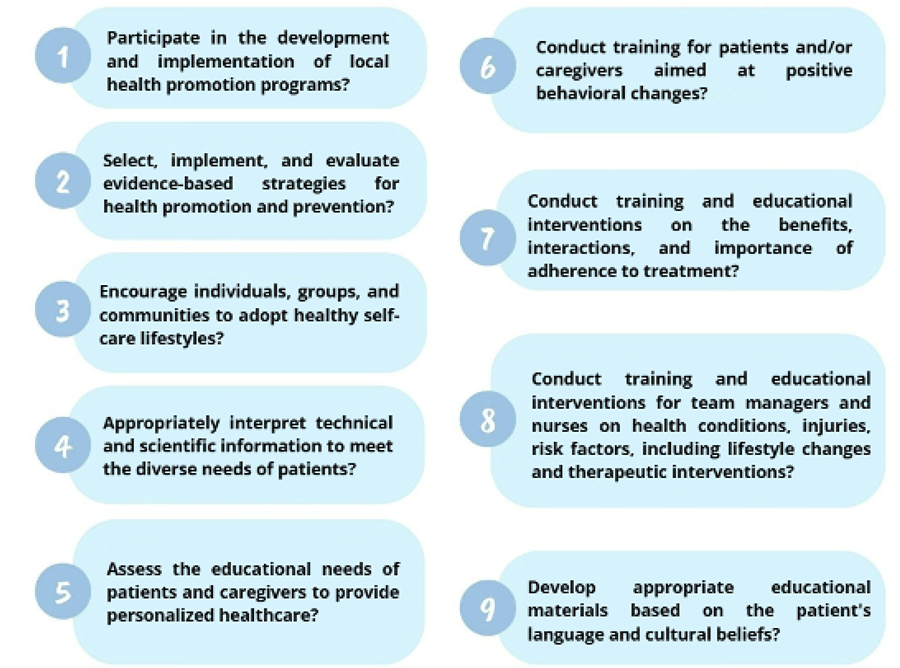
The categories defined a priori and coded followed Flick’s thematic coding framework.(21) This study presents the results of the category “Nurses’ role in PHC in health promotion and prevention.” The following questions guided the analysis of the textual data obtained (Figure 1).

The methodological framework adopted for the analysis of qualitative data was Bardin’s content analysis(22) instrumentalized by Maxqda® software through the creation of a table containing the correlation or co-occurrence of statements, also known as the Code Relationship Matrix, using the coding questions themselves as indicators. In Maxqda®, the path to generate this table is: visual tools, viewer of connections between codes, selection of codes and documents desired for analysis. The selection of interviews for inclusion in the analysis adopted a minimum number of 9 coded statements, the minimum threshold based on the existence of 9 coding questions for the material, and 22 interviews were included for analysis of the statements. To ensure the anonymity of the participants, the presentation of excerpts from the selected interviews will follow the following coding: ENF (nurse(s), followed by an underline; abbreviation of the region of the country where they work (N, SE, and NE); another underline; ending with the interview registration number.
The primary study was approved by the UnB research ethics committee, under opinion no. 3,619,308 and Certificate of Ethical Review: 20814619.2.0000.0030. The interviews began with reading of the Free and Informed Consent Form (FICF), at which point all participants were briefed on the research and then gave their consent to proceed with the questions. In addition, ethical issues in research were observed, including the guarantee of anonymity and voluntary participation.
Results
The sociodemographic characteristics of the 22 participants are as follows, according to the selection strategy. The sample was predominantly female (90.9%), with an average age of 41.9 years; marital status was married (54.5%); the location of the unit was urban (68.2%), with 95.5% of nurses working in the Family Health Strategy (ESF), and of these, 35% had a specialization in Family Health. By region of the country, Southeast (45.5%), Northeast (31.2%), and North (22.7%). Regarding the co-occurrence of statements (Chart 1).
The following questions stand out as having the highest representation of responses: “Does it encourage individuals, groups, and communities to adopt healthy self-care lifestyles?” (55); “Does it provide training for patients and/or caregivers with a view to positive behavioral changes?” (55), and “Does it assess the educational needs of patients and caregivers to provide personalized health care?” (52). In total, 320 co-occurrences of statements were counted for the codes analyzed.
Regarding the correlation of statements, a cutoff of 10 or more co-occurrences was adopted for the presentation of results. The question that concentrated the largest number of statements with the highest number of questions was “Do you encourage individuals, groups, and communities to adopt healthy self-care lifestyles?”, with 13 co-occurrences of statements with the question “does it provide training for patients and/or caregivers with a view to positive behavioral changes?”, 11 with “does it assess the educational needs of patients and caregivers to provide personalized health care?” and 11 with “does it participate in the development and implementation of local health promotion programs?”. In addition to these, “do you provide training for patients and/or caregivers with a view to positive behavioral changes?” with “do you provide training and educational interventions on the benefits, interactions, and importance of treatment adherence?” had 11 co-occurrences of statements. “Provides training for patients and/or caregivers with a view to positive behavioral changes?” with “assesses the educational needs of patients and caregivers to provide personalized healthcare?” had 10 co-occurrences of statements.
Below are some statements that, due to their co-occurrence in two or more codes/analysis questions, express relevance to the participants. In addition, in order to better understand the relationships between the codes, they were renamed based on the themes involved in the statements, as shown in Chart 2.
Discussion
The group investigated shows a similar profile to that found in another study.(23) However, an important piece of demographic data that stands out is the specialty of the participants, because according to the National Primary Care Policy (PNAB), nurses working in the ESF should preferably have a specialization in Family Health,(24) but less than 50% of the participants reported having this specialization, although they obtained it in other areas, even those not included in the Strategy.
According to the ICN, the APN has essential competencies for the development of their skills, such as education, research, care practice, and management.(17) In this study, the important role of this professional patient education practices was revealed, even though the other competencies were not present in their statements, which can be justified, in a way, by the nature of the questions asked.
It should be noted that the PNAB chooses Family Health as a strategic priority for expanding and strengthening Primary Care,(24) which is why the workforce active in the ESF should be qualified in a manner consistent with their activities. Despite this, based on the discourse presented in the study, its focus directly or indirectly meets the general objective of the National Health Promotion Policy (PNPS), which is to “promote equity and improve living conditions and lifestyles, expanding the potential for individual and collective health and reducing vulnerabilities and health risks resulting from social, economic, political, cultural, and environmental determinants.”(25)
In this vein, a comparative study in Brazil (Florianópolis/SC – southern region) and Spain on health promotion activities highlighted five areas that were classified as training in health promotion for health professionals; health promotion practices during individual consultations; health education for groups; health promotion in community actions; and health promotion in actions carried out at home.(26) When compared with the participants’ discourse, this set, to a greater or lesser extent, aligns with actions that meet the general objective of the PNPS.
Although not all of these practices were observed in their entirety in this study, it is important to highlight the strategy of the operational groups as the most widely adopted, followed by monthly color-themed campaigns, such as Pink October for Women’s Health in attention to the prevention and early diagnosis of breast and cervical cancer,(27)Blue November for Men’s Health, mainly for the early detection of prostate cancer and other conditions,(28) Yellow September for suicide prevention and other mental health issues,(29) among others. However, health care transcends these campaigns, serving mainly as drivers, disseminators, and strengtheners of the right to health and promotion and prevention practices.
The prominent groups focusing on chronic diseases (hypertension and diabetes), life cycles (elderly and children), women’s and men’s health, focus on transforming harmful habits into healthy behaviors and reflecting on the importance of self-care and the role of nurses beyond prescribing care. In this sense, physical exercise, healthy eating, and dietary monitoring to combat obesity and/or malnutrition, prevention of sexually transmitted infections (STIs), immunization, medication monitoring, family planning, as well as programs to combat smoking and other purposes, become goals for health promotion and prevention based on these groups.
Furthermore, the APN plays an innovative role in the context of its professional practice through training and continuing education, promoting the qualification of various health professionals and acting in targeted care practices, in the control of chronic noncommunicable diseases (CNCDs) and others.(8) In fact, the data corroborate this study, since it was evident in the interviewees’ statements that health promotion occurs in all life cycles, as well as in the control of STIs and NCDs, although there is no complete evidence, for example, in the training of other professionals to achieve the required set of skills.
Certainly, the work performed by the operational groups has undeniable potential, but it does not exclude the need to carry out other actions, such as active screening, as verified in the participants’ statements, to detect cases of breast and cervical cancer and, for men’s health, mainly because they are not in the habit of seeking health care. This strategy is described in a legal provision (PNAB), and it is the responsibility of any team member to carry it out and report health conditions and diseases that are subject to mandatory notification, as well as other issues of local importance, as such findings contribute to the planning of actions at the level of prevention, protection, and even health recovery in the assigned area.
On the topic of active screening, it is worth mentioning that a portion of the vulnerable population lives on the streets or in shelters, as stated by the participants. Therefore, nurses need to travel to attend to these users, which brings to light a reflection on the street and its understandings, as it is about the encounter between humans and the bonds that are created over time. The street therefore encompasses human beings themselves, work, health, urbanism, exclusion, public policies, vulnerability, and, as such, the need to look at it and act with a focus on communication, psychology, and health.
This movement provides an opportunity for the APN to act in the fulfillment of actions and feedback on public policies based on the data produced, recorded, and disseminated in research. However, the logic of knowledge construction and subsequent dissemination based on their actions was not addressed in the participants’ discourse, which is why it can be inferred that this is not a skill present in their work routine.
Despite the recognition of nurses as potential educators, meeting part of the demands for health promotion by empowering users to engage in self-care, their role as APNs in Brazil is still in its infancy. The implementation of APN in Brazil still requires effort, as it is necessary to ensure that nurses have quality training and professional development at the postgraduate level, invest in career plans and valuation in the labor market, together with strategies for recognition by civil society with the support of the government, education, and regulatory bodies.(8) This reality is consistent with the professional qualification profile of the participants and their work experience shared here.
Conclusion
The actions of PHC nurses reported in this study denote potentialities and convergences with APN competencies, especially regarding health education activities as health promotion strategies, but without constituting APN and, therefore, without adding to the professional’s recognition as an APN. It should be noted that the role of nurses in PHC should not be restricted to educational practices aimed at health promotion and disease prevention, as APNs must have clinical competencies with a view to greater complexity in order to meet the demands of the population, which was also not evident in their statements. Thus, it is clear that investment is needed in the training and regulation of APNs so that their skills can be put into practice and the quality of healthcare and nursing care can be ensured.
Acknowledgments
To the Federal Nursing Council (Cofen), for its institutional support of the qualitative secondary analysis of the database of the research study “Nursing practices in the context of Primary Health Care (PHC): a national study of mixed methods.” To the University of Brasília, for releasing the qualitative database, of which UnB and Cofen hold the intellectual property rights. This study was conducted by the research group formed by the COFEN Advanced Nursing Practices Commission and the Working Group responsible for analyzing the qualitative data from the research study “Nursing Practices in the Context of Primary Health Care (PHC): a national study using mixed methods.” The authors are grateful for the valuable collaboration of the researchers who made up the research group: Ellen Marcia Peres, Beatriz Rosana Gonçalves de Oliveira Toso, Elizimara Ferreira Siqueira, Manoel Vieira de Miranda Neto, Jeanne Marie Rodrigues Stacciarini, Joseane Mota Bonfim, Mayra Santos Mourão Gonçalves, Rodrigo Alexandre Teixeira, Bruna Fatima Sczepanhak, Débora Cecília Chaves de Oliveira, Emerson Willian Santos de Almeida, and Vanessa Cappellesso Horewicz Felix.
References
-
1 Brasil. Presidência da República. Constituição da República Federativa do Brasil de 1988. Brasília (DF): Presidência da República; 1988 [citado 2025 Maio 22]. Disponível em: https://www.planalto.gov.br/ccivil_03/constituicao/constituicao.htm
» https://www.planalto.gov.br/ccivil_03/constituicao/constituicao.htm - 2 Giovanella L, Mendonça MH, Buss PM, Fleury S, Gadelha CA, Galvão LA, et al. From Alma-Ata to Astana. Primary health care and universal health systems: an inseparable commitment and a fundamental human right. Cad Saude Publica. 2019;35(3):e00012219.
- 3 Pires-Alves FA, Cueto M. The Alma-Ata Decade: the crisis of development and international health. Cien Saude Colet. 2017; 22(7):2135-44.
-
4 Brasil. Ministério da Saúde. Secretaria de Políticas de Saúde. Projeto Promoção da Saúde. As Cartas da Promoção da Saúde. Brasília (DF): Ministério da Saúde; 2002 [citado 2025 Maio 22]. Disponível em: https://bvsms.saude.gov.br/bvs/publicacoes/cartas_promocao.pdf
» https://bvsms.saude.gov.br/bvs/publicacoes/cartas_promocao.pdf - 5 Heidmann IT, Almeida MC, Boehs AE, Wosny AM, Monticelli M. Health promotion: historic trajectory of its conceptions. Texto Contexto Enferm. 2006;15(2):352-8.
-
6 World Health Organization (WHO). The Ottawa charter for health promotion. Geneve: WHO; 1986 [cited 2025 Apr 29]. Available from: https://www.who.int/teams/health-promotion/enhanced-wellbeing/first-global-conference
» https://www.who.int/teams/health-promotion/enhanced-wellbeing/first-global-conference -
7 World Health Organization (WHO). State of the world's nursing report - 2020. Geneve: WHO; 2020 [cited 2025 Apr 29]. Available from: https://www.who.int/publications/i/item/9789240003279
» https://www.who.int/publications/i/item/9789240003279 - 8 Cassiani SH, Dias BM. Perspectives for advanced practice nursing in Brazil. Rev Esc Enferm USP. 2022;56(spe):e20210406.
-
9 Pan American Health Organization (PAHO). Expanding the roles of nurses in primary health care. Washington: PAHO; 2018 [cited 2025 Apr 29]. Available from: https://iris.paho.org/handle/10665.2/34958
» https://iris.paho.org/handle/10665.2/34958 - 10 Maier CB, Aiken LH, Busse R. Nurses in advanced roles in primary care. Health Working Papers. 2017;98:71.
-
11 Pan American Health Organization (PAHO). The essential public health functions in the Americas: a renewal for the 21st century. Conceptual framework and description. Washington: PAHO; 2020 [cited 2025 Apr 29]. Available from: https://iris.paho.org/handle/10665.2/53124
» https://iris.paho.org/handle/10665.2/53124 - 12 Sousa MF. Práticas de enfermagem no contexto da Atenção Primária à Saúde (APS): estudo nacional de métodos mistos (Relatório final). Núcleo de Estudos em Saúde Pública, Centro de Estudos Avançados Multidisciplinares (CEAM), Universidade de Brasília (UnB), Conselho Federal de Enfermagem (COFEN). Brasília (DF): Editora ECoS; 2022
- 13 Conselho Federal de Enfermagem (COFEN). Portaria Cofen nº 1349 de 17 de julho de 2024. Altera a Comissão de Práticas Avançadas de Enfermagem. Brasília (DF): COFEN; 2024.
- 14 Conselho Federal de Enfermagem (COFEN). Portaria Cofen nº 1075 de 10 de junho de 2024. Institui Grupo de Trabalho - GT para análise de dados da etapa qualitativa da pesquisa "Práticas de Enfermagem no contexto da Atenção Primária à Saúde (APS): estudo nacional de métodos mistos". Brasília (DF): COFEN; 2024.
- 15 Souza VR, Marziale MH, Silva GT, Nascimento PL. Tradução e validação para a língua portuguesa e avaliação do guia COREQ. Acta Paul Enferm. 2021;34:eAPE02631.
-
16 Instituto Brasileiro de Geografia e Estatística (IBGE). Classificação e caracterização dos espaços rurais e urbanos do Brasil: uma primeira aproximação. Série. Estudos e Pesquisas. Informação Geográfica, n. 11. Diretoria de Geociências. Coordenação de Geografia. Rio de Janeiro: IBGE; 2017 [citado 2025 Abr 29]. Disponível em: https://biblioteca.ibge.gov.br/visualizacao/livros/liv100643.pdf
» https://biblioteca.ibge.gov.br/visualizacao/livros/liv100643.pdf -
17 International Council of Nurses (ICN). Guidelines on advanced practice nursing. Geneva: ICN; 2020 [cited 2025 May 22]. Available from: https://www.icn.ch/system/files/documents/2020-04/ICN_APN%20Report_EN_WEB.pdf
» https://www.icn.ch/system/files/documents/2020-04/ICN_APN%20Report_EN_WEB.pdf - 18 Cassiani SH, Aguirre-Boza F, Hoyos MC, Barreto MF, Peña LM, Mackay MC, et al. Competencies for training advanced practice nurses in primary health care. Acta Paul Enferm. 2018;31(6):572-84.
- 19 Dias FC, Baitelo TC, Toso BR, Sastre-Fullana P, Oliveira-Kumakura AR, Gasparino RC. Adaptation and validation of the Advanced Practice Nursing Competency Assessment Instrument. Rev Bras Enferm. 2022;75(5):e20210582.
- 20 Minosso KC, Santos MB, Toso BR. Validation of the Brazilian version of the modified scale for delineating advanced practice nursing roles. Rev Bras Enferm. 2024;77(2):e20230211.
- 21 Flick U. An introduction to qualitative research. 6th ed. Thousand Oaks, CA: SAGE Publications; 2018.
- 22 Bardin L. Análise de conteúdo. [Tradução Luís Antero Reto, Augusto Pinheiro]. São Paulo: Edições 70, 2016.
- 23 Aguiar LM, Sousa MF. Perfil sociodemográfico e de formação dos enfermeiros atuantes na Atenção Primária à Saúde no Distrito Federal. Tempus Actas Saúde Colet. 2023;16(4):183-98.
-
24 Brasil. Ministério da Saúde. Portaria nº 2.436, de 21 de Setembro de 2017. Aprova a Política Nacional de Atenção Básica, estabelecendo a revisão de diretrizes para a organização da Atenção Básica, no âmbito do Sistema Único de Saúde (SUS). Brasília (DF): Ministério da Saúde; 2017 [citado 2025 Maio 21]. Disponível em: https://bvsms.saude.gov.br/bvs/saudelegis/gm/2017/prt2436_22_09_2017.html
» https://bvsms.saude.gov.br/bvs/saudelegis/gm/2017/prt2436_22_09_2017.html -
25 Brasil. Ministério da Saúde. Política Nacional de Promoção da Saúde (PNPS) Anexo I da Portaria de Consolidação n. 02, de 28 de setembro de 2017, que consolida as normas sobre as políticas nacionais de saúde do SUS. Brasília (DF): Ministério da Saúde; 2018 [citado 2025 Maio 21]. Disponível em: https://bvsms.saude.gov.br/bvs/publicacoes/politica_nacional_promocao_saude.pdf
» https://bvsms.saude.gov.br/bvs/publicacoes/politica_nacional_promocao_saude.pdf - 26 Heidemann IT, Juvinyà-Canal D, Durand MK, Reig-Garcia G, Correa SM, et al. Health Promotion Practices in Primary Care: comparison between Florianópolis-Brazil and Girona-Spain. Texto Contexto Enferm. 2023;32:e20230075.
- 27 Rodrigues MC, Garcia LF, Bernuci MP. Outubrorosa and health promotion: analysis of Instagram posts about breast cancer. Reciis. 2021;15(4):938-59.
- 28 Ribeiro AF, Pimentel SK, Muniz WQ, Muniz WQ, Bouillet LÉ. Man's health: analysis of I-PSS, PSA and uroflowmetry the population participat of the campaign "blue november" in 2017. Saúde Redes. 2020;5(3):71-9.
- 29 Rocha GA, Vieira Júnior DN, Silva RK, Brito VR, Leite JR, Silva EV, et al. Promoting the mental health of university students through educational video: experience report. Rev Enferm UFPI. 2022;11(1):e1632.
- 30 Roriz ML, Oliveira A. "The street people": health, public policies and communication. RECIIS. 2023;17(4):757-60.
-
Data availability:
The authors did not make the data from this article available in repositories prior to submission.
Edited by
-
Guest associate editor:
Marcia Barbieri (https://orcid.org/0000-0002-4662-1983) Escola Paulista de Enfermagem, Universidade Federal de São Paulo, São Paulo, SP, Brazil
The authors did not make the data from this article available in repositories prior to submission.