 THE NASALIZATION OF VOWELS AND DIPHTHONGS IN THE ANCESTRY OF CURRENT BRAZILIAN PORTUGUESE
Abstract
This paper aims to analyse phonological phenomena from the medieval period of Portuguese (or Galician-Portuguese), investigating vowels and diphthongs’ nasalisation in 250 religious and secular troubadours’ poetical texts. Our objective is to verify whether the diacritic tilde in the graphic representation of words that survived in the considered manuscripts corresponds to an abbreviation of a nasal consonant or to a signal of the vowel/diphthong nasalisation. The methodology is based on the consideration of the word origin (=etymology) and the distribution of the graphic marks of nasalisation inside the word. Data show that nasality in the archaic period originates from nasal consonants present in previous periods in which it was graphically represented by n, which disappeared at the phonetic level, transferring its nasal feature to the nearest vowel. In this context, even if the nasal is not phonetically realised as a consonant but as vowel nasalisation, syllables containing nasal vowels phonologically still correspond to a syllable closed by a nasal element.
Keywords:
nasalisation; vowels; diphthongs; Ancient Portuguese; medieval Galician-Portuguese cantigas
Resumo
A finalidade deste trabalho é a de analisar a nasalização das vogais e dos ditongos presentes em 250 textos poéticos das vertentes religiosa e profana da lírica trovadoresca. O objetivo da pesquisa consiste em verificar, por meio da análise dos manuscritos remanescentes daquela época, se o til presente na representação gráfica das palavras encontradas no corpus era a abreviatura de uma consoante nasal ou se esse sinal simbolizava a nasalização da vogal e do ditongo. A metodologia se embasa em um estudo voltado à origem de tais palavras e à análise do contexto de ocorrência desses termos. A relevância deste estudo se mostra pela importância de se discutir as mudanças sofridas pelos segmentos, no contexto das palavras analisadas, no que diz respeito à nasalidade na diacronia do português. Essa evolução histórica foi definida por vários processos linguísticos, que nos auxiliam a compreender a trajetória desse fenômeno nesta língua. Os dados coletados demonstraram que a nasalidade presente na língua registrada nas cantigas vinha de períodos anteriores e era representada, na origem, por um elemento nasal n que, ao desaparecer, transferiu seu traço nasal para a vogal das imediações. Logo, mesmo que a nasal não fosse mais realizada foneticamente como uma consoante e sim como a nasalização de uma vogal, sílabas com vogais com marca de til (que já marcava nasalização da vogal na época) ou seguidas por consoante nasal no registro escrito do ancestral medieval do galego e do português se comportam como travadas por elemento consonântico, no nível fonológico.
Palavras-chave:
Nasalização; Vogais; ditongos; Ancestral do português brasileiro atual; Cantigas medievais galego-portuguesas
Introduction and goal
This article aims to conduct a phonological analysis of vowels and diphthongs that display some graphic marker of nasality (tilde or nasal consonant in syllabic coda) in the writing of Archaic Portuguese (AP), a term we will use to refer to the medieval ancestor of Brazilian Portuguese (BP), in homage to Mattos e Silva (1989), commonly referred to in other works as “Galician-Portuguese.”1 This study seeks to examine, through the analysis of graphic variation, the rhymes of the songs, and the reconstruction of the origin of words containing such elements, the phonological behavior of the segments represented by graphic elements related to nasality during the period in question. For this study, 250 Galician-Portuguese cantigas were selected: 100 Cantigas de Santa Maria (CSM), from the religious tradition, and 150 poems from the secular tradition, 50 from each of the three canonical genres (love, of friend, and satire).2
This study aims to characterize the nasal vowels and diphthongs of a historical period, specifically the medieval stage of the language. To this end, it was essential to conduct a historical analysis, of a diachronic nature, of words with nasal elements, in order to trace the origins of this nasalization in Latin and other Romance languages. Thus, although the focus is on the archaic period of the language, at times it was necessary to refer to Latin (or even older languages such as Greek, depending on the origin of the studied words) to clarify unresolved issues.
According to Mattos e Silva (2006), the language of the archaic period had not yet established a standard orthographic norm by law, which caused the documentation of that era to exhibit significant variation in written representation. As the author explains:
The written documentation of that period is characterized by variation. This includes not only variation in spelling—since the first orthographic proposals for Portuguese began in the mid-16th century—but also variation in morphology and syntax. From graphic variation, it is possible to infer coexisting phonetic realizations, and from morphological and syntactic variation, structural possibilities in use at the time can be observed, serving as indicators of changes that later occurred. Following grammatical standardization, written documentation excludes these variations, as only some variants are selected for the standardized written use of languages. This highlights the fact that written texts from the archaic period are generally closer to spoken language than texts written after grammatical standardization (Mattos e Silva, 2006, p. 17).3
Thus, Mattos e Silva (2006) considers the remaining material from Archaic Portuguese (AP) a valuable resource for understanding the language as it was used at the time, despite the necessary limitations imposed by the transfer from oral to written forms4. Since spelling variation dominated the poetry produced during the Middle Ages, nasal elements were represented in various ways. This article focuses on vowels and diphthongs with graphic markers of nasalization, aiming to clarify issues that remain unresolved in the literature.
Massini-Cagliari (2015) notes that earlier works on the medieval phase, such as those by Granucci (2001) and Biagioni (2002), revealed that nasal vowels of that period cannot be considered intrinsically nasal but rather the result of a nasal feature spreading from an unspecified consonant located in the syllable coda. Wetzels (1997), in his studies on Brazilian Portuguese, argues that syllables containing nasal vowels are heavy, with two slots filled in the rhyme.
In AP, words written with <n> and <m> or the coda often also appeared with a tilde <~>, for example: bem/ben/bẽ [well]. These written representations were, at that stage of the language5, possible variants of the same word. However, the tilde was widely used as an abbreviation in various manuscripts that represent texts of that time, whether contemporary to AP or not. Was the tilde, then, merely an abbreviation in writing for the nasal consonant ‘n’, or did it already symbolize the nasalization of the vowel or diphthong? Camara Jr. (1979 [1975], p. 63) explains that the tilde, “placed above the vowel letter, [...] initially served as an abbreviation for n used by medieval scribes.”
As can be seen, many questions remain regarding nasalization in the archaic period. This article seeks, through the analysis of selected religious and secular cantigas, to help clarify the issues raised above. As mentioned, while this study focuses on the medieval stage of the language, the findings may contribute in the future to the development of etymological and diachronic studies on Portuguese, considering the analysis undertaken here regarding the origin of various words.
The Song of the Middle Ages
Mongelli (2009) explains that troubadour lyric poetry, during its 300 years of existence in the West, distinguished itself from other compositions due to its alliance with music and its integration into a feudal context with limited thematic options. In this study, texts from the religious and secular strands of medieval lyric poetry were chosen to represent, through the corpus, the particularities of a period of great importance for the development of Portuguese. The Cantigas de Santa Maria (CSM) are characterized by their portrayal of the strong religiosity of that era. These texts stand out for being attributed to King Alfonso X of León and Castile, known as “the Wise,” although research indicates that the monarch did not compose all of them. Leão (2007) notes that while the king wrote part of the compositions, he was aided by collaborators in creating most of the texts. According to Parkinson (1998), the exact identities of the king’s collaborators remain uncertain, though they are believed to have been renowned troubadours of the time.
Massini-Cagliari (2015) observes that the CSM were created in the second half of the 13th century. According to the author, the religious collection comprises 427 poems praising the Virgin Mary, seven of which appear twice. There are two types of CSM: miracle and praise. Mongelli (2009) explains that the former includes narratives of the Virgin’s miraculous interventions for her faithful, while the latter is more personal and subjective, encompassing poems in which the king extols Mary’s virtues and beauty.
According to Leão (2002), the CSM not only provide a panorama of medieval religious life, but also depict the daily life of the people in all its complexity, narrating the feudal routine in the Iberian Peninsula in detail. Thus, the religious cantigas offer the reader insights not only into the habits of the population at that time but also into their diseases, games, professions, prostitution, monastic practices, and more.
Mongelli (2009) and Massini-Cagliari (2015) note that the body of religious lyric poetry is preserved in four codices. Parkinson (1998) explains that these four codices reflect a process of expansion and evolution, as the initial number of cantigas produced was 100, belonging to the Toledo Codex (To), the smallest and oldest of the codices. The Rico Codex (T) was the second to be created, driven by the King Alfonso X’s desire to expand the initial collection. T is regarded as the richest manuscript in artistic content, featuring miniatures decorating its folios. A less ornate copy of T was subsequently made, resulting in the Escorial Musicians Codex (E), considered the most complete of the four codices. Finally, the Florence Codex (F), also understood as a copy, emerged. F is considered a second volume of T, though it is quite incomplete, forming with T what is known as the Codices of the Histories.
Regarding the secular collection, Massini-Cagliari (2007) clarifies that this strand of troubadour lyric poetry consists of over 1,700 cantigas, attributed to approximately 160 troubadours. The compositions within secular lyric poetry demonstrate their diversity by encompassing different periods, locations, social categories, and nationalities. These poems are considered true poetic treasures, written in three genres:
-
Cantigas de amor [love songs]: These are works in which the troubadour directly addresses the lady, demonstrating his absolute submission to her. They are distinguished as a more cultured, courtly, and scholarly type of text (Bueno, 1968).
-
Cantigas de amigo [friendship songs]: In contrast to cantigas de amor, these poems portray the woman taking the initiative, shifting from being a passive object of distant veneration to an active subject in her relationship with her lover (Bueno, 1968). Though written by men, these poems are voiced by a female character. This genre is more closely tied to dance and music and, compared to cantigas de amor, is more popular and has deeper roots in national tradition (Massini-Cagliari, 2007).
-
Cantigas de escárnio e maldizer [satirical songs]: According to Massini-Cagliari (2007), these consist of moral, political, and literary satires, debates (tenções), parodies, laments, and personal invectives. Mongelli (2009) explains that the essence of these works lies in their ambiguity and contrast. Critics unanimously agree that these poems aimed more to entertain their audience than to denounce the social ills of the time.
Massini-Cagliari (2007) states that very little of the production from the archaic phase has survived to the present day, with only three songbooks containing general compilations and five loose sheets with one or more texts remaining. In summary, what has been preserved from the secular production of that period amounts to eight testimonies, dating between the late 12th and the 16th centuries.
For the purposes of this article, the three secular manuscripts were utilized. The Cancioneiro da Ajuda (CA), according to Massini-Cagliari (2007), is considered the manuscript most contemporary to the troubadours (late 13th and early 14th centuries) and the only one with Iberian provenance. The CA contains only cantigas de amor and lacks musical notation for any of the songs. The Cancioneiro da Biblioteca Nacional de Lisboa (CBN) is the most complete of the three secular songbooks, serving as the sole witness to approximately 250 songs. It contains around 1,560 cantigas without musical notation, spanning the three canonical genres and authored by more than 150 troubadours. The Cancioneiro da Vaticana (CV) is considered the couple of the CBN, as they share a significant number of texts. Both CBN and CV are believed to be copies made in Italy during the second half of the 16th century. The CV contains the text of 1,200 poems without musical notation and has a significant gap, and is missing 390 texts that are present in the CBN.
Methodology
The study method adopted in this article is based on analyzing the graphic representations of words with markers of nasalization in vowels and diphthongs collected from the corpus, as well as studying the origin of the terms containing such elements. Initially, all words with vowels and diphthongs bearing graphic markers of nasalization were collected from the 250 troubadour poems. This first collection was conducted using updated editions6 of the poetic compositions to facilitate the identification and understanding of all the words and the organization of the data found.
In the second stage, after collecting all instances of vowels and diphthongs with tildes in the 250 Galician-Portuguese texts, all the collected words were cross-checked against facsimile editions. Such editions provide researchers with the original data, free from editorial modifications. These are real-size photographs of the manuscripts containing the texts. The use of facsimiles is highly significant for research aiming to analyze historical writings, as they present the data in its entirety, without any interference.7
After mapping the 250 cantigas comprising our corpus, the collected data were studied qualitatively. The occurrences of written variation, the rhymes in the cantigas, and the origins of the words containing nasal vowels and diphthongs indirectly reveal insights into the phonetic realization and phonological function of these elements in the language recorded in the poems. A detailed study of these aspects is thus of utmost importance for the analysis undertaken here, as observing the possible and impossible rhymes between identical endings may indicate whether such endings were pronounced similarly or differently during that period.
A Brief Overview of Nasal Vowels and Diphthongs in Portuguese
Camara Jr. (1985 [1970]) explains that there are two types of nasalization of BP vowels: a phonological one, in which there is a distinction between nasal and non-nasal realization; and a phonetic, in which there is no opposition. To the author:
[…] it is necessary to note, therefore, that nasality in words like junta (as opposed to juta), or cinto (as opposed to cito), or lenda (as opposed to leda), and so on, should not be confused with a slightly nasal pronunciation of the first vowel in amo, cimo, uma, or tema, etc., where the speaker tends to anticipate the lowering of the velum, required for the production of the nasal consonant in the following syllable, and already emits the preceding vowel with nasality. In these cases, there is no opposition between the nasalized vowel and the vowel, which could also occur without any nasality. With or without nasality, the same word forms will always appear: ano, cimo, uma, tema, etc. (Camara Jr., 1985 [1970], p. 47).8
According to Camara Jr. (2019), nasal vowels consist of a combination of two phonemes within the syllable (vowel + nasal element). Thus, within the syllable, a nasal vowel is accompanied by a nasal element known as the archiphoneme /N/. The scholar explains that this archiphoneme is realized as m before a labial consonant in the following syllable, as n before an anterior consonant under the same conditions, and as the allophone ñ before a posterior vowel (e.g., campo [field], lenda [legend], and sangue [blood]). According to Camara Jr. (1986 [1970], p. 58), such observations have been noted since the 19th century in the works of Gonçalves Viana.
Wetzels (1997) aligns with Câmara Jr.’s work, arguing that syllables with nasal vowels behave as syllables closed by a consonantal element. Camara Jr. (1985 [1970], p. 59-60) presents several arguments to support this interpretation9:
-
The absence of vowel contraction (crase) in sequences where the first vowel is nasal (e.g., lã azul [blue wool] vs. bom homem [good man]), contrasting with its frequent occurrence in European Portuguese.
-
Only strong /r/ occurs after nasal vowels, while soft /r/ does not (e.g., genro [son-in-law] and honra [honor]).
-
The lack of a hiatus involving a nasal vowel followed by another vowel in Portuguese. In such cases, the nasal quality of the vowel either disappears (e.g., boa [good, fem.] vs. bom [good, masc.]) or the nasal consonant shifts to the next syllable (e.g., valentona [tough woman] vs. valentão [tough man]). The absence of nasal vowels in hiatus demonstrates that the archiphoneme /N/ behaves like any intervocalic nasal consonant.
Camara Jr.’s (1985 [1970]) arguments are crucial for considering the presence of a nasal consonant following the nasalized vowel. These include:
-
The block on vowel contraction, indicating the presence of an intervening nasal;
-
The occurrence of strong /r/ following nasal vowels, signaling a consonant between the vowel and the rhotic;
-
The impossibility of a hiatus involving a nasal vowel, indicating an obstacle between the vowels in question (Bisol, 2013, p. 113-114).
Bisol (2013) adds another argument to Camara Jr.’s (1985 [1970]) points: the prefix in- (as in infeliz [unhappy] and incapaz [incapable]) loses its nasal element before lateral or rhotic consonants through assimilation and emerges with an oral vowel. For example, in + legal > illegal > ilegal; in + regular > irregular. These cases, according to Bisol, indicate that in the sequence in, /i/ is an oral vowel. Furthermore, it also functions as an oral vowel when the nasal shifts to the onset, as in inadmissível [inadmissible] and inoperante [inoperative].
Bisol (2013, p. 132) argues that the process of nasalization in Portuguese does not exhibit long-distance spreading, as observed in other languages. In Portuguese, nasalization is restricted to the neighboring vowel. According to Moraes (2013, p. 96), the consonant from which the [+nasal] feature spreads in various languages can occupy three syllabic positions:
-
Syllable coda, where it characterizes a process of regressive assimilation.
-
Syllable onset, in an intervocalic position, allowing nasalization to propagate regressively to the left.
-
Syllable onset, characterizing a process of progressive assimilation.
Wetzels (1997) argues that nasal (phonological) and nasalized (phonetic) vowels in Portuguese are results of regressive assimilation, where an oral vowel assimilates the nasal feature of the following consonant. In his analysis of Carioca and Paulista dialects, Wetzels explains that allophonic (phonetic) nasalization applies almost obligatorily to stressed vowels (e.g., [ˈdõnʊ] for dono [owner]) and only exceptionally to unstressed vowels (e.g., [aˈmoh]/[ãˈmoh] for amor [love]). Phonological (contrastive) nasalization, however, is mandatory and stress-insensitive, nasalizing both stressed and unstressed vowels.
Mattos e Silva (2006, p. 67) explains that nasal vowels and diphthongs in Portuguese originate from vowels followed by nasal consonants in Latin. These consonants could appear in the syllable coda (e.g., Latin dente > Portuguese dente [tooth]); in an intervocalic context, where the Latin consonant disappears (e.g., Latin lana, manu > Portuguese lã [wool], mão [hand]); at the end of a word (e.g., Latin cum > Portuguese com [with]); and in proximity to a nasal consonant initiating the next syllable (e.g., Latin amare, annu- > Portuguese amar [to love], ano [year]). Regarding the latter case, the author notes that the loss of the intervocalic nasal consonant left a nasal trace on the preceding vowel, which then spread to the following vowel. In the archaic documentation analyzed by the scholar, this phonetic outcome resulted in the emergence of hiatuses involving nasal vowels, which would later undergo changes.
Mattos e Silva (2006, p. 69) observes that vowels of the same height brought into contact by the loss of intervocalic n eventually underwent contraction (crase), merging into a single vowel. The writing of duplicated vowels with nasalization marked by a tilde was common in AP poetry. Mattos e Silva (2006) cites such spellings as lãa, bõo, tẽer (Latin lana, bonu, tenere) [wool, good, to have], which persisted until the 15th century. However, the fusion of these vowels began as early as the 13th century, thus forming nasal vowels.
When the loss of the intervocalic nasal brought vowels of different heights into contact, vocalic hiatuses occurred, according to Mattos e Silva (2006), in which the vowel preceding the etymological -n- became nasalized. These hiatuses would be resolved by various phonetic rules during the medieval period. The examples presented by the author, along with previous ones, are part of our corpus.
(1)

As seen, the nasal feature disappears in perdoar [to forgive], coroa [crown], and boa [good, fem.]. In the word menos [less], the etymological nasal is reinserted in modern Portuguese. In cheia [full], alheio [other people’s], and seio [bosom], the sequences <eo/ea>, observed in the 16th century, were resolved by inserting a preceding palatal semivowel, forming a diphthong. In vĩo (from Latin), the hiatus was resolved by introducing a palatal nasal consonant <nh> (Mattos e Silva, 2006, p, pp. 70–71).
According to Teyssier (1994), there were five nasal vowels in Archaic Portuguese: ᾶ, e͂, ĩ, õ, ũ. Mattos e Silva (2006, p. 68) clarifies that, “in medieval manuscript documentation, the representation of nasalization” could appear as “a tilde over the vowel or with n or m following the vowel, according to Latin orthography.” This statement was confirmed in this analysis, as the same word within a single cantiga often displayed different spellings of nasal elements. For instance, as seen in Figure 1, voontade(s) [will/desires] appears in two distinct forms: with a tilde and without n, and without a tilde but with n.

According to Maia (1986), the nasal diphthong ão in Portuguese, found in words like mão (hand), cão (dog), and coração (heart), originates from three distinct Latin endings: -anu, -ane, and -one. Mattos e Silva (2006) notes that the loss of the intervocalic nasal -n- underlies the development of the diphthong ão. In Latin, Archaic Portuguese (AP), and 16th-century Portuguese, the progression was as follows:
(2)

As shown in (2), the Latin endings -ane and -one resulted in -an and -on, respectively, in AP, due to the loss of the final vowel -e. Mattos e Silva (2006) explains that scholars propose, from a phonetic perspective, that the nasal closure present in -an and -on facilitated the development of a semivowel, which later combined into a diphthong with the preceding nasal vowel. In this model, the nasal segment, after transferring its nasal feature to the preceding vowel, persisted in the form of a semivowel (sharing similar features with the preceding vowel).
Massini-Cagliari (2011) conducted a study investigating nasal endings in Old Portuguese from a diachronic perspective. In her research, she reveals that the plural forms of terms whose diphthong ão originates from -ane and -one can be explained, phonetically, by the loss of -n-. When -n- was removed, its nasal feature was transferred to the preceding vowel, as seen in canes > cães (dogs) and corationes > corações (hearts). Regarding nasal endings composed of identical or similar vowels in Latin (such as -ana and -onu), the author notes that nasal resonance was preserved after the loss of intervocalic -n-. At a later stage, contraction (crase) of the contiguous final vowels occurred.
Below, we present examples also included in our corpus:
(3)

According to Parkinson (1993, 1997), Massini-Cagliari (1995, 1999), and Fonte (2011), the Latin endings -anu, -ane, and -one gave rise to hiatuses in AP, rather than diphthongs. That is, while the endings ão, ães, and ões are now considered diphthongs, this was not the case in Archaic Portuguese. During that period, ão, ães, and ões were hiatuses, which later evolved into diphthongs11. This fact was verified by researchers in medieval works through the analysis of poetic meter, where they observed that, in the scansion of verses, the vowels in these endings belonged to separate syllables.
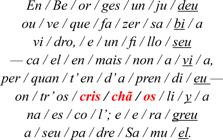
Below, we present an example taken from Cantiga de Santa Maria (CSM) 4. This text features only verses with seven poetic syllables, and upon scanning the poetry, we confirmed the findings of the researchers. It is important to note that poetic syllables are counted up to the last stressed syllable, which is why the final stresses in the verses are highlighted. In the example in (4), it is evident that to maintain seven poetic syllables in each verse, crischãos was segmented as cris-chã-os, since ãos was a hiatus in PA.
(4)12
Furthermore, Massini-Cagliari (1995, 1999) and Fonte (2011) reveal that the vowels in terms ending in -ãa, such as lãa [wool], vãa [vain], sãa [healthy], antivãa [antiphon], grãa [a type of cloth], and others, do not occupy the same syllable in the cantigas. This indicates that, in the medieval ancestor of Portuguese underpinning the analyzed cantigas, the final vowels of these words had not yet undergone contraction (crasis). Additionally, according to Fonte (2011), the endings -an/-am from Latin -ane were not conflated in the Cantigas de Santa Maria (CSM) with the ending -ãa, which resulted from the Latin ending -ana.
Data Collection and Analysis
A total of 1,368 words with vowels and diphthongs containing graphic markers of nasalization were collected from the 250 poems that make up the corpus. Of this total, 1,185 words belong to the religious songs, and 183 to the secular cantigas. Tables 1 and 2 present the list of words found. To facilitate visualization, repeated terms have been removed.
To analyze the nasalization of the words listed in Tables 1 and 2, this study will rely on etymology to uncover the origins of the nasal feature in the vowels and diphthongs of the language recorded in the cantigas. As previously mentioned, the process of nasalization occurs when the nasal feature is shared between neighboring syllables. Thus, in this article, we consider that the nasalization of such elements in troubadour Portuguese likely stems from nasal elements that were present nearby and, for various reasons, may have disappeared as consonants. Regarding the nasalization of the vowel <ã>, we have constructed the following table:
Regarding words written with the nasal vowel <ã>, all occurrences of nasalization originate from a nasal consonant present near the vowel in the word’s etymology or at some stage of its formation. As shown in Table 3, the terms listed previously contained a nasal consonant n in the following syllable, where the tilde is now located in the written forms of the cantigas. For example, vãydade [vanity] comes from the Latin vanitate, sãar [to heal] derives from the Latin sanare, and so on. In this way, the archaic stage of Portuguese preserved the nasal feature present in the origin of these words, which later underwent various changes over time.
In some cases, such as gãar [to win] and estrãya/o [strange one], the Latin nasal feature was palatalized, giving rise to ganhar and estranha/o. Other terms retained the nasal consonant n from Latin, preserving it into modern forms like mãefestou/manifestou [manifested] and esvãeçeu/desvanecer [disappeared]. However, in some instances, the nasalization that still existed in AP was lost in the transition to Brazilian Portuguese, as seen in vaidade [vanity]. The term afã [effort] has maintained its archaic configuration to this day, while eãyo and alermã did not survive into contemporary Brazilian Portuguese.
Next, we detail the etymology of words written with <ẽ>:
As with words containing the nasal vowel <ã>, many of the words with <ẽ> result from the loss of the intervocalic nasal consonant <n> in Latin. With the disappearance of this segment, the nasal feature was transferred to the preceding vowel, as shown in Panel 4. This phenomenon was observed in the vast majority of the words listed in the table, except for amercẽar, which stands out due to its different origin. This word was not found in any of the consulted etymological dictionaries. Houaiss (2009), however, presents the term’s etymology as being a + mercê + ar. This description, however, does not account for the nasal feature present in amercẽar. When analyzing the context in which this word appears in Cantiga de Santa Maria 93, we find:
(5)13

Amercẽar rhymes with sãar in the stanza transcribed earlier in (5). Sãar (modern sanar, meaning “to heal”) derives from the Latin sanare. Therefore, the nasalization present in the Latin form (represented by the intervocalic consonant n) came to appear above the vowel in the first syllable of the word (sãar), preserving the nasal feature after the consonant n was lost. Although the origin of the term amercẽar [commiserate] is difficult to reconstruct, it can be considered that, at some point in its formation, a nasal consonant existed, which, upon disappearing, transferred its nasal feature to the vowel e.
Regarding words written with the vowels <ĩ> or <ỹ>, we compiled Panel 5:
Regarding the cases shown in Panel 5, the transfer of nasalization due to the earlier disappearance of the intervocalic element -n- remains the predominant phenomenon. It is important to note that some of the words with <ĩ> or <ỹ> are diminutives. According to Abreu (2012, p, p. 59), in the diminutive suffix of the medieval ancestor of Portuguese, the sound /i/ was represented by <y> in -ynno and -ỹo and by <i> in -inno and -ĩo. Thus, in AP, as the researcher explains, different letters were used to graphically represent the same sound, resulting in four distinct spellings for the suffix -inho.14 The /ɲ/ sound of this suffix was represented at that time by <nn/nh> or by a tilde placed over the preceding vowels <i> or <y>.
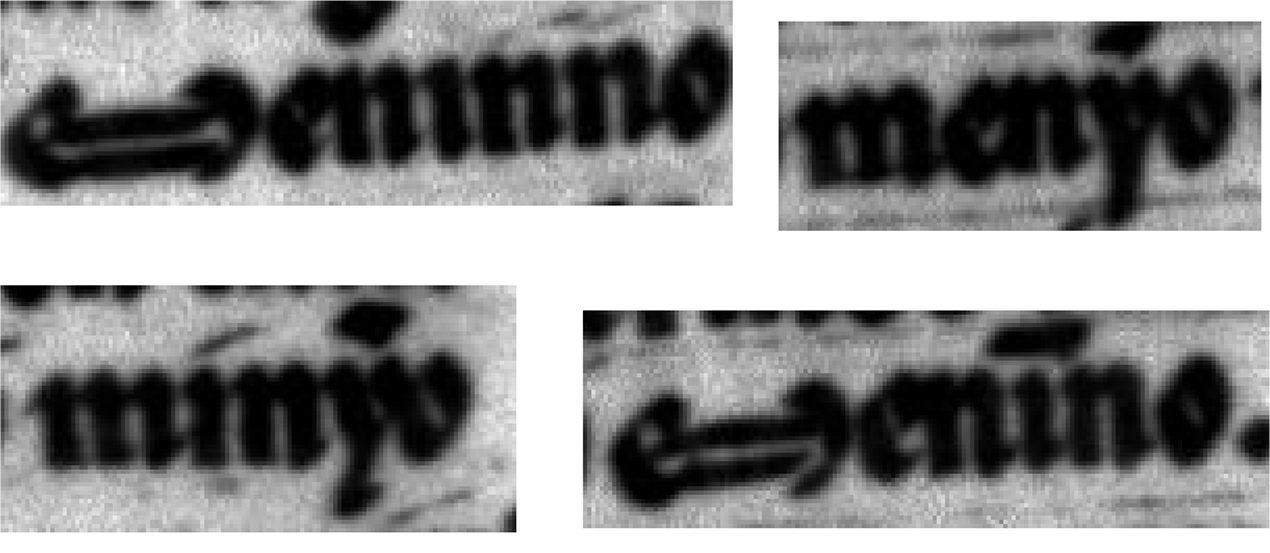
The ending -ĩo/-ỹo did not appear solely in diminutives in the medieval language. For instance, according to Mettmann (1972, p. 191), menĩo/menỹo are just some of the possible spellings for the word menino [boy] in medieval Portuguese. This term, derived from Latin minimu or meninu, as shown in Table 5, had many graphic representations at the time, including: meninno, mininno, menino, menyno, menĩo, minĩo, menỹo, minỹo, menĩno. These representations even varied within the same cantiga in the same codex. Below, we portray the written representations of the word menino found in the T codex. All cases were taken from a single poetic composition (Cantiga de Santa Maria 53).

Regarding the nasal vowel <õ>, the following occurrences were identified:
As with the other Panels, Panel 6 demonstrates that the nasalization of vowels in Archaic Portuguese, graphically represented by a tilde, originates from the historical roots of these terms, which, in the past, lost the intervocalic nasal consonant -n-. An interesting observation from the data listed in Panel 6 is that many of these words are feminine nouns which, during the medieval stage, had not yet lost their nasal feature. Ladrõa [thief, fem.], leõa [lioness], and varõa [woman?] in AP retained the nasalization present in their corresponding masculine forms: ladrão [thief, masc.], leão [lion], and varão [man]. Over time, these words lost the nasal feature of their masculine counterparts, as modern Portuguese now uses the spellings ladroa (or ladra), leoa, and varoa for their respective forms. The noun infançõa, the feminine form of infanção, retained its nasalization through an intervocalic nasal -n-. However, the spelling infançona appears in very few dictionaries and is rarely used in Modern Brazilian Portuguese (BP). For this term, the word fidalga [noblewoman] is used, devoid of nasal features.
Regarding the vowel <ũ>, we investigated the data listed in Panel 7:
Panel 7 once again supports what Camara Jr. (1979 [1975], p. 63) proposed: the nasalization observed in the words collected from the 250 medieval Galician-Portuguese cantigas that comprise our corpus (represented by a tilde over a vowel) corresponded to an abbreviation of “the n employed by medieval scribes.” As demonstrated, this consonant n was, in fact, part of the origin of the words, typically Latin.
For cases involving two consecutive identical vowels, where one bears a tilde, we compiled Panel 8:
Like Panel 6, Table 8 presents various feminine nouns that, due to their corresponding masculine forms (typically ending in -ão), still retained nasalization in AP. As seen in Panel 8, many masculine nouns ending in -ão in the troubadour language had corresponding feminine forms ending in -ãa, such as são/sãa. However, the ending -ãa was not exclusive to feminine words with a corresponding masculine form ending in -ão. Words like lãa [wool], rãa [frog], quintãa [manor], and maçãa [apple], for instance, do not have masculine counterparts and exist solely as feminine forms, carrying nasalization due to their often Latin origins. As in other panels, these terms originally had an intervocalic nasal -n- that disappeared over time. The vast majority of words listed in Panel 8 derive their nasal quality precisely from the loss of the Latin nasal -n-.
Two terms in Panel 8 differ from the others as they do not originate from an intervocalic nasal -n- following the vowel that bears the tilde in PA: remĩir and mẽesmo. Remĩir (modern redimir, meaning “to redeem”) derives from Latin redimere, while mẽesmo (modern mesmo, meaning “same”) comes from Latin metipsimu. For the latter term, Mettmann (1972, p. 190) clarifies that in archaic songbooks, the form menesmo alternated with mẽesmo, which explains the tilde in mẽesmo.
However, regarding the word remĩir, the only variation in spelling found in the codices was the loss of the tilde: remĩir appears as remiir in the T codex. Nascentes (1955, 1966) shows that this term was represented as remiir or reimir in PA. Thus, while reconstructing the historical trajectory of this term is challenging due to limited documentation, it can be understood that the nasalization of remĩir likely emerged during the transition from Latin to the spoken language of the troubadour period, a time when spellings with and without a tilde coexisted.
Finally, we present Panels 9 and 10, which list all cases of <ão/ãos> and <ões>. It is worth noting that during the period studied, these endings were not yet diphthongs but rather hiatuses.
Regarding words ending in <ão/ãos> and <ões>, it is evident that, beyond cases where the Latin intervocalic -n- was lost in the transition to AP, several words originated from terms with the ending -on. In some of the cases presented in Tables 9 and 10, it was not possible to trace the term’s earliest origin; however, at least part of its developmental path was identified. In the mapped fragments, it was observed that the nasalization present in AP derived from earlier stages, consistently represented in Latin writing by the nasal element n, which, when it disappearing, transferred its nasal feature to the preceding vowel.
Final considerations
This study, although focused on the medieval ancestor of Portuguese, constituted a historical investigation of terms with vowels and diphthongs that exhibited typical graphic markers for nasalization (tilde or nasal consonants). By examining the origins of words from the troubadour period, we were able to understand that the tilde, previously used graphically to represent the abbreviation of a suppressed nasal consonant, does not merely represent the nasalization of the vowel or diphthong in AP. Instead, it symbolizes the loss of a nasal n element that once followed the vowel.
Through the analysis of graphic variation, rhymes, and the origins of words where vowels and diphthongs with representative graphic markers of nasalization appear, it was possible to determine that nasalization in AP, represented in writing by the tilde, is the result of the presence of a nasal n consonant in the origin of these words. This consonant, typically derived from Latin and occupying an intervocalic position within the word, disappeared and transferred its nasal feature to the preceding vowel in the syllable. It is worth noting that the tilde, while still potentially representing at that time the abbreviation of a nasal consonant element in the syllabic coda, had undoubtedly come to symbolize at least some degree of vowel nasalization (or vowel nasalization in diphthongs)15 during the medieval period of the Portuguese language.
Thus, this research aligns with the conceptions of Camara Jr. (1985 [1970]) and Wetzels (1997) regarding the configuration of nasal vowels in Portuguese, understanding such vowels as comprising a combination of a vowel and a nasal segment. Consequently, syllables with nasal vowels behave as closed by a consonantal element. This definition proves accurate when examining the origins of AP words, as demonstrated throughout this study.
Acknowledgements
The Authors wish to thank Fapesp (Processo: 2022/09590-4) and CNPq (Processo: 304657/2023-9) for funding this research.
References
- ABREU, T. H. Estudo das formas aumentativas e diminutivas em português arcaico. 2012. Dissertação (Mestrado em Linguística) - Faculdade de Ciências e Letras, Universidade Estadual Paulista, Araraquara, 2012.
- AFONSO X O SABIO. Cantigas de Santa María: edición facsímile do Códice de Toledo (To). Biblioteca Nacional de Madrid (Ms. 10.069). Vigo: Consello da Cultura Galega, Galáxia, 2003.
- BARRETO, D. A. R. J.; MASSINI-CAGLIARI, G. (no prelo) Análise do status fonológico das consoantes róticas, laterais e nasais duplas do português arcaico. Aceito para publicação em Alfa, Revista de Linguística. Unesp.
- BIAGIONI, A. B. A sílaba em português arcaico. Araraquara, 2002. Dissertação (Mestrado em Linguística) - Faculdade de Ciências e Letras, Universidade Estadual Paulista, Araraquara, 2002.
- BISOL, L. O ditongo na perspectiva da fonologia atual. D.E.L.T.A., São Paulo, v. 5, n. 2, p. 185-224, 1989.
- BISOL, L. Fonologia da nasalização. In: ABAURRE, M. B. M. Gramática do português culto falado no Brasil: volume VII: a construção fonológica da palavra. Coordenador-geral: Ataliba T. de Castilho. (org.). São Paulo: Contexto, 2013. p. 113-140.
- BUENO, F da S. Antologia Arcaica: trechos, em prosa e verso, coligidos em obras do século VIII ao século XVI. São Paulo: Indústria Gráfica Saraiva, 1968.
- CAMARA JR, J. M. História e Estrutura da Língua Portuguesa. 3. ed. Rio de Janeiro: Padrão, 1979. [1ª edição brasileira: 1975]
- CAMARA JUNIOR, J. M. Estrutura da língua portuguesa. 15. ed. Petrópolis: Vozes, 1985. [1ª ed. 1970]
- CAMARA JUNIOR, J. M. Estrutura da língua portuguesa. Edição crítica. 1. ed. Petrópolis: Vozes, 2019.
- COROMINAS, J. Breve diccionario etimológico de la lengua castellana. 4. ed. Madrid: Gredos, 1987. [1ª ed. 1961]
- FONTE, J. S. As terminações nasais do português antigo. Revista Moara, Estudos Linguísticos, n. 36, jul.-dez. 2011.
- GRANUCCI, P. M. F. O sistema vocálico do português arcaico: um estudo a partir das rimas das cantigas de amigo. 2001. Dissertação (Mestrado em Linguística) - Faculdade de Ciências e Letras, Universidade Estadual Paulista, Araraquara, 2001.
- HOUAISS. Dicionário eletrônico Houaiss da língua portuguesa. Rio de Janeiro: Objetiva, 2009.
- LEÃO, Â. V. Cantigas de Santa Maria de Afonso X, o sábio Aspectos culturais literários. São Paulo: Linear B; Belo Horizonte: Veredas & Cenários, 2007.
-
LOPES, G. V.; FERREIRA, M. P. et al. (2011-), Cantigas Medievais Galego Portuguesas [base de dados online]. Lisboa: Instituto de Estudos Medievais, FCSH/NOVA. Disponível em: http://cantigas.fcsh.unl.pt Acesso em: 30 mar. 2024.
» http://cantigas.fcsh.unl.pt - MASSINI-CAGLIARI, G. Cantigas de amigo: do ritmo poético ao linguístico. Um estudo do percurso histórico da acentuação em Português. Campinas, 1995. Tese (Doutorado em Linguística) - Instituto de Estudos da Linguagem, Universidade Estadual de Campinas, Campinas, 1995.
- MASSINI-CAGLIARI, G. Escrita do Cancioneiro da Biblioteca Nacional de Lisboa: fonética ou ortográfica? Filologia e Linguística Portuguesa, São Paulo, n. 2, p. 159-178, 1998.
- MASSINI-CAGLIARI, G. Do poético ao lingüístico no ritmo dos trovadores: três momentos da história do acento. Araraquara: FCL, Laboratório Editorial, UNESP; São Paulo: Cultura Acadêmica, 1999.
- MASSINI-CAGLIARI, G. Cancioneiros Medievais Galego-Portugueses. Fontes, edições e estrutura. São Paulo: WMF Martins Fontes, 2007.
- MASSINI-CAGLIARI, G. A música da fala dos trovadores: desvendando a prosódia medieval. 1. ed. São Paulo: Editora UNESP Digital, 2015.
- MAIA, C. de A. História do Galego-Português: estado linguístico da Galiza e do Noroeste de Portugal desde o século XIII ao século XVI (Com referência à situação do galego moderno). Coimbra: INIC, 1986.
- MATTOS E SILVA, R. V. O português arcaico: fonologia, morfologia e sintaxe. São Paulo: Contexto, 2006.
- METTMANN, W. Glossário. In: AFONSO X, O SÁBIO. Cantigas de Santa Maria. Coimbra: Universidade, 1972. v.IV: Glossário.
- METTMANN, W. (org.). Cantigas de Santa María (cantigas 1 a 100): Alfonso X, el Sabio. Madrid: Castalia, 1986.
- MONGELLI, L. M. Fremosos cantares: Antologia da lírica medieval galego-portuguesa. São Paulo: Editora WMF Martins Fontes, 2009.
- MORAES, J. A. de. Produção e percepção das vogais nasais. In: ABAURRE, M. B. M. Gramática do português culto falado no Brasil: volume VII: a construção fonológica da palavra. Coordenador-geral: Ataliba T. de Castilho. (org.). São Paulo: Contexto, 2013. p. 95-112.
- NASCENTES, A. Dicionário Etimológico da Língua Portuguesa Com prefácio de W. MEYER LÜBKE, Professor jubilado da Universidade de Bonn. Rio de Janeiro, 1955.
- NASCENTES, A. Dicionário Etimológico Resumido. Coleção: Dicionários Especializados. Instituto Nacional do Livro. Ministério da Educação e Cultura, 1966.
- NUNES, J. J. Crestomatia Arcaica: Excertos da Literatura Portuguesa desde o que de mais antigo se conhece até ao Século XVI, acompanhados de Introdução Gramatical, Notas e Glossário. 7ª ed. Lisboa: Livraria Clássica Editora, 1970.
- PARKINSON, S. Final nasals in the Galician-Portuguese cancioneiros. In: MACKENZIE, D. & MICHAEL, I. (ed.). Hispanic Studies in Honour of F. W. Hodcroft. Llangrannog: The Dolphin Book Co., 1993. p. 51-62.
- PARKINSON, S. Aspectos teóricos da história das vogais nasais portuguesas. Actas do XII Encontro Nacional da Associação Portuguesa de Lingüística. Braga-Guimarães 1996. Lisboa: APL, 1997. vol. II. p. 253-272.
- PARKINSON, S. As Cantigas de Santa Maria: estado das cuestións textuais. Anuario de estudios literarios galegos, 1998, p. 179-205.
- TEYSSIER, P. História da língua portuguesa 6. ed. portuguesa. Lisboa: Sá da Costa, 1994.
- VENÂNCIO, F. Assim nasceu uma língua. São Paulo: Tinta da China, 2019.
- WETZELS, W. L. The lexical representation of nasality in Brazilian Portuguese. Probus, p. 01-34, fev. 1997.
-
1
Although Venâncio (2019) questioned the use of the term “Archaic Portuguese” to designate the ancestor of Portuguese, arguing that it would be more accurate to use “Galician,” since the language originated in Galicia, the discussion of the appropriateness of the label given to the language/languages of the Iberian Peninsula at the time is beyond the scope of this work.
-
2
The criteria used to select the secular works are based on the work of Massini-Cagliari (2015) and include representativeness (choosing texts from authors of different periods), location, and social class.
-
3
Original in Portuguese: Caracteriza a documentação escrita dessa época a variação. Não apenas variação na grafia – as primeiras propostas de ortografia para o português se iniciam nos meados do século XVI – mas também a variação na morfologia e na sintaxe. Pela variação gráfica se podem depreender indícios de realizações fônicas conviventes e pela variação morfológica e sintática podem ser percebidas possibilidades estruturais, então em uso, que são indicadores para mudanças que depois vieram a ocorrer e que, a partir da normatização gramatical, a documentação escrita exclui, já que serão sempre algumas das variantes as selecionadas para o uso escrito normativizado das línguas. Com isso queremos pôr em destaque o fato de que o texto escrito do período arcaico se aproxima, em geral, mais da fala do que os textos escritos posteriores à normativização gramatical (Mattos e Silva, 2006, p. 17).
-
4
Massini-Cagliari (1998) explains that the writing of Archaic Portuguese was based on Latin, which comprised orthographic rather than phonetic spelling. Therefore, various forces governed the AP system, which could not be considered purely phonetic. Among such characteristics, Massini-Cagliari (1998, p. 162) notes that certain sounds, such as [ɲ] and [i], had multiple graphic representations, as different graphemes could symbolize the same sound. Moreover, the same letter could represent distinct sounds, such as the grapheme <i>, which, according to the author’s hypothesis, could signify the sound [i] and the voiced palatal fricative [ʒ].
-
5
It is important to highlight that the data from that historical period come from manuscripts from different times. The codices that have survived to this day are all copies or copies of copies. Therefore, none of them is the original of the cantigas (Massini-Cagliari, 2007).
-
6
For the CSM, Mettmann (1986) was used, and for the secular works, Lopes and Ferreira et al. (2011-) was adopted.
-
7
Massini-Cagliari (2015) explains that decisive features of the original version, such as data on graphic variations, may have been erased in an updated version after the application of more modern orthographic standards. Therefore, the use of primary sources is essential for this research.
-
8
Original in Portuguese: é preciso assinalar, portanto, que uma nasalidade como junta, oposto a juta, ou de cinto, oposto a cito, ou de lenda, oposto a leda, e assim por diante, não se deve confundir com uma pronúncia levemente nasal da primeira vogal de amo, ou de cimo, ou de uma, ou de tema etc., em que o falante tende a antecipar o abaixamento do véu palatino, necessário à emissão da consoante na sílaba seguinte, e emite já nasalada a vogal precedente. Aí, não há oposição entre a vogal nasalada e a vogal, também possível, sem qualquer nasalação. Com a nasalação, ou sem ela, aparecerão sempre as mesmas formas vocabulares, ano, cimo, uma, tema etc. (Câmara Jr., 1985[1970]), p. 47).
-
9
Camara Jr. (1985 [1970], p. 60) argues that this interpretation also applies to the nasal diphthongs in Portuguese, meaning that diphthongs are composed of a sequence of two vowels + a nasal archiphoneme. For example, in muito [much] the diphthong is represented as: /uiN/.
-
10
Transcription of the verses, according to Mettmann (1986, p, p. 150): muit’ amar devemos en nossas voontades / a Sennor, que coitas nos toll’ e tempestades. / Quand’ aquest’ oyron dizer a aquel sant’ abade, / enton todos dun coraçon e dũa voontade. (we must love greatly in our wills / the Lady, who takes away our troubles and storms. / When they heard this said by that holy abbot, / then all with one heart and one will.)
-
11
According to Bisol (1989, p, p. 205), ão is a true diphthong in Portuguese, occupying (at least) two positions in the rhyme of the syllable, meaning it has a branched rhyme in the underlying structure.
-
12
Transcription of the verses, according to Kulp-Hill (2000, p. 6): In Bourges there was a Jew who made glass. A son of this, the only one he had as nearly as I could determine, studied in the school among Christians, which grieved his Father Samuel.
-
13
Transcription of the verses, according to Kulp-Hill (2000, p. 6): While he was there, he began to say a thousand “Ave Marias” to please the Mother of God so that She might have pity and compassion and show him mercy.
-
14
It is worth noting that the palatal nasal consonant /ɲ/, represented in modern BP writing as <nh>, could be written in two ways: <nn> or <nh>. The <nn> form predominantly appears in the Cantigas de Santa Maria (CSM). In secular works, <nn> is more common in the Cancioneiro da Ajuda (CA), which is older, like the CSM; the Cancioneiro da Biblioteca Nacional (CBN) and the Cancioneiro da Vaticana (CV) feature both spellings.
-
15
On the function of the tilde as a graphic representation of vowel nasalization in the medieval ancestor of Portuguese, see Barreto and Massini-Cagliari (forthcoming).
-
Data Availability Statement
All datasets supporting the findings of this study have been published within the article itself.
-
Editor responsible:
Gisele Cássia de Sousa
All datasets supporting the findings of this study have been published within the article itself.

 Source: adapted from
  Source: Facsimile Edition of the Toledo Codex (2003, p. 48v)
 Source: adapted from
  Source:
  Source: adapted from
  Source:
  Source: Microfilm of the Escorial Rico codex, provided by the Library of the Monastery of El Escorial. This microfilm is part of the archive of the research group “Phonology of Portuguese: Archaic & Brazilian”