
 SEED-BORNE FUNGI OF SOME TROPICAL ORNAMENTAL PLANTS
SUMMARY
The paper describes and illustates seed-bome fungi of 23 tropical commercial ornamental plant seeds collected from different sources for a period of 3 years. Both blotter test and aær plate test were conducted to study both external and internal fungi of seeds and other floral parts. The seeds of the 23 plants studied were carrying various fungi.
The distribution and types of various fungi encountered in these studies are discussed.
KEY-WORDS
Seed-borne fungi; ornamental plants.
RESUMO
O tabalho descreve e ilustra fungos de sementes de 23 plantas ornamentais econömicas de clima tropical, coletadas de diferentes locais durante trés anos. Testes de sanidade pelos métodos de papel de filtro ("blotter-method") e cultivo em ågar ("agar plating") foram conduzidos para estudar fungos locdizados interna e externamente nas sementes e outras partes florais. As sementes das 23 Dlantas estudadas veiculavam fungos. A distribuigäo e as espécies de rungos encontrados nesses estudos säo discutidas.
PALAVRAS-CHAVE:
Fungos de sementes; plantas omamentais.
INTRODUCTION
The objective of this study was to investigate various aspects of stored seed samples of omamental plants carrying fungal infections, and their inoculum components like conidia, sclerotia, chlamydospores, dormant mycelium fragments etc. The seed material included in the present study was of economic sigiificance, since such ornamental plants are grown on a large scale for commercial purposes. From the literature it showed that the seed-borne fungi of many om ntal plants are not fully investigated, especiall from the tropics (1, 2, 6, 16, 17). NEERGAARD, in a 1977 survey (14), pointed out that very few seed-bome pathogens could be detected in arid or semi-arid regons, but that these are present abundantly in rainy seasons or areas. Those fungi that are frequently found on seeds of ornamental plants are in their imperfect state, rarely in perfect state.
MATERIAL AND NETHODS
In the present study 23 seed samples have been screened for seed-bome fungi. In all cases, random sample of 100 seeds were picked from each seed sample and equally distributed into four replicates (each with 25 seeds). The seed samples were collected from the university ornamental garden stores and the local seed suplliers in small quantities (25 g), in separate polythene bags. The most commonly used techniques for the detection of seed-bome fungi were adopted: a) Blotter test (BT) (7) and b) Agar plate test (APT) (12, 13, 15). In BT method seeds were incubated on a moist blotter paper (Whatman No. 42) at 24°C and observed after 48 hous thereon. In case of APT seeds were surface sterilized with 0.01 percent mercuric chloride for 1 minute, washed with sterilized distilled water and were placed on potato dextrose agar (PDA) media and in•cubated at 24°C. All samples were examined by stereo zoom binocular microscope (Bausch and Lomb-7x-30x) for top growth and pycnidial structures etc. on seeds and photomicrographs were taken.
RESULTS AND DISCUSSION
The mycoflora of seeds, particularly the phytopathogenic composition types of fungi and distribution has been studied and the results obtained thereon are presented (Tab. 1 and Fig. A-B). The 23 omamgntal plant seeds studied were found to be contaminated with various fungi. Among these, in plants like Calenåzla officinalis L. and Gerbera jamesonii Bolus, seeds were completely deteriorated with Alternaia dianåzicola Neerg. (8, 16) and Fuscium conmlor Reinkng. (=F. roseunt Link) (4,5) respectively (Fig. A-I and Fig. B4).


External and internal seed-borne fungi of some tropical ornamental plants detected by the blotter and agar plate methods.
Seeds contamination due to species of Alta•nria dianthimla, Alternaia tenuis Nees., Altana•ia zinniae Pape. and Fusarium oxyspæum Schl. ex Fr. was found to be of common occurrence on many seeds (Fig. A-2 to 5,9 and Fig. B-2) with percentage rangng from 4 to 21. Preemergence dampingoff of seedlings in case of Impaiaas balsamina L. was due to Fuscium oxysporum which at first appeared on the seed coat (Fig. B-6), but complete invasion by the pathogen occurred after germination, and resulted in wilting of the seedlings. The other interesting observation was that of Curvalariata (Wakker) Boedijn. infection (Fig. A-7); this fungus was highly pathogenic to the seedlings of %'ia officinalis and Delphinüm ajacis L. , which developed typical damping-off within 4-5 days of germination. Other fungi encountered were homa glomeata (Corda) W & H (Fig. B"), Phoma exigua Desm. (Fig. B-8) and Colletotrichum gloeosporioides (Penz) Sacc.
With agar plate test direct isolation was resorted to by planting the seeds on PDA ms was made to recover any other fung being associated and not developed on wet blotter paper. The surface sterilized seeds were mostly free from many of the commonly associated molds. Further, the seeds carrying fungi at sub layers readily germinated and showed infection, especially by forms like Fuurium oxysporum on Ebenus umbellata L., Colletotrichum gloeæ sg»rioides and Phytophthora palmivora Butler. on Gerbera jamesonii and Phonu exigu on Gaillardia pulchella Foug., which firmly adhere to the seed coat and remained 'in-situ' even after repeated mild washing with sterilized distilled water. Apart from these, the floral parts like ovary, corolla, bracts and seed appendages also carried fung (Fig. A-2,3 Fig. m, 7, 8). The surface sterilized seeds on agar plate test did show the seed-borne nature of a few fungi (Tab. 1). Further study showed that some of the fungi which were associated with the seed material and appendages are also responsible for inciting diseases on the foliage, flowers, twigs and branches (3, 6, 16).
ACKNOWLEDGEMENT
The authors are gateful to Dr. Paul Neergrd, Director, Danish Govemment, Institute of Seed Patholow for Developing Countries, Denmark, for the suggestions during the preparation of the manuscript. The senior author acknowledges Department of Science & Technology (Govt. of India) for providing financial assistance. The present paper is a part of the Ph.D. thesis submitted to University of Poona.
REFERENCES
- 1 BMCR, K.F. Patholog of flower seeds. Seed sci & Tech., 8: 575-89, 1980.
- 2 BASS, L.V. Flower seed storage. Seed & Tech., a: 591-9, 1980.
- 3 BAKER, J.J. Report on diseases of cultivated plants in Engand and Wales for the years 1957-68. Tech. Bull No. 25, 322p. HMSO. Publ. London, 1972.
- 4 BOOlH, C. Toe Genus Fusarlum. CMI. Publ. Kew, England, 237p., 1971.
- 5 BOOTH, C. Fuscium. Laboratory guide to the identification of the major vecies. CMI. Kew, England. 58p., with 112 fig., 1977.
- 6 DAYAKAR YADAV, B.R. & RAO, V.G. Fungal diseases of ornamental plants from Maharashtra (India). J. Univ. Poona, SCL & Tech., 54: 179-96, 1981.
- 7 DE TEMPE, J. Comparison of methods of seed health testing. Proc Int Seed Test Assn, 28: 97-105, 1962.
- 8 ELLIS, M.E. Demaüceous Hyphomycetes. CMI. Publ. Kew, England. 1971.
- 9 GREGG, B.R. Seed processing in the tropics. Seed Sci & Tech., 11: 19-39, 1983.
- 10 HARMAN, G.E., HEIT, C.L. & BRAVEMAN, S. W. Seed-borne fungi of fresh Antirrhinum majus R Dis. Reptr., 55: 63942, 1971.
- 11 KULSHRESTHA, D.D. Colletotrichum aeulatum - A new seed-borne pathogen of Zinnk Cum Sci, 45: 64, 1976.
- 12 MUSKETT, A.E. & MALONE, J.P. The ulster method for the exarnination of flax seed for the presence of seed-borne parasites. Ann. Bioz, 28: 13, 1941.
- 13 MUSKETT, A.E. Technique for the examination of seeds for the presence of seed-bome fung. TBMS 39:74-83, 1948.
- 14 NEERGAARD, P. Seed Patholow vol. 1 & IL MacMillan Press Ltd., London and Basingstoke, 1187p., 1977.
- 15 NOBEL, M. Introduction to series 3 of the hand book on seed health testing. Int. Seed Test Am, 30: 1045-115, 1965.
- 16 RICHARDSON, M.J. An annotated list of seedborne diseases. 3rd Edition. Phytopathological papers No. 23. 320p. CAB Publ. London, 1979.
- 17 SURYANARAYANA, D. & BHOMBE, LB. Studies on the funæl flora of some vegetable seeds. Indian phytopathol., 14: 3041, 1961.

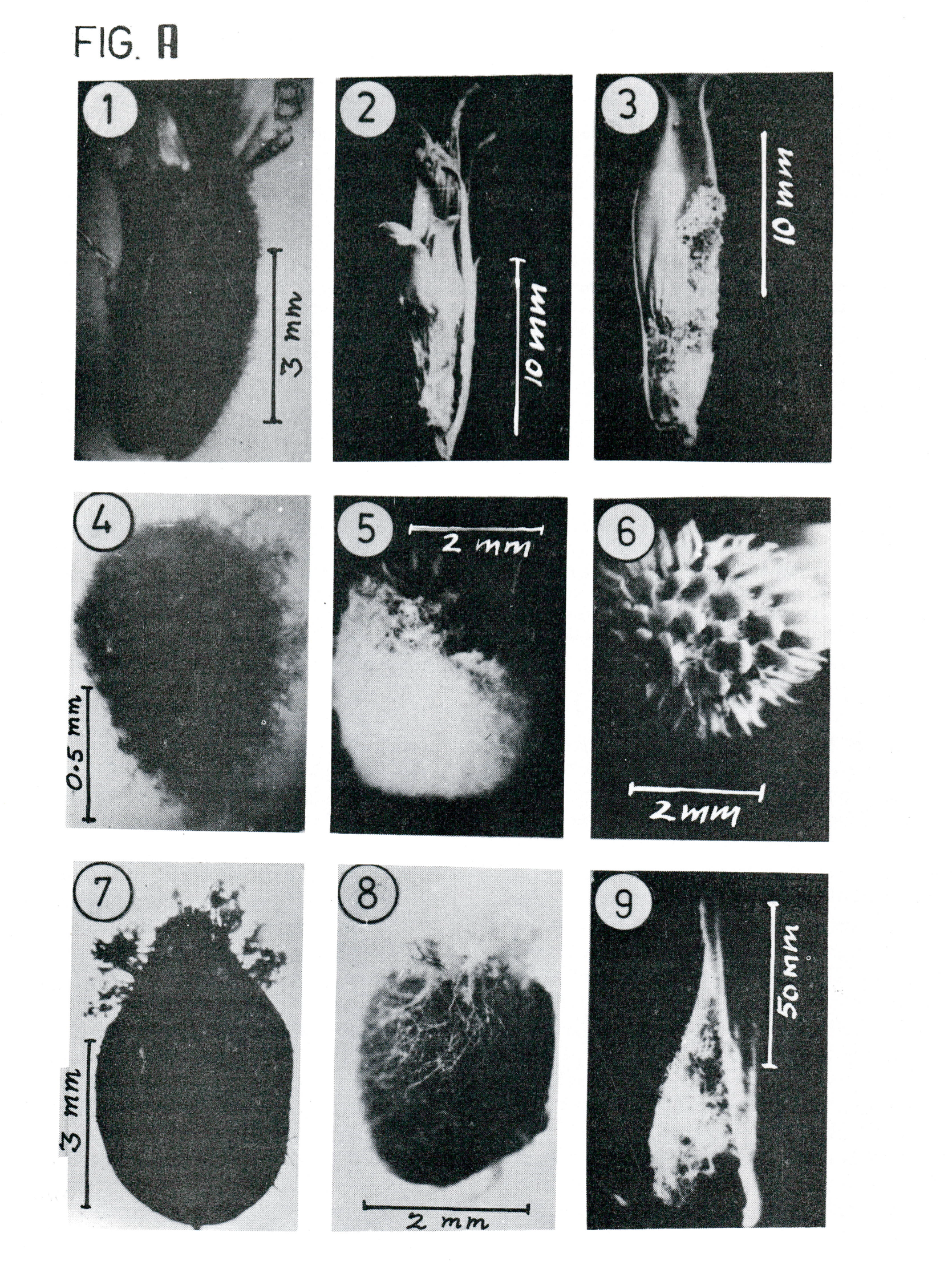 1. Alternaria dianthicola on Calendula officinalis seed. 2 - 3. Fusarium oxysporum on Dianthus caryophyllus ovary. 4. Alternæia dianthicola on Antirrhinum majus seed. 5. Fuurium oxysporum on Crossandm infundibuliformis seed. 6. Normal seed of Crossandra infundibuliformis. 7. Curvularia lunata on Salvia officinalis seed. 8. Mycelia mat of Alternaria sp. on Salvia officinalis seed. 9. Fusarium oxysporum on Tagetus erecta seed.
 1. Alternæia dianthi on Dianthus caryophyllus corola. 2. Fusarium oxysporum on Dianthus azryophyllus seed (normal seed above). 3. Pycnidial structur on Ebenus umbellata seed. 4. Fusarium oxysporum on Gerbera jamesonni seed. 5. Alternaria zinniae on Chrysanthemum indicum seed. 6. Fusarium oxysporum on Impatiens balsamina seed. 7. Pycnidial bodies on GaiUarü pulåeUa seed appendage. 8. homa exigua on Oossandm infundibuliformis bracts.