
 Sugarcane isolated endophytic fungi and their pathogenicity in adult Sphenophorus levis Vaurie (Coleoptera: Curculionidae)
ABSTRACT
Trichoderma sp., Fusarium sp., Beauveria sp., and Cordyceps sp. are among the most frequently reported endophytic fungi in sugarcane, a crop severely affected by the sugarcane weevil, Sphenophorus levis. This study aimed to isolate endophytic fungi from commercial sugarcane fields and evaluate their pathogenicity against S. levis. Two sampling campaigns were conducted in 2022 in three municipalities of São Paulo State, Brazil (Sertãozinho, Araras, and Paraguaçu Paulista). Leaf and root samples were surface-sterilized, disinfected, and plated on potato dextrose agar (PDA), followed by incubation at 26 ± 1°C for five days. Isolates were initially characterized based on macroscopic traits and subsequently identified using molecular techniques. Pathogenicity bioassays were performed with adult S. levis (10–40 days old) in a completely randomized design consisting of five treatments (four conidial concentrations: 1×10⁶, 1×10⁷, 1×10⁸, and 5×10⁸ conidia/mL, plus a sterile water control), five replicates per treatment, and five insects per replicate. Mortality was recorded daily for seven days and analyzed by analysis of variance followed by Tukey’s test (p 0.05). The identified species included Beauveria bassiana, Fusarium oxysporum, Penicillium chrysogenum, Trichosporon asahii, Aspergillus sojae, and Fusarium andiyazi. Among them, F. oxysporum exhibited the highest pathogenicity, causing significantly greater mortality at all tested concentrations. These findings highlight the potential of sugarcane-associated endophytic fungi as promising biological control agents against S. levis.
Keywords
Fusarium oxysporum
; mortality; beetle; molecular assessment
INTRODUCTION
Sugarcane crops are of great economic importance to Brazil, and São Paulo State accounts for approximately 60% of the national production (CONAB, 2024; ÚNICA, 2024). The enactment of State Law No. 11,241/2002 was a milestone in this crop’s management, since it prohibits straw burning before harvest. Although this measure improved soil quality, it also brought along a significant agronomic challenge, i.e., leaving the straw on the soil without causing any further damage. This vegetation cover favors the emergence of subterranean pests, including the beetle Sphenophorus levis, which is one of the most harmful pests for sugarcane crops. This beetle’s population has been significantly growing in sugarcane crops, despite its low mobility in the field (Dinardo-Miranda, 2014; Pereira; Santos, 2022).
Damage caused by S. levis is significant because it affects plants’ root systems and compromises their development and nutrient absorption. This situation often leads to the need for early replanting, which increases production costs (Giometti et al., 2011; Casteliani et al., 2020). Pest management is hampered by this species’ holometabolous life cycle and cryptic habits at the larval stage. Furthermore, besides the risk of resistance (Satyanarayana et al., 2024), chemical control has limitations. Previous studies have reported low pest mortality, even after the application of higher doses of it (Ferreira et al., 2024).
Interest in sustainable management alternatives is growing due to the aforementioned obstacles. Thus, biological control through entomopathogenic fungi application emerges as a promising strategy (Alves et al., 2008; Pereira et al., 2021; Pereira et al., 2023). Endophytic fungi, in particular, which inhabit internal plant tissues and cause damage, stand out for their multifunctional potential. They can act in pests’ biological control against pathogens and help plant growth, in addition to increasing tolerance to environmental stress (Fors et al., 2020; Silva et al., 2024). Species like Daldinia eschscholzii and Trichoderma sp. are already known for presenting these features (Sektiono et al., 2023; Asniah; Taufik, 2025).
Accordingly, favorable opportunities for the development of biological solutions and for investigations focused on assessing these microorganisms’ pathogenicity have arisen, and they can provide important support to future biological control strategies aimed at this and other pests. This scenario corroborates bio-inputs market figures in Brazil that have recorded 15% sales growth in the 2023/2024 harvest (CROPLIFE BRASIL, 2024). However, studies on endophytic fungi’s pathogenic potential against soil pests, such as S. levis, are still scarce.
The present research aimed to collect endophytic fungi from sugarcane crops and assess the entomopathogenic potential of some isolates identified at the molecular level against adult S. levis under laboratory conditions.
MATERIAL AND METHODS
Collections
Leaf, root, and soil samples were collected from sugarcane crops in three São Paulo State regions in the 2022 rainy season (March and April), namely Usina Santo Antônio (USA), Boa Esperança Farm, and Sertãozinho City. Plot 24 was the chosen one; it covered 24 ha and was subdivided into a 12.28-ha area. Third-cut RB 85-5156 was the chosen plant variety. Sphenophorus levis infestation index at the time reached 17% at São João Plant (USJ), in São João Farm, rural zone of Araras, São Paulo State, Brazil. The chosen area (Plot 4) is located at zone 11004 and covers a 27.3-ha territory. A third-cut SP 80-3280 variety was the cultivated one, and this area presented 18% S. levis infestation index at collection time. The farm belongs to Agroterenas (AT), which is a Agroterenas S.A. subsidiary, Maracaí Unit, Paraguaçú Paulista, São Paulo State, Brazil. Plot 6 (7.7 ha) was the chosen one, and it was planted with the second-cut sugarcane variety CTC 9002; 40% S. levis infestation index was recorded at collection time. Two collections were conducted in each area, for a total of six. In total, 10 leaf and 10 root samples were collected during each collection, which totaled 60 leaf and 60 root samples.
Macroscopic and molecular assessment criteria
The following parameters were assessed for macroscopic analysis: front and rear color, texture, and topography (Carvalho; Pereira, 2016). Shoot mycelia height was observed for texture classification as follows: cotton (tall and dense shoot mycelium), velvety (low shoot mycelium), granular (flat and crumbly surface), and glabrous (without shoot mycelium/yeasts). Parameters used for colony topography assessment were rugose (deep furrows/rays from the center), umbilicate (central elevation), flat (no elevation, but starting from the center), and verrucous (wrinkled and twisted surface).
Endophytic fungi isolation
Recently collected endophytic fungi samples for fungi isolation purposes were subjected to surface disinfection. This procedure consisted of washing them in neutral detergent and running water to remove epiphytic microorganisms. Subsequently, plants were classified into 1–10 sugarcane mills, and a code was created for each mill. Then, samples were subjected to deep disinfection based on protocols by the Reference Laboratory Service in Biological Control of the Instituto Biológico de Campinas, São Paulo State, adapted from Araújo (2002) and Mello et al. (2011). This deep disinfection procedure was carried out in a laminar flow chamber through material immersion in 70% alcohol for 3 minutes. This procedure was followed by immersion in sodium hypochlorite (2.5% active chlorine) for 10 minutes and in 70% alcohol for 1 minute, and by two-round wash in autoclaved distilled water. One drop of this last solution was placed on a Petri dish filled with potato-dextrose-agar (PDA) medium and incubated in a biochemical oxygen demand (BOD)-type chamber at 26°C ± 1°C for seven days to assess disinfection effectiveness. Material fragments were dried on paper towels and cut to allow three leaf or root fragments (approximately 1.5 cm each) to be placed in Petri dishes filled with PDA culture medium. The plates filled with the material were stored in a BOD-type climate chamber at 26°C ± 1°C under a 12-hour photoperiod for four or five days, depending on the colony growth shown by different fungi. Each plate was labeled with a code showing the mill’s acronym, sugarcane number, replicate letter, and the number referring to the observed fungus (Fig. 1).
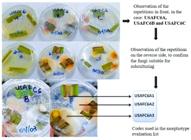
Flowchart for codes created for fungi macroscopic classification expressed after fragments were placed in a biochemical oxygen demand incubator at 26°C ± 1°C under a 12-hour photoperiod for four or five days.
A new subculture was performed to isolate each fungus after this stage. All morphotypes were assessed based on Carvalho; Pereira (2016). Fungi growing after five consecutive subcultures were stored at 18°C ± 1°C and subjected to a new macroscopic assessment. The original subculture plate was compared with the newly subcultured plate to observe any morphological differences. Then, they were sent for molecular analysis and identification.
Molecular analysis and species identification
The isolates were subcultured in triplicate for molecular analysis, and species were identified after the strains showing good colony formation were selected. Approximately 10-day-old colonies were arranged at three free-contamination points and sent (in duplicate) to a company expert in molecular identification. The identification method was based on sequencing common fungal markers, namely internal transcribed spacer (ITS) and elongation factor 1-alpha (TEF). Bio-editing was applied to the base sequencing, and species were determined by comparing the results of each sequencing based on the National Library of Medicinal Plants, National Center for Biotechnology Information (NCBI), and Blast.
Experiments with Sphenophorus levis adults
The following fungi were randomly selected based on the identified ones: endophytic fungus collected from leaves, USJFC6B1 sample’s morphotype 20, collection I, São João Mill, and fungi identified as Beauveria bassiana; the endophytic fungus Trichosporon asahii collected from leaves, ATFC5A2 sample’s morphotype 21, collection II, Agroterenas Mill; and endophytic fungus Fusarium oxysporum collected from roots, USARC10C2 sample’s morphotype 40, collection I, and Santo Antônio Mill. Fungi were subcultured on Petri dishes filled with PDA to get young colonies and conidia with higher feasibility probability for fungal suspension preparations. Treatment suspensions were water 1×10⁶, 1×10⁷, 1×10⁸, and 5×10⁸ conidia/mL. Immersion in a 1-mL fungal suspension for 60 seconds was the application method. In total, five treatments were run (including the control), with five replicates and five beetles per replicate. Mortality was monitored and recorded for seven days. The dead beetles were placed on sterile Petri dishes filled with hydrophilic cotton moistened in distilled water to simulate a humid chamber and stored in a BOD-type climate-controlled chamber at 26°C ± 1°C under a 12-hour photoperiod for seven days for sporulation observations.
Statistical analysis
Analysis of variance (ANOVA) followed by Tukey’s test (p < 0.5) was applied to the experiments run with adult S. levis and carried out in RStudio software.
RESULTS
Endophytic fungi isolation
It was possible to isolate 480 endophytes (leaves and roots) from collections I and II after macroscopic observation and morphological classification. Macroscopic observation of several genera was possible at this stage, namely: Beauveria sp., Rhizopus sp., Aspergillus sp., Fusarium sp., and Penicillium sp. However, most isolates did not keep on growing after five subcultures on PDA, which allowed identifying the genera presenting fastidious features. Thus, species identification through molecular biology was significantly smaller.
Molecular assessment and identified species
In total, 11 isolates were listed (Table 1) and sent for molecular analysis after macroscopic and colony growth condition assessments, after subculturing.
Sugarcane endophytic fungal leaf and root isolates from collections I and II were sent for molecular assessment.
Six of the samples sent for molecular assessment were different species, recording reliability level higher than 98%, according to comparison criteria set for results recorded for each sequencing based on the National Library of Medicine, NCBI, Blast (Table 2; Fig. 2).
Species identified after sugarcane leaf and root endophytic fungi from collections I and II were subjected to molecular analysis.

Fungi identified at species level: (a) Beauveria bassiana, (b) Penicillium chrysogenum, (c) Fusarium andiyazi, (d) Fusarium oxysporum, (e) Trichosporon asahii, (f) Aspergillus sojae.
Experiments with adult Sphenophorus levis
According to the results, the tested endophytic isolates presented different effects in response to different concentrations of applied spores. The dose-dependent response observed for USJFC6B1 and ATFC5A2 pointed out that treatments T2 and T5 concentrations were more effective. However, isolated USARC10C2 showed higher efficiency at all tested concentrations, and it pointed towards an effective option for biological S. levis control (Figs. 3 and 4).

Sphenophorus levis mortality after the application of fungal sugarcane endophytic fungi suspensions. Identical letters in the columns did not statistically differ from each other in the Tukey’s test (p < 0.5).

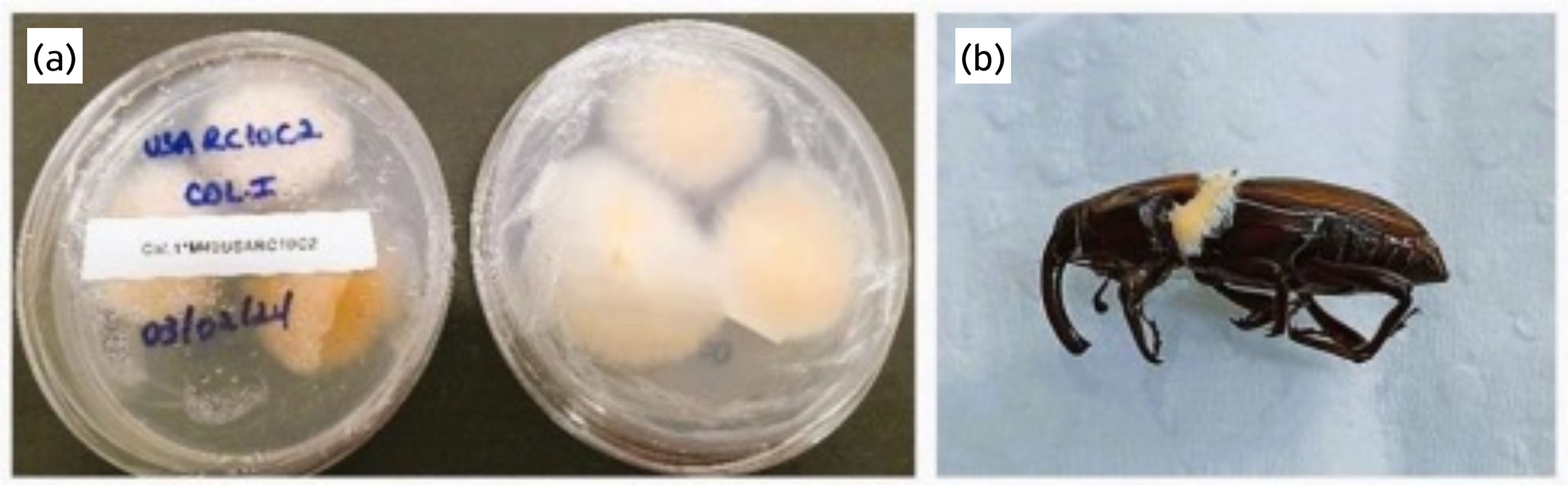
Endophytic fungus (species) collected from a sugarcane root: (a) Petri dish with colonies; (b) infected and sporulated adult Sphenophorus levis in an experiment.
DISCUSSION
Endophytic fungi
Endophytic fungi collection on sugarcane led to the isolation of a significant number of colonies (480), most of which did not develop after subculturing. The maintenance challenge emerged from these microorganisms’ specific requirements, such as the need for interactions with other microorganisms or with the host itself (Ishida et al., 2022; Duan et al., 2024). Colonies decline after five subculturing procedures, in combination with lower growth and changes in their morphological features, suggesting that many isolates were more endophytism dependent, which hindered their preservation in vitro. Species like Epicoccum nigrum show facultative endophytism. Therefore, they can live in or outside plants (Fávaro et al., 2012). There are complex interactions with bacteria affecting plant metabolism in some cases, such as “white root” formation associated with Dictyophora indusiata (Duan et al., 2024). Although many endophytes are adaptable, some of them seem to depend on specific conditions or partners to develop.
This finding can highlight requirements similar to those presented by fastidious organisms and justify most isolates’ decline recorded in the current study. Isolates that did not develop after subculturing also presented minute colonies with macroscopic features different from the initial ones. Isolates variability can be related to the environmental conditions around the plots and to the applied bio-inputs (Huang et al., 2020), because the samples were collected in a short period of time, in the rainy season. Diverse morphological variations in colony color corroborated these microorganisms’phenotypic plasticity (Bernardi Wenzel, 2012).
Despite endophytic fungi having significant potential for sugarcane health and yield, the small number of studies on these microorganisms’ interaction with hosts limits their use as biocontrol agents or biofertilizer (Kumar et al., 2018). Therefore, studies to clarify these fungi’s biodiversity and potential are essential to optimize their use in sustainable agriculture.
Molecular analysis
Fungi’s ubiquity is undeniable since fungi can be found in different ecosystems and on different hosts. Results of molecular analysis applied to strains from collections I and II pointed towards the prevalence of fungi belonging to the genus Fusarium sp., mainly the F. oxysporum species complex. Identification of high reliability (98 to 100%) stressed these strains’ adaptation to the sugarcane agricultural environment. Although Fusarium sp. is widely known for its phytopathogenic nature in several crops, its identification as an endophyte opens room for a dual function, namely: pathogen under certain conditions and endophyte under other ones. This finding reinforces the plant-microorganism interaction complexity and the need for further studies to better understand these dynamics (Michereff et al., 2005; Lucas et al., 2023). The presence of B. bassiana is another important finding. Beauveria bassiana is widely recognized for its effectiveness in controlling agricultural pests (Pereira et al., 2021) and may also have endophytic properties, a fact that could explain its occurrence in the samples. Thus, this species’ isolation on sugarcane can highlight its endophytic potential or adaptation boosted by bio-inputs application in crops. This outcome reinforces its role as a potential biocontrol agent in the local microbiota (Roswanjaya et al., 2021).
Experiments with Sphenophorus levis
Endophytic isolates showed different effects against adult S. levis in pathogenicity experiments. Surprisingly, F. oxysporum recorded higher mortality rates than B. bassiana. This finding contrasts with the traditional literature, which often pinpoints B. bassiana as a more robust biocontrol agent. The herein recorded B. bassiana lower efficacy points out the need for further research to optimize its application or isolation conditions. On the other hand, F. oxysporum’s higher mortality rates highlight that this strain may have developed adaptation mechanisms to act as a pathogenic endophyte in S. levis, although it is a causal agent of the disease in other crops (Quevedo et al., 2023).
Although the tested endophytic isolates showed good performance, it is important observing that results recorded under laboratory conditions may not be fully reproducible in the field due to environmental variability and plant-microorganism interactions. Therefore, adopting these isolates as bio-insecticides requires standardized application methods, persistent assessments, and proven compatibility with existing agricultural practices. Nevertheless, the results indicate these isolates potential, although it must be confirmed through further studies.
CONCLUSION
-
Endophytic fungus F. oxysporum showed higher pathogenicity against adult S. levis than B. bassiana in laboratory tests;
-
Further pathogenicity tests are needed to validate the use of the collected fungi as an effective bio-insecticide to control S. levis under field conditions.
ACKNOWLEDGEMENTS
Thanks to the Instituto Biológico de São Paulo and the Programa para Bioprodutos para Agricultura Tropical/Fundação de Desenvolvimento da Pesquisa do Agronegócio.
ETHICAL APPROVAL
DECLARATION OF USE OF ARTIFICIAL INTELLIGENCE TOOLS
FUNDING
AVAILABILITY OF DATA AND MATERIAL
The datasets generated and/or analyzed during the current study are available from the corresponding author on reasonable request.
REFERENCES
- ALVES, S.B.; LOPES, R.B. Fungos entomopatogênicos usados no controle de pragas na América Latina. In: ALVES, S.B.; LOPES, R.B. (Eds.). Controle microbiano de pragas na América Latina: avanços e desafios. Piracicaba: Fealq, 2008. p.69-110.
- ARAÚJO, W.L.; LIMA, A.D.S.; AZEVEDO, J.L.D.; MARCON, J.; SOBRAL, J.K.; LACAVA, P.T. Manual de isolamento de microrganismos endofíticos Piracicaba: Esalq, 2002.
-
ASNIAH, A.; TAUFIK, M. Morphological and molecular characteristics of endophytic fungi in sugarcane as antagonists of the pathogen Fusarium sacchari Journal of Global Innovations in Agricultural Sciences, v.13, n.1, p.181-192, 2025. https://doi.org/10.22194/jgias/25.1538
» https://doi.org/10.22194/jgias/25.1538 - BERNARDI WENZEL, J. Isolamento e atividade antagonística de fungos endofíticos de soja (Glycine max (L.) Merrill). SaBios, v.7, n.3, p.86-96, 2012.
-
CARVALHO, S.B.G.; PEREIRA, M. Fungos endofíticos em raízes de Prosthechea pachycepala (Orchidaceae) da Serra do Cipo – MG. Natureza online, Santa Tereza, v.15, n.1, p.50-58, 2016. Available from: https://naturezaonline.com.br/revista/article/view/86 Accessed on: Sep. 10, 2023.
» https://naturezaonline.com.br/revista/article/view/86 -
CASTELIANI, A.; MARTINS, L.F.; CARDOSO, J.F.M.; SILVA, M.S.O.; SILVA, R.S.A.; CHACON-OROZCO, J.G.; CASTELIANI, A.G.B.; PŮŽA, V.; HARAKAVA, R.; LEITE, L.G. Behavioral aspects of Sphenophorus levis (Coleoptera: Curculionidae), damage to sugarcane and its natural infection by Steinernema carpocapsae (Nematoda: Rhabditidae). Crop Protection, v. 137, 105262, 2020. https://doi.org/10.1016/j.cropro.2020.105262
» https://doi.org/10.1016/j.cropro.2020.105262 -
CONAB – Companhia Nacional de Abastecimento. Produção de cana-de-açúcar é estimada em 689,8 milhões de toneladas na safra 2024/2025 Brazil: CONAB, 2024. Available from: https://www.conab.gov.br/ultimas-noticias/5685-producao-de-cana-de-acucar-e-estimada-em-689-8-milhoes-de-toneladas-na-safra-2024-2025#:~:text=Com%20uma%20estimativa%20de%208,em%2079.953%20quilos%20por%20hectare Accessed on: Sep. 12, 2024.
» https://www.conab.gov.br/ultimas-noticias/5685-producao-de-cana-de-acucar-e-estimada-em-689-8-milhoes-de-toneladas-na-safra-2024-2025#:~:text=Com%20uma%20estimativa%20de%208,em%2079.953%20quilos%20por%20hectare -
CROPLIFE BRASIL. Mercado de bioinsumos cresceu 15% na safra 2023/2024 Croplife Brasil, 2024. Available from: https://croplifebrasil.org/noticias/mercado-de-bioinsumos-cresceu-15-na-safra-2023-2024/ Accessed on: Oct. 10, 2024.
» https://croplifebrasil.org/noticias/mercado-de-bioinsumos-cresceu-15-na-safra-2023-2024/ - DINARDO-MIRANDA, L.L. Nematoides e pragas da cana-de-açúcar Campinas: Instituto Agronômico, 2014.
-
DUAN, M.; LI, X.; WU, X.; LONG, S.; HUANG, H.; LI, Y.; LIU, Q.-H.; ZHU, G.; FENG, B.; QIN, S.; LI, C.; YANG, H.; QIN, J.; CHEN, Z.; WANG, Z. Dictyophora indusiata and Bacillus aryabhattai improve sugarcane yield by endogenously associating with the root and regulating flavonoid metabolism. Frontiers in Plant Science, v.15, 1326917, 2024. https://doi.org/10.3389/fpls.2024.1326917
» https://doi.org/10.3389/fpls.2024.1326917 -
FÁVARO, L.C.L.; SEBASTIANES, F.L.S.; ARAÚJO, W.L. Epicoccum nigrum P16, a sugarcane endophyte, produces antifungal compounds and induces root growth. PloS One, v.7, n.6, e36826, 2012. https://doi.org/10.1371/journal.pone.0036826
» https://doi.org/10.1371/journal.pone.0036826 -
FERREIRA, P.H.U.; FERREIRA, M.C.; VIEIRA, E. Improving Sphenophorus levis adult mortality with solid insecticide applications and increased insecticide dose. 2024. https://doi.org/10.21203/rs.3.rs-4018984/v1
» https://doi.org/10.21203/rs.3.rs-4018984/v1 -
FORS, R.O.; PATREZE, C.M.; BERBARA, R.L.L.; CARNEIRO, M.A.C.; SAGGIN-JÚNIOR, O.J. Dark septate endophytic fungi associated with sugarcane plants cultivated in São Paulo, Brazil. Diversity, v.12, n.9, p.351, 2020. https://doi.org/10.3390/d12090351
» https://doi.org/10.3390/d12090351 - GIOMETTI, F.H.C.; LEITE, L.G.; TAVARES, F.M.; SCHMIT, F.S.; BATISTA FILHO, A.; DELL’ACQUA, R. Virulência de nematoides entomopatogênicos (Nematoda: Rhabditida) a Sphenophorus levis (Coleoptera: Curculionidae). Bragantia, v.70, n.1, p.81-86, 2011.
-
HUANG, W.; SUN, D.; FU, J.; ZHAO, H.; WANG, R.; AN, Y. Effects of continuous sugar beet cropping on rhizospheric microbial communities. Genes, v.11, n.1, p.13, 2020. https://doi.org/10.3390/genes11010013
» https://doi.org/10.3390/genes11010013 -
ISHIDA, J. K.; BINI, A. P.; CRESTE, S.; VAN SLUYS, M.-A. Towards defining the core Saccharum microbiome: input from five genotypes. BMC Microbiology, v.22, n.1, p.193, 2022. https://doi.org/10.1186/s12866-022-02598-8
» https://doi.org/10.1186/s12866-022-02598-8 -
KUMAR, N.M.; MUTHUKUMARAN, C.; SHARMILA, G.; GURUNATHAN, B. Genetically modified organisms and its impact on the enhancement of bioremediation. In: VARJANI, S.; AGARWAL, A.; GNANSOUNOU, E.; GURUNATHAN, B. (Eds.). Bioremediation: applications for environmental protection and management. Singapore: Springer, 2018. p.53-76. https://doi.org/10.1007/978-981-10-7485-1_4
» https://doi.org/10.1007/978-981-10-7485-1_4 -
LUCAS, S.S.G.; FREITAS, C.E.G.; MENESES, D.N.N.; FREIRE, V.E.B.; SOUZA, S.H.N.; ASSUNÇÃO, M.C.; SOUZA JUNIOR, F.J.C. Fusariose no semiárido brasileiro: impacto e danos em culturas agrícolas. In: SOUZA JUNIOR, F.J.C.; ASSUNÇÃO, M.C.; SILVA, T.S. (Eds.). Avanços da pesquisa e inovação em sistemas agrícolas: conjuntura das ciências agrárias. São Paulo: Científica Digital, 2023. p.21-41. https://doi.org/10.37885/231114945
» https://doi.org/10.37885/231114945 - MELLO, S.C.M.; REIS, A.; SILVA, J.B.T. Manual de curadores de germoplasma, microorganismos: fungos filamentosos. Brasília, DF: Embrapa Recursos Genéticos e Biotecnologia, 2011. (Documento técnico, 134).
- MICHEREFF, S.J.; ANDRADE, D.E.G.T.; PERUCH, L.A.M.; MENEZES, M. Importância dos patógenos e das doenças radiculares em solos tropicais. In: MICHEREFF, S.J.; ANDRADE, D.E.G.T.; MENEZES, M. (Eds.). Ecologia e manejo de patógenos radiculares em solos tropicais Recife: Imprensa Universitária UFRPE, 2005. p.1-18.
-
PEREIRA, D.G.S.; SANTOS, L.A.O. Revisão de literatura: Uso de Beauveria bassiana no controle biológico de Sphenophorus levis Vaurie 1978 (Coleoptera: Curculionidae) em cana-de-açúcar. In: SILVA, A.P. (Ed.). Manejo de pragas e doenças: a busca por formas sustentáveis de controle. São Paulo: Científica Digital, 2022. v.2. p.133-150. https://doi.org/10.37885/220308014
» https://doi.org/10.37885/220308014 -
PEREIRA, R.M.C.; ALMEIDA, J.E.M.; BATISTA FILHO, A. Comparison of different application methods to biological control Hypothenemus hampei Coffee Science, Lavras, v.16, e161873, 2021. https://doi.org/10.25186/.v16i.1873
» https://doi.org/10.25186/.v16i.1873 -
PEREIRA, R.M.C.; ALMEIDA, J.E.M.; BATISTA FILHO, A. Applying different infective structures of Beauveria bassiana to Coffea arabica infested with Hypothenemus hampei (Coleoptera: Curculionidae) under field. Arquivos do Instituto Biológico, v.89, e00182022, 2023. https://doi.org/10.1590/1808-1657000182022
» https://doi.org/10.1590/1808-1657000182022 -
QUEVEDO, A.C.; MUNIZ, M.F.B.; SAVIAN, L.G.; SARZI, J.S.; SALDANHA, M.A. Ação antagonista in vitro de Trichoderma spp. sobre Fusarium oxysporum Ciência Florestal, v.32, n.4, p.2288-2303, 2023. https://doi.org/10.5902/1980509868437
» https://doi.org/10.5902/1980509868437 -
ROSWANJAYA, Y.P.; SARYANAH, N.A.; DEVY, L. Conidia production of Beauveria bassiana in solid substrate fermentation using a biphasic system. In: FIRST ASIAN PGPR INDONESIAN CHAPTER INTERNATIONAL E-CONFERENCE, 2021. Anais […]. KnE Life Sciences, 2022. p.648-663. https://doi.org/10.18502/kls.v7i3.11169
» https://doi.org/10.18502/kls.v7i3.11169 -
SATYANARAYANA, P.; GUHAN, T.; GANESAN, T.; BHAGYALAKSHMI, A.; PALLAVI, L.; KOSHARIYA, A. K.; SABARIMUTHU, M.; RAJARAM, A. Exploring the impact of pesticide resistance in agricultural pest management. Global NEST Journal, v.26, n.9, 05931, 2024. https://doi.org/10.30955/gnj.05931
» https://doi.org/10.30955/gnj.05931 -
SEKTIONO, A.W.; HABTUTI, N.; SANDY, Y.A.; SETIAWAN, Y. Potential of endophytic fungi as plant growth-promoting fungi (PGPF) against growth of single bud set seedlings on sugarcane plants (Saccharum officinarum L.). Plantropica: Journal of Agricultural Science, v.8, n.1, p.71-79, 2023. https://doi.org/10.21776/ub.jpt.2023.008.1.8
» https://doi.org/10.21776/ub.jpt.2023.008.1.8 -
SILVA, L.C.; SAGGIN-JÚNIOR, O.J.; CARNEIRO, M.A.C.; SILVA, E.M.R.; ZILLI, J.É.; BERBARA, R.L.L. Characterization of dark septate endophytic fungi Periconia macrospinosa isolated from roots of sugarcane in São Paulo, Brazil. Anais da Academia Brasileira de Ciências, v.96, suppl.3, e20231367, 2024. https://doi.org/10.1590/0001-3765202420231367
» https://doi.org/10.1590/0001-3765202420231367 -
ÚNICA – UNIÃO DA AGROINDÚSTRIA CANAVIEIRA DE SÃO PAULO. Safra 2023/2024 termina como a maior da história São Paulo: ÚNICA, 2024. Available from: https://unica.com.br/noticias/safra-2023-2024-termina-como-a-maior-da-historia/ Accessed on: Sep. 22, 2024.
» https://unica.com.br/noticias/safra-2023-2024-termina-como-a-maior-da-historia/

 Source:
  Source: Elaborated by the authors.
 Source: Elaborated by the authors.
 Source: Elaborated by the authors.