 EFFECT OF OLIVACINE ON FOOT-AND-MOUTH DISEASE VIRUS REPLICATION
SUMMARY
The antiviral activity of olivacine, obtained from Aspidosperma olivaceum, on a single cycle of foot-and-mouth disease virus (FMDV) replication in IB-RS-2 cell line was studied. It was found that the action of olivacine was critical during the viral RNA and proteins synthesis.
KEY-WORDS
Olivacine•; antiviral activity; FMDV; 1B-RS-2 cells.
RESUMO
A atividade antiviral da olivacina, obtida de Aspidosperma olivaceum, sobre um ünico ciclo de replicagäo do virus da febre aftosa em células da linhagem IB-RS-2 foi estudada. Constatou-se que a acäo da olivacina foi critica durante a sfntese de RNA e protefnas virais.
PALAVRAS-CHAVE
Olivacina; atividade antiviral; FMDV•; 1B-RS-2 células.
Since 1920 some plant extracts, which had presented antiviral inhibitors to plant viruses (7, 15, 16, 22), also inhibited the multiplication of some animal viruses in cell cultures (1, 10, 22, 23). One of them even showed marked inhibitory activity against Ehrlich tumor (17). Otherwise, some plant extracts as lapachol (14) and nitidine (4) and extracts from Beta vulgaris (7), endowed with antitumor activity, showed antiviral activity against polio (12, 13), vesicular stomatites (13), pseudorabies and toga (10) viruses.
The present paper describes the effects of olivacine [1,5 dimethyl-6H-pyrido (4,3) carbazole], extracted from Aspidosperma olivaceum root barks a potent inhibitor against lymphocytic leukemia L121() in murine system (21), on a single cycle of foot-and-mouth disease virus (FMDV) type 0, strain Campos, in IB-RS-2 clone 26-3 cell line (6).
For the infectious virus yield determination at the 4th hour post-infection (pp.i.), olivacine hydrochloride at 0.25, 0.50 and 1.00pg/ml were added to 24h old cell cultures, prior (GROUP A), together (GROUP B) or at several times after inoculation (GROUP C) with 0. Iml of a 1058 TCID5d ml virus titer suspension.
The cell cultures of the GROUP A were previously exposed for lh at 3 TC to a modified Melnick nutrient medium (6) without calf serum but supplemented with the drug. After this period, they were rinsed Once with Hanks' solution, infected by the virus and incubated for lh at 3TC to viral adsorption. After this period, the excess virus was removed by washing twice with Hanks' solution and the cell monolayers were overlaid with the nutrient medium without the drug and incubated for 3h at 3TC, in order to complete 4h p.i. The supernatant media containing extracellular virus (ECV) were collected from duplicate cell cultures and frozen. At same time, the infected cells containing intracellular virus (ICV) were frozen and thawed three times, centrifuged at 2,000rpm for 30min and the supernatants were collected and frozen.
The cell cultures of the GROUP B, infected by 0.2ml of virus-drug mixture (1:1) per bottle, were incubated for lh at 3TC. After this period of virus adsorption, the cell monolayers were rinsed twice with Hanks' solution and overlaid with nutrient medium without the drug for 3h at 3TC. The procedures for the harvest of IC and EC viruses were the same employed to the GROUP A.
The cell cultures of the GROUP Cwere infected by 0. Iml of virus suspension and incubated for lh at 3TC. After this period, the cell monolayers were washed twice with Hanks' solution and distributed in two series of treatments. In the serie a, the infected cell cultures were overlaid with the nutrient medium with the drug during the first I or 2 hours of incubation at 3TC. After this period the supernatants were collected and the cell monolayers were overlaid with medium without the drug for 2 or I hour at 3TC, respectively. The serie b was firstly overlaid with medium without the drug during I or 2 hours at 3TC. After this time, the supernatants 3h p.i. , period of maximal RNA synthesis, as already obserwere collected and the cell monolayers were again overlaid ved in IB-RS-2 cells and in bovine kidney cells infected by with medium with the drug for 2 or 1 hour at 3TC, respectively, in order to complete 4h p.i. 'The procedures for the harvest of IC and EC viruses were described elsewhere.

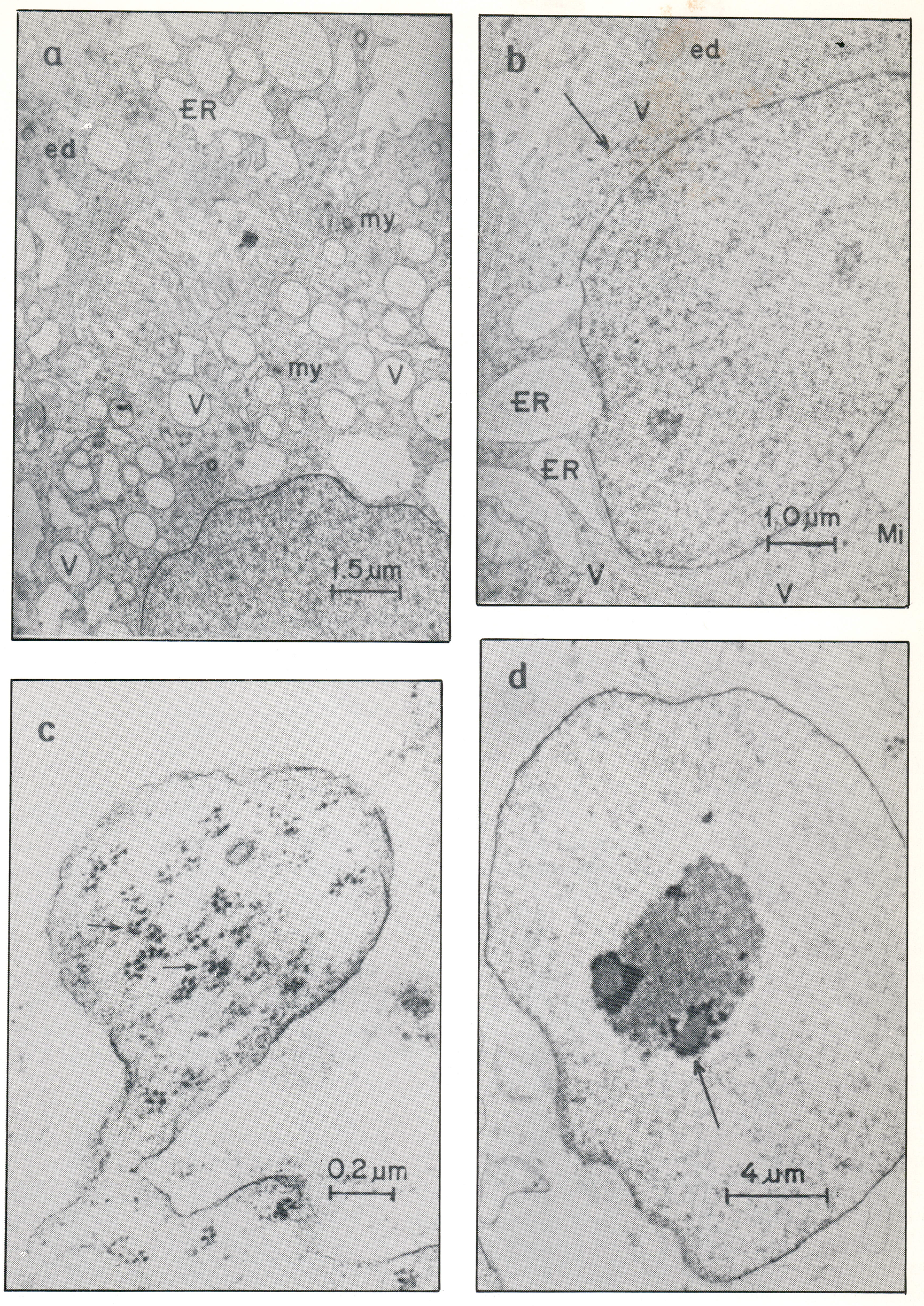
ULTRASTRUCTURAL ASPECTS. (a) - cells exposed to olivacine hydrochloride showed non-specific lesions of cytoplasm such as disorganization of endoplasmic reticulum (ER), intense vacuolization (V), inclusions with electron-dense material (ed) and some myelin figures (my). (b) cells infected by FMDV presented non-specific lesions, ER, V and ed. Some degenerated mitochondria (MI) were detected and free ribosomes ( were evident. (c) - Cytoplasmic blebs, containing arrays of spherical particles with 23nm, probably, viral particles, were observed in FMDV-infected cells. (d) - FMDV-infected cells, after the virus adsorption time, were exposed to olivacine hydrochloride during the last 2 hours of incubation at 3TC for 4h. Very damage aspect was seen, inducing clear areas, surrounded by a dense granular chromation, inside the nucleolus.
ThelC and EC infectious viruses were titrated by TCID50 method in microplate, that was seeded with 3 x 10⁴ cells per well 24h before.
The antiviral activity of olivacine hydrochloride was estimated by the viral inhibition index (VIl) > 1.710g (11).
For the ultrastructure analysis, pellets obtained from infected and control cell cultures of GROUP C, serie b, exposed to 1 .00μg/ml of olivacine hydrochloride were subjected to the electron microscope preparation as described in (9).
The results of the viral inhibition index, showed in the table I, indicate that the pretreatment of the cells with the olivacine hydrocloride prior the viral infection (GROUP A) , did not interfere on the viral cycle of 4h p.i. , although these cells might already present some non-specific cytoplasmic lesions, including disorganization of endoplasmic reticulum and intensive vacuolization, as seen in cells exposed for lh or 2h at 3 TC to I .00pg/ml of olivacine hydrochloride (Figure la). It had been also observed in cells exposed to this drug for 24h (9).
In the virus-drug mixture infected cells (GROUP B), when olivacine hydrocloride had simultaneously acted for lh at 3TC as on the viral particles and the first steps of FMDV viral cycle as on the cellular machinery, the antiviral activity was not detected. This drug neither was virucidal nor acted on the first steps of the viral cycle, since the drug was removed lh p.i. from FMDV - infected cells.
IC and EC viruses were inhibited when the infected cells of the GROUP C were exposed do olivacine hydrocloride during the first I or 2 hours (serie a) after the virus adsorption time. However, when the exposure to this drug was on the last I or 2 hours (serie b) only IC virus was inhibited. In the serie a, the drug acted on FMDV-infected cells from 1 to 3h p.i., period of maximal RNA synthesis, as already observed in IB-RS-2 cells and in bovine kidney cells infected by FMDV (5,20) and virai protein sy nthe sis (2). ln the serie b the drug acted on FMDY-infected cells from 2 to 4h p. i., period ofviral RNA and protein synthesis (2). However. since the drug was exposed to infected cells up to 2h p. i., some virai RNA and virus specific protein synthesis had already occurred , allowing the first progeny formation at about 11 0min (18. 19). So, infectious virus particles could be detected as EC virus, although in swine and bovine cells the extracellular provgeny was seen at about 3h and 2,5h p.i., respective ly (8, 18).
On the other hand, when the cell ultrastructure of the GROUP C, serie b, was analysed, the FMDV-infected cells revealed some similar changes observed in cells exposed only to olivacine hydrocloride (Figure la), but free ribosomes (Figure 1b) were more evident in infected cells than in control or drug treated cells. Besides, only in FMDV-infected cells extruded cytoplasmic blebs containing structures like ribosomes similar to FMDV viral particles as described by other authors (3, 24) were observed (Figure lc). However the FMDV-infected cells exposed to olivacine hydrochloride revealed damage aspect (Figure I d).
So, the olivacine hydrochloride action on a single viral replication of FMDV seems to be critical mostly during the viral RNA and protein synthesis.
REFERÉNCIAS BIBLIOGRÅFICAS
- 1 ARON, G.M. & IRVIN, J.D. Inhibition of herpes simplex virus multiplication by the pokeweed antiviral protein. Antimicrob. Agents Chemother. 17:1032-3, 1980.
- 2 BLACK, D.N. Proteins induced in BHK cells by infection with footand-mouth disease virus. J. Gen. Virol., 26:109-19, 1975.
- 3 BLACKWELL, J.H.; WOOL, S.; KOSIKOWSKI, F.v. Vesicular exocytosis of foot-and-mouth disease virus from mammary gland secretory epithelium of infected cows. J. Gen. Virol., 56:207-12, 1981.
- 4 BOWEN, I.H. & LEWIS, J.R. Rutaceous constituents. Part 10: A phytochemical and antitumour survey of Malayan rutaceous plants. J. Med. Plant Res., 34:129-34, 1978.
- 5 BROWN, CARTWRIGHT, STEWART, D.L. Mechanism of infection of pig kidney cells by foot-and-mouth disease virus. Biochim. Biophys. Acta. 47:172-7, 1961.
- 6 CASTRO, M.P. Chromosome deletion and cell susceptibility to the foot-and-mouth disease virus (FMDV). Arg. Inst. Biol., Säo Paulo, 39:205-7, 1972.
- 7 DUGGAR, B.M. & ARMSTRONG, J.K. The effect of treating the virus of tobacco mosaic with the juices of various plants. Ann. Missouri Dot. Gard. 12:359-66, 1925.
- 8 KOSEKI, I. Sublinhagens celulares suinas com ploidias diferentes. Ill-Susceptibilidade ao virus da febre aftosa. Arq. Inst. Biol., Säo Paulo, 45:261-72, 1978.
- 9 KOSEKI, 1.; PAULILO, K.; OLIVEIRA, M.M. de; NAKAMURA, I.T.; CAPELLARO, C.E.M.P.D.M.•, CATROXO, M.H.B. Effects of olivacine on 1B-RS-2 cell line. Arg. Inst. Biol., Säo Paulo, 56(1/2) 19-21, 1989. [No prelo].
- 10 KOSEKI, 1.; SIMONI, l.c.; NAKAMURA, I.T.•, ABUHAB, T.G., NORONHA, A.B.; COSTA, S.S. Antiviral activity of plant extracts against aphtovirus, pestivirus annd pseudorabies virus in cell cultures. In: ENCONTRO NACIONAL DE VIROLOGIA, 4. , Säo Lourengo, MG, 1988. Resumos. p. 177.
- 11 LAGROTA, M.H.C. Atividade antiviral "in vitro" de subståncias sintéticas e naturais. Rio de Janeiro. Univ. Fed. R.J., 1978 [Dissertaqäo (Mestr.) Univ. Federal do Rio de Janeiro].
- 12 LAGROTA, M.H.C.; WIGG, M.D.; PEREIRA, L.O.B.; PEREIRA, N.A.; GUIMARÄES, J.C. Atividade antiviral de subståncias naturais: I. Nitidina e ajmalina. Rev. Bras. Farm. , abr./jun.:8894, 1982.
- 13 LAGROTA, M.H.C.; WIGG, M.D.; PEREIRA, L.O.B.; FONSECA, M.E.F.•, PEREIRA, N.A.; GUIMARÄES, J.C. Atividade antivir6tica de lapachol. Rev. Microbiol., 14:21-6, 1983.
- 14 LINARDI, M.C.F.; OLIVEIRA, M.M.; SAMPAIO, M.R.P. A lapachol derivative active against mouse lymphocytic leukemia P388. J. Med. Chem., 18:1159-61, 1975.
- 15 NORONHA, A.B.; GIL, v.L.; VICENTE, M. Occurrence of plant virus inhibitors in species of caryophyllales. I. Alternanthera ficoidea, Amarantus deplexus, Bougainvillea spectabilis, Chenopodium ambrosioides and Mirabilis jalapa. Arq. Inst. Biol., Säo Paulo, 47:71-76, 1980.
- 16 NORONHA, A.B. ; GIL, V.L. ; VICENTE, M. ; GONCALVES, A.L. Occurrence of plant virus inhibitors in five species of caryophyllales. Il. Alternanthera amoena, A. brasiliana. A. philoxeroides, Iresine herbstii and Talinum paniculatum. Fitopatol. Bras., 8:317-23, 1983.
- 17 OLIVEIRA, M.M. de & SAMPAIO, M.R.P. Extracts of virusinhibiting plants active against Ehrlich tumor. Rev. Bras. Biol., 40:519-24, 1980.
- 18 PLEDGER, R.A. Formation and release of foot-and-mouth disease virus from bovine calf kidney cell culture. Virology, 13:366-67, 1961.
- 19 POLATNICK, J. & BACHRACH, H.L. Metabolie studies of bovine kidney cultures infected with foot-and-mouth disease virus. Virology, 12:450-62, 1960.
- 20 RODRIGUES, M.A. La R. Influéncia de hormönios sobre a susceptibilidade de células da Jinhagem sufna IB-RS-2 ao virus da febre aftosa. Arq. Inst. Biol.. Säo Paulo, 45:61-82, 1978.
- 21 SAMPAIO, M.R.P. & OLIVEIRA, M.M. de Aigumas experiéncias com a olivacina em leucemia linf6ide L1210 de camundongo. Cienc. e cult., Säo Paulo, 26:517-20, 1974.
- 22 TOMLINSON, S.A.; WALKER, v.M.; FLEWETT, T.H.; BARCLAY, G. R. The inhibition of infection by cucumber mosaic virus and influenza virus by extracts from Phytolacca americana. J. Gen. Virol., 22:225-32, 1974.
- 23 USSERY, M.A.; IRVIN, J.D.; HARDESTY, B. Inhibition of poliovirus replication by a plant antiviral peptide. Ann. NY. Acad. sci., 284:431-40, 1977.
- 24 YILMA, T.; McVICAR, J.w.; BREESE, S.S. Jr. Prelytic release of foot-and-mouth disease virus in cytoplasmic blebs. J. Gen. Virol. 41:105-14, 1978.