
 Processing of audio files for the construction of speech recognition tests in portuguese
Purpose To develop computational codes for the automated modification of large quantities of sentence recordings, capable of performing format modifications, filtering, simulating sound signal processing in cochlear implants, and adjusting root mean square amplitude to equalize perceived volume between sentences.
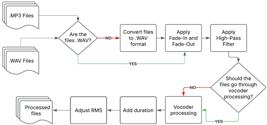
Methods Python codes were developed for the intended processes, using the Spyder interface and packages such as pydub, soundfile, os, and numpy. The codes were tested on two sets of previously recorded audio files in Brazilian Portuguese, in .MP3 and .WAV formats.
Results Codes were implemented for 1) file format modification, 2) fade-in and fade-out adjustment, 3) high-pass filtering, 4) optional vocoderization, and 5) adjustment of root mean square amplitude. Testing the developed codes on two sets of sentence recordings available in .WAV and .MP3 formats in Portuguese showed consistent results as expected.
Conclusion Python codes were developed for the automated modification of audio files, available on the GitHub website for further adaptations and improvements by third parties.
Keywords:
Audiology; Signal processing computer-assisted; Hearing tests; Cochlear implantation; Computer simulation
 Thumbnail
 Thumbnail
 Thumbnail
 Thumbnail
 Thumbnail
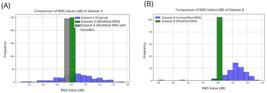
 Subtitle: RMS = Root Mean Square. Source: Prepared by the author, 2023
 Source: Prepared by the author, 2023-2024
 Source: Prepared by the author, 2023
 Source: Prepared by the author, 2023
 Subtitle: RMS = Root Mean Square; dB = decibel. Source: Prepared by the author, 2023