Fencing off commons for the energy expansion: Conflicts over lithium extraction in Cornwall (UK), Jequitinhonha (BR) and Barroso (PT)
ABSTRACT
This article examines how the global push for “green” energy expansion produces new enclosures and conflicts in territories historically organised around common land use. Focusing on lithium extraction in Covas do Barroso (Portugal), Cornwall (UK), and the Jequitinhonha Valley (Brazil), it shows how the so-called energy transition manifests as energy expansion: the simultaneous growth of energy production, consumption, and territorial occupation under the legitimating discourse of decarbonisation. Drawing on multi-sited ethnographic research, it traces how intensive and wasteful lithium mining transforms local ecologies and social relations, converting communal and post-industrial commons into fenced extraction zones. In Portugal, the servidão administrativa opens centuries-old baldios to corporate access; in Cornwall, the “mining renaissance” threatens post-industrial leisure commons; in Brazil, open-pit operations turn living ground into “sterile” residue. Across these cases, the article argues that lithium’s framing as essential to decarbonisation conceals a colonial continuity - displacing peripheral populations in the name of planetary salvation - and calls for defending the commons as spaces for alternative transitions.
Keywords:
Energy transition; Violence; Local communities; Lithium mining
INTRODUCTION
“The Chapada do Lagoão is our mother. It is where we collect our medicines. It is where our water comes from.”
[A chapada do Lagoão é a nossa mãe - é lá que colhemos os nossos medicamentos. É de lá que vem a nossa água]
(community leader, community workshop, Araçuaí, September 2025).
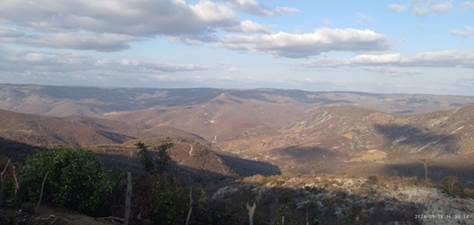
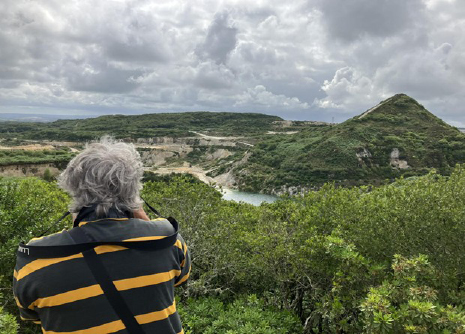
Partial view of Chapada do Lagoão [Lagoão Plateau], Araçuaí-MG, Brazil. 18/09/2024. Photo by the authors.
Plateaus, or chapadas, play an essential role in sustaining life in the semiarid region of the middle Jequitinhonha Valley in Minas Gerais, Brazil. The chapadas regulate water flows and preserve vegetation during the season when the surrounding landscape dries out, functioning as vital hydric reservoirs. Thus, community interdependence with the commons is a key element for understanding the relationship between local populations and chapadas, which can be treated as symbolic mothers, expressing kinship connections with the territory. In the case of Lagoão (meaning “large lake”), numerous creeks and other streams spring from its three-dimensional topography, making it a vital water source for entire communities. For these reasons, in 1990, the municipality established the Chapada do Lagoão Environmental Protection Area (Área de Proteção Ambiental, or APA). Following pressure from local communities, it was subsequently regulated in 2007. (Figure 1)
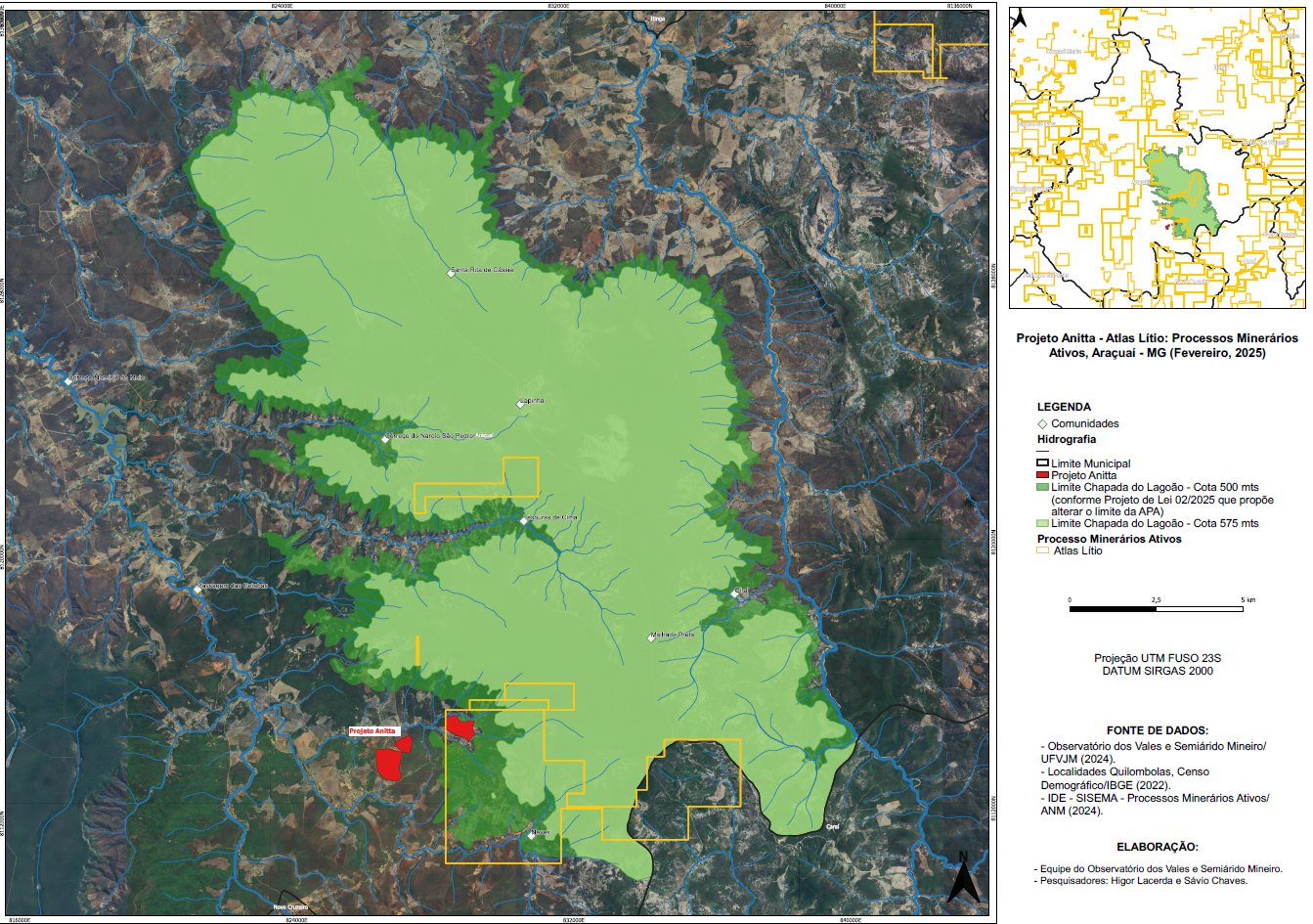
Yet, in January 2025, the president of the Araçuaí town council scheduled, as a matter of utmost urgency (urgência urgentíssima), a vote on the mayor’s proposal to reduce the protection area by 23% (see Figure 2). The proposal followed the issuance, in December 2024, of a license to expand the Atlas Lithium project near its borders. To many residents and campaigners, this expansion might have been obstructed due to its proximity to - or intrusion into - the APA. The timing revealed the collusion between local politics, regulatory flexibility, and corporate mining interests, even though the link between the proposal to reduce the APA and the license to expand the mine was never explicitly acknowledged by its proponents and supporters.

Location of the Anitta-Atlas Lithium project in the Chapada do Lagoão Environmental Protection Area (in dark green the proposed reduction), Araçuaí-MG. Source: Observatory of the Valleys and Semi-Arid Region of Minas Gerais / LIQUIT Project, 2025.
This episode epitomises a broader tension in the Jequitinhonha Valley, where lithium mining is rapidly transforming landscapes, economies, and social relations. The middle and lower regions of the valley are under intense pressure from global demand for lithium, a mineral framed as both critical and strategic. Lithium’s centrality to the technologies of the energy transition - batteries, electric vehicles, and renewable energy storage - as well as to the current global expansion of military spending, has propelled a new wave of extractivism framed by policymakers and the media as urgent and inevitable1. Securing lithium supply is associated not only with climate mitigation but also with geopolitical affirmation, national security, and reindustrialisation. Yet these global discourses mask the localised consequences of current extraction rates and methods: environmental degradation, the disruption of ways of life, and the dismantling of community-based, common, and communitarian land-use systems and practices.
In this article, we situate lithium mining in the Jequitinhonha Valley alongside two other frontiers of lithium extraction. In these three locations, the method involves open-pit extraction of spodumene - a mineral that typically contains around 1% of battery-grade lithium. This process, also called hard rock mining, generates up to 95% waste as the soil or mountain tops are removed to reach the lithium-bearing rock. One of these locations is northern Portugal, where Covas do Barroso has become a symbol of European “onshoring” strategies. The other is Cornwall, in southwest England, where lithium prospecting is reactivating mining landscapes and historic dreams of cyclical prosperity. Despite their geographical distance, these territories are bound together by the imperatives of a global consensus on energy transition that dismisses the adverse effects of reconfiguring land and livelihoods.
What connects these disparate and distant sites is that they are places where common relationships with the land have developed, albeit in different ways. The fact that they are not fully integrated into the industrial mode of production allowed for alternative forms of relationships with the land that appear negligible in the trade-offs proposed by extractive industries between economic growth, urbanisation, and industrial development on one side, and eco-social, property, licensing, and opportunity costs on the other. As Thea Riofrancos (2025) observes, “geology is not destiny”: mining does not simply follow mineral deposits; the power local populations have or gather determines decisions about where and how to extract. In this sense, the local resistance may constitute a decisive factor in the implementation and continuity of mineral extractivism. Projects sold to investors as feasible, by transforming deposits into resources and then into reserves, tend to concentrate in places where communitarian forms of life, peripheral geographies, and fragile political protections create conditions that render materially inefficient processes economically viable.
In the northeast of Minas Gerais, the Jequitinhonha Valley was labelled “Lithium Valley” in 2023 during a ceremony at Nasdaq - an act that formalised the alignment of state, federal, and corporate interests. Communities, however, insist that the valley belongs to the Jequitinhonha River, not to lithium. In public hearings held in Araçuaí and Itinga in early 2025, residents of a fully operating mine 30 km away from the Chapada described the impacts of mining: explosions, dust, heavy truck traffic, and their consequences for physical and mental health. They spoke of cracks in their houses, the disruption of hydric systems, and the restrictions on mobility imposed by the sprawling mine. Inflation, housing booms, and the overcrowding of public infrastructure are other consequences of the current boom.
The southern parts of the state of Minas Gerais (meaning “General Mines”), up to the high Jequitinhonha, were historically centres of colonial extractivism - gold, diamonds, and other gemstones - and, more recently, have become among the world’s most important suppliers of iron ore. The north and northeast of the state, in turn, were historically a refuge for runaway Indigenous and enslaved populations who developed close relationships with its harsh environments and unique biomes. According to Brazilian geographer Porto-Gonçalves, “As Minas” expresses the colonial, extractive economy characteristic of the South, while “Os Gerais” expresses the communal, subsistence-based culture rooted in collective use of land and ecological balance, more prevalent in the northern and northeastern parts of the state.
This frontier resonates with others around the world, where extractivism advances into areas where common land uses predominate (Gudynas 2015). In Portugal, lithium is viewed as crucial for the European energy transition and independence from foreign supply chains. At first sight, this shift of mining operations to the former centre of Brazil’s colonisation might seem like a step towards a more just transition. Yet this expansion occurs on the periphery of a country that is itself on the periphery of Europe. The region of Barroso has developed since the Middle Ages as a centre of communal land management and ownership, leading to its recognition by the UN as a World Agricultural Heritage site (Calafate-Faria et al. 2025).
Cornwall, in the southwest corner of Great Britain, presents a different but related story. Long associated with centuries of mining, the county is now rebranded as a hub of “green extractivism.” Lithium prospecting in the area has revived dormant mineral rights and geological research, promising economic regeneration for a region marked by high levels of deprivation. Yet it also threatens forms of land use that have been reappropriated since the decline of mining, including spaces for small-scale farming, grazing, leisure, and community heritage. The commons at stake are not only productive but also cultural, symbolic, and recreational. The threat to these layered uses of land highlights how a monolithic narrative of energy transition obscures less ecological transitions and risks erasing histories of community adaptation and reappropriation in post-mining landscapes.
We built an analysis on a multi-sited methodology that combines ethnographic research, participatory workshops, and a review of secondary sources2. By placing Brazil, Portugal, and Cornwall in the same frame, we seek to illuminate both their shared logics and the specific articulations of lithium extraction. In all three contexts, lithium projects bring physical and symbolic violence - sometimes abrupt and intense, sometimes slow and enduring (Nixon 2011) - through the loss of environments that sustain ways of life. What is at stake is not only ecological integrity but also the commons: land-use systems based on solidarity, reciprocity, connection to local ecologies, and collective stewardship, whether the Gerais of Jequitinhonha, the baldios of Barroso, or the reappropriated landscapes of Cornwall.
The article argues that lithium mining, propelled by the urgency of the energy transition, reproduces a centuries-old cycle of extractive boom-and-bust that undermines community autonomy. At the same time, it provokes new forms of political articulation and resistance, in which local actors denounce what Martín Arboleda (2020) terms the “planetary mine” - a global web of entangled extractivisms linking lithium to iron, copper, solar panels, eucalyptus plantations and transmission grids (Artiga-Purcell 2024). By tracing these connections, we demonstrate how the promise of decarbonisation risks legitimising new rounds of dispossession (Andreucci et al. 2023), even as communities mobilise to affirm their right to water, land, culture, and life.
The next section of the article establishes the concept of energy expansion to describe the web of processes commonly referred to as the energy transition. Our focus is on territorial expansion, one crucial element of this process. This expansion materialises on the ground through fences that obstruct, remove, and displace people in their movements and uses of land, as well as through extended atmospheric and hydric occupation - explosions, dust, water consumption, and other injuries to the environmental commons. This process is akin to enclosure in that it has the double effect of pushing people into urbanised, industrial modes of life and dependence on sociotechnical systems for water, food, energy services, and leisure. The next three sections discuss data from the three locations before returning to the connections between the three cases and the themes of enclosure, commons, and Gerais in the conclusion.
FROM ENERGY TRANSITION TO ENERGY EXPANSION: TERRITORIAL FRONTIERS AND THE THREAT TO THE COMMONS
THE MYTH OF TRANSITION AND THE REALITY OF EXPANSION
The notion of an ongoing energy transition dominates contemporary public debates on climate change. According to this narrative, societies are on a path to replace fossil fuels with renewable energy, enabled by new technologies for energy capture, conversion, storage, transmission, and commercialisation. The promise is substitution: a clean future in which oil, coal, and gas are replaced by solar, wind, and hydropower as energy sources.
This consensus that decarbonisation (Bringel and Svampa 2023; Bruna 2023) is a simple consequence of investing in new, cleaner technologies is challenged by the evidence. Various studies show that new energy systems - based on the capture and commercialisation of solar and wind energy, as well as the production of large mobile batteries to store this energy in electric vehicles - are simply adding to the continuing growth of technologies based on the combustion of carbon-based fuels (Fressoz 2024; Greiner et al. 2022; York 2017; York and Bell 2019). Moreover, the development of these new technological systems requires more fossil-fuel energy, thereby contributing to their current expansion.
When examining percentages, the share of renewables increases relative to the share of fossil- and biofuel combustion. Yet in absolute terms, the production of energy services from all sources is expanding, propelling increases in consumption on one side and mineral extraction on the other3. The transition consensus remains unaffected by these facts. It persists, sustained by the belief that this expansion of carbon fuels is temporary and that, once established, new technologies will require less of it to operate - eventually leading to complete decarbonisation.
This reformulation of the consensus reinforces the sense of urgency surrounding the expansion of new technologies, while simultaneously justifying the continuation of a supposedly transitory increase in fossil fuel consumption. Part of this faith rests on a historical narrative suggesting that humanity has successfully transitioned before - from wood to coal, to oil and gas - and that the present shift is simply the next energy age (Burke and Pomeranz 2009). Yet, historian Jean-Baptiste Fressoz’s (2024) compelling thesis shows that the history of energy is marked not by substitution but by addition and accumulation. New sources of energy rarely displace old ones; instead, they layer upon and complement each other. Moreover, each energy innovation depends on and intensifies the previous regime: wood consumption increased with the introduction of coal, and demand for both coal and wood expanded with the rise of oil.
A striking historical episode illustrating this symbiotic effect is told by Richard York (2012). In the late nineteenth century, many hoped that the use of petroleum would save whales from extinction. Instead, oil-fuelled ships made whaling more efficient and enabled the hunting of larger species, while new petrochemicals created new uses for whale oil. This historical perspective helps us understand contemporary data on energy consumption: rather than replacing fossil energy, technologies for capturing energy from renewable sources are expanding total demand for all sources, including coal, wood, gas, and oil. York and Bell (2019) call this pattern “energy addition”, the material reality behind what is still called an energy transition.
The present context is therefore not one of transition but of expansion - the enlargement of energy sources, infrastructures, and demands under the legitimating banner of transition. The term expansion captures how this process materialises in both technological growth and territorial conquest.
THREE DIMENSIONS OF ENERGY EXPANSION
The expansion of energy systems has at least three interconnected dimensions: 1) appropriation and commercialisation, 2) expansion of consumption, and 3) territorial expansion. Together, they constitute what might be better described as energy expansion rather than energy transition.
The first is the increase in production, as shown by the argument presented above. The second dimension is the expansion of consumption. New energy sources and technologies generate new needs, devices, and infrastructures, multiplying demand rather than merely responding to it. The third dimension, and the focus of this article, is territorial expansion.
Energy systems require not only technological innovation and consumption growth but also spatial frontiers - landscapes to supply materials, host infrastructures, and absorb waste. As the global economy pursues electrification and decarbonisation, these frontiers advance into rural, Indigenous, and post-industrial regions, converting them into resource zones and waste sinks - their victimisation justified as a necessary sacrifice for the higher good of the transition.
Under the banner of the green transition, lithium-rich plateaus in Brazil’s Jequitinhonha Valley, the baldios of northern Portugal, and the post-industrial commons of Cornwall are being re-enclosed and reclassified as sites of strategic extraction. This process reflects what Polanyi (1944) described as the commodification of land, where territories embedded in social relations are turned into market resources. As Thompson (1963) and Federici (2004) show, enclosure is not only an economic process but also involves the reorganisation of social life, labour, and access to subsistence. In this sense, what appears as a necessary step in decarbonisation can be understood as a contemporary example of what Harvey (2003) calls “accumulation by dispossession,” extending extractive frontiers into areas where communal land uses still exist.
This dynamic points more closely to a tragedy of commodification (Longo, Clausen, and Clark 2015) in which the transformation of land and resources into commodities drives extraction and dislocation, even where systems of commoning remain robust (Ostrom 1990). What was once seen as idle, marginal, or “waste” land - often because it supported non-capitalist ways of life - is now redefined as valuable through its incorporation into global extraction, obscuring the histories and practices of common land use that have continuously sustained these landscapes.
As Bispo dos Santos (2019) argues, there are still places “not yet colonised,” where counter-colonial practices of coexistence and care persist. Similarly, Anna Tsing (2015) reminds us that the edges of capitalism - the ruins, gaps, and unassimilated commons - harbour the possibility of other worlds: pericapitalist counterspaces of alternative possibilities. The new energy expansion thus unfolds not only as a project of extraction but as a confrontation with these living frontiers - spaces where enclosure advances, threatening the social and ecological relations that sustain life and the possibilities of life outside capital accumulation.
It is this third dimension - territorial expansion and the struggle over the commons - that forms the analytical focus of this article. The following sections examine how it materialises in three distinct contexts: the baldios of Covas do Barroso in northern Portugal, the post-industrial clay landscapes of Cornwall, and the Gerais of Brazil’s Jequitinhonha Valley.
COVAS DO BARROSO - COMMONS UNDER PRESSURE
We are driving through the mountains of Covas do Barroso, a village in northern Portugal said to contain the largest lithium deposits in Europe - enough, according to Reuters, to power half a million electric vehicles (Gonçalves 2025). With us in the car is V., a local activist and researcher who moved to the village to support its long resistance to lithium mining. Two years ago, he completed a year-long ethnography in Covas do Barroso and has since continued to work alongside residents, helping them navigate the legal and bureaucratic procedures that shape their struggle.
The narrow road that winds up and down the slopes is better suited to a jeep than to the small rental car we brought. A tractor appears behind us, pulling a water reservoir up toward a fenced drill site. The company contracted by the mining firm to carry out geological prospecting has enclosed a patch of ground for an exploratory borehole; to prevent an imminent spill into the river, wastewater mixed with diesel and drilling oils is being pumped out into this tank. Curious to see the operation from above, we stop the car and climb a bank. The tractor cannot pass. The driver honks, walks over, and - less a request than a demand - tells us to move. Despite his expression of urgency - “the machine needs me there quickly” - we take some time to shift the car. In the meantime, he calls someone and, in a threatening gesture, begins filming us on his phone. We stay in our vantage point and watch as he drives the tractor toward the machine, which is now allowed to continue drilling.
This brief encounter captures the tense choreography of extraction and resistance - the urgency of the machines and their operators meeting the slow rhythms of local life, and the stubborn gestures that have become a language of opposition in Covas do Barroso.
Until recently, both private landowners and the assemblies of compartes who administer the baldios4 - the common lands - had managed to refuse entry to mining companies. For seven years, that collective refusal blocked all lithium prospection (Dunlap and Riquito 2023). Now, the Portuguese government has issued a servidão administrativa (administrative easement) forcing owners and communal institutions to open their land for drilling and sampling (Direção-Geral do Território 2011; Direção-Geral de Energia e Geologia 2024). The order marks a new phase in the conflict.5 Boundaries that were once clear are now contested: where does the easement apply, who decides, and who enforces its limits?
Police have been called by both sides to enforce or contest access; residents, in turn, summon journalists to witness confrontations. Media visibility offers a fragile form of protection. Yet the conflict also divides neighbours and families - even siblings find themselves on opposite sides.
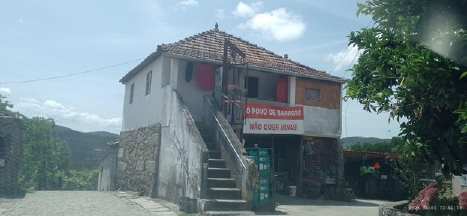
Amid this growing tension and uncertainty, the words of a local resident capture both the clarity and defiance that have guided the community’s resistance. Speaking in 2025 in an interview to the authors of this article, he recalled the moment when opposition became inevitable: (Figure 3)
“A partir do momento em que nós soubemos o que eles queriam fazer e que tínhamos noção do que seria, foi a partir daí que nós começamos a nos opor. Não conseguiam [a empresa] fazer prospecções porque as pessoas não deixavam. Então, eles recorreram à servidão administrativa. A servidão no privado e no baldio.”
(“Once we understood what they wanted to do, and what it would be like, that’s when we began to oppose. The company couldn’t carry out prospecting because people didn’t allow it. So, they resorted to administrative easement - on private land and on the commons.”)
Resident of Covas do Barroso, interview, May 2025

Banner expressing the resistance of the population to mining in the area, Portugal, 02/06/2025. Photo by the authors.
This resistance did not begin with the servidão. It is rooted in much older ways of inhabiting and caring for the land. For generations, Covas do Barroso’s economy and culture have rested on a mosaic of family plots, lameiros (private meadows), and baldios (common lands). These different land regimes are intertwined rather than separate, forming a landscape organised through reciprocity and mutual dependence.
The baldios are managed collectively by assemblies of compartes - residents who hold rights of use and stewardship. These areas have long provided pasture for goats and cattle, as well as firewood, fodder, and other essential resources for households without enough private land. They sustain both economic subsistence and social solidarity, embodying a system of use that blurs the distinction between private and collective property. (Figure 4)
“Havia muitos rebanhos de cabras e de ovelhas. Muita gente, especialmente as pessoas mais pobres, não tinham terrenos privados. Então o baldio era onde eles pastejavam os animais.”
(“There used to be many herds of goats and sheep. Many people, especially poorer ones, didn’t have private land. So the baldio was where they grazed their animals.”)
Resident of Covas do Barroso, interview, May 2025

By contrast, lameiros - the small, irrigated pastures used for hay or grazing - are privately owned but operate under flexible, reciprocal arrangements. As another villager explains:
“Os lameiros são privados, mas estão abertos. Outros arrendam. Quer dizer, são privados, os donos é que tomam conta deles. São os donos quem decidem. No baldio é diferente: há uma assembleia de compartes, que é quem toma certas decisões, mas para tomar essas decisões tem que ser levado à assembleia.”
(“The meadows are private, but open. Some are leased out. The owners decide. In the commons it’s different: an assembly of compartes makes decisions, and every decision has to go to the assembly.”)
Resident of Covas do Barroso, interview, May 2025
These institutions represent a form of collective governance that predates modern land law. Covas do Barroso, with its 2,967 hectares and just under 500 residents, is part of a wider landscape of communal management across northern Portugal. Streams and rivers provide water for both people and livestock; pine plantations coexist with small farms. The region’s agro-silvo-pastoral system has been recognised by the FAO as a Globally Important Agricultural Heritage System for its integration of agriculture, forestry, and grazing within a communal framework (Calafate-Faria et al. 2025).
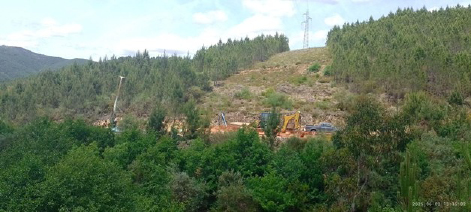
When lithium prospectors arrived under the banner of the “energy transition,” promising jobs and development, locals responded by defending these commons. The Associação Unidos em Defesa de Covas do Barroso (UDCB) emerged as a coordination platform, and since 2021, the village has hosted the annual camping festival - Acampamento em Defesa de Covas do Barroso, bringing together anti-extractivist movements from across Portugal, Europe and beyond. (Figure 5)
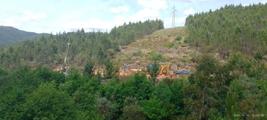
Partial view of lithium prospecting on common (baldio) land, Covas do Barroso, Portugal. 02 June 2025. Photo by the authors.
The servidão administrativa has not ended this organising, but it has transformed it. Instead of collectively denying access, communities must now navigate the state’s legal and physical impositions. Disputes erupt over the placement of boreholes, the scope of permits, and the very meaning of public interest. The conflict has become a struggle over territorial sovereignty - over who defines how the land is used and what its future will be. But ultimately, the local population’s resistance aims to prevent the implementation of the entire project, which would entail converting a wider area of mixed uses and fruition into an enclosed, single-purpose territory focused on producing one metal.
As in Cornwall and Brazil’s Jequitinhonha Valley, Barroso reveals how the rhetoric of the green transition legitimises new enclosures. Under the banner of “critical minerals,” the state and corporations reclaim lands that were once regenerated through communal use, presenting extraction as sustainable because it occurs in already inhabited or supposedly “degraded” landscapes. Yet, in doing so, they erase the social and ecological repair that communities have practised for generations.
The struggle in Covas do Barroso is not only against mining but for the survival of a way of living that binds together land, labour and community. This dynamic - through which the promise of a green transition opens new frontiers of enclosure - reappears in other mining regions. The next section turns to Cornwall, where a different temporality of mining, associated with the revival of old mined land, reveals parallel tensions between industrial heritage, environmental repair, and the redefinition of the commons.
MINING ‘RENAISSANCE’ - THREATS TO OTHER RESURGENCES IN THE ‘CLAY COUNTRY’ OF CORNWALL, UK
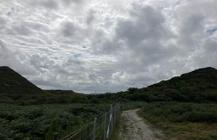
A path through St Dennis, Cornwall, flanked by dense vegetation reclaimed since the closure of the china clay pit. The hills in the background - known locally as Flatty and Pointy - are waste tips from the former mine. The fence to the right marks the boundary of land owned by Cornish Lithium, which inherited the site from the china clay industry. Photo by the authors.
We are walking along a narrow path surrounded by dense, untamed vegetation. Ahead, two green hills rise from the landscape, marking the entrance to St Dennis on the other side. Locals call them Flatty and Pointy, after the shapes of their tops. Their affectionate names - and the fact that they appear on the emblem of the village school - speak of a symbolic kinship between the hills and the community. (Figure 6)
Yet these are not natural hills. They are waste tips from a long-abandoned china clay (kaolin) pit. When the mining complex closed in the early twentieth century, water filled the pits and algae, moss, and other plants gradually colonised the acidic, mica-rich soils. Over the decades, nature’s slow reclamation turned the site into a mosaic of ponds, scrub and forest. It became, in effect, a common once more - a place where life returned, and people reclaimed space for walking, playing, and gathering. (Figure 7)
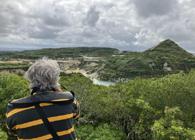
A resident photographs the fenced-off disused mining pit and waste tip where he used to play as a child. Photograph by author 2023
Today, Flatty and Pointy are landmarks of memory and identity, places where generations have walked, cycled, and played. As we pass, young people on bikes and motorbikes weave through the tracks; my companions identify birds and insects and recall climbing the tips as children. These post-industrial commons provide rare leisure space in a region with few public amenities. Yet the path we walk now runs alongside a fence enclosing the area where Cornish Lithium is drilling the projected Trelavour Pit as part of its prospecting phase.
Restrictions on access and use have angered those who value this open space. The most visible conflict with the local community erupted when the company announced that the next phase of exploration would require demolishing Flatty and Pointy. Locals reacted strongly during public consultations and have since begun organising to oppose the plans (BBC 2025). These are not simply mine waste tips - they are tangible symbols of community identity and living memory, features that can be seen, touched and incorporated into everyday life. The threat of their demolition has become the main obstacle to the otherwise positive consensus surrounding Cornwall’s so-called “mining renaissance.”
Interest from two companies, Cornish Lithium6 and British Lithium7, has sparked renewed public debate about the possibility of a new mining boom. Consultation events and media campaigns highlight the opportunities of a “renaissance” in extraction, centred on a globally coveted “critical mineral.” Yet this optimism obscures a long and uneven history.
Cornwall’s economy has been tied to mining for centuries. In this part of the county, open-pit mining for china clay consumed vast tracts of land, displacing houses, churches, and schools. China clay was first discovered in the mid-18th century, and production expanded rapidly throughout the 19th and early 20th centuries. By the early 1900s, dozens of companies operated across the clay country, competing fiercely and driving down wages and safety standards. After the Second World War, state-supported modernisation brought a new wave of expansion that lasted through the 1960s and 1970s, maintaining high output until the industry’s long decline from the late 1980s (Pinch 2000). This boom-and-bust cycle fostered a collective association of prosperity with extraction - and endurance in times of collapse.
Emigration played a crucial role in this endurance: between 1815 and 1915, roughly a quarter of a million people left Cornwall for overseas destinations, with a similar number moving elsewhere in Britain. Yet even during booms, miners’ lives were precarious - not only because of accidents and disease, but because their very ground was unstable. Roads were rerouted; towns where generations had lived, married, and been buried were consumed by the expanding pits whenever global prices surged. The legacy of this extractive economy, as elsewhere, is persistent deprivation, precarious relations to land and labour, and limited public infrastructure amid a scarred environment. Still, people make do with what remains.
While drawing on Cornwall’s mining expertise and identity, the companies now promoting lithium extraction present contradictory narratives. Cornish Lithium, a start-up, has compiled geological data from historic mine plans and partnered with the Camborne School of Mines. Apart from the development of the Trelavour site above, it is also experimenting with direct lithium extraction from underground geothermal streams. British Lithium, meanwhile, aims to convert a former china clay pit into a lithium mine and refinery. Despite optimistic headlines claiming it has already produced battery-grade lithium, the operation remains far from commercial viability. (Figure 8)

reminder that a path is not public but only used at the discretion of the mining company, which owns it, Photograph by the authors 2025
British Lithium’s first environmental credential is that it occupies a “brownfield” site in need of remediation. Yet its recent partnership with Imerys - the multinational that has dominated china clay mining since the 1990s - reveals a deep contradiction. Imerys itself created the brownfield through decades of extraction and now seeks to extract “green value” from remediating its own industrial legacy. This paradox exemplifies how previous destruction becomes a credential for new extraction.
In reality, Cornwall’s mining ruins are not wastelands. The post-industrial landscape has been re-imagined through heritage and leisure initiatives such as the Mineral Tramways Project, which, as Hilary Orange (2018, 111) notes, “created 60 km of cycling trails … using disused tramway routes to link together mining sites.” Sites like Minions and St Agnes have become open spaces for walkers, cyclists, dog owners, and heritage tourists - “a living heritage, one that is walked, grazed, surfed, and photographed rather than a static monument” (Orange 2012, 394).
The Eden Project, built inside a former clay pit, extends this logic of transformation: an industrial scar turned into biodomes and gardens, a global symbol of environmental renewal. Yet even here, recent financial troubles (BBC News 2024) expose the fragility of such reinventions. As Orange (2018, 122) cautions, heritage “utilises the past for the curation of contemporary values - economic growth, prestige and civic pride.” Leisure and ecological restoration coexist with enclosure and commodification; everyday users and local meanings are displaced by managerial and corporate narratives of sustainability.
These spaces function as commons - not only productive but also cultural and recreational. The threatened demolition of Flatty and Pointy exemplifies how new extraction projects undermine these reappropriated commons, erasing the slow work of communal regeneration.
Contemporary lithium exploration in Cornwall treats clay pits as brownfields, arguing that extracting a new mineral adds “green” value to already damaged land. This logic turns prior destruction into a credential while overlooking the commons of walking trails, bike paths, and ecological refuges (Mah 2012). Tsing (2015) describes this as part of “salvage accumulation,” in which capitalist projects capture value produced in pericapitalist landscapes. Yet, as she also reminds us, “global landscapes strewn with ruins can be lively despite announcements of their death.” The same ruins that companies treat as waste often sustain multispecies life and social renewal.
The tension between redeveloping ruins for “green” extractivism and preserving them for public use underscores the article’s central argument: the consensus on energy transition legitimises new rounds of dispossession by framing extraction as urgent and inevitable. Recognising industrial and environmental ruins as spaces of possibility - rather than mere sites of profit - is essential to defending common land uses and imagining alternatives to extractive development.
In the next section, we return to Brazil’s Jequitinhonha Valley to examine a different temporality of lithium extraction: not exploration but full-scale operation. While Cornwall’s post-industrial landscapes are being re-enclosed and re-inhabited, the Jequitinhonha Valley is entering a cycle of active extraction whose pits, waste mounds, and noise threaten to erase common uses and community livelihoods. This operational phase is reshaping the valley’s cultural landscapes and identities, enclosing and exploiting pericapitalist eco-social relations under the banner of green progress.
JEQUITINHONHA - OPERATION AND EXPANSION - “EXPLOSÃO”, “BARULHÃO”, “POEIRÃO”
We are travelling, in September 2024, in a small convoy of four cars, some of them university-marked, toward Piauí - Poço D’antas, the community most directly affected by the first open-pit lithium mine in Brazil8. The cars follow a dirt road that winds alongside a fence. Behind the wire, the processing plant soon comes into view. It looks modern, shiny, and efficient - part of what the company proudly calls ‘green tech’.
As we move further along, it becomes clear that we are driving around the perimeter of a vast enclosed area. For kilometres, all we can see are hills of waste sand piled high, some covered with a thin layer of greenish powder. Coming from the opposite direction, a company vehicle slows beside us. The driver rolls down his window and begins to film our convoy. His attitude is intimidating, making us feel unwelcome. Yet this is a public path, the only access route to reach the community. Residents must walk this way or cut through the creek on the other side. We film back and keep going. (Figure 9)
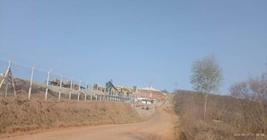
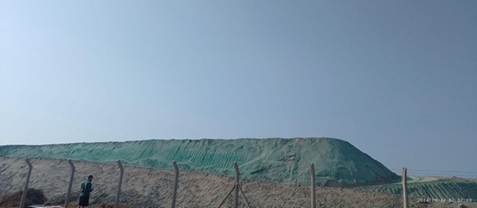
Partial view of the processing facilities at Sigma Mineração’s open-pit lithium mine. Araçuaí, Minas Gerais, Brazil. 17 September 2024. Photo by the authors
The space now fenced off contains open pits and mountains of “sterile” material removed to reach the lithium-bearing rock. This mine produces ninety-four parts of waste for every six of gross spodumene. The so-called green-tech operation produces mostly waste. Yet this “sterile” material - classified as without economic value - was once the very ground on which people walked, planted, and lived. (Figure 10)
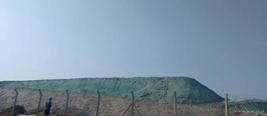
Waste-rock (“sterile”) pile at Sigma Mineração’s open-pit lithium mine. Araçuaí, Minas Gerais, Brazil. 17 September 2024. Photo by the authors
The transformation of this fertile soil into “sterile” matter is itself a form of violence - and perhaps an even deeper one lies in naming this process green. Dust fills the air. The constant noise of trucks, drills, and explosions creates an unending rumble that has become part of the soundscape, woven into the daily life of those who live near the mine. What was once a landscape of shared paths and rural rhythms now follows the tempo of extraction: 24-hour shifts, timed detonations, truck schedules, and industrial routines.
“Explosão, barulhão, poeirão.”
(“Explosions, loud noise, dust.”)
Resident of Piauí - Poço D’antas, public hearing, Araçuaí, April 2025
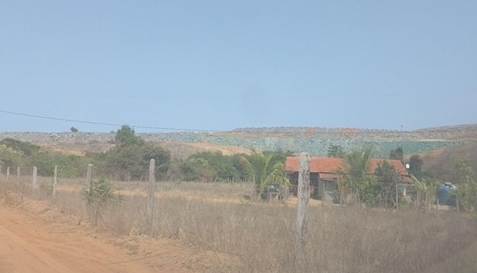
These three words, spoken by a resident during a public hearing about the mine’s expansion, have come to summarise life in Piauí - Poço D’antas9. Other residents’ testimonies describe the entrapment of having to now circumvent the sprawling mine to get from home to health services, the market, or to meet their neighbours. At least one of the houses has been completely besieged by the mine and the road, and is now only accessible either by crossing the creek or by going through a company gate. (Figure 11)

Partial view of the community of Piauí-Poço D’antas, with the open-pit lithium mine in the background. Araçuaí, Minas Gerais, Brazil. 17 September 2024. Photo by the authors
Sigma Lithium’s mine next to this community is the trailblazer of lithium extraction in the Jequitinhonha Valley. Unlike other sites still under prospecting or licensing, this territory is already transformed, already converted into an extractive operation with an industrial rhythm. Here, lithium has ceased to be a promise and has become an event - material, audible, visible. Around it, other temporalities coexist: the anticipation of nearby communities fearing or desiring mining’s arrival; the long memory of how the land once was; and the accelerated industrial time that compresses years of communal life into the urgent rhythm of intensive production cycles (Mah 2012; Tsing 2015).
When the company describes its operations as part of a green transition, it mobilises a global narrative of urgency and inevitability - the same logic that underpins contemporary energy expansion elsewhere (York 2012; Chavez et al. 2021; Fressoz 2024). Added to this is the discourse of employment, entrepreneurship, and economic redemption (redenção econômica), which portrays the arrival of large mining corporations as salvation for poor regions (Barbosa 2024). Behind this narrative of redemption lies a process of disqualification: the delegitimisation of local economies and ways of life, reclassified as backward, inefficient, or unsustainable (Polanyi 1944; Federici 2004).
For the residents of Piauí-Poço D’antas, this transition has taken the form of enclosure - the conversion of living ground into fenced territory, of fertile soil into sterile residue, of community landscape into industrial property; from the tranquillity of rural life to the inferno of unending noise, from clean air to the dust that makes the act of breathing a heavy and continuous burden.
Beyond the widely recognised environmental damage to soil and waterways, open-pit lithium mining in the Middle Jequitinhonha produces a less visible but equally devastating cercamento da vida - an enclosure of life itself: the destruction of social, affective, and ecological relations that once sustained the commons of the Gerais (Porto-Gonçalves 2021; Bispo dos Santos 2019).
If, in Cornwall, the ruins of past extraction have become spaces of recreation and re-signification (Orange 2012, 2018), and in Barroso the commons are under pressure from renewed enclosures, then in the Jequitinhonha Valley the frontier has already advanced. Here, the “green transition” manifests as a total occupation - the conversion of possibility into permanence, of anticipation into exhaustion.
These different sites trace a continuum of energy addition (York and Bell 2019): a territorial expansion from the ruins reclaimed for leisure (Cornwall) through the territories of resistance (Barroso) to the landscapes already engulfed or being conquered by extraction (Jequitinhonha). Together, they reveal how the green transition reproduces older patterns of colonial and capitalist occupation while foreclosing the very possibilities of reappropriation, repair, and communal abundance that once defined these places (Tsing 2015; Mah 2012). However, local communities resist and struggle to defend their ways of life within their territories. Environmental conflicts (Acselrad 2004; Zhouri et al. 2005; Zhouri and Laschefski 2010), whether latent or manifest, reveal disputes between distinct forms of symbolic and material appropriation of the world.
As the conclusion will argue, when the mines occupy the Gerais, they not only consume the earth’s material resources but also exhaust the cultural and ecological foundations of everyday life - the largueza and abundância that once opposed enclosure (Porto-Gonçalves 2021).
CONCLUSION - WHEN THE MINES OCCUPY SPACES OF COMMON USE
Brazilian geographer Carlos Walter Porto-Gonçalves describes the Gerais as spaces that remained, for a long time, beyond the reach of the extractive and colonial regime that shaped much of Minas Gerais. The Gerais were, he writes, lands of common use (uso comum): open territories not held under private property but collectively shared by local populations. They supported ways of life organised around gathering, small-scale farming, herding, and the sharing of water, pastures, and medicinal plants (Dayrell 1998; Nogueira and Rabelo 2009; Oliveira 2017). The Gerais thus represent not only a physical landscape but also a political and ethical form of inhabiting the land (Porto-Gonçalves 2021; Costa 2021) - an alternative to enclosure and accumulation. The Gerais are sites of intense struggle among diverse local communities, traditional communities, Quilombola communities and Indigenous peoples to secure their ways of life.
In this article, we have examined how high-intensity lithium mining arrives in one of these Gerais - the Jequitinhonha Valley in Brazil - while tracing parallel processes in two European territories, Cornwall and Covas do Barroso. Across these sites, lithium extraction unfolds within the global narrative of the “energy transition,” a discourse that legitimises territorial expansion in the name of planetary salvation. What emerges, however, is less a transition than a continuation: a new phase of resource colonialism that reoccupies spaces of common use and transforms them into zones of extraction (Andreucci et al. 2023).
Lithium mining in Cornwall, Covas do Barroso, and the Jequitinhonha Valley reveals distinct temporalities of enclosure and destruction, each producing shifts in the conditions of possibility for local ways of life. In Cornwall, the reopening of old china clay pits has been accompanied by the fencing of areas that, for decades, had served as informal commons - reclaimed by vegetation and used for walking, grazing, and recreation. Artificially re-soiled waste mounds and lakes, once integrated into local cultural landscapes, are now enclosed again under the justification of “green mining.” Residents of St Dennis denounce this renewed expropriation of community space, pointing to how the rhetoric of green value overwrites the meanings attached to these everyday landscapes.
In Covas do Barroso, the Portuguese state’s use of servidão administrativa - the administrative easement - has allowed mining companies to enter both private land and baldios, the collectively managed commons that structure rural life in the region (Direção-Geral do Território 2011; Direção-Geral de Energia e Geologia 2024). The resulting clearings, boreholes, and fences disrupt centuries-old systems of communal governance. Villagers contest what they see as an abuse of state power in favour of corporate interests, denouncing the destruction of forests, the drying of springs, and the fracturing of neighbourly relations.
In the Jequitinhonha Valley, the situation has progressed to the stage of active extraction and environmental devastation, most visibly in the community of Piauí-Poço D’Antas in Araçuaí. Explosions, incessant noise, and dust pollution mark a landscape already surrounded by fences and heavy machinery. Residents describe not only the physical destruction of their territory but also the corrosion of the social and affective bonds that once held it together.
Within the analytical horizon of this article, the idea of the Gerais is mobilised as an expression of vastness, abundance, and communality - that which stands opposed to narrowness, scarcity, and privatisation. These qualities of largueza and shared use, characteristic of communal life in the Gerais, echo across the other cases discussed: the recreational commons of Cornwall and the pastoral commons of Barroso. In all three regions, what is at stake is not only the loss of land but the destruction of forms of abundance and collective stewardship that resist the logic of enclosure.
The lithium frontier thus advances by occupying what remains of the Gerais-material and symbolic spaces where other relations between people, land, and more-than-human life have persisted. To defend these commons is to affirm that the future cannot be built on the ruins of abundance, nor on the green rhetoric of necessity. It is to insist that, even amid extraction, other worlds continue to exist and demand recognition.
Acknowledgements
The British Academy
CNPq - Conselho Nacional de Desenvolvimento Científico e Tecnológico
FAPEMIG - Fundação de Amparo à Pesquisa do Estado de Minas Gerais
REFERENCES
- Acselrad, Henri. 2004. Conflitos ambientais no Brasil Rio de Janeiro: Relume Dumárá/ Fundação Heinrich Böll.
-
Andreucci, Diego, Gustavo García López, Isabella M. Radhuber, Marta Conde, Daniel M. Voskoboynik, J. D. Farrugia, and Christos Zografos. 2023. “The coloniality of green extractivism: Unearthing decarbonisation by dispossession through the case of nickel.” Political Geography 107: 102997. https://doi.org/10.1016/j.polgeo.2023. 102997
» https://doi.org/10.1016/j.polgeo.2023. 102997 - Arboleda, Martin. 2020. Planetary mine: Territories of extraction under late capitalism London: Verso Books.
-
Artiga-Purcell, James Alejandro. 2024. “Relational resources: Moving from plural to entangled extractivisms.” Political Geography 110: 103076. https://doi.org/10.1016/j.polgeo. 2024.103076.
» https://doi.org/10.1016/j.polgeo. 2024.103076 -
Barbosa, Rômulo. 2024. “Mineração no semiárido mineiro: Neoextrativismo, atos de Estado, princípios de classificação e resistência de comunidades tradicionais.” Revista Cerrados 22(2): 354-378. https://doi.org/10.46551/rc24482692202431
» https://doi.org/10.46551/rc24482692202431 -
BBC News. ‘”Campaigners oppose demolition plans for St Dennis China clay pits”. 8 August 2025. https://www.bbc.co.uk/news/articles/c3ezv2deek7o
» https://www.bbc.co.uk/news/articles/c3ezv2deek7o -
BBC News. 2024. “Eden Project faces financial difficulties amid fall in visitor numbers.” BBC News, May 22, 2024. https://www.bbc.co.uk/news/uk-england-cornwall-69123018
» https://www.bbc.co.uk/news/uk-england-cornwall-69123018 - Bispo dos Santos, Antônio. 2019. Colonização, quilombos: Modos e significações Brasília: INCTI.
- Bringel, Breno, and Maristela Svampa. 2023. “The Decarbonisation Consensus.” Global Dialog 13(3): 28-31.
- Bruna, Natacha. 2023. The rise of green extractivism: Extractivism, rural livelihoods and accumulation in a climate-smart world Milton: Taylor & Francis.
- Burke, Edmund, and Kenneth Pomeranz. 2009. The environment and world history Berkeley: University of California Press.
- Calafate-Faria, F., K. Laschefski, B. Viana de Freitas, F. Soares Leme, R. Barbosa, and A. W. Sulzbacher. 2025. “Energy expansion at the global peripheries: The end of territories.” IDS Bulletin Brighton: Institute of Development Studies.
- Chavez, Daniel, et al 2021. Energy transition or energy expansion? New York and Amsterdam: Transnational Institute (TNI) and Trade Unions for Energy Democracy (TUED).
- Costa, João Batista de Almeida. 2021. Norte de Minas, cultura catrumana, suas gentes, razão liminar Montes Claros: Editora Unimontes.
- Dayrell, Carlos. 1998. “Geraizeiros y biodiversidad en el norte de Minas Gerais”. Master’s dissertation, Universidad Internacional de Andalucía.
-
Dunlap, Alexander, and Mariana Riquito. 2023. “Social warfare for lithium extraction? Open-pit lithium mining, counterinsurgency tactics and enforcing green extractivism in Northern Portugal.” Energy Research and Social Science 95: 102912. https://doi.org/ 10.1016/j.erss.2022.102912
» https://doi.org/10.1016/j.erss.2022.102912 - Federici, Silvia. 2004. Caliban and the Witch: Women, the body and primitive accumulation New York: Autonomedia.
- Fressoz, Jean-Baptiste. 2024. More and more and more: An all-consuming history of energy New York: Random House.
-
Gonçalves, Sergio. 2025. “Savannah resources raise lithium reserve estimate at Portugal Mine Project by 40%.” Reuters, September 15, 2025. https://www.reuters.com/markets/ europe/savannah-resources-raises-lithium-reserve-estimate-portugal-mine-project-by-40-2025-09-15/
» https://www.reuters.com/markets/ europe/savannah-resources-raises-lithium-reserve-estimate-portugal-mine-project-by-40-2025-09-15 -
Greiner, Patrick T., Richard York, and Julius Alexander McGee. 2022. “When are fossil fuels displaced? An exploratory inquiry into the role of nuclear electricity production in the displacement of fossil fuels.” Heliyon 8(1): e08795. https://doi.org/10.1016/j.heliyon. 2022.e08795
» https://doi.org/10.1016/j.heliyon. 2022.e08795 - Gudynas, Eduardo. 2015. Extractivismos: Ecología, economía y política de un modo de apropiación de la naturaleza Cochabamba: CEDIB/CLAES.
-
Longo, Stefano B., Rebecca Clausen, and Brett Clark. The tragedy of the commodity: Oceans, fisheries, and aquaculture Rutgers University Press, 2015. https://doi.org/10.2307/ j.ctt16xwb3r
» https://doi.org/10.2307/ j.ctt16xwb3r - Harvey, David. 2003. The New Imperialism Oxford: Oxford University Press.
- Mah, Alice. 2012. “Industrial ruination, community, and place: Landscapes and legacies of urban decline”. Toronto: University of Toronto Press.
- Nixon, Rob. 2011. Slow violence and the environmentalism of the poor Cambridge, MA: Harvard University Press.
- Nogueira, Mônica, and Celeida Rabelo. 2009. “Os Gerais a dentro e a fora: Identidade e territorialidade entre os geraizeiros no norte de Minas Gerais”. PhD thesis, Universidade de Brasília (UnB).
- Oliveira, Moisés Dias de. 2017. “Autodefinição identitária e territorial entre os geraizeiros do norte de Minas Gerais: O caso da Comunidade Sobrado”. Master’s dissertation, Universidade de Brasília (UnB).
- Orange, Hilary. 2012. “Public perceptions of the Cornish mining landscape”. PhD thesis, University College London.
-
Orange, Hilary. 2018. “The Cornish miner: Public art and the post-industrial landscape.” Public Archaeology 17(2-3): 89-110. https://doi.org/10.1080/14655187.2018. 1533479
» https://doi.org/10.1080/14655187.2018. 1533479 - Ostrom, Elinor. 1990. Governing the commons: The evolution of institutions for collective action Cambridge: Cambridge University Press.
- Pinch, Phil. 2000. “Making the wrecker seem not all malevolent: re-regulating the UK’s China clay mining industry.” Journal of Rural Studies 16(1): 45-58.
- Polanyi, Karl. 1944. The great transformation: The political and economic origins of our time New York: Farrar & Rinehart.
-
Porto-Gonçalves, Carlos Walter. 2021. “As Minas e os Gerais: Breve ensaio sobre desenvolvimento e sustentabilidade a partir da geografia do Norte de Minas.” Revista Verde Grande: Geografia e Interdisciplinaridade 3(2): 3-25. https://doi.org/10.46551/ rvg26752395202120325
» https://doi.org/10.46551/ rvg26752395202120325 - Riofrancos, Thea. 2025. Extractivism and the energy transition Durham, NC: Duke University Press.
- Thompson, Edward Palmer. 1963. The making of the English working class London: Victor Gollancz.
- Tsing, Anna Lowenhaupt. 2015. The mushroom at the end of the world: On the possibility of life in capitalist ruins Princeton: Princeton University Press.
-
York, Richard. 2012. “Do alternative energy sources displace fossil fuels?” Nature Climate Change 2(6): 441-443. https://doi.org/10.1038/nclimate1451
» https://doi.org/10.1038/nclimate1451 -
York, Richard. 2017. “Why petroleum did not save the whales.” Socius 3: 2378023117739217. https://doi.org/10.1177/2378023117739217
» https://doi.org/10.1177/2378023117739217 -
York, Richard, and Shannon Bell. 2019. “Energy transitions or additions? Why a transition from fossil fuels requires more than the growth of renewable energy.” Energy Research and Social Science 51: 40-43. https://doi.org/10.1016/j.erss.2019.01.008
» https://doi.org/10.1016/j.erss.2019.01.008 - Zhouri, Andréa, Klemens Laschefski, and Doralice Barros Pereira, orgs. 2005. A insustentável leveza da política ambiental: Desenvolvimento e conflitos socioambientais Belo Horizonte: Autêntica.
- Zhouri, Andréa , andKlemens Laschefski , orgs. 2010. Desenvolvimento e conflitos ambientais Belo Horizonte: Editora UFMG.
OFFICIAL AND INSTITUTIONAL SOURCES
-
Direção-Geral do Território. 2011. Servidões e restrições de utilidade pública Lisboa: DGOTDU. https://www.dgterritorio.gov.pt/node/1615
» https://www.dgterritorio.gov.pt/node/1615 -
Direção-Geral do Território. 2011. Servidões e restrições de utilidade pública https://www. dgterritorio.gov.pt/node/351
» https://www. dgterritorio.gov.pt/node/351 -
Direção-Geral de Energia e Geologia. 2024. Editais de servidão administrativa - Mina do Barroso https://www.dgeg.gov.pt/pt/divulgacao/editais/
» https://www.dgeg.gov.pt/pt/divulgacao/editais -
Agência Portuguesa do Ambiente. 2023. Declaração de Impacte Ambiental - Ampliação da Mina do Barroso (AIA3353). https://siaia.apambiente.pt/AIADOC/AIA3353/aia3353_ parecerca_barroso_modificado_assinado202353111367.pdf
» https://siaia.apambiente.pt/AIADOC/AIA3353/aia3353_ parecerca_barroso_modificado_assinado202353111367.pdf
-
1
The discourse of inevitability can be observed in other activities associated with neo-extractivist mining; see Barbosa (2024) and Calafate-Faria et al. (2025).
-
2
Ethnographic fieldwork carried out by the authors in Jequitinhonha during September and December 2024, September 2025 and March 2026 and Covas do Barroso and Cornwall in June 2025. It involved observation of local cultural events, interviews, walking research (Bates and Jackson 2026) and participatory workshops with local residents.
-
3
Cf. Energy Institute (2025) Statistical Review of World Energy 2025. London: Energy Institute. Energy Institute website.
-
4
Baldios are common-use lands, and the normative definition is set out in Portuguese Law No. 75 of 17 August 2017.
-
5
Administrative servitude (servidão administrativa) is a public law mechanism through which the state, or authorised entities, impose a legal burden on private land in the public interest, allowing access and use without transferring ownership. In the context of mining in Portugal, it has been used to authorise companies to enter and carry out exploration activities on private and communal lands, typically with compensation (Direção-Geral do Território 2011; Direção-Geral de Energia e Geologia 2024; Le Monde diplomatique 2025).
-
6
Cornish Lithium is a UK-based mineral exploration and development company focused on sustainably extracting lithium from geothermal waters and hard rock (lithium mica) in Cornwall. Founded in 2016, it aims to secure a domestic supply of battery-grade lithium for the UK’s electric vehicle industry
-
7
Imerys British Lithium (IBL) is a joint venture developing a sustainable, commercial-scale lithium mining and refining project in Cornwall, UK, aimed at producing battery-grade lithium carbonate.
-
8
It is a community located in the rural area of the municipality of Itinga, on the banks of the Ribeirão Piauí, a tributary of the Jequitinhonha River, in Minas Gerais.
-
9
A Public Hearing held in Araçuaí on 29 April 2025, as a mandatory procedure within environmental licensing requested by Atlas Lithium for the Anitta Project.
-
Statement regarding the availability of information
The data underlying this article consist of ethnographic fieldwork materials, including field notes, semi-structured interview recordings and transcripts, and records from participatory workshops conducted at the three locations between September 2024 and March 2026. These materials are not deposited in an open data repository and will not be made publicly available. This decision is justified by the nature of the research: the data include personal testimonies and identifying details of research participants - community members, activists, and residents in active socio-environmental conflicts - who shared information under conditions of trust and did not consent to the public disclosure of their contributions. Making these materials openly available could expose participants to institutional, legal, or personal risks, particularly given that conflicts over land and mining rights remain ongoing and contentious in all three field sites. The publicly available sources that inform the article - including official documents, environmental impact declarations, and institutional publications - are fully cited and accessible via the references listed in the bibliography.
Edited by
-
Chief-editor
Carlos Sautchuk (https://orcid.org/0000-0002-2427-2153)
-
Associate Editors
Rosana Castro (https://orcid.org/0000-0002-1069-4785).Sara Morais (https://orcid.org/0000-0003-1490-1232).Jose Arenas Gómez (https://orcid.org/0000-0002-2159-0527).Alberto Fidalgo Castro (https://orcid.org/0000-0002-0538-5582).Elisabeth Defreyne (https://orcid.org/0009-0009-2559-0047).
-
Approved by the editor Sara Morais (https://orcid.org/0000-0003-1490-1232)
The data underlying this article consist of ethnographic fieldwork materials, including field notes, semi-structured interview recordings and transcripts, and records from participatory workshops conducted at the three locations between September 2024 and March 2026. These materials are not deposited in an open data repository and will not be made publicly available. This decision is justified by the nature of the research: the data include personal testimonies and identifying details of research participants - community members, activists, and residents in active socio-environmental conflicts - who shared information under conditions of trust and did not consent to the public disclosure of their contributions. Making these materials openly available could expose participants to institutional, legal, or personal risks, particularly given that conflicts over land and mining rights remain ongoing and contentious in all three field sites. The publicly available sources that inform the article - including official documents, environmental impact declarations, and institutional publications - are fully cited and accessible via the references listed in the bibliography.