 Reducing Water Adsorption in Bacterial Nanocellulose through via sol-gel method
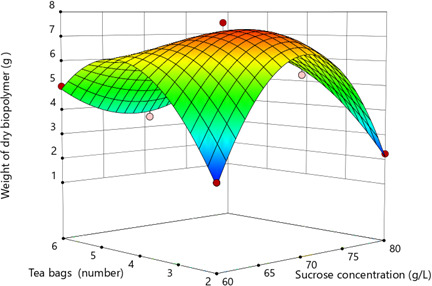
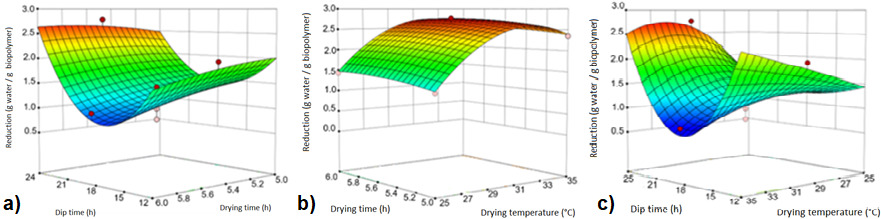
Bacterial nanocellulose (BNC), produced by Gluconacetobacter xylinus and G. hansenii, is a promising biopolymer. In this study, green tea and sucrose were used as a sustainable and low-cost culture medium, achieving optimal conditions at 60 g/L sucrose supplemented with green tea, with a maximum yield of 7.56 g of dry BNC after 15 days of cultivation. To address the limitation posed by BNC’s high water-holding capacity in textile applications, BNC was functionalized with titanium dioxide (TiO₂) nanoparticles via a sol–gel method, applied for the first time for this specific purpose. Optimal conditions (24 h immersion, 30 °C drying temperature, and 5.5 h drying time) reduced the water-holding capacity to 2.77 g of water per gram of dry BNC, representing a reduction of more than 98% compared to uncoated BNC. Mechanical properties improved significantly after TiO₂ incorporation, reaching a Young’s of 0.50 ± 0.30 MPa and tensile stress of 5.57 ± 1.50 MPa. FTIR, SEM, AFM, and EDS analyses confirmed the formation of a continuous TiO₂ coating that acts as an effective barrier to water ingress. These results highlight BNC–TiO₂ composites as economical, ecological, and robust alternatives for advanced textile applications.
Key words
bacterial nanocellulose; dip coating; Kjeldahl method; surface response; TiO2 nanoparticles
 Thumbnail
 Thumbnail
 Thumbnail
 Thumbnail
 Thumbnail
 Thumbnail
 Thumbnail
 Thumbnail
 Thumbnail
 Thumbnail
 Thumbnail