 Reducing Water Adsorption in Bacterial Nanocellulose through via sol-gel method
Abstract
Bacterial nanocellulose (BNC), produced by Gluconacetobacter xylinus and G. hansenii, is a promising biopolymer. In this study, green tea and sucrose were used as a sustainable and low-cost culture medium, achieving optimal conditions at 60 g/L sucrose supplemented with green tea, with a maximum yield of 7.56 g of dry BNC after 15 days of cultivation. To address the limitation posed by BNC’s high water-holding capacity in textile applications, BNC was functionalized with titanium dioxide (TiO₂) nanoparticles via a sol–gel method, applied for the first time for this specific purpose. Optimal conditions (24 h immersion, 30 °C drying temperature, and 5.5 h drying time) reduced the water-holding capacity to 2.77 g of water per gram of dry BNC, representing a reduction of more than 98% compared to uncoated BNC. Mechanical properties improved significantly after TiO₂ incorporation, reaching a Young’s of 0.50 ± 0.30 MPa and tensile stress of 5.57 ± 1.50 MPa. FTIR, SEM, AFM, and EDS analyses confirmed the formation of a continuous TiO₂ coating that acts as an effective barrier to water ingress. These results highlight BNC–TiO₂ composites as economical, ecological, and robust alternatives for advanced textile applications.
Key words
bacterial nanocellulose; dip coating; Kjeldahl method; surface response; TiO2 nanoparticles
INTRODUCTION
Currently, the textile industry is considered the second most polluting industry in the world, due to the large amounts of natural resources that it consumes such as water, arable land, vegetable, and animal supplies used to produce fibers, not to mention the chemical effluents produced from this activity. It is estimated that around 2.6% of the world’s water consumption is assigned to produce cotton, considered one of the least sustainable natural fibers on the planet (Carrera 2017). In response to this challenge, the textile industry is seeking sustainable processes with a green approach based on renewable materials (Li et al. 2017), among which bacterial nanocellulose—hereafter referred to as BNC—stands out.
This biopolymer is synthesized by acetic acid bacteria belonging to the species Gluconacetobacter xylinus and Gluconacetobacter hansenii, in a strictly aerobic culturing process at room temperature (25-30 °C), using as a carbon source glucose or any other carbohydrate (Castro et al. 2011). Bacterial Nanocellulose was first isolated in 1886 by Adrian Brown ever since, a broad number of studies have been published around to determine the influence of different sustainable carbon source on nanocellulose synthesis as: the use of waste from beer culture broth (Ha et al. 2008), the addition of 0.4% agar into saccharified food wastes (Song et al. 2009), the use of Japanese fruit juices supplemented with nitrogen (Kurosumi et al. 2009), and pineapple peel juice and sugar cane juice from Colombian agro-industrial wastes as a carbon source (Castro et al. 2011).
In contrast with plant cellulose, bacterial nanocellulose (BNC) has higher purity since its structure is free of lignin, pectin, and hemicellulose. It has a high-water holding capacity, crystallinity, and excellent mechanicals properties (Yan et al. 2017) as a Young’s modulus corresponding to 138 GPa and a tensile strength of 2 GPa (Leitão et al. 2013). The coefficient of thermal expansion of the nanofibers in the axial direction have similar qualities as glass (0.1 ppm/K), and it has a uniform nanostructure with a high degree of polymerization (Esa et al. 2014).
Since the discovery of bacterial nanocellulose (BNC) in Eastern cultures, green tea and sugar have been recognized as an effective culture medium for its production. Green tea provides essential nutrients, including nitrogen sources, polyphenols, and other bioactive compounds that enhance bacterial growth and cellulose synthesis, while sugar serves as the primary carbon source for microbial metabolism. Several studies have demonstrated that tea-based media, particularly those using green or black tea, support the proliferation of Komagataeibacter spp., the primary cellulose-producing bacteria, leading to efficient BNC formation (Jagannath et al. 2021, Gorgieva & Trček 2019). The combination of green tea and sugar not only offers a cost-effective and natural alternative to synthetic culture media but also aligns with sustainable and scalable production methods.
To our knowledge, BNC has not been previously investigated as a highly sustainable textile material. However, BNC applications in textile area have been limited by the high-water holding capacity of fibers. Due to this, all the studies have been carried out as a prototype level, such as the production of BNC clusters in shoe’s manufacture (Maurello 2018) to promote an environmentally friendly textile industry (Niyazbekova et al. 2018). In terms of the world market, in 2015 the market for cellulosic fibers presented a value of 5.2 million tons and it is expected that by 2030 this quantity will increase to 10 million tons (Alam & Christopher 2017) for this reason, the necessity to implement new biodegradable fibers has been growing. Despite this, there are few scientific studies aimed to reduce the hydrophilic capacity of the fibers through the incorporation of particles at the microscale and/or nanoscale level to implement the BNC in garments production at large-scale. Although BNC is a biodegradable and sustainable polymer, it exhibits a remarkably high-water retention capacity, making it less attractive for textile applications. To address this limitation, this study explores the nanostructuring of BNC with TiO₂.
The sol-gel method has been widely employed for producing TiO₂-nanostructured materials, including polymer-based composites, due to its numerous advantages. This process enables precise control over the morphology, particle size, and crystallinity of TiO₂, which is essential for tailoring properties such as surface area, porosity, and photocatalytic activity (Macwan et al 2011). Additionally, sol-gel synthesis occurs under relatively mild conditions, making it suitable for processing temperature-sensitive polymer substrates. The liquid-phase nature of this technique facilitates the uniform dispersion and deposition of TiO₂ nanoparticles on polymer surfaces or within polymer matrices, enhancing functionalities such as UV protection, antimicrobial activity, and photocatalysis (Gobena & Woldeyonnes 2024). Furthermore, the chemical composition of TiO₂ can be tuned through precursor modification, allowing for doping or functionalization to optimize its interaction with polymers. One particularly significant advantage of sol-gel-derived TiO₂ impregnations is their ability to modify surface wettability, enabling hydrophobic or superhydrophobic properties, which are highly desirable for self-cleaning, anti-fouling, and moisture-resistant applications (Macwan et al. 2011). Finally, sol-gel synthesis is a cost-effective and scalable approach, making it highly suitable for industrial applications, including coatings, membranes, textiles, and biomedical devices. These advantages make the sol-gel method a versatile and efficient technique for fabricating TiO₂-based polymer composites with enhanced functional properties.
The primary goal of this work is to develop a novel functionalized bacterial nanocellulose (BNC) material with reduced water-holding capacity through the incorporation of TiO₂ nanoparticles—a strategy that, to our knowledge, has not yet been investigated. This modification is essential for expanding the potential applications of BNC, particularly in industries such as textiles, where lower water adsorption is critical for enhancing performance and durability. By addressing the inherent hydrophilicity of BNC, we aim to create a material that retains the beneficial properties of bacterial cellulose—such as biodegradability, mechanical strength, and flexibility—while overcoming its limitations in water-sensitive applications. To achieve this goal, the specific objectives of this study include (i) producing BNC from a SCOBY and modifying it with TiO₂ nanoparticles to reduce water retention, (ii) optimizing the production conditions for BNC and BNC/TiO₂ using experimental design, (iii) quantifying the total nitrogen content in commercial green tea as a nutrient source for culturing, (iv) evaluating the effect of culturing time on the mechanical properties of BNC produced at 8, 15, and 21 days of culturing, and (v) characterizing the chemical, morphological, and mechanical properties of the resulting materials (BNC and BNC/TiO₂). Each objective is designed to systematically contribute to the development of a low-water-adsorption BNC material with tailored properties for specific industrial applications.
MATERIALS AND METHODS
Materials
The microorganisms used in this work were a commercial Symbiotic Culture of Bacteria and Yeast (SCOBY), available in the local market. In this study, the tea contained within the green tea bags was selected as a sustainable and natural source of polyphenols—particularly catechins, theaflavins, and thearubigins—which function as reducing and stabilizing agents in the green synthesis of TiO₂ nanoparticles. Furthermore, the tea bags were used with their original envelopes intact, to avoid direct contamination of the bacterial cellulose with soluble tea components, while still allowing nutrient diffusion to support acetic acid bacteria growth. Green tea bags (Brand: Olimpica) were purchased. Pure green tea, free of added flavors or additional components, was used in this study. The tea bags were weighed (1.850 ± 0.036 g; n = 5), and the net content of green tea per bag was determined to be 1.644 ± 0.036 g (n = 5).
Ammonium chloride (NH4Cl, 99%, Merck), sulfuric acid (H2SO4, 96% v/v, Merck), Kjeltabs ST, sodium hydroxide (NaOH, 35% w/v, Merck), hydrochloric acid (HCl, 0.1N) and hydrogen peroxide (H2O2, 30% v/v, Merck) were supplied by Merck (Bogotá, Colombia). However, boric acid (H3BO3, 4% v/v, Biopack) and titanium tetraisopropoxide (TTIP, 97% v/v, Alfa AESEV) were obtained by biopack and Alfa Aesav, respectively.
Bacterial nanocellulose culture conditions
Considering that tea and sugar serve as the primary nitrogen and carbon sources respectively, this study explored a range of concentrations to assess their potential influence on BNC production. The literature (Wang et al. 2022, Teoh et al. 2004, Villarreal-Soto et al. 2018) reports several concentrations of these ingredients in the culture medium. Based on this review, a study range of 60–80 g/L of sugar and 2–6 tea bags per liter of medium was selected. The fermentation time and temperature conditions were maintained at 15 days and 28°C as constant parameters. To systematically evaluate the effects of sugar and green tea composition on BNC production, a central composite experimental design was employed. Figure 1 shows the BNC production using the medium described above.

Bacterial nanocellulose (BNC) production. Left: A white membrane formed as the final product of SCOBY culture. Right: Large-scale production of homogeneous BNC using tray-based culturing.
Kjeldahl method
To determine the total nitrogen content in green tea commercial bags, the AOAC 978.04 was used (AOAC 2002). Briefly, 1 g of sample and 1 mg of standard ammonium chloride were transferred in a digestion tube. As a catalyst, 12 mL of sulfuric acid and two Kjeltabs ST (3.5 g potassium sulphate and, 0.0035 g selenium per tab) were added. To follow, tubes were shaken gently to wet the sample and placed in the preheated digestion at 150 °C for 30 min, and then at 420 °C for 60 min. The resulting solutions were cooled at 50-60 °C and placed in a distillation unit, which was fed with 50 mL of sodium hydroxide solution to drag the ammonium vapors. The ammonia was collected in 25 mL of boric acid solution, and it was automatically titrated against the standard 0.1 N hydrochloric acid with colorimetric endpoint detection.
The content of total nitrogen in commercial green tea bags (n=3) was determined by the Kjeldahl method using boric acid as the receiving solution (Eq. 1).
In the Eq. 1, Va represents mL of standard acid (HCl), VbmL of ammonium chloride, N normality of standard acid and W, weight of sample in grams (Jiang et al. 2014).
Titanium dioxide nanoparticles synthesis (NPs-TiO2)
The synthesis of titanium dioxide nanoparticles by the sol-gel method was based and modified from the work of Yaghoubi et al. (2010). For this purpose, a complex of titanium peroxide was created by mixing titanium tetraisopropoxide TTIP, hydrogen peroxide H2O2, and deionized water at a volumetric ratio of 12:90:200, respectively. The solution was maintained in constant stirring at 1150 rpm for 26 h at room temperature, until obtaining an orange viscous gel (Ramirez & Pataquiva-Mateus 2018).
Production of BNC/TiO2 composite
The BNC pellicles obtained at the end of the culturing were washed with deionized water to inhibit microbial activity besides removing biomass residues. After that, pellicles were dried in an oven at 28 °C for 5 d, until they reached constant weight.
The dry samples (2 cm x 5 cm) were placed in a desiccator for 24 h to remove the remaining moisture and ensure a better adherence of the TiO2 particles in the biopolymer’s surface. Subsequently, samples were dipped into the sol-gel solution, dried in a muffle, and placed in a desiccator for 26 h to finalize the surface modification.
As no study of this nature has been reported to date, it was necessary to investigate the conditions under which BNC could retain the least amount of water per gram of material. To this end, a preliminary study (data not shown) was conducted to identify the most influential factors affecting the outcome, as well as the relevant parameter ranges for further investigation. This initial screening revealed that dip-coating time had a greater influence on water retention than the number of immersion cycles. Additionally, both drying time (20 to 60 min) and drying temperature (20 to 60°C) after dip-coating were found to be critical parameters, as they significantly affected the reduction of water retention in BNC.
The dip time and the drying conditions (temperature and time) were set by a central composite design experiment, for evaluating the conditions at which the highest reduction in water adsorption capacity is achieved. Where the dip time (h) ranged from 12 to 24, the drying temperature (°C) and drying time (h) evaluated from 25 to 35 and from 5 to 6, respectively.
To determine the reduction of the water holding capacity, the dry functionalized samples were previously weighed (dry biopolymer) and after dipping for 1 hour in deionized water (hydrated biopolymer). The difference between both weights was established as the amount of adsorbed water, and the reduction in the hydrophilic capacity was determined as the grams of adsorbed water/ grams of the dry biopolymer, taking as a reference the uncoated control group.
Mechanical, chemical, and physical characterizations of BNC and BNC/TiO2
Mechanicals properties
Bacterial nanocellulose dry samples (from 8, 15, 21 days and functionalized) were placed in a desiccator for 24 h before testing.
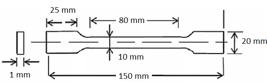
The tensile properties of polymeric samples were assessed using ASTM D5937-96 (ASTM 1998). Dried sample was first prepared according to the dimensions specified in the standard (Figure 2). The specimen was then mounted in a universal tensile machine (Jinan Testing Equipment IE Corporation, WDW-30) equipped with appropriately sized grips to prevent slippage. The test was conducted under controlled environmental conditions, ensuring temperature and humidity are within the prescribed range. A uniaxial tensile force is applied at a constant strain rate until the specimen fractures, while the load and elongation data are continuously recorded. All tests were conducted with a crosshead speed of 300 mm/min at room temperature (n=10). The data provided by the universal machine were analyzed from the stress/strain graph, to identify the different properties such as, tensile stress, Young’s modulus and strain and stress at break, respectively.
Fourier Transform Infrared Spectroscopy (FTIR)
FTIR spectra were recorded using an Agilent Cary 630 FTIR spectrometer equipped with an ATR (attenuated total reflectance) accessory. Measurements were performed in the range of 4000–650 cm⁻¹ with a resolution of 4 cm⁻¹, averaging 32 scans per sample under ambient conditions.
Scanning Electron Microscopy (SEM)
Dry BNC and BNC/TiO2 composite samples were cut in circles of 6 mm using a hole puncher and later coated with gold by the sputtering method (Detom Vaccum desk IV), with a layer thickness of 10 nm for its later visualization in a scanning electron microscopy (JEOL JSM-6490LV). The diameter of the cellulose nanofibers was measured using the Image J software (v.1.471 NIH, USA) using a SEM micrograph where the nanofibers are visible. The samples were analyzed using a scanning electron microscope (SEM) operating at an accelerating voltage of 10 kV. Images were acquired at magnifications of 50×, 1,500×, 10,000×, and 50,000×, with a working distance of 9 mm. An accelerating voltage above 10 kV is not recommended for visualizing BNC and BNC/TiO₂ samples, as higher voltages may cause thermal damage or burning of the specimen. Additionally, to verify the presence of titanium in the functionalized samples an energy dispersive X-ray spectroscope (EDS) was employed.
Atomic Force Microscopy (AFM)
AFM images were acquired using an Asylum Research MFP-3D Bio instrument (Oxford Instruments) operating in tapping mode. A silicon cantilever (AC240TS) with a nominal spring constant of approximately 40 N/m and a resonance frequency of ~300 kHz was used. Measurements were performed in air at room temperature. Scan areas of 5 × 5 µm² and 1 × 1 µm² were captured with a resolution of 512 × 512 pixels.
Statistical analysis
The effect of the culturing time on the BNC mechanical properties were studied by analysis of variance (ANOVA). A value of p < 0.05 was considered statistically significant. Moreover, a comparison between the means of the mechanical properties in each culturing time point, were made using Fisher’s least significant difference (LSD) test (McKenna et al. 2009).
RESULTS AND DISCUSSION
Bacterial Nanocellulose (BNC) production
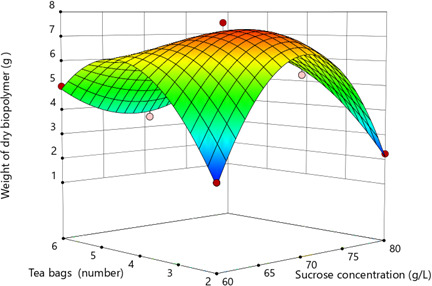
From the surface response methodology and a central composite design, the influence of the sucrose concentration and the amount of green tea bags on the bacterial nanocellulose production were evaluated. Table I shows the results from the central composite design. Using the software Design-Expert® a third order model was obtained (Eq. 2, R2=0.98), and it correlated the weight of the dry biopolymer with the principal components into the culturing media. Where: x1, is the concentration of sucrose (g/L); x2, the number of green tea bags and y, the weight of the dry biopolymer (g).
Eq. 2 was employed in the surface response (Figure 3), and it allowed us to determine the conditions in which the highest production of BNC was reached.

Surface response to produce bacterial nanocellulose from a Symbiotic Culture of Bacterial and Yeast (SCOBY) showing the effects between interactions of sucrose concentration and the number of tea bags.
According to the reports of Zhou et al. (2007), the use of sucrose as a carbon source produced consistently high yields of cellulose in culturing times, less than 14 d. Previous studies have reached a production of 3.83 g of dry BNC using an initial sucrose concentration of 20 g/L, during 3 d (Mikkelsen et al. 2009). However, the results of this work show a high yield of BNC (7.56 g) at 60 g/L in 15 d. In the present research, a high concentration of carbon source in contrast to the literature was used due to the studied strains corresponding to a variable colony of microorganism which demands more nutrients. According to the American Type Culture Collection SCOBY has the presence of yeast, such as Brettanomyzec, ygosaccharomyces, and Saccharomyces, and Acetobacter xylinum as the primary bacterium in the culture (Greenwalt et al. 2000). Previous studies were carried out from pure strains like Gluconacetobacter xylinus (ATCC 53524) and Acetobacter xylinus (ATCC 700178) (Islam et al. 2017) whose carbon requirements are lower because it is a single microorganism and not a colony.
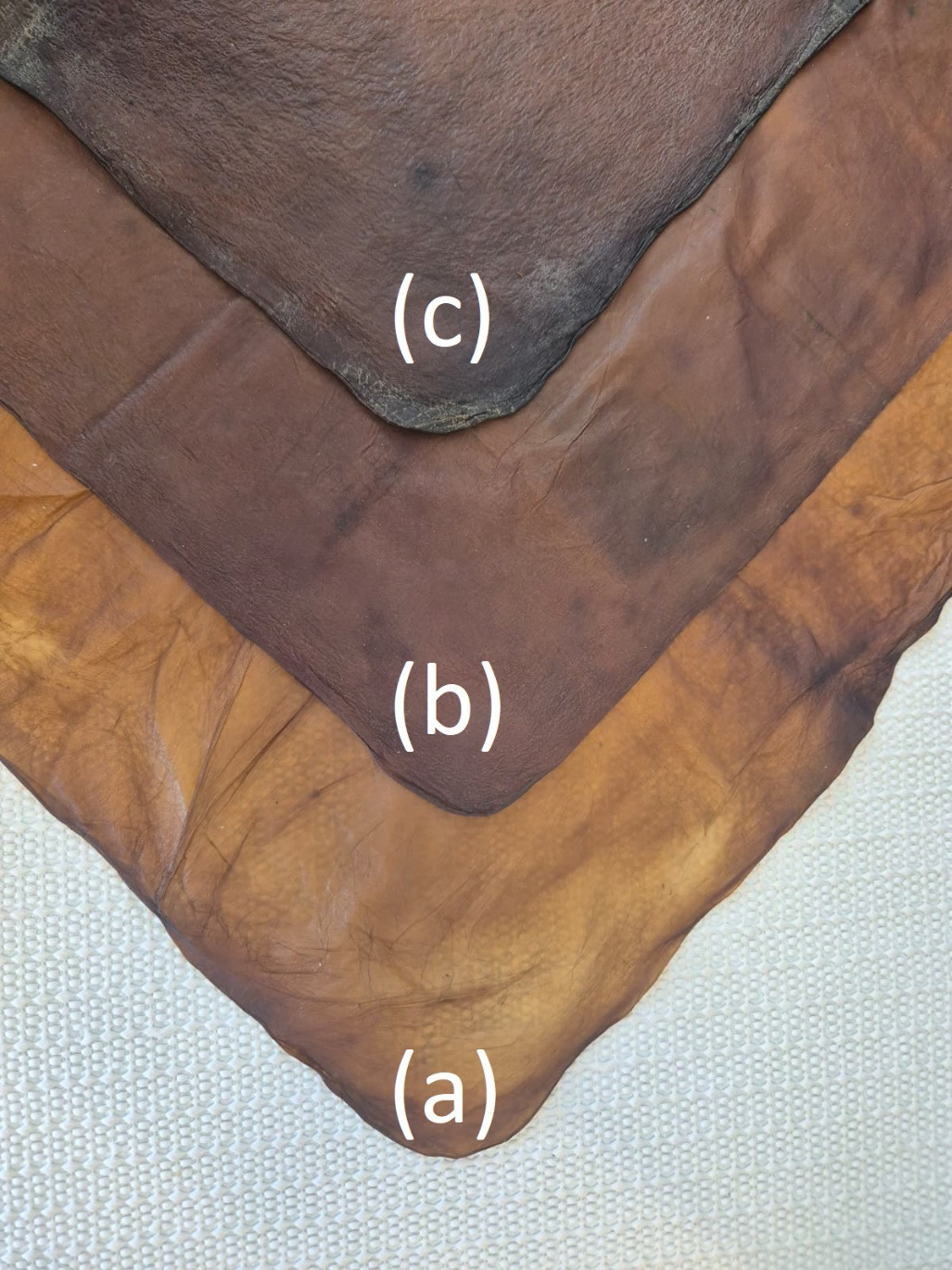
Based on the results from the surface response, it was decided to produce the biopolymer that then was characterized and functionalized, under the optimal culturing conditions (60 g/L of sucrose and 4 tea bags) to standardize the production of the biopolymer. The culturing time was set by the results for the mechanical properties evaluated on the biopolymers obtained at three culturing times (8, 15, and 21 days, Figure 4).

Bacterial nanocellulose (BNC) samples cultured based on the results from the surface response under the optimal culturing conditions (60 g/L of sucrose and 4 tea bags) at 8 (a), 15 (b), and 21 days (c).
Determination of the total nitrogen content in commercial green tea bags
From Eq. 1, it was found that a green tea bag (weight average = 1.48 ± 0.03 g) has a total nitrogen content of 2.85 ± 0.05 %w/w, which is due to the presence of proteins/peptides, caffeine and 18 essential amino acids in a composition of: 6.9 %, 7.6 % and 5.3 %, respectively (percentage of dry extract solids) (Greenwalt et al. 2000). Moreover, some works have reported the presence of other important nitrogenous components like theobromine and theanine that with all the additional components referred to above, represent the 15 %w/w of green tea (Harbowy et al. 1997). The nitrogen quantification allowed to express the values for the factor 2 (number of commercial tea bags in the above experimental design), in terms of the concentration of total nitrogen present in the culturing medium.
Based on results, it can be observed that the nitrogen requirement into the culturing medium is considerably lower (170 mg/L) than the sucrose requirement (60 g/L). Therefore, it is considered that green tea bags stimulate the ability of the bacteria to produce cellulose as well as, it provides a medium of complex micronutrients such as amino acids, glucides, proteins, caffeine, volatile compounds, polyphenols, alkaloids, minerals, and trace elements like, aluminum, chromium, selenium, sodium, potassium, calcium, iron, fluoride, and manganese (Reto et al. 2007). Moreover, caffeine and polyphenols have shown an antibiotic activity against Streptococcus mutans and other harmful microorganisms that affect SCOBY (Otake et al. 1991).
In addition to this, the extensive global market that involve green tea allows to categorize it as a commercial, inexpensive, and natural nitrogen source, which maintain the concept of sustainability, avoiding the use of chemicals behind the production of bacterial nanocellulose.
Production of BNC/TiO2 composite
Table II shows the results from the central composite design, in which the influence of the factors involved through the surface modification process on the reduction in water adsorption capacity of the BNC/TiO2 composite can be observed. The selected parameters in Table II were based on previous studies reporting optimal BNC production yields and nanoparticle loading efficiencies, as well as on initial trials conducted to ensure structural integrity of the composite
Central composite experimental design for the inclusion of titanium dioxide nanoparticles (NPs- TiO2) into bacterial nanocellulose.
By the software Design-Expert®, a third-order model was obtained (Eq. 3, R2=0.92) and correlated the reduction in water adsorption capacity with the main factors that influence the production of BNC-TiO2 composite. Where: x1, immersion time; x2, drying temperature; x3 drying time and y, reduction in water adsorption.
The polynomial model generated by Design Expert® software describes the relationship between processing conditions and the reduction in water adsorption (y) of bacterial cellulose nanostructured via the sol-gel method using TiO₂. The independent variables included in the model are immersion time in the TiO₂ solution (𝑥₁), drying temperature after immersion (𝑥₂), and drying time (𝑥₃). The model incorporates linear, quadratic, interaction, and cubic terms, reflecting the complex and nonlinear behavior of the response surface, which is characteristic of multivariable and physicochemically intricate processes like sol-gel treatment. It is important to highlight that the objective of this study is to minimize the response variable, as a lower value indicates reduced water adsorption in the final nanostructured cellulose — a critical property for applications where hydrophobicity and dimensional stability are desired.
Among the three process variables, immersion time (𝑥₁) emerges as the most influential. It appears in most of the model terms, including first-order interactions (𝑥₁𝑥₂, 𝑥₁𝑥₃), quadratic terms (𝑥₁²), and higher-order interactions (𝑥₁²𝑥₂, 𝑥₁²𝑥₃, 𝑥₁𝑥₂², 𝑥₁𝑥₃², and the three-way interaction 𝑥₁𝑥₂𝑥₃). The relatively large negative coefficient of the quadratic term (−0.03𝑥₁²) reveals a strong curvature effect, indicating that there is an optimal immersion time that minimizes water adsorption, and that deviations from this optimal point — whether shorter or longer — result in a less favorable (higher) water content in the final material.
This result is consistent with the physicochemical mechanisms of the sol-gel process, where immersion time directly influences the amount and uniformity of TiO₂ deposited onto the cellulose surface. An optimal immersion time allows for effective surface coverage and nanostructure formation that reduces the material’s affinity for water. In contrast, both insufficient immersion (leading to incomplete coating) and excessive immersion (which can cause TiO₂ particle agglomeration or pore blockage) can result in a less efficient barrier, thereby increasing water retention. Thus, while drying temperature and drying time also contribute to the final performance, immersion time plays a dominant and highly nonlinear role in achieving the lowest possible water adsorption, making it the most critical parameter for optimizing the hydrophobic behavior of the nanostructured cellulose.
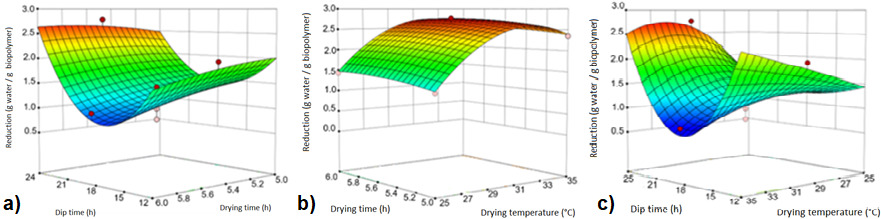
Eq.3 was employed in the surface response (Figure 5), which allowed assessing the conditions that improve the hydrophilic capacity of the biopolymer functionalized.

Surface response for the surface modification of BNC with titanium dioxide nanoparticles (TiO2) showing the effects between interactions of (a) dip and drying time at a constant drying temperature of 30 °C, (b) drying time, and temperature at constant dip time of 24 h, (c) drying temperature and dip time at constant drying time of 5.5 h.
Figure 5 presents the response surfaces generated by Equation 3. Specifically, Figure 5a depicts a response surface evaluating the reduction in water retention within the BNC sample following dip-coating with TiO₂ nanostructuring via the sol-gel technique, as well as the drying time after nanostructuring. The response surface indicates that a longer exposure time of the sample to the TiO₂ sol-gel increases the probability of reducing its water retention capacity. However, within the studied range, the reduction in retained water is directly proportional to the dip-coating time. On the other hand, while drying time influences the outcome, its effect is less significant compared to dip-coating time. In fact, similar reductions in water retention can be achieved within the studied range (5–6 hours of drying). On the other hand, Figure 5b illustrates the influence of drying time and drying temperature on the water retention capacity of the material. It is observed that, within this range, drying time does not significantly affect the response variable. In contrast, temperature plays a more critical role, with an optimal point identified at 30°C. Within the 30–35°C range, no substantial changes in water reduction are observed, regardless of the drying time. Finally, Figure 5c shows that, while maintaining a constant drying temperature, a reduction in dip-coating time significantly decreases the water retention within the material. However, a critical inflection point is observed around 18 hours of dip-coating, beyond which water retention begins to increase, reaching approximately 20 g of water per gram of biopolymer at 12 hours of dip-coating at 35°C. As conclusion, the model presented in Figure 5 illustrates that at low drying temperatures, the resulting surface modification allowed a greater amount in water adsorption than in the samples tested at higher temperatures 30 °C and 35 °C while, at 24 h and 5.5 h of dip and drying time, respectively, a reduction of 2.77 g water/g dry biopolymer in the uncoated sample control group.
According to the literature (Czaja et al. 2006), bacterial cellulose membranes have been reported to hold water up to 200 times their dry weight, reflecting their high hydrophilicity and porosity due to its internal structure. In this context, the reduction to 2.77 g of water per gram of BNC observed in this study indicates that the nanostructuring with TiO₂ nanoparticles reduced the water-holding capacity by more than 98% compared to its original potential. This result suggests that the incorporation of TiO₂ significantly alters the nanostructure of the bacterial cellulose, limiting its ability to absorb and retain water.
Based on the results from the surface response (Figure 5), it was decided to produce the BNC/TiO2 composite under optimal conditions. Therefore, all the characterization of the functionalized biopolymer was conducted under these conditions.
Mechanical, chemical, and physical characterizations of BNC and BNC/TiO2
Effect of the culturing time on BNC mechanical properties
Table III shows the results of the uniaxial tensile test carried out in BNC pellicles to determine the effect of the culturing time on the mechanical properties. By Fisher’s LSD test it was possible to perform a multiple comparison between groups (mechanical properties and culturing point), and it was verified that the mechanical properties at each culturing point changed with a level of significance of 95%. As observed, the Young’s modulus was the only property that did not varied significantly with time compared to the stress at break, which it increased 2.35 MPa from 8 to 21 d, whilst the strain at break decreased 16.36 % from 8 to 21 d, meaning that the mechanical resistance increases proportionally with the culturing time as a result, to an increase in the density of the biopolymers.
Mechanical properties of the BNC without functionalizing at three culturing times: 8, 15 and 21 days (± standard deviation values).
However, stress/strain curves of bacterial nanocellulose at three culturing points show that at 8 d the dry BNC has the characteristic behavior of polymeric materials, which requires low stresses to reaches high deformation (60.93 ± 11%). As a result, the biopolymer presented a sustained plastic deformation, with a low mechanical resistance and high ductility (Shackelford & Martín 2005).
At 15-days, this feature changes due to the fibers network has higher density and requires the greatest stress to be separated (3.39 ± 1.00 MPa). Some authors attribute this behavior to a rearrangement of the fibers during the strain process (McKenna et al. 2009). This means that the 15-day-biopolymer has an elastic and plastic deformation, the former corresponds to the ability of the fibers to return to their initial position, once the elastic limit was reached (0.02% of strain). The later plastic deformation is due to an irreversible deformation before the breaking point. At 21-days, a similar behavior in the shape of the curve was obtained. However, this biopolymer presented higher mechanical resistance because the density of the fibers’ network increases with time.
According to the reports of Bäckdahl et al. (2006), Young’s modulus of bacterial nanocellulose pellicles determined from the linear stress/strain region was established between 1 to 10 MPa. However, the results obtained in this research (0.06 – 027 MPa) were out of the range reported by literature. This mainly, dry BNC was studied while previous studies were carried out using hydrated BNC pellicles, which have about 98% of water what generates better mechanical behavior at low strains (less than 30%), as a viscoelastic material (McKenna et al. 2009).
Considering that biopolymers obtained at 15 and 21 days of culturing exhibited a similar behavior in the stress/strain curve, the researchers decided to functionalize only the 15-days biopolymer because it represents the intermediate mechanical properties of the range analyzed. Therefore, the subsequent chemical and physical characterizations were carried out for the BNC and BNC /TiO2 composite during 15 days of culturing.
Figure 6 presents the stress-strain curves for representative samples under each experimental condition. Pristine BNC exhibits the lowest tensile stress, whereas samples cultured for 24 days show increased stress values due to the thicker layered structure that develops with extended culturing time. Notably, the BNC/TiO₂ composite demonstrates enhanced mechanical properties compared to pristine BNC across all fermentation periods.

Representative stress–strain curves showing the general mechanical trend of BNC samples at (a) 8, (b) 15, and (c) 24 days of culturing, and (d) after TiO₂ incorporation via the sol-gel method. Stress-Strain curves of Bacterial Nanocellulose (BCN) under different conditions: (a) 8, (b) 15, and (c) 24 days of Culturing, and (d) Nanostructured BNC via the sol-gel method.
Mechanical properties of the BNC and BNC/TiO2 composite
Figure 7 presents selected pairs of BNC specimens for each set point. The color of each sample is characteristic of the culture medium, which consists of green tea and white sugar. A darker and brownish hue indicates a longer culturing time.

BCN specimens with dimensions as per corresponding ASTM D5937-96 for 8 (a), 15 (b), and 21 days (c) of culturing.
Overall, the shape of the BNC/TiO2 curve, up to 15% of strain has a characteristic behavior of an elastomeric material that does not exhibit linear stress/strain behavior at low deformations. The low slope region corresponds to the initial elastic modulus, in which the molecules start to disorganize. This behavior is associated with the crushing of the composite (TiO2) generating the breakdown of the weak hydrogen bonds that interact between the surface of the BNC and the TiO2 particles, while the region of the elevated module corresponds to the elongation of the extended chains fibers, until the breaking point (Shackelford & Martín 2005). In contrast with pure BNC, the functionalized BNC showed an increase in mechanical resistance due to the compact structure made by TiO2 layers present in the surface of the material.
The effect of the surface modification on the mechanical properties of the BNC is presented in Table IV. The Young’s modulus of the BNC-composite increased with the addition. This behavior could be due to interactions between the sol-gel layers and BNC. As other authors have mentioned, the interactions may include hydrogen bonding, van der Waals and even entanglement (Dayal & Catchmark 2016), which can reinforce the structure of the BNC. As a result, the Young’s modulus of the BNC/TiO2 increased, whilst the strain at break decreased because of the increase in the ductility.
Comparison of the Mechanical properties of the BNC, BNC/TiO2 composite (± standard deviation values) and selected textile materials.
On the other hand, Table IV presents the mechanical properties of widely used textile materials, including cotton, silk, wool, and polyester. The comparison of bacterial nanocellulose (BNC) and BNC/TiO₂ composite with textile materials of vegetal, animal, or synthetic origin reveals key differences in their mechanical behavior. BNC exhibits significantly lower tensile stress (~3.39 MPa) and Young’s modulus (0.21 MPa) compared to cotton (~5 GPa) and wool (~120 MPa), indicating lower mechanical strength and durability. However, BNC demonstrates a higher strain at break (38%) than wool (25–50%), suggesting greater flexibility and deformation capacity before rupture. Due to BNC’s high-water retention and moisture-wicking properties, it could be utilized in sweat-absorbing base layers or cooling fabrics for athletes, whereas BNC/TiO₂ could serve as a lightweight, breathable fabric for hot climates. TiO₂ nanostructuring enhances BNC’s mechanical properties, making it more viable for functional textiles, such as antimicrobial or UV-protective fabrics. Additionally, BNC and BNC/TiO₂ offer a more sustainable alternative to polyester, as the latter generates microplastics during degradation and washing processes, posing an increasing risk to human health and the environment (Periyasamy & Tehrani-Bagha 2022).
l characterization: Fourier Transform Infrared Spectroscopy (FTIR)
Figure 8 shows a comparison between the wavenumber from bacterial nanocellulose and bacterial nanocellulose/TiO2 composite, verifying that after the functionalization the biopolymer presented a change in its chemical composition.

In contrast with plant cellulose, bacterial nanocellulose has a higher purity due to its structure is free of lignin, pectin, and hemicellulose (Yan et al. 2017). This fact was confirmed in the BNC FTIR spectrum (a), in which it can be seen, the presence of the main functional groups of the β-glucose molecules that constitute the cellulose polysaccharide, and the absence of methoxy groups (O-CH3) characteristics of lignin.
In Fig. 3b, it was observed that the spectra obtained from the BNC/TiO2 composite shares functional groups present in the TiO2 nanoparticles, due to the surface modification having multiple layers on the biopolymer. Therefore, the main functional groups of coating overlapped some substrate (BNC) functional groups, as in the case of the peaks around 800-1600 cm-1, which are weak compared to the non-functionalized sample, because the stretching of C-O-H vibrations generated by adhesion of TiO2 nanoparticles at the biopolymer surface (Sun et al. 2010). As well as, for the spectra BNC/TiO2 the peak 484 cm-1 represents Ti-O and Ti-O-Ti bending from surface modification (Amalraj & Pius 2014) and the peak 3146 cm-1 shows the interaction between the hydroxyl groups (OH-) of both (substrate and TiO2 sol-gel) allowing the union by weak bonds (Gutierrez et al. 2012).
Physical characterization: Scanning Electron Microscopy (SEM)
SEM images of the BNC surface (Figure 9a) clearly show a fibrous network of nanofibrils in a discontinuous and randomly oriented configuration, but with no indication of fibers directionality. The average diameter of the fibers was measured to be 74 ± 0.03 nm (n=150) using Image J software, these evaluations confirmed the nanoscale of the biopolymer and are similar to the diameters reported by other authors (Vazquez et al. 2013). As it can be seen in Figure 9b, the nanofibrils altogether form ribbons that assembled in a porous three-dimensional network. Figures 9c and 9d illustrate TiO2 particles deposed on the surface and between the fibers. During the surface modification process, BNC fibers act as a hydrophilic substrate, which has hydroxyl groups that are present on its surface and provide the H-bonding interaction between the hydrophilic inorganic TiO2 sol-gel and fibers (Sun et al. 2010). Subsequently, the TiO2 particles agglomerate in clusters that enable them to assemble a film on the surface, and it completely covers the fibers. To avoid the agglomeration of particles some author recommended increasing the temperature at which the substrate dries after surface modification (Rao et al. 2005), nevertheless; working with a natural polymer, high temperatures affect the material properties for this reason, the set temperature were low (30 °C) and allowed the clusters growth.

Scanning electron microscopy images of bacterial nanocellulose fibers (a) surface of the uncoated biopolymer, (b) white arrows show nanofibers of uncoated BNC, (c) An overview of the treated surface, and (d) BNC fibers modified by the agglomeration of titanium dioxide particles.
Determination of film width distribution is not straightforward because the surface modification was not captured longitudinally. Nevertheless, as can be observed (Figure 9d) the film has an appreciable length in micrometers of length, which is the result of the high time (24 h) that the biopolymer was immersed in the sol-gel solution. This condition was set by the results obtained from the surface response of BNC/TiO2 composite studied before. If a thinner coating is desired, the dip time can be reduced; however, the retention capacity of the material will increase.
Finally, to verify the presence of titanium in the biopolymer surface, a micro-elementary analysis was carried out. Figure 10 illustrates an energy dispersive X-ray spectroscopy (EDS) analyzed in a section of the coating, in which a highly defined semi-quantitative peak for titanium (Ti) can be see, as well as the presence of carbon (C) and oxygen (O) peaks, characteristics of the bacterial nanocellulose.

Physical characterization: Atomic Force Microscopy (AFM)
AFM images of BNC surface (Figure 11a) confirmed the interlaced distribution of the nanofibers network with an average roughness of 42.5 nm. In Figure 11b it can be observed the uniformity of the TiO2 nanoparticles coating that clearly covers the fiber’s surface with an average roughness of 46.1 nm. The increase in roughness was due to the agglomeration of the inorganic nanoparticles on the hydrophilic substrate. As can be noted, no fibers were seen in the surface because the film was thick enough to cover them.

Atomic Force Microscopy images of (a) Bacterial nanocellulose surface uncoated with a scanning area of 25.9 μm2, and (b) BNC/TiO2 surface composite with a scanning area of 25.3 μm2. (c) BNC/TiO2 surface composite with a scanning area of 4.0 μm2, in which an agglomeration of TiO2 nanoparticles were clearly observed.
To verify the presence of TiO2 nanoparticles, a visualization of the sample was made with a scanning area of 4 μm2, in which protuberances of 50 to 70 nm wide were observed as illustrated in Fig. 6c. These protuberances are likely agglomerations of TiO₂ nanoparticles, as the resolution of this technique does not allow for the distinction between individual nanoparticles and their aggregates in this specific case. Both the SEM images (Figures 9a and 9b) and AFM images (Figure 11a) reveal a rough TiO₂ layer uniformly covering the BNC surface after nanostructuring. For BNC/TiO2, individual TiO₂ nanoparticles cannot be clearly distinguished, as the nanostructuring process resulted in the formation of continuous layers on the polymer, as evidenced in the SEM image (Figures 9c and 9d).
It was demonstrated that TiO₂ nanoparticles coat the BNC forming a continuous layer over the polymer, resulting in a significant enhancement of its mechanical properties. Specifically, the Young’s modulus increases from 0.21 ± 0.07 MPa to 0.50 ± 0.30 MPa, the tensile stress from 3.39 ± 1.00 MPa to 5.57 ± 1.50 MPa, and the stress at break from 2.36 ± 0.72 MPa to 4.44 ± 1.54 MPa. These improvements indicate that the nanostructuring process markedly enhances both the mechanical robustness and water adsorption behavior of the material. The inherent flexibility of BNC is attributed to its interwoven nanofiber structure, as demonstrated in Figures 9c and 11a. Moreover, the observed reduction in water retention in the BNC/TiO₂ composite is due to the formation of a continuous TiO₂ coating, which acts as an effective barrier, thereby limiting water ingress into the material.
CONCLUSIONS
The following conclusions have been drawn based on the proposed objectives:
-
Bacterial nanocellulose (BNC) was successfully produced from a Symbiotic Culture of Bacteria and Yeast (SCOBY) using green tea and sugar as a culture medium. Green tea was identified as a low-cost and essential source of nutrients, including nitrogen and polyphenols, that promote bacterial growth and cellulose synthesis, while sugar served as the primary carbon source. This method aligns with sustainable and scalable production, making it promising for industrial textile applications.
-
Optimal production conditions for BNC were determined to be 60 g/L of sucrose and green tea (from 4 green tea bags), yielding a maximum of 7.56 g of dry biopolymer within 15 days under aerobic conditions at 28 °C. For the BNC/TiO₂ composite, optimal conditions for modification included 24 hours of dip-coating, a drying temperature of 30 °C, and 5.5 hours of drying, which resulted in a significant reduction of water-holding capacity to 2.77 g of water per gram of dry biopolymer. This represents a reduction of over 98% in water retention compared to uncoated BNC, achieved through the nanostructuring with TiO₂. While the sol-gel process adds steps, the enhanced functional properties of the BNC/TiO₂ composite, such as improved hydrophobicity and durability, can justify these costs for specialized applications.
-
Quantification revealed that a commercial green tea bag contains 2.85% w/w of nitrogen, translating to approximately 170 mg/L of nitrogen in the optimal culture medium.
-
The mechanical resistance of BNC was found to increase significantly with longer culturing times. Furthermore, the incorporation of inorganic particles (TiO₂) also enhanced the mechanical resistance of the material.
-
Through comprehensive chemical and morphological characterizations using SEM, AFM, FTIR, and EDS, the study confirmed a fibrous and discontinuous network in pure BNC samples, and notably, the presence of a TiO₂ coating on the BNC/TiO₂ composite. This TiO₂ coating forms a continuous layer that acts as an effective barrier, significantly reducing water ingress and enhancing mechanical properties such as Young’s modulus and tensile stress. These findings collectively highlight BNC and its nanostructured composite with TiO₂ as promising, eco-friendly alternatives for diverse textile industry applications, given their improved properties and low production cost.
Acknowledgements
The authors wish to thank Universidad Jorge Tadeo Lozano and the Nanotechnology Laboratory staff.
References
-
ALAM MN & CHRISTOPHER LP. 2017. A novel, cost-effective and eco-friendly method for preparation of textile fibers from cellulosic pulps. Carbohydr Polym 173: 253-258. https://doi.org/10.1016/j.carbpol.2017.06.005.
» https://doi.org/10.1016/j.carbpol.2017.06.005 - AMALRAJ A & PIUS A. 2014. Photocatalytic Degradation of Alizarin Red S and Bismarck Brown R Using TiO2 Photocatalyst. J Chem Appl Biochem 1: 1-7.
-
AOAC – ASSOCIATION OF OFFICIAL ANALYTICAL CHEMISTS INTERNATIONAL. 2002. AOAC Guidelines for Single Laboratory Validation of Chemical Methods for Dietary Supplements and Botanicals [WWW Document]. URL https://s27415.pcdn.co/wp-content/uploads/2020/01/64ER20-7/Validation_Methods/d-AOAC_Guidelines_For_Single_Laboratory_Validation_Dietary_Supplements_and_Botanicals.pdf (accessed 4.14.16).
» https://s27415.pcdn.co/wp-content/uploads/2020/01/64ER20-7/Validation_Methods/d-AOAC_Guidelines_For_Single_Laboratory_Validation_Dietary_Supplements_and_Botanicals.pdf - ASTM. 1998. Standard test method for determination of tensile properties of moulding and extrusion plastics. Am Soc Test Mater.
-
BÄCKDAHL H, HELENIUS G, BODIN A, NANNMARK U, JOHANSSON BR, RISBERG B & GATENHOLM P. 2006. Mechanical properties of bacterial cellulose and interactions with smooth muscle cells. Biomaterials 27: 2141-2149. https://doi.org/10.1016/j.biomaterials.2005.10.026.
» https://doi.org/10.1016/j.biomaterials.2005.10.026 - CARRERA GE. 2017. Los retos sostenibilistas del sector textil. Rev Quím Ind Text: 20-32.
-
CASTRO C, ZULUAGA R, PUTAUX J-L, CARO G, MONDRAGON I & GAÑÁN P. 2011. Structural characterization of bacterial cellulose produced by Gluconacetobacter swingsii sp. from Colombian agroindustrial wastes. Carbohydr Polym 84: 96-102. https://doi.org/10.1016/j.carbpol.2010.10.072.
» https://doi.org/10.1016/j.carbpol.2010.10.072 - CZAJA W, KRYSTYNOWICZ A, BIELECKI S & BROWN JR RM. 2006. Microbial cellulose—the natural power to heal wounds. Biomaterials 27(2): 145-151.
-
DAYAL MS & CATCHMARK JM. 2016. Mechanical and structural property analysis of bacterial cellulose composites. Carbohydr Polym 144: 447-453. https://doi.org/10.1016/j.carbpol.2016.02.055.
» https://doi.org/10.1016/j.carbpol.2016.02.055 -
ESA F, TASIRIN SM & RAHMAN NA. 2014. Overview of Bacterial Cellulose Production and Application. Agric Sci Procedia, 2nd International Conference on Agricultural and Food Engineering (CAFE 2014) - New Trends Forward 2: 113-119. https://doi.org/10.1016/j.aaspro.2014.11.017.
» https://doi.org/10.1016/j.aaspro.2014.11.017 - GOBENA ST & WOLDEYONNES AD. 2024. A review of synthesis methods, and characterization techniques of polymer nanocomposites for diverse applications. Discover Mat 4(1): 52.
- GORGIEVA S & TRČEK J. 2019. Bacterial cellulose: Production, modification, and perspectives in biomedical applications. Nanomaterials 9(10): 1352.
-
GREENWALT CJ, STEINKRAUS KH & LEDFORD RA. 2000. Kombucha, the Fermented Tea: Microbiology, Composition, and Claimed Health Effects. J Food Prot 63: 976-981. https://doi.org/10.4315/0362-028X-63.7.976.
» https://doi.org/10.4315/0362-028X-63.7.976 -
GUTIERREZ J, TERCJA A, ALGAR I, RETEGI A & MONDRAGON I. 2012. Conductive properties of TiO2/bacterial cellulose hybrid fibres. J Colloid Interf Sci 377: 88-93. https://doi.org/10.1016/j.jcis.2012.03.075.
» https://doi.org/10.1016/j.jcis.2012.03.075 -
HA JH, SHEHZAD O, KHAN S, LEE SY, PARK JW, KHAN T & PARK JK. 2008. Production of bacterial cellulose by a static cultivation using the waste from beer culture broth. Korean J Chem Eng 25: 812-815. https://doi.org/10.1007/s11814-008-0134-y.
» https://doi.org/10.1007/s11814-008-0134-y -
HARBOWY ME, BALENTINE DA, DAVIES AP & CAI Y. 1997. Tea Chemistry. Crit Rev Plant Sci 16: 415-480. https://doi.org/10.1080/07352689709701956.
» https://doi.org/10.1080/07352689709701956 -
ISLAM M, ULLAH MW, KHAN S, SHAH N & PARK JK. 2017. Strategies for cost-effective and enhanced production of bacterial cellulose. Int J Biol Macromol 102: 1166-1173. https://doi.org/10.1016/j.ijbiomac.2017.04.110.
» https://doi.org/10.1016/j.ijbiomac.2017.04.110 - JAGANNATH A, RAMESH P & MOHAN T. 2021. Bacterial nanocellulose: Recent developments in synthesis, properties, and applications. Carbohydrate Polymers 267: 118188.
-
JIANG B, TSAO R, LI Y & MIAO M. 2014. Food Safety: Food Analysis Technologies/Techniques, in: Van Alfen NK (Ed), Encyclopedia of Agriculture and Food Systems. Academic Press, Oxford, p. 273-288. https://doi.org/10.1016/B978-0-444-52512-3.00052-8
» https://doi.org/10.1016/B978-0-444-52512-3.00052-8 -
KUROSUMI A, SASAKI C, YAMASHITA Y & NAKAMURA Y. 2009. Utilization of various fruit juices as carbon source for production of bacterial cellulose by Acetobacter xylinum NBRC 13693. Carbohydr Polym 76: 333-335. https://doi.org/10.1016/j.carbpol.2008.11.009.
» https://doi.org/10.1016/j.carbpol.2008.11.009 -
LEITÃO AF, SILVA JP, DOURADO F & GAMA M. 2013. Production and Characterization of a New Bacterial Cellulose/Poly (Vinyl Alcohol) Nanocomposite. Materials 6: 1956-1966. https://doi.org/10.3390/ma6051956.
» https://doi.org/10.3390/ma6051956 -
LI J, HE J & HUANG Y. 2017. Role of alginate in antibacterial finishing of textiles. Int J Biol Macromol 94: 466-473. https://doi.org/10.1016/j.ijbiomac.2016.10.054.
» https://doi.org/10.1016/j.ijbiomac.2016.10.054 - MACWAN DP, DAVE PN & CHATURVEDI S. 2011. A review on nano-TiO 2 sol–gel type syntheses and its applications. J Mat Sci 46: 3669-3686.
-
MAURELLO ME. 2018. Biotextiles: el cultivo de organismos vivos para fabricar telas. La Nacion. Available at: https://www.lanacion.com.ar/moda-y-belleza/biotextiles-el-cultivo-de-organismos-vivos-para-fabricar-telas-nid2111290/
» https://www.lanacion.com.ar/moda-y-belleza/biotextiles-el-cultivo-de-organismos-vivos-para-fabricar-telas-nid2111290/ -
MCKENNA BA, MIKKELSEN D, WEHR JB, GIDLEY MJ & MENZIES NW. 2009. Mechanical and structural properties of native and alkali-treated bacterial cellulose produced by Gluconacetobacter xylinus strain ATCC 53524. Cellulose 16: 1047-1055. https://doi.org/10.1007/s10570-009-9340-y.
» https://doi.org/10.1007/s10570-009-9340-y -
MIKKELSEN D, FLANAGAN BM, DYKES GA & GIDLEY MJ. 2009. Influence of different carbon sources on bacterial cellulose production by Gluconacetobacter xylinus strain ATCC 53524. J Appl Microbiol 107: 576-583. https://doi.org/10.1111/j.1365-2672.2009.04226.x.
» https://doi.org/10.1111/j.1365-2672.2009.04226.x -
NIYAZBEKOVA ZT, NAGMETOVA GZ & KURMANBAYEV AA. 2018. An overview of bacterial cellulose applications. Eurasian J Appl Biotechnol 2. https://doi.org/10.11134/btp.2.2018.3
» https://doi.org/10.11134/btp.2.2018.3 -
OTAKE S, MAKIMURA M, KUROKI T, NISHIHARA Y & HIRASAWA M. 1991. Anticaries effects of polyphenolic compounds from Japanese green tea. Caries Res 25: 438-443. https://doi.org/10.1159/000261407.
» https://doi.org/10.1159/000261407 - PERIYASAMY AP & TEHRANI-BAGHA A. 2022. A review on microplastic emission from textile materials and its reduction techniques. Polym Degrad and Stabil 199: 109901.
- RAMIREZ D & PATAQUIVA-MATEUS A. 2018. Síntesis por sol-gel de un recubrimiento nanoestructurado de TiO2 para ser aplicado en sustrato de vidrio. Chemical Engineering Thesis. Universidad Jorge Tadeo Lozano. (Unpublished).
-
RAO KS, EL-HAMI K, KODAKI T, MATSUSHIGE K & MAKINO K. 2005. A novel method for synthesis of silica nanoparticles. J. Colloid Interface Sci 289: 125-131. https://doi.org/10.1016/j.jcis.2005.02.019.
» https://doi.org/10.1016/j.jcis.2005.02.019 -
RETO M, FIGUEIRA ME, FILIPE HM & ALMEIDA CMM. 2007. Chemical Composition of Green Tea (Camellia sinensis) Infusions Commercialized in Portugal. Plant Foods Hum Nutr 62: 139-144. https://doi.org/10.1007/s11130-007-0054-8.
» https://doi.org/10.1007/s11130-007-0054-8 - SHACKELFORD JF & MARTÍN N. 2005. Introducción a la ciencia de materiales para ingenieros. Pearson Educación.
-
SONG H-J, LI H, SEO J-H, KIM M-J & KIM S-J. 2009. Pilot-scale production of bacterial cellulose by a spherical type bubble column bioreactor using saccharified food wastes. Korean J Chem Eng 26: 141-146. https://doi.org/10.1007/s11814-009-0022-0.
» https://doi.org/10.1007/s11814-009-0022-0 -
SUN D, YANG J & WANG X. 2010. Bacterial cellulose/TiO2 hybrid nanofibers prepared by the surface hydrolysis method with molecular precision. Nanoscale 2: 287-292. https://doi.org/10.1039/B9NR00158A.
» https://doi.org/10.1039/B9NR00158A - TEOH AL, HEARD G & COX J. 2004. Yeast ecology of Kombucha fermentation. Inter J Food Microbiol 95(2): 119-126.
-
VAZQUEZ A, FORESTI ML, CERRUTTI P & GALVAGNO M. 2013. Bacterial Cellulose from Simple and Low Cost Production Media by Gluconacetobacter xylinus. J Polym Environ 21: 545-554. https://doi.org/10.1007/s10924-012-0541-3.
» https://doi.org/10.1007/s10924-012-0541-3 - VILLARREAL-SOTO SA, BEAUFORT S, BOUAJILA J, SOUCHARD JP & TAILLANDIER P. 2018. Understanding kombucha tea fermentation: a review. J Food Sci 83(3): 580-588.
- WANG B, RUTHERFURD-MARKWICK K, ZHANG XX & MUTUKUMIRA AN. 2022. Kombucha: Production and microbiological research. Foods 11(21): 3456.
-
YAGHOUBI H, TAGHAVINIA N & ALAMDARI EK. 2010. Self cleaning TiO2 coating on polycarbonate: Surface treatment, photocatalytic and nanomechanical properties. Surf Coat Technol 204: 1562-1568. https://doi.org/10.1016/j.surfcoat.2009.09.085.
» https://doi.org/10.1016/j.surfcoat.2009.09.085 -
YAN H, CHEN X, SONG H, LI J, FENG Y, SHI Z, WANG X & LIN Q. 2017. Synthesis of bacterial cellulose and bacterial cellulose nanocrystals for their applications in the stabilization of olive oil pickering emulsion. Food Hydrocoll 72: 127-135. https://doi.org/10.1016/j.foodhyd.2017.05.044.
» https://doi.org/10.1016/j.foodhyd.2017.05.044 -
ZHOU LL, SUN DP, HU LY, LI YW & YANG JZ. 2007. Effect of addition of sodium alginate on bacterial cellulose production by Acetobacter xylinum. J Ind Microbiol Biotechnol 34: 483. https://doi.org/10.1007/s10295-007-0218-4.
» https://doi.org/10.1007/s10295-007-0218-4
Edited by
-
Handling editor
Vasco Azevedo
Data will be made available upon reasonable request.