 Revealing the first records of endoparasitic interactions in the non-native fish Moenkhausia costae within a reservoir in Northeastern Brazil
Abstract
Parasites are an important part of ecosystems, but are frequently ignored in studies on major anthropogenic impacts on aquatic environments. Biological invasions are responsible for biodiversity loss, and are one of the possible consequences of water transfer projects. In addition, there is a possibility that the non-native species brings, at least in part, its parasite fauna to the invaded area, or acquire new parasites in the new environment. Here, we investigated the endoparasites of a non-native fish species that was recently recorded in the upper Paraíba River basin, Northeastern Brazil, after a major water transfer project. Fifty specimens of Moenkhausia costae were collected from the Poções reservoir, Monteiro municipality, Paraíba State. Forty-two hosts were parasitized (84%), and 179 parasite specimens were collected. The endoparasite community was composed of six species of nematodes. There was no significant correlation between parasitism and the size of the hosts, nor the host’s condition factor. Although the size of parasitized and non-parasitized fish did not differ, the relative condition factor was significantly higher for parasitized fish. Future studies should investigate which parasites were introduced with M. costae, and which ones were part of the invaded environment.
Key words
biological invasions; fish parasites; Poções reservoir; Procamallanus; water transfer
INTRODUCTION
Freshwater habitats are among the most threatened by anthropogenic impacts, and are in accelerated degradation (Albert et al. 2020), affecting all ecosystems and life forms. In Northeastern Brazil, the São Francisco River Integration Project with the Northern Northeastern Basins (PISF) has been underway since 2017. This project, inaugurated by connecting the São Francisco River with the Paraíba River, aims to provide water to parts of the semiarid region in Northeastern Brazil. Some impacts on water quality, as well as the introduction of fish species into the receiving environment, have already been detected (Ramos et al. 2021, Silva et al. 2023). The fish Moenkhausia costae (Steindachner 1907) (Characiformes: Characidae) naturally occurs in the São Francisco and Itapicuru river basins and other basins of Northeastern Caatinga and Coastal Drainages, and is considered a non-native species in the upper Paraíba River basin (Ramos et al. 2021, Silva et al. 2023). Ramos et al. (2021) recorded this species for the first time in Paraíba state following the arrival of waters from the São Francisco River transposition, specifically in the Poções reservoir. Additionally, Ramos et al. (2021) emphasized the species’ high potential for dominance. Within one and a half year after the São Francisco River diversion, M. costae ranked among the three most dominant species in Poções reservoir, posing “a threat to the native ichthyofauna of the Paraíba do Norte River basin” (Ramos et al. 2021).
Ignoring parasites in fish ecology is a mistake (Timi & Poulin 2020), since parasites can have diverse effects on their fish hosts, ranging from changes in behavior and physiology to severe impacts on fitness and survival (Barber et al. 2000, Johnson & Dick 2001). Parasitism can be related to the relative condition factor (Kn) of the host, which is a measure of the overall health and physiological condition of the hosts (Le Cren 1951). Parasitized hosts often have a reduction in their Kn due to the effects of parasites on their health, such as nutrient loss, tissue damage, and compromised immune system. These effects can have significant consequences for the survival, reproduction, and evolutionary success of both hosts and parasites (Guidelli et al. 2011, Özer et al. 2016). In addition, parasites are often aggregated among their hosts, and the intensity of aggregation may be related to the potential harm to the host and stability of the host-parasite association (Morrill et al. 2023).
Therefore, due to its relevance regarding the possibility of potentially invasive fish parasite species being introduced into these aquatic ecosystems, the aims of the present study were: (1) to collect and identify endoparasite specimens that compose the parasitic fauna of the host Moenkhausia costae in the new environment, the Poções reservoir; (2) determine the infection and discrepancy indices of endoparasites and, (3) investigate correlation between parasitism and the host’s functional traits (host length and Kn).
MATERIALS AND METHODS
Fish were captured in July 2018 (N=6), February 2019 (N=5) and January 2020 (N=39), in the littoral zone of the Poções reservoir, located in the Borborema Plateau region, in the upper Paraíba River basin (7°53’38”S and 37°0’30”W) in the Monteiro municipality, Paraíba State, Northeastern Brazil (Figure 1). Multi mesh gillnets and trawl nets were used: two sets of gillnets (30 m long and 20, 25, 40, 50, 60, 100 and 120 mm meshes), were randomly placed at the littoral zone for at least four hours. And the trawl nets (10 m long and 12 mm mesh) were dragged twice in three different regions of the littoral zone. The specimens were anesthetized in the field with eugenol solution (Lucena et al. 2013) and fixed in 10% formaldehyde solution. At the laboratory, fish were preserved in 75° GL alcohol, identified, weighed and measured according to Malabarba & Reis (1987). Samplings were performed under the collection permit (N°56416-4/2019), from Instituto Chico Mendes de Conservação da Biodiversidade/Sistema de Autorização e Informação em Biodiversidade – ICMBio/SISBIO and registered in the National System of Genetic Resource, Management and Associated Traditional Knowledge (SisGen, AC94800).

Maps of Brazil (a), State of Paraíba (b) and Poções Reservoir (c), indicating the hydrographic drainage (blue line) and the São Francisco River Integration Project (PISF) water transfer east axis (black dashed line).
The fish were necropsied, and the endoparasites found were mounted in slides according to Eiras et al. (2002). The eyes, internal organs and mesentery were analyzed under a stereomicroscope, and the endoparasites found were stored in 70% alcohol for posterior identification. For identification, the parasites found (Phylum Nematoda) were clarified with Amann’s Lactophenol. The parasites were identified based on the specialized literature, considering morphological aspects and measured parameters (Moravec 1998). The ecological terminology and parasitic indices are according to Bush et al. (1997) and Rózsa et al. (2000). For data analysis, Quantitative Parasitology 3.0 software was used, which provided descriptive parasitic indices (prevalence, mean intensity, and mean abundance) and aggregation indices (variance and Poulin’s index of discrepancy) of the parasite community. The literature indicates that 0 corresponds to a completely uniform distribution while 1 corresponds to an extremely aggregated distribution (Poulin 1993). Spearman’s rank correlation (rho) test was used to investigate the correlation between parasitism (species abundance and infracommunity richness) and functional traits of the hosts (standard length and relative condition factor - Kn), and the Mann-Whitney U test was used to compare parasitized and non-parasitized fish groups, adopting 5% significance value (Zar 2009). The relative condition factor (Kn) was calculated according to Le Cren (1951). The tests were performed in the software R version 4.4.0 (2024-04-24 ucrt), using the packages “Hmisc” and “coin”.
RESULTS
Fifty specimens of M. costae were analyzed for endoparasites. The standard length of the fish ranged between 47.4 and 57.0 mm (mean = 52.6, SE = 1.9), and the relative condition factor ranged from 0.79 to 1.17. A total of 179 parasites were collected from the stomach, intestine and liver. Forty-two hosts (84%) were parasitized with at least one specimen of endoparasite. The present community was composed of six endoparasite taxa, all belonging to the Phylum Nematoda (Table I; Figures 2, 3 and 4). The taxa were identified as: Procamallanus (Spirocamallanus) saofranciscensis (Moreira, Oliveira, and Costa, 1994) and Procamallanus (Spirocamallanus) neocaballeroi (Caballero-Deloya, 1977) (adult individuals) and Spiroxys sp., Procamallanus sp. 1, Procamallanus sp. 2 and Rhabdochona sp. Four larval nematodes found in the intestine could not be identified because they were damaged and missing parts. The parasitological indices are shown in Table I and representative specimens were deposited in the Coleção de Invertebrados Paulo Young (CIPY), Universidade Federal da Paraíba, João Pessoa (deposit numbers: UFPB.NEMA-176 to 180).

Parasite specimens of the host Moenkhausia costae from Poções reservoir, Monteiro/PB. (a) Anterior end of P. (S.) neocaballeroi; (b) Detail of the posterior end of P. (S.) neocaballeroi; (c) Anterior end of P. (S.) saofranciscensis; (d) Detail of the posterior end of P. (S.) saofranciscensis.

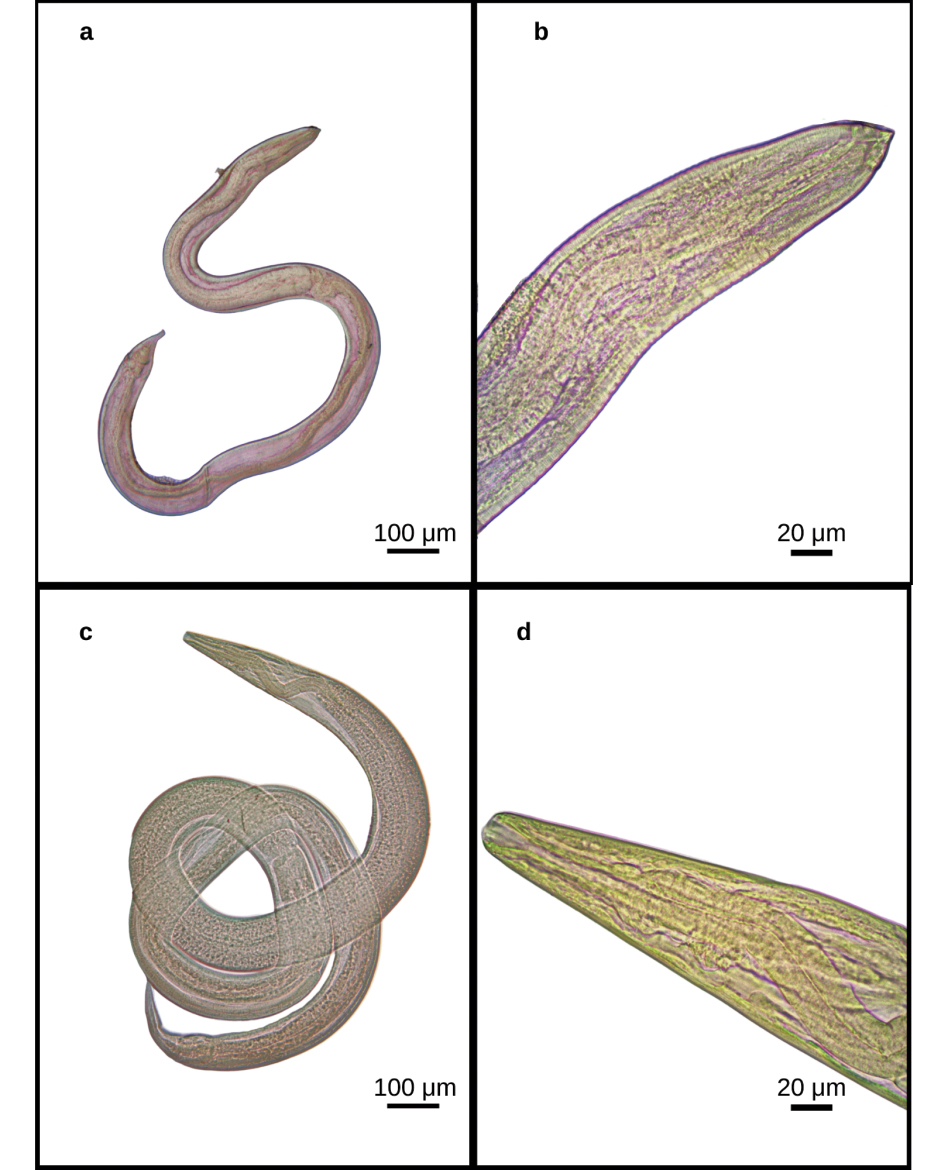
Parasite specimens of the host Moenkhausia costae from Poções reservoir, Monteiro/PB. (a) Anterior and posterior end of Spiroxys sp.; (b) Detail of the anterior end of Spiroxys sp.; (c) Individual of the species Rhabdochona sp.; (d) Detail of the anterior end of Rhabdochona sp.
Parasite specimens of the host Moenkhausia costae from Poções reservoir, Monteiro/PB. (a) Anterior end of Procamallanus sp. 1; (b) Posterior end of Procamallanus sp. 1; (c) Anterior end of Procamallanus sp. 2; (d) Posterior end of Procamallanus sp. 2.
Parasite taxa, infection site (IS; s = stomach, i = intestine and l = liver), abundance (A), Mean abundance (MA), Prevalence (P%), Mean intensity (MI), and Poulin’s discrepancy index (D). CI = confidence interval.
The parasite with the highest abundance was Rhabdochona sp. with 134 individuals (74.9%), followed by Procamallanus (S.) saofranciscensis, with 21 specimens (11.7%), and Spiroxys sp. with 13 individuals (7.2%). Four individuals belonging to Procamallanus sp. 2 and Nematoda gen. sp. were collected (2.2% each). The taxa Procamallanus (S.) neocaballeroi presented only 2 individuals (1.1%), while Procamallanus sp. 1 was the least present species with only 1 individual found (0.6%).
The most prevalent nematodes in the parasite community were, respectively, Rhabdochona sp. (62%), P. (S.) saofranciscensis (32%), Spiroxys sp. (16%) and Procamallanus sp. 2 (6%). The other parasitic indices, across all parasite species, had mean abundance values ranging from 0.26 to 2.68 and mean intensity values ranging from 1.00 to 4.32. The mean richness of infracommunities was 1.1 (confidence interval between 0.87 and 1.32.
The data were also analyzed to observe the existence of four correlations: whether the size of parasitized fish is related to their level of parasitism (parasite abundance vs. standard length); whether the relative condition factor (Kn) is related to the level of parasitism (parasite abundance vs. Kn); whether the size of parasitized fish is related to their richness of parasites (parasite richness vs. standard length) and whether the relative condition factor (Kn) is related to the richness of parasites (parasite richness vs. Kn). The aim of investigating these correlations is to determine if the parasitism is influenced by the host size and Kn. It is worth noting that only parasite species with prevalence higher than 10% were included in the analyzes.
The Spearman test revealed that there is no significant relationship between parasitism and host size (Abundance x SL nor Richness x SL) (Table II). The Spearman coefficient values (rs) ranged from -0.0949 to 0.6419 for the three most prevalent parasite species in the community. Regarding the correlation between parasitism and relative condition factor (Abundance x Kn, and Richness x Kn), the Spearman coefficient values varied between -0.0356 and 0.4368. The Spearman test showed a significant relationship for the Kn with the species Rhabdochona sp. (rs = 0.4368, p-value = 0,0015) and with the parasite richness (rs = 0.4728, p-value = 0.0005). This value suggests that fish with a higher Kn value, indicating better health, could harbor a greater parasitic burden for the nematode Rhabdochona sp., and greater diversity of parasites.
Spearman’s correlation coefficients (values shown in the table) were calculated to assess the relationships between host traits—standard length (SL) and relative condition factor (Kn) as predictor variables—and parasite abundances and infracommunity richness as response variables. Significant correlations are highlighted in bold (p < 0.01, assuming α = 0.05). Parasite species were limited to those with a prevalence greater than 10%.
Subsequently, the data related to the standard length and the condition factor were organized into two groups: parasitized fish and non-parasitized fish. Thus, it was possible to perform the Mann-Whitney U comparative test. Regarding the standard length, the test had no significant difference between the groups (U=162.5; two-tailed p=0.8843). For the relative condition factor (Kn), the Mann-Whitney U test found a significant difference between the two groups of hosts (U=67; two-tailed p=0.0075), as shown in Figure 5. Although the size of parasitized and non-parasitized fish did not differ, the relative condition factor was significantly higher for parasitized fish.

Relative condition factor (Kn) in parasitized and non-parasitized Moenkhausia costae from Poções reservoir, Monteiro/PB.
DISCUSSION
Research on the parasites of M. costae has been limited. Albuquerque (2013) recorded 14 species of endoparasites in fish from the Três Marias reservoir, Upper São Francisco River, in Minas Gerais, within their native range. Some species of nematodes identified in this study had already been reported in fish of the species M. costae. Albuquerque (2013) recorded the species Procamallanus (S.) saofranciscensis, Spiroxys sp., and Rhabdochona sp. composing the parasitic fauna of this host in the Três Marias reservoir, in the upper São Francisco River region, Minas Gerais state. Not all the parasite species reported in the M. costae native area in the São Francisco river were reported in the new environment; this pattern is described in numerous studies, considering several host taxa (see Torchin et al. 2003, Lacerda et al. 2012a, b). Recent studies by Falkenberg et al. (2024a, b) in the Jaguaribe river basin, Ceará state, where the host is also native, reported the parasites Diplostominae gen. sp. (metacercariae) and Hysterothylacium sp. (larvae).
The absence of all parasite species from M. costae native range in its new environment may have significant ecological implications. This phenomenon, often referred to as “enemy release,” may give M. costae a competitive advantage by reducing parasitic pressure, leading to increased survival and fecundity, and potentially enabling population expansion in the new habitat (Roy et al. 2011). This shift can alter ecological dynamics, including predator-prey relationships and interspecific competition, potentially leading to imbalances in the new environment (Baalen et al. 2001). Additionally, the reduced parasitic load may facilitate host’s invasive potential, threatening native biodiversity by outcompeting local species or introducing novel pathogens (Dunn et al. 2012). Furthermore, the new host-parasite interactions could drive the coevolution of remaining parasites and native species, altering evolutionary trajectories (Buckingham & Ashby 2022). These ecological consequences underscore the need to consider host-parasite dynamics when assessing the impact of species introductions and highlight the importance of ongoing monitoring to understand long-term effects. However, it is important to recognize that the present study has some limitations, including the potential underestimation of the parasitic community due to the low taxonomic resolution of larvae, as molecular analyses were not performed. Additionally, the host fixation process did not prioritize ectoparasites, and some of them might have been lost during sampling and fixation, which could have affected the accuracy of the parasitological diversity. The Poulin’s discrepancy index (D) revealed that the parasite community is distributed relatively aggregated on its host. It is possible to observe that the taxa Rhabdochona sp. presented the lowest index of the community, thus we can infer that these nematodes were distributed less aggregated compared to the other species.
Overall, it is expected that parasitism affects the well-being of hosts due to its pathogenicity, reducing the value of Kn. Similar results indicating a positive correlation between parasite richness and host condition have been reported in various studies (see Guidelli et al. 2011, Lagrue & Poulin 2015). In these studies, it is also suggested that fish with larger size and higher Kn values have more tolerance to higher levels of parasitism. The relationship between parasitism and host condition can influence the success and impact of invasive species (Telfer & Bown 2012). If invasive fish with larger size and higher Kn values exhibit greater tolerance to parasitism, they may maintain better overall health despite higher parasite loads (Guidelli et al. 2011). This resilience could enhance their ability to establish and spread in new environments, where they might compete with native species that are less tolerant to parasitic infections (Dunn & Hatcher 2015). Furthermore, the introduction of invasive species with high parasite richness could disrupt local ecosystems by introducing novel parasites or altering host-parasite dynamics, potentially leading to cascading effects on native biodiversity and ecosystem stability (Poulin 2017). The relative condition factor reflects animal well-being and is the result of the proportion between observed weight and expected weight. The results tend to be 1 under normal conditions, when the observed weight equals the theoretically expected weight, thus minimizing reproductive events and gonad maturation. Variations in the calculation of Kn can be caused by changes in the environment, low food availability, and parasitism (Le Cren 1951). When analyzing the host’s standard length, it is possible to observe that there is not a high variation among the fish, which may explain why there was no significant relationship in the tests. The same pattern is observed when analyzing the host weight; this measure is used in the calculation of the condition factor (Kn).
Hosts with the highest level of parasitism (i.e. high level of Rhabdochona sp. in this study) and a high relative condition factor (Kn) suggest a complex interplay between parasite burden and host health. High levels of parasitism typically indicate a significant burden on the host, potentially impairing its physiological functions, growth, and reproductive success (Sindermann 1987). However, a high Kn, which reflects better than average body condition, may imply that the host is still managing to maintain or even exceed expected health standards despite the parasitic load (Sánchez et al. 2018). This paradox could be due to compensatory mechanisms like increased energy intake, enhanced immune responses, or genetic factors that allow the host to sustain good condition even under high parasitic stress (Biller & Chagas 2022). Alternatively, it could indicate that the impact of parasites is not immediately detrimental to visible health metrics but could manifest later or in more subtle ways (Dunn et al. 2012).
The significant difference observed between the two groups may be explained by the variation in Kn. It is possible that non-parasitized fish had consumed less food compared to the fish in the other group. As there is no impairment due to parasitism, this fact explains the low values of Kn. Considering that the life cycle of endoparasites usually develops through trophic interactions (Goater et al. 2014), it is probable that parasitized fish, which showed better conditions, feed more, which may have resulted in more infective stages. This is a possible explanation; however, such hypothesis was not tested in the present study.
The results of this study provide relevant contributions to the ichthyoparasitological understanding of Paraíba’s reservoirs, considering this is the first study on fish parasites in these important ecosystems. The fact that M. costae is a non-native species to the region may represent a threat to the native ichthyofauna of reservoirs and rivers that are under direct or indirect influence of the São Francisco River transposition. Furthermore, there is a possibility that potentially invasive fish parasite species may be introduced into these ecosystems. However, further studies are needed to determine whether the parasite species found in this research are non native to these ecosystems.
ACKNOWLEDGMENTS
The authors thank Gilson do Nascimento Melo (LAHMP/DSE) for suggestions on the text. The present manuscript was elaborated based on the undergrad project developed by JWGS with scholarship provided by grant No 008/2021 (Fundação de Apoio à Pesquisa do Estado da Paraíba - FAPESQ-PB, Brazil), supervised by ACFL. This work was also supported by the grants DEMANDA UNIVERSAL 3090/2021 and PELD RIO PARAÍBA INTEGRADO 403/2021 (FAPESQ-PB), and by the Conselho Nacional de Desenvolvimento Científico e Tecnológico – CNPq, (Process number: 421997/2018-4). IEW received a scholarship provided by CNPq (IC). VMML received a doctoral scholarship (grant 16/2022, FAPESQ-PB). JMF thanks for the Funcap (Fundação Cearense de Apoio ao Desenvolvimento Científico e Tecnológico, Brazil) postdoctoral fellowship (process number: 0213-00077.01.01/23). TPAR Senior Postdoctoral fellowship was funded by the (CNPq) (process number: 102460/2022–1).
REFERENCES
- ALBERT JS, TAGLIACOLLO VA & DAGOSTA F. 2020. Diversification of Neotropical freshwater fishes. Annu Rev Ecol Evol Syst 51: 27-53. DOI: 10.1146/annurev-ecolsys-011620-031032.
-
ALBUQUERQUE MC. 2013. Biodiversidade das Comunidades Endoparasitárias de Peixes Forrageiros do Reservatório de Três marias, Alto Rio São Francisco, Brasil. Doctorate thesis at the Curso de Pós-Graduação em Ciências Veterinárias, Universidade Federal Rural do Rio de Janeiro. Seropédica, Rio de Janeiro, 258 p. Available at: https://rima.ufrrj.br/jspui/handle/20.500.14407/9573
» https://rima.ufrrj.br/jspui/handle/20.500.14407/9573 -
BAALEN MV, KRIVAN V, RIJN PV & SABELIS MW. 2001. Alternative food, switching predators, and the persistence of predator-prey systems. Am Nat 157: 512-524. https://doi.org/10.1086/319933.
» https://doi.org/10.1086/319933 -
BARBER I, HOARE D & KRAUSE J. 2000. Effects of parasites on fish behaviour: a review and evolutionary perspective. Rev Fish Biol Fish 10: 131-165. DOI: https://doi.org/10.1023/A:1016658224470.
» https://doi.org/10.1023/A:1016658224470 -
BILLER JD & CHAGAS EC. 2022. Mechanisms of resistance and tolerance against parasites in fish: the impairments caused by Neoechinorhynchus buttnerae in Colossoma macropomum. An Acad Bras Cienc 94: e20210258. DOI: https://doi.org/10.1590/0001-3765202220210258.
» https://doi.org/10.1590/0001-3765202220210258 -
BUCKINGHAM LJ & ASHBY B. 2022. Coevolutionary theory of hosts and parasites. J Evol Biol 35(2): 205-224. DOI: https://doi.org/10.1111/jeb.13981.
» https://doi.org/10.1111/jeb.13981 -
BUSH AO, LAFFERTY KD, LOTZ JM & SHOSTAK AW. 1997. Parasitology meets ecology on its own terms: Margolis et al. revisited. J Parasitol 83: 575-583. DOI: https://doi.org/10.2307/3284227.
» https://doi.org/10.2307/3284227 -
DUNN AM & HATCHER MJ. 2015. Parasites and biological invasions: parallels, interactions, and control. Trends Parasitol 31(5): 189-199. DOI: https://doi.org/10.1016/j.pt.2014.12.003.
» https://doi.org/10.1016/j.pt.2014.12.003 -
DUNN AMET AL. 2012. Indirect effects of parasites in invasions. Funct Ecol 26: 1262-1274. DOI: https://doi.org/10.1111/j.1365-2435.2012.02041.x.
» https://doi.org/10.1111/j.1365-2435.2012.02041.x - EIRAS JC, TAKEMOTO RM & PAVANELLI GC. 2002. Métodos de estudio y técnicas laboratoriales en parasitología de peces. Zaragoza (Espanha): Editorial Acribia, 133 p.
- FALKENBERG JM, LIMA VMM, RAMOS TPAR & LACERDA ACF. 2024b. Drivers of richness and abundance of parasites of fishes from an intermittent river before and after an interbasin water transfer in the Brazilian semi-arid region. Parasitol Res 123: 328.
-
FALKENBERG JM, LIMA VMM, YAMADA FH, RAMOS TPAR & LACERDA ACF. 2024a. Changes in parasite communities of fishes from an intermittent river in the Brazilian semi-arid, after a major interbasin water transfer. Aquat Ecol 58: 895-916. https://doi.org/10.1007/s10452-024-10112-7.
» https://doi.org/10.1007/s10452-024-10112-7 - GOATER TM, GOATER CP & ESCH GW. 2014. Parasitism: the diversity and ecology of animal parasites, 2nd ed., Cambridge: Cambridge University Press, 497 p.
-
GUBIANO EA, RUARO R, RIBEIRO VR & SANTA-FÉ UMG. 2020. Relative condition factor: Le Cren’s legacy for fisheries science. Acta Limnol Bras 32: e3. DOI: https://doi.org/10.1590/S2179-975X13017.
» https://doi.org/10.1590/S2179-975X13017 -
GUIDELLI G, TAVECHIO WLG, TAKEMOTO RM & PAVANELLI GC. 2011. Relative condition factor and parasitism in anostomid fishes from the floodplain of the Upper Paraná River, Brazil. Vet Parasitol 177: 145-151. DOI: https://doi.org/10.1016/j.vetpar.2010.11.035.
» https://doi.org/10.1016/j.vetpar.2010.11.035 -
JOHNSON MW & DICK TA. 2001. Parasite effects on the survival, growth, and reproductive potential of yellow perch (Perca flavescens Mitchill) in Canadian Shield lakes. Can J Zool 79: 1980-1992. DOI: https://doi.org/10.1139/z01-155.
» https://doi.org/10.1139/z01-155 - LACERDA ACF, TAKEMOTO RM, POULIN R & PAVANELLI GC. 2012a. Parasites of the fish Cichla piquiti (Cichlidae) in native and invaded Brazilian basins: release not from the enemy, but from its effects. Parasitol Res 112: 279-288. DOI: 10.1007/s00436-012-3135-z.
- LACERDA ACF, TAKEMOTO RM, TAVARES-DIAS M, POULIN R & PAVANELLI GC. 2012b. Comparative parasitism of the fish Plagioscion squamosissimus in native and invaded river basins. J Parasitol 98: 713-717. DOI: https://doi.org/10.1645/GE-2882.1.
- LAGRUE C & POULIN R. 2015. Measuring the body condition of fish with or without parasites: does it matter? J Fish Biol 87: 836-847.
-
LE CREN ED. 1951. The length-weight relationship and seasonal cycle in gonad weight and condition in the perch (Perca fluviatilis). J Anim Ecol 20: 201-219. DOI: http://dx.doi.org/10.2307/1540.
» https://doi.org/10.2307/1540 - LUCENA CA, CALEGARI B, PEREIRA E & DALLEGRAVE E. 2013. O uso de óleo de cravo na eutanásia de peixes. Bol Soc Bras Ictiol 105: 20-24.
- MALABARBA LR & REIS RE. 1987. Manual de técnicas para a preparação de coleções zoológicas. 36. Peixes. Campinas: Sociedade Brasileira de Zoologia, 15 p.
- MORAVEC F. 1998. Nematodes of freshwater fishes of the Neotropical Region. Praga: Academy of Sciences of the Czech Republic, 464 p.
- MORRILL A, POULIN R & FORBES MR. 2023. Interrelationships and properties of parasite aggregation measures: a user’s guide. Int J Parasitol 53: 763-776. DOI: 10.1016/j.ijpara.2023.06.004.
-
POULIN R. 1993. The disparity between observed and uniform distributions: A new look at parasite aggregation. Int J Parasitol 23: 937-944. DOI: https://doi.org/10.1016/0020-7519(93)90060-C.
» https://doi.org/10.1016/0020-7519(93)90060-C -
POULIN R. 2017. Invasion ecology meets parasitology: Advances and challenges. Int J Parasitol Parasites Wildl 6(3): 361-363. DOI: https://doi.org/10.1016/j.ijppaw.2017.03.006.
» https://doi.org/10.1016/j.ijppaw.2017.03.006 -
RAMOS TPA, LUSTOSA-COSTA SY, LIMA RMO, BARBOSA JEL & MENEZES RF. 2021. First record of Moenkhausia costae (Steindachner 1907) in the Paraíba do Norte basin after the São Francisco River diversion. Biota Neotrop 21: e20201049. DOI: https://doi.org/10.1590/1676-0611-BN-2020-1049.
» https://doi.org/10.1590/1676-0611-BN-2020-1049 -
ROY HE, HANDLEY LJL, SCHÖNROGGE K, POLAND RL & PURSE BV. 2011. Can the enemy release hypothesis explain the success of invasive alien predators and parasitoids? BioControl 56: 451-468. DOI: https://doi.org/10.1007/s10526-011-9349-7.
» https://doi.org/10.1007/s10526-011-9349-7 -
RÓZSA L, REICZIGEL J & MAJOROS G. 2000. Quantifying parasites in samples of hosts. J Parasitol 86: 228-232. DOI: http://dx.doi.org/10.1645/0022-3395(2000)086[0228:QPISOH]2.0.CO;2.
» https://doi.org/10.1645/0022-3395(2000)086[0228:QPISOH]2.0.CO;2 -
SÁNCHEZ CA, BECKER DJ, TEITELBAUM CS, BARRIGA P, BROWN LM, MAJEWSKA AA, HALL RJ & ALTIZER S. 2018. On the relationship between body condition and parasite infection in wildlife: a review and meta-analysis. Ecol Lett 21(12): 1869-1884. DOI: https://doi.org/10.1111/ele.13160.
» https://doi.org/10.1111/ele.13160 -
SILVA ALB, GALVÃO GA, ROCHA AAF, GUTIERRE SMM, SANTOS GR, COSTA BDF, PEREIRA LCM & NICOLA PA. 2023. Ichthyofauna on the move: fish colonization and spread through the São Francisco Interbasin Water Transfer Project. Neotrop Ichthyol 21: e220016. DOI: https://doi.org/10.1590/1982-0224-2022-0016.
» https://doi.org/10.1590/1982-0224-2022-0016 -
SINDERMANN CJ. 1987. Effects of parasites on fish populations: Practical considerations. Int J Parasitol 17(2): 371-382. DOI: https://doi.org/10.1016/0020-7519(87)90112-3.
» https://doi.org/10.1016/0020-7519(87)90112-3 -
TELFER S & BOWN K. 2012. The effects of invasion on parasite dynamics and communities. Funct Ecol 26: 1288-1299. DOI: https://doi.org/10.1111/j.1365-2435.2012.02049.x.
» https://doi.org/10.1111/j.1365-2435.2012.02049.x -
TIMI JT & POULIN. P. 2020. Why ignoring parasites in fish ecology is a mistake. Int J Parasitol 50: 755-761. DOI: https://doi.org/10.1016/j.ijpara.2020.04.007.
» https://doi.org/10.1016/j.ijpara.2020.04.007 - TORCHIN ME, LAFFERTY KD, DOBSON AP, MCKENZIE VJ & KURIS AM. 2003. Introduced species and their missing parasites. Nature 421: 628-630. DOI: 10.1038/nature01346.
- ZAR JH. 2009. Biostatistical Analysis. 5th edition. London: Pearson, 960 p.