 Use of lyophilized larval extracts associated with Bti in Double BR-OVT trap: Strategy to attract and kill mosquitoes of the genera Aedes and Culex
Abstract
The present study evaluated the efficiency of the larval extract of Aedes aegypti associated with Bacillus thrurigiensis var. israelensis as oviposition bait to enhance the attractiveness of the Double BR-OVT trap. In the laboratory, paired tests were carried out, using two oviposition sites. Thirty pregnant females of A. aegypti were used per test. In the field, paired traps were installed at eight points. The test traps (2 g larval extract + 1 g Bti/ 2 L), controls (1 g Bti/ 2 L). For tests with lyophilized extract, each test trap contained 0.26 g/lyophilized larvae + 1 g Bti/ 2 L. Laboratory results showed that all cups treated (68.8 %/ 842 ± 177; 72.5 %/ 822 ± 167; 70.4 %/ 904 ± 169, respectively), with or without Bti, collected more eggs. In the field, traps treated with larval extract or lyophilized plus Bti collected more Aedes spp eggs (64 %/ 582 ± 467; 62.5 %/ 511 ± 531) and C. quinquefasciatus (65 %/ 11 ± 10; 70 %/ 5 ± 4.3) rafts. The association of Double BR-OVTs traps with larval extract plus Bti proves to be efficient alternatives for the integrated control, with the strategy of attracting and eliminating mosquitoes.
Key words
Aedes aegypti; Culex quinquefasciatus; mosquito control; oviposition attractant; vectors
INTRODUCTION
Population control of Aedes (Stegomyia) aegypti Linnaeus (1762) is a necessity imposed by its involvement in the transmission of pathogenic agents to humans, such as Dengue, Chikungunya, Yellow Fever, Mayaro and Zika, putting at risk more than 3.9 billion people in more than 129 countries (Lwande et al. 2020). On the other hand, Culex quinquefasciatus (Say, 1823) is also present in urban anthropogenic environments. In addition to representing a significant nuisance to people, its role as a vector of bancroftian filariasis in the Americas (WHO 2017, Albuquerque et al. 2020) makes it a target for control. This is also due to its potential in the transmission of arboviruses, such as West Nile virus in Africa, Asia, Europe, and South America (Fagre et al. 2023). Zika, Oropouche, and Mayaro in Brazil (Vasconcelos et al. 2011, Cardoso et al. 2015, Guedes et al. 2017). in addition to viral encephalitis, with Venezuelan, Japanese, and Saint Louis (USA) (Spinsanti et al. 2003, Wang et al. 2012, Lopes et al. 2014).
Brazil has been investing in population control of A. aegypti for decades through the National Dengue Control Program (PNCD), established in 2002, where it currently operates in more than 5.000 Brazilian municipalities (Brasil 2002). However, the country continues to have high rates of A. aegypti, with 2024 being the year marked by the largest dengue epidemic in Brazil, exceeding 1.8 million cases in the first two months of the year (Brasil 2024). Additionally, Brazil was hit in 2015 by the second largest recorded dengue epidemic, with more than 1.6 million cases reported (Luna et al. 2020), and by the first report of autochthonous transmission of the Zika virus (Zanluca et al. 2015). Some of the main weaknesses of the PNCD involve the limitation of visual inspection to the survey of indices in the surveillance of Aedes species (Codeço et al. 2015), and the application of insecticides as the main control method (Zara et al. 2016). On the other hand, although there is a surveillance program for C. quinquefascaitus in Brazil (Brasil 2011), there are no programs aimed at controlling this species, as occurs for A. aegypti.
These measures contrast with what is suggested by the Global Response to Vector Control 2017–2030, which suggests the use of integrated strategies to suppress the vector population (WHO 2017). One of the applications of integrated control is the use of traps to collect mosquitoes at different life stages. Compared to the larval research commonly observed in the PNCD, the use of oviposition traps (ovitrap) proved to be more sensitive and operationally simpler to work with for the survey of entomological indices (Braga et al. 2000, Regis et al. 2013, Melo et al. 2024); Regis et al. (2013) disseminated 5.680 ovitraps treated with water and Bti; Nascimento et al. (2020) used ovitraps treated with grass infusion (Megathyrsus maximus); Resende et al. (2012) worked on the efficiency of MosquiTRAP® traps treated with larval rearing water; Xavier et al. 2020, showed that the Double BR-OVT trap treated with water and Bti has multiple functionalities due to its ability to simultaneously capture adults and eggs from genera Culex and Aedes.
Given the need to improve traps, studies on semiochemicals are highlighted in the formulation of baits, as they act as regulators of the main types of insect behavior, such as the search for oviposition sites (Leal et al. 2008, Serpa et al. 2008, Melo et al. 2024). Studies by our group, using ovitrap associated with larval extract A. aegypti and Bti, demonstrated in field experiments, A. aegypti laid signifcantly more eggs in traps loaded with larval extracts plus Bti (Faierstein et al. 2019). Finally, we explored the potential application of this larval extract with the larvicide Bti in attraction-and-kill strategies. Specifically, we questioned whether this combination would be active in the field when used in another trap model. The present study evaluated the efficiency of the larval extract of A. aegypti associated with Bacillus thrurigiensis var. israelensis as oviposition bait to enhance the attractiveness of the Double BR-OVT trap under field conditions.
MATERIALS AND METHODS
Study site
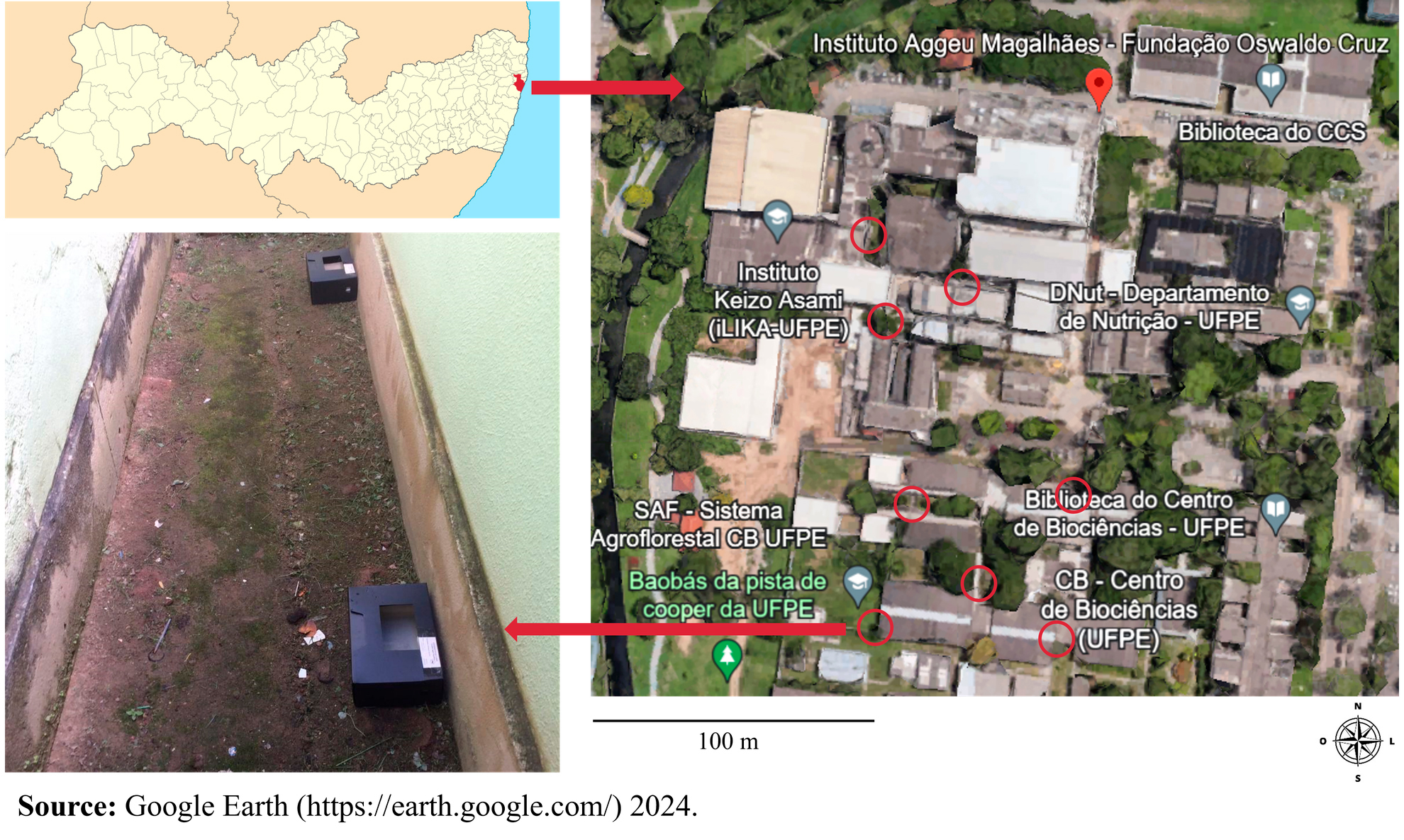
Recife, the capital of Pernambuco State (8° 3’ 14” S, 34° 52’ 51” W), is a coastal city characterised by a warm and humid climate with an annual mean temperature of 25.5°C with narrow variations, greatly favouring mosquito proliferation throughout the year (Regis et al. 2013). Lymphatic filariasis and dengue fever are both endemic in Recife (Regis et al. 1995, Regis et al. 2008) while Chikungunya and Zika viruses were introduced in 2014-2015 (Codeço et al. 2015). The laboratory bioassays were carried out in the insectarium of the Entomology Department of the Instituto Aggeu Magalhães/Fiocruz-PE (IAM_FIOCRUZ/PE) and the field tests were carried out at eight locations, three points at IAM_FIOCRUZ/PE and five in the Biosciences Center on the campus of the Universidade Federal de Pernambuco (CB-UFPE) (Figure 1).

Distribution location of the eight installation points for paired Double BR-OVT traps. Five points at the Biosciences Center on the campus of the Universidade Federal de Pernambuco (UFPE) and three points at the Instituto Aggeu Magalhães (FIOCRUZ-PE).
Mosquitos. The A. aegypti colony (RecL) started in 1996, from eggs collected in neighborhoods in Recife (Araújo et al. 2019). The colony were kept in Recife at 26 ± 2 °C, 65–85% relative humidity, and under a photo period of 12:12 h (light: dark). Larvae were kept in plastic containers (30×15 cm; 10 cm height) with a density of approximately 0,5 larvae/ mL. After emergence, the mosquitoes were transferred to a containment cage (30 x 22 x 20 cm), with food available ad libitum on cotton balls, one soaked with water and the other with 10% sucrose solution. The mosquitoes were grouped into approximately 800 individuals, between males and females (1:1), and between the seventh and tenth day after emergence, an artificial blood meal was offered with 20 mL of defibrinated blood from the rabbit Oryctolagus cuniculus, Lineu (1758) (Faierstein et al. 2019).
Trap. The Double BR-OVT trap is a tool derived from the adaptation of the Sticky BR-OVT trap (Xavier et al. 2018) and can simultaneously collect eggs and adult mosquitoes of C. quinquefasciatus and Aedes spp. The Double BR-OVT trap model (Xavier et al. 2020) is composed of a black polyethylene box, which has a central opening (16 × 9 cm) on the upper side. A black plastic container (4 L) is placed inside the box, and a black polyethylene edge is placed on top of the container, which has adhesive capacity due to the addition of a thin layer of insect glue (Colly®, Colly Quimica, Mombuca, SP, Brazil). Furthermore, the inner wall of the container was coated with a strip of raw cotton fabric (10 × 110 cm), serving as a substrate for the collection of eggs of Aedes spp. In this study we did not use the adhesive edge. The traps were evaluated in pairs, one under treatment with 2 litters of larvae extract (larvae in natura or lyophilized), at a concentration of 0.33 L4/mL (Faierstein at al. 2019) with the addition of 1 g Bacillus thuringiensis var. israelensis biolarvicide (Bti, VectorBac® WG) to prevent the traps from becoming breeding sites (Melo et al. 2024).
Biolarvicide. VectoBac® WG (registered trademark of Valent BioSciences LLC, New York USA), is a biological larvicide for controlling mosquito larvae composed of Bacillus thuringiensis subsp. israelensis (Bti) strain AM65-52 (Lot: 257-352-PG), concentration 37.4%, in water-dispersible granule formulation. The product has a potency of 3.000 international toxic units (UTI) per milligram against Aedes aegypti larvae. The choice of Bti larvicide was since it is an efficient larvicide against species of urban mosquitoes of the genera Culex and Aedes. In addition to the proven long persistence of larvicidal activity in shaded areas (Melo-Santos et al. 2009), and this larvicide can also help attract pregnant females (Carrieri et al. 2009, Barbosa et al. 2010), potentially promoting the concentration of mosquito eggs in lethal ovitraps.
Extraction procedures
Extrat larval in nature: Fourth-stage larvae (L4) were collected with a plastic mesh net and washed with distilled water 3–7 times. Five larvae were placed into a 2 mL microcentrifuge tube. After adding 0.5 mL of distilled water, the larvae were grinded, the pistil was washed twice with 0.5 mL of distilled water. The extract was then filtered through a Whatman #1 filter paper (catalogue number 1001-110) and washed with a total 150 mL of distilled water (Marques & Miranda 1992, Faierstein et al. 2019).
Lyophilized larvae extract: Initially, 600 fourth-stage larvae (L4) were dispersed in a lidless glass Petri dish, the opening of which was subsequently covered with perforated parafilm. The sample was stored at -80 °C for five hours, and then lyophilized (Edward® model LHKR Boc) for fifteen hours. Then, the lyophilized larvae were suspended in 300 mL of distilled water using a disperser and was conventionally filtered through a paper filter. Finally, 1.500 mL of water was added to reach an equivalence of 0.33 larva/ mL (Serpa et al. 2008).
Laboratory test
For further evaluations of the potential of the larvae extract associated with VectorBac® WG (Bti) biolarvicide as a lethal oviposition bait, we first checked the influence of Bti biolarvicide on extracts and destilled water (control) in relation to the oviposition behaviour of A. aegypti. The oviposition bioassay initially evaluated in the laboratory whether there would be any influence on the association between Bti biolarvicide and the larvae extract of A. aegypti. We carried out three tests: 1- Larvae extract + Bti versus distilled water + Bti; 2- Larvae extract + Bti versus distilled water; 3- Larvae extract versus distilled water + Bti. The tests were carried out in cages (50 × 40 × 32 cm), where two cups (150 mL) were placed (test and control). Twenty pregnant females of A. aegypti were released per cage and eggs were counted after 7 days/12 repetitions. These experiments were performed at the same time using 12 cages with different configurations of the treatments inside each cage.
Field test
With the objective of simultaneously evaluating the effect of larvae extract on the oviposition of Aedes and Culex mosquitoes in the field, on a small scale, sixteen Double BR-OVTs were used in eight locations protected from the sun and rain, three points on the external area of the IAM_FIOCRUZ- PE and five nearby points, located in the Biosciences Center, campus of the Universidade Federal de Pernambuco (CB-UFPE), an area with intense movement of people and high infestation by A. aegypti and C. quinquefasciatus (Krokovsky et al. 2022). The traps test was loaded with 2 g of larvae extract in 2 L of tap water plus 1 g of Bti biolarvicide, whereas the control traps were loaded with 2 L of tap water plus 1 g of Bti. To each trap, strip of raw cotton fabric (10 × 110 cm) was attached to the border of the water cups to facilitate oviposition. These experiments were performed from July to December 2018. Traps were inspected and rotated every 2 weeks. Each data set from the eight locations was considered one statistical point, and the observations on the number of Aedes/Culex eggs/rafts experiments were replicated 63 and 44 times. Field tests were also carried out with the traps, using lyophilized larvae extracts of A. aegypti. For each test trap, a macerate of 0.26 g of larvae lyophilized in 10 mL of water was used, associated with 1 g Bti in 2 L of public water supply. 55 and 46 repetitions were carried out, respectively, between April and July 2019.
Ethics - The study was carried out according to resolution 466/12 for research with human beings and approved by the Research Ethics Committee of the Instituto Aggeu Magalhães (CEP/IAM) under the protocol code approval 1.547.598 on the Brazil Platform and CAAE: 51012015.9.0000.5190.
Data analysis
Data from laboratory bioassay results were analysed with Prism 7 (GraphPad, La Jola, CA). They were arcsine transformed and, after passing the Shapiro-Wilk normality test, were compared using the two-tailed paired t test. Data from Field tests were analysed by comparing the means by using the Wilcoxon matched-pairs signed rank test (Siegel & Castellan 1988). The oviposition activity index (OAI) was estimated according to Kramer and Mulla (Kramer & Mulla 1979). The effectiveness of the Double BR-OVT trap associated with larval extract A. aegypti plus Bti was evaluated based on the mean and standard deviation values of eggs and rafts collected in each trap. Mean positivity was determined by the quotient between the number of positive traps (at least one raft/egg) and the total number of traps deployed.
RESULTS
Laboratory evaluation
The evaluation of larval extract, with or without the addition of the biolarvicide VectorBac® WG (Bti), on the oviposition behavior of A. aegypti revealed that all containers treated with larval extract attracted significantly more eggs (p = 0.005). In the first evaluation, containers treated with larval extract + Bti were compared to control containers with distilled water + Bti. The treated containers received 68.9% of the eggs (totalling 10.104 eggs; mean 842 ± 177), while the control containers collected only 31.1 %, indicating that the treated containers acted as oviposition stimulants, with an OAI of +0.38 (Figure 2a). Next, the treatment with larval extract + Bti was compared to a control with distilled water alone, the treated containers collected 72.5 % of the eggs (totalling 9.865 eggs; mean 822 ± 167), while the controls collected only 27.5 %, showing an OAI of +0.45 (Figure 2b). In the final test, containers with larval extract only were compared to controls containing distilled water + Bti. The treated containers continued to stimulate oviposition (OAI = +0.41), attracting 70.4 % of the eggs (totalling 10,853 egs; mean 904 ± 169), compared to 29.6 % for the controls (Figure 2c).

Oviposition preference for larvae extracts in the presence of Bacillus thuringiensis israelensis (Bti) or not. Bti was added to cups loaded with larvae extracts from Aede aegypti as well as to the control water cups in laboratory with 12 replications. Means were compared by using the Wilcoxon matched-pairs signed rank test. (a): larvae extract + Bti versus distilled water + Bti; (b): larvae extract + Bti versus distilled water; (c): larvae extract versus distilled water + Bti.
Field evaluation
The results demonstrated that Double BR-OVTs treated with larval extract + Bti biolarvicide collected significantly more eggs from Aedes ssp mosquitoes, OAI = +0.28 (totalling 36.683 eggs 64 % mean 582 ± 467) (p = 0.001). The IPO ranged from 97 % on control and treatment, and IDO of 337 eggs on control and 601 on treatment (Figure 3a). Regarding C. quinquefasciatus oviposition in Double BR-OVTs treated with larval extract + Bti, we observed significantly higher collections, OAI= +0.30 (totalling 478 rafts 65 % mean 11 ± 10) (p < 0.0001). The IPO ranged from 75% on control and 98% on treatment with IDO of 8 rafts on control and 11 on treatment (Figure 3b).

Oviposition preference for larvae extracts in the presence of Bacillus thuringiensis israelensis (Bti). Bti was added to Double BR-OVT traps loaded with larval extracts from Aedes aegypti as well as to the control water traps. Pairs of traps were deployed in the eight different locations in the field and experiments were replicated 63 and 44 times. Means were compared by using the Wilcoxon matched-pairs signed rank test. (a): Aedes sp; (b): Culex sp.
The Double BR-OVTs associated with lyophilized larvae extract and Bti biolarvicide collected significantly more eggs (p < 0.0001; IAO = +0.24) in relation to the oviposition of Aedes ssp mosquitoes (totalling 28.085 eggs 62.5 % mean 511 ± 531), demonstrating the IPO ranged from 96% on control and 100% on treatment, with IDO ranging 318 eggs on control and to 511 on treatment (Figure 4a) Evaluating the oviposition of C. quinquefasciaus mosquitoes in Double BR-OVTs, we also observed significant collections in traps treated with lyophilized larvae extract and Bti (totalling 190 rafts, 70 % mean 5 ± 4.3) (p < 0.1025; IAO = +0.30), with IPO ranged 66% on control and 78% on treatment and IDO ranging 3 rafts on control and 6 on treatment (Figure 4b).
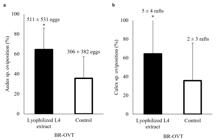
Oviposition preference for lyophilized larvae extracts in the presence of Bacillus thuringiensis israelensis (Bti). Bti was added to Double BR-OVT traps loaded with larval extracts from Aedes aegypti as well as to the control water traps. Pairs of traps were deployed in the eight different locations in the field and experiments were replicated 55 and 46 times. Means were compared by using the Wilcoxon matched-pairs signed rank test. (a): Aedes sp; (b): Culex sp.
DISCUSSION
For pregnant female mosquitoes, the selection of appropriate sites for larval development is crucial and is considered one of the most important steps for establishing their populations, since immatures are not migratory, and many of them develop in confined environments, such as A. aegypti, whose water retention sites have varying capacities, from those that hold a few millilitres, to those filled with tens or hundreds of litters (Forattini & Brito 2003). For this reason, female mosquitoes search for physical and chemical clues in the environment, with predilections between oviposition sites. In this way, oviposition semiochemicals act as attractants/stimulants, or repellents/deterrents, of which two factors deserve discussion: oviposition pheromones and kairomones produced by mosquito larvae and eggs (Gonzalez et al. 2016), and oviposition kairomones produced by bacteria, related or not, to larval development (Ponnusamy et al. 2015).
The results showed that the use of A. aegypti extract with larvae in natura or lyophilized associated with the biological larvicide Bti, in oviposition traps of the Double BR-OVT trap, collected more eggs of mosquitoes of the genera Aedes and Culex when compared to traps only treated with water and Bti.
Faierstein et al. (2019) described for the first time the influence that extracts from eggs, larvae and pupae of A. aegypti, C. quinquefasciatus and A. albopictus exert on intra and interspecific oviposition behaviour, whose reports pointed to larval extracts as the most promising for creating oviposition baits with multiple targets, possibly because there are similarities between some compounds from the different extracts that influenced the oviposition behaviour of different species of mosquitoes. Some confounding factors can be found in the literature regarding what a larval extract represents. While some studies described extracts from crushing the bodies of larvae (Marques & Miranda 1992, Faierstein et al. 2019), others described that the extracts evaluated were obtained from exposing distilled water to live larvae for a few days (Boullis et al. 2021), reporting containers with high larval densities in water (1 larva/ mL) outside of oviposition grounds of A. aegypti in relation to controls, whose compounds identified in the extracts and evaluated separately showed that pentadecanoic acid (1 ppm) is an oviposition stimulant, while myristoleic acid (10 ppm or more) is an oviposition deterrent.
Methodological differences compared to those in our studies likely led to different results, as cups treated with homogenized larval extracts (1 larva/ mL) collected significantly more eggs at the higher larva/ml concentrations (Faierstein et al. 2019). The results of Boullis et al. (2021) are similar to those of Allan & Kline (1998) and Davis et al. (2015), who described that, A. aegypti and A. albopictus admit or prefer containers in which intraspecific larvae developed at low densities (0.33 larva/ mL), while the rearing water in which many intraspecific larvae developed was deterrent/repellent. In relation to other mosquito species, it was also observed that larval development water influences the oviposition behaviour of pregnant females of A. togoi (Theobald, 1907) (Trimble & Wellington 1980), A. triseriatus (Say, 1823) and A. atropalpus (Coquillett, 1902) (Bentley et al. 1976), and Anopheles gambiae (Giles, 1926) (Blackwell & Johnson 2000), with Anopheles (Meigan, 1818) having a different behaviour, as only containers with the initial stages of larval development attracted females for oviposition, while containers with more advanced stages were avoided, regardless of the concentration of larva/ mL (Himeidan et al. 2013).
Evaluating larval extracts of A. aegypti in relation to oviposition, we observed that both in the laboratory and in the field, the treated containers collected more eggs than the control containers. Oviposition tests in the laboratory are generally punctual and controlled, while in the field a range of factors can influence the oviposition behaviour of mosquitoes, such as availability of surrounding breeding sites, changes in temperature and humidity and changes in the intensity of movement of people. However, the objective of this research focused only on the evaluation of traps treated with extracts, and not on explaining the factors that influenced the dynamics of collected eggs, generally observed in mosquito monitoring and surveillance studies.
Controlling mosquitoes using traps associated with oviposition bait with practicality and low cost is a challenge. Nascimento et al. (2020) compared the sensitivity of ovitraps treated with infusion of grass Megathyrsus maximus (Jacq.) B.K. Simon & S.W.L. Jacobs (Guinea grass) tin relation to the conventional method of LIRAa (Rapid Index Survey for Aedes aegypti), in Cambé-PR. The sensitivity of the Property Infestation Index generated by traps (54%) was extremely more sensitive in relation to LIRAa (1.3%). However, producing grass infusions for large-scale monitoring and/or control actions implies the production and transporting hundreds of litters of infusion. Regarding the treatment of the traps in our study, with larval extracts, it was only necessary to transport Falcon tubes with up to 10 mL of the crude extract, to then be transferred to the trap vats with 2 litters of water purchased at the installation site, demonstrating greater practicality for covering large-scale traps.
The association of oviposition traps with larval extracts and biolarvicides prove to be efficient alternatives for monitoring and, mainly, for entomological control, especially involving Aedes mosquitoes, since the species are capable of dispersing eggs from the same gonotrophic cycle in more than 10 containers, thanks to skip oviposition behaviour (Wu et al. 2020). Traps with oviposition stimulants can induce Aedes mosquitoes to lay more eggs in an environment treated with biolarvicide, thus reducing the number of eggs deposited in untreated locations, or even reducing the search for other oviposition sites. The treated and untreated Double BR-OVT traps obtained an IPO of almost 100%, proving their sensitivity, with the IDO of traps treated with larval extracts always higher in all evaluations. Over ten years, Regis et al. (2013) used 5.680 ovitraps treated with water and Bti as one of the integrated control methods for Aedes mosquitoes in Santa Cruz do Capibaribe and Ipojuca, two municipalities in Pernambuco, eliminating more than 3.500,000 eggs in the regions, whose actions helped to reduce the mosquito population density of more than 90%.
In another context, oviposition baits are also valuable for collecting pregnant female mosquitoes during arbovirus surveillance, as treated traps will be more likely to collect females infected with circulating pathogens (Leal et al. 2008). This way, it is possible to detect the circulation of arboviruses more accurately in the vicinity where the traps were installed. This particularity is important, as the wrong choice of bait can result in false-negative data in relation to entomological surveillance. The use of CO2 as bait to capture adults in traps is observed in some contexts (Wu et al. 2020, Amos & Cardé 2021), but the physiological state of females attracted to this type of bait, which they find in CO2 evidence of a host, may not be useful for surveillance, as they are attractive to mosquitoes that seek blood feeding, consequently attracting the large portion of the mosquito population that has not yet had a blood meal, making it difficult to collect information on the circulation of arboviruses. Therefore, the baits used to attract pregnant mosquito females are more efficient in providing true indicators of arbovirus circulation (Johnson et al. 2017).
Xavier et al. (2020) demonstrated that the Double BR-OVT trap is a very sensitive tool for detecting the presence of C. quinquefasciatus and Aedes spp. in the environment, mainly in the egg phase, indicating its potential for use in mosquito surveillance strategies. Our results ensure that the association of a tool capable of collecting eggs from different genera of mosquitoes, and when associated with an oviposition stimulant, becomes more efficient and effective. In view of these observations, larval extracts of A. aegypti associated with Bti have potential for application in integrated management between Aedes and Culex mosquitoes, which represent the most important genera in the field of medical entomology. The logistics of this attract-and-kill strategy can be further simplified when the active ingredients are identified, replacing the larval extract with synthetic oviposition attractant and/or stimulatory counterparts. The association of Double BR-OVTs traps with larval extracts and biolarvicide proves to be efficient alternatives for the integrated control. Therefore, extracts of lyophilized larvae associated with Bti can be used as bait, thus enhancing traps for use in the field, in the surveillance and control of mosquito populations. This strategy will bring cost-benefit to environmental agents, as it is a specific, environmentally safe and low-cost alternative for action.
ACKNOWLEDGMENTS
This work was supported by grants from the National Institutes of Health R01AI095514 and R21AI128931 and Conselho Nacional de Desenvolvimento Científico (CNPq- 400752/2019-0).
REFERENCES
- ALBUQUERQUE AL, ARAÚJO TA, MELO DCTV, PAIVA MHS, MELO FL, OLIVEIRA CMF & AYRES CFJ. 2020. Development of a molecular xenomonitoring protocol to assess filariasis transmission. Exp Parasitol 215: 107918.
- ALLAN AS & KLINE DL. 1998. Larval Rearing Water and Preexisting Eggs Influence Oviposition by Aedes aegypti and Ae. albopictus (Diptera: Culicidae). J Med Entomol 35: 943-947.
- AMOS BA & CARDÉ RT. 2021. Efficiency of the CO2-baited omni-directional Fay-Prince trap under semi-field conditions and characterizing response behaviours for the yellow fever mosquito, Aedes aegypti. Med Vet Entomol 1: 12516.
- ARAÚJO AP ET AL. 2019. Screening Aedes aegypti (Diptera: Culicidae) Populations from Pernambuco, Brazil for Resistance to Temephos, Diflubenzuron, and Cypermethrin and Characterization of Potential Resistance Mechanisms. J Insect Sci 19: 12.
- BARBOSA RMR, REGIS L, VASCONCELOS R & LEAL WS. 2010. Culex mosquitoes (Diptera: Culicidae) egg laying in traps loaded with Bacillus thuringiensis variety israelensis and baited with skatole. J Med Entomol 47: 345-348.
- BENTLEY MD, MCDANIEL IN & LEE HP. 1976. Studies of Aedes triseriatus oviposition attractants produced by larvae of Aedes triseriatus and Aedes atropalpus (Diptera: Culicidae). J Med Entomol 13: 112-15.
- BLACKWELL A & JOHNSON SN. 2000. Electrophysiological investigation of larval water and potential oviposition chemo-attractants for Anopheles gambiae s.s. Ann Trop Med Parasitol 94: 389-98.
- BOULLIS A, MULATIER M, DELANNAY C, HE´RY L VERHEGGEN F & VEGA-RÚA A. 2021. Behavioural and antennal responses of Aedes aegypti (l.) (Diptera: Culicidae) gravid females to chemical cues from conspecific larvae. PLoS ONE 16: e0247657.
- BRAGA IA, GOMES AC, NELSON M, MELLO RCG, BERGAMASCHI DP & SOUZA JMP. 2000. Comparação entre pesquisa larvária e armadilha de oviposição, para detecção de Aedes aegypti. Rev Soc Bras Med Trop 33: 347-353.
-
BRASIL. 2002. Ministério da Saúde - Programa Nacional de Controle da Dengue. Available in: < http://bvsms.saude.gov.br/bvs/publicacoes/pncd_2002.pdf> Access at: 25 mai. 2023.
» http://bvsms.saude.gov.br/bvs/publicacoes/pncd_2002.pdf -
BRASIL. 2011. Ministério da Saúde - Guia de Vigilância de Culex quinquefasciatus. Available in:<https://www.gov.br/saude/pt-br/centrais-de-conteudo/publicacoes/svsa_2011.pdf/view> Access at: 17 jul. 2024
» https://www.gov.br/saude/pt-br/centrais-de-conteudo/publicacoes/svsa_2011.pdf/view -
BRASIL. 2024. Ministério da Saúde - Centro de Operações de Emergências. Informe semanal. Edition n° 02 | SE 01 a 07/ 2024. Available in: < https://www.gov.br/saude/pt-br/assuntos/saude-de-a-a-z/a/arboviroses/informe-semanal/coe-dengue-informe-02-led_.pdf> Access at: 21 mar. 2024.
» https://www.gov.br/saude/pt-br/assuntos/saude-de-a-a-z/a/arboviroses/informe-semanal/coe-dengue-informe-02-led_.pdf - CARDOSO CAA, OLIVEIRA RL, CODEÇO CT & MOTTA MA. 2015. Mosquitoes in bromeliads at ground level of the Brazilian Atlantic Forest: the relationship between mosquito fauna, water volume, and plant type. Ann Entomol Soc Am 108: 449-458.
- CARRIERI M, MASETTI A, ALBIERI A, MACCAGNANI B & BELLINI R. 2009. Larvicidal activity and influence of Bacillus thuringiensis var. israelensis on Aedes albopictus oviposition in ovitraps during a twoweek check interval protocol. J Am Mosq Cont Assoc 25: 149-155.
- CODEÇO CT, LIMA AW, ARAÚJO SC, LIMA JB, MACIEL-DE-FREITAS R, HONÓRIO NA, GALARDO AK, BRAGA IA, COELHO GE & VALLE D. 2015. Surveillance of Aedes aegypti: comparison of house index with four alternative traps. PLoS Negl Trop Dis 9: e0003475.
- DAVIS TJ, KAUFMAN PE, HOGSETTE JÁ & KLINE DL. 2015. The Effects of Larval Habitat Quality on Aedes albopictus Skip Oviposition. J Am Mosq Control Assoc 31: 321-328.
- FAIERSTEIN GB, LU W, SENA AKLS, BARBOSA RMR & LEAL WS. 2019. Conspecific and allospecific larval extracts entice mosquitoes to lay eggs and may be used in attract-and-kill control strategy. Sci Rep 9: 13747.
- FORATTINI OP & BRITO M. 2003. Reservatórios domiciliares de água e controle do Aedes aegypti. Rev Saúde Public 37: 676-677.
- FAGRE AC, LYONS S, STAPLES JE & LINDSEY N. 2023. West Nile Virus and Other Nationally Notifiable Arboviral Diseases — United States, 2021. MMWR Morb Mortal Wkly Rep 72: 901-906.
- GONZALEZ PV, GONZÁLEZ AUDINO PA & MASUH HM. 2016. Oviposition Behavior in Aedes aegypti and Aedes albopictus (Diptera: Culicidae) in Response to the Presence of Heterospecific and Conspecific Larvae. J Med Entomol 53: 268-272.
- GUEDES DR ET AL. 2017. Zika virus replication in the mosquito Culex quinquefasciatus in Brazil. Emerg Microbes Infect 6(8): e69.
- HIMEIDAN YE, TEMU EA, RAYAH ELA, MUNGA S & KWEKA EJ. 2013. Chemical Cues for Malaria Vectors Oviposition Site Selection: Challenges and Opportunities. J Insects: 1-9.
- JOHNSON B, RITCHIE S & FONSECA D. 2017. The State of the Art of Lethal Oviposition Trap-Based Mass Interventions for Arboviral Control. Insects 8(1): 5.
- KRAMER WL & MULLA MIR S. 1979. Oviposition Attractants and Repellents of Mosquitoes: Oviposition Responses of Culex Mosquitoes to Organic Infusions. Environ Entomol 8(6): 1111-1117.
- KROKOVSKY L, GUEDES DRD, SANTOS FCF, SALES KGDS, BANDEIRA DA, PONTES CR, LEAL WS, AYRES CFJ & PAIVA MHS. 2022. Potential Nosocomial Infections by the Zika and Chikungunya Viruses in Public Health Facilities in the Metropolitan Area of Recife, Brazil. Trop Med Infect Dis 7: 351.
- LEAL WS, BARBOSA RMR, XU W, ISHIDA Y, SYED Z, LATTE N, CHEN AM, MORGAN TI, CORNEL AJ & FURTADO A. 2008. Reverse and Conventional Chemical Ecology Approaches for the Development of Oviposition Attractants for Culex Mosquitoes. PLoS ONE 3(8): e3045.
- LOPES N, NOZAWA C & LINHARES REC. 2014. General features and epidemiology of emerging arboviruses in Brazil. Revista Pan-Amazônica de Saúde, Ananindeua 5(3): 55-64.
- LUNA EJA ET AL. 2020. A cohort study to assess the incidence of dengue, Brazil, 2014-2018. Acta Trop 204: 5313.
- LWANDE OW, OBANDA V, LINDSTRÖM A, AHLM C, EVANDER M, NÄSLUND J & BUCHT G. 2020. Globe-trotting Aedes aegypti and Aedes albopictus: risk factors for arbovirus pandemics. Vector Borne Zoonotic Dis 20: 71-81.
- MARQUES CCA & MIRANDA C. 1992. Infuence of larval, pupal and eggs extracts on the oviposition behavior of Aedes abopictus (Skuse). Rev Saude Publ 26: 269-271.
- MELO-SANTOS MAV, ARAÚJO AP, RIOS EMM & REGIS L. 2009. Long lasting persistence of Bacillus thuringiensis serovar. israelensis larvicidal activity in Aedes aegypti (Diptera: Culicidae) breeding places is associated to bacteria recycling. Bio Control 49: 186-191.
- MELO DCTVD ET AL. 2024. Integrated Strategies for Aedes aegypti Control Applied to Individual Houses: An Approach to Mitigate Vectorial Arbovirus Transmission. Trop. Med Infect Dis 9(3): 53.
- NASCIMENTO KLC, DA SILVA JFM, ZEQUI JAC & LOPES J. 2020. Comparison Between Larval Survey Index and Positive Ovitrap Index in the Evaluation of Populations of Aedes (Stegomyia) aegypti (Linnaeus, 1762) North of Paraná, Brazil. Environ Health Insights 14: 1-8.
- PONNUSAMY L, SCHAL C, WESSON DM, ARELLANO C & APPERSON CS. 2015. Oviposition responses of Aedes mosquitoes to bacterial isolates from attractive bamboo infusions. Parasit Vectors 8: 486.
- REGIS LN ET AL. 2008. Developing new approaches for detecting and preventing Aedes aegypti population outbreaks: basis for surveillance, alert and control system. Mem Inst Oswaldo Cruz 103: 50-59.
- REGIS LN ET AL. 2013. Sustained reduction of the dengue vector population resulting from an integrated control strategy applied in two Brazilian cities. PLoS ONE 8: 67682.
- REGIS LN, SILVA-FILHA MHNL, DE OLIVEIRA CMF, RIOS EM, DA SILVA SB & FURTADO AF. 1995. Integrated control measures against Culex quinquefasciatus, the vector of filariasis in Recife. Mem Inst Oswaldo Cruz 90: 115-119.
- RESENDE MC, ÁZARA TMF, COSTA IO, HERINGER LC, ANDRADE MR, ACEBA JL & EIRAS AE 2012. Field optimisation of MosquiTRAP sampling for monitoring Aedes aegypti Linnaeus (Diptera: Culicidae). Mem Inst Oswaldo Cruz 107: 294-302.
- SERPA LL, MONTEIRO SD & VOLTOLINI JC. 2008. Effect of larval rearing water on Aedes aegypti oviposition in the laboratory. Rev Soc Bras Med Trop 41: 515-517.
- SIEGEL S & CASTELLAN JR NJ. 1988. Nonparametric statistics for the behavioural Science, 2nd ed., McGraw-Hill, p. 1-339.
- SPINSANTI L ET AL. 2003. St. Louis Encephalitis in Argentina: the first case reported in the last seventeen years. Emerg Infect Dis 9(2): 271-273.
- TRIMBLE RM & WELLINGTON WG. 1980. Oviposition Stimulant Associated with Fourth Instar Larvae of Aedes Togoi (Diptera: Culicidae). J Med Entomol 17: 509-514.
- WANG S-M, LEI H-Y & LIU C-C. 2012. Cytokine immunopathogenesis of enterovirus 71 brain stem encephalitis. Clin Dev Immunol 2012: 876241.
-
WHO – WORLD HEALTH ORGANIZATION. 2017. Global vector control response 2017–2030. Available in: <https://apps.who.int/iris/handle/10665/259205 >. Access at: 1 mai. 2021.
» https://apps.who.int/iris/handle/10665/259205 - VASCONCELOS PF, NUNES MR, CASSEB LM, CARVALHO VL, DA SILVA EVP, SILVA M & CASSEB SM. 2011. Molecular epidemiology of Oropouche virus, Brazil. Emerg Infect Dis 17(5): 800-806.
- WU Y, WANG J, LI T, LIU Q, GONG Z & HOU J. 2020. Effect of different carbon dioxide (CO2) flows on trapping Aedes albopictus with BG traps in the field in Zhejiang Province, China. PLoS ONE 15: e0243061.
- XAVIER MN, RODRIGUES MP, MELO DCTV, SANTOS EMM, BARBOSA RMR & OLIVEIRA CMF. 2020. Double BR-OVT: a new trap model for collecting eggs and adult mosquitoes from Culex quinquefasciatus and Aedes spp. Rev Inst Medicina Trop 62: e94.
- XAVIER MN, SANTOS EMM, SILVA APA, GOMES JÚNIOR PP, BARBOSA RMR & OLIVEIRA CMF. 2018. Field evaluation of sticky BR-OVT traps to collect culicids eggs and adult mosquitoes inside houses. Rev Soc Bras Med Trop 51: 297-303.
- ZANLUCA C, ANDRADE DE MELO VC, MOSIMANN ALP, DOS SANTOS GIV, DOS SANTOS CND & LUZ K. 2015. First report of autochthonous transmission of Zika virus in Brazil. Mem Inst Oswaldo Cruz 110: 569-572.
- ZARA ALSA, SANTOS SM, FERNANDES-OLIVEIRA ES, CARVALHO RG & COELHO GE. 2016. Estratégias de controle do Aedes aegypti: uma revisão. Epidemiol Serv Saúde 25: 391-404.