
 Salmonella spp. detection in fresh and freeze-dried frog meat: a comparison of methods
Abstract
This study examined the presence of Salmonella spp. in fresh frog meat and freeze-dried seasoned frog meat stored for up to 90 days at room temperature. The samples were analyzed in triplicate using the conventional official method, by polymerase chain reaction (PCR) and mass spectrometry technique (MALDI –TOF) — for a comparison of the results obtained by the three tested methods. Mass spectrometry analyses confirmed the presence of Salmonella spp. in 100% of the fresh frog meat samples. In the analysis by the conventional method, the percentages of detection were 67% and 100% in samples B2 and B3, whereas the PCR method indicated 100% and 67% presence of the bacteria in the respective samples. In the analyses of freeze-dried none of the three methods detected the presence of Salmonella spp. The different analysis methods tested in this study were efficient in determining the presence or absence of Salmonella spp. in the samples, and the comparison between methods revealed a high percentage of compatibility of results. Adoption of efficient detection methods, such as PCR and MALDI-TOF, is essential, not only for public health, but also for compliance with Brazilian regulations, ensuring that food products are free from Salmonella spp. contamination and safe for consumption.
Key words
Aquarana catesbeiana; MALDI-TOF; microbiological analysis of foods; polymerase chain reaction
INTRODUCTION
Fish is a food of high nutritional value that constitutes an important source of protein for the world population. The 2020 fish production data published by the World Food and Agriculture Organization (FAO 2022) highlights that the most consumed aquaculture species are fish, crustaceans, and mollusks, whose total produced volume is 87.5 million tons. Other species produced on a smaller scale are termed “other aquatic animals”, which include frogs, which account for 11% of the production of this group, i.e., approximately 900 thousand tons. As a foodstuff, fish provides several health benefits, including antioxidant, anti-inflammatory, healing, neuroprotective, cardioprotective, and hepatoprotective properties. In this context, frog meat stands out for being used in special diets, where it is included as a food with high nutritional content, low fat, and high levels of available calcium, which can be used by children with some type of food intolerance or allergy and by the elderly to prevent osteoporosis (Sabrá et al. 2015, Oliveira et al. 2017, Andrade et al. 2022). Frog legs are marketed worldwide, but in the majority of cases the back of the animal (trunk and forelegs) is discarded. The back is a by-product of frog leg processing whose utilization represents the availability of meat of high biological value for the development of new products that can add value to the aquaculture sector.
The various existing food processing techniques always seek to establish technological barriers to prevent the growth of and contamination by microorganisms. Food preservation through drying extends the availability and shelf life of these products, facilitating storage and preparation by the final consumer. In studies aimed at the development of freeze-dried chicken breast meat, researchers concluded that this product is safe from a health standpoint; has high nutritional value; does not contain additives; and has a long shelf life. Additionally, it can be used for consumption in communities with access difficulty and without electricity, which require long periods of transport, as well as in programs aimed at food security (Vianna 2020).
Although fishery products have numerous health benefits, they are extremely perishable foods, thus being prone to a wide range of hazards (Gatti Junior et al. 2014). To monitor the microbiological quality of these products, samples must be periodically analyzed. This practice is a legal requirement that must be adopted by the agroindustry to ensure the quality of its products. According to RDC No. 724 of The Brazilian Health Regulatory Agency (ANVISA 2022a), which provides for microbiological standards of food and their application, the methods used in microbiological analysis of food must consider at least one of the following references: Codex Alimentarius - Food and Agriculture Organization of the United Nations (FAO)/ World Health Organization (WHO); International Organization for Standardization (ISO); Compendium of Methods for the Microbiological Examination of Foods of the American Public Health Association (APHA); Standard Methods for the Examination of Dairy Products of the American Public Health Association (APHA); Bacteriological Analytical Manual (BAM/FDA); Official Methods of Analysis of AOAC International (AOAC INTERNATIONAL); Brazilian Pharmacopoeia; United States Pharmacopoeia (USP).
Salmonella spp., members of the family Enterobacteriaceae, are characterized as Gram-negative, non-sporogenic, facultative anaerobic oxidase-negative rods. The main habitat of salmonellae is the intestinal tract of humans and animals (Da Silva et al. 2017). According to the World Health Organization (WHO 2018) diarrheal diseases are the most common disorders stemming from the consumption of unsafe food. A total of 550 million people fall ill with the condition each year, with Salmonella spp. being one of the top four global causes of diarrheal disease.
Salmonella infection is one of the major global public health hazards and remains as an economic burden to both developed and developing countries due to the costs associated with trade banning, as well as surveillance, and disease prevention and treatment. Therefore, identification of Salmonella spp. in animal feed and foods of animal origin is crucial to public health and food commercialization issues (Md. Al-Amin et al. 2022).
Normative Instruction No. 161 of the Brazilian Health Surveillance Agency (ANVISA 2022b) establishes the microbiological standards for food. For different categories of raw fish and its derivatives, as well as for dehydrated products, Salmonella testing is mandatory, and this bacteria must be absent in 25 grams of the analyzed sample.
Analyses performed to identify Salmonella spp. in samples of frog meat produced and sold in the state of Rio de Janeiro revealed a frequency of 10% (Barreira et al. 2011). The prevalence of Salmonella spp. in samples of fresh frog meat from frog farms and protected forest areas in Thailand was 90% and 44.83%, respectively (Ribas & Poonlaphdecha 2017). These studies point to the need for improvements in the hygienic-sanitary conditions of frog farms as well as in the handling of frogs at slaughtering and processing establishments, since the quality of the raw material is crucial for the development of fishery products.
The conventional technique for the detection of Salmonella in foods is based on the presence/absence of the bacterium and was developed to ensure its detection even in extremely unfavorable situations, as contaminated foods normally have a competing microbiota and may also have a reduced number of cells or even cells injured by the preservation process employed (Da silva et al. 2017).
Pathogenic microorganisms are commonly identified in a classical manner by methods that involve culturing followed by biochemical tests that investigate metabolic differences between the various species. These analyses, which take place in microbiology laboratories, are usually very expensive and time-consuming, taking approximately five days for the identification of a bacterium. The time spent on conventional microbiological diagnosis is one of the main reasons for the search for new techniques for the detection of Salmonella spp. in food. Polymerase chain reaction (PCR) stands out among the methodologies to be used due to the reduced time for identification and detection of the pathogen, which favors routine analysis at clinical and industrial laboratories (Almeida et al. 2018). Another technology that is becoming an important analytical tool in microbiology is matrix-assisted laser desorption/ionization time-of-flight (MALDI-TOF) mass spectrometry (MS), whereby the material to be analyzed is placed on a matrix plate and bombed with a laser pulse that evaporates it. A system then ionizes and aspirates the volatilized material, which travels to detectors that measure the time it takes for the substance to arrive at them (Jang & Kim 2018). By this technique, the bacteria present in the sample are identified by an analysis of proteins (mainly ribosomal), as the method creates a specific mass spectrum for each species (Bier et al. 2017).
This study aims to investigate the presence of Salmonella spp. in fresh and freeze-dried frog meat (Aquarana catesbeiana) using a conventional microbiological analysis method recommended by official bodies to determine the absence or presence of salmonella in 25 grams of sample, as well as using the matrix-assisted laser desorption/ionization (MALDI-TOF) technique, and the molecular biology method - polymerase chain reaction (PCR) – the latter two aiming at rapid and accurate identification and confirmation.
MATERIALS AND METHODS
Sample preparation
Samples from two batches of fresh frozen frog backs obtained on different days of processing in a slaughterhouse under State Sanitary Inspection corresponded to treatments B1 and B2. Treatment B3 consisted of a mixture of frogs from the batches that originated treatments B1 and B2. To prepare the samples of freeze-dried seasoned frog meat (F1, F2, F3, F4, F5, F6, F7), the frog backs that corresponded to sample B3 were thawed (at a refrigerated temperature of 7 ºC for 12 h) and then packed in ziplock plastic bags that were subsequently immersed in a water bath at a temperature of 60 °C, where they remained for 20 min for blanching (Andrade et al. 2022). The blanched backs were deboned, seasoned, placed in stainless-steel trays of a freeze dryer, and then frozen in an “ultrafreezer” (–40 °C) for approximately three hours. Afterwards, the trays with frozen back meat were placed in a benchtop freeze dryer (model LS 3000 B); the freeze-drying process lasted 24 h.
Portions of approximately 30 g of the freeze-dried samples were vacuum-packed in 21 cm × 22 cm plastic bags (BPA-free) using a hand pump. The packaged samples were kept at room temperature, which ranged from 22 to 32 ºC, for a period of 90 days. Salmonella analyses were performed on the first day (F1) and then at 15 (F2), 30 (F3), 45 (F4), 60 (F5), 75 (F6), and 90 (F7) days.
Quality control and validation of analyses
Standard samples from the collection of the National Reference Laboratory for Enterobacterial Infections/Laboratory of Enterobacteria/IOC/FIOCRUZ were used in the present study. Escherichia coli K-12 DH5α was used as a negative control for conventional microbiological analyses and PCR, while Salmonella enterica serovar Enteritidis strains 10555/10 IOC and 10405/10 IOC were used as positive controls. Bacterial stocks kept frozen at -80 °C were used throughout the study.
For quality control and validation of the MALDI Biotyper CA System, the US IVD Bacterial Test Standard was used – a substance containing an extract of Escherichia coli DH5 alpha that exhibits a characteristic peptide and protein profile mass spectrum when tested on the MALDI Biotyper CA System. The US IVD Bacterial Test Standard is enriched with two additional proteins that extend the upper limit of the mass reading range, generating an overall mass reading range of 3,600 to 17,000 m/z. This quality control and validation device is used periodically to calibrate the equipment.
The detection methods used in this study were selected and applied according with the Brazilian guidelines established by Normative Instruction No. 161 of 2022 (ANVISA 2022b) and by the Resolution of the Collegiate Board, RDC No. 724/2022 (ANVISA 2022a), which define the microbiological criteria for animal products.
Salmonella detection by the conventional method
Conventional microbiological analyses of fresh (B1, B2, and B3) and freeze-dried (F1, F2, F3, F4, F5, F6, F7) samples of frog back were performed in triplicate by the method described in the U.S. Food and Drug Administration Bacteriological Analytical Manual (Andrews et al. 2007) with modifications (Cabral et al. 2017).
Pre-enrichment
A 25-g portion of the sample was transferred to an Erlenmeyer flask containing 225 mL of pre-enrichment broth (buffered peptone water 1%), which was subsequently homogenized by shaking, left to sit, and finally incubated in a bacteriological incubator at 35±2 °C for 24 h.
Selective enrichment
A 0.1-mL aliquot of the incubated material was transferred to test tubes containing 10 mL Rappaport-Vassiliadis broth (RV) in triplicate; and 1 mL was transferred to test tubes containing 10 mL Mossel broth in triplicate, according to. The inoculated RV tubes were incubated at 42±0.2 °C for 24 h, whereas the inoculated Mossel tubes were incubated at 35±2 °C for 24 h. After incubation, a portion of the solution in the Mossel tubes was transferred to BHI broth and kept in a bacteriological incubator at 35±2 °C for another 24 h.
Differential plating, preliminary confirmation, and biochemical tests
Streaking was performed in triplicate on plates containing Hektoen enteric (HE) agar and Salmonella - Shigella (SS) agar for each of the selective enrichment broths. The plates were incubated in an inverted position at 35±2 °C for 24 h. For preliminary confirmation, typical colonies from selective agar after 24 ± 2 h incubation, that present a greenish-blue color with black centers or may appear as almost completely black colonies, were selected from the plates and inoculated with a needle, under aseptic conditions, in tubes with triple-sugar-iron (TSI) agar and lysine-iron agar (LIA). To perform the biochemical tests, colonies were selected from TSI agar and inoculated under aseptic conditions in commercial kit tubes (Laborclin) and then kept in a bacteriological incubator at 35±2 °C for 24 h for later reading. The following tests were carried out: L-tryptophan deamination; glucose fermentation; gas production from glucose; hydrogen sulfide (H2S) production; lysine decarboxylation; ornithine decarboxylation; motility; indole production; citrate utilization; urea hydrolysis.
Salmonella identification by Polymerase Chain Reaction (PCR)
For DNA extraction for Salmonella spp. analysis, typical colonies obtained in selective plating were transferred to enrichment broth (BHI) and incubated for 24 h at 35-37 °C. The colonies inoculated in BHI were streaked on nutrient agar plates and later taken to the bacteriological incubator at 35-37 °C for 24 h, with the microbial growth used for DNA extraction. For DNA extraction, an aliquot of bacterial growth was dispersed into 600 µL of ultrapure water inside a microtube, which was heated in a water bath at 100 °C for 10 min and then immersed in an ice bath. Then, the material was centrifuged (14,000 g, 3 min) and the supernatant was collected and separated into 200-µL aliquots, which were stored in a freezer at – 20 °C until PCR reactions were performed.
For the PCR reaction, the reagents were used at the following concentrations: each reaction containing 1.25 u Taq, 1X (1.5 mM MgCl2)2 buffer with running dye, 0.2 mM of each dNTP, 1.0 μM of each oligonucleotide primer, 0.1-0.5 μg template DNA, and nuclease-free ultrapure water to make up the volume to 25 μL. The thermocycler used was the PTC100 (MJR). The oligonucleotide primers used were Randon sequence (ST11-ST15) (Forward: CCAACCATTGCTAAATTGGCGCA; Reverse: GGTAGAAATTCCCAGCGGGTACTGG) (Soumet et al. 1999). The program adopted was 95 °C/5 min; 40 cycles at 95 °C/30 s, 55 °C/45 s, and 72 °C/45 s; and a final extension at 72 °C/5 min.
The PCR product was electrophoresed in 1.5% agarose gel (Invitrogen®) with ethidium bromide (0.5 μg/mL), in 1x TBE buffer (Tris–Borate-EDTA: Tris-base 89 mM, 89 mM boric acid, 2 mM EDTA). Electrophoresis was performed with the same buffer to identify the amplification product and determine the approximate molecular weight, using a 1-Kb ladder (DNA fragments from 250 to 10,000 base pairs) as a marker. This was performed at 72 V for 30 min and the gel was stained with ethidium bromide (0.5 μg/mL), visualized under ultraviolet light, and photographed by the Digidoc-It (UVP) digital system.
Analysis for identification of Salmonella by mass spectrometry (MALDI-TOF)
The method based on matrix-assisted laser desorption/ionization time-of-flight (MALDI-TOF) mass spectrometry (MS) was used.
After 24 h of growth in a bacteriological incubator at 35-37 °C, typical colonies selected from HE and SS plates from samples B2 and B3 and colonies not characteristic of Salmonella from samples F1, F2, F3, F4, F5, F6, and F7 were selected and inoculated in BHI broth and kept in a bacteriological incubator at 35.5 °C for 24 h. Subsequently, they were streaked on nutrient agar plates and kept for 24 h in a bacteriological incubator at 35.5 °C. A film of biological material (isolated colony) of the triplicate samples was placed directly on the wells of the analyzer plate, which contained 96 wells; this plate was used as a physical support for the analysis of all samples in the mass spectrometer. According to Zhang et al. (2022) each sample was overlaid with 1 µL of 70% v/v formic acid, to facilitate the disruption of bacterial cells. After drying, each sample point was covered with 1 µL of matrix solution, which was prepared to a final concentration of 10 mg/mL of α-CHCA diluted in an aqueous solution of 70% (V/V) acetonitrile, ultrapure water, and 3% (V/V) diluted trifluoroacetic acid. The mass spectra were obtained using a MALDI Biotyper CA System mass spectrometer and processed using the FlexControl – microflex program and processed by the FlexControl program, later the spectra obtained were compared with the data available in the universal database Biotyper v 3.0 (Bruker Daltonics TM, Germany).
Water activity (aw) analysis
The aw of fresh and freeze-dried frog back samples was measured in a portable Aqua Lab (Decagon) instrument in triplicate. The samples were ground and placed in the sample holder of the device, which was previously calibrated with a molar 6.0 NaCl solution (aw = 0.76).
RESULTS
The conventional analyses indicated the presence of Salmonella spp. in all samples of fresh frog back (B1, B2, and B3) evaluated. Figure 1 illustrates the characteristics of typical colonies, which grew on Hektoen agar plates and in TSI and LIA agar tubes. (H2S). The colonies on the plates and in the tubes were dark in color, suggesting a strong presence of hydrogen sulfide (H2S).

Salmonella spp. colonies isolated in Hektoen enteric agar (HE) plates and in triple-sugar-iron (TSI) and lysine-iron (LIA) agar tubes indicating strong presence of H2S (dark staining). 1a- LIA agar tubes with high H2S production. 1b- TSI and LIA tubes with H2S production and Hektoen agar plate with a large number of black colonies. 1c- Hektoen agar plate showing isolated colonies with a black center or entirely black and medium with a greenish color. 1d- TSI and LIA tubes with high H2S production and Hektoen agar plate with abundant growth of black colonies.
Considering the results found in selective differential plating and the results of the presumptive biochemical tests, using the TSI and LIA media, all the analyzed samples of fresh frog meat (B1, B2, and B3) were indicative of Salmonella spp. Complementary biochemical tests performed for samples B2 and B3 also indicated the presence of Salmonella spp. (Table I) also shows the results of the complementary biochemical tests, carried out every 15 days, on samples of freeze-dried frog meat stored at room temperature for up to 90 days (F1, F2, F3, F4, F5, F6, and F7). These samples did not exhibit results indicative of the presence of Salmonella spp. in the selective plating steps and in the presumptive biochemical tests (TSI and LIA). The results of water activity (aw) analysis revealed an increase during storage at room temperature for up to 90 days, but at values that remained below the recommended threshold of 0.6 for freeze-dried products (Table II).
Results of complementary biochemical tests to identify the presence of Salmonella spp. in fresh (B2 and B3) and freeze-dried (F1, F2, F3, F4, F5, F6, and F7) frog meat samples.
Percent identification of Salmonella spp. in samples of fresh and freeze-dried frog meat, by the three analysis methods used, and means and standard deviations of water activity analysis.
Polymerase chain reaction (PCR) analyses confirmed the presence of Salmonella spp. in the samples of fresh frog meat; however, in the freeze-dried samples, the presence of this bacterium was not identified. It is worth mentioning that the percentage of detection of this strain in fresh meat samples B1, B2, and B3 analyzed in triplicate was 33%, 100%, and 67%, respectively.
Figure 2 shows the result of electrophoresis in agarose gel stained with ethidium bromide, visualized under ultraviolet light, and photographed. The result was positive for the presence of Salmonella spp. in the three replicates of sample B2. Figure 3 depicts the results of agarose gel electrophoresis in the triplicates of sample B3 and in four replicates of sample F1.
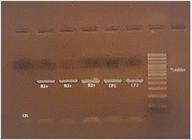
PCR for Salmonella spp. identification indicating positivity in the three replicates of sample B2. *250-10,000 bp DNA ladder RTU marker. CN- Negative control (Escherichia coli K-12 DH5α). Cp1 and Cp2- Positive controls (Salmonella enteritidis 10555/10 IOC and 10405/10 IOC, respectively). B2 (+) - fresh frog meat sample positive for the presence of Salmonella spp.

PCR for Salmonella spp. identification indicating positivity in two replicates of sample B3 and negative results in one replicate of sample B3 and in four replicates of sample F1. *250-10,000 bp DNA ladder RTU marker. CN- Negative control (Escherichia coli K-12 DH5). CP- Positive control (Salmonella enteritidis 10405/10 IOC). B3(+) - fresh frog back meat sample positive for the presence of Salmonella spp. B3(-) - fresh frog back meat sample negative for the presence of Salmonella spp. F1(-)- samples of freeze-dried seasoned frog back meat negative for the presence of Salmonella spp.
The results of mass spectrometry analysis (MALDI-TOF) performed on the fresh frog meat samples (B2 and B3) confirmed the presence of Salmonella spp. in all replications, with a score greater than 2.0, which indicates safety in genus identification. For sample B2, 67% of the results scored higher than 2.3, indicating a high probability of species identification, while 33% of the results of sample B3 achieved that level. For both samples, the species likely identified was Salmonella enterica. The system also suggested a list of probable serotypes, among which the Enteritidis serotype was pointed out. None of the freeze-dried frog meat samples (F1 to F7) exhibited positive results for Salmonella spp.
Table II shows the percentages of results positive for the presence of Salmonella spp., by the three analysis methods evaluated, in fresh and freeze-dried frog meat samples, as well as the results of water activity analysis.
DISCUSSION
Water activity (aw) in the freeze-dried products remained within the expected range for the products preserved by this method. In freeze-dried products, a preservative effect is achieved by reducing aw without heating the food, which allows for a greater retention of nutritional quality. Therefore, the aw of these products should be maintained between 0.00 and 0.60 (Fellows 2006). In this study, there was an increase in aw during the storage period, which is likely associated with the type of packaging used, which provided water absorption through exchanges with the environment. Other authors working with freeze-dried chicken breast obtained similar results, i.e., an increase in the aw of this vacuum-packaged product kept at room temperature, for up to six months of storage (Vianna 2020).
The negative results for the presence of Salmonella spp. in the samples of freeze-dried seasoned frog back meat indicate that blanching the meat at a temperature of 60 °C for 20 min, before the freezing and freeze-drying processes, eliminated Salmonella. This is despite the fact that the raw material used was fresh frog meat corresponding to sample B3, which showed the presence of Salmonella spp. A study examined fresh tilapia fillets and fillets smoked in a process in which they were subjected to hot smoking temperatures from 50 to 80 °C for three hours. The smoked samples showed negative results for Salmonella spp., differing from the fresh fillets (Franco et al. 2013). It is worth mentioning that the quality of the raw material used in fishery products must be considered at the time of processing. In the present study, we used raw material that was positive for the presence of Salmonella spp., as the objective was to compare methods of analysis. In addition, the use of this contaminated raw material was important to allow a more effective comparison between the evaluated methods. The presence of Salmonella spp. in the raw material indicates a need for improving hygienic-sanitary conditions on frog farms as well as the handling of frogs at slaughter and processing establishments. Studies that evaluated frog carcass samples detected contamination by Salmonella spp. in both animals from commercial farming and those captured in the wild (Barreira et al. 2011, Ribas & Poonlaphdecha 2017).
In the complementary biochemical tests, the results seen in the freeze-dried frog meat samples differed from those obtained in the fresh samples. Regarding the presence of H2S, 100% of the freeze-dried samples were negative. For indole production, 71.4% of these samples were positive. Finally, for motility, 14.2% of the samples were negative. These results suggest the presence of other enterobacteria in the samples such as Klebsiella, but the legislation in force in Brazil does not impose the identification of these other species to attest to the microbiological quality of analyzed products.
Molecular methods were made official by AOAC International (Latimer Jr. 2023) and their use in microbiological analyses grows every day. According to Melo et al. (2018), recent advances in technologies for detecting and identifying microorganisms have made available faster, more sensitive and specific alternatives to conventional methods. These are generally referred to as “rapid” or alternative methods. Most molecular tests are performed using the Polymerase Chain Reaction (PCR) technique and, because it is highly sensitive, it is the most widely used test for detecting the Salmonella in food.
In countries such as Brazil, although conventional methods of analysis are the most used, legislation (ANVISA 2022b) determines that molecular methods can be used in microbiological analyses provided that they are validated. Among the methods made official by AOAC, the “Assurance GDSTq” stands out, which provides two additional levels of specificity through the use of highly specific primers and probes, with 93.2% sensitivity, as well as real-time PCR methods (Ripolles-Avila et al. 2020).
In the present study, to identify the presence of Salmonella spp. by the PCR technique, we performed the initial isolation, using the steps of pre-enrichment and selective enrichment employed in the conventional method. The PCR technique was important in confirming the presence of Salmonella spp. and the presence of Salmonella enteriditis could be inferred, but not confirmed, as this strain was used as a positive control.
In a comparison of the conventional method with the PCR method for the identification of Salmonella dublin in samples of calf feces enriched in two different selective broths, 44 (57.9%) and 42 (55.3%) samples were positive by conventional bacterial isolation, whereas 41 (53.9%) and 35 (46.1%) positive samples were detected by the PCR technique. This study concluded that although conventional bacteriological isolation performed better than PCR in detecting samples positive for Salmonella dublin, PCR was able to detect positive samples not identified by bacterial isolation in less time (Silva et al. 2010).
According to the studies of Alzwghaibi et al. (2018) which were conducted to determine and identify Salmonella serovars isolated from poultry, calves and foods (such as egg and meat), Multiplex PCR can be considered as simple, rapid, accurate and useful test to identify and differentiate between Salmonella serovars. The results obtained in this study are in line with the statements of these authors and indicate that the PCR method showed sensitivity and specificity in detection of Salmonella spp., which is crucial to ensure that frog meat products meet the standards established by Normative Instruction No. 161 (ANVISA 2022b) and RDC 724 (ANVISA 2022a). Compliance with these standards is fundamental to preventing outbreaks of food-borne illness.
The results of analyses involving both the conventional method and PCR were confirmed by mass spectrometry analysis (MALDI-TOF). It shows that this analysis method confirmed the presence of Salmonella in 100% of results in all replications of samples B2 and B3. In analyses by the conventional method, the percentages for samples B2 and B3 were 67 and 100%; by PCR, and 100 and 67%, respectively. The results obtained by the MALDI-TOF technique indicated the genus with complete safety (score greater than 2.0), and replications of both samples showed a score greater than 2.3, suggesting the species enterica and also the likelihood of serotypes, such as Enteritidis and Typhimurium, which are considered the main agents involved in foodborne diseases. It is worth remembering that in the presentation of the results, the data analysis program used in this study informs that analysis by the MALDI-TOF method can only ensure the identification of the genus Salmonella spp.
The Bruker MALDI Biotyper method is intended to be used for the automatic identification and confirmation of bacteria (Bastin et al. 2018).
These authors developed a collaborative study in the United States and Europe for the detection of Salmonella spp., involving 15 European laboratories that evaluated 24 blind-coded isolates of Salmonella spp., and a hit rate 100% was achieved. These results were compared with traditional biochemical methods as prescribed in the appropriate reference methods. The authors recommended the adoption of the Bruker MALDI Biotyper approach as the official method for confirming and identifying Salmonella spp. and other Gram-negative organisms obtained from selected culture media.
CONCLUSIONS
The presence of Salmonella spp. found in fresh samples of frog meat points to a critical need to intensify Good Practices in all stages of frog farming in order to ensure the quality of this raw material.
The different analysis methods evaluated in this study were efficient in determining the presence or absence of Salmonella spp. in the samples, and the comparison between the methods revealed a high percentage of compatibility of results.
The MALDI-TOF method is intended for the automatic identification and confirmation of bacteria, being a fast and accurate method for identifying Salmonella, but can only guarantee the identification of the genus.
Analytical methods for identification or detection of Salmonella, either by PCR or MALDI-TOF can replace biochemical tests, reducing the workload and consumable material required to perform the analyses.
The adoption of efficient detection methods, such as PCR and MALDI-TOF, is essential not only for public health but also for compliance with Brazilian regulations, ensuring that food products are free from Salmonella spp. contamination and safe for consumption.
ACKNOWLEDGMENTS
The authors thank the Research Support Foundation of Rio de Janeiro State – FAPERJ (processes E-26/010.001586/2019 and 262234/2021) and the Conselho Nacional de Desenvolvimento Científico e Tecnológico (CNPq, process DT- 313302/2019-7) for the financial aid, which enabled the development of this study.
REFERENCES
-
AL-AMIN MD, RAHMAN MM, AKTAR M & KAMAL MM. 2022. Development and Verification of a MALDI-TOF MS-Based Method for Rapid and Confirmatory Identification of Salmonella in Feed and Foods. Int J Microbiol Biotechnol 7(2): 84-92. https:// doi.org/ 10.11648/j.ijmb.20220702.16.
» https://doi.org/ 10.11648/j.ijmb.20220702.16 - ALMEIDA CB, RAMOS CA, ABDO MA, FRANCO ML & GALHARDO JA. 2018. Análise comparativa entre isolamento microbiológico convencional e PCR para detecção de Salmonella spp. em produtos cárneos. Hig Aliment 32: 91-96. Available in: https://docs.bvsalud.org/biblioref/2018/10/916638/282-283-jul-ago-2018-91-96.pdf.
-
ALZWGHAIBI AB, YAHYARAEYAT R, FASAEI BN, LANGEROUDI AG & SALEHI TZ. 2018. Rapid molecular identification and differentiation of common Salmonella serovars isolates from poultry, domestic animals and foodstuff using multiplex PCR assay. Arch Microbiol 200: 1009-1016. https://doi.org/10.1007/s00203-018-1501-7.
» https://doi.org/10.1007/s00203-018-1501-7 -
ANDRADE ML, SEIXAS FILHO JT, RODRIGUES E, PEREIRA MM, SILVA AC & MELLO SC. 2022. Development of freeze-dried products with frog meat for special diets: microbiological and sensory traits. Cien Agron 53: p. e20207474. https://doi.org/ 10.1590/S0100-204X2013000800037.
» https://doi.org/ 10.1590/S0100-204X2013000800037 -
ANDREWS WH, WANG H, JACOBSON AP, GE B, ZHANG G & HAMMACK TS. 2007. Salmonella December 2007 Edition: Bacteriological Analytical Manual by Food and Drug Administration, Chapter 5. Available in: https://www.fda.gov/media/79991/download?attachment
» https://www.fda.gov/media/79991/download?attachment -
ANVISA – AGÊNCIA NACIONAL DE VIGILÂNCIA SANITÁRIA. 2022a. Resolução – RDC nº 724, de 1 de julho de 2022. Available in: https://antigo.anvisa.gov.br/documents/10181/2718376/RDC_724_2022_.pdf/33c61081-4f32-43c2-9105-c318fa6069ce
» https://antigo.anvisa.gov.br/documents/10181/2718376/RDC_724_2022_.pdf/33c61081-4f32-43c2-9105-c318fa6069ce - ANVISA – AGÊNCIA NACIONAL DE VIGILÂNCIA SANITÁRIA. 2022b. Instrução Normativa nº 161, de 1 de julho de 2022. Available in: htpps://antigo.anvisa.br/document/10181/6503717/(1)in_161_2022_comp.pdf/64b8368b-1f56-43c9-ab89-0674ef9a069f.
- BARREIRA VB, MESQUITA EF, FRANCO RM & MELLO SC. 2011. Análise bacteriológica da carne de rã-touro comercializada no município do Rio de Janeiro. Hig Aliment 25: 145-150. Available: https://higienealimentar.com.br/wp-content/uploads/2019/07/REVISTA-202-203.pdf.
-
BASTIN B, BIRD P, JOSEPH, B, CROWLEY E, AGIN J, GOINS D, SOHIER D, TIMKE M, SHI G & KOSTRZEWA M. 2018. Confirmation and Identification of Salmonella spp., Cronobacter spp., and Other Gram-Negative Organisms by the Bruker MALDI Biotyper Method: Collaborative Study, First Action 2017.09. J AOAC Int 101: 1593-1609. https://doi.org/10.5740/jaoacint.18-0012.
» https://doi.org/10.5740/jaoacint.18-0012 -
BIER D, TUTIJA JF, PASQUATTI TN, OLIVEIRA TL, ARAUJO FR & VERBISCK NV. 2017. Identificação por espectrometria de massa MALDI-TOF de Salmonella spp. e Escherichia coli isolados de carcaças bovinas. Pesq Vet Bras 37: 1373-1379. https://doi.org/10.1590/S0100-736X2017001200003.
» https://doi.org/10.1590/S0100-736X2017001200003 - CABRAL CC, PANZENHAGEN PH, DELGADO KF, SILVA GR & RODRIGUES DP. 2017. Contamination of Carcasses and Utensils in Small Swine Slaughterhouses by Salmonella in the Northwestern Region of the State of Rio de Janeiro, Brazil. J Food Prot 80(7): 1128-1132. https:// doi:10.4315/0362-028X.JFP-16-387.
- DA SILVA N, JUNQUEIRA VC, SILVEIRA NF, TANIWAKI MH, GOMES RA & OKAZAKI MM. 2017. Manual de métodos de análise microbiológica de alimentos e água, 5ª ed., São Paulo: Blucher, 560 p.
-
FAO. 2022. The State of World Fisheries and Aquaculture. Roma: FAO. Available in: https://www.fao.org/documents/card/en/c/cc0461en
» https://www.fao.org/documents/card/en/c/cc0461en -
FRANCO ML, AMARAL LA, MACEDO-VIEGAS EM, KRONKA SN, GASPARINO E & MIKCHA AP. 2013. Qualidade microbiológica e vida útil de filés defumados de tilápia-do-nilo sob refrigeração ou congelamento. Pesq Agropec Bras 48: 1071-1079. https://doi.org/10.1590/S0100-204X2013000800037.
» https://doi.org/10.1590/S0100-204X2013000800037 - FELLOWS PJ. 2006. Tecnologia do processamento de alimentos: princípios e prática, 2ª ed., Porto Alegre: Artmed, 602 p.
-
GATTI JUNIOR P, ASSUNÇÃO AW, BALDIN JC & AMARAL LA. 2014. Microbiological quality of whole and filleted shelf-tilapia. Aquaculture 433: 196-200. https://doi.org/10.1016/j.aquaculture.2014.06.015.
» https://doi.org/10.1016/j.aquaculture.2014.06.015 -
JANG KS & KIM Y. 2018. Rapid and robust MALDI-TOF MS techniques for microbial identification: a brief overview of their diverse applications. J Microbiol 56: 209-216. https://doi.org/10.1007/s12275-018-7457-0.
» https://doi.org/10.1007/s12275-018-7457-0 - LATIMER JR GM. 2023. Official Methods of Analysis of AOAC international. 22nd ed., United Kingdom: Oxford University Press, 3750 p.
-
MELO AM, BORGES MF, ALEXANDRE, DL, FURTADO RF, ALVES CR & FIGUEIREDO EA. 2018. Métodos alternativos para detecção de Salmonella em alimentos. Fortaleza: Embrapa Agroindústria Tropical, 34 p. (Embrapa Agroindústria Tropical. Documentos, 183). Available in: https://ainfo.cnptia.embrapa.br/digital/bitstream/item/189768/1/DOC18005.pdf
» https://ainfo.cnptia.embrapa.br/digital/bitstream/item/189768/1/DOC18005.pdf -
OLIVEIRA LP, PEREIRA MM, SEIXAS FILHO JT & MELLO SC. 2017. Frog meat in special diets: potential for use as a functional food. Bol Inst Pesca 43: 99-106 https://doi.org/10.20950/1678-2305.2017.99.106.
» https://doi.org/10.20950/1678-2305.2017.99.106 -
RIBAS A & POONLAPHDECHA S. 2017. Wild-Caught and Farm-Reared Amphibians are Important Reservoirs of Salmonella, A Study in North-East Thailand. Zoonoses Public Health 64:106-110. https://doi.org/10.1111/zph.12286.
» https://doi.org/10.1111/zph.12286 -
RIPOLLES-AVILA C, GARCIA MM, CAPELLAS M, YUSTE J, FUNG DC & RODRÍGUEZ-JEREZ JJ. 2020. Microbiology: A practical approach for the food industry. Compr Rev Food Sci Food Saf 19: 1877-1907. https://doi.org/10.1111/1541-4337.12592.
» https://doi.org/10.1111/1541-4337.12592 - SABRÁ A, DEL CASTILHO R, SABRÁ S & MADI K. 2015.Tratamento da alergia alimentar. J Food Allergy 4: 53-59.
-
SOUMET C, ERMEL G, ROSE N, ROSE V, DROUIN P, SALVAT G & COLIN P. 1999. Evaluation of a Multiplex PCR assay for simultaneous identification of Salmonella sp., Salmonella Enteritidis and Salmonella Typhimurium from environmental swabs of poultry houses. Lett Appl Microbiol 28(2): 113-117. https://doi.org/10.1046/j.1365-2672.1999.00488.x.
» https://doi.org/10.1046/j.1365-2672.1999.00488.x -
SILVA DG, SILVA DR, SILVA PR, CÍCERO EA, FERRAZ AL, LEMOS MV & FAGLIARI JJ. 2010. Avaliação da reação em cadeia da polimerase e do isolamento bacteriológico convencional na detecção de Salmonella Dublin em amostras de fezes de bezerros infectados experimentalmente. Arq Bras Med Vet Zootec 62: 752-756. https://doi.org/10.1590/S0102-09352010000300035.
» https://doi.org/10.1590/S0102-09352010000300035 - VIANNA BC. 2020. Qualidade bromatológica e microbiológica da carne de peito de frango liofilizado em diferentes ambientes de armazenamento. SAJEBTT 7: 558-569. Available in: https://periodicos.ufac.br/index.php/SAJEBTT/article/view/3202.
-
WHO - WORLD HEALTH ORGANIZATION. 2018. Salmonella (non-typhoidal). Fact Sheet n.139. Available in: http://www.who.int/mediacentre/factsheets/fs139/en/
» http://www.who.int/mediacentre/factsheets/fs139/en/ -
ZHANG R, ZHANG Y, ZHANG T, XU M, WANG H, ZHANG S, ZHANG T, ZHOU W & SHI G. 2022. Establishing a MALDI-TOF-TOF-MS method for rapid identification of three common Gram-positive bacteria (Bacillus cereus, Listeria monocytogenes, and Micrococcus luteus) associated with foodborne diseases. Food Sci Technol 42: e117021. https://doi.org/10.1590/fst.117021.
» https://doi.org/10.1590/fst.117021


