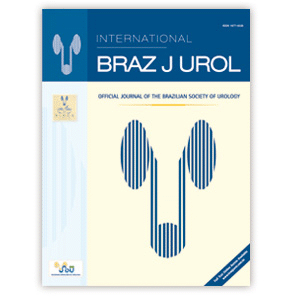
 International braz j urol

Brief Background
The International Braz J Urol was first published in 1975. The International Braz J Urol (ISSN 1677-5538, print; ISSN 1677-6119, online) is the official journal of the Brazilian Society of Urology (SBU) and is published six times per year (bimonthly, beginning with the January–February issue).
|
Open Access
This journal follows the Open Access model, providing unrestricted virtual access (including financial restrictions) to all scientific texts published by the journal. Open Access is the condition where the copyright holder of a scholarly work grants usage rights to others using an open license (Creative Commons Attribution - CC-BY) allowing for immediate free access to the work and permitting any user to read, download, copy, distribute, print, search, or link to the full texts of articles, crawl them for indexing, pass them as data to software, or use them for any other lawful purpose. |
Open Science Compliance
The International Braz J Urol follow the model Gold Open Access. Open Science Compliance Form
|
Ethics in Publication
In response to the concerns of the editors of scientific medical journals with ethics, quality and seriousness of published articles, a Committee on Publication Ethics (COPE) was established in 1997 and a guideline document was published. The International Braz J Urol signed, approved, and follows the COPE guidelines. The Editor strongly encourages the authors to carefully read these guidelines before submitting a manuscript (www.publicationethics.org.uk/guidelines or https://intbrazjurol.com.br/vol-numbers-21-30/vol-26-n-01-2000/).
|
Focus and Scope
The Int Braz J Urol is an international scientific journal dedicated to clinical, surgical, and basic research urology, publishing original and review articles covering the following thematic areas:
|
Digital Preservation
| This journal follows the standards defined in the program of SciELO Program Digital Preservation Policy. |
Indexing Sources
The journal is an affiliated member of ABEC - the Brazilian Association of Scientific Publishers.
|
Bibliographic Journal Information
|
Websites and Social Media
Preprints
The International Brazilian Journal of Urology does not accept pre-print articles.
|
Peer Review Process
Submitted manuscripts initially undergo an evaluation by the Editor-in-Chief, who verifies their suitability to the journal's scope and compliance with the editorial submission guidelines. If necessary, the author will receive notification of any inconsistencies in the article, which may result in immediate rejection or require adjustments to the journal's submission criteria, as listed in the Instructions to Authors. Once the manuscript is approved at this stage, an associate editor from the subject area is assigned, who will decide, once again, whether or not to accept the submission and will indicate reviewers from the journal's pre-existing list or send invitations to new reviewers. This editor is responsible for supervising the review process and monitoring the editorial decision, together with the editor-in-chief. Their name will be published with the article as the responsible associate editor. The secretariat will be responsible for the anonymization process of the article, removing the identification of the authors, the institution of origin, and other forms of recognition of its origin. Once this is done, the original articles will be evaluated by at least two independent reviewers chosen by the editor (double-blind peer review).
|
Open Data
This journal follows the Open Access model, allowing unrestricted virtual access (including financial restrictions) to all scientific texts published by the journal. Open access is the condition in which the copyright holder of an academic work grants usage rights to third parties using an open license (Creative Commons Attribution, CC-BY), allowing immediate free access to the work and authorizing any user to read, download, copy, distribute, print, search or link to the full texts of the articles, track them for indexing, pass them as data to software or use them for any other lawful purpose. Research Data and Other Materials Availability Authors are invited to make all content (data, program code, and other materials) underlying the manuscript text available prior to or at the time of publication. Exceptions are permitted in cases involving legal and ethical issues. The goal is to facilitate manuscript evaluation and, if approved, contribute to the preservation and reuse of the content and the reproducibility of the research. ( ) Yes: Please provide the titles and respective URLs, accession numbers, or DOIs of the files containing the content underlying the article text (use one line for each item): ( ) No: |
Fees
The Int Braz J Urol is an Open Free journal, charging authors no fees for article submission or publication once accepted.
|
Ethics and Misconduct, Correction and Retraction Policy
The Int Braz J Urol follows best practices for correcting or retracting articles, adhering to SciELO and PubMed guidelines. A submission letter signed by all authors must accompany each manuscript. This letter must state that: a) – the paper or portion thereof have not been previously published and are not under consideration by another Journal, b) – that all authors have contributed to the information or material submitted for publication, and that all authors have read and approved the manuscript, c) – that the authors have no direct or indirect commercial financial incentive associated with publishing the manuscript, d) – that the source of extra-institutional funding, specially that provided by commercial companies, is indicated, e) – that the study had been reviewed and approved by a certified Ethical Board or Committee, including the number of the approval document and the date of the approval, f) – a non-plagiarism statement ( I (We) declare that all material in this assignment is my (our) own work and does not involve plagiarism), g) – Clinical trials must be registered on any Clinical Trials Registry and the letter must bring the number of registration and the name of the registry.
The Archives adopt the principles of publication ethics included in the code of conduct of the Committee on Publication Ethics (COPE). Ethical issues and/or issues that may harm the journal's reputation will be evaluated and retracted by the Editorial Board. In the event of misconduct, the retraction policy will be applied by the journal, in accordance with the Good Practices Guide proposed by SciELO. The registration and publication of errata will follow the recommendations proposed by SciELO. The registration and publication of retraction will be as proposed by SciELO.
After accepted for publication, the manuscript will become property of the authors
|
Policy on Conflict of Interest
Conflicts of interest can be of a personal, commercial, political, academic, or financial nature. Conflicts of interest may arise among authors, reviewers, or editors. Authors must disclose any and all conflicts of interest that have arisen during the development of the submission. Additionally, upon manuscript submission, authors are responsible for acknowledging and disclosing financial or other conflicts that may have influenced the work. If there is, even potentially, a conflict of interest, the author(s) must disclose it in a separate document signed and attached to the submission platform. For more information, see: Disclosure of Financial and Non-Financial Relationships and Activities, and Conflicts of Interest. The scientific board is instructed to disclose any and all conflicts of interest before accepting the task of scientific evaluation. |
Adoption of Similarity Software
The Int Braz J Urol uses the Ithenticate software, available on our platform, for similarity checking, and it is an integral part of our editorial workflow. The International Journal of Urology (Int Braz J Urol) identifies significant similarities in the text by informing the authors, who can then provide justification by sending a letter. If no justification is provided, the article is withdrawn from the evaluation process, and the authors are notified.
|
Adoption of Software Using Artificial Intelligence Resources
The use of artificial intelligence (AI) tools, such as ChatGPT or Large Language Models, in research publications cannot be listed as authors of an article in the Int Braz J Urol, according to the position adopted by COPE (https://publicationethics.org/cope-position-statements/ai-author) and WAME (https://wame.org/page3.php?id=106). Declaration on the Use of Artificial Intelligence Tools/Services. The authors declare that they used Artificial Intelligence tools and/or services ethically and responsibly in the preparation of this scientific article. The use of these technologies was limited to [specify], with the objective of [specify]. After using AI, the authors reviewed all the generated content. The authors assume responsibility for the originality, integrity, and authorship of the work. All ideas, interpretations, and conclusions presented are the sole responsibility of the authors. We declare: (all must sign electronically or with a physical signature). |
Gender and Sex Issues
The editorial team of the Int Braz J Urol, as well as the authors who publish in the journal, must always observe the guidelines on Sex and Gender Equity in Research (SAGER) (Sex and Gender Equity in Research – SAGER). The SAGER guidelines comprise a set of guidelines that guide the reporting of sex and gender information in study design, data analysis, and the results and interpretation of findings. Furthermore, the Int Braz J Urol observes a gender equity policy in the formation of its editorial board.
|
Ethics Committee
The authors must attach a statement of approval from the ethics committee of the institution responsible for approving the research.
|
Copyright
Authors of articles published by Int Braz J Urol retain copyright to their work, licensing it under the Creative Commons Attribution CC BY 4.0 license Creative Commons Attribution CC BY 4.0, which allows articles to be reused and distributed without restriction, provided the original work is properly cited. The journal retains the right of first publication. |
Intellectual Property and Terms of Use
All content of the journal and articles published by the journal Int Braz J Urol, except where otherwise specified, are licensed under the Creative Commons Attribution CC-BY license. Authors of articles published by Int Braz J Urol retain copyright to their work, licensing it under the Creative Commons Attribution license, which allows articles to be reused and distributed without restriction, provided the original work is properly cited. The Int Braz J Urol encourages authors to self-archive their accepted manuscripts, publishing them on personal blogs, institutional repositories, and academic social media, as well as posting them on their personal social media, provided that full citation to the journal's website version is included.
|
Editor-in-Chief
| Luciano A. Favorito, Universidade do Estado do Rio de Janeiro, Unidade de Pesquisa Urogenital, Rio de Janeiro, RJ, Brasil. Lattes: https://lattes.cnpq.br/0256126734685935, ORCID: https://orcid.org/0000-0003-1562-6068, e-mail: brazjurol@brazjurol.com.br |
Associate or Section Editors
Section: Robotic and Telesurgery
Marcio C. Moschovas, AdventHealth Celebration, FL, USA. ORCID: https://orcid.org/0000-0002-3290-7323 Eliney Ferreira Faria, Hospital Câncer de Barretos, Barretos, São Paulo/SP, Brasil. ORCID: https://orcid.org/0000-0002-8297-3417, Lattes: http://lattes.cnpq.br/1200696137896712 Miguel Silva-Ramos, Hospital de Santo António, Porto, Portugal. ORCID: https://orcid.org/0000-0002-1232-3232 |
Section: General Urology
| José de Bessa Jr. Universidade Estadual de Feira de Santana, Feira de Santana, Bahia/BA, Brasil. ORCID: https://orcid.org/0000-0003-4833-4889, Lattes: http://lattes.cnpq.br/5258362769958269 |
Section: Infertility
| Sandro Esteves, ANDROFERT, Clínica de Andrologia e Reprodução Humana, Campinas, São Paulo/SP, Brasil. ORCID: https://orcid.org/0000-0002-1313-9680, Lattes: http://lattes.cnpq.br/9908246331294282 |
Section: Male Health
| Valter Javaroni, Hospital Federal do Andaraí, Rio de Janeiro, RJ, Brasil. ORCID: https://orcid.org/0000-0003-3877-0601, Lattes: http://lattes.cnpq.br/7273858822337193 |
Section: Uro-Oncology
Arie Carneiro, Hospital Israelita Albert Einstein, São Paulo, SP, Brazil. ORCID: https://orcid.org/0000-0002-0152-0513, Lattes: http://lattes.cnpq.br/1083730377808458 Leonardo O. Reis, Universidade Estadual de Campinas, UNICAMP, Campinas, São Paulo/SP, Brasil. ORCID: https://orcid.org/0000-0003-2092-414X, Lattes: http://lattes.cnpq.br/8285758239980543 Leonardo O. Reis, Universidade Estadual de Campinas, UNICAMP, Campinas, São Paulo/SP, Brasil. ORCID: https://orcid.org/0000-0003-2092-414X, Lattes: http://lattes.cnpq.br/8285758239980543 Stênio de C. Zequi, A. C. Camargo Cancer Center, Fundação Prudente, São Paulo, SP, Brasil. ORCID: https://orcid.org/0000-0003-1897-8085, Lattes: http://lattes.cnpq.br/2840443665071024 Ricardo Leão, Hospital da CUF, Coimbra, Portugal |
Section: BPH and Neurourology
| Cristiano Mendes Gomes, Hospital das Clínicas Universidade de São Paulo, São Paulo, SP, Brasil. ORCID: https://orcid.org/0000-0002-8486-4003, Lattes: http://lattes.cnpq.br/4105665879347957 |
Section: Pediatric Urology
José Murillo Bastos Netto, Univ. Federal de Juiz de Fora, UFJF, Juiz de Fora, Minas Gerais/MG, Brasil. ORCID: https://orcid.org/0000-0002-9959-6160, Lattes: http://lattes.cnpq.br/9108615868765660 Tiago E. Rosito, Hospital de Clínicas de Porto Alegre, Porto Alegre, Rio Grande do Sul/RS, Brasil. ORCID: https://orcid.org/0000-0001-6240-448X, Lattes: http://lattes.cnpq.br/5336601738436481 |
Section: Endourology and Lithiasis
| Fábio C. M. Torricelli, Hospital das Clínicas Universidade de São Paulo, São Paulo, SP, Brasil. ORCID: https://orcid.org/0000-0002-5845-0894, Lattes: http://lattes.cnpq.br/8539986611140744 |
Section: Video Section
| Philippe E. Spiess, H. Lee Moffitt Cancer, Center, Tampa, FL, USA |
Technical Team
|
Types of articles
The Int Braz J Urol requires that manuscripts be structured according to the submission section. Authors must prepare their manuscripts in the specified format: Original Articles: Original articles should contain a Cover Page, Abstract, Introduction, Materials and Methods, Results, Discussion, Conclusions, References, Tables and Legends, each section beginning in a separate page and numbered consecutively. Original articles should cover contemporary aspects of Urology or experimental studies on Basic Sciences applied to urology. The manuscript text should contain no more than 2500 words, excluding the Abstract. The number of authors is limited to five. References should contain no more than 30 citations, including the most important articles on the subject. Articles not related to the subject must be excluded. Review Articles: Review articles are accepted for publication upon the Editorial Board’s request in most cases. A Review Article is a critical and systematic analysis of the most recent published manuscripts dealing with a urological topic. A State-of-the-Art article is the view and experience of a recognized expert in the topic. An abstract must be provided. International Braz J Urol requires a completed PRISMA checklist and flow diagram as a condition of submission when reporting findings from a systematic review or meta-analysis. Templates for these can be found here or on the PRISMA website which also describes several PRISMA checklist extensions for different designs and types of data beyond conventional systematic reviews evaluating randomized trials. At minimum, your article should report the content addressed by each item of the checklist. Meeting these basic reporting requirements will greatly improve the value of your review and may enhance its chances for eventual publication. See more information and documentation:
Surgical Technique: These manuscripts should present new surgical techniques or instruments and should contain Introduction, Surgical Technique, Comments and up to five References. An abstract must be provided. At least five cases performed with the technique must be included. Radiology Page: A typical pathognomonic image, be it an ultrasonography, computed tomography, X-ray, magnetic resonance imaging, etc., followed by a explanatory text. Maximum length: 300-word text and no more than 10 references. Will be published upon the Section Editor decision. Video Section: The material must be submitted in the appropriate local, in the Journal’s site, where all instructions may be found (Video Section link). NOTE: Articles without references will not be accepted for submission.
|
Authors' Contribution
Authors should submit a declaration file for each author describing their individual contributions to the article using the relevant CRediT roles: Conceptualization; Data Curation; Formal Analysis; Fundraising; Research; Methodology; Project Management; Resources; Software; Supervision; Validation; Visualization; Roles/Writing - original draft; Writing - revision and editing. Author declarations should be formatted with the authors' names first and the CRediT roles following. More information at https://credit.niso.org/ - The ORCID of all authors is mandatory.
|
Manuscript Preparation
Manuscripts must be written in current English only. Non-native English speakers should ask a native specialist in medical English for checking the grammar and style. Either American or British English may be used but should be consistent throughout the manuscript. Conflict of Interest – Any conflict of interest, mainly financial agreement with companies whose products are alluded to in the paper, must be clearly disclosed when submitting a manuscript for review. If accepted, a disclosure will be published in the final manuscript. MODEL OF THE SUBMISSION LETTER: (Download click here) Peer Review – All submissions are subject to editorial review. Typically, each manuscript is anonymously forwarded by the Editor to 4 Reviewers (at least 2). If the Editor receives conflicting or inconclusive revisions, the manuscript is always sent to 1 or 2 additional Reviewers before the Editor’s decision. If considered necessary by the Editor or by the Reviewers, statistical procedures included in the manuscript will be analyzed by a statistician. The International Braz J Urol contains six sections: Review Articles, Original Articles, Video Section, Radiology Page and Surgical Techniques. The articles should be written in English only official orthography. Every manuscript submitted to publication should have a cover page containing the title, short title (up to 50 characters), authors and institution. Up to six key words should be provided. These words should be identical to the medical subject headings (MeSH) that appear in the Index Medicus of the National Library of Medicine (http://www.nlm.nih.gov/mesh/meshhome.html). If any financial support has been provided, the name of the institution should be mentioned.
|
Article Submission Format
THE EDITORS SUGGEST THE AUTHORS OBSERVE THE FOLLOWING GUIDELINES WHEN SUBMITTING A MANUSCRIPT: The Ideal Manuscript may not exceed 2500 words.
|
Digital Assets
ILLUSTRATIONS: ELECTRONIC SUBMISSION 3) For Submitting Line Artwork Electronically please note that: 4) IMPORTANT – Avoid – Do Not TABLES: The tables should be numbered with Arabic numerals. Each table should be typed on a single page, and a legend should be provided for each table. Number tables consecutively and cite each table in text in consecutive order.
|
Citations and References
REFERENCES: The References should be numbered following the sequence that they are mentioned in the text. The references should not be alphabetized. They must be identified in the text with Arabic numerals in parenthesis. Do not include unpublished material and personal communications in the reference list. If necessary, mention these in the body of the text. For abbreviations of journal names refer to the “List of Journals Indexed in Index Medicus” (http://www.nlm.nih.gov). The authors must present the references according to the following examples; the names of all authors must be included; when exist more than six authors, list the first six authors followed by et al. Use Vancouver format in this references. The initial and the final pages of the reference should be provided: Papers published in periodicals: Books: Chapters in Books:
|
Additional Information
OPEN ACCESS POLICY The online journal has open and free access. International Braz J Urol is published under the Open Access model and is therefore free for anybody to read and download, and to copy and disseminate for educational purposes. Articles will be published immediately after the final corrections of the master proof have been made. When posted online, articles will be assigned a DOI number (Digital Object Identifier) whereby it becomes possible to search and cite them without delay. The Open Access model used for International Braz J Urol implies that production costs are covered by publication, no fees normally paid for institution or authors. NOTE: |
Contact
Sociedade Brasileira de Urologia, Rua Real Grandeza 108 sala 101, 22281-034, Rio de Janeiro, RJ, Brasil, e-mail: brazjurol@brazjurol.com.br, telefone: +55 (21) 2246-4092.
|
Read our Open Access Statement